Categories
Archive Blogroll UNDP Mongolia 1997-1999

UN Contest Winner In State Of Total Bliss

DS Consulting logo copy

In the autumn of 1997, a national contest – Let’s Make Life Better! – was launched to inspire and mobilise Mongolian youth between the ages of 20 and 30. The idea was simple: for youth to come up with the best ideas to “design their own small and local development project.”

Launched with a cross-country advertising campaign, the prize of US $1,000 to implement the winning project (a substantial sum of money at the time) drew 580 project proposals by the contest deadline of December 15, 1997.

So many of the ideas were excellent, they were later to receive support from either the government, NGOs or international organisations. Read the story in the Blue Sky Bulletin newsletter about the contest’s winner below:

Editor: David South

Publisher: UNDP Mongolia Communications Office

Published: Blue Sky Bulletin, Issue Number Six, May/June 1998 

“When the phone operator told me it was a call from the UN in Ulaanbaatar, I didn’t expect I would be the winner – my uncle was almost in tears.”

The words of 27-year-old UN contest winner Mr. Ciezd Nygmed tells it all. Speaking to a group of journalists at UN headquarters in Ulaanbaatar, Mr. Ciezd confirmed his joy: “I’m in a state of total bliss!”

On Monday, May 4 the United Nations awarded US $1,000 to Mr. Ciezd – a teacher from Bayan-Ulgii aimag – for his project to start a ger school for herder children who have dropped out of school.

“Herders don’t want to send children to school without school supplies,” says Ciezd, who has been teaching for six years at the primary school in Delwnuu soum. This means poor children end up dropping out of the school system – or never going in the first place.

The ger school will be set up in June in the summering pastures of 33 Kazakh families. A teacher will be hired for the 40 children in need of basic literacy skills. The school will operate from June until September.

Ciezd says there are many benefits to bringing the school to the children. In the school where he currently teaches, many children stay in dormitories and parents must pay for their food. The children attending the ger school will be able to eat at home, saving parents precious togrogs.

The project is already receiving support from local governors. They have pledged to help buy the ger, leaving more funds for school supplies and the maintenance of the school.

During his six-day stay in Ulaanbaatar, Ciezd received one-on-one counselling from distance education advisers at UNESCO, the UN culture and education agency. UNESCO has pioneered distance education in Mongolia, particularly in the Gobi desert. Mr. Monxor, UNESCO coordinator for non-formal education, told Ciezd this was the first initiative of its kind in Bayan-Ulgii.

He also spent some time in the newly-established United Nations Information Shop, a one-stop, drop-in resource centre on development issues. Ciezd particularly found the advice from donors most helpful in planning the future of the project.

In October 1997, the UN “Let’s Make Life Better!” contest asked Mongolian youth between 20 and 30 to tell us how they would make life better in their communities. We wanted small projects that could significantly change the lives of people in one community. By the deadline of December 15, the UN office was flooded with 580 project proposals from across Mongolia. To speed up the selection of the winner, the Mongolian Youth Federation formed a panel of judges and selected the five finalists. Keeping in the spirit of the contest, the four runners-up receive gardening kits complete with trowels, watering cans, seeds and spades.

BSKYB 6_mini
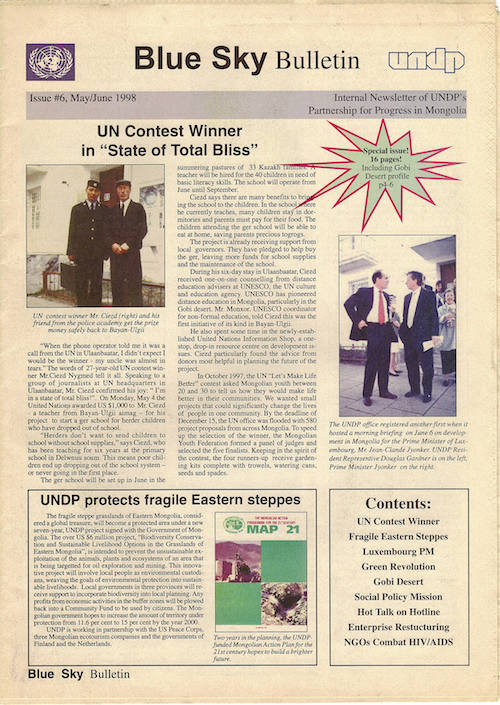
Cover stories: UN contest winner and visit of Jean-Claude Juncker to UNDP Mongolia (pictured with UNDP Resident Representative Douglas Gardner).
DSC web address in green_mini (1)

ORCID iD: https://orcid.org/0000-0001-5311-1052.

© David South Consulting 2017 
Categories
Archive Blogroll

Interviews for the GOSH Child Health Portal 2001-2003 | 14 April 2016

Roundabout, November 2001 Issue No. 18

Joint Website Launched

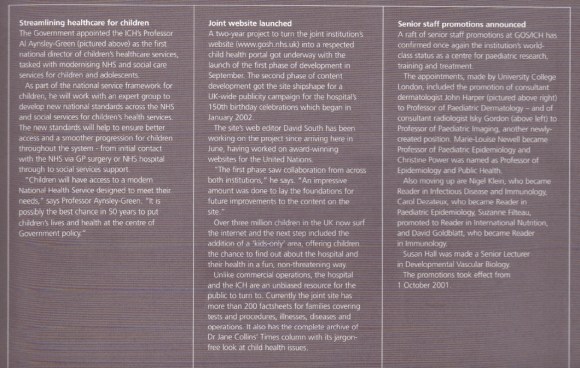
A two-year project to turn our joint institution’s website (www.gosh.nhs.uk) into a respected child health portal got underway with the launch of the first phase of development in September. The second phase of content development will get the site ship shape for a UK-wide publicity campaign as the hospital’s 150th birthday celebrations begin in January.

The site’s web editor, David South, has been working on the project since arriving here in June, having worked on award-winning websites for the United Nations.

“The first phase saw collaboration from staff across both institutions,” he says. “An impressive amount was done, and we have now laid the foundations for future improvements to the content on the site. I really want to offer more for children. Over three million children in the UK now surf the internet.”

The opportunity for both institutions is enormous. As the internet has evolved, it has become increasingly clear that the future of its development lies in the public sphere. US government sites now outstrip commercial operations, selling far more books than the largest online bookseller, amazon.com. Here in the UK, the http://www.ukonline.gov.uk site is working to offer one-stop access to all government services, including health care.

Unlike commercial operations, the hospital and the Institute are an unbiased resource for the public to turn to. Currently, the joint site has more than 180 factsheets for families covering tests and procedures, illnesses and diseases and operations. It also has the complete archive of Dr. Jane Collins’ Times column, with its jargon-free look at child health issues.

“This being London, we have the unique advantage of being at the centre of so many developments, and having the opportunity to communicate this through our website,” says David South.

Across the NHS the Modernisation Plan involves the largest data collection exercise in its history. More and more resources will be offered online, and the content produced by individual trusts like ours will be linked with national sites like NHS Direct.

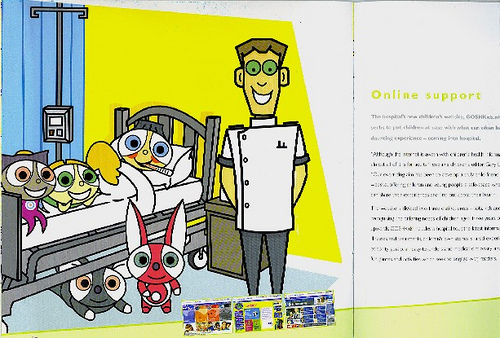
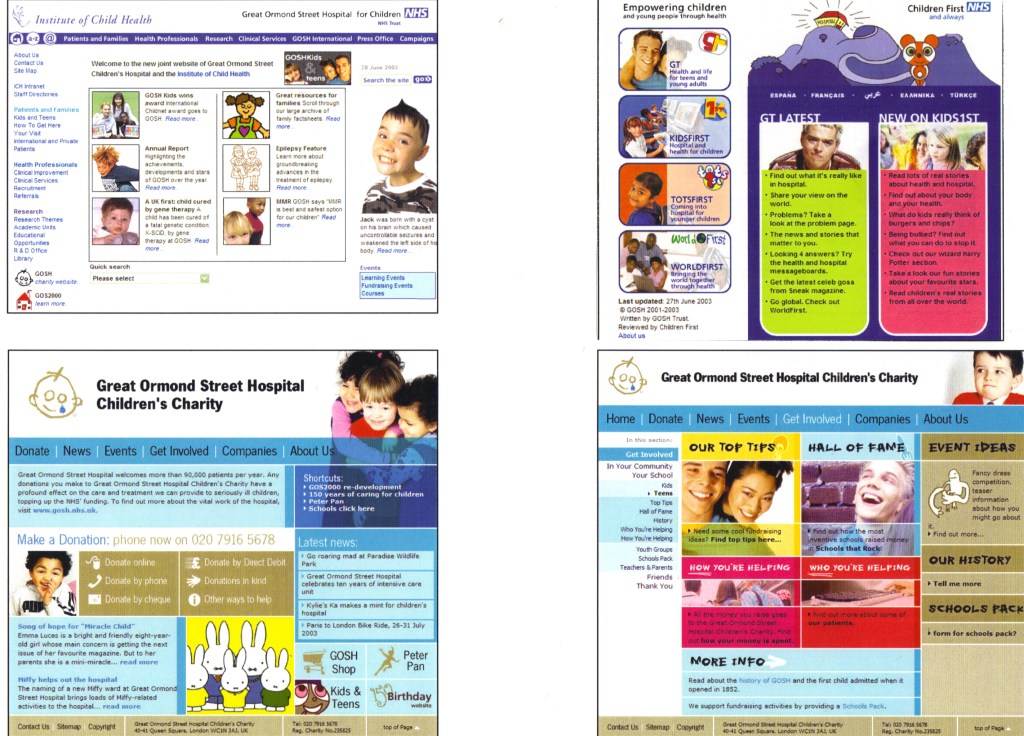
New GOSH/ICH website

With over three million children in the UK now using the internet, and a total of 33 million UK citizens accessing it through work, school or the home, no organisation can afford not to make the most of this valuable communications tool. Estimates vary, but some put the number of health-related websites at more than 100,000. Trust is an even more important issue, as users search for accurate information. It is in this context that the new hospital and ICH website, http://www.gosh.nhs.uk, launched in September. Web editor David South puts us in the picture.

The new site reflects the hard work and collaboration of staff across both institutions, and it is hoped it will quickly make its mark as a trusted resource on complex child health issues. The site also becomes one of the most visible signs of our on-going modernisation programme, and can uniquely tie together the breadth of our work in a way that no other medium can. The site development project spans two years and will fit in with the wider move across the NHS to offer a wide range of services online.

The next phase of the site’s development is aimed at getting the site ready for a larger publicity campaign slated to coincide with the hospital’s 150th birthday celebrations with start in January. In preparation for this public launch, a number of improvements will be made to the site’s content, interactivity, platform and design. To put it simply, the site should become a critical first stop for anybody seeking our services, or wanting to learn more about the latest research and care developments in the field of complex child issues.

The joint site will also be available via Gosweb for staff in the hospital who don’t already have internet access.

As the project evolved, regular updates were communicated to colleagues and the public through the media.
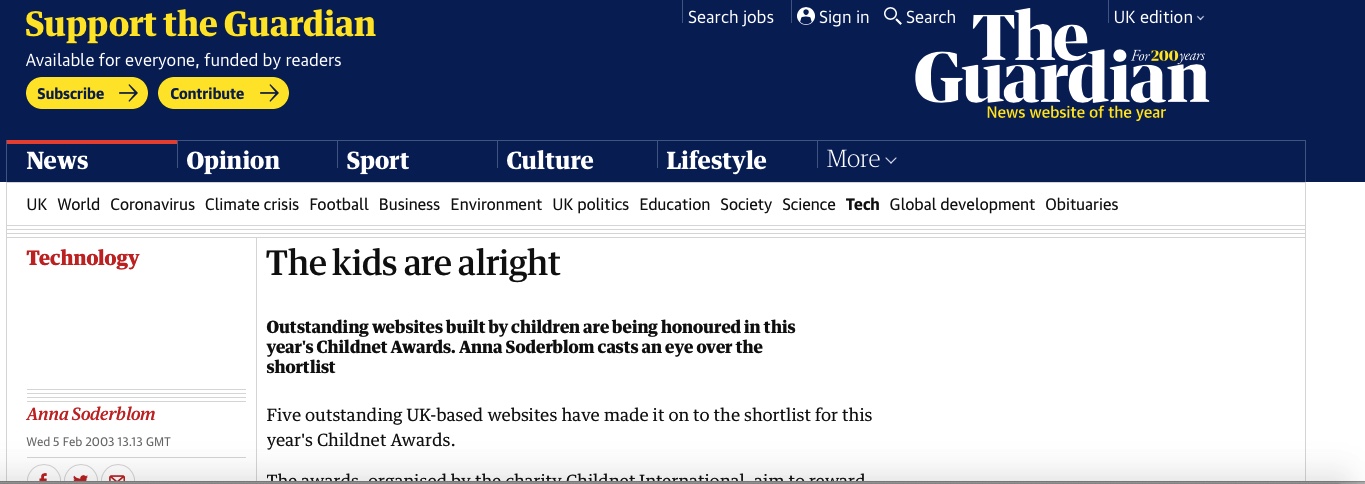
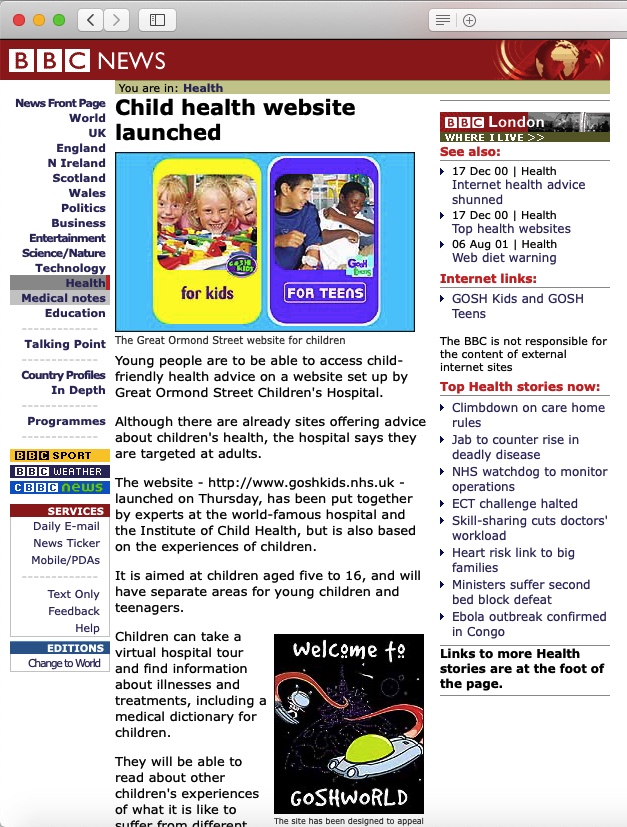
The BBC story from 2002’s launch of the GOSH Child Health Portal’s children’s content (www.gosh.nhs.uk).
Creative Commons License

This work is licensed under a
Creative Commons Attribution-Noncommercial-No Derivative Works 3.0 License.

ORCID iD: https://orcid.org/0000-0001-5311-1052.

© David South Consulting 2022