Categories
Archive Blogroll Scan Magazine

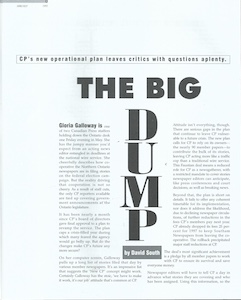
The Big Dump: CP’s New Operational Plan Leaves Critics With Questions Aplenty

By David South

Scan Magazine (Toronto, Canada), June/July, 1997

Gloria Galloway is one of two Canadian Press staffers holding down the Ontario desk one Friday evening in May. She has the jumpy manner you’d expect from an acting news editor entangled in deadlines at the national wire service. She cheerfully describes how cooperative the Northern Ontario newspapers are in filing stories on the federal election campaign. But the reality driving that cooperation is not so cheery. As a result of staff cuts, the only CP reporters available are tied up covering government announcements at the Ontario legislature.

It has been nearly a month since CP’s board of directors gave final approval to a plan to revamp the service. The plan caps a crisis-filled year during which many feared the agency would go belly up. But do the changes make CP’s future any more secure?

On her computer screen, Galloway pulls up a long list of stories filed that day by various member newspapers. It’s an impressive list that suggests the ‘New CP’ concept might work. Certainly Galloway has the stoic, ‘we have to make it work, it’s our job’ attitude that’s common at CP.

Attitude isn’t everything, though. There are serious gaps in the plan that continue to leave CP vulnerable to a future crisis. The new plan calls for CP to rely on its owners – the nearly 90 member papers – to contribute the bulk of its stories, leaving CP acting more like a traffic cop than a traditional wire service. This Faustian deal means a reduced role for CP as a newsgatherer, with a restricted mandate to cover stories newspaper editors can anticipate, like press conferences and court decisions, as well as breaking news.

Beyond that, the plan is short on details. It fails to offer any coherant timetable for its implementation, nor does it address the likelihood, due to declining newspaper circulations, of further reductions in the fees CP’s members pay next year. CP already dropped its fees 25 percent for 1997 to keep Southam Newspapers from leaving the cooperative. The rollback precipitated major staff reductions at CP.

The deal’s most significant achievement is a pledge by all member papers to work with CP to ensure its survival and save everyone money.

Newspaper editors will have to tell CP a day in advance what stories they are covering and who has been assigned. Using this information, so the theory goes, it will be possible to avoid assigning several reporters from competing papers to cover a story when one will do. A reporter will not only be working for his or her own paper that day, but for every CP paper, and will be expected to file updates throughout the day to a CP editor, who in turn will write the story that is then ‘wired’ to all the members. That way, it is hoped, no superfluous stories will be going out on the wire. Member papers will still file analytical and feature stories to CP but, as is the case now, they are under no obligation to give away their prized family jewels – exclusive stories – to other CP papers.

In practical terms, the new approach has been creeping into CP’s way of doing things by stealth rather than command. CP has been increasing its reliance on member papers to pick up the slack when CP reporters aren’t available. The most recent example was the federal election campaign: only one CP reporter was assigned full-time to cover the whole campaign. The rest of the coverage was handled by a combination of CP bureau staff and member paper reporters.

While many smaller papers are dependent on CP for their provincial, national and international stories, the bigger papers, who are the main sources of these stories, can afford to be blase’. Their willingness to co-operate will decide the success or failure of the member-exchange component of CP.

Southam’s vice-president of editorial, Gordon Fisher, maintains his papers will support the plan because it will save his company approximately $2.5 million a year. “We pay a significant amount of money towards this cooperative,” he maintains. “A member exchange is one of the more efficient ways we can find to deliver news without incurring a huge amount of expense.”

“What is CP needs a story earlier than a reporter normally files?” asks managing editor Jane Perves of Halifax’s Chronicle-Herald and Mail-Star. “Theoretically, they should be spending all their time doing the story for our paper.”

Jane Purves is an enthusiastic supporter of CP. Nonetheless she wonders if CP editors will be caught in a contest of wills with editors at member papers. She would like to see a reporter’s CP obligations involve simply calling in a quote or raw data. She would have a problem if a reporter working on a major story for her paper was distracted by CP’s needs.

The Globe and Mail is conidering hiring a full-time co-ordinator to handle the heavy volume of stories that paper generates for CP. Newspaper managers elsewhere are split on the question of whether the plan will increase workloads. The extent that it does so will be a crucial test of their commitment.

Not only will editors need to regularly ‘loan’ reporters to CP, they will have to change how they do things on a daily basis if the plan is to work. Editors will have to file an assignment list one day in advance to CP, a task that could get easily overlooked when papers get hit with multiple big stories.

“It’s pretty minor stuff,” says Perry Beverley, the co-publisher of Brockville’s Recorder and Times. Although the Recorder and Times is an afternoon paper where copy is edited in the morning, Beverley has no plans to switch an editor to an evening shift to fit CP’s deadlines.

Deadlines are a particularly thorny question in a country that spans six time zones. Newspapers on the East coast can file stories at the end of the day and still meet CP deadlines that are pegged at Toronto time. The problem is with newspapers west of Ontario; they will have to file stories well before the end of the day. In the case of B.C., filing will have to be done in the morning so that stories picked up by CP will be ready in time for East coast papers.

The copy will have to go out to CP unedited.

At the Edmonton Sun, editor-in-chief Paul Stanway isn’t sanguine about sending out unedited copy. Stanway had editorial deadlines pushed back to 6 p.m. 18 months ago as part of a re-organization at the paper, but they still mean copy would be sent straight from reporters to CP, where copy needs to be in between 4 p.m. and 9 p.m. Toronto time. Stanway is concerned the CP staff will not have the time to fact-check stories to weed out mistakes, which would reflect poorly on his paper.

The anticipated deadline crunch has been nicknamed “the big dump” in CP circles: a tidal wave of material hitting the wire service’s desks all at once, leaving editors scrambling to do re-writes before newspapers are put to bed.

CP general manager Jim Poling, who vacates he job in June, believes this problem will be solved by the restructuring, not exacerbated by it. “The volume of copy has already dropped significantly,” he says. “We are hoping for a wider spectrum of deadlines. Hopefully you are going to get your copy spread out over a longer period, instead of over the course of a couple of hours. You might not need a massive shift of people to a certain time.”

Poling claims the resolution is in better planning which will result in fewer unwanted stories. Fewer stories, so Poling maintains, means more time for editors to re-write.

At CP’s Winnipeg bureau, Canadian Media Guild vice-president Scott Edmonds is sceptical. He isn’t convinced the slimmed down CP will have the staff to handle what he sees as an increasing workload.

“It sounds like the meatgrinder approach to journalism,”says Edmonds. “There is no way these desks are going to be able to cope with any degree of thoughtfulness with this copy. The pressure is going to be too great.”

Edmonds also sees a bigger problem in staff moral. “The majority of people working for Canadian Press don’t want their career to end up as a re-writer… It will require a lot more attention on the desk for this material, so we will be taking resources away from reporting. In other words, taking somebody away from doing the story to redoing the story.”

CP’s raison d’etre is its ability to turn out stories written in a homogenous national voice that can be tailored for a specific paper’s readers. Another important asset is the agency’s ability to quickly add knowledge and background to stories, drawing on the experience of its reporters and editors. According to Martin O’Hanlon at CP’s Ontario Desk, cut-backs have compromised this ability. Three business reporters have been poached by the Financial Post, including Ian Jack and Sandy Rubin. Over 40 talented reporters and editors took buyouts in the fall of 1996.

This means CP isn’t as well equipped as it once was to turn raw copy from reporters into high-quality journalism that can draw the respect and admiration of its subjects.

“Our reporters are not trained to write for a national audience,” emphasizes Jane Purves in Halifax.

Scott Edmonds doesn’t believe member contributors are a substitute for CP staff. “I’m very concerned about attempting to replace quality staf-written material that caters to a national audience and is written to uniform standards, with material picked up from newspapers that in some cases may be very good, but in some cases may not be of the same quality.”

There is a great deal of confusion over when the plan is supposed to kick in. One camp, which includes Jim Poling, sees it more as a gradual, evolutionary change that will take several years to fine tune. There are others who want to see trial runs. Still others believe there will be a date set for a total national switch-over.

Perry Beverley favours test sites and single switch-over date.

“Once that D-Day time is chosen for the switch-over into the restructured CP,” she says, “there will be an appointed person in the newsroom responsible for sending the schedule to CP.”

Purves favours a gradual switch. “A shot-gun approach might backfire. I’d rather have a gradual approach providing we had a starting date and an aim.”

“We don’t have to have a roll-out day,” says Poling. “But if all the managers and staff rise up and say ‘shit, we need test sites,’ then I will listen. Anybody who is waiting for a date will be disappointed. All of this started a long time ago and is a continuing process that will take a couple of years to get everything in place.”

Seven regional news committees will co-ordinate and oversee this new approach, each one staffed by representatives from member papers and CP. According to the plan, these regional news committees will act as enforcers for the new regime. They will work out the logistics of member exchange and use fines to penalize papers that miss deadlines or obstruct exchange.

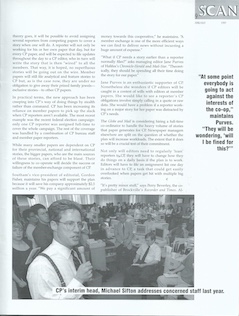
How such an approach would work in practice is still up in the air. “At some point everybody is going to act against the interests of the co-op,” maintains Purves. “They will be wondering, ‘will I be fined for this?’”

Nobody contacted by SCAN could tell us what these fines would be, how violations would be investigated or what constituted offences. Purves wondered what deterrence value the fines would have if a paper thought it had acted in its best interests. If paper X decided to hold back a juicy scoop that was supposed to be that day’s CP story, a fine of $2,000 might be worth incurring if it sells more newspapers. It was generally agreed none of these committees would meet until after the federal election at the earliest.

For now, Poling is generally optimistic (though he won’t around past June and a replacement has yet to be found). He is talking about raising salaries for the first time in five years, about hiring new staff, about stabilizing life at CP.

The lower fees have lured back one newspaper group, British Columbia’s Sterling. A trial use of CP stories started at the beginning of May. It remains to be seen whether New Brunswick’s Telegraph Journal/Times Globe papers will return, after pulling out of CP in 1993 and hiring more of its own reporters with the money saved. Publisher Jamie Milne remains coy as to his interest in returning to CP, but Poling thinks a deal will be worked out by the fall.

And what about the mood of the man charged with overseeing CP’s transition? Jim Poling, as some CP staffers like to mention, is losing that cautious reserve managers usually have for talking to the media. He isn’t happy with the state of the print media in Canada.

“There has been a lot of cutting in this industry,” says an audibly frustrated Poling. “The fact of the matter is this: cutting isn’t the only answer to having an efficient operation. There has to be some money available to allow journalists to walk around a bit. People who walk around and poke at things and stare at things write good stories.”

With phones ringing all around us, Galloway begins to think out loud about possible wrinkles in the new CP plan: how newspaper reporters at trials will have to keep leaving the courtroom to file updates for CP, how stories written for local papers will translate for national readers, how hard it can be for local, non-CP reporters to cover elections when they don’t know what questions have been asked elsewhere on the campaign trail.

But Galloway has to get back to work. She has to push the Toronto Star to file a story early so the Hamilton Spectator can pick it up.

Scan magazine was published for media professionals in Toronto, Canada in the 1990s.
“The Big Dump”
Breaking the news to CP staff.

https://davidsouthconsulting.org/2022/10/21/african-media-changing-to-reach-growing-middle-class/

https://davidsouthconsulting.org/2021/06/14/case-study-1-investigative-journalism-1991-1997-2/

https://davidsouthconsulting.org/2021/07/14/freedom-of-expression-introducing-investigative-journalism-to-local-media-in-mongolia-1999-25-january-2016/

https://davidsouthconsulting.org/2021/05/25/ger-mongolias-first-web-magazine-and-a-pioneering-web-project-for-the-united-nations-12-january-2016/

https://davidsouthconsulting.org/2022/05/16/high-impact-communications-in-a-major-crisis-undp-mongolia-1997-1999-18-february-2016/

https://davidsouthconsulting.org/2021/07/25/in-their-own-words-selected-writings-by-journalists-on-mongolia-1997-1999-6-january-2010/

https://davidsouthconsulting.org/2022/11/01/indian-newspapers-thrive-with-economy/

https://davidsouthconsulting.org/2022/05/27/media/

https://davidsouthconsulting.org/2022/11/01/new-journal-celebrates-vibrancy-of-modern-africa/

https://davidsouthconsulting.org/2021/12/08/new-media-markets-and-screen-finance/

https://davidsouthconsulting.org/2022/10/04/popular-chinese-social-media-chase-new-markets/

https://davidsouthconsulting.org/2022/11/23/publications/

https://davidsouthconsulting.org/2021/01/16/redneck-renaissance-a-coterie-of-journalists-turn-cracker-culture-into-a-leisure-lifestyle/

https://davidsouthconsulting.org/2021/01/14/from-special-report-nmm-new-media-markets-spotlight-on-the-emergence-of-satellite-porn-channels-in-the-uk/

https://davidsouthconsulting.org/2020/12/11/top-reporters-offer-military-media-handling-tips/

https://davidsouthconsulting.org/2020/12/11/undercurrents-a-cancellation-at-cbc-tv-raises-a-host-of-issues-for-the-future/

https://davidsouthconsulting.org/2022/05/27/undp-travelling-seminar-environment-and-development-mongolia-1998/

Creative Commons License

This work is licensed under a
Creative Commons Attribution-Noncommercial-No Derivative Works 3.0 License.

ORCID iD: https://orcid.org/0000-0001-5311-1052.

© David South Consulting 2023

Categories
Archive Blogroll Scan Magazine

Undercurrents: A Cancellation At CBC TV Raises A Host Of Issues For The Future

By David South

Scan Magazine (Canada), April/May 1997

The screensaver on an Undercurrents researcher’s computer terminal bears a maxim that might strike a chord in a lot of CBC units these days: “Only the paranoid survive.”

The quirky media and technology show will fade to black at the end of March. Its cancellation raises a host of issues for a CBC deeply troubled by budget cuts, an ageing audience, a dearth of alternative programme concepts and an inability to plan for a future.

In the show’s pilot, Wendy Mesley – Undercurrents’ host and progenitor – set the tone for this accessible look at the relationship among technology, media and society: “Like it or not we are living in a wired world where OJ Simpson, Big Brother, even your bank machine, all converge … we’ll explore all the issues, the undercurrents of the information age.”

To those who loved it, Undercurrents was a program that satisfied a vital public need, and an ambitious concept for a public broadcaster that some say had grown a little musty. The show promised avant-garde production and investigative journalism that critically explored today’s new media and technology culture. Youngish researchers and producers were hired from outside the CBC. They brought with them experience and new ideas from specialty channels, TV Ontario and CTV. Some came straight out of journalism school.

Critical reaction to the first programs was mixed. John Doyle, a critic with the Globe and Mail’s Broadcast Week, lauded Undercurrents when it launched, calling it “a superb example of  solid CBC-TV journalism and original reporting.” Others were less flattering. The Toronto Star’s Greg Quill accused the show of “flirting with infotainment.” At the Vancouver Sun, Alex Strachan wasn’t impressed by a report on a weekend conclave of computer geeks in the California desert for a kind of Hackerstock. “It sounds interesting,” he wrote, “but it isn’t.”

What hurt more was schedulers playing musicial chairs with the show’s slot. Switching Undercurrents from Tuesday at 7 pm to Friday at 7 pm midway through its life left viewers confused and sent ratings plummeting just as network programmers were casting about for places to apply a whopping 30 percent budget cut. As a result, some feel the show never had a fighting chance.

In the end, it was the show’s precarious financial arrangement that killed it. Undercurrents was never funded from the general current affairs budget. Instead, it drew on a special reserve of cash created by the network. When it came time to mete out the cuts in December, the special funding bubble burst. Rather than cut further into the budgets of flagship current affairs programs, executives chose to drop Undercurrents.

Executive producer Frances Mary (FM) Morrison acknowledges that gratitude for her program’s special funding obscured a recognition of its fragility. “That was really our Achilles heel,” she says. “We were just this little orphan that didn’t have its own money. We weren’t adopted into the larger family.”

With the network funding gone, Undercurrents’ budget (rumoured to be over a million dollars per season) was nowhere to be found. Discussions about chasing a corporate sponsor went nowhere because the show needed more money than any sponsor could have provided. “It was never an issue of $100,000 or $200,000,” says Morrison. “It was the issue of our entire budget. [CBC] would still have had to come up with the rest of it.”

CBC TV’s news, current affairs and Newsworld director Bob Culbert and former current affairs head Norm Bolen both say they wanted the show to stay on the air but couldn’t find a way to fund it withou seriously hurting programs like The Fifth Estate, Marketplace and Venture.

Bolen, now VP of programming at the History and Entertainment Network, says it came down to choosing between The Health Show and Undercurrents. The Health Show won because it had a “bigger audience, a broader demographic and was bringing in revenue from sales of programming to the specialty channels.”

Mesley has another theory. “The majority of people who worked on this programme are not traditional CBCers… They can’t bump, they don’t get huge severance packages. Of course, if you want a future, those are the wrong reasons for letting people go.”

With its intensive focus on issues like the abuse of computer-morphed images, surreptitious “data-mining” of consumer purchase records, or media “freebies,” there’s no question that Undercurrents has met a need in this media-saturated world. But controversy over the cancellation centres on the age-old question of CBC and the youth audience.

Morrison and Mesley both say they intended the show to appeal to a younger-than-usual CBC audience. But CBC executives weren’t convinced it was an audience the network could, or should, go after. According to Culbert, a youth mandate was something the production team brought to Undercurrents. “It started as a media ethics show targeted at a classic CBC audience. Nobody sat around one day and said ‘let’s invent the show that will go after younger viewers.’”

Bolen expresses a profound lack of faith in the under-30 audience. “People under 30 don’t watch information programming, okay? Let’s get that straight. I sure wouldn’t spend the rest of my life trying to get an audience that doesn’t watch a certain genre of programming. This is a business where you pay attention to reality. People under 30 watch trashy American sitcoms, which I’m not in the business of doing, and which the CBC isn’t in the business of doing.”

“I think that’s bullshit,” says Reid Willis, producer and director of CityTV’s Media Television. “People under 30 are interested in what’s going on in the media. The 20 to 30 group is more media savvy than the generation that preceded them.” But Willis thinks the lack of information programming pitched at a young audience is down to a lack of interest from advertisers.

Mesley and Morrison remain convinced Undercurrents did appeal to a younger audience, but felt it was sabotaged by the schedule shuffling. In the show’s first slot, Tuesdays at 7 pm, its average audience was 499,000. The biggest night came on Sunday, October 22, 1995 when a repeat aired at 9:30 pm got an audience of 865,000. But Undercurrents’ debut in the 96/97 season in its new 7 pm slot on Fridays was demoralizing for the crew. Morrison reports the audience for the season opener at 438,000 and 434,000 for a strong programme the following week.

She says the numbers built as audiences found the programme’s new location, peaking at 678,000 on December 6. According to CBC audience research figures, average minute audience for the 96/97 season to February 2 stood at 518,000 viewers.

“Friday at seven was not a good place for Undercurrents,” claims Morrison. “It’s an older audience. In fact the audience for Air Farce [which followed Undercurrents at 7:30] is quite old, surprisingly old. I was actually astonished to find out how old that audience was.”

CBC audience research bears Morrison out, reporting that the 18-34 demographic for both Air Farce and Undercurrents has been identical this season – a mere 14 percent of the total audience.

Fridays at seven is also a heavily competitive slot packed with overhyped American tabloid TV shows like Entertainment Tonight, Inside Edition, Hard Copy and A Current Affair. Morrison says focus groups told her that audiences in that time period surf around looking for stories they like and then switch around with no loyalty to a particular programme.

“People build a menu. We took a leaf out of the tabloid book in terms of our presentation in order to survive in the seven o’clock environment.”

Undercurrents’ jerky camera work and flashy graphics didn’t endear itself to everyone, a fact the show’s producers recognized early on. “I can point to stories where we sabotaged ourselves with stylistic extremes,” admits Morrison.

But Mesley bristles at accusations the show was all style and no content, or a clone of Media Television. “We are the antithesis of Media Television. Obviously everyone has adopted their style from rock videos.  But they get nearly all their video as handouts. We are not saying, ‘This is hip.’ We are not saying, ‘This is the latest consumer thing you can add to your collection.’ We are saying ‘Think about this.’”

Undercurrents’producers express pride in the show’s innovations. They cite its lead role in web page design at the corporation., its efforts at promoting a more playful visual presentation, and its success in promoting an acceptance of media stories elsewhere in news and current affairs. But what seemed to enliven everyone interviewed for this story was a love of the public broadcasting ethos, where stories are told because they are important, not because advertisers say they are important. Many of the young researchers and producers at Undercurrents had done time at the privates, and appreciated the freedom and extensive resources offered by the CBC. But they felt they had come to a CBC whose values were in peril.

“It will be like C-SPAN here,” quipped an Undercurrents freelancer who has done time at the specialty channels.

Others who thrived in the upbeat atmosphere at Undercurrents say they’re not too keen to look for work elsewhere in the CBC. One such is 25-year-old researcher Bret Dawson. “It’s not a happy place,” he says.

It’s not clear what, if any, programming will replace Undercurrents. If the current trend prevails, it looks like any new programming will have to survive on a smaller budget, generate outside income and prove it can draw in viewers in short order. Under those conditions, people at Undercurrents and elsewhere wonder how long CBC’s commitment to innovative new programming  can hold out.

CBC TV’s Undercurrents host Wendy Mesley. Scan Magazine was published in the 1990s for Canadian media professionals.

In 2021 Wendy Mesley commented on the story in a Tweet.

More from Scan Magazine:

The Big Dump: CP’s New Operational Plan Leaves Critics With Questions Aplenty

https://davidsouthconsulting.org/2021/02/05/channel-regulation-swedes-will-fight-childrens-advertising-all-the-way/

https://davidsouthconsulting.org/2021/02/03/do-tv-porn-channels-degrade-and-humiliate/

https://davidsouthconsulting.org/2021/01/14/from-special-report-nmm-new-media-markets-spotlight-on-the-emergence-of-satellite-porn-channels-in-the-uk/

https://davidsouthconsulting.org/2022/04/21/nsd-partners-in-bitter-row-over-choice-of-satellite-as-brussels-deadline-nears/

https://davidsouthconsulting.org/2022/10/27/reality-television-teaches-business-skills-in-sudan/

https://davidsouthconsulting.org/2020/12/11/tvs-moral-guide-in-question-again/

https://davidsouthconsulting.org/2021/02/01/uk-laws-on-satellite-porn-among-toughest-in-europe/

Creative Commons License

This work is licensed under a
Creative Commons Attribution-Noncommercial-No Derivative Works 3.0 License.

ORCID iD: https://orcid.org/0000-0001-5311-1052.

© David South Consulting 2023

Categories
Archive Blogroll Development Challenges, South-South Solutions Newsletters Southern Innovator magazine

Model Indian Villages to Keep Rural Relevant

By David SouthDevelopment Challenges, South-South Solutions

(Havana, Cuba), November 2008

SOUTH-SOUTH CASE STUDY

The world’s rush to urban centres is the great challenge of the 21st century. In 2007, the world became a majority urban place. The consequences of this shift can be seen in the blight of urban poverty, with its slums and squalor, environmental degradation, and rising social tensions. But there are people working on keeping rural areas relevant and pleasant places to live. These rural advocates see a vibrant countryside as part of the solution to the world’s plethora of crises.

In India, a pioneering initiative is reviving impoverished rural villages. Drawing on self-organizing methods used in India since 1200 BC, the Model Village India (www.modelvillageindia.org.in) is based around India’s democratic system of Panchayats: a village assembly of people stemming back to pre-colonial times.

“Decentralizing is necessary if development is to reach the grassroots,” said the concept’s founder, Rangeswamy Elango, a head of the village of Kuthampakkam, 20 kilometres (12 miles) from the bustling city of Chennai, and one of the 12,600 Panchayats in the Indian state of Tamil Nadu.

While all villages have the ability to use the Panchayat system to improve their lives, few are making the most of this system. The model villages are about showing other villages the true power they have at their disposal. And that with a plan and determination, they can increase their income and improve their quality of life, attracting more money from government and other sources to do so.

The concept has now expanded to 30 model villages. At its core it is about being positive, eschewing griping about problems and instead getting down to work to solve them.

“We demonstrate the basic infrastructure, sustainable housing, food security,” said Elango. “If the government is not bothering, maybe through the local people’s efforts, we can try to demonstrate a variety of development models.”

As India’s economy has boomed, its small towns and villages have withered. Home to the majority of the country’s population, they are in crisis, with declining populations and high suicide rates. India’s urban slums are where people are going – they are growing 250 percent faster than the country’s population. India is a country in danger of neither having a viable rural economy, nor viable cities, but just vast tracts of slums.

Originally left out of the first draft of India’s constitution, Panchayats became legitimized in 1992. They are now elected in every one of the 260,000 villages in India. If they use them, the local Panchayats have extensive powers to transform the destiny of a village, with control of budgets, and decision-making power on how services are to be delivered. This ranges from the provision of clean water, to burying the dead and building roads. The trick is in getting people to realize the power they wield over their destiny and how it can transform their economic situation.

“The village-level local governments are constitutionally important bodies,” said Elango, “but the way it is implemented is not good. The system is unable to deliver the goods to the people.”

The model village approach has revived once-declining villages plagued with high unemployment, chronic alcohol abuse, and domestic violence. The residents are involved in the building of new and healthier homes, providing clean drinking water, waste facilities, education services – including an academy dedicated to teaching the skills and lessons leaned by the villagers to other villages – and even trying to break down the barriers between people because of India’s caste social hierarchy.

“Instead of having a big college, this is a practical people’s model,” Elango said. “It is not done by an academic but by a layman. The learning is spontaneous and emotional.”

Elango is driven by making his village a model that works, and in turn, becoming a magnet for others wishing to improve their lives and their villages.

Elango’s village was not able to support itself with its two crop harvests a year and the villagers resorted to illegal alcohol production instead to make a living. Despite being well connected by highway with nearby Chennai, the village was socially and economically dying.

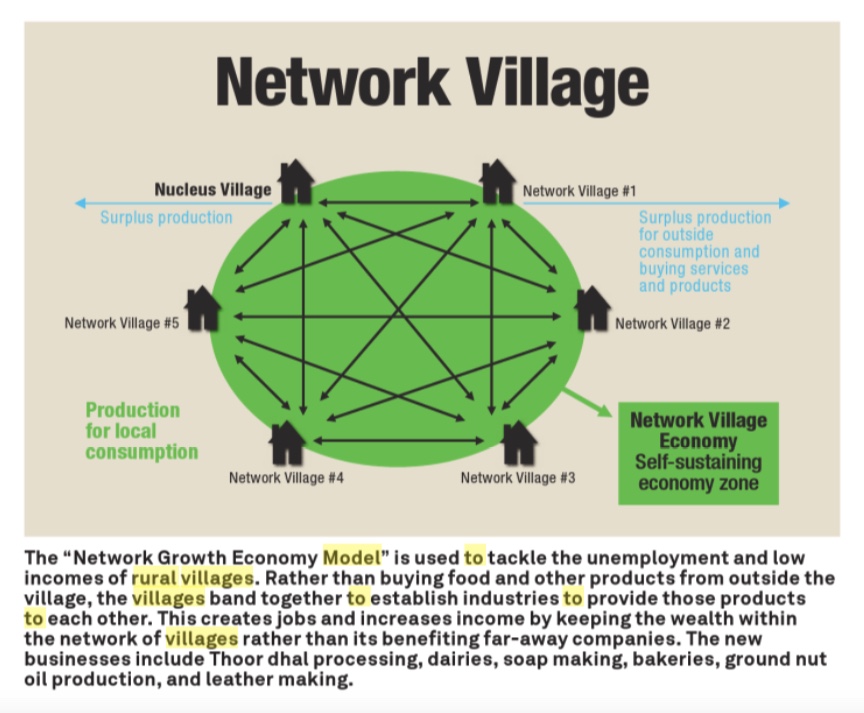
Like a spreading ink spot, the concept is to create a network of like-minded villages that act as self-reinforcing positive role models, spreading the prosperity and stability outwards. The “Network Growth Economy Model” is a direct challenge to the “special economic zones that benefit only capitalist owners,” said Elango.

Ambitious, Elango is hoping to draw in 2,000 villages over the next 10 years, until a tipping point is reached, and the model explodes across India.

A native of the village, Elango became saddened by the community’s decline, including widespread domestic violence against women. The booming city of Chennai’s prosperity had not rippled out to the village, and it was still lacking good infrastructure and sanitation. A trained chemical engineer, he was elected the President of the Kuthambakkam Panchayat in 1996, and set about using his engineer’s perspective to draft the village’s five-year plan from 1996 to 2001.

But the budget was tight. And he had to turn to innovative solutions: recycling building materials, conserving water and reducing electricity consumption. But the resourcefulness paid off, and the state of Tamil Nadu provided the money to upgrade roads, drains, build a community centre, child care facilities, 200 low cost toilets, and work sheds for the village’s industries. By the end of 2001, most basic needs were being met. He then turned to providing good quality housing for the villagers still living in thatch huts.

He has used the “Network Growth Economy Model” to tackle the unemployment and low incomes. It works like this: rather than buying food and other products from outside the village, the villages band together to establish industries to provide those products to each other. This creates jobs and increases income by keeping the wealth within the network of villages, rather than it benefiting far-away companies. The new businesses include Thoor dhal processing, dairies, soap making, bakeries, ground nut oil production, and leather making.

“India was strong when this model was in place – we had strong villages,” said Elango. “Globalization’s trickle down is not working for India.”

Published: November 2008

Resources

  • Unleashing India’s Innovation: Toward Sustainable and Inclusive Growth, a report by the World Bank. Website: http://web.worldbank.org/WBSITE/EXTERNAL/COUNTRIES/SOUTHASIAEXT/0,,contentMDK:21490203~pagePK:146736~piPK:146830~theSitePK:223547,00.html
  • NextBillion.net: Hosted by the World Resources Institute, it identifies sustainable business models that address the needs of the world’s poorest citizens. Website:http://www.wri.org
  • CIDEM and Ecosur specialise in building low-cost community housing using eco-materials. They have projects around the world and are based in Cuba. Website: http://www.ecosur.org

Sponsored by BSHF. BSHF is now called World Habitat and it aims to seek out and share the best solutions to housing problems from around the world.

https://davidsouthconsulting.org/2022/11/22/bio-ethanol-from-sturdy-and-once-unwanted-indian-plant/

https://davidsouthconsulting.org/2022/09/29/cheap-indian-tablet-seeks-to-bridge-digital-divide/

https://davidsouthconsulting.org/2022/10/09/entrepreneurs-use-mobiles-and-it-to-tackle-indian-traffic-gridlock/

https://davidsouthconsulting.org/2021/08/29/indian-business-model-makes-green-energy-affordable/

https://davidsouthconsulting.org/2022/10/25/indian-city-slum-areas-become-newly-desirable-places-to-live/

https://davidsouthconsulting.org/2021/08/28/indian-entrepreneur-brings-dignity-to-poor-women/

https://davidsouthconsulting.org/2021/03/04/indian-id-project-is-foundation-for-future-economic-progress/

https://davidsouthconsulting.org/2022/10/18/indian-initiatives-to-make-travel-safer-for-women/

https://davidsouthconsulting.org/2022/06/15/indian-mobile-phone-application-innovators-empower-citizens/

https://davidsouthconsulting.org/2022/11/01/indian-newspapers-thrive-with-economy/

https://davidsouthconsulting.org/2022/10/06/indian-solar-economy-brings-new-vocation-for-women/

https://davidsouthconsulting.org/2022/10/06/indian-solar-power-pack-powers-villages/

https://davidsouthconsulting.org/2022/10/25/indian-toilet-pioneer-champions-good-ideas/

https://davidsouthconsulting.org/2022/10/18/indians-fighting-inflation-with-technology/

Development Challenges, South-South Solutions was launched as an e-newsletter in 2006 by UNDP’s South-South Cooperation Unit (now the United Nations Office for South-South Cooperation) based in New York, USA. It led on profiling the rise of the global South as an economic powerhouse and was one of the first regular publications to champion the global South’s innovators, entrepreneurs, and pioneers. It tracked the key trends that are now so profoundly reshaping how development is seen and done. This includes the rapid take-up of mobile phones and information technology in the global South (as profiled in the first issue of magazine Southern Innovator), the move to becoming a majority urban world, a growing global innovator culture, and the plethora of solutions being developed in the global South to tackle its problems and improve living conditions and boost human development. The success of the e-newsletter led to the launch of the magazine Southern Innovator.

https://davidsouthconsulting.org/2021/03/05/southern-innovator-issue-3/

Creative Commons License

This work is licensed under a
Creative Commons Attribution-Noncommercial-No Derivative Works 3.0 License.

ORCID iD: https://orcid.org/0000-0001-5311-1052.

© David South Consulting 2023

Categories
Archive Blogroll Today's Seniors

Psychiatric Care Lacking For Institutionalised Seniors

Don Weitz wears a T-shirt bluntly saying, “Fry rice – not brains.”

By David South

Today’s Seniors (Canada), November 1992

Seniors who live in nursing homes and homes for the aged are receiving an inadequate amount of psychiatric care, according to a study conducted by Toronto’s Baycrest Centre for Geriatric Care. 

Dr. David Conn, director of psychiatry at Baycrest and an author of the report, says action must be taken to remedy this situation, since at least 80 per cent of elderly long-term care residents suffer from some form of mental disorder. 

The issue of psychiatric care for seniors is complex. There are many, often strongly-held, opinions about the nature of this care and what measures will genuinely improve the mental well-being of seniors in institutions. 

According to The Senior Citizens’ Consumer Alliance for Long-Care Reform, Ontario has the highest rate of institutionalisation of seniors in the world, with 7.5 per cent of seniors over the age of 65 and 15 per cent over 75 in institutions. The Alliance demanded in its reforms in Ontario that seniors’ mental health problems be taken more seriously and be included in any assessment for care. 

Baycrest’s report surveyed 1,148 medical directors and nursing directors in over 500 nursing homes and homes for the aged across Ontario. The 601 who responded reported that 37 per cent of their residents received no psychiatric care, while only 12 per cent received more than five hours per month. The most common psychiatric problems under treatment were depression, agitation, wandering and physical aggression. 

“Recognition of significant mental disorders in nursing homes is a recent phenomenon because geriatric psychiatry is a relatively new field,” says Dr. Conn. “The usual approach has been to reach for the prescription pad. We know now that antidepressants have been underused and tranquillizers overused.

“To deliver effective psychiatric care requires more than just psychiatrists – teams of psychiatric nurses can also be involved. Hopefully the staff of these institutions will become better educated as a result of this report.”

Dr. Kenneth Shulman, head of psychiatry at the Sunnybrook Health Sciences Centre, feels the worst neglect occurs in private rest homes. 

“There is general lack of accountability when it comes to geriatric psychiatric services.” Schulman advocates a coordinated, comprehensive regional network of services. 

Dr. Conn is sensitive to reports of sexual, physical and mental abuse of residents in some institutions. He says staff as well as residents of institutions can benefit from psychiatric consultations. “If more psychiatric consultants were available, the staff could also receive help in working out their problems,” he says. “Unfortunately the fee-for-service system doesn’t include paying for visiting staff.

“Being in an institution is not easy for anyone. It often means being apart from family, living with strangers, loss of freedom and having to live by the institution’s timetable.”

One of the most controversial of psychiatric treatments is electroconvulsive therapy (ECT). ECT involves placing electrodes on the sedated patient’s head and passing 100 to 175 volts of electricity into one of the lobes of the brain to induce grand mal seizure and coma. 

Opponents of ECT say the procedure can cause memory loss and confusion, and in some cases proves fatal. A 1985 Ontario government task force report recommended against using ECT in certain cases: “For patients whose work requires a clear and precise memory, ECT is probably contraindicated.”

But many other sources say that while ECT has been abused in the past and, like many other medical procedures, may not be a pretty sight, it is sometimes effective in combating depression. 

Dr. Conn confirms that the controversial procedure is still being used on seniors. “ECT is used on very depressed people,” he says. “It is a hospital-based service. The patient is admitted to a psychiatric unit of the hospital. We do it at Baycrest. It is only a last resort and has often been life-saving.”

Don Weitz, a senior citizen and spokesperson for Resistance Against Psychiatry, doesn’t mince words about what he says is the adverse effects of electroshock therapy and psychiatric practice in general. He wears a T-shirt bluntly saying, “Fry rice – not brains.”

“We have known about the adverse effects of shock for years,” says Weitz. “Research from the ‘40s and ‘50s was very clear that there was brain damage.

“What doctors mean by improvement is in fact post-injury euphoria – the brain will overcompensate with giddiness, and this only lasts for two to four weeks. Doctors seldom test people for more than two or three months afterwards.”

“What we know for sure is that within the institutions, they would rather give drugs or shock than talk to seniors. I think this should be called elder abuse – what else could it be? Is it such a mystery why people are depressed in institutions where they are abused? Psychiatrists have a vested interest in billing OHIP for pushing the button.”

But Dr. Shulman disagrees with blaming the atmosphere of institutions. “It is simplistic to think that the environment is responsible for aggressiveness or other problems,” he says. “These people are cognitively impaired – it could be medication-related or something else. These are complicated issues.”

For any nursing home workers who want further advice about psychiatry, Baycrest has produced a “Jargon-free” guide called Practical Psychiatry in the Nursing Home. 

Read more of David South’s 1990s health and medical journalism here: 

https://davidsouthconsulting.org/2022/06/24/can-we-talk-hannah-promotes-communication-between-medical-schools/

https://davidsouthconsulting.org/2021/02/05/changing-health-care-careers-a-sign-of-the-times/

https://davidsouthconsulting.org/2017/10/18/hannah-institute-for-the-history-of-medicine-1992-1994/

https://davidsouthconsulting.org/2022/04/28/health-care-in-danger/

https://davidsouthconsulting.org/2020/12/17/lamas-against-aids/

https://davidsouthconsulting.org/2017/08/15/mongolian-aids-bulletin/

https://davidsouthconsulting.org/2020/12/17/philippine-conference-tackles-asias-aids-crisis/

https://davidsouthconsulting.org/2022/06/24/professor-puts-chronic-fatigue-into-historical-perspective/

https://davidsouthconsulting.org/2021/02/05/study-says-jetliner-air-quality-poses-health-risks-cupe-takes-on-airline-industry-with-findings-of-survey/

https://davidsouthconsulting.org/2020/04/20/take-two-big-doses-of-humanity-and-call-me-in-the-morning/

https://davidsouthconsulting.org/2020/04/17/taking-medicine-to-the-people-four-innovators-in-community-health/

https://davidsouthconsulting.org/2021/02/05/us-health-care-businesses-chasing-profits-into-canada/

More from Canada’s Today’s Seniors

https://davidsouthconsulting.org/2021/02/05/critics-blast-government-long-term-care-reforms/

https://davidsouthconsulting.org/2022/10/08/dodging-the-health-insurance-minefield/

Feds Call For AIDS, Blood System Inquiry: Some Seniors Infected

Government Urged To Limit Free Drugs For Seniors

https://davidsouthconsulting.org/2020/06/14/government-urged-to-limit-free-drugs-for-seniors/

Health Care On The Cutting Block: Ministry Hopes For Efficiency With Search And Destroy Tactics

New Seniors’ Group Boosts ‘Grey Power’: Grey Panthers Chapter Opens With A Canadian Touch

https://davidsouthconsulting.org/2021/02/20/private-firms-thrive-as-ndp-reinvents-medicare/

https://davidsouthconsulting.org/2020/06/14/psychiatric-care-lacking-for-institutionalised-seniors/

Seniors Falling Through The Health Care Cost Cracks

https://davidsouthconsulting.org/2020/06/14/specialists-want-cancer-treatments-universally-available/

ORCID iD: https://orcid.org/0000-0001-5311-1052.

© David South Consulting 2023