Categories
Archive Blogroll id magazine

Man Out Of Time: The World Once Turned On The Ideas Of This Guelph Grad, But Does The Economist John Kenneth Galbraith Know The Way Forward?

By David South

Id Magazine (Canada), January 23 to February 5, 1997

John Kenneth Galbraith was photographed by David South at the University of Toronto.

It was with hungry enthusiasm that I rushed to hear the great liberal economist John Kenneth Galbraith speak. It was with enormous disappointment that I found a genius emptied of solutions to the current political battles in today’s Ontario.

For those unfamiliar with Galbraith, think of him as a hybrid of the liberalism of former prime minister Pierre Trudeau and the manner of Jimmy Stewart. Now 88, the former Guelph agricultural economist became a servant of the US government just as president Franklin Roosevelt was beginning to introduce the New Deal – today’s rusting welfare state – as a solution to the cruel hardships imposed on Americans as a result of the Great Depression. Galbraith rode out the Second World War in a senior government position as Roosevelt’s price-control czar. He later advised Democratic presidents John F. Kennedy and Lyndon Johnson, before seeing his influence in American economic thought wane under Ronald Reagan’s Republicans.

Galbraith has long followed the ideas of British economist John Maynard Keynes, who believed goverments should keep money tight in good times, but should spend their way out of bad times to avoid undue hardship. Galbraith also made the plight of the poor one of the pillars of his economic theory, and criticized the unnecessary appetites and demands created by the goliath American advertizing industry. He has supported wage and price controls and once, in the 1930s, even wanted to join the American Communist Party.

Last week, Galbraith breezed into Toronto with his ivy league roadshow. Speaking to a stodgy crowd of liberals (and Liberals, including former prime minister Pierre Trudeau and failed Ontario leadership candidate Gerrard Kennedy) at the University of Toronto, Galbraith was at an institution that comes as close as Canada gets to his current stomping ground, Harvard.

Symbolically, Galbraith couldn’t have visited Ontario at a better time. The Conservative government of Mike Harris is in the middle of an ambitious campaign to reverse everything that Galbraith has stood for: budget deficits to avoid depressions; social programmes to prevent poverty; taxes on the rich to fund those programmes; government policy subservient to public good. Harris oozes contempt out of every pore for the pillars of Galbraith’s thinking. In fact Ontario, once the bedrock of Canadian liberalism, is now joining Alberta in dismantling the welfare state.

A graduate of the University of Guelph when it was still the Ontario Agricultural School, Galbraith took his bitter memories of farming in southern Ontario to the University of California, Berkeley and subsequently to the Roosevelt government.

In his day, Galbraith was amongst a rare species of mainstream economists that earned respect from the once-abundant Marxists who cluttered universities. Not that the Marxists liked his compromises and complicity with the American government, or his assertions that he could save capitalism. But they thought he softened up the system for some body blows to be delivered by the workers’ revolution.

I am a member of a generation that grew up on government largesse, well-funded public schools, family allowance, university grants, and make-work progammes. But we have seen a lot of that eroded over the past eight years, during a period of high unemployment not seen since the Depression. It was time to see if this titan of liberal thought had something new to say.

Galbraith’s talk had two main points: the market economy is the best system going; he supports a guaranted minimum salary to prevent poverty. Other than that, Galbraith’s speech was a rehash of the same ideas he has been mulling over for the past 50-plus years. It could be called Liberalism 101.

His speech was peppered with euphamisms like the “socially concerned.” Perhaps he was pulling his punches so as not to offend the “distinguished” audience. The most exciting moments displayed his dry wit: “In the United States , the war against the poor having now been won,” or “We, the socially concerned, do not seek the euthanasia of the rentier class.”

He struck out against annual balanced budgets because they have been used as an excuse in the US to cut off benefits to the poor. He also slammed the globalization-uber-alles philosophy that sees welfare policies as uncompetitive – a sentiment that doesn’t seem to be in vogue these days with liberals. Last week, Prime Minister Jean Chretien told the South Koreans they need to remove jobs-for-life provisions to join the global marketplace.

His ideas and his approach to communicating those ideas come from a special historical time. A time when governments under pressure from trade unions and the far-left and right political parties decided to make capitalism a little friendlier. But they needed advisers who could speak the language of the elite. Eloquent, confident, pragmatic – advisers who felt comfortable in the courts of the democratic government. They didn’t want hot-headed union guys or hectoring left-wing demagogues.

Galbraith takes credit for civilizing capitalism and ensuring its survival: “It would not have survived had it not been for our successful civilizing efforts. We, the socially concerned, are the custodians of the political tradition and action that saved classical capitalism from itself. We are frequently told to give credit where credit is due. Let us accept it when it is ours.”

Galbriath’s economic theories have always been grounded by morality, preferring to avoid being a servant to flow charts. It is his most insightful side. When many fear to speak in broad terms about current economic problems, where many fear to make connections, Galbraith has pieced the complex puzzle together, much to the frustration of those who believe capitalism should be left unfettered. It is his worthiest legacy.

The Galbraith Interview

You point out it is reforms that have given capitalism a new lease on life. What policies would alleviate the worst aspects of today’s capitalism?

We still have the oldest problem. (That is) to eliminate the cruelties that are inherent in the system. In the United States, and I imagine also in Canada, we still have the terrible problems of the urban poor, of the people who do not make it. I see one of the central tasks of our time is to do two things: to provide a safety net so that in a modern rich society we don’t let people starve, and that we provide the means for escape from urban poverty.

How would you elliminate poverty?

No novelty about that. Two things are absolutely essential. One, that there be a basic safety net. That we accept in a modern society that there has to be a level of income below which people are not allowed to go. I do not join this attack on welfare, this notion the poor should be allowed to starve. Another thing is a strong educational system, which allows people to escape from poverty in the next generation. Those are the two absolute essentials.

Should government just concentrate on ending poverty and abandon universal programmes like public health care?

You can always have a conversation that separates itself from the reality. I think in Canada if some politician or some political group wanted to repeal the health system, they would soon find themselves in considerable disfavour. If they were committed to allowing the poor to starve, they would get a reputation for cruelty that no civilized society would tolerate. And if they started saving money on the schools, as some already have, we would find out how absolutely essential good education is for economic and social well-being. So we have a difference between what is possible in oratory and what is possible in reality … When the axing comes, it is a good deal less popular than it is in the previous rhetoric.

Who do you think, within or outside political movements, represents the socially concerned today?

I don’t speak generally on this. There is in all countries a substantial voting and politically expressive group. In the United States it is the political left, in Britain it is the Labour Party, in France it is the socialists, in Germany the social democrats. They are broadly committed to the welfare state and I think will remain so.

Would you include the Liberal Party in Canada amongst those?

I would include a substantial part of the Liberal Party in the United States. The Liberal Party in Canada, like the Democrats in the United States, have a double orientation, on one hand to the welfare state and on the other hand a more centrist attitude. Both parties have an internal problem to resolve.

Do you think they have lost interest in the welfare state?

To some extent I regret that. We must take some responsibility for human suffering and human well-being.

You don’t see that with the Democrat Party?

I prefer it to the Republicans.

Are some of these policies like welfare reform in the US making it harder for the poor?

I was not in favour of welfare reform.

I grew up in a very poor household but was able to go to the University of Toronto because of various government policies. In fact, they have kept me from destitution. You have written about a culture of contentment that prevents further social reforms. Will it whither?

Those of us who have been associated with the welfare state have made a lot of people comfortable, happy and conservative. We have undermined our own political influence by our success.

Do you think current levels of high unemployment and economic stagnation might erode that contentment?

No, if we suffer another recession there will be a desperate effort to have the government do something about it. The present conservatism is an aspect of good times. We had it in the 1980s under Reagan.

Are we still in good times?

We still have a lot of people who have a problem. We should have sympathy.

Do you see any political parties in Canada who defend the welfare state?

I’ve lived all my life in the the United States and I’ve always avoided coming back to give Canada advice. As I said in my lecture, anybody who does that should have stayed in Canada for his own lifetime. Let Canadians look after their affairs in Canada.

You said the socially concerned don’t seek income equality. I guess that is where you split with socialists?

I accept the inevitable, that people are going to be different in aspirations, ability and luck and probably different in parentage. All of this is going to mean differences in income.
Citations

Political Governance of Capitalism: A Reassessment Beyond the Global Crisis by Helmut WillkeGerhard Willke, Edward Elgar, 2012

https://davidsouthconsulting.org/2021/07/20/case-study-3-id-magazine-1996-1997-2/

https://davidsouthconsulting.org/2022/11/16/canadian-magazines-newspapers-1990s/

This work is licensed under a Creative Commons Attribution 4.0 International License.

ORCID iD: https://orcid.org/0000-0001-5311-1052.

© David South Consulting 2023
Categories
Archive Blogroll Development Challenges, South-South Solutions Newsletters Southern Innovator magazine The Global Urbanist

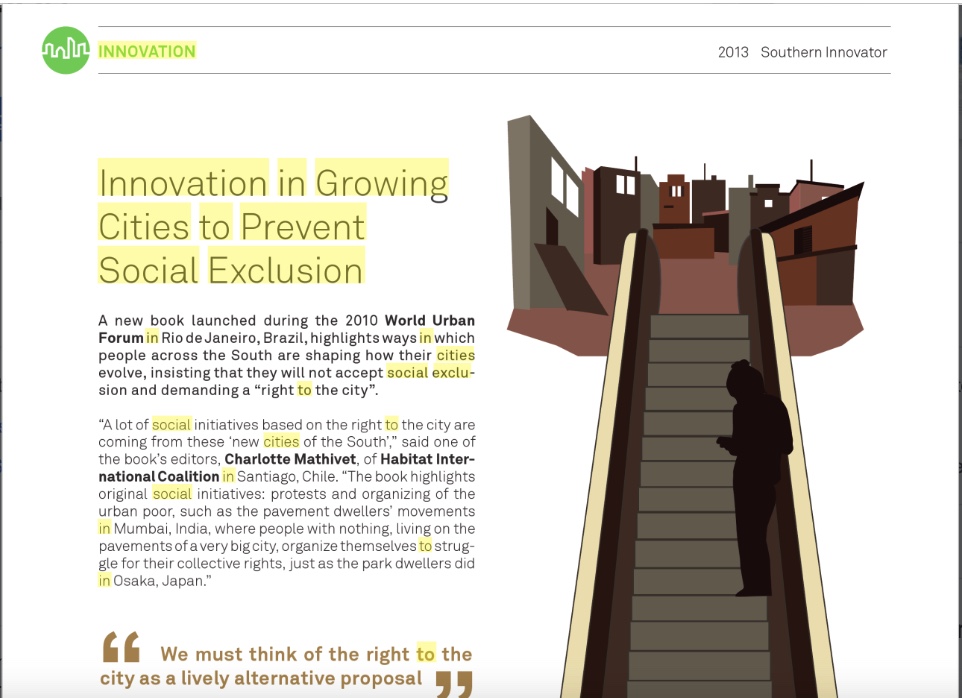
Innovation in Growing Cities to Prevent Social Exclusion

By David SouthDevelopment Challenges, South-South Solutions

SOUTH-SOUTH CASE STUDY

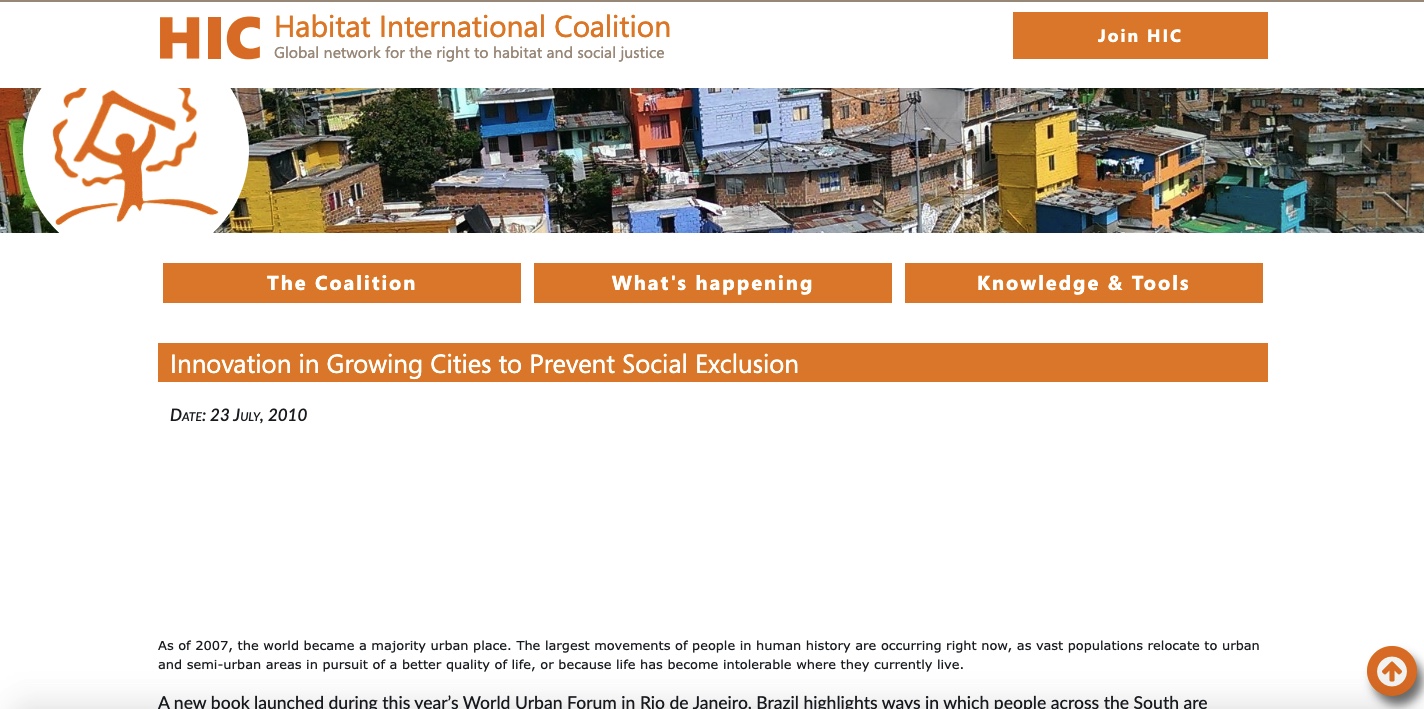
As of 2007, the world became a majority urban place. The largest movements of people in human history are occurring right now, as vast populations relocate to urban and semi-urban areas in pursuit of a better quality of life, or because life has become intolerable where they currently live.

A new book launched during this year’s World Urban Forum in Rio de Janeiro, Brazil highlights ways in which people across the South are shaping how their cities evolve, insisting that they will not accept social exclusion and demanding a “right to the city.”

“A lot of social initiatives based on the right to the city are coming from these ‘new cities of the South,’ said one of the book’s editors, Charlotte Mathivet of Habitat International Coalition in Santiago, Chile. “The book highlights original social initiatives: protests and organizing of the urban poor, such as the pavement dwellers’ movements in Mumbai, India where people with nothing, living on the pavements of a very big city, organize themselves to struggle for their collective rights, just as the park dwellers did in Osaka, Japan.”

This first edition of Cities for All: Proposals and Experiences towards the Right to the City, comes in three languages – English (http://www.hic-net.org/document.php?pid=3399) , Spanish ( http://www.hic-net.org/document.php?pid=3400) and Portuguese (http://www.hic-net.org/document.php?pid=3401) – is intended to inspire people to tackle positively this fast-changing urban world.

The book’s chapters span an eclectic mix of topics, from democracy in the world’s future cities to experiences in Africa’s cities, to how the 2008 Beijing Olympics affected the metropolis, to ways of involving children in urban planning.

One innovative case study included in the book is the children’s workshops in Santiago, Chile, which aim to make a more child-friendly city by including children in the planning process.

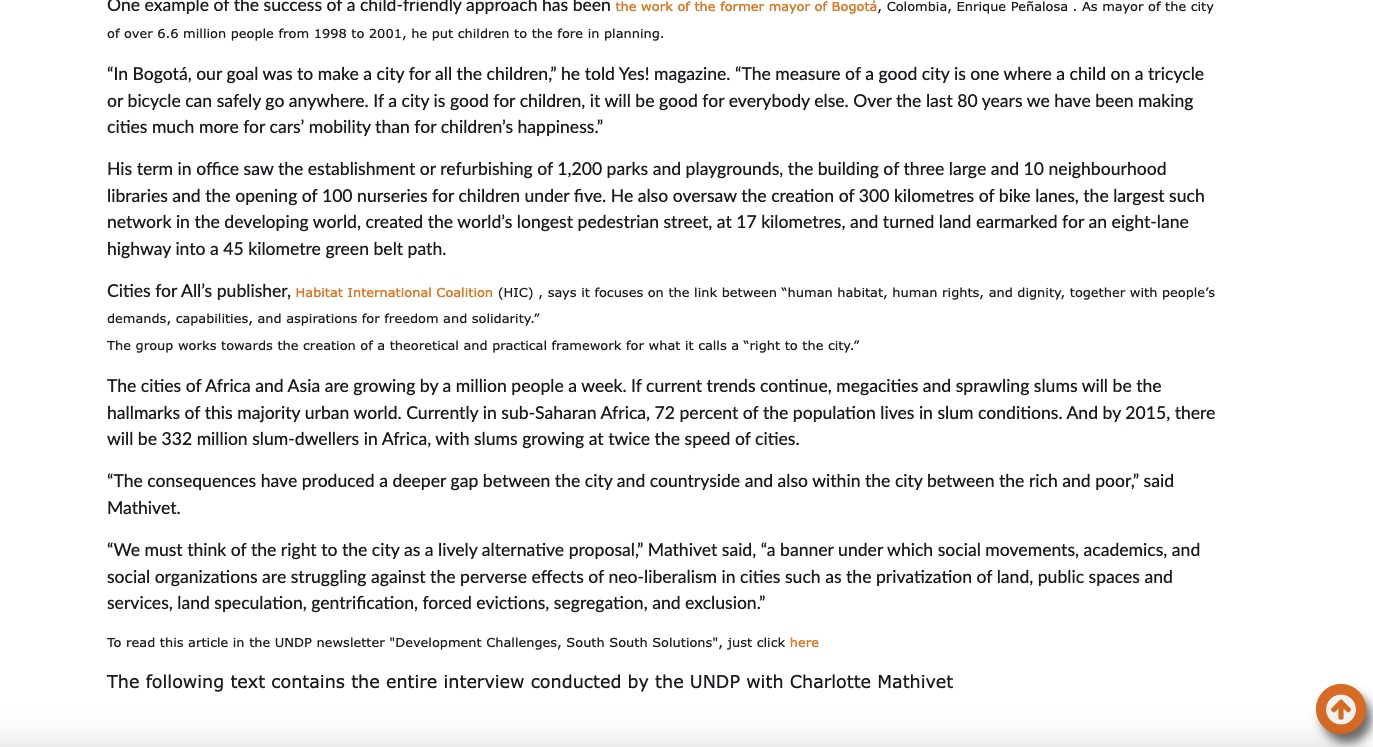
One example of the success of a child-friendly approach has been the work of the former mayor of Bogotá, Colombia, Enrique Peñalosa (http://www.pps.org/epenalosa-2/) . As mayor of the city of over 6.6 million people from 1998 to 2001, he put children to the fore in planning.

“In Bogotá, our goal was to make a city for all the children,” he told Yes! magazine. “The measure of a good city is one where a child on a tricycle or bicycle can safely go anywhere. If a city is good for children, it will be good for everybody else. Over the last 80 years we have been making cities much more for cars’ mobility than for children’s happiness.”

His term in office saw the establishment or refurbishing of 1,200 parks and playgrounds, the building of three large and 10 neighbourhood libraries and the opening of 100 nurseries for children under five. He also oversaw the creation of 300 kilometres of bike lanes, the largest such network in the developing world, created the world’s longest pedestrian street, at 17 kilometres, and turned land earmarked for an eight-lane highway into a 45 kilometre green belt path.

Cities for All’s publisher, Habitat International Coalition (HIC) (www.hic-net.org) , says it focuses on the link between “human habitat, human rights, and dignity, together with people’s demands, capabilities, and aspirations for freedom and solidarity.”

The group works towards the creation of a theoretical and practical framework for what it calls a “right to the city.”

The cities of Africa and Asia are growing by a million people a week. If current trends continue, megacities and sprawling slums will be the hallmarks of this majority urban world. Currently in sub-Saharan Africa, 72 percent of the population lives in slum conditions. And by 2015, there will be 332 million slum-dwellers in Africa, with slums growing at twice the speed of cities.

“The consequences have produced a deeper gap between the city and countryside and also within the city between the rich and poor,” said Mathivet.

“We must think of the right to the city as a lively alternative proposal,” Mathivet said, “a banner under which social movements, academics, and social organizations are struggling against the perverse effects of neo-liberalism in cities such as the privatization of land, public spaces and services, land speculation, gentrification, forced evictions, segregation, and exclusion.”

Published: July 2010

Resources

1) Model Village India: Drawing on self-organizing methods used in India since 1200 BC, the Model Village India is based around India’s democratic system of Panchayats: a village assembly of people stemming back to pre-colonial times. Website: www.modelvillageindia.org.in

2) More Urban, Less Poor: The first textbook to explore urban development and management and challenge the notion unplanned shanty towns without basic services are the inevitable consequence of urbanization. Website:www.earthscan.co.uk

3) Building and Social Housing Foundation: The Building and Social Housing Foundation (BSHF) is an independent research organisation that promotes sustainable development and innovation in housing through collaborative research and knowledge transfer. Website: http://www.bshf.org

4) World Social Forum Dakar, Senegal 2011. Website:www.worldsocialforum.info

Development Challenges, South-South Solutions was launched as an e-newsletter in 2006 by UNDP’s South-South Cooperation Unit (now the United Nations Office for South-South Cooperation) based in New York, USA. It led on profiling the rise of the global South as an economic powerhouse and was one of the first regular publications to champion the global South’s innovators, entrepreneurs, and pioneers. It tracked the key trends that are now so profoundly reshaping how development is seen and done. This includes the rapid take-up of mobile phones and information technology in the global South (as profiled in the first issue of magazine Southern Innovator), the move to becoming a majority urban world, a growing global innovator culture, and the plethora of solutions being developed in the global South to tackle its problems and improve living conditions and boost human development. The success of the e-newsletter led to the launch of the magazine Southern Innovator. 

“Cities for All, recently published by Habitat International Coalition, draws together thinkers and innovators in a compilation of case studies addressing the challenges of inclusive cities in the global South. The book seeks to articulate experiences of South-South cooperation and enhance the links between different regions. David South interviews the co-editor, Charlotte Mathivet.”

Read the full interview here: https://www.hic-net.org/innovation-in-growing-cities-to-prevent-social-exclusion/.
Creative Commons License

This work is licensed under a
Creative Commons Attribution-Noncommercial-No Derivative Works 3.0 License.

ORCID iD: https://orcid.org/0000-0001-5311-1052.

© David South Consulting 2023

Categories
Archive Blogroll Development Challenges, South-South Solutions Newsletters Southern Innovator magazine

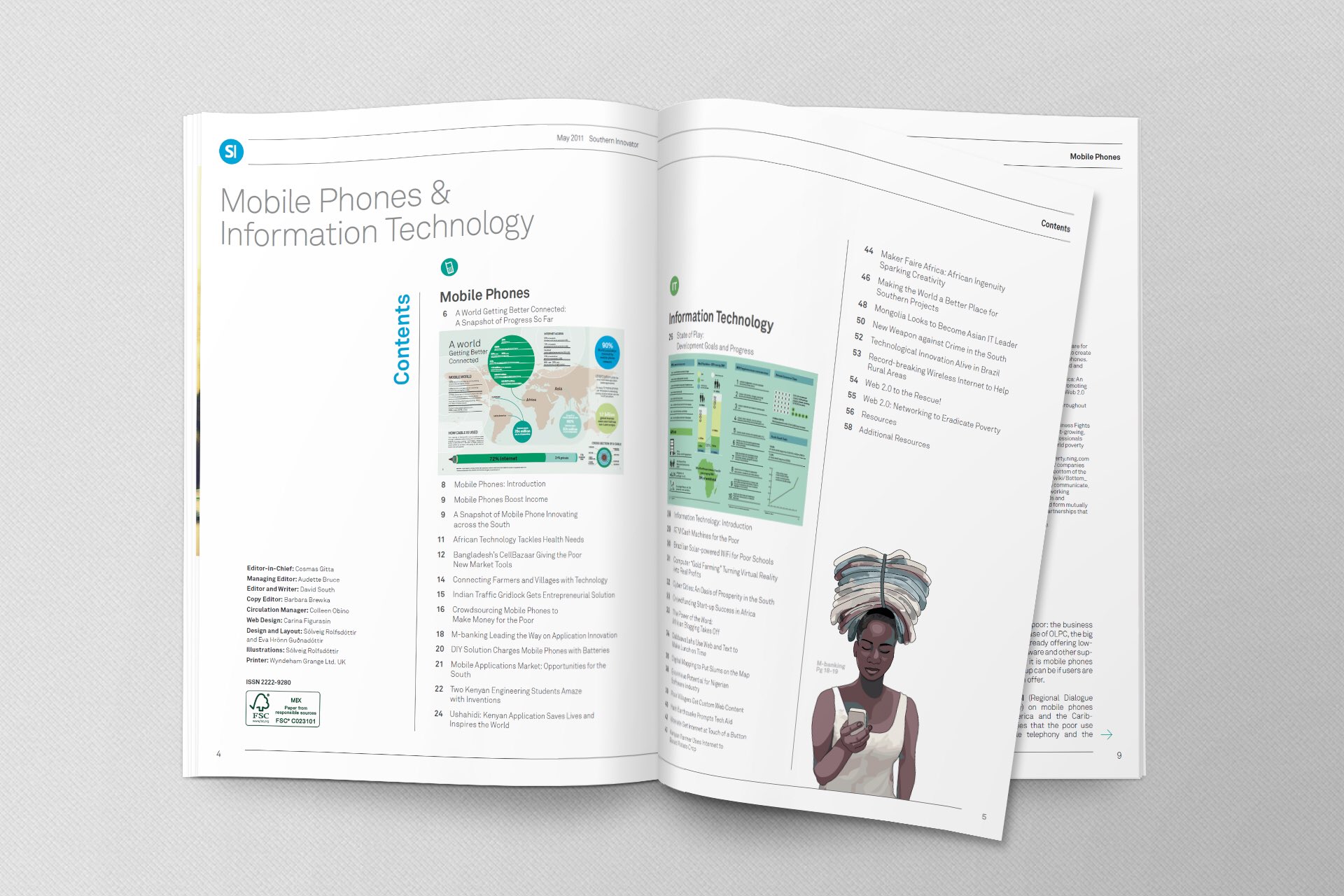
Mongolia Looks to Become Asian IT Leader

By David SouthDevelopment Challenges, South-South Solutions

SOUTH-SOUTH CASE STUDY

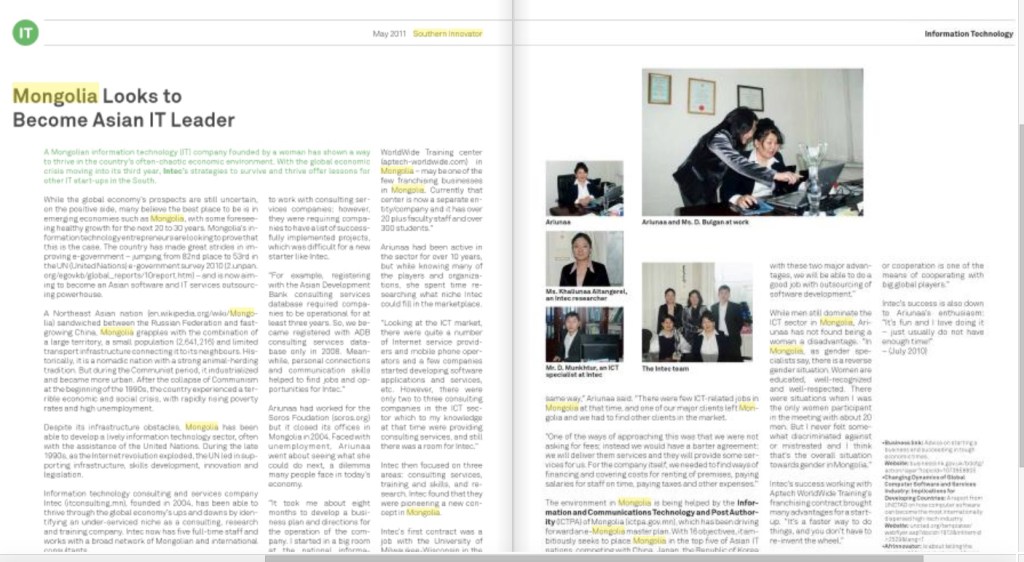
A Mongolian information technology company founded by a woman has shown a way to thrive in the country’s often-chaotic economic environment. With the global economic crisis moving into its third year, Intec’s strategies to survive and thrive offer lessons for other IT start-ups in the South.

While the global economy’s prospects are still uncertain, on the positive side, many believe the best place to be is in emerging economies like Mongolia, with some foreseeing healthy growth for the next 20 to 30 years. Mongolia’s information technology entrepreneurs are looking to prove this is the case. The country has made great strides in improving e-government – jumping from 82nd place to 53rd in the UN e-government survey 2010 (http://www2.unpan.org/egovkb/global_reports/10report.htm) – and is now aiming to become an Asian software and IT services outsourcing powerhouse.

A Northeast Asian nation (http://en.wikipedia.org/wiki/Mongolia) sandwiched between Russia and fast-growing China, Mongolia grapples with the combination of a large territory, a small population (2,641,216) and limited transport infrastructure connecting it to its neighbours. Historically, it is a nomadic nation with a strong animal herding tradition. But during the Communist period, it industrialized and became more urban. After the collapse of Communism at the beginning of the 1990s, the country experienced a terrible economic and social crisis, with rapidly rising poverty rates and high unemployment.

Despite its infrastructure obstacles, Mongolia has been able to develop a lively information technology sector, often with the assistance of the United Nations. During the late 1990s, as the internet revolution exploded, the UN led on supporting infrastructure, skills development, innovation and legislation.

Information technology consulting and services company Intec (www.itconsulting.mn) , founded in 2004, has been able to thrive through the global economy’s ups and downs by identifying an under-serviced niche as a consulting, research and training company. Intec now has five full-time staff and works with a broad network of Mongolian and international consultants.

As is often the case with new businesses, Intec initially found that many doors were closed to start-up enterprises.

“The major challenges which I faced were to make people understand about the consulting services,” said Intec’s founder, Lkhagvasuren Ariunaa. “The consulting services concept was new to Mongolia and Mongolians at that time and not many organizations were willing to work with consulting services. The international and donor organizations were keen to work with consulting services companies; however, they were requiring companies to have a list of successfully implemented projects, which was difficult for a new starter like Intec.

“For example, registering with the Asian Development Bank consulting services database required companies to be operational for at least three years. So, we got registered with ADB consulting services database only in 2008. Meanwhile, personal connections and communication skills helped to find jobs and opportunities for Intec.”

Ariunaa had worked for the Soros Foundation (http://www.soros.org/) but it closed its offices in Mongolia in 2004. Faced with unemployment, Ariunaa went about seeing what she could do next: a dilemma many people face in today’s economy.

“It took me about eight months to develop a business plan and directions of operation of the company. I started in a big room at the national information technology park building with one table, chair and computer.

“It has been quite challenging years for bringing a company to the market and finding niches for us. We have franchised the Indian Aptech WorldWide Training center (http://www.aptech-worldwide.com) in Mongolia – may be one of the few franchising businesses in Mongolia. Currently that center is now a separate entity/company and it has over 20 plus faculty staff and over 300 students.”

Ariunaa had been active in the sector for over 10 years, but while knowing many of the players and organizations, she spent time researching what niche Intec could fill in the marketplace.

“Looking at the ICT market, there were quite a number of internet service providers, mobile phone operators, a few companies started developing software applications, and services etc. However, there were only two to three consulting companies in the ICT sector which to my knowledge at that time were providing consulting services, and still there was a room for Intec.”

Intec then focused on three areas: consulting services, training and skills, and research. Intec found they were pioneering a new concept in Mongolia.

Intec’s first contract was a job with the University of Milwaukee-Wisconsin in the United States to organize a three week course for American students to learn about the digital divide in Mongolia. But the global economic crisis hit Mongolia hard in 2009.

“It was challenging to survive and continue working the same way,” Ariunaa said. “There were few ICT-related jobs in Mongolia at that time, and one of our major clients left Mongolia and we had to find other clients in the market.

“One of the ways of approaching this was that we were not asking for fees, instead we would have a barter agreement – we will deliver them services and they will provide some services for us. For the company itself, we needed to find ways of financing and covering costs for renting of premises, paying salaries for staff on time, paying taxes and other expenses.”

The environment in Mongolia is being helped by the Information and Communications Technology and Post Authority (ICTPA) of Mongolia (http://www.ictpa.gov.mn) , which has been driving forward an e-Mongolia master plan. With 16 objectives, it ambitiously seeks to place Mongolia in the top five of Asian IT nations, competing with South Korea, Singapore, Japan and China.

Ariunaa believes Mongolia has many competitive advantages. “Mongolia is known for a high-literacy rate and math-oriented training and education, and ICT specialists are targeting to become a software outsourcing country for other countries. Another advantage of Mongolians is that they can easily learn other languages: we are fluent in Russian, English, Japanese, Korean, German and we believe that with these two major advantages, we will be able to do a good job with outsourcing of software development.”

While men still dominate the ICT sector in Mongolia, Ariunaa has not found being a woman a disadvantage. “In Mongolia, as gender specialists say, there is a reverse gender situation. Women are educated, well-recognized and well-respected. There were situations, when I was the only women participant in the meeting with about 20 men. But I never felt somewhat discriminated or mis-treated and I think that’s the overall situation towards gender in Mongolia.”

Intec’s success working with Aptech WorldWide Training’s franchising contract brought many advantages for a start-up. “It’s a faster way to do things, and you don’t have to re-invent the wheel.”

As a Mongolian company, Intec has found it best to play to its local strengths. “National companies have knowledge, expertise and experience of local situations, know players and understand about legal, regulatory matters. … partnership or cooperation are one of the means of cooperating with big global players.”

Intec’s success is also down to Ariunaa’s enthusiasm: “It’s fun and I love doing it – just usually do not have enough time!”

Published: July 2010

Resources

1)  Advice on starting a business and succeeding in tough economic times. Website:http://www.businesslink.gov.uk/bdotg/action/layer?topicId=1073858805

2) Changing Dynamics of Global Computer Software and Services Industry: Implications for Developing Countries: A report from UNCTAD on how computer software can become the most internationally dispersed high-tech industry. Website:http://www.unctad.org/templates/webflyer.asp?docid=1913&intitemid=2529&lang=1

3) Afrinnovator: Is about telling the stories of African start-ups, African innovation, African made technology, African tech entrepreneurship and entrepreneurs. Their mission is to ‘Put Africa on the Map’ by covering these kinds of stories from all over Africa. As their website says, “if we don’t tell our own story, who will tell it for us?” Website:http://afrinnovator.com

4) TechMasai: Pan-African start-up news and reviews. Website: www.techmasai.com

5) Ger Magazine Project: Mongolia’s first online magazine pioneered communicating on the web. Website: http://en.wikipedia.org/wiki/Ger_magazine

Development Challenges, South-South Solutions was launched as an e-newsletter in 2006 by UNDP’s South-South Cooperation Unit (now the United Nations Office for South-South Cooperation) based in New York, USA. It led on profiling the rise of the global South as an economic powerhouse and was one of the first regular publications to champion the global South’s innovators, entrepreneurs, and pioneers. It tracked the key trends that are now so profoundly reshaping how development is seen and done. This includes the rapid take-up of mobile phones and information technology in the global South (as profiled in the first issue of magazine Southern Innovator), the move to becoming a majority urban world, a growing global innovator culture, and the plethora of solutions being developed in the global South to tackle its problems and improve living conditions and boost human development. The success of the e-newsletter led to the launch of the magazine Southern Innovator. 

Creative Commons License

This work is licensed under a
Creative Commons Attribution-Noncommercial-No Derivative Works 3.0 License.

Launched in 1997 in a major crisis, the UN Mongolia Development Portal (www.un-mongolia.mn) became the country’s largest online bilingual publisher and an award-winning pioneer of web content. It proved Mongolia had the potential to innovate in digital.
Story featured in the UN E-Government Knowledgebase and E-Government Survey in Media.
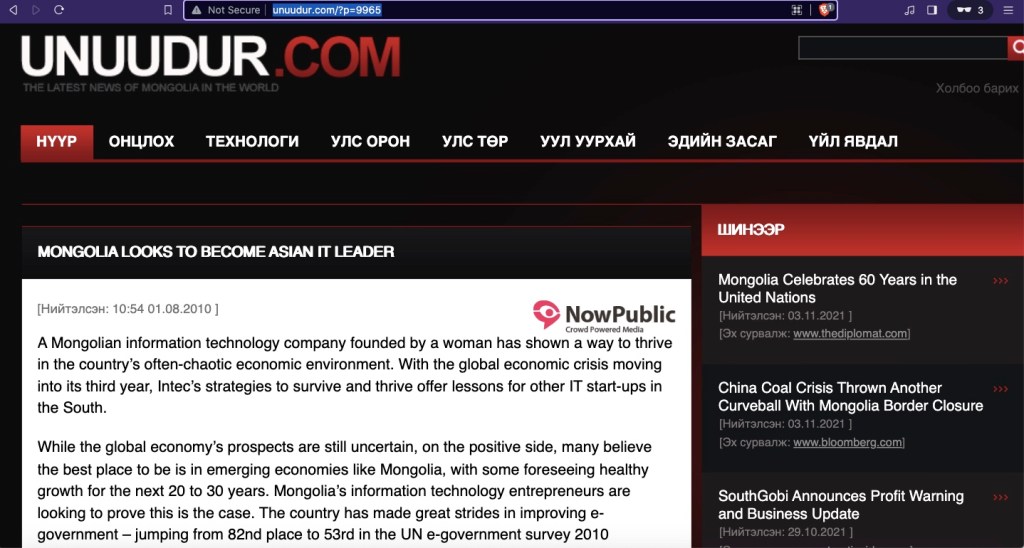
Posted in 2010 on the Unuudur.com (“The latest news of Mongolia in the world”) website.
Creative Commons License

This work is licensed under a
Creative Commons Attribution-Noncommercial-No Derivative Works 3.0 License.

ORCID iD: https://orcid.org/0000-0001-5311-1052.

© David South Consulting 2023

Categories
Archive Blogroll id magazine

TV’s Moral Guide In Question – Again

By David South

Id Magazine (Canada), November 28-December 11, 1996

Television programmers are under attack once again. Thanks to Guelph activist Patricia Herdman’s Coalition for Responsible Televsion (CORT), two violent television shows – Poltergeist (CTV) and Millennium (Fox/Global) – have lost several advertisers in recent weeks due to pressure from CORT. It’s just another wave in a new assault on the immorality of television.

Positive Entertainment Alternatives for Children Everywhere (PEACE), a Montreal group founded after the murder of 14 young women in that city in 1989, staged a press conference last week, complete with sweet-faced children, to announce its “Toxic TV” list. Who is toxic? Old favourites like Bugs Bunny, Batman and Robin and The Simpsons. PEACE also produced a list of “Positive” TV shows. It included a wrist-slashing selection of insipid programming, such as Barney and Friends, Fresh Prince of Bel-Air and Kratt’s Creature.

But critics of television overlook the strong and often simplistic moral messages that infuse most programming. Some even argue the mostly Judeo-Christian morality comes at the expense of atheistic and agnostic perspectives.

University of Guelph philosophy professor Jay Newman argues that religious moralists are making television the scapegoat for all of society’s ills.

He argues television, rather than being a moral vacuum, is heavily influenced by Judeo-Christain values – often in shows many people don’t suspect.

Newman sharply criticizes religious moralists, who he says, neglect to observe the same contradictions in their own beliefs that they see in television.

In Newman’s view, religion shares many sins with television. Religion promotes passivity (“The meek shall inherit the earth”), disrupts family life (who needs to talk to that “immoral” gay brother/sister?), does a questionable job of moral education, invents celebrities (the saints), sacrifices spiritual wisdom for meaningless ritual and entertainment (the Mass), and promotes violent behaviour (who can forget the Crusades or the Spanish Inquisition?).

Leaning back in his chair at his University of Guelph office, the irascible New York-born Newman enthusiastically defends television.

“When we assess TV as bad,” he says, “I’m not convinced religion is the only moral teacher, and it has not been the best moral teacher. Religion has been a very important force of hatred, whereas Star Trek teaches us to respect other cultures.

“TV has been of great value in promoting pluralism and an increase in tolerance.”

Newman isn’t talking about gore-soaked TV like Poltergeist and Millennium, shows he says speak more about their producers than about the medium of television. “Wanton slaughter can’t be blamed on TV. But I do agree with psychologists that some television inures us to violence.”

He sees Star Trek as a moral force for both pluralism and tolerance, strong values that are essential to democracies with many ethnic, cultural and racial groups. “This show promotes tolerance towards people who appear different. It shows aliens have aspirations and desires just like us.”

Newman does take offence to one race of aliens on the popular series: the Ferengi. While the Ferengi are supposed to be the equivalent of used car dealers in Star Trek’s universe, they draw criticism from Newman for their anti-semitic undertones. But even here, says Newman, TV can’t beat the pantheon of Christain anti-semites.

As for the bumbling antics of Bart Simpson and his dad Homer, Newman says The Simpsons also contain positive morals. “The Simpsons teaches us to accept the foibles of others and empathize. It does it in a gentle way without passing a very austere judgement.”

Newman even sees hope in the dreamy world of daytime soap operas. They teach people to develop empathy. They also use negative role models to show that hatred and contempt backfire on people; that promiscuity and adultry don’t come without a cost.”

As for Seinfeld, a sitcom about a group of friends who seem to never do anything, Newman says, “I’m a New Yorker and I can’t sit through it.”

Newman, an expert on religious fanaticism and hypocrisy, has responded to religious critics of television in his new book, appropriately titled Religion vs. Television. Newman sees religious critics of television as at best hypocrites, at worst specious claimants to higher moral ground.

“[Religious leaders] make judgements to show the usefulness of their institutions in an attempt to restore the lustre of religious authority.”

Newman believes the debate surrounding violence on TV is misguided. He believes the root causes of violence should be dealt with first.

“Television is a convenient scapegoat. Its criticism parallels religious bigotry. They don’t focus on the individual, just the medium. And this is accepted by people who call themselves liberal!”

TV immoral?

But critics of TV say any decent moral messages that slip through are undermined by television’s subservience to a higher God: consumerism. For Rose Anne Dyson of Canadians Concerned About Violence in Television (C-CAVE), this corrupted morality can’t be ignored. “There is only one over-riding religion today: consumerism. Its main purveyor is TV.

“Television is a major socializer today. Parents and teachers are key to modifying that influence. But most of television is very bad and just teaches consumer-driven values. There isn’t a single children’s programme that isn’t infused with commercial values.”

Dyson believes the negative effects aren’t just psychological. “Watching too much TV is bad – it causes obesity and hyperactivity.”

Dyson’s claims were recently backed up by a new study showing unhealthy minds may lead to unhealthy bodies. A study conducted by Columbia University claimed the more that children watched TV, the fatter they got. Researcher Dr Barbara Dennison found children who watched 14 hours of television a week had diets with 35 per cent of their calories from fat. The study blamed the high representation of junk food in television ads and the fact they promoted couch potato dining. Canadian children on average watch 18 hours a week of television.

Dyson does agree with Newman’s criticism of organized religions’ spurious claims to higher ground. “Judeo-Christian religions have gotten us into a lot of trouble!”

To control this morally wayward TV, Dyson looks forward to more entertainment conglomerates self-regulating their programming. “The cornerstone of democracy is to obey rules.

“A lot of cultural studies people tend to underestimate the impact of TV – there is too much of a value-free approach.”

Id was published in Guelph, Ontario, Canada in the 1990s.

Further Reading:

Channel Regulation: Swedes Will Fight Children’s Advertising All The Way

From Special Report: NMM (New Media Markets) Spotlight On The Emergence Of Satellite Porn Channels In The UK

Undercurrents: A Cancellation At CBC TV Raises A Host Of Issues For The Future

https://davidsouthconsulting.org/2021/02/05/channel-regulation-swedes-will-fight-childrens-advertising-all-the-way/

https://davidsouthconsulting.org/2021/02/03/do-tv-porn-channels-degrade-and-humiliate/

https://davidsouthconsulting.org/2021/03/03/kommunikation-total-der-siebte-kontinent/

https://davidsouthconsulting.org/2021/12/08/new-media-markets-and-screen-finance/

https://davidsouthconsulting.org/2022/04/21/nsd-partners-in-bitter-row-over-choice-of-satellite-as-brussels-deadline-nears/

https://davidsouthconsulting.org/2021/02/01/playboy-is-not-for-sad-and-lonely-single-men/

https://davidsouthconsulting.org/2022/11/22/popular-characters-re-invent-traditional-carving/

https://davidsouthconsulting.org/2022/10/27/reality-television-teaches-business-skills-in-sudan/

https://davidsouthconsulting.org/2021/01/14/from-special-report-nmm-new-media-markets-spotlight-on-the-emergence-of-satellite-porn-channels-in-the-uk/

https://davidsouthconsulting.org/2021/02/01/uk-laws-on-satellite-porn-among-toughest-in-europe/

https://davidsouthconsulting.org/2020/12/11/undercurrents-a-cancellation-at-cbc-tv-raises-a-host-of-issues-for-the-future/

Creative Commons License

This work is licensed under a
Creative Commons Attribution-Noncommercial-No Derivative Works 3.0 License.

ORCID iD: https://orcid.org/0000-0001-5311-1052.

© David South Consulting 2023