Categories
Archive Development Challenges, South-South Solutions Newsletters Southern Innovator magazine

Turning African Youth on to Technology

By David SouthDevelopment Challenges, South-South Solutions

SOUTH-SOUTH CASE STUDY

An African NGO believes the Internet is the single biggest key to rapid development in Africa – and it is working to connect youth, women and rural populations to the web, and in turn, switch them on to the vast resources stored across the world’s Internet sites.

After initial successes with a youth project and with farmers, Voices of Africa (VOA) (http://www.voicesofafrica.info) is now seeking to scale up its work to fan out across Africa – and take its services to the world’s largest refugee camp, the Dadaab Refugee Camp in Kenya. 

The youth and technology empowerment NGO has developed a business model to deliver low-cost Internet access and e-resources to Africa’s slums and rural farmers.

VOA argues that “the digital divide, defined by a lack of access to information for a specific population, symbolizes the largest difference between developed and developing countries: the opportunity to obtain and utilize information.”

“The digital divide runs much deeper than hardware and software,” it says. “While equipment is necessary it is not sufficient. The real heart of the digital divide is that those without access to information resources often suffer needlessly while the solutions to their problems are floating in the air.”

But why is the Internet so important?

“The internet puts the choice of content at the fingertips of the user,” explains executive director Crystal Kigoni. “Traditional media is one way communications. Internet is bi-directional.

“Our NGO is completely grassroots. We train the people who train the people. It is an each one, teach one philosophy and is highly effective. We also design our projects to be self-sustainable after one year of successful implementation.”

The philosophy behind Voices of Africa – “Sustainable Development through Information Empowerment” – is to give people the information and resources to take better control of their lives.

Access to the Internet in Africa is patchy and, for the poor, an expensive resource. The penetration of mobile phones in Africa has been spectacular in the past five years. But there are limits to the resources people can afford to access with their phones. Issues abound about data costs, mobile phone networks, and mobile phone capability.

VOA targets youth and women in sub-Saharan Africa through online educational resources offered on their e-learning website (http://elearning.voicesofafrica.info/). The resources have been certified by Nazarene University (http://www.anu.ac.ke), a private university in Nairobi, Kenya.

The e-learning resources include high quality training videos, presentations and screencasts (http://en.wikipedia.org/wiki/Screencast) – like a movie, it is a digital recording of changes on a computer screen and is used to teach software – to share on the web. The resources are also shared through compact discs (CDs) and iPods (http://en.wikipedia.org/wiki/IPod).

Project coordinator Nick Kungu coordinates the staff working on the pilot Kenyan projects: a Rural Internet Kiosk; a Youth Empowerment Center; and KiberaNet, which launched in August 2011. VOA uses a part-time and volunteer staff of more than 20 Kenyans and four international ‘virtual’ volunteers.

The group is also working with farmers in Kutus, central Kenya, to help them get a better price for their products and introduce sustainable agriculture practices. This is done through online courses so the farmers do not need to travel. It is hoped by doing this they can improve the supply of food for the country.

The Youth Empowerment Center in Webuye constituency of the Western province of Kenya involves a partnership with the government of Kenya to teach computer basics, research and data collection, social media, ICT (information communication technology) for development, social business and community health.

In rural areas, the need for information cannot be overestimated. In the remote countryside, there are few schools with adequate resources and almost no community libraries. The lifesaving knowledge the people require has to date been completely beyond their grasp. As one rural woman in the Western province of Kenya exclaimed to VOA after encountering the resources on the Internet, “It is like being brought from the darkness into the light.”

Another project in development is SlumNet, which seeks to combine the Internet with low-cost devices like tablet computers and netbooks. Its pilot scheme, KiberaNet, launched this month in the Kibera slum of Nairobi, Kenya to test the business model. VOA hopes to then expand it to Uganda, Tanzania, Ghana, Nigeria and Sierra Leone. It is using a business model to bring low-cost Internet access to Africa’s slums that is fully funded by the local communities and the users.

It has identified the key needs of youth in slums that need to be met: a way to access the vast resources available on the Internet; a way to generate income, undertake low-cost learning, and organise for social justice; ways to overcome social, economic and political isolation; a way to access affordable equipment and resources to improve their quality of life in the short-term.

To make it a sustainable business model, the community takes a 60 percent stake in the incorporated entity. Voices of Africa will select six local civil society organisations to take another 10 percent stake in the business. VOA takes 10 percent and the remaining 30 percent will be open to outside investors.

It involves setting up a closed intranet system and Internet access covering the entire Kibera slum, which has an estimated population of 2 million, a majority under the age of 30.

KiberaNet hopes to act as a community hub for socialising, education and generating content. A key part is creating an atmosphere that is welcoming to novices. The business model is about delivering the bandwidth of Internet access and simultaneously generating a sustainable source of income to keep it going. Partners in the business include Promote Africa, Plexus Group and Future Optics Networks.

VOA also has been blogging about its time in Kenya’s Dadaab Refugee Camp (http://www.unhcr.org/cgi-bin/texis/vtx/page?page=49e483a16) at their website, www.voicesofafrica.info, and has been developing plans to expand services to the camp, home to over 400,000 refugees from drought and famine in Somalia. The camp was only designed to hold 90,000 people. The chronic food insecurity has caused a massive humanitarian crisis in the Horn of Africa, leaving over 10 million people in need of help.

“There are plenty of resources going in but it is aid business as usual,” claims Kigoni. “You see lots of waste in many areas, and a lack in others that would be extremely beneficial. Hence, why Voices of Africa has come up with the youth technology and empowerment plan that accompanies a general information and communications system, DadaabNet.”

DadaabNet will be a youth-run community Internet service and education service. VOA plans to use a wireless intranet, internal communications systems and low-cost internet access in the refugee camp.

The project is the first of its kind in Dadaab and a first in Kenya, claims VOA, allowing free educational content without needing to access the Internet

The intranet will host free educational videos that can be accessed by mobile phones and computers. The topics covered in the videos include health, nutrition, sanitation and computer training and how to use technology for sustainable development.

The curriculum is also approved by Nazerene University to certificate level.

The system is supervised and would be able to offer resources to other NGOs seeking to provide services to the camp’s residents. The intention is to open up opportunities for education and employment youth who are currently unemployed.

At present the youth in the camp, many of whom have not completed secondary school, get by ‘hustling’ for work, according to VOA. By being left to their own devices, there is a risk they will fall into negative behaviour like crime and drug use or be preyed upon by terrorist organisations operating in the area like al Shabaab, they maintain.

“In our dreams, everyone everywhere in the world can have the opportunity to develop their minds. It is through this creativity that Africa will rise,” concludes Kigoni.

Published: August 2011

Resources

1) The Impact of Mobile Phones on Profits from Livestock Activities by Roxana Barrantes. Website: http://www.mendeley.com/research/impact-mobile-phones-profits-livestock-activities-evidence-puno-peru-14/

2) 2011 UNHCR Country Operations Profile – Kenya. Website: http://www.unhcr.org/cgi-bin/texis/vtx/page?page=49e483a16

3) Southern Innovator magazine: New global magazine Southern Innovator’s first issue is out now and is about Mobile Phones and Information Technology in the global South. Website: http://www.scribd.com/doc/57980406/Southern-Innovator-Issue-1

Creative Commons License

This work is licensed under a
Creative Commons Attribution-Noncommercial-No Derivative Works 3.0 License.

ORCID iD: https://orcid.org/0000-0001-5311-1052.

© David South Consulting 2023

Categories
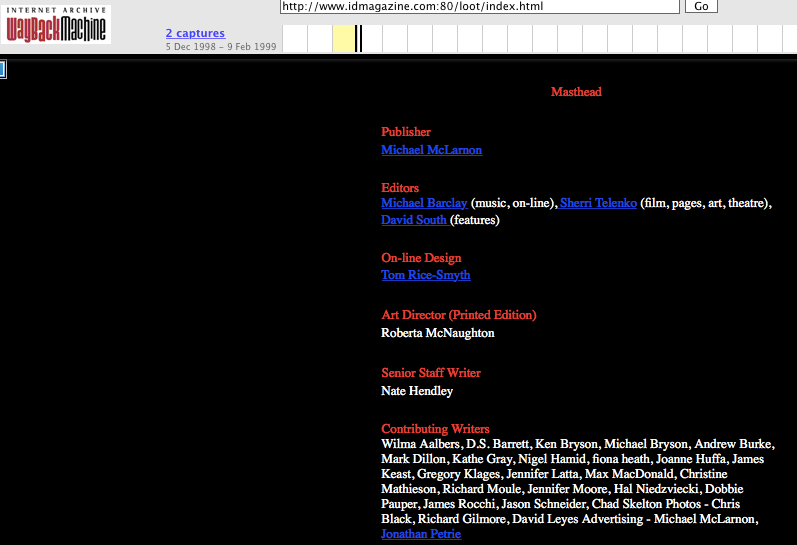
Archive id magazine

Will Niagara Falls Become The Northern Vegas?

By David South

Id Magazine (Canada), May 16-29, 1996

Niagara Falls – Niagara Falls has always been a town that attracted big dreamers with even bigger schemes. The beauty of the Falls has intoxicated many with grand ideas. Towards the turn of the century, the inventor of the Gillette safety razor, King Camp Gillette, tried to transform the American side into a Utopian paradise, planning to house most of the US population in a community of beehive-style high-rises covering an area 135 miles long and 45 miles wide.

Given the long history of grand schemes to remake both sides of Niagara Falls, it is hard not to see the hyperbole surrounding the planned casnio, slated to open by the end of the year, as another over-hyped dream. Just as Gillette spoke of untold riches, the government-owned Ontario Casino Corporation also sees Utopia ready to be born at the edge of the Falls. As provincial tourism minister Doug Saunderson said last month, “The casino and tourist development will provide Niagara with a kick start into the 21st century… I believe they will move Niagara to the very top of the list of destinations for world travellers.”

Those expectations sound even more impressive if you believe the government’s estimates for job creation. In a city of 76,000, the government projects between 3,000 and 9,000 jobs will result from the casino and its spin-offs. With numbers like that, it is hard to find many people who will say no.

Everywhere in Niagara Falls’ tourist district roads are being ripped up. Tourists from New York, Japan and Quebec tread through the clouds of gravel dust to see the Falls. But it isn’t just the government which is dreaming big for Niagara Falls.

Three dreams are fighting in this town for the hearts and souls of its residents, and depending on your perspective, have their merits. One, a scheme being championed by a group of local church leaders, is to build a wholesome theme park based around the exploits of local heroine Laura Secord during the War of 1812. Another more flamboyant scheme that has been on and off again since 1993, involves building a $1.4 billion theme park dedicated to transcendental meditation. So far, the casino is winning hands down.

The casino on its own is helping to raise another dream, phoenix-like, from the ashes. In 1979, the DiCenzo family built Maple Leaf Village as a joint shopping mall/theme park attraction. Now it sits derelict, waiting for renovations by the Buttcon construction company to turn it into the temporary site for the casino.

The run-down Maple Leaf Village, with its old-world European facade resembling a castle, became known for tacky attractions like the JFK Assassination Museum, the Elvis Presley Museum and the Nightmares Therapy Centre.

Judy MacCarthy has fought plans to build a casino since they were first discussed. She helped put together a coalition of church groups called the Try Another Way Committee. MacCarthy’s dream involves a theme park extolling the virtues of Laura Secord, whose claim to fame was snitching on the American invaders, having them ambushed by Indians near Niagara Falls.

MacCarthy says the provincial government has shown some interest in the project, even sending officials from Toronto to meet with her.

As for the more ambitious transcendental meditation theme park, it looks as if the whole project hangs on securing enough funds to get it off the ground.

In 1993, Maharishi Veda Land’s chair, the effervescent magician Doug Henning, told the media that Niagara Falls had to make up its mind: choose between the transcendental theme park, with its centre-piece floating bridge, or the moral decadence of a casino.

Three years later, what many thought to be a project even less tangible than Henning’s metaphysical musings, seems to still have some life left. Tucked away on the 13th floor of a Bay Street office tower in Toronto, Maharishi Veda Land Inc. – Enlightenment, Knowledge, Entertainment – continues to run with a handful of staff. As three office workers scatter behind closed doors, a secretary tells me the theme park is still a go, but refuses to give any more details. But MVL has told a Florida newspaper it isn’t going to build a theme park on property the company owns there.

Tucked away on the 13th floor of a Bay Street office tower in Toronto, Maharishi Veda Land Inc. – Enlightenment, Knowledge, Entertainment – continues to run with a handful of staff. As three office workers scatter behind closed doors, a secretary tells me the theme park is still a go, but refuses to give any more details.

Ted Cook, the former vice-president of PCL Eastern, the construction company Henning contracted to build the park, says there was a change in attitude: “Henning’s position softened as time passed (over the casino). He became less opposed on moral grounds, and it was now ‘maybe we can make it work’.”

If there was an epicentre to the Niagara dream machine, it is the office of its mayor, Wayne Thompson.

Dean Iorfida is the mayor’s executive assistant. For Iorfida, the casino is a matter of turning a seasonal economy dependent on summer-time tourists into a viable year-round attraction. Even when they do come to Niagara Falls, he says, the average tourist’s stay is just four hours.

Iorfida is dreaming large, imagining the permanent site will include an auditorium, convention centre and amusement park. “Vegas has gone that way,” he says.

But he also wants to see the whole city transformed by the casino. “We have to spread it around or you get a black hole effect: too much in one location.”

As for the complaints that the casino will only add to the tacky reputation of Niagara Falls, Iorfida believes “the city doesn’t want anything that turns people off, but we can’t stop private enterprise. We are talking about one location, I don’t think it will be like Vegas where casinos try to out-garish each other.”

Many associated with the traditional tourist attractions in Niagara are banking on seeing some of the casino cash. Merchants on Clifton Hill, “The street of fun at the falls,” are hoping they can complement the casino rather than compete.

So far, the tourist trap, despite the shabby strip of Clifton Hill with its wax museums and fudge shops, or even the block after block of cheap hotels and motels, has been able to avoid turning into a seedier form of sleaze – it is still a family atmosphere. In fact, the declasse’ tone of the city hides an impressive stability and prosperity that makes the residents of Niagara Falls, New York jealous. For many opposed to the casino, it is this stability that is at stake.

Overhead is the dayglo pink and turquoise marquee of the Movieland Wax Museum, where one can see wax likeness’ of such luminaries as Jim Carrey. Guy Paone, the general manager of the museum, says he is happy about the casino, hoping it will bring year-round business.

“We get families down here,”he says. “If dad wants to go to the casino, then mom and the kids can come here.”

Paone isn’t expecting any business from the die-hard gamblers though. “The hard-core gamblers didn’t come here any way. You know how it is – in Vegas some people don’t eat or sleep.”

As for some of the doom and gloom about increasing crime scaring off the family tourists, Paone doesn’t buy it. “We are pretty tight on petty crime here. I don’t think the casino will affect the family reputation.”

Paone does have a sobering thought he leaves me with, “we are the suicide capital.”

All the hope has already spawned new jobs teaching the unemployed how to gamble. Frank Cricenti, black jack course co-ordinator at the National Casino Academy, joins a growing number of people employed in the lucrative business of teaching the unemployed casino skills. According to Cricenti, casino schools “are just popping up.” At government employment centres, staff are anticipating more than 100,000 applications to flood in chasing the 3,000 jobs being offered. Such a yawning chasm between expectations and reality means times are good for the adult education business.

At the 47-room Cataract Motel, the casino is an excuse to spiff the place up. “We have painted and renovated the rooms so that they look like they’re brand new,” says the motel’s manager, who will only give his name as B. John.

Other property owners are banking on the casino rescuing them from the slump. Eva Klein of Klein Developments, wants to especially unload her pricier properties. “There has been a little bit of change in the rental market, some casino people are moving into town,” Klein tells id. “We’ve had a high vacancy of higher-end rentals in Niagara Falls and we’re expecting these to be filled by a new influx from the casino.”

For Niagara Falls, the casino looks set to turn the city into a smaller, more Canadian Las Vegas. For a city desperate for more work, that doesn’t sound too bad. For the provincial government’s travelling road show, the next stop is to move the existing Windsor casino’s management over to staff the new casino at Niagara Falls.

Casino Calamity: One Gambling Guru Thinks The Province Is Going Too Far

https://davidsouthconsulting.org/2020/06/16/casino-calamity-one-gambling-guru-thinks-the-province-is-going-too-far/

CASE STUDY 3: Id Magazine | 1996 – 1997

https://davidsouthconsulting.org/2021/07/20/case-study-3-id-magazine-1996-1997-2/

A visionary ahead of his time, we now see the Channel Zero concept everywhere, from You Tube to Tik Tok.

https://davidsouthconsulting.org/2021/02/07/cock-tales-too-much-for-hamilton/

https://davidsouthconsulting.org/2020/11/17/land-of-the-free-home-of-the-bored/

https://davidsouthconsulting.org/2020/12/22/man-out-of-time-the-world-once-turned-on-the-ideas-of-this-guelph-grad-but-does-the-economist-john-kenneth-galbraith-know-the-way-forward/

https://davidsouthconsulting.org/2021/01/20/pulling-the-plug-on-hate-rock-1996/

https://davidsouthconsulting.org/2021/01/16/redneck-renaissance-a-coterie-of-journalists-turn-cracker-culture-into-a-leisure-lifestyle/

https://davidsouthconsulting.org/2021/01/14/from-special-report-sexual-dealing-todays-sex-toys-are-credit-cards-cash-a-report-on-the-sex-for-money-revolution/

https://davidsouthconsulting.org/2020/12/11/tvs-moral-guide-in-question-again/

Creative Commons License

This work is licensed under a
Creative Commons Attribution-Noncommercial-No Derivative Works 3.0 License.

ORCID iD: https://orcid.org/0000-0001-5311-1052.

© David South Consulting 2023

Categories
Blogroll Great Ormond Street Hospital for Children/Institute of Child Health

20 Years Ago

It was 20 years ago this month (September 2001) that the GOSH Child Health Portal was launched in London, UK. The award-winning website was called “One of the three most admired websites in the UK public and voluntary sectors”.

“Making sure that your child has helpful, easy-to-read information will make a significant difference to their time in hospital. I am sure that this website will prove very useful for children and their families.” Prime Minister Tony Blair.

Britain’s best-loved children’s hospital and charity, Great Ormond Street Hospital for Children NHS Trust (GOSH), contracted me to lead a two-year project to modernise the hospital’s web presence and take its brand into the 21st century. GOSH is both Britain’s first children’s hospital and a pioneering child health institution (along with its partner the Institute for Child Health). The hospital’s outstanding reputation meant the project was carried out under intense public, media and professional scrutiny, and required a keen awareness of new media developments and the needs of the hospital’s patients, their families and the public.

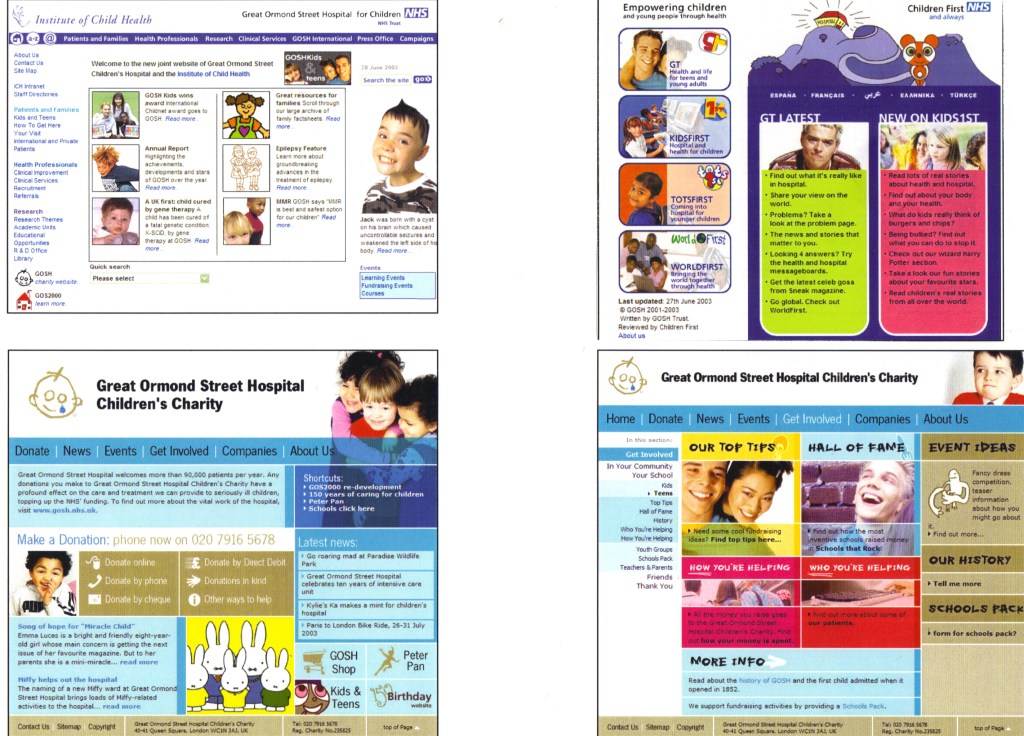
The project was developed in three, distinct phases. Screen grabs from these phases are now available for download and evaluation. They also include web traffic statistics. This unique snapshot of a complex project as it unfolded, should prove useful for other e-health practitioners.

Phase 1: www.scribd.com/doc/47241951/GOSH-Child-H ealth-Portal-Proj...
Phase 2: www.scribd.com/doc/47242473/GOSH-Child-H ealth-Portal-Proj...
Phase 3: www.scribd.com/doc/47242267/GOSH-Child-H ealth-Portal-Proj...

In 2001, the project also launched an interactive Christmas child health advent calendar offering top tips from health professionals on how to have a safe holiday season. The PDF can be viewed here: http://www.scribd.com/doc/44905926/Christmas-Advent-Calendar-for-GOSH-Child-Health-Portal-2001.

A great way to track the historical development of a web project is to use the Wayback Machine’s internet archive here. By typing in the web address (for example, www.gosh.nhs.uk, and www.gosh.org), you can see a chronological history of the website by month.

Content produced for the GOSH Child Health Portal (now MyGOSH) in 2003 on the ketogenic diet and how it can help with the treatment of epilepsy.
Annual Clinical Governance Report 2000/2001.

Read here about the child health portal project’s vision and strategy, its launch and overall impact. Or download a brief Powerpoint presentation here: GOSH Powerpoint.

In 2003, the UK’s Guardian newspaper called the Children First website one of the “three most admired websites in the UK public and voluntary sectors,” and a UK government assessment called the overall GOSH child health web portal a role model for the NHS.

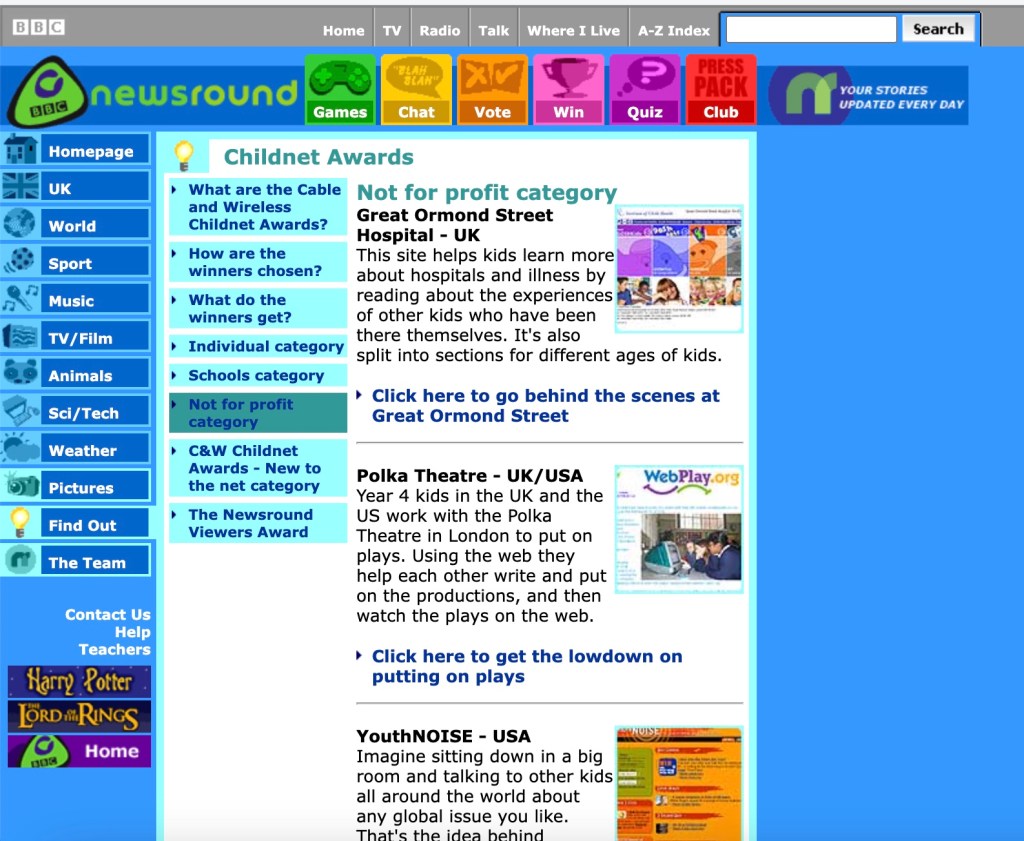
The GOSH Child Health Portal team receive the Childnet Award in 2003 at London’s Science Museum (Photo: CBBC Newsround).

In 2006, The Times of London called Children First the Top Child Health Website in its Wellbeing on the Web: The Best Portals survey (November 11, 2006).

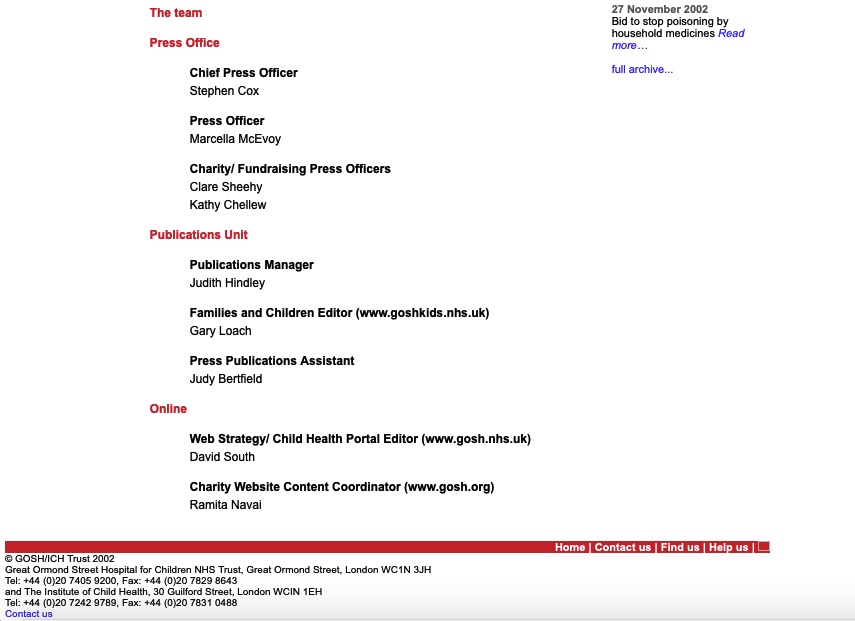
The GOSH Child Health Portal Team circa 2002.

What we did 10 Years Ago

This work is licensed under a Creative Commons Attribution 4.0 International License.

ORCID iD: https://orcid.org/0000-0001-5311-1052.

© David South Consulting 2024

Categories
Archive data Development Challenges, South-South Solutions Newsletters digital ID

Microwork Pioneer Transforms Prospects For Poor, Vulnerable

By David SouthDevelopment Challenges, South-South Solutions

SOUTH-SOUTH CASE STUDY

A pioneering technology social enterprise has found a way to connect people around the world to the new digital economy, transforming their lives and providing long-term employment opportunities. It is closing the digital divide in a very practical way, teaching new skills and, most importantly, providing income to the poor and vulnerable.

The San Francisco, USA-based non-profit social enterprise Samasource (samasource.org) uses what it calls microwork – a virtual assembly line of small tasks broken down from a larger project so they can be completed over the Internet – to outsource work to its network of workers around the world.

The tasks in this virtual piecework range from writing to transcribing to organizing online content.

The company organizes the projects using its own online work distribution system connecting workers around the world to the SamaHub in San Francisco. Most of the workers are women, youth and refugees. When they complete their task, it is sent back to the SamaHub in San Francisco where the staff check it and assure its quality. Once approved and completed, the project is returned to the client.

The company was founded in 2008 and draws on experts in “distributed work, economic development, and outsourcing.”

The microwork is divided into three areas: content services, data enrichment and transcription.

Content services can include writing descriptions for online business listings, organizing large databases on information or creating brief descriptions of existing content to make it easier for search engines to find it. “Data enrichment” tackles the vast quantity of information on the Internet that needs to be kept up to date and reliable. It also includes ‘tagging’, where text or images on the Internet need to have appropriate ‘tags’ or labels. And finally, transcription services include digitizing paper documents like receipts or books or transcribing audio and video files for the web.

All these tasks are labour intensive and require high attention to detail. And they are critical to any online business’s success if it wants a reputation for accuracy and consistency.

Samasource is optimistic about its future potential because of the sheer size of the market for business process outsourcing: estimated to be worth over US $100 billion. What Samasource does, called ‘impact sourcing’ – outsourcing to people in the developing world living in poor or remote communities – is a market worth US $5 billion, according to Samasource’s website.

It differs from conventional business process outsourcing in a number of respects, including the educational background of the workers. Most conventional outsourcing goes to college graduates in cities in India, China and the Philippines. Impact outsourcing is done by people with at most a high school education.

The digital economy needs these workers to handle the many millions of detailed tasks required to link together information. It is easy to take this for granted because it is hidden from view, but it is what enables the Internet to function and businesses to thrive. Samasource provides outsourcing services including content moderation and data entry to clients like LinkedIn, Intuit and the US State Department.

“We bring dignified, computer-based work to women, youth, and refugees living in poverty,” said Samasource’s founder and chief executive officer, Leila Janah.

Janah has a background in development studies and formerly worked for the World Bank. This experience convinced her that much foreign aid was failing to target what poor people are really looking for: a job that pays well.

Samasource sees what it does as work, and not handouts.

It also believes it is changing perspectives, proving people from the poorest places on earth can become trustworthy, hard-working knowledge workers.

The Internet is a unique medium because it transcends borders and smooths contact between people with varying linguistic, cultural and educational capabilities.

“The Internet reduces the friction of collaboration across all of these centres and time zones, and with a highly distributed workforce,” said Janah.

Samasource claims to have paid out US $1 million in wages to more than 1,500 workers around the world. Ambitiously, it wants to expand this to reach some of the 144 million youth between 16 and 24 living on less than US $2 a day.

Youth are a particular focus for Samasource. Samasource targets young people who are literate and have received an education but still can’t get a job.

As for the many women employed by Samasource, they were either unemployed or earning poverty-level wages doing precarious work in low-level manufacturing and not building their skills.

Samasource currently has 16 partnerships in Haiti, India, Pakistan, Kenya, Uganda and South Africa. Criteria to work with Samasource includes being in a high-poverty region. Another criteria is for most of the money earned to stay within the region where the work is done and adhere to the standards laid down by Samasource.

Samasource’s success means it has attracted further funding. In December 2011, it was given a US $1.5 million grant from Google.org – the Google.com search engine’s charity. It has also raised US $5 million from non-profit investors, including the Ford Foundation, the Rockefeller Foundation and the eBay Foundation. The challenge for the Samasource model will be to prove, with this new funding, that it can scale its operations to pay out more to its workers than it is taking in to meet its operating costs.

Microwork is turning out to be big work indeed!

Published: January 2012

Development Challenges, South-South Solutions was launched as an e-newsletter in 2006 by UNDP’s South-South Cooperation Unit (now the United Nations Office for South-South Cooperation) based in New York, USA. It led on profiling the rise of the global South as an economic powerhouse and was one of the first regular publications to champion the global South’s innovators, entrepreneurs, and pioneers. It tracked the key trends that are now so profoundly reshaping how development is seen and done. This includes the rapid take-up of mobile phones and information technology in the global South (as profiled in the first issue of magazine Southern Innovator), the move to becoming a majority urban world, a growing global innovator culture, and the plethora of solutions being developed in the global South to tackle its problems and improve living conditions and boost human development. The success of the e-newsletter led to the launch of the magazine Southern Innovator.  

Follow @SouthSouth1

Like this story? Here is a dirty secret: this website is packed with stories about global South innovators. We spent 7 years researching and documenting these stories around the world. We interviewed the innovators to learn from them and we visited them to see how they did it. Why not use the Search bar at the top and tap in a topic and see what stories come up? As for my work, I have been involved with start-ups and media ventures since the early 1990s. In the years since I have learned a great deal about innovation and digital and have shared these insights in the stories on this website as well as in the 5 issues of Southern Innovator magazine. So, stick around and read some more!    

Google Books: https://books.google.co.uk/books?id=qLYTxcC8HgcC&dq=development+challenges+january+2012&source=gbs_navlinks_s

Slideshare: http://www.slideshare.net/DavidSouth1/development-challengessouthsouthsolutionsjanuary2012issue

Southern Innovator Issue 1: https://books.google.co.uk/books?id=Q1O54YSE2BgC&dq=southern+innovator&source=gbs_navlinks_s

Southern Innovator Issue 2: https://books.google.co.uk/books?id=Ty0N969dcssC&dq=southern+innovator&source=gbs_navlinks_s

Southern Innovator Issue 3: https://books.google.co.uk/books?id=AQNt4YmhZagC&dq=southern+innovator&source=gbs_navlinks_s

Southern Innovator Issue 4: https://books.google.co.uk/books?id=9T_n2tA7l4EC&dq=southern+innovator&source=gbs_navlinks_s

Southern Innovator Issue 5: https://books.google.co.uk/books?id=6ILdAgAAQBAJ&dq=southern+innovator&source=gbs_navlinks_s

Creative Commons License
This work is licensed under a
Creative Commons Attribution-Noncommercial-No Derivative Works 3.0 License.

ORCID iD: https://orcid.org/0000-0001-5311-1052.

© David South Consulting 2021