“A political anthropologist, she uses complex-systems tools to analyze three different databases: Mongolians’ changing ideas on democracy and capitalism, the emergence of early states all over the world, and 19-20th century Cozumel.”
The Santa Fe Institute “is the world’s leading research center for complex systems science.”
Paula L. W. Sabloff (2020) Buying into capitalism: Mongolians’ changing perceptions of capitalism in the transition years, Central Asian Survey, 39:4, 556-577, DOI: 10.1080/02634937.2020.1823819.
Cutting-edge medical research in China is promising to boost human health and development. Futuristic science is being conducted on a large scale and it is hoped this will increase the pace of discovery.
Around the world, rapid progress is being made in understanding the role played by genes and how they affect our overall health and susceptibility to diseases. Other developments are leading to the possibility of creating replacements for organs and other body parts that have been damaged through accidents, disease or genetic faults – without the need for organ donors.
Medical advances straight out of science fiction could be closer than many believe. By using machines and gene therapy, radical new methods will emerge to deal with damage done to human bodies as a result of accidents or disease. These solutions will become, in time, quicker, smaller and cheaper and will be available to more and more countries. They will spread outwards around the global South just as mobile phones and computing electronics have done.
In China, the government is investing heavily in this cutting-edge research and attracting investment and projects from around the world to increase the pace of progress in these areas.
In September 2013, Reuters reported that a 22-year-old man named Xiaolian in Fuzhou, China had a new nose grown on his forehead to replace his original nose that had been damaged in a car accident. Conventional reconstructive surgery was not possible, so this radical new approach was taken.
The advantages of growing a nose on the patient include a reduced chance of rejection by the body when the new organ is attached. Transplants of body parts from other people come with a high risk of rejection and require many drugs to prevent it. Using skin near where the transplant is to take place, on the face, improves the chances of success and the blood vessels in the forehead offer nourishment to grow the new nose.
The procedure works like this: tissue expanders are placed on the patient’s forehead. As it grows, the doctors cut the mass of tissue into the shape of a nose and cartilage from the patient’s ribs is placed inside to give the nose shape. The new proboscis (http://en.wikipedia.org/wiki/Proboscis) grows under the skin until it is the right size and then transplanted onto the patient’s face where their old nose was.
Many believe this is just the beginning and that in the future replacement organs will be also grown in a lab. And this is where the new medical technology of 3D bioprinting comes into play.
3D printing machines (http://www.k8200.eu/), or fabricators, can create 3D objects based on a design sent from a computer. This concept is now also being applied to biological materials with 3D bioprinters.
Hangzhou Dianzi University of Electronic Science and Technology (hdu.edu.cn) in China launched the Regenovo 3D Bio-printer in August 2013. It prints living tissue and looks like a silver metal frame with various nozzles situated above a platform for printing the tissue. Its makers claim it can print a liver in 40 minutes to an hour or an ear in 50 minutes.
A sheet of hydrogel is placed on the platform and then the bioprinter deposits cells into the hydrogel. As the process is repeated over and over again, layer after layer, a 3D biological structure emerges.
Unique Technology (sinounic.com) in Qingdao, Shandong province has also launched a 3D printer called “Re-human”. It is capable of printing at 15 microns and can operate in temperatures of between 0 and 300 degrees Celsius. Scientists there are working on clinical trials of 3D-printed tissue scaffolds and bones.
China is very advanced in the development of 3D manufacturing technology, and is home to the world’s largest 3D printers, developed by Dalian University of Technology (http://www.dlut.edu.cn/en/). Another Chinese company pioneering this technology is Shaanxi Hengtong Intelligent Machines (http://www.china-rpm.com/english/), which sells various laser-using rapid prototyping machines and 3D machines.
Around the world, bioprinting is currently being pioneered for printing heart valves, ears, artificial bones, joints, vascular tubes, and skin for grafts.
The number of scientific papers mentioning bioprinting tripled between 2008 and 2011 according to Popular Science. But why is this happening? Three things are occurring at once: sophisticated 3D printers are now available, there are significant advances in regenerative medicine, and CAD (computer-aided design) (http://en.wikipedia.org/wiki/Computer-aided_design) software continues to become more advanced.
San Diego, California’s Organovo (organovo.com), a company that designs and creates functional human tissues using 3D bioprinting, has big ambitions for the technology.
“Getting to a whole organ-in-a-box that’s plug-and-play and ready to go, I believe that could happen in my lifetime,” its chief technology officer, Sharon Presnell, told Popular Science.
In the field of gene science, China is also investing significant resources to make rapid progress. China is working to make its genetic research industry into one of the country’s pillar industries.
Beijing Genomics Institute (BGI) (http://www.genomics.cn/en/index) is the world’s largest genome-mapping institute, with more than 1,000 biological analysis devices working with top-of-the-line genome-sequencing machines. What makes BGI different is scale: it can handle data in vast quantities and industrialize its research, according to China Daily.
But what will they do with this information? By doing embryo screening, it will be possible to pick the brightest zygote (http://en.wikipedia.org/wiki/Zygote) and ensure an entire generation’s intelligence is increased by five to 15 IQ (intelligence quotient) points. This could have a significant impact on the country’s economic performance, the researchers believe, and help in the country making more rapid economic and development gains. This line of research is also seen globally as being fraught with ethical dilemmas and is controversial.
But the Chinese researchers believe the country’s economic productivity, business success, international competitiveness and the amount of innovation in the economy could all increase with an IQ boost.
The eggs are fertilized in the lab with the father’s sperm and the embryos are tested until they find the smartest one.
Embryo analysis could take place on a large scale in a few years. But it is not just better brains that are possible with this technique: choices can be made about hair and eye colors, and physical attributes such as body shape.
This level of research is benefiting from vast investments in higher education in China.
And it isn’t just human beings receiving the vast investment in gene research.
To help agriculture and agribusiness, the National Center for Gene Research (NCGR) (ncgr.ac.cn) is mapping and sequencing the rice genome, and genomes of other organisms. Since 2007, it has been using the latest generation sequencing technology to map the rice genome to identify common genetic factors. It has 50 million base pairs of rice genomic DNA sequences in its public database. It is hoped this will lead to more robust rice varieties that can withstand disease and climate fluctuations and help meet the food needs of a growing global population.
Published: November 2013
Resources
1) Wake Forest Institute for Regenerative Medicine: Wake Forest Innovations was created in 2012 as a new operating division of Wake Forest Baptist Medical Center. As the Medical Center’s technology commercialization arm, Wake Forest Innovations supports scholarship, investing in the innovative potential of academic and clinical communities and helping translate ideas and discoveries into valuable commercial products and services. Website: http://www.wakehealth.edu/WFIRM/
2) DEKA Research & Development: DEKA Research and Development Corporation is an established company focused on the development of radical new healthcare technologies that span a diverse set of applications. Website: http://www.dekaresearch.com/index.shtml
3) Organovo: Organovo design and create functional human tissues using proprietary three-dimensional bioprinting technology. The goal is to build living human tissues that are proven to function like native tissues. Website: http://www.organovo.com/
6) Autodesk is working on CAD software for bioprinting. Website: autodesk.co.uk
7) BGI Cognitive Genetics Project: BGI Cognitive Genomics is an interdisciplinary research group at BGI, one of the largest genomics institutes in the world. The focus is human cognition, with emphasis on the use of tools made available by rapid advances in DNA sequencing technology. Website: https://www.cog-genomics.org/
8) Institute of Genetics and Developmental Biology Chinese Academy of Sciences: The mission of the institute is to address fundamental questions in genetics and developmental biology and to develop new technologies for the uses in health care and agriculture sciences as well as to meet the nation’s strategic needs in science and technology. Scientists in the institute use both plant and animal models to address fundamental questions in life sciences, such as genetic control of growth and development, gene expression, signal transduction, structural and functional genomics, biotech and molecular breeding, bioinformatics and systems biology. As China owns the biggest agricultural market in the world, researchers in the Institute have also made significant efforts on water saving agriculture and agronomic studies, focusing on the improvement of crop productivity and quality as well as bio-safety. Website: http://english.genetics.cas.cn/au/
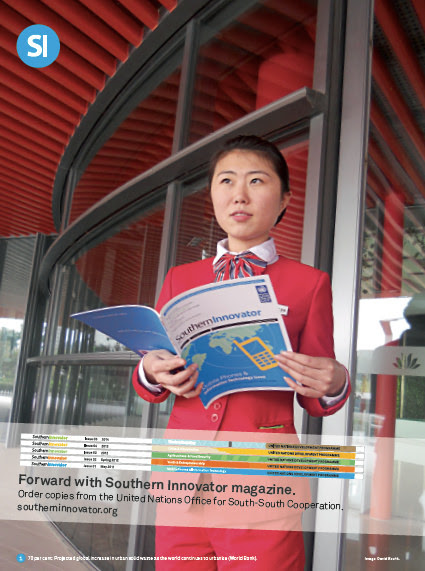
Development Challenges, South-South Solutions was launched as an e-newsletter in 2006 by UNDP’s South-South Cooperation Unit (now the United Nations Office for South-South Cooperation) based in New York, USA. It led on profiling the rise of the global South as an economic powerhouse and was one of the first regular publications to champion the global South’s innovators, entrepreneurs, and pioneers. It tracked the key trends that are now so profoundly reshaping how development is seen and done. This includes the rapid take-up of mobile phones and information technology in the global South (as profiled in the first issue of magazine Southern Innovator), the move to becoming a majority urban world, a growing global innovator culture, and the plethora of solutions being developed in the global South to tackle its problems and improve living conditions and boost human development. The success of the e-newsletter led to the launch of the magazine Southern Innovator.
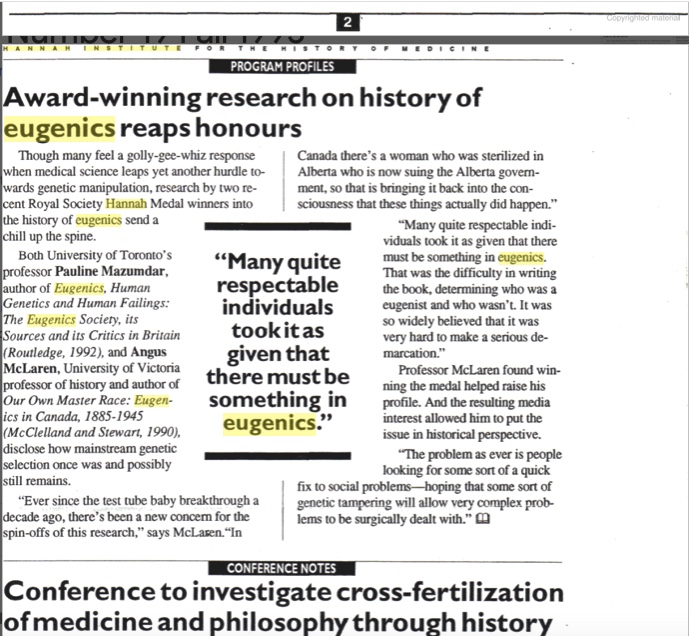
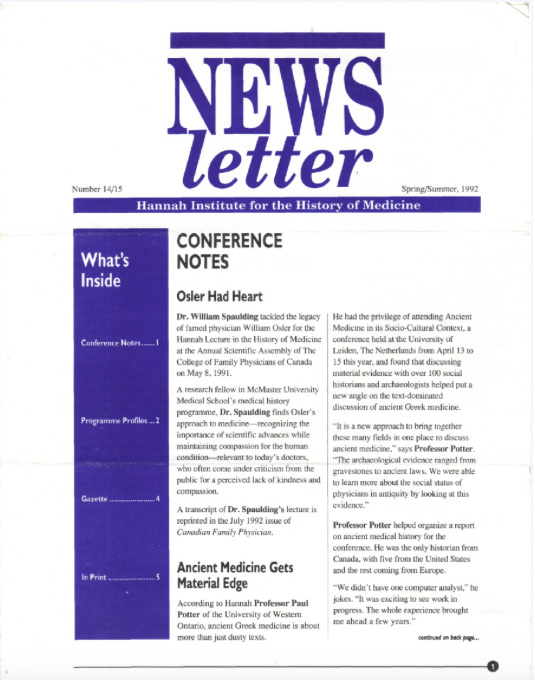
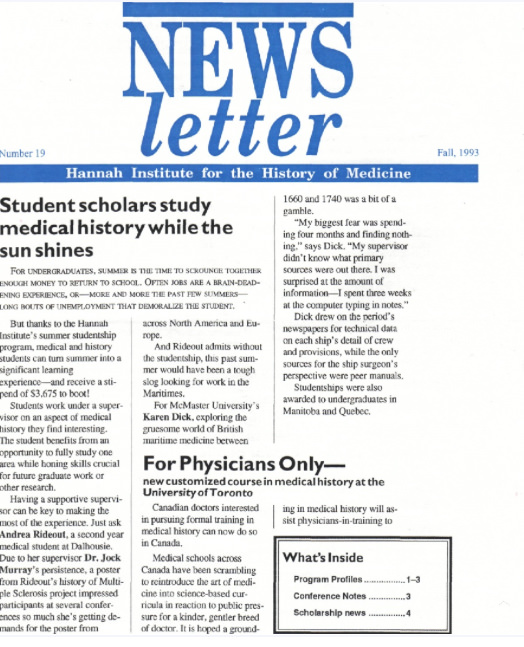
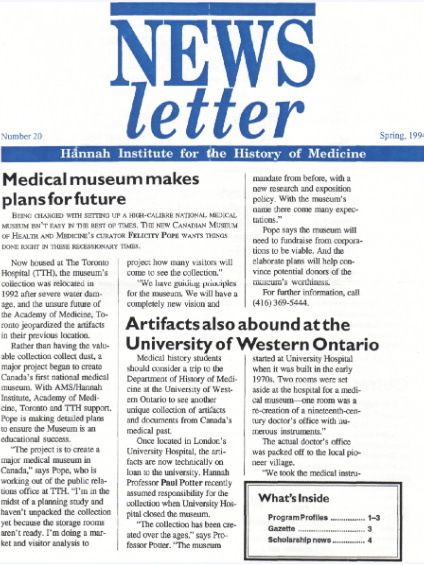
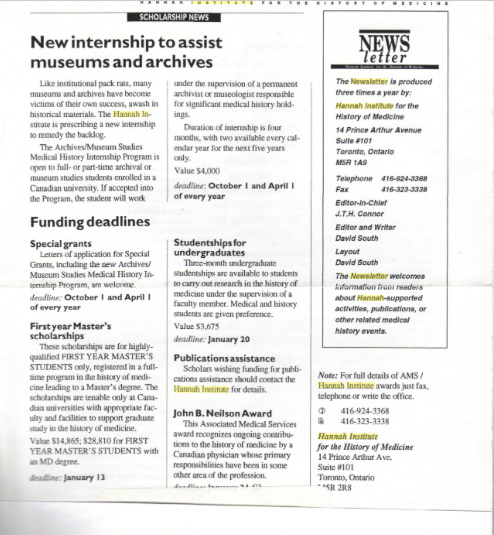
I worked as Editor and Writer for the newsletter of the Hannah Institute for the History of Medicine (under the direction of the Editor-in-Chief and Hannah Executive Director Dr. J.T. H. Connor) in the early 1990s. Located close to the University of Toronto and within a neighbourhood claiming a long association with medical and scientific discovery (Sir Frederick Banting, co-developer of insulin for the treatment of diabetes, lived at 46 Bedford Road,), the goal was to better connect Canada’s medical history community of scholars and raise the profile of the funding resources available to further the study of medical history in Canada.
The Toronto Legacy Project and Heritage Toronto plaque marking the location of Sir Frederick Banting’s former home.
I also revamped the application process for awards, scholarships and grants to make them user-friendly and compatible with word processing software packages of the time.
The Hannah Institute was the adminstrator for the grants and awards funded by AMS (Associated Medical Services). It has had a profound impact on the medical history field in Canada, as the AMS website states:
“As a result of the growth of the discipline and the burgeoning of scholarship, as well as financial support from other funding bodies, in 2006, the AMS Board of Directors decided not to provide new competitive grants and further, decided to bring AMS- administered competitive grants to closure by 2011.
In the 1970’s when the Hannah Chairs and the Hannah Institute were established, the discipline of the history of medicine was an “orphan’ within the Canadian scholarly community. Three decades later with the support of AMS, history of medicine and healthcare continued to thrive in universities and colleges across Canada.”
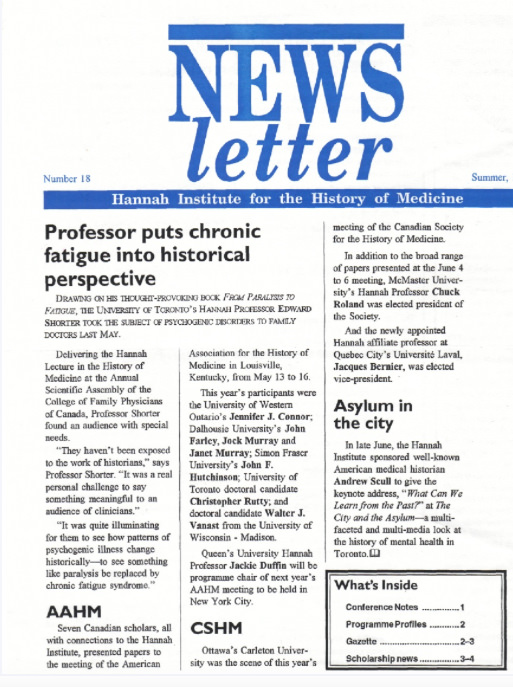
The archive of newsletters is held at the Wellcome Collection Library in London, UK and at the University of Toronto.“Professor puts chronic fatigue into historical perspective” announced the launch of a new book by the University of Toronto’s Hannah Professor Edward Shorter. Abstracts in Anthropology, Volume 43, Issues 3-4: “… in recent years it has become a pursuit for a growing number of researchers. … Behind much of this growth has been the Hannah Institute for the History of Medicine which has encouraged writing …”.













 David South Consulting
You must be logged in to post a comment.