Tag: institute

  • CASE STUDY 5: GOSH/ICH Child Health Portal | 2001 – 2003

    CASE STUDY 5: GOSH/ICH Child Health Portal | 2001 – 2003

    Expertise: Strategy, vision, team leadership, managing suppliers, design vision, digital strategy, content creation, editing, project management, innovation, child health, public health, modernising large institutions. 

    Location: London, UK 2001 to 2003

    Project Manager: David South

    Charity Content Coordinator: Ramita Navai

    Abstract 

    In 2001 I was hired to project manage and deliver a Child Health Web Portal for the prestigious Great Ormond Street Children’s Hospital NHS Trust (GOSH)/Institute of Child Health (ICH) based in London, UK.  

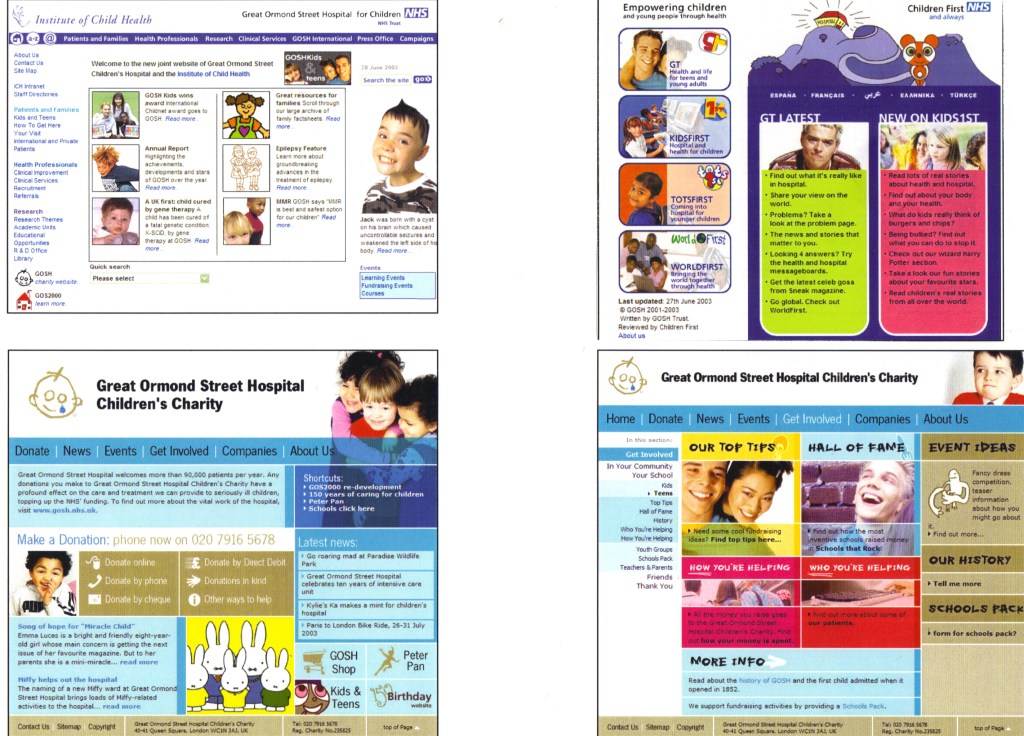
    The project was intended to lead on innovation at the institutions and in the wider National Health Service (NHS) and was delivered in three phases. Screen grabs can be viewed below:  

    Phase 1 

    Phase 2

    Phase 3

    About

    From the start, the project begged the question: Could we take a complex (and complicated) mandate and successfully achieve it in just two years? All under great public and media scrutiny (London being a world centre for media)? And how do you innovate for the 21st century in a major health care institution and build on its already high reputation?

    Britain’s best-loved children’s hospital and charity, Great Ormond Street Hospital for Children NHS Trust (GOSH), contracted me to lead a two-year project to modernise the hospital’s web presence and take its brand into the 21st century. GOSH is both Britain’s first children’s hospital and a pioneering child health institution (along with its partner the Institute for Child Health). The hospital’s outstanding reputation meant the project was carried out under intense public, media and professional scrutiny, and required a keen awareness of new media developments and the needs of the hospital’s patients, their families and the public. It drew on an extensive public consultation and the NHS Modernisation Plan and the Information for Health strategy – which had identified strong demand for services and information to be made available online – to develop this innovative online offering. The NHS had also set the goal of having 25 per cent of all its services accessible via the web. 

    From the start, the project represented a new phase in how the institutions communicated. An announcement in PR Week in April 2001 acknowledged this, declaring the role will deal “with what is increasingly becoming an important part of the press office and the hospital”. Prior to beginning the two-year project in 2001, the existing website was an amateurish affair and not suitable for an internationally renowned centre for paediatric treatment, training and research. 

    The UK had become out of step with wider web developments at that time and had to do a lot of catching up. But there was a ready audience for better web content already established in the country. By 2001, data showed 3 million children in the UK were using the Internet and 33 million UK citizens could access it through work, school or home. 

    By 2001, the Internet offered an estimated 100,000 health-related websites (most based in the United States, leaving a gap for high-quality information based on UK research and experience). Trust was key and this was a crucial part of the content strategy that was developed. 

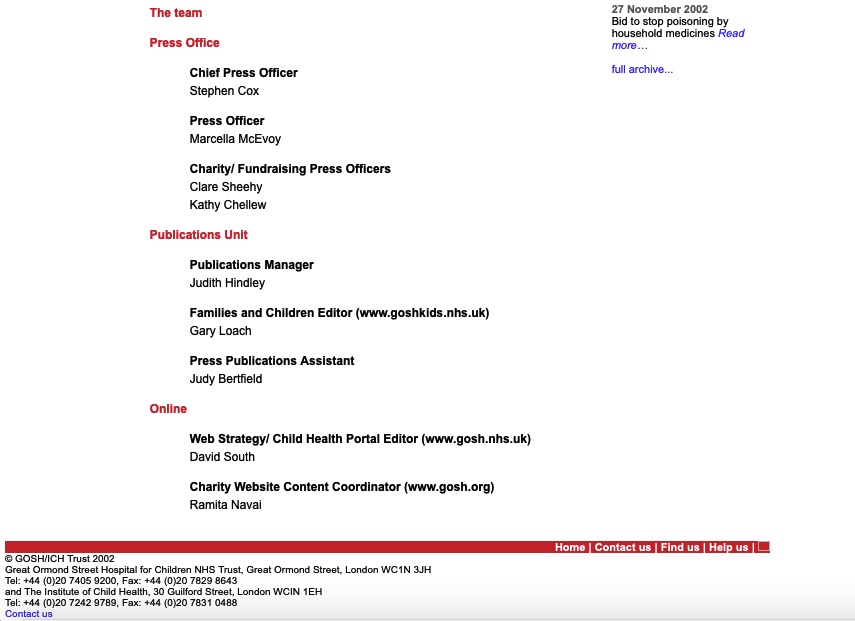
    As lead staff member for the website, I was in charge of recruiting and managing staff and suppliers, liaising with stakeholders inside and outside the organisations, planning work and seeking opportunities and partnerships.

    The project was developed in three, distinct phases. Screen grabs from these phases are available for download and evaluation. They also include web traffic statistics. This unique snapshot of a complex project as it unfolded, should prove useful for other e-health practitioners. 

    As an innovator, the project became a catalyst for numerous online and offline initiatives across the institutions. The website made enormous strides, winning a number of national and international awards and leapfrogging to become one of the best NHS-linked sites in the UK. Areas radically improved included the design and navigation, patient information for families, press office, and the development and launch of the award-winning children’s website. 

    Phase 1 

    Phase 2 

    Phase 3 

    Each stage was transparently communicated and accompanied by high-profile publicity campaigns: a necessity because the hospital relies heavily on public trust and funding to function. 

    The first phase involved getting buy-in on a new design vision, assembling a team, extensive work on migrating the very large legacy website into the new template, and exciting colleagues on the potential of the new child health portal vision. It was launched in September 2001.  

    Ask Dr Jane Collins, a regular column written by the Chief Executive Dr. Jane Collins for The Times newspaper, was one of the more popular features of the child health portal. The portal was also directly connected to the NHS Direct service with its extensive online health encyclopedia.  

    In 2001, the project launched an interactive Christmas child health advent calendar offering top tips from health professionals on how to have a safe holiday season. It showed what could be done with the improving web design and production skills of the team. The PDF can be viewed here: http://www.scribd.com/doc/44905926/Christmas-Advent-Calendar-for-GOSH-Child-Health-Portal-2001.

    As another example, the hospital’s 150th birthday celebration on 14th February 2002, attended by Her Majesty the Queen (and celebrities, including Madonna), was accompanied by an online interactive history prepared by the project and was used to inform the wider public about the child health portal.  

    Phase two involved the launching of new content developed by some of the world’s top child health experts and scientists, substantial new resources for sick children and their families, an online awareness-raising campaign to drive traffic to the health portal as a trusted and reliable resource, plus a wider media campaign. Based on user experience testing and user feedback, changes were made to the design and content structure to make the portal more user-friendly and to follow best practice in web design at that time.  

    The overall child health portal also gave birth to a highly successful new resource, the award-winning Children First website in May 2002. This resource was a year in development and was calibrated by age to provide relevant resources to guide children through the hospital experience. It used high-quality animation and partnered with BBCi and BBC Science to create resources that would resonate with children and youth. It included high-profile elements such as the Write4GOSH children’s writing prize, attracting entries from around the world, with winners receiving prizes from Cherie Booth QC, Dannii Minogue and children’s writer Jacqueline Wilson.  

    Children First attracted an average of 700,000 visitors each month with over 800 children in its first year contributing to the site. It addressed a gap in the online marketplace for health resources written for children rather than for their parents and families. It also gave birth to its own project: The Virtual Children’s Hospital (VCH). Funded by the PPP Foundation in August 2002, it worked with a team of psychologists to meet the social, psychological and information needs of ill children. 

    In March 2003 the Commission for Health Improvement (CHI) in its review and assessment found, in answer to the question “What, if anything, did CHI find that the rest of the NHS can learn from?” at the hospital, it was the child health portal, because “The trust’s website has different sections for children and families as well as for health professionals. The website also has sections for children of different ages and a broad range of information leaflets is available to download. The website has 3.5 million hits per month.”  

    In 2003, the UK’s Guardian newspaper called the Children First website one of the “three most admired websites in the UK public and voluntary sectors,” and a UK government assessment called the overall GOSH child health web portal a role model for the NHS. Children First also won the prestigious Cable and Wireless Childnet Award that year as well. And was short-listed for the New Stateman’s New Media Awards. 

    The GOSH Child Health Portal team receive the Childnet Award in 2003 at London’s Science Museum (Photo: CBBC Newsround).
    The Childnet Awards in 2003 were awarded by Trond Waage, the Norwegian Ombudsman for Children, at the Science Museum in London (and hosted by British media personality Carol Vorderman) (https://en.wikipedia.org/wiki/Carol_Vorderman).

    In 2006, The Times of London called Children First the Top Child Health Website in its Wellbeing on the Web: The Best Portals survey (November 11, 2006). 

    Phase three saw online traffic growing at a steady clip, the portal gaining accolades, awards and positive reviews; it also helped the hospital to gain the highest rating in a government review (5*), and Children First was awarded significant further funding so it could expand its resources. The award-winning team also re-developed thewww.gosh.org charity website (one of the highest profile charity brands in the UK) and launched it in 2003 as well.  

    A great way to track the historical development of a web project is to use the Wayback Machine’s Internet archivehere (https://archive.org). By typing in the web address (for example, http://www.gosh.nhs.uk, and http://www.gosh.org), you can see a chronological history of the website by month. 

    Timeline 

    PR Week: “PUBLIC SECTOR: Great Ormond Street to get website editor.”

    2001: Initial design vision articulated and team assembled. First phase of content creation and ‘soft launch’ of portal in September 2001. Begin experiments with new graphic design, including an online interactive Christmas advent calendar with health tips.  

    2002: Launch new content during the hospital’s 150th anniversary celebrations; begin development work on Children First content. Partnering with BBCi and BBC Science to improve quality of child and youth resources. Significant new content is launched throughout the year as the portal sees month-on-month growth in web traffic. Awarding of further funding for Children First and the Virtual Children’s Hospital. 

    2003: Winning of Childnet Award; launch of new GOSH Charity website. Record web traffic to the website.

    “Hospital unveils international website for children”: The Guardian, 8 October 2003.
    “The kids are alright”: The Guardian, 5 February 2003.
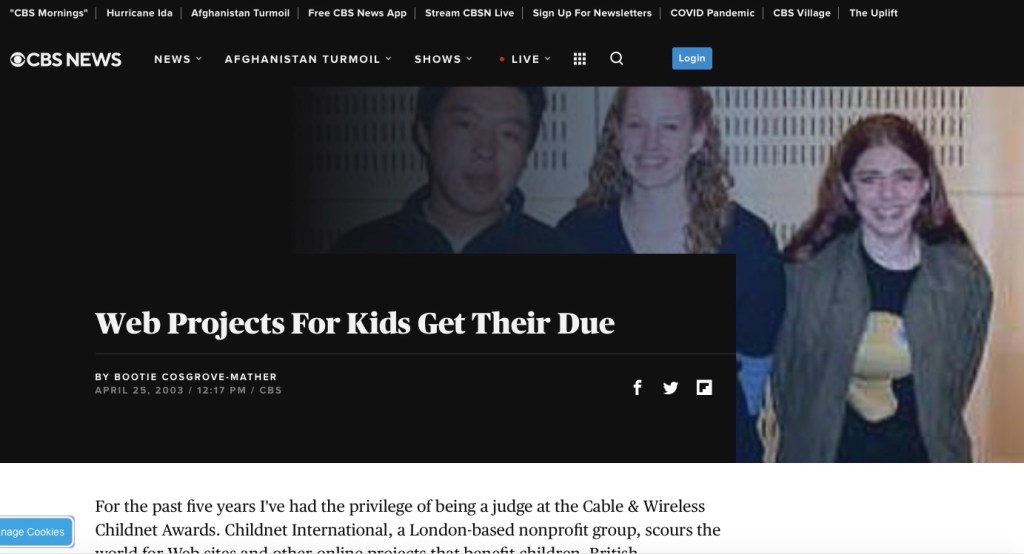
    “Web Projects For Kids Get Their Due”: CBS News, April 25, 2003.
    The GOSH Child Health Portal Team circa 2002.

    Testimonials

    “As a parent, I recognise how important it is to help your child understand all that they can about their stay in hospital and their care and treatment. Time spent in hospital can often be a very frightening experience. Making sure that your child has helpful, easy to read information will make a significant difference to their time in hospital. 

    I am sure that this website will prove very useful for children and their families.” Prime Minister Tony Blair, May 2002

    “A highly attractive website written by and with children at Britain’s biggest specialist hospital for children. The site is carefully segmented for different age groups and provides a powerful platform on which children can reach out from the confines of their hospital wards, share their experiences and learn about a range of medical issues as well as have access to fun interactive resources.” Childnet Award 2003

    “I am glad you mentioned the web site. If you can access it and haven’t recently please have a look. It has vastly improved and both David Latchman and I (it is a joint site with ICH) are very pleased.” Dr Jane Collins, Chief Exec’s Corner, Roundabout newsletter, February 2002

    “I never thought that GOSHKids would be so valuable to the hospital or, more importantly, to children and young people attending the hospital or simply interested in health matters. I think that this reflects my age, though!

    “Many of us over 30, even if we use the internet ourselves, are surprised how much children and young people use it both as a source of information and for entertainment. 

    “Even quite young children are using it routinely now and as an increasing number of families have access to it, either at home and/or at school or work, presumably more and more will do so. 

    “There are over 42,000 hits per day (1,260,000 a month) on our GOSHKids website already. Of course, part of the success of the website is down to its design and content. I would like to take this opportunity to congratulate Gary Loach, David South and the whole team who have worked so hard to make it successful.” Dr Jane Collins, Chief Exec’s Corner, Roundabout newsletter, June 2003 

    “The GOSH/ICH web site to date has been a notable success. Not only has it met a majority of its objectives as delineated in the PIN report of 2000 and achieved recognition as ‘exemplary’ among NHS resources, but it has also generated a number of spin-off projects, including Children First (as a successor to GOSHKids) and The Virtual Children’s Hospital.

    “It has moved from providing a poor representation of the organisations, to above average for corporate web resources, and compares highly favourably with those of other NHS sites and departments. The most notable success lies in the resource it now provided for the public, especially GOSHKids.

    “In a context in which less than 25% of all projects realise even 50% of their benefits, the satisfaction of 75% of the original objectives set out in the PIN report must rank as a significant achievement.” Website Project Audit by Passmasters Limited, 17 April 2003

    “Great Ormond Street Hospital has launched this health site targeted specifically at childen, with a separate version aimed at young teenagers. The site aims to give young ‘uns information about health, illness and treatment in an easily digestable, non-threatening manner.” Internet Magazine, July 2002

    “… it’s a good site and not just for those about to go into the hospital.” New Media Age, 20 June 2002

    “The project was instrumental in pulling together a number of key strategies (including the NHS’s Modernisation Plan, and its Information for Health Strategy), and acting as a catalyst for numerous online and offline initiatives. Critical to these strategies is the need to provide information and services online and in an accessible way. The aim has not only been about serving the specific needs of the institutions, but also to become a broader child health portal.  

    “The website in 2001 was an amateurish affair and a disgrace to an internationally renowned centre for paediatric treatment, training and research. Run largely from the Research Office it was focused on one particular audience, uninspiring in design, reactive in updating and made little use of the potential of the internet. We needed someone to take it forward …

    David [South] was lead staff member for the website, recruiting and managing staff and suppliers, liaising with stakeholders inside and outside the organisations, planning work and seeking opportunities and partnerships. It is fair to say that the site made enormous strides under his leadership, winning a number of national and international awards, and leapfrogging to become one of the best NHS-linked sites in the UK. 

     “A number of areas were drastically improved, including design and navigation, patient information for families, press material, and the award-winning children’s site, which is now an international project with many different partners. David [South] project managed many projects in this time including linked sites for London IDEAS Genetics Knowledge Park, and the hospital charity site …” Stephen Cox, Chief Press Officer, Great Ormond Street Hospital for Children NHS Trust and the Institute of Child Health

    Impact 

    Micro

    • took public consultation and consultant’s report and crafted and developed a strategy to implement the GOSH Child Health Web Portal
    • assembled team across two institutions
    • set clear milestones and brought project management methodology previously deployed with the United Nations
    • led on teaching new ways of project management for results
    • took GOSH brand forward for the digital age
    • advised colleagues on digital publishing and design
    • awarded additional funding

    Macro 

    • role model for NHS and government/charity sector. Awarded five stars in government review
    • Childnet Award
    • launched major milestones with well-known figures, including Her Majesty the Queen, Madonna, and pop stars
    • significant media coverage of project
    • attracted funding not only for the GOSH Child Health Portal but also for other projects at the institutions
    • grew web traffic month-on-month, becoming one of the top online child health resources
    • website cited in many other resources. One of the goals of the project was to increase access to high-quality child health resources and to have them cited in books etc.

    Citations

    The Great Ormond Street Hospital Manual of Children’s Nursing Practices by Susan Macqueen, Elizabeth Bruce and Faith Gibson, John Wiley & Sons, 2012

    Help! My Child’s in Hospital by Becky Wauchope, Marbec Family Trust, 2012

    Oxford Desk Reference: Nephrology by Jonathan Barratt, Peter Topham and Kevin P.G. Harris, Oxford University Press, 2008

    Research Review 2001: A Year of Excellence and Innovation, Institute of Child Health and Great Ormond Street Hospital for Children NHS Trust, 2001

    Research Review 2002: Building on Success, Institute of Child Health and Great Ormond Street Hospital for Children NHS Trust, 2002

    Other Resources

    GOSH Child Health Portal Phase 1a

    GOSH Child Health Portal Phase 1b

    GOSH Child Health Portal Phase 2a

    GOSH Child Health Portal Phase 2b

    GOSH Child Health Portal Phase 3 

    GOSH Project Launch Brochure and Screen Grabs, 2001-2003

    GOSH Child Health Portal 2001 to 2003 Resources

    Further Reading:

    Embedding Young People’s Participation in Health Services: New Approaches edited by Louca-Mai Brady, Policy Press, 7 October 2020

    “There is increasing interest in young people’s participation in the design and delivery of health services. But young people’s views are not consistently sought or acknowledged, and they are still often marginalised in healthcare encounters. Drawing on original research and a diverse range of practice examples, Brady explores the potential for inclusive and diverse approaches to young people’s participation in health services from the perspectives of young people, health professionals and other practitioners. She presents a practical new framework, embedded in children’s rights, that shows how young people’s participation can be integrated into services in ways that are meaningful, effective and sustainable.”

    DSC web address in green_mini (1)

    ORCID iD: https://orcid.org/0000-0001-5311-1052.

    © David South Consulting 2025
  • Southern Innovator in Southasiadisasters.net

    Southern Innovator in Southasiadisasters.net

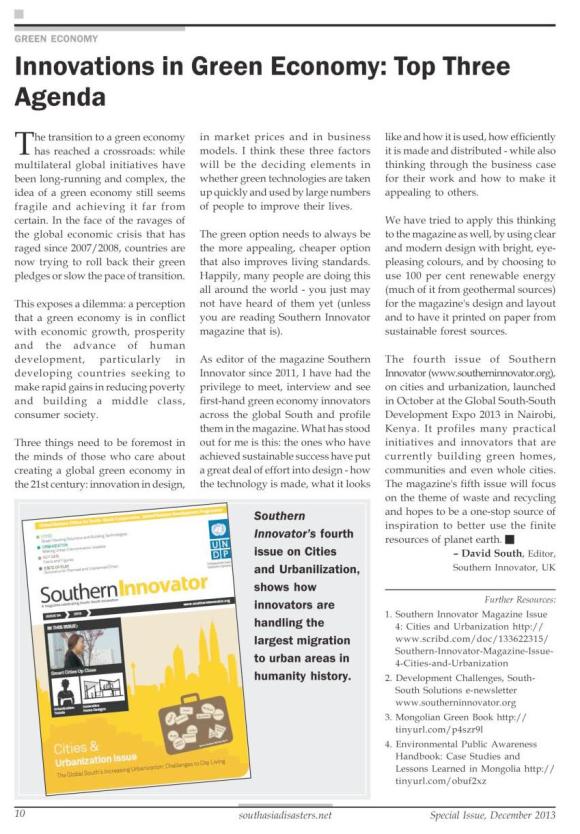
    Innovations in Green Economy: Top Three Agenda

    c22e6-innovations20in20green20economy20top20three20agenda20december202013

    By David South

    southasiadiasters.net December 2013

    The transition to a green economy has reached a crossroads: while multilateral global initiatives have been long-running and complex, the idea of a green economy still seems fragile and achieving it far from certain. In the face of the ravages of the global economic crisis that has raged since 2007/2008, countries are now trying to roll back their green pledges or slow the pace of transition. 

    This exposes a dilemma: a perception that a green economy is in conflict with economic growth, prosperity and the advance of human development, particularly in developing countries seeking to make rapid gains in reducing poverty and building a middle class, consumer society. 

    Three things need to be foremost in the minds of those who care about creating a global green economy in the 21st century: innovation in design, in market prices and in business models. I think these three factors will be the deciding elements in whether green technologies are taken up quickly and used by large numbers of people to improve their lives. 

    The green option needs to always be the more appealing, cheaper option that also improves living standards. Happily, many people are doing this all around the world – you just may not have heard of them yet (unless you are reading Southern Innovator magazine that is). 

    As editor of the magazine Southern Innovator since 2011, I have had the privilege to meet, interview and see first-hand green economy innovators across the global South and profile them in the magazine. What has stood out for me is this: the ones who have achieved sustainable success have put a great deal of effort into design – how the technology is made, what it looks like and how it is used, how efficiently it is made and distributed – while also thinking through the business case for their work and how to make it appealing to others. 

    We have tried to apply this thinking to the magazine as well, by using clear and modern design with bright, eye-pleasing colours, and by choosing to use 100 per cent renewable energy (much of it from geothermal sources) for the magazine’s design and layout and to have it printed on paper from sustainable forest sources. 

    The fourth issue of Southern Innovator (www.southerninnovator.org), on cities and urbanization, launched in October at the Global South-South Development Expo 2013 in Nairobi, Kenya. It profiles many practical initiatives and innovators that are currently building green homes, communities and even whole cities. The magazine’s fifth issue will focus on the theme of waste and recycling and hopes to be a one-stop source of inspiration to better use the finite resources of planet earth.

    David South, Editor, Southern Innovator
    United Nations Office for South-South Cooperation (UNOSSC)

    https://www.preventionweb.net/publication/climate-smart-disaster-risk-management-action

    South-South Cooperation for Cities in Asia

    South-South Cooperation for Cities July 2014

    Published: July 2014

    Publisher: Southasiadisasters.net

    Issue No. 114, July 2014

    Theme: Towards Urban Resilience

    The coming wave of technological innovations aimed at global South cities will dominate civic debates whether people wish it to or not. Already, futuristic, 21st-century cities are being built around Asia from scratch. I had the privilege of visiting a couple of them in 2012 while researching the fourth issue of our magazine, Southern Innovator (  h t t p : / / w w w . s c r i b d . c o m / SouthernInnovator). Each city had a different focus for its construction – one was seeking to be an “eco-city” and the other one called itself a “smart city,” focused on becoming a regional business and technology hub. Both aimed to use the latest information technologies to make the way Asian cities operate on a day-to-day basis smarter – and greener.

    Large information technology companies – including India’s Infosys (infosys.com) – have their sights set on selling all sorts of technological solutions to common problems of urban living. This aspiring revolution is built on two foundations: One is the Internet of Things – in which everyday objects are connected to the
    Internet via microchips. The other is Big Data, the vast quantities of data being generated by all the mobile phones and other electronic devices people use these days.

    Much of this new technology will be manufactured in Asia, and not just that – it will also be developed and designed in Asia, often to meet the challenges of urban Asia.

    By their nature, cities are fluid places. People come and go for work and pleasure, and successful cities are magnets for people of all backgrounds seeking new opportunities. This fluidity puts stress on cities and leads to the constant complaints familiar to any urban dweller – inadequate transport, traffic jams, air pollution, poor housing, and a high cost of living.

    If handled well and with imagination, new information technologies can ensure Asian cities do more than pay lip service to aspirations to improve human development. They can make cities resilient places – able to bounce back from disasters, whether man made or natural.

    During the late 1990s, I saw first-hand the pressures placed on one Asian city, Mongolia’s capital, Ulaanbaatar. The country endured the worst peacetime economic collapse since World War II while confronting the wrenching social and economic stresses of switching from a command economy during Communism to a free-market democracy. The city’s population grew quickly as rural economies collapsed and poverty shot upwards. I can only imagine now how the response could have been different with the technologies available today.

    In 2010, I interviewed one of the editors of the Cities for All book, Charlotte Mathivet (http://globalurbanist.com/2010/08/24/cities-for-all-shows-how-the-worldspoor-are-building-ties-across-theglobal-
    south), and she stressed the importance of South-South cooperation to ensuring cities are good places to live for everyone.

    “A lot of social initiatives based on the right to the city are coming from these ‘new cities of the South,’” Mathivet said. “The book highlights original social initiatives: protests and organizing of the urban poor, such as the pavement dwellers’ movements in Mumbai where people with nothing, living on the pavements of a very big city, organise themselves to struggle for their collective rights, just as the park dwellers did in Osaka.”

    Recently, an Indian restaurant uploaded to the Internet a video of what it claimed to be the first drone delivering a pizza in an Indian city. While this may or may not be a practical solution to traffic congestion, the subsequent negative fallout – angry police and public officials – from this use of new technology highlights the promise
    and perils of innovating in the real world of Asian cities (http:/
    /www.bbc.co.uk/news/
    b l o g s – n e w s – f r o m –
    elsewhere-27537120).

    Micro electronics are becoming cheaper and more powerful by the month. Small businesses armed with a only laptop computer, access to the Internet and/or mobile phone networks, and cloud computing services, can offer very powerful business and public services solutions. And sharing solutions across the global South via information technologies has never been easier.

    The U.S. Pentagon published various reports and studies in the 2000s forecasting a dark future for cities in the global South. As author Mike Davis revealed in his seminal work, Planet of Slums (http://www.amazon.com/exec/obido/ASIN/1844670228/nationbooks08), the Pentagon saw the developing world’s cities as the “battlespace of the twenty-first century.” It imagined sprawling, crime ridden cities full of poverty and slums and needing tiny drones and robots darting back and forth, keeping an eye on everything and suppressing unrest. This threat-based view of future cities is one to be avoided. It is possible, through the right application of quick solutions to the challenges that arise as cities grow, to turn to cooperation across the cities of the global South to avoid this pessimistic fate.


    David South, Editor,
    United Nations Office for
    South-South Cooperation

    (UNOSSC), UK

    https://reliefweb.int/report/india/southasiadisastersnet-issue-no114-july-2014-towards-urban-resilience

    Lima To Delhi: What Can Be Learned On Urban Resilience?

    Published: March 2015

    Publisher: Southasiadisasters.net

    Issue No. 128, March 2015

    Theme: Challenges of Urban Resilience in India

    Fast-growing cities and urban areas in the global South can be vulnerable because they lack the web of structures and institutions that enable more long-established cities to mitigate risks and, when a disaster does strike, to bounce back quickly. But thanks to many new technologies, and some smart new thinking, it is possible to bring resilience to even the poorest and most deprived urban communities.

    The essence of resilience is to build into plans and daily activities a
    community’s ability to weather any disaster, small or large. All cities, rich or poor, can experience a disaster of some sort, be it weather, civil unrest, war, earthquakes, shortages, or economic, financial and health crises. New technologies make it possible for all cities, no matter how poor and overcrowded, to build in urban resilience. The ubiquity of mobile phones introduces a powerful city and urban planning tool. Mapping chaotic and unplanned areas is already underway in many cities of the global South (in Brazil and Kenya for example (http://tinyurl.com/qgba8kb).

    Impressively, innovators in the South are using affordable microelectronics in the form of mobile phones and laptops to gather data and map it. This computing capability was once the sole domain of big information technology companies such as IBM. Now, a single laptop computer combined with a smartphone equipped with the right software can manage a large urban area, a task that once required rooms full of computers. The data can then be used to manage growth today and re-build after a disaster. Any excuse not to be resilient has been wiped out with this technological leap.

    But how to deal with the common reality of feeling overwhelmed by the many obstacles to rational planning and building for urban growth in the South? Innovators have stepped in to take matters into their own hands with simple construction technologies as the solution. One example is the Moladi system of recycled plastic moulds (moladi.net). Anybody can master this simple building technique, as the mortar-filled moulds are designed to fit easily together to construct an earthquake-resistant, beautiful home.

    This approach has the advantage of bypassing the failings of authorities to enforce building codes and standards in poor, urban communities, creating safer places to live and preventing the growth of unregulated shanty towns at risk to fire and earthquakes.

    Others have found social ways to organize people, even in the most desperate of conditions, providing services and laying down the groundwork for an upgrading of an urban area to improve living conditions and long-term opportunities. The concept of ‘cities for all’ has inspired many to re-energize civic organizations and networking in poor areas to ensure they are not left out of economic growth. In Colombia, a famous example of this is the escalator in the city of Medellin, which connects a hillside slum to the centre of the city, opening up economic opportunities to all (http://tinyurl.com/nm47d3u).

    Still more exciting, new technologies are in the works to simplify construction of major infrastructure and new buildings. A future city will be able to gather extensive data on an expanding urban area, make detailed development plans with architects and engineers, and then have robots and 3D fabricating machines quickly lay down infrastructure and erect buildings. Sounds far-fetched?
    Well, in China one company recently used a 3D machine to make 10 houses in a single day (http://www.yhbm.com/index.aspx).

    An infographic from Southern Innovator’s fourth issue (http://
    tinyurl.com/m9vfwur) shows 10 ways any urban area – either planned or unplanned – can build in resilience. All are proven approaches from cities in the global South.

    Southern Innovator’s upcoming sixth issue will explore the interplay
    of science, technology and innovation in the global South and how people are making the most of 21st century advances to increase wealth and improve human development. Hopefully, all of this innovation will lead to more resilient cities in the future!


    David South,
    Editor, Southern Innovator, UNOSSC

    https://www.preventionweb.net/publication/challenges-urban-resilience-india

    This work is licensed under a Creative Commons Attribution 4.0 International License.

    ORCID iD: https://orcid.org/0000-0001-5311-1052.

    © David South Consulting 2021

  • Rebuilding After Chinese Earthquake: Beautiful Bamboo Homes

    Rebuilding After Chinese Earthquake: Beautiful Bamboo Homes

    By David SouthDevelopment Challenges, South-South Solutions

    SOUTH-SOUTH CASE STUDY

    It has been a year since the May 12, 2008 Sichuan earthquake in China that killed more than 70,000 people.

    China’s strongest earthquake for more than half a century, with a magnitude of 8.0 (en.wikipedia.org), it devastated large parts of the province of Sichuan. More than 10 million people were made homeless, most of them poor and elderly villagers (cities were not badly damaged).

    Getting Sichuan back to normal is critical for not only the province’s people, but for all of China. Sichuan is China’s rice bowl, growing more food than any other province. But despite the abundance of food, Sichuan remains poor and has seen its working age population move away for work. If it is to have a viable future then its communities need to get back to normal as fast as possible – and its farming economy back to full production.

    The unprecedented media coverage of the disaster meant people across China saw the scenes of devastation and have since contributed large donations to help with the reconstruction. The Chinese government has pledged to spend US $151 billion on reconstruction projects.

    Finding ways to re-house people after large disasters has become an urgent issue over the last five years. From the Asian tsunami to Hurricane Katrina in the United States and multiple hurricane disasters in the Caribbean, restoring communities is critical for the health of the people and the economies they rely on. Experience has shown that temporary shelters have many drawbacks, being usually of poor quality for long-term habitation and a source of health problems.

    The temporary shelters erected for the Sichuan homeless are unsuitable for long-term housing: the 12 square metre grey boxes – two sheets of aluminium sandwiching a polystyrene core for insulation – have no heating. The occupants roast inside in the summer and freeze in the winter. They are also located away from the main source of income: the farms.

    The dilemma is how to build new, long-term houses that will not cost too much. Inflation has increased the costs of conventional building materials: bricks, cement and steel.

    But the use of traditional building materials and home designs offers an alternative. By drawing on the abundant bamboo and wood in Sichuan and by building to traditional designs, cheaper but sturdy and beautiful homes can be built.

    An average home now costs around 80,000 yuan (US $11,688). The Chinese government estimates the price is now 820 yuan per square meter for a new home: bamboo homes cost between 300 and 400 yuan per square meter. Government compensation is between 16,000 yuan (US $2,337) and 23,000 yuan (US $3,360) per family. The bamboo houses range in size from 75 to 200 square metres, and in cost from 22,500 yuan to 80,000 yuan for a very large home.

    In Daping village, Pengzhou Town, original homes destroyed by the earthquake sit at the edge of a forested hill. Their frames are more or less intact, but the walls and roofs have collapsed. The new houses replacing them are large, two stories high and have solid grey clay tile roofs. The beauty of the designs stands out and sits in stark contrast to the temporary shelters and concrete buildings.

    “There are 43 houses and two public buildings being rebuilt in this project,” says team member Hu Rong Rong of the Green Building Research Centre of Xi’an University of Architecture and Technology. “The design and the main building material are based on the ecological and sustainable habitat idea. The place (Sichuan) is rich in bamboo and wood. These natural materials are cheap and friendly to the environment. In some buildings we use light steel which can be also recycled.”

    The new homes are built to earthquake resistance standards. Led by Professor LiuJiaping, a team of 15 people from the research centre and two from a design institute developed the home designs and supervised the training of local people. They were joined by 10 people from an NGO called Global Village of Beijing, who managed the project to completion.

    “All the designs were discussed with the local people,” continues Hu. “We trained a local construction team, which means the local people would build their own houses by themselves. Both our research center and the local people were involved in developing the home design.

    “To get the trust from the local people is a challenge in the project. We resolved it by showing our respect to the local people. Before we started our design we discussed with the local people many times to know what kind of house they like. We built the first house to make them believe us.”

    Hu believes it is possible to replicate the homes across Sichuan.

    “The design is suitable for other villages in Sichuan which have a similar climate and culture with this village. To rebuild sustainable houses after a disaster we should know well about the local life, environment and culture – try to find the useful technique which was used in their traditional houses and upgrade the traditional house to meet the need of their modern life.”

    Others have not been as lucky as these villagers. In the village of Yuan Bao, Chen Jingzhong, 66, has had to build a makeshift shack: “They wanted to get us to build our own houses but they didn’t give us enough money,” Chen told the Telegraph Magazine. “All we could afford was this shack, which we built ourselves, with our own hands and without any help from anyone.”

    Published: May 2009

    Resources

    Architecture for Humanity: By tapping a network of more than 40,000 professionals willing to lend time and expertise to help those who would not otherwise be able to afford their services, they bring design, construction and development services where they are most critically needed. Website: www.architectureforhumanity.org

    Chinese Red Cross: The Red Cross Society of China is accepting donations for disaster reconstruction and is coordinating rebuilding efforts in Sichuan Website: http://www.redcross.org.cn/ywzd/

    Gerd Niemoeller has developed flat pack, cardboard homes that can be deployed quickly after a disaster and can become permanent homes.Website: http://tinyurl.com/6t6jtf and the company
    Website: http://www.wall.de/en/home

    Global Greenhouse Warming is a website that tracks extreme weather events around the world: drought, flooding, severe storms, severe winter, tropical cyclone, wildfires, and extreme heat waves.Website: www.global-greenhouse-warming.com

    The Building and Social Housing Foundation: An independent research organization promoting sustainable development and innovation in housing through collaborative research and knowledge transfer. Website: www.bshf.org

    https://davidsouthconsulting.org/2021/09/01/disaster-recovery-ten-years-after-the-gujarat-india-experience/

    https://davidsouthconsulting.org/2021/11/12/energy-efficient-wooden-houses-are-also-earthquake-safe/

    https://davidsouthconsulting.org/2021/09/01/haiti-earthquake-prompts-tech-aid/

    https://davidsouthconsulting.org/2021/02/12/rammed-earth-houses-china-shows-how-to-improve-and-respect-traditional-homes/

    https://davidsouthconsulting.org/2022/09/26/3d-home-printing-landmark-10-houses-in-a-day/

    Development Challenges, South-South Solutions was launched as an e-newsletter in 2006 by UNDP’s South-South Cooperation Unit (now the United Nations Office for South-South Cooperation) based in New York, USA. It led on profiling the rise of the global South as an economic powerhouse and was one of the first regular publications to champion the global South’s innovators, entrepreneurs, and pioneers. It tracked the key trends that are now so profoundly reshaping how development is seen and done. This includes the rapid take-up of mobile phones and information technology in the global South (as profiled in the first issue of magazine Southern Innovator), the move to becoming a majority urban world, a growing global innovator culture, and the plethora of solutions being developed in the global South to tackle its problems and improve living conditions and boost human development. The success of the e-newsletter led to the launch of the magazine Southern Innovator.

    https://davidsouthconsulting.org/2021/03/05/southern-innovator-issue-4/

    Creative Commons License

    This work is licensed under a
    Creative Commons Attribution-Noncommercial-No Derivative Works 3.0 License.

    ORCID iD: https://orcid.org/0000-0001-5311-1052.

    © David South Consulting 2023

  • Cuba’s Hurricane Recovery Solution

    Cuba’s Hurricane Recovery Solution

    By David SouthDevelopment Challenges, South-South Solutions

    (Havana, Cuba), November 2008

    SOUTH-SOUTH CASE STUDY

    The frequency of extreme weather in the past decade has been attributed to global warming (http://tinyurl.com/5peel). Many scientists believe the future will bring even more turbulent weather events and disasters. The devastation and hardship brought by natural disasters can eradicate development gains, and destroy livelihoods and health. It is critical countries help people to get back to their normal lives as fast as possible.

    The Intergovernmental Panel on Climate Change (http://www.ipcc.ch) says extreme weather events will become more frequent, more widespread and/or more intense during the 21st century. Extreme weather is already costly for countries in the global South. The United Nations Environment Program (UNEP) found that the cost of droughts, storm surges, hurricanes and floods reached a record US$210 billion in 2005.

    The Caribbean island of Cuba (http://en.wikipedia.org/wiki/Cuba) was particularly affected in 2008 by extreme weather, as the island was battered by two devastating hurricanes – Ike and Gustav – and a lesser one, Paloma.  It was the only time that three major hurricanes have hit Cuba in the same season, with just a 10 day gap between Gustav and Ike. The hurricanes were described as the “worst ever” storms by Cuban officials

    The cost to Cuba has been high: Damages from Ike and Gustav are estimated at more than US$5 billion (http://tinyurl.com/ba7xny).

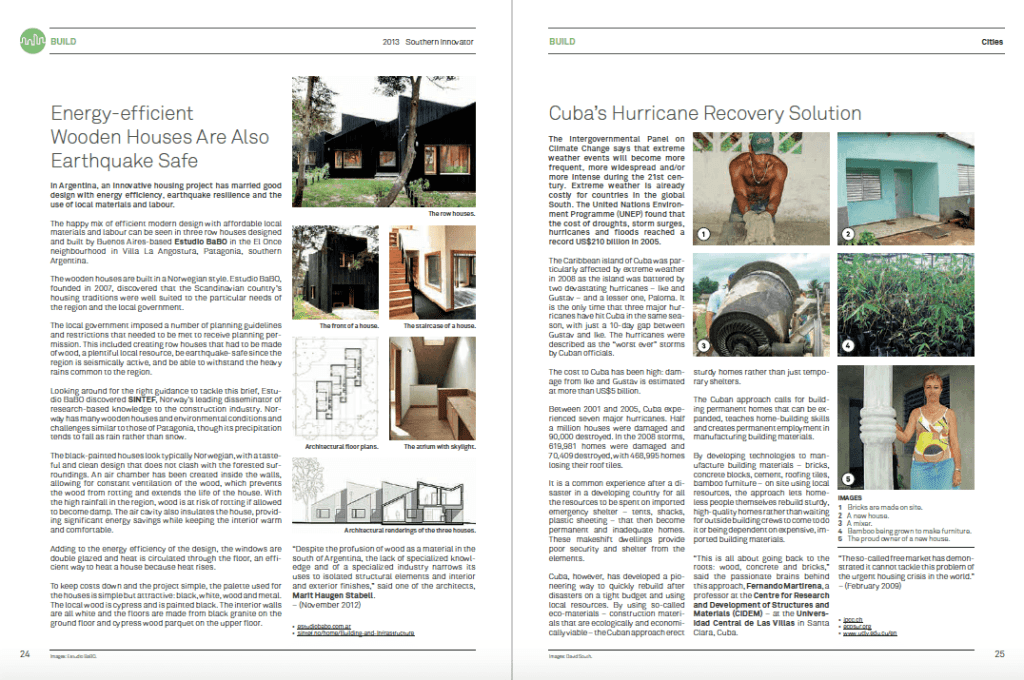
    Between 2001 and 2005, Cuba experienced seven major hurricanes. Half a million houses were damaged, and 90,000 destroyed. In the 2008 storms, 619,981 homes were damaged and 70,409 destroyed, with 468,995 homes losing their roof tiles.

    But Cuba has developed a pioneering way to quickly rebuild after disasters on a tight budget and using local resources. By using so-called ecomaterials – construction materials that are ecologically and economically viable – the Cuban approach erects sturdy homes, rather than just temporary shelters.

    It is a common experience after a disaster in a developing country for all the resources to be spent on imported emergency shelter – tents, shacks, plastic sheeting – that then become permanent and inadequate homes. These makeshift dwellings provide poor security and shelter from the elements. For Cuba, the enormous scale of the repair and reconstruction job is especially difficult because of the fuel shortages and building supply restrictions brought on by the United States’ embargo on the country (http://tinyurl.com/4alwrb). In turn, Cubans are adaptable and creative with their solutions.

    The Cuban approach builds permanent homes that can be expanded, teaches homebuilding skills and creates permanent employment in manufacturing building materials.

    By developing technologies to manufacture building materials – bricks, concrete blocks, cement, roofing tiles, bamboo furniture – on site using local resources, the approach lets homeless people themselves rebuild sturdy, high-quality homes, rather than waiting for outside building crews to come and do it, or being dependent on expensive, imported building materials. By doing this, jobs are created and wealth and gets the community back on its feet after the disaster.

    “This is all about going back to the roots: wood, concrete and bricks,” said the passionate brains behind this approach, Fernando Martirena, a professor at CIDEM  — the Centre for Research and Development of Structures and Materials — at the Universidad Central de Las Villas, in Santa Clara , Cuba (www.ecosur.org).

    “The so-called free market has demonstrated it can not tackle this problem of the urgent housing crisis in the world.”

    At the heart of the Cuban approach are easy-to-use machines that produce the building materials. They range from hand-cranked presses that make mud and clay bricks, to vibrating presses for concrete brick making.

    Training the homeless population to do the building themselves allows reconstruction work to begin straight away, rather than waiting for professional building crews to arrive on the scene. It is also psychologically more empowering for the people to be active participants in the rebuilding of their lives. The pride the people have in their new homes is visible.

    And quality has been critical for the programme so it can become sustainable and long-lasting:

    “The driving force for this project is need,” Martirena said. “If we want to obtain sustainability, we must go beyond need. After disaster, need is the driving force. But after two years, when most things have been completed, it must be a business. Good, beautiful, cheap. Normally, this technology is cheaper than industrial technology.”

    To stay prepared for future natural disasters that destroy or damage homes, the Cubans have established strategic reserves of micro-concrete roofing tiles. The lightweight but strong tiles can be used to quickly erect a small module home, and then the home can be expanded and built on as resources and time allow.

    Martirena, a former UNHABITAT award-winner, believes this approach to building materials brings prosperity back to rural areas and helps stem the flood of people to cities and urban sprawl seen across the global South.

    “You have to go back to the origin of the problem: people are looking for money and better jobs. It is not because they like the cities; they hate the cities!”

    “Bamboo harvesting (for furniture making) can bring people three times more income than they would make in the cities. They are really making money.”

    For Cuba, this has been a journey from a highly centralised and fuel-dependent approach to house building, to a decentralised, low-fuel approach. From 1959, the year of the revolution, until 1988, Cuba built housing using a centralised factory method to make building materials. Prefabricated houses were erected across the country. The materials were delivered by road and rail, all fuelled by cheap oil from the former Soviet Union.

    After the collapse of the Soviet Union in the early 1990s, oil became scarce and the transport network the building industry depended on fell apart. This time was called the “special period.”

    Apart from natural disasters, Cuba’s housing stock has suffered under the US embargo. The country’s housing began to decay as repairs were not happening and new houses were not being built. When people did want to do the repairs themselves, the lack of building supplies made it difficult for them to do so. Cuba realized it had to do things differently: the solutions had to be local, energy-efficient, and easy to use.

    CIDEM oversees workshops, training and building teams across the country. It tests new materials and designs in its labs before they are deployed as building solutions. The ecomaterials are chosen for low energy use and the ability to recycle waste. Being inexpensive, they offer a sustainable solution for the poor.

    In the community of Jatibonico, single mothers make up 40 percent of those who have benefited from the building projects. One woman proudly showed off the home she had built in the Spanish style, complete with Greco-roman columns on the porch. It has a clean, modern bathroom with shower and toilet.

    Martirena is currently working on a book of case studies about CIDEM’s projects helping Cubans cope with reduced oil dependency.

    CIDEM collaborates with universities around the world and has 19 workshops employing over 200 people in Cuba, and 15 in other countries in Latin America and Africa. It works with the Ecosur initiative and all the machines and advice on how to use them is available from the Ecosur website (www.ecosur.org).

    Published: November 2008

    Resources

    • “How Cuba Survived Peak Oil” is an award-winning film on how Cuba transitioned from a highly mechanized, industrial agricultural system to one using organic methods of farming and local, urban gardens. It is an unusual look into the Cuban culture during this economic crisis, which they call “The Special Period.” Website:http://www.powerofcommunity.org/cm/index.php
    • Global Greenhouse Warming is a website that tracks extreme weather events around the world: drought, flooding, severe storms, severe winter, tropical cyclone, wildfires, and extreme heat waves.Website:http://www.global-greenhouse-warming.com/extreme-weather.html
    • Cuba Hurricanes: Real-time reports of current hurricane threats to Cuba provided by an office in Old Havana. Also information on hurricanes of historical significance to Cuba. Website: http://www.cubahurricanes.org/
    • Gerd Niemoeller has developed flat pack, cardboard homes that can be deployed quickly after a disaster and can become permanent homes. Website: http://tinyurl.com/6t6jtf and the company website: http://www.wall.de/en/home
    • CIDEM and Ecosur specialise in building low-cost community housing using eco-materials. They have projects around the world and are based in Cuba. Website: http://www.ecosur.org

    https://davidsouthconsulting.org/2021/10/03/a-new-house-kit-for-slum-dwellers-that-is-safe-and-easy-to-build/

    https://davidsouthconsulting.org/2022/05/23/debt-free-homes-for-the-poor/

    https://davidsouthconsulting.org/2021/11/11/decent-and-affordable-housing-for-the-poor/

    https://davidsouthconsulting.org/2022/11/16/housing-innovation-in-souths-urban-areas/

    https://davidsouthconsulting.org/2021/11/11/housing-solution-for-worlds-growing-urban-population/

    https://davidsouthconsulting.org/2021/02/12/rammed-earth-houses-china-shows-how-to-improve-and-respect-traditional-homes/

    https://davidsouthconsulting.org/2021/02/12/rebuilding-after-chinese-earthquake-beautiful-bamboo-homes/

    https://davidsouthconsulting.org/2022/05/23/solar-bottle-bulbs-light-up-dark-homes/

    https://davidsouthconsulting.org/2022/09/26/3d-home-printing-landmark-10-houses-in-a-day/

    https://davidsouthconsulting.org/2022/11/17/tiny-homes-to-meet-global-housing-crisis/

    https://davidsouthconsulting.org/2021/03/05/southern-innovator-issue-4/

    Sponsored by BSHF. BSHF is now called World Habitat and it aims to seek out and share the best solutions to housing problems from around the world.

    Creative Commons License

    This work is licensed under a
    Creative Commons Attribution-Noncommercial-No Derivative Works 3.0 License.

    ORCID iD: https://orcid.org/0000-0001-5311-1052.

    © David South Consulting 2023