Tag: institute

  • Southern Innovator In Dhaka, Bangladesh: Public Service Innovation Workshop | December 2017

    Southern Innovator In Dhaka, Bangladesh: Public Service Innovation Workshop | December 2017

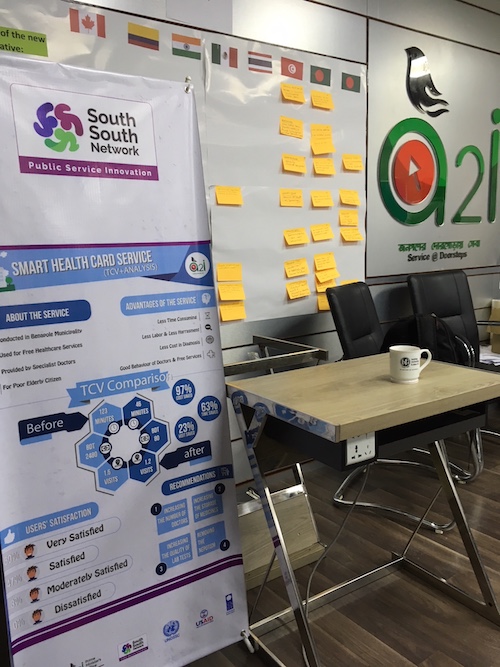
    Southern Innovator issues 1 and 5 at the Bangladesh workshop on public service innovation, 9-11 December 2017, and the launch of the South-South Network.

    The following blog report does not reflect the views of the UNOSSC or UNDP. 

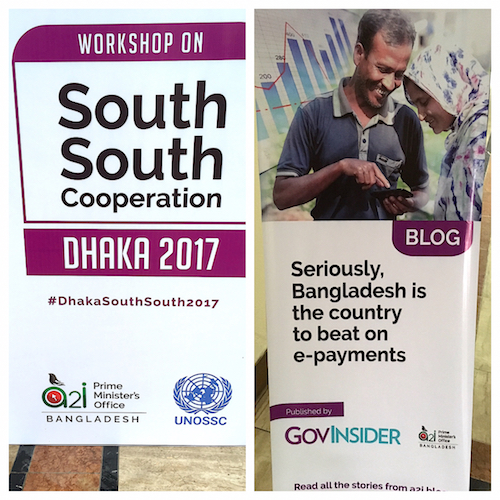
    Dateline: Dhaka, Bangladesh (9-11 December 2017) – From 9-11 December 2017, I participated in the Workshop on Innovations in Service Delivery: The Scope for South-South and Triangular Cooperation held in Dhaka, Bangladesh. Hosted by the a2i (access to information) division of the Bangladesh Prime Minister’s Office, the implementing unit for Digital Bangladesh, it was convened by the Government of Bangladesh and the United Nations Office for South-South Cooperation (UNOSSC).

    I was asked to do a presentation for the health component of the Workshop on my past experience in public sector digital innovation. This work stretches back to the beginning of the roll out of the Internet in the late 1990s. I chose three projects I have led that had a large and significant impact in the digital public space: the UN Mongolia development web portal I launched and ran for two years (1997-1999), the GOSH Child Health Web Portal I launched and ran for two years (2001-2003) and the Southern Innovator brand I launched for the UNOSSC (2010-2015). 

    I also joined a panel discussion as Senior Partner representing the David South Consulting/David South International consultancy at the end of the last day (we have worked with the UNOSSC since 2007 and with UNDP since 1997 – a timeframe which saw the rise of the Internet and the mobile and information technology revolution take the global South by storm). 

    As the Workshop invitation letter says, “The digitization of service delivery, user-centric methodologies, and experimentation geared towards improvement in service delivery, and the data revolution may have originated in developed countries but is now of increasing relevance for the developing world. To respond to rapidly rising expectations of the citizens, governments in both developing and developed countries are embracing approaches and tools to adopt more citizen-centric approaches in their service delivery. These practices are establishing a culture of citizen-centric innovation within governments, breaking silos of operations and helping move towards a whole-of-government planning and execution.”

    According to the a2i, Bangladesh has the “world’s largest government web portal” comprising over 25,000 government websites for 43,000 government offices (Bangladesh’s population was over 162 million as of 2016 – World Bank). Bangladesh has one of the highest population densities in the world and is considered the 8th most populace country in the world (Wikipedia). In total, these government websites receive 60 million plus hits a month, according to the a2i, from an online population of 79.7 million people, nearly half the population.

    A lot is at stake: According to the World Bank (which has been supporting the country since 1972), “Bangladesh has made substantial progress in reducing poverty, supported by sustained economic growth. Based on the international poverty line of $1.90 per person per day, Bangladesh reduced poverty from 44.2 percent in 1991 to 18.5 percent in 2010, and is projected to decrease to 12.9 percent in 2016.

    The country achieved the MDG 1 on halving poverty five years ahead of time, with 20.5 million people rising out of poverty during the 1991-2010 period. In parallel, life expectancy, literacy rates and per capita food production have increased significantly.  Progress was underpinned by strong economic growth, with 6 percent plus growth over the decade and reaching to 7.1 percent growth in 2015/2016. Rapid growth enabled Bangladesh to reach the lower middle-income country status in 2014.      

    However, sustained growth has rapidly increased the demand for energy, transport and urbanization. Insufficient planning and investment have resulted in increasingly severe infrastructure bottlenecks.”

    Arriving in the capital, Dhaka, on the 9th of December, it was clear to see what the World Bank is highlighting: the “severe infrastructure bottlenecks”. Just like other megacities, Dhaka is clogged with traffic and suffers from the air pollution this causes (one of the worst cities for this in Asia). But these are just the visible signs of success if you think about it (as frustrating as that might be), as booming economies combined with rapid urbanisation, if not planned well, tend to lead to traffic congestion and high levels of air pollution. 

    The country’s rising living standards since 2000 and impressive gains in the provision of information and mobile technology services and connectivity, reveal a country brimming with potential and capable of getting a handle on its many development challenges. The streets are visibly lined with small and medium enterprises and there are construction projects in various states of completion all around Dhaka. At the airport, glossy posters advertise many real estate developer’s dreams and show-off the heavy construction equipment for sale or lease from China and Russia. 

    The population no longer suffers from food crises such as the 1974 famine, which killed 1.5 million people (Christian Science Monitor). According to the UN, Bangladesh cut chronic hunger by half since 2000 and is considered one of the success stories from the past 10 years that the rest of the developing world can look to as they push to eliminate hunger by 2030 as part of the SDGs (Sustainable Development Goals) (https://www.csmonitor.com/USA/Foreign-Policy/2015/0617/From-famine-to-food-basket-how-Bangladesh-became-a-model-for-reducing-hunger). Clearly, Bangladesh is a country that can get things done when it draws on the power of its population. 

    According to Digital Bangladesh, with a deadline of 2021, it has achieved half its goals to get the population online and its economy and government services online. In 2017, the country made US $800 million from exporting ICT (information and communication technologies) products and services. It is currently building 12 hi-tech parks with the ambitious goal to export US $10 billion in ICT services from them by 2030 and make US $5 billion by 2021. 

    The streets of Dhaka.

    Workshop

    Sharing ideas at the Workshop.

    Speaking at the Workshop, Anir Chowdhury, Policy Advisor to the Access to Information (a2i) Programme of the Prime Minister’s Office, believes the concept of South-South Cooperation (SSC) is about enlightened self-interest but at present there is no framework for SSC in Bangladesh and most cooperation is ad hoc. If global South countries are not cooperating, then they are just re-inventing the wheel, he added. SSC is about avoiding feeling each country has to make it own their own: SSC can facilitate development leapfrogging and prevent leaving country success to chance. However, there needs to be better ways to communicate Southern solutions.

    And Bangladesh has a good story to tell to the global South: To date, Bangladesh’s digital public service delivery has saved the country US $2 billion in cost for government services plus 1 billion man days in time spent trying to carry out tasks using government services, according to the a2i. With this success under their belts, the hope is to market Bangladesh as a world leader in innovation. To go from MDGs poster child to leader of the global South. 

    UNOSSC Director and Envoy of the UN Secretary-General on SSC,  Jorge Chediek (https://www.unsouthsouth.org/about/unossc-director/), emphasised the need to tell stories of how South-South is changing the world; the pressing need to change the narrative around the global South in order to be able to achieve the 2030 agenda.

    It was an honour to be invited to present my three case studies on public sector digital innovation (GOSH Child Health Portal, Southern Innovator Magazine and the UN/UNDP Mongolia Development Portal). All three share the same characteristics: a public demand for digital resources and a need to create high-quality content on limited budgets and to build public confidence in those resources. These projects were also engaging with enormous complexity and needed to find a way to simplify this for online readers.

    I was impressed by the level of debate at the Workshop, and how Bangladesh’s digital initiatives are communicated (the excellent use of infographics and simple step-by-step explanations), and the overall excitement and energy around digital and the digital economy in Bangladesh. But, importantly, the foresight to give attention to the coming wave of automation and robotics (the so-called fourth industrial revolution) and how this will affect Bangladesh. 

    In the health workshop, we shared two projects for the reverse engineering component: the GOSH Child Health Portal and the magazine Southern Innovator (link to PowerPoint). Using the Reverse Engineering tool (see images below), each project was broken down as to how it worked and also what was its contribution to South-South Cooperation. 

    I shared experience from the early days of digital public innovation in the late 1990s. This has included applying digital to crisis recovery, healthcare modernisation in the early 2000s, and the campaign to achieve the MDGs (Millennium Development Goals), as well as during the mobile/information technology and social media revolution in the global South, which took off after 2007. 

    Reverse Engineering

    GOSH Child Health Portal (2001-2003)

    Issues discussed here included the recent online fake news scandals and how important it is for the public sector to offer the antidote to this with quality, factual digital information and resources. The GOSH Child Health Portal was one good example, where it entered the crowded online medical and health information marketplace and succeeded in drawing a large online audience by offering high-quality, peer-reviewed resources, thoroughly fact-checked and proofread and presented using high-quality online design. By the end of the project’s two-year timeframe, it was receiving over 7 million hits a month and was acknowledged as a trusted global source in child health. The content is cited in many books and papers, as well. 
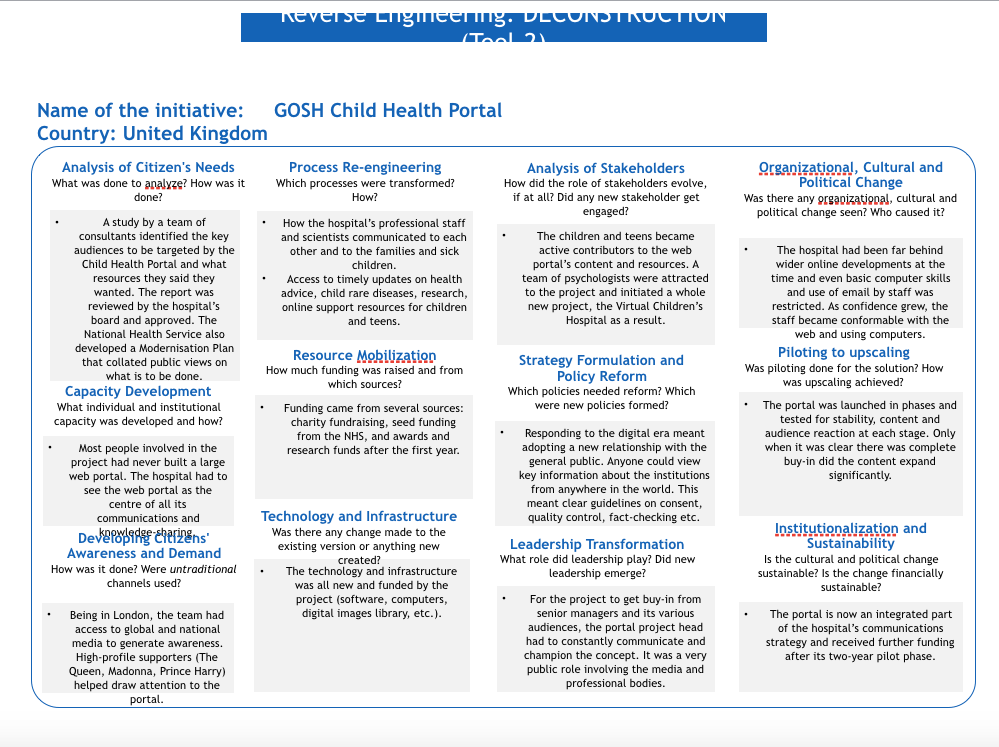
    Reverse engineering GOSH Child Health Web Portal, 2001-2003.

    Southern Innovator Magazine (2010-2015)

    Throughout the Workshop, I heard over and over again about the urgent need for a more cohesive platform for sharing Southern innovations and initiatives. Many complained this was currently very fragmented. While there are many media and development organisations documenting innovations and stories, there is no one-stop shop for countries to go to. 

    The Southern Innovator brand (incubated and developed by the UNOSSC) is a good example of what can be achieved with a more cohesive and strategic approach. Southern Innovator, first launched in 2011 by the UNOSSC, was able to leverage its limited resources to reach a large global audience via the web and social media. The brand became established with innovators and five issues were published (from 2011 to 2015). An Action Plan for scaling-up the Southern Innovator brand was also developed with the UNOSSC in 2015 (but awaits funding). 

    The original Southern Innovator website (southerninnovator.org, now southerninnovator.com) did fulfil the role of offering a one-stop shop for stories on global South innovation and these stories were widely cited in websites, papers and books on the global South. But the terrain has shifted radically in the global South – and at the UN – since Southern Innovator’s launch in 2011. With the widespread adoption of mobile and digital technologies, the opportunities to communicate innovator solutions have never been better but require a more sophisticated approach to be effective. In fact, we now exist in a world where the solutions already exist to the major problems affecting the global South (and even the funding is available through many sources). The problem is not the lack of solutions, innovators or technologies and business models to resolve problems (both e-newsletter Development Challenges, South-South Solutions and Southern Innovator proved this) but how people can access these resources and in a format that makes sense to them and is available when they are searching for a solution. With modern computing technologies, this is no longer an unsolvable problem. And the people to connect with to do this also already exist in the global South. What is missing is a coherent and cohesive approach. The multiplicity of development actors in this case are hampering effective action by dissecting and scattering resources, leaving end-users confused and poorly communicated with in many cases. As an example, there was a definite need to assist people in understanding how the 17 SDGs can fit into practical actions and a definite psychological need for simplicity: a problem highlighted by former UNDP head Helen Clark back in 2015 (https://www.theguardian.com/global-development/2015/jul/07/sustainable-development-goals-will-be-hard-sell-for-united-nations).

    For UNDP, with its human development approach and presence in most countries, an opportunity exists to rapidly accelerate development gains and shorten the time it takes to recover when disaster or conflict strikes. Something that came out of the Workshop is the presence of excellent examples of global knowledge sharing already underway for decades around the world. Think of the scientific community in general (working on vast projects such as the CERN facility in Switzerland), or aerospace industries, or the global adoption of the principles of air safety managed by IATA in Montreal, Canada, or sport – all proof countries do successfully share knowledge and adopt common, high standards when they feel it is a priority and necessity. No country wants to be frozen out of flight routes, for example. 
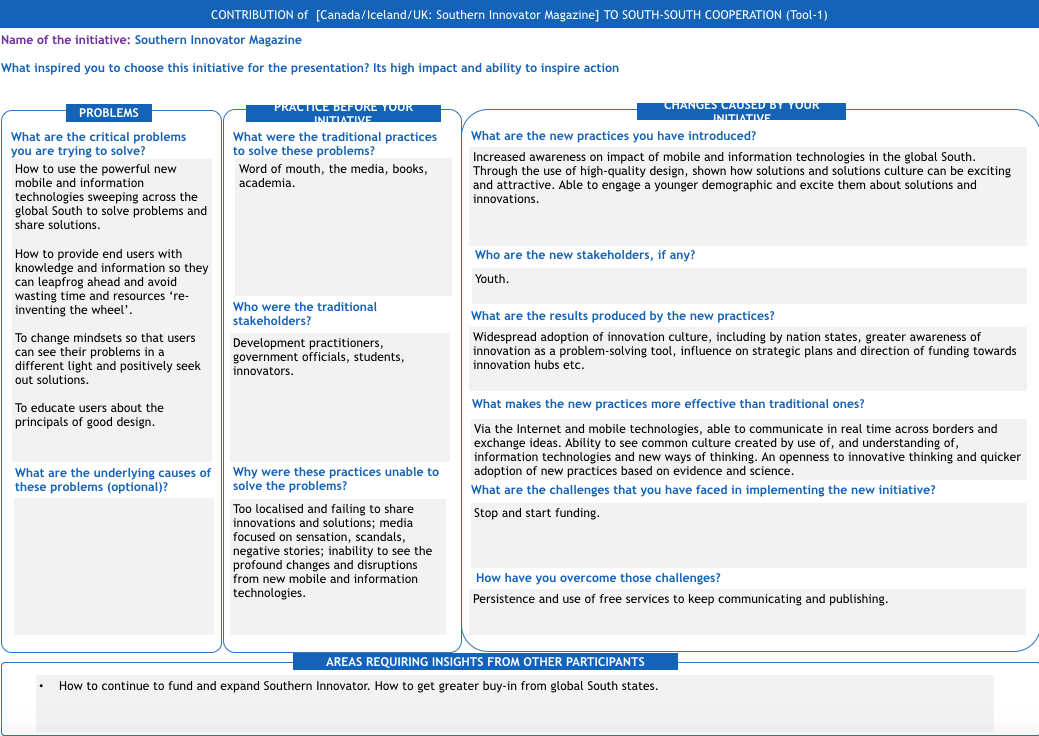
    Reverse engineering the Southern Innovator magazine brand, 2010-2015. 

    Panel Discussion

    At the closing panel discussion, I was asked how to engage more donors to be part of the South-South Network. I said there is a need to get people excited and show why the South-South Network is different; how it is related to the Sustainable Development Goals (SDGs). There needs to be a communications strategy and to establish some ambitious first goals that are original: to show that this is part of a clear trend. International aid and development is a crowded space so there is a need to show how the Network would tackle the challenges of the global South in the 21st century head-on, with a more effective solution. And of course, I championed the existing and successful Southern Innovator brand developed by the UNOSSC since 2010 as, potentially, part of this communications strategy. 

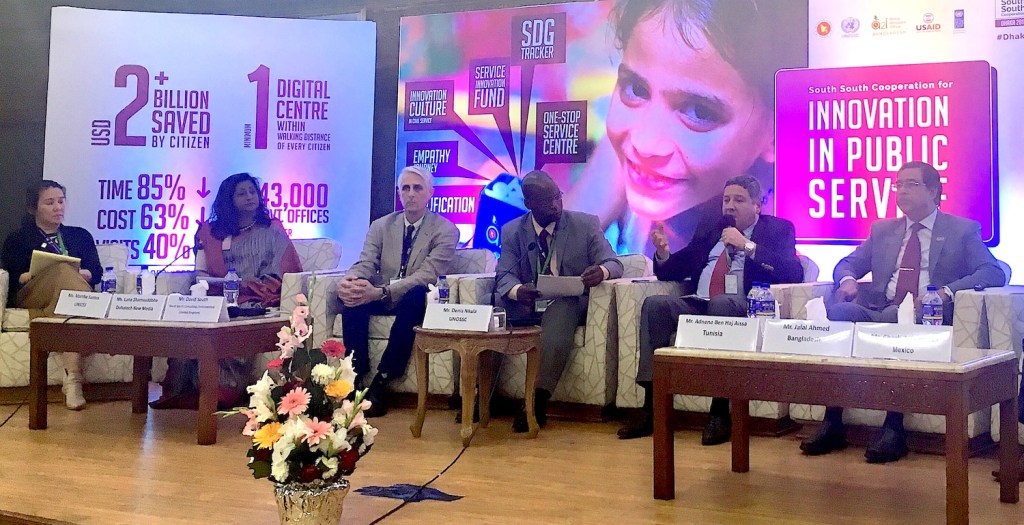
    Senior Partner David South is third from the left on the panel. Photo: Yoko Shimura.
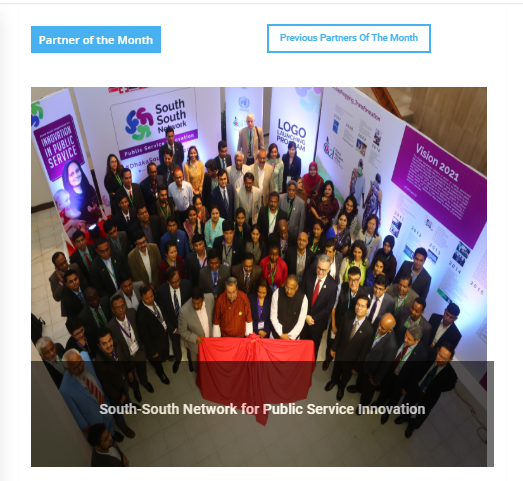
    Senior Partner David South is centre at back with the South-South Network for Public Service Innovation, Dhaka, Bangladesh, 2017.

    Finally

    This impressive embracing of e-initiatives and all things digital was visibly missing at the airport. On the way in, long lines and then a confusing scramble to buy a visa created confusion for visitors. As the first impression for visitors, this could be a great place to show-off Bangladesh’s digital capabilities. 

    And finally, as the World Bank says, this all about job creation and increased living standards: “The World Bank has identified job creation as the country’s top development priority. Bangladesh needs to create more and better jobs for the 2.1 million youths entering the job market every year. But to do so, Bangladesh will need to remove the barriers to higher growth posed by low access to reliable and affordable power, poor transportation infrastructure, limited availability of serviced land, rapid urbanization and vulnerability to climate change and natural disasters, among others.”
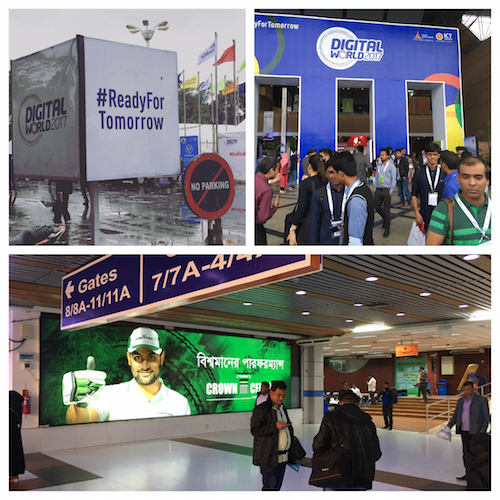
    Bangabandhu International Conference Center hosting Digital World 2017 and Dhaka’s Shahjalal International Airport.

    Further reading and links: 

    South-South in Action: Citizen-friendly Public Service Innovation in Bangladesh

    Digital Bangladesh: Digital Service for All

    GOSH Child Health Web Portal

    UN/UNDP Mongolia Development Portal 

    Southern Innovator and Development Challenges, South-South Solutions

    ORCID iD: https://orcid.org/0000-0001-5311-1052.

    © David South Consulting 2017 
  • South–South Cooperation For Cities In Asia

    South–South Cooperation For Cities In Asia

    Published: July 2014

    Publisher: Southasiadisasters.net

    Issue No. 114, July 2014

    Theme: Towards Urban Resilience

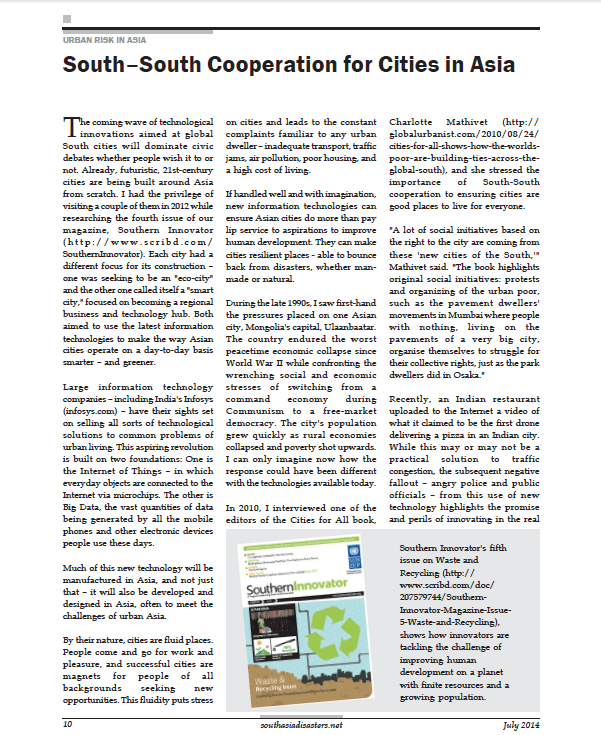
    The coming wave of technological innovations aimed at global South cities will dominate civic debates whether people wish it to or not. Already, futuristic, 21st-century cities are being built around Asia from scratch. I had the privilege of visiting a couple of them in 2012 while researching the fourth issue of our magazine, Southern Innovator (  h t t p : / / w w w . s c r i b d . c o m / SouthernInnovator). Each city had a different focus for its construction – one was seeking to be an “eco-city” and the other one called itself a “smart city,” focused on becoming a regional business and technology hub. Both aimed to use the latest information technologies to make the way Asian cities operate on a day-to-day basis smarter – and greener.

    Large information technology companies – including India’s Infosys (infosys.com) – have their sights set on selling all sorts of technological solutions to common problems of urban living. This aspiring revolution is built on two foundations: One is the Internet of Things – in which everyday objects are connected to the
    Internet via microchips. The other is Big Data, the vast quantities of data being generated by all the mobile phones and other electronic devices people use these days.

    Much of this new technology will be manufactured in Asia, and not just that – it will also be developed and designed in Asia, often to meet the challenges of urban Asia.

    By their nature, cities are fluid places. People come and go for work and pleasure, and successful cities are magnets for people of all backgrounds seeking new opportunities. This fluidity puts stress on cities and leads to the constant complaints familiar to any urban dweller – inadequate transport, traffic jams, air pollution, poor housing, and a high cost of living.

    If handled well and with imagination, new information technologies can ensure Asian cities do more than pay lip service to aspirations to improve human development. They can make cities resilient places – able to bounce back from disasters, whether man made or natural.

    During the late 1990s, I saw first-hand the pressures placed on one Asian city, Mongolia’s capital, Ulaanbaatar. The country endured the worst peacetime economic collapse since World War II while confronting the wrenching social and economic stresses of switching from a command economy during Communism to a free-market democracy. The city’s population grew quickly as rural economies collapsed and poverty shot upwards. I can only imagine now how the response could have been different with the technologies available today.

    In 2010, I interviewed one of the editors of the Cities for All book, Charlotte Mathivet (http://globalurbanist.com/2010/08/24/cities-for-all-shows-how-the-worldspoor-are-building-ties-across-theglobal-
    south), and she stressed the importance of South-South cooperation to ensuring cities are good places to live for everyone.

    “A lot of social initiatives based on the right to the city are coming from these ‘new cities of the South,’” Mathivet said. “The book highlights original social initiatives: protests and organizing of the urban poor, such as the pavement dwellers’ movements in Mumbai where people with nothing, living on the pavements of a very big city, organise themselves to struggle for their collective rights, just as the park dwellers did in Osaka.”

    Recently, an Indian restaurant uploaded to the Internet a video of what it claimed to be the first drone delivering a pizza in an Indian city. While this may or may not be a practical solution to traffic congestion, the subsequent negative fallout – angry police and public officials – from this use of new technology highlights the promise
    and perils of innovating in the real world of Asian cities (http:/
    /www.bbc.co.uk/news/
    b l o g s – n e w s – f r o m –
    elsewhere-27537120).

    Micro electronics are becoming cheaper and more powerful by the month. Small businesses armed with a only laptop computer, access to the Internet and/or mobile phone networks, and cloud computing services, can offer very powerful business and public services solutions. And sharing solutions across the global South via information technologies has never been easier.

    The U.S. Pentagon published various reports and studies in the 2000s forecasting a dark future for cities in the global South. As author Mike Davis revealed in his seminal work, Planet of Slums (http://www.amazon.com/exec/obido/ASIN/1844670228/nationbooks08), the Pentagon saw the developing world’s cities as the “battlespace of the twenty-first century.” It imagined sprawling, crime ridden cities full of poverty and slums and needing tiny drones and robots darting back and forth, keeping an eye on everything and suppressing unrest. This threat-based view of future cities is one to be avoided. It is possible, through the right application of quick solutions to the challenges that arise as cities grow, to turn to cooperation across the cities of the global South to avoid this pessimistic fate.


    David South, Editor,
    United Nations Office for
    South-South Cooperation
    (UNOSSC), UK

    https://reliefweb.int/report/india/southasiadisastersnet-issue-no114-july-2014-towards-urban-resilience

    Southern Innovator’s fifth issue on Waste and Recycling (https://books.google.co.uk/books?id=6ILdAgAAQBAJ&dq=southern+innovator&source=gbs_navlinks_s), shows how innovators are tackling the challenge of improving human development on a planet with finite resources and a growing population.

    https://davidsouthconsulting.org/2021/10/21/cities-for-all-shows-how-the-worlds-poor-are-building-ties-across-the-global-south/

    https://davidsouthconsulting.org/2020/12/14/innovation-in-growing-cities-to-prevent-social-exclusion/

    https://davidsouthconsulting.org/2021/10/22/innovations-in-green-economy-top-three-agenda/

    https://davidsouthconsulting.org/2021/10/22/lima-to-delhi-what-can-be-learned-on-urban-resilience/

    https://davidsouthconsulting.org/2021/02/23/southern-innovator-in-southasiadisasters-net/

    https://davidsouthconsulting.org/2021/03/05/southern-innovator-issue-4/

    https://davidsouthconsulting.org/2021/03/05/southern-innovator-issue-5/

    https://davidsouthconsulting.org/2021/03/12/southern-innovator-magazine/

    Creative Commons License

    This work is licensed under a
    Creative Commons Attribution-Noncommercial-No Derivative Works 3.0 License.

    ORCID iD: https://orcid.org/0000-0001-5311-1052.

    © David South Consulting 2023

  • Lima To Delhi: What Can Be Learned On Urban Resilience?

    Lima To Delhi: What Can Be Learned On Urban Resilience?

    Published: March 2015

    Publisher: Southasiadisasters.net

    Issue No. 128, March 2015

    Theme: Challenges of Urban Resilience in India

    Fast-growing cities and urban areas in the global South can be vulnerable because they lack the web of structures and institutions that enable more long-established cities to mitigate risks and, when a disaster does strike, to bounce back quickly.
    But thanks to many new technologies, and some smart new thinking, it is possible to bring resilience to even the poorest and most deprived urban communities.

    The essence of resilience is to build into plans and daily activities a
    community’s ability to weather any disaster, small or large. All cities, rich or poor, can experience a disaster of some sort, be it weather, civil unrest, war, earthquakes, shortages, or economic, financial and health crises. New technologies make it possible for all cities, no matter how poor and overcrowded, to build in urban resilience. The ubiquity of mobile phones introduces a powerful city and urban planning tool. Mapping chaotic and unplanned areas is already underway in many cities of the global South (in Brazil and Kenya for example (http://tinyurl.com/qgba8kb).

    Impressively, innovators in the South are using affordable microelectronics in the form of mobile phones and laptops to gather data and map it. This computing capability was once the sole domain of big information technology companies such as IBM. Now, a single laptop computer combined with a smartphone equipped with the right software can manage a large urban area, a task that once required rooms full of computers. The data can then be used to manage growth today and re-build after a disaster. Any excuse not to be resilient has been wiped out with this technological leap.

    But how to deal with the common reality of feeling overwhelmed by the many obstacles to rational planning and building for urban growth in the South? Innovators have stepped in to take matters into their own hands with simple construction technologies as the solution. One example is the Moladi system of recycled plastic moulds (moladi.net). Anybody can master this simple building technique, as the mortar-filled moulds are designed to fit easily together to construct an earthquake-resistant, beautiful home.

    This approach has the advantage of bypassing the failings of authorities to enforce building codes and standards in poor, urban communities, creating safer places to live and preventing the growth of unregulated shanty towns at risk to fire and earthquakes.

    Others have found social ways to organize people, even in the most desperate of conditions, providing services and laying down the groundwork for an upgrading of an urban area to improve living conditions and long-term opportunities. The
    concept of ‘cities for all’ has inspired many to re-energize civic organizations and networking in poor areas to ensure they are not left out of economic growth. In Colombia, a famous example of this is the escalator in the city of Medellin, which connects a hillside slum to the centre of the city, opening up economic opportunities to all (http://tinyurl.com/nm47d3u).

    Still more exciting, new technologies are in the works to simplify construction of major infrastructure and new buildings. A future city will be able to gather extensive data on an expanding urban area, make detailed development plans with architects and engineers, and then have robots and 3D fabricating machines quickly lay down infrastructure and erect buildings. Sounds far-fetched?
    Well, in China one company recently used a 3D machine to make 10 houses
    in a single day (http://www.yhbm.com/index.aspx).

    An infographic from Southern Innovator’s fourth issue (http://
    tinyurl.com/m9vfwur) shows 10 ways any urban area – either planned or unplanned – can build in resilience. All are proven approaches from cities
    in the global South.

    Southern Innovator’s upcoming sixth issue will explore the interplay
    of science, technology and innovation in the global South and how people are making the most of 21st century advances to increase wealth and improve human
    development. Hopefully, all of this innovation will lead to more resilient cities in the future!


    David South,
    Editor, Southern Innovator, UNOSSC

    www.davidsouthconsulting.com

    https://www.preventionweb.net/publication/challenges-urban-resilience-india

    https://www.preventionweb.net/publication/challenges-urban-resilience-india

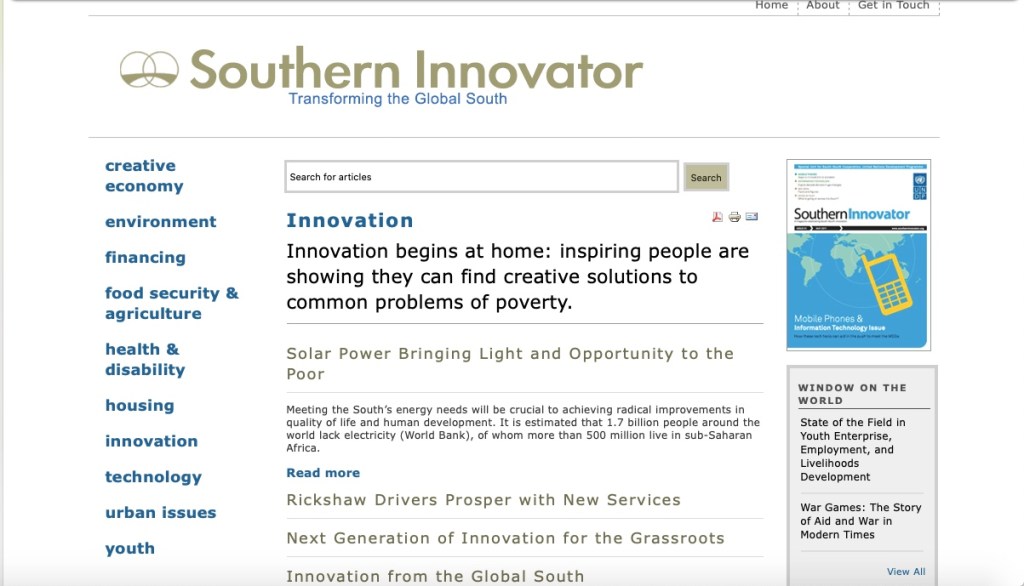
    Southern Innovator’s first web portal archiving stories from the e-newsletter Development Challenges, South-South Solutions and Southern Innovator Magazine.
    Archived issues of Southern Innovator Magazine can be downloaded from the web portal of the United Nations Office for South-South Cooperation (UNOSSC).

    https://davidsouthconsulting.org/2021/10/21/cities-for-all-shows-how-the-worlds-poor-are-building-ties-across-the-global-south/

    https://davidsouthconsulting.org/2020/12/14/innovation-in-growing-cities-to-prevent-social-exclusion/

    https://davidsouthconsulting.org/2021/10/22/innovations-in-green-economy-top-three-agenda/

    https://davidsouthconsulting.org/2021/10/22/south-south-cooperation-for-cities-in-asia/

    https://davidsouthconsulting.org/2021/02/23/southern-innovator-in-southasiadisasters-net/

    https://davidsouthconsulting.org/2021/03/05/southern-innovator-issue-4/

    https://davidsouthconsulting.org/2021/03/05/southern-innovator-issue-5/

    https://davidsouthconsulting.org/2021/03/12/southern-innovator-magazine/

    Creative Commons License

    This work is licensed under a
    Creative Commons Attribution-Noncommercial-No Derivative Works 3.0 License.

    ORCID iD: https://orcid.org/0000-0001-5311-1052.

    © David South Consulting 2023

  • Innovations In Green Economy: Top Three Agenda

    Innovations In Green Economy: Top Three Agenda

    By David South

    southasiadiasters.net December 2013

    The transition to a green economy has reached a crossroads: while multilateral global initiatives have been long-running and complex, the idea of a green economy still seems fragile and achieving it far from certain. In the face of the ravages of the global economic crisis that has raged since 2007/2008, countries are now trying to roll back their green pledges or slow the pace of transition. 

    This exposes a dilemma: a perception that a green economy is in conflict with economic growth, prosperity and the advance of human development, particularly in developing countries seeking to make rapid gains in reducing poverty and building a middle class, consumer society. 

    Three things need to be foremost in the minds of those who care about creating a global green economy in the 21st century: innovation in design, in market prices and in business models. I think these three factors will be the deciding elements in whether green technologies are taken up quickly and used by large numbers of people to improve their lives. 

    The green option needs to always be the more appealing, cheaper option that also improves living standards. Happily, many people are doing this all around the world – you just may not have heard of them yet (unless you are reading Southern Innovator magazine that is). 

    As editor of the magazine Southern Innovator since 2011, I have had the privilege to meet, interview and see first-hand green economy innovators across the global South and profile them in the magazine. What has stood out for me is this: the ones who have achieved sustainable success have put a great deal of effort into design – how the technology is made, what it looks like and how it is used, how efficiently it is made and distributed – while also thinking through the business case for their work and how to make it appealing to others. 

    We have tried to apply this thinking to the magazine as well, by using clear and modern design with bright, eye-pleasing colours, and by choosing to use 100 per cent renewable energy (much of it from geothermal sources) for the magazine’s design and layout and to have it printed on paper from sustainable forest sources. 

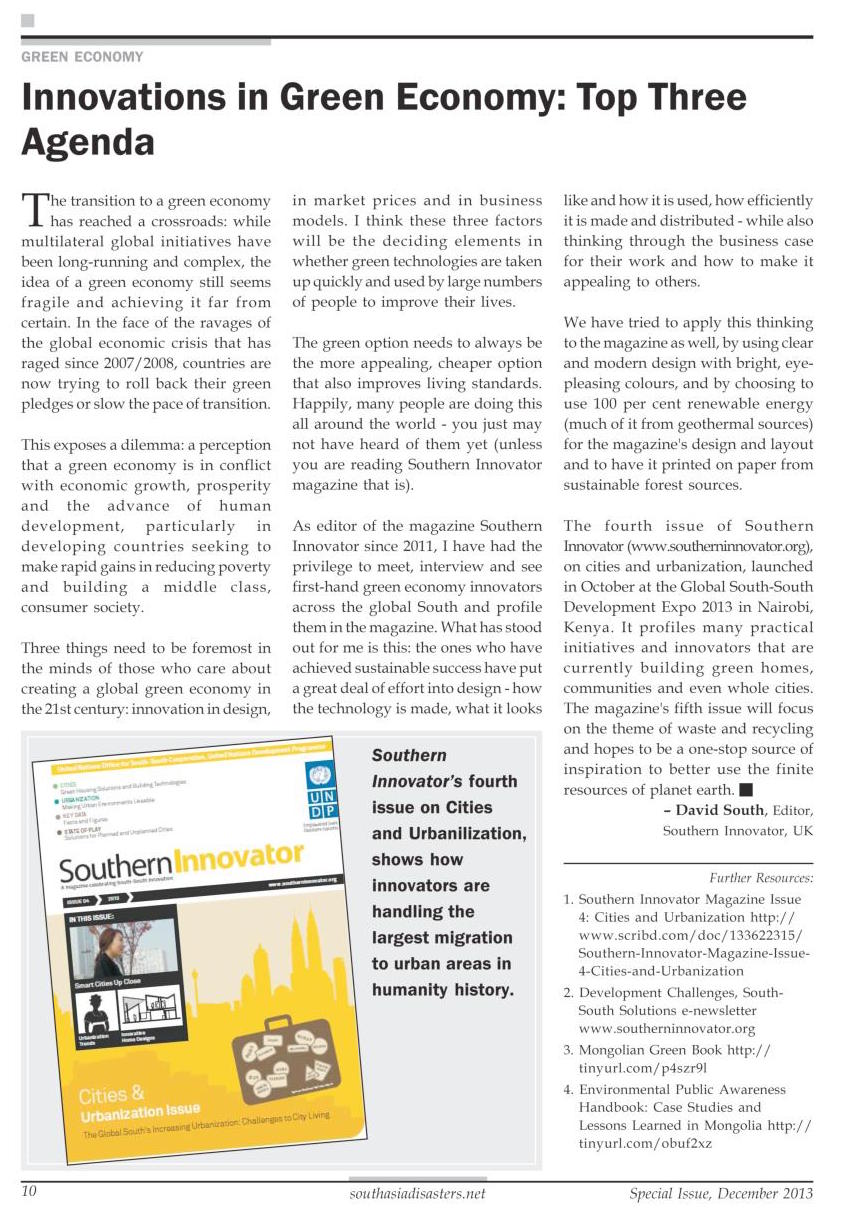
    The fourth issue of Southern Innovator (www.southerninnovator.org), on cities and urbanization, launched in October at the Global South-South Development Expo 2013 in Nairobi, Kenya. It profiles many practical initiatives and innovators that are currently building green homes, communities and even whole cities. The magazine’s fifth issue will focus on the theme of waste and recycling and hopes to be a one-stop source of inspiration to better use the finite resources of planet earth.

    David South, Editor, Southern Innovator
    United Nations Office for South-South Cooperation (UNOSSC)

    Southern Innovator Issue 1: https://books.google.co.uk/books?id=Q1O54YSE2BgC&dq=southern+innovator&source=gbs_navlinks_s

    Southern Innovator Issue 2: https://books.google.co.uk/books?id=Ty0N969dcssC&dq=southern+innovator&source=gbs_navlinks_s

    Southern Innovator Issue 3: https://books.google.co.uk/books?id=AQNt4YmhZagC&dq=southern+innovator&source=gbs_navlinks_s

    Southern Innovator Issue 4: https://books.google.co.uk/books?id=9T_n2tA7l4EC&dq=southern+innovator&source=gbs_navlinks_s

    Southern Innovator Issue 5: https://books.google.co.uk/books?id=6ILdAgAAQBAJ&dq=southern+innovator&source=gbs_navlinks_s

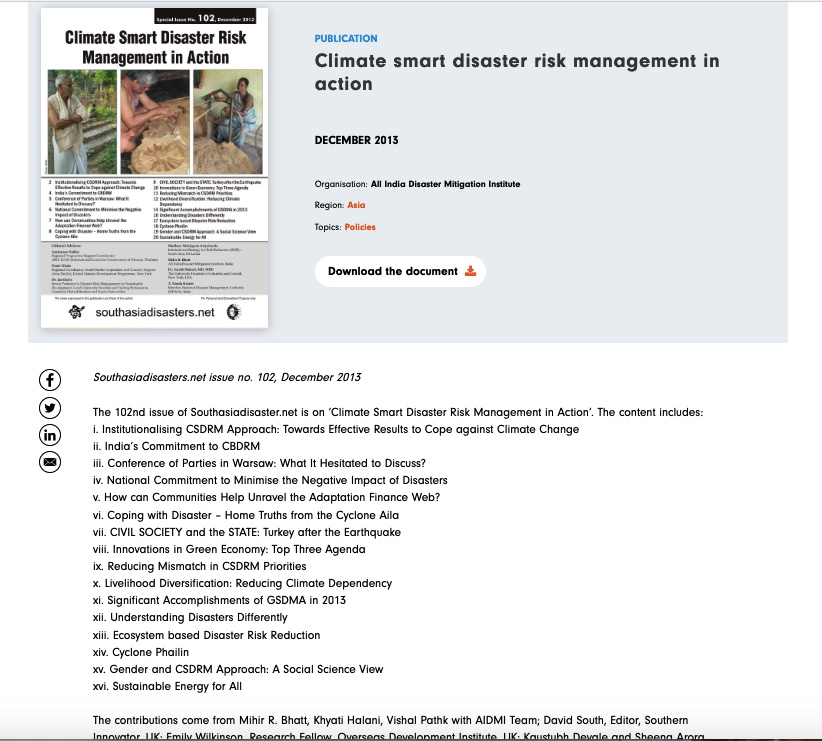
    https://wrd.unwomen.org/explore/library/climate-smart-disaster-risk-management-action

    https://davidsouthconsulting.org/2022/09/28/asian-factories-starting-to-go-green/

    https://davidsouthconsulting.org/2022/09/27/caribbean-island-st-kitts-goes-green-for-tourism/

    https://davidsouthconsulting.org/2021/01/25/creating-green-fashion-in-china/

    https://davidsouthconsulting.org/2023/02/03/environmental-public-awareness-handbook-case-studies-and-lessons-learned-in-mongolia/

    https://davidsouthconsulting.org/2021/02/01/ethiopia-and-djibouti-join-push-to-tap-geothermal-sources-for-green-energy/

    https://davidsouthconsulting.org/2021/08/29/indian-business-model-makes-green-energy-affordable/

    https://davidsouthconsulting.org/2022/11/11/innovation-cairos-green-technology-pioneers/

    https://davidsouthconsulting.org/2021/10/22/lima-to-delhi-what-can-be-learned-on-urban-resilience/

    https://davidsouthconsulting.org/2021/08/07/mongolian-green-book/

    https://davidsouthconsulting.org/2022/04/14/prisons-with-green-solutions/

    https://davidsouthconsulting.org/2021/10/22/south-south-cooperation-for-cities-in-asia/

    https://davidsouthconsulting.org/2021/02/23/southern-innovator-in-southasiadisasters-net/

    https://davidsouthconsulting.org/2021/03/05/southern-innovator-issue-5/

    https://davidsouthconsulting.org/2021/07/15/undp-mongolia-handbooks-and-books-1997-1999/

    https://davidsouthconsulting.org/2021/01/02/a-undp-success-story-grassroots-environmental-campaign-mobilizes-thousands-in-mongolia-1998/

    https://davidsouthconsulting.org/2021/02/04/us-450-million-pledged-for-green-economy-investments-at-kenyan-gssd-expo/

    Creative Commons License

    This work is licensed under a
    Creative Commons Attribution-Noncommercial-No Derivative Works 3.0 License.

    ORCID iD: https://orcid.org/0000-0001-5311-1052.

    © David South Consulting 2023