Tag: innovators

  • US $450 Million Pledged for Green Economy Investments at Kenyan GSSD Expo

    US $450 Million Pledged for Green Economy Investments at Kenyan GSSD Expo

    By David SouthDevelopment Challenges, South-South Solutions

    SOUTH-SOUTH CASE STUDY

    Innovators working in the global green economy could benefit from over US $450 million in investment recently pledged at the UN’s Global South-South Development Expo (GSSD Expo) held in Nairobi, Kenya.

    A combination of green investors, businesses, governments and others came together at the UN Environment Programme’s (UNEP) headquarters in the Kenyan capital from 28 October to 1 November 2013 to share solutions and strike deals and partnerships.

    The event represented a significant turning point in awareness of the role played by the global South’s innovators in global development and growing economies. The quantity of pledges and investment deals struck at the Expo bodes well for the future of south-south solution sharing.

    Organized by the UN’s Office for South-South Cooperation in UNDP (UNOSSC) (southsouthexpo.org) and hosted by UNEP (unep.org) under the theme “Building inclusive green economies”, the Global South-South Development Expo (GSSD Expo) is the world’s biggest event for development solutions created in the South for the South.

    “The theme of this year’s Expo is fitting in that Southern countries have both the opportunity and the obligation to pursue a ‘smarter’ development course than their predecessors,” said General Assembly President John Ashe.

    Examples of the investment deals struck include helping to build organic fertilizer factories and constructing solar power plants in Kenya, and growing green business ventures for women in Egypt.

    South-South cooperation is the exchange of resources, technology and knowledge between developing countries. Today, over US $5 trillion in currency reserves are held by countries of the global South. They also make up 47 per cent of global trade.

    Tapping this rich resource is an unparalleled economic development opportunity and could be one of the main engines of growth in the years ahead, the Expo organizers believe.

    “As so many stories that we have heard this week demonstrate, South-South Cooperation is playing a vital role in facilitating this global transition,” said UN Under-Secretary-General and UNEP Executive Director Achim Steiner.

    “Not only are these local, national and regional efforts producing positive results, but they are overcoming barriers, building new partnerships, creating new finance mechanisms, generating knowledge, sharing information, providing training and capacity building in areas and sectors that are critical for a global transition to a low carbon, resource efficient and inclusive economy,” he added.

    As an example of how solutions are shared and deals are struck, more than 40 companies were successfully matched and held business negotiations using the Expo’s South-South Global Assets and Technology Exchange (SS-GATE). An online match-making service bringing together innovative companies with the knowledge and funding they need to grow, the SS-GATE was able to get 148 companies to list their projects on the SS-GATE web-platform during an Expo event.

    For the first time in its history, the Expo garnered a strong online presence with the help of volunteers who collaborated remotely around the world on social media. The event was so popular that it trended on Twitter in Kenya, meaning that the message of the value and growing scope of South-South cooperation reached the next generation of development practitioners, entrepreneurs, environmentalists, thinkers and leaders.

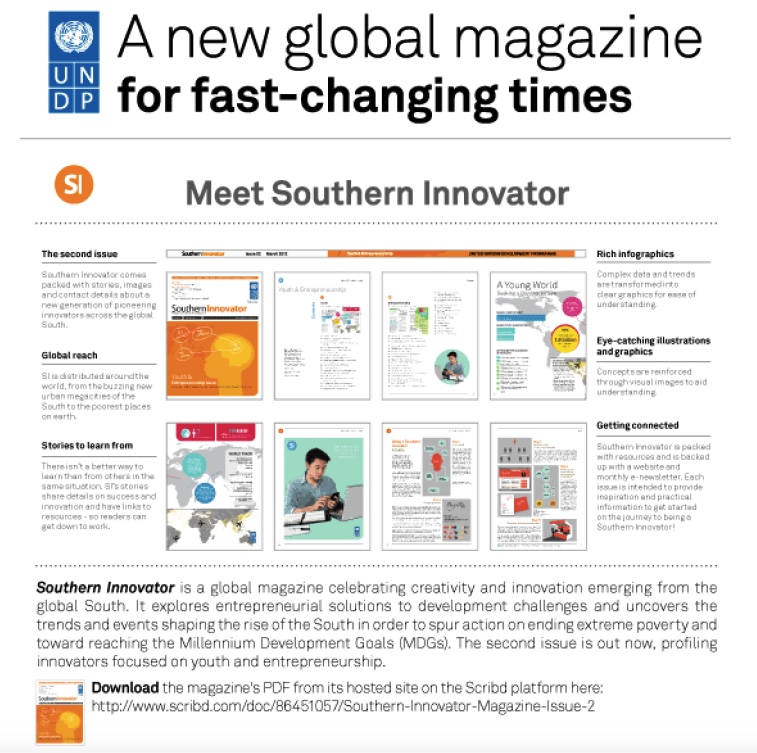
    Also at the Expo, the fourth issue of Southern Innovator magazine (southerninnovator.org) had its official launch. Southern Innovator Issue 4 visits the new cities being built to tackle the challenges of a rapidly urbanizing 21st-century world. The magazine also highlights some of the solutions being devised to the challenges people face as the world becomes a majority urban place.

    Some innovators are building new cities from scratch, applying the latest thinking and hard-wiring in cutting-edge information technologies and innovative environmental measures to create “smart” cities and eco-cities. Architects are designing and refining homes that are beautiful and functional, easy to build, affordable and conserve energy. Social entrepreneurs are innovating ways to create liveable and socially inclusive urban areas, often in places where planning has been scant and where incomes are very low. All the stories featured in the magazine were chosen for their focus on improving human development and for their ingenuity and fresh thinking.

    Southern Innovator champions a 21st-century global innovator culture. It is being distributed through the United Nations’ network and partners and reaches some of the world’s poorest and remotest places, as well as the vibrant but stressed growing global megacities. It is hoped the magazine will inspire budding innovators with its mix of stories, essential information, facts and figures, images and graphics.

    Published: November 2013

    Resources

    1) Global South-South Development Expo: The Global South-South Development Expo (GSSD Expo) is the FIRST EVER Expo solely from the South and for the South. It showcases successful Southern-grown development solutions (SDSs) to address the need to meet the Millennium Development Goals (MDGs). Website: http://www.southsouthexpo.org/

    2) Southern Innovator online story archive: Organized by theme, the story archive is a treasure trove of innovation stories and resources from the global South stretching back to 2006. Website: southerninnovator.org

    3) Southern Innovator on Scribd: Archived copies of the full-color, 60-page magazine can be downloaded here. Website: http://www.scribd.com/SouthernInnovator.

    4) Southern Innovator on Twitter: Catch Southern Innovator’s Tweets and keep on top of a growing global network of innovators. Follow @SouthSouth1

    Development Challenges, South-South Solutions was launched as an e-newsletter in 2006 by UNDP’s South-South Cooperation Unit (now the United Nations Office for South-South Cooperation) based in New York, USA. It led on profiling the rise of the global South as an economic powerhouse and was one of the first regular publications to champion the global South’s innovators, entrepreneurs, and pioneers. It tracked the key trends that are now so profoundly reshaping how development is seen and done. This includes the rapid take-up of mobile phones and information technology in the global South (as profiled in the first issue of magazine Southern Innovator), the move to becoming a majority urban world, a growing global innovator culture, and the plethora of solutions being developed in the global South to tackle its problems and improve living conditions and boost human development. The success of the e-newsletter led to the launch of the magazine Southern Innovator.
    Creative Commons License

    This work is licensed under a
    Creative Commons Attribution-Noncommercial-No Derivative Works 3.0 License.

    ORCID iD: https://orcid.org/0000-0001-5311-1052.

    © David South Consulting 2021
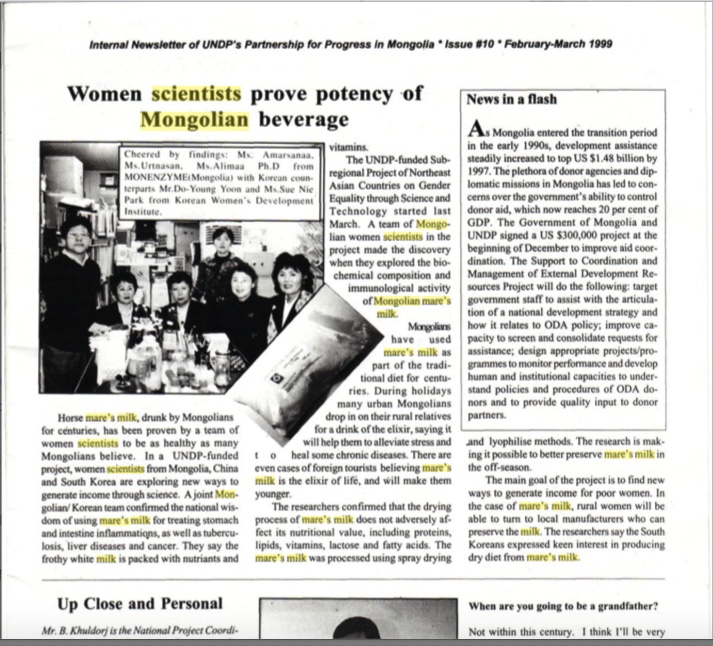
  • Women scientists prove potency of Mongolian beverage

    Women scientists prove potency of Mongolian beverage

    By David South, Blue Sky Bulletin (Ulaanbaatar, Mongolia), Issue 10, February-March 1999

    Horse mare’s milk, drunk by Mongolians for centuries, has been proven by a team of women scientists to be as healthy as many Mongolians believe. In a UNDP-funded project, women scientists from Mongolia, China and South Korea are exploring new ways to generate income through science. A joint Mongolian/Korean team confirmed the national wisdom of using mare’s milk for treating stomach and intestine inflammations, as well as tuberculosis, liver diseases and cancer. They say the frothy white milk is packed with nutrients and vitamins.

    The UNDP-funded Subregional Project of Northeast Asian Countries on Gender Equality through Science and Technology started last March. A team of Mongolian women scientists in the project made the discovery when they explored the bio-chemical composition and immunological activity of Mongolian mare’s milk.

    Mongolians have used mare’s milk as part of the traditional diet for centuries. During holidays many urban Mongolians drop in on their rural relatives for a drink of the elixir, saying it will help them to alleviate stress and to heal some chronic diseases. There are even cases of foreign tourists believing mare’s milk is the elixir of life, and will make them younger.

    The researchers confirmed that the drying process of mare’s milk does not adversely affect its nutritional value, including proteins, lipids, vitamins, lactose and fatty acids. The mare’s milk was processed using spray drying and lyophilise methods. The research is making it possible to better preserve mare’s milk in the off-season.

    The main goal of the project is to find new ways to generate income for poor women. In the case of mare’s milk, rural women will be able to turn to local manufacturers who can preserve the milk. The researchers say the South Koreans expressed keen interest in producing dry diet from mare’s milk.

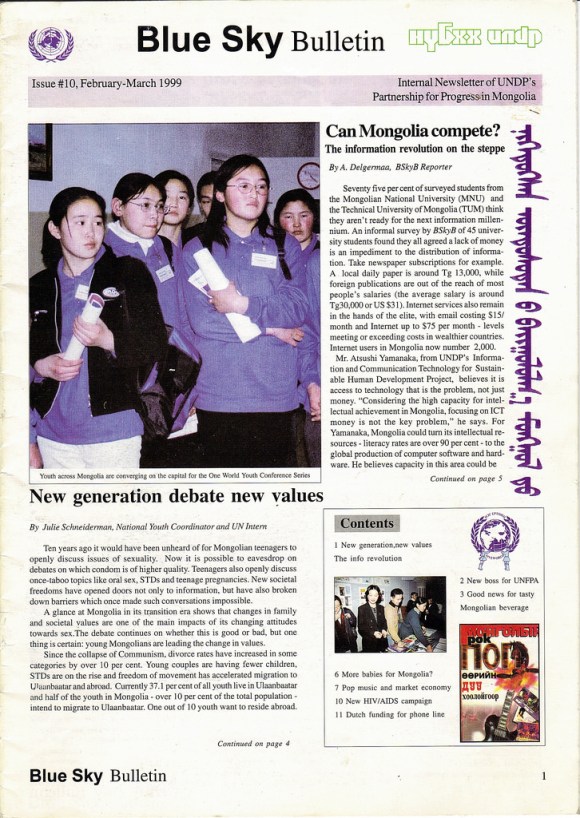
    The Blue Sky Bulletin newsletter provided timely and valuable updates on Mongolia in the late 1990s. In particular, it was able to highlight urgent health needs for a population undergoing extreme crisis resulting from food supply disruptions, loss of income, social distress (alcoholism, family breakdown etc.), sexually transmitted diseases, and extreme weather. Stories from the newsletter have been cited in many journals and books since 2000, and the high quality of its contributers is evident in their scholarship and career success since. An example is below:

    Poor Nutrition Taking its Toll on the Health of Mongolians By Jacinda Mawson

    Rickets very prevalent in Mongolia – 1998

    Prevalence of rickets in Mongolia

    Asia Pacific J Clin Nutr (1998) 7(3/4): 325-328
    U Tserendolgor1 MD pubhealth@magicnet.mn, JT Mawson2 MA, AC MacDonald3 MSc and M Oyunbileg1 MD, PhD

    “The high prevalence of rickets in Mongolian children is a serious public health concern. In addition to the adverse effects on growth, development and immune function, it is probably indicative of widespread subclinical vitamin D deficiency.”

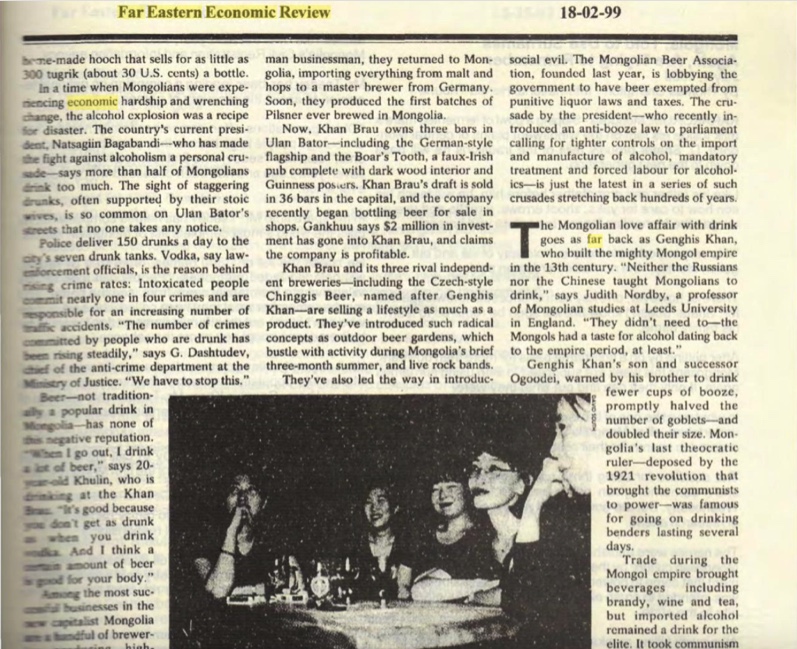
    Another beverage was catching the interest of Mongolians in the late 1990s: beer. 

    From The Far Eastern Economic Review, February 18, 1999

    A New Brew: As Mongolia changes under the influence of economic reforms, the country’s elite are trading fermented mare’s milk and vodka for a new status symbol: beer 

    Story by Jill Lawless

    Photo by David South

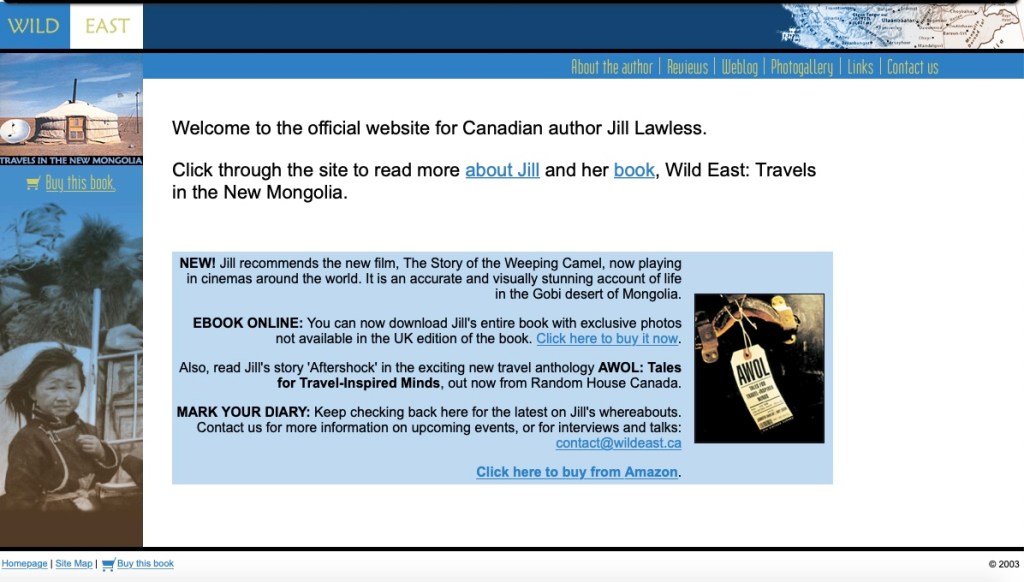
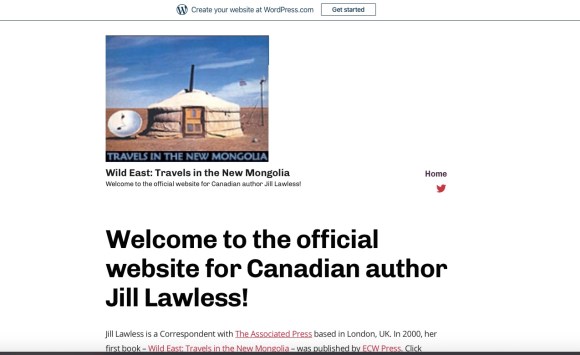
    Jill Lawless has two websites about her book, Wild East: Travels in the New Mongolia.

    Designed in London, the first website for Wild East: Travels in the New Mongolia launched in 2003.
    The new brand site for Jill Lawless is currently under construction.

    More of Jill Lawless‘ journalism for The Far Eastern Economic Review here: https://www.google.co.uk/books/edition/Far_Eastern_Economic_Review/SkuvAAAAIAAJ?hl=en&gbpv=1&bsq=david%20south,%20Mongolian%20rock

    https://davidsouthconsulting.org/2022/06/24/can-we-talk-hannah-promotes-communication-between-medical-schools/

    https://davidsouthconsulting.org/2021/06/02/case-study-5-gosh-ich-child-health-portal-2001-2003/

    https://davidsouthconsulting.org/2020/04/25/china-pushing-frontiers-of-medical-research/

    https://davidsouthconsulting.org/2021/03/08/the-dawn-of-the-genetics-revolution-2001-2003/

    https://davidsouthconsulting.org/2021/05/25/ger-mongolias-first-web-magazine-and-a-pioneering-web-project-for-the-united-nations-12-january-2016/

    https://davidsouthconsulting.org/2017/10/18/hannah-institute-for-the-history-of-medicine-1992-1994/

    https://davidsouthconsulting.org/2021/05/27/het-wilde-oosten-reizen-in-het-moderne-mongolie%cc%88/

    https://davidsouthconsulting.org/2021/03/12/mongolia-prepares-for-a-magazine-explosion-1998/

    https://davidsouthconsulting.org/2023/01/09/mongolia-update-1998/

    https://davidsouthconsulting.org/2023/02/07/mongolian-rock-and-pop-book-mongolia-sings-its-own-song/

    https://davidsouthconsulting.org/2022/11/11/online-free-knowledge-sharing/

    https://davidsouthconsulting.org/2020/12/17/philippine-conference-tackles-asias-aids-crisis/

    https://davidsouthconsulting.org/2021/10/20/research-reviews-2001-2002/

    https://davidsouthconsulting.org/2021/04/19/reviews-wild-east-the-new-mongolia/

    https://davidsouthconsulting.org/2022/11/18/southern-drink-challenges-corporate-dominance/

    https://davidsouthconsulting.org/2020/04/17/taking-medicine-to-the-people-four-innovators-in-community-health/

    Like our content? Help contribute to the costs of keeping it online. 

    Scan code with your phone and help us out.

    ORCID iD: https://orcid.org/0000-0001-5311-1052

    © David South Consulting 2023

  • Mobile Phones: Engineering South’s Next Generation of Entrepreneurs

    Mobile Phones: Engineering South’s Next Generation of Entrepreneurs

    By David SouthDevelopment Challenges, South-South Solutions

    SOUTH-SOUTH CASE STUDY

    Technology is fuelling unprecedented growth in productivity in Asia, with sub-Saharan Africa languishing behind (International Labour Organization). But the growth in mobile phones could help close this gap, as home-grown entrepreneurs are stepping up to exploit this new opportunity.

    Mobile phone applications are proving a boon to small businesses and entrepreneurs. They are now putting power in the hands of individuals, making it easier to invent new ways of doing things, transfer money, organise business accounts, provide services, sell things, and keep in touch and up-to-date.

    Technology has been the common factor in increases in productivity around the world, and with the rapid rise in mobile phone use, especially in Africa, it looks as if this handy device augers in the next wave of innovation.

    And technology and mobile phones in particular, are creating a whole new route to wealth: “The switch.. frees people from geography,” Gregory Clark, an economic historian at the University of California, Davis told The Christian Science Monitor. “Singapore can be as rich as Canada, even though Singapore has no land.”

    Technology is seen to be opening a new phase in economic competition in services, embracing a wide range of fields, from banking to tourism to healthcare. And it is entrepreneurs who will be at the forefront of making this happen. The majority (59 per cent) of the world’s 2.4 billion mobile phone users live in developing countries (MIT) – making it the first telecommunications technology in history to have more users there than in the developed world. The number of African mobile phone users passed 200 million at the beginning of this year (www.ovum.com), making it the fastest growing mobile phone market. It has increased at an annual rate of 65 per cent – twice the global average (MIT Media Laboratory).

    In Kenya in 2005, the government’s Economic Survey found the small business sector, which employs the majority of workers in the nation of 32 million people, created 437,900 jobs – mostly down to the boom in mobile phones. According to the Massachusetts Institute of Technology (MIT), adding an additional 10 mobile phones per 100 people boosts a typical developing country’s GDP growth by 0.6 per cent. The boost comes from the innovative use of mobile phone technology by local entrepreneurs.

    At the University of Nairobi, the SMS Boot Camp (SMS is the text messaging system on mobile phones) is breeding the next generation of African technology entrepreneurs. Working in partnership with MIT, the student entrepreneurs are working on an impressive list of projects, which can be found online at eprom.mit.edu. The projects are varied, and include perfecting prototype ways to collect medical data on mobiles, accurately tracking phone user’s profiles (habits, friend networks etc.), improving communication between Kenyan hospitals and the centralised blood banks in the country, and quick ways to install applications on all of Kenya’s mobile phone SIM cards.

    One graduate, Mohammed Temam Ali in Addis Ababa, is now working on a project for the Ethiopian Telecommunications Company. Another is working for Kenyan mobile phone download service, Cellulant.

    Nathan Eagle, a visiting lecturer at the University of Nairobi, has been working with the students on the projects: “Phones are starting to be used as a surrogate for all sorts of technology we take for granted in the West. Credit cards, TVs, radios, computers, etc… In the small Kenyan village where I’m writing this email, I can pay for the taxi ride home with my mobile — we’re even scheduled to be getting a Wimax network (wireless internet) here next year. Talk about leapfrog…”

    “I’m also advising a small group of newly graduated Rwandan hackers who are building an SMS-based payment system for electricity.”

    But Eagle says the obstacles can still be huge: “Government corruption and red-tape. SMS is illegal in Ethiopia… it is pretty frustrating when you go over to teach an ‘sms bootcamp’ class.”

    In India, where there are 185 million mobile phone subscribers, computer science doctoral student and founder of Ekgaon Technologies, Tapan Parikh, has founded a business specifically targeting developing mobile phone-based information systems for small businesses in the developing world. Working in rural India, the applications are designed to make it easier for business owners to manage their own operations in an efficient and transparent way, and also to build strong connections both with established financial institutions and their customers. By making it easier to access finance, and also to get a better price, these businesses will stand a better chance of flourishing, it is believed.

    One of his applications is called Cam (named after the phone’s camera). It is a toolkit that makes it simple to use phones to capture images and scan documents, enter and process data, and run interactive audio and video.

    Parikh is also using these applications to improve micro-finance. Targeting Indian self-help groups (15 to 20 people who pool their capital together, usually women), the application (called SHG MIS – self-help group management and information system) uses the phone’s camera to enter data, uploading it to online databases, and a package of Web-based software for managing data and reporting to the institution that lent the money.

    “In these groups, things are often done in a somewhat ad hoc manner, using informal documentation,” Parikh says, “which can lead to instability and impermanence and contribute to the kinds of tensions that lead small groups to fall apart.” The software gives groups a more systematic method of documenting decisions, tracking financial performance over time, and collecting information on loan effectiveness. Parikh has developed his applications around the needs and behaviour of the users.

    This next wave of entrepreneurs will be joining a growing list of made-in-the-South mobile phone innovators like ARYTYG-Cash and Smart Money in the Philippines; WIZZITand MTN Mobile Money in South Africa; M-Pesa in Kenya; Celpay in Zambia and the Democratic Republic of Congo.

    Published: September 2007

    Resources

    • Key Indicators of the Labour Market, 2007: www.ilo.org
    • Commission for Africa report on mobile phones and development: www.commissionforafrica.org
    • The Massachusetts Institute of Technology and the University of Nairobi are training the next generation of mobile phone entrepreneurs with their “SMS Boot Camp”, focused on developing applications for African phone users: eprom.mit.edu.
    • Entrepreneurs can track the growth of the mobile phones market here: www.wirelessintelligence.com

    Development Challenges, South-South Solutions was launched as an e-newsletter in 2006 by UNDP’s South-South Cooperation Unit (now the United Nations Office for South-South Cooperation) based in New York, USA. It led on profiling the rise of the global South as an economic powerhouse and was one of the first regular publications to champion the global South’s innovators, entrepreneurs, and pioneers. It tracked the key trends that are now so profoundly reshaping how development is seen and done. This includes the rapid take-up of mobile phones and information technology in the global South (as profiled in the first issue of magazine Southern Innovator), the move to becoming a majority urban world, a growing global innovator culture, and the plethora of solutions being developed in the global South to tackle its problems and improve living conditions and boost human development. The success of the e-newsletter led to the launch of the magazine Southern Innovator.

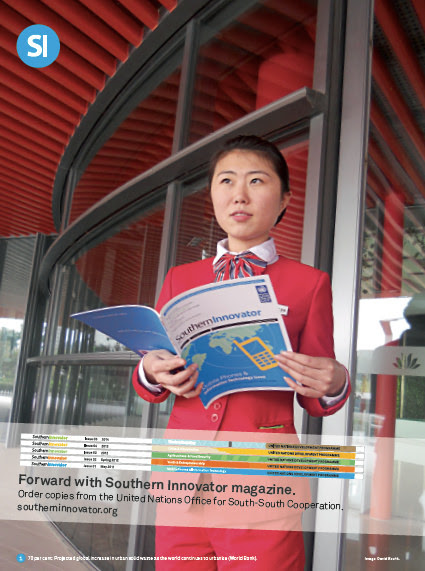
    Four issues of Southern Innovator Magazine.
    Creative Commons License

    This work is licensed under a
    Creative Commons Attribution-Noncommercial-No Derivative Works 3.0 License.

    ORCID iD: https://orcid.org/0000-0001-5311-1052.

    © David South Consulting 2022