Categories
Archive Blogroll Ger Magazine UNDP Mongolia 1997-1999 United Nations Development Programme

Mongolian Rock and Pop Book: Mongolia Sings its Own Song

Publisher: UNDP Mongolia Communications Office/Press Institute of Mongolia

Managing Editor: David South

Editorial Advisors: Ts. Enkhbat, Mustafa Eric, David South

Author and Researcher: Peter Marsh, Indiana University

Copy Editor: N. Oyuntungalag

Production Editor: B. Bayarma

Published: 1999

ISBN 99929-5-018-8

In the Mongolian language, the book explores how Mongolia’s vibrant rock and pop music scene led on business innovation and entrepreneurship in the country during the transition years (post-1989). Written by an ethnomusicologist, it details the key moments and events in this story, while splicing the narrative with first-person interviews with the major players.

https://davidsouthconsulting.org/2020/12/17/mongolias-musical-entrepreneurs-led-way-out-of-crisis-2018/

From Ger Magazine Issue 1

Published: September 9, 1998

Mongolia Sings its Own Song

MTV is available on cable television, bootleg CDs blare from kiosks and the latest news on the Spice Girls is available in one of dozens of entertainment newspapers. Despite the flood of foreign music it is local musicians who the youth turn to to voice their new-found freedoms, dreams and angst. Pop music researcher Peter Marsh swings to the new beat of the steppe…

It is something that would have horrified the old socialist leaders. Pop singer T. Ariunaa – Mongolia’s answer to Madonna – is doing what she does best: pushing the barriers of what a performer can and can’t do. Notorious in the local press as “Mongolia’s Queen of the Erotic,” she struts onto the stage of the Non-Stop – one of the newest and trendiest disco clubs in the Mongolian capital, Ulaanbaatar – wearing a black silk robe over black lingerie bikini underwear. Jumping into her hit song, “Telephone Number”, she sings the lines,

When you begin to take off your shirt, I am happy you’re staying;

When your hot breath is near me, the lights go out,

Cheekily writhing her torso, seductively opening and closing her robe, she teases her audience. And her audience, mostly Mongolian youth from the late teens to early thirties, take it all in with good humour, smiling and giggling. Whether they like her music or not, they appreciate what she’s doing and are having fun. The message of free expression is reflective of the enormous changes in attitudes over this decade. 

“I like Ariunaa very much,” says 30-year-old Sukhbaatar, a graphic designer. Wearing a dress shirt, slacks and noticebly shiny shoes, he’s sitting with his two friends, glasses of beer in hand, watching the show. “She has a powerful voice,” he says gesticulating towards the stage. “She has a peculiar style, and this kind of style should be developed in Mongolia. 

“But we don’t admire her as a singer,” he says with a wry laugh.

Not long ago, when this landlocked Northeast Asian nation was still subject to Soviet-backed socialist rule, pop-rock musicians like Ariunaa would never have been allowed to bring such explicit expressions of ‘the erotic’ anywhere near the public stage. Ariunaa’s boldness and charisma, which have made her one of Mongolia’s most well-known and controversial young pop stars, show something of the new openness and growing diversity that characterizes the emerging popular music industry in capitalist Mongolia. There are girl bands like Spike, boy bands like Nomiin Talst and Camerton and pop divas like Saraa.

A typical concert in Ulaanbaatar, like this one at the Non-Stop – a converted public gymnasium which opened earlier this year – consists of a succession of live Mongolian bands interspersed with breaks for dancing to Western pop, disco and techno music. The styles of music in these concerts fall into what the Mongolians call pop-rock, which ranges from rock ‘n’ roll, soft rock, and heavy metal rock to techno, hip-hop and rap. Mongolian music fans today now have a wide choice of styles to choose from.

Someone who would know about this well is the ‘elder statesman’ of rock, D. Jargalsaikhan. Wearing leather cowboy boots, sequined leather pants and a leather jacket, and with his black hair streaming down over his shoulders, Jargalsaikhan sees the new diversity of groups as a positive sign of the times, as he said in a recent newspaper interview. 

“In the stores today there are maybe 10 different varieties of sausage: salted, unsalted, spiced and so on. You can then look at them all and then choose the one you want, like spiced sausage. It’s the same thing with the music business in Mongolia today. In the era of the market economy many different bands and singers have come out, and the listeners can choose the recordings of those bands and music styles that they like. … The most important thing is that the other bands or styles of singers should not be ignored. All of them have a wish to do something. Usually, those who criticize different styles or forms of music are people with too much time on their hands.”

Although turning 40 this year, Jargalsaikhan is not a man with too much time on his hands. As head of the Mongolian Singer’s Association, his many responsibilities keep him on the run. In between numerous breaks to answer calls on his cell phone, Jargalsaikhan tells me about being a rocker in the 1970s and ’80s, which he terms the “Golden Era” of rock in Mongolia, and the difficulties they faced. “Because Mongolia was ruled by one party, the Revolutionary [Socialist] Party [from 1921 to 1990], there was little foreign influence allowed into the country. Rock and pop were not to be found on the [state-controlled] radio or TV, and aside from records and cassettes brought into the country by individuals coming from Europe and Russia, people here had very little experience with the music. … It was easier for the early rock-pop musicians to take examples from folk music, which was close to them, which they had been listening to since their childhood.” Much of the early music included settings of popular folk songs and melodies in the rock genre. And the youth, eager for alternatives to the state-sponsored cultural offerings, found the music to their liking.

The popularity of this early rock-pop, or so-called folk-pop groups soon drew the attention of the socialist party, which saw opportunities to use the music for the purpose of advancing its mission in Mongolia. In exchange for the state government’s granting of musical instruments, rehearsal and performance spaces, and concert and touring opportunities, the early bands were closely watched, their actions restricted by suspicious government officials. “Everything was planned by the government, and we had to do what it had planned,” says Jargalsaikhan. “For example, when we were abroad, we couldn’t go to the discos nor arrive at the hotel late. We couldn’t go where we wanted. There were conflicts between the singers and musicians and the government representatives [sent to oversee the tour]. If I spoke to foreigners, I would be considered a spy. Who I spoke with was also controlled. At that time, the social condition in Mongolia was like that of North Korea today.”

Considered by the government to be a “capitalist art,” the direct imitation of Western rock was not allowed. Mongolian bands instead had to create a unique Mongolian style of the music that drew from traditional folk or classical musical and literary traditions. Band members were often compelled to compose songs to lyrics written by members of the powerful Mongolian Union of Writers. “It was difficult for musicians to play their own compositions, and they were often forbidden to do so,” recalls Jargalsaikhan. “For the concert programmes, our songs had to include the topics of Mongolia and the Soviet Union, as well as the Mongolian love for Nature or for Father and Mother. … The topic of love between a man and woman was considered to be too personal for the public stage, and was almost forbidden.”

But rock and pop musicians gained more and more freedoms of expression as political and social reforms were introduced in Mongolia throughout the 1980s. “The rock-pop musicians of the 1970s became more skilled and their abilities improved,” says Jargalsaikahn. “They began to compose at the level of professional composers. Also, the older generations wanted to give more artistic freedoms to the youth at the same time as the Party controls were being lifted.” And the youth, in turn, were more intent on creating traditions of music of their own generation. “The young rock-pop musicians wanted to hand-down their own music to the next generation-their own pop-rock art.

Jargalsaikhan gained fame throughout Mongolia for his 1988 song “Chinggis Khan,” when he was lead singer of the band by the same name. Making use of traditional folk music instruments alongside of the group’s electric guitars, synthesizers and drums, the song praises the 13th century Mongolian leader as a great, if historically misunderstood, man who always had in mind the good of the Mongolian nation–and this at a time when expressing such sentiments could have landed him in prison. “I had to show my civil courage to sing this song. But many of my friends and fellow composers encouraged me to write and perform it.”

His was the voice of a new generation, one seeking more freedoms to express Mongolian identity in new ways. The efforts of many musicians of his generation contributed to the popular political movements and protests that eventually led, in 1990, to the downfall of the socialist government and the introduction of democratic and market economic reforms throughout the nation.

In the new social and cultural climate of the late-1980s and early ’90s, musicians saw it as their responsibility to introduce Western rock music and popular culture to Mongolia. Besides Jargalsaikhan’s Chinggis Khan (“soft rock”), other groups came onto the popular music scene, including bands like Haranga (“heavy-metal/grunge”) and Hurd (“metal rock”).

The leader and percussionist of the group Hurd (“Speed”), D. Ganbayar, saw it as a national service to his people to introduce his group’s unique form of Western-style rock. “The Mongolian people, and especially the youth, don’t want [their bands] to imitate Western rock art. They want a pop-rock with its own specific character, music that’s different from other types of Western rock-pop, music with its own national character.” Wearing a leather jacket and black hair down to his chest, Ganbayar, moves to the edge of his chair. “No one but us will introduce this kind of music to the Mongolian people. We serve our people. It’s our duty to introduce Western music to the Mongolian people through the Mongolian language and Mongolian melodies. We want to show that Mongolian rock-pop has its own unique character.”

Nearing a decade of life, Hurd continues to experiment with new sounds and performance styles. They recently softened their driving, heavy metal style in two “Unplugged” concerts given at another new disco club in Ulaanbaatar, Top Ten, a cavernous warehouse located in a former cultural centre. This was the first time any rock group had tried such a concert idea in Mongolia. Even on acoustic guitars, however, the group, consisting of a bass, two guitars, drums, percussion and keyboards, managed to fill the club with their sound and fury. Their fans packed the house, and the lead singer, Tumurtsog, needed little effort to get them to sing along with him on many songs.

Hurd and Haranga are still very popular groups in Mongolia, but in the past years few new heavy metal or hard rock groups have come onto the pop-rock scene here. Instead, a new generation of popular singers and music groups have been working their way up and into the limelight of the concert stages. These are youths that mostly eschew the long hair and leather jackets of the older groups in favor of short, styled hair and suits and ties. The music would be recognized in the West as techno, hip-hop, and pop along the lines of the Backstreet Boys, Celene Dion and the Spice Girls, and is almost always electronically produced in recording studios and then backgrounded to the singers and dancers themselves on stage with the use of a tape player.

Mostly in their late teens and early 20s, these performers appeal to Mongolian audiences with their singing, dancing and stage presence. One of the most popular of the current crop of bands is Har Sarnai (“Black Rose”), a “hip-hop techno” male duo, famous for their dancing, nationalistic song lyrics and sometimes outrageous clothes and hair styles.

In their concerts they often come out on stage wearing specially designed silken dels (traditional Mongolian robes worn by both men and women), with sunglasses and big bushy black and gray colored wigs on their heads. As the heavy techno beat of one of their most famous songs, “Alarm,” begins, they launch into their synchronized dance routines and lyrics, which exhort Mongolians to wake up from their dreaming and set to work producing a new society. Their audiences watch from their tables-as Mongolians hardly ever dance while the bands are performing-clearly enjoying the show.

“Har Sarnai is my favorite band,” says 19-year-old Buyanbaatar, a student at the Mongolian State University. “I like how different they are. Their clothes, their behavior on stage is different. And the songs that they sing, their dances and their clothes and style are all well suited together.”

Even older youth, like Sukhbaatar, age 30, mirror these sentiments. “I like Har Sarnai because I like their style and their dancing very much. I also like their unique styles of hair.” His friend Tsooj, age 31, adds, “In America you have rap bands, like New Kids [on the Block], and they dance really well. We like dancing very much. We are not too old for this!”

To both of them, the infectiousness of the new music pop scene transcends traditional age definitions. “I started to listen to music from the Beatles and other foreign bands. But now it’s become very nice in Mongolia. It’s just impossible not to be a fan because we are young people. We don’t think we are old. We are young enough, and we are here to support our favorite bands, and we will scream and whistle with everyone else!”

How audience members of different age groups can mix together at concerts and share such similar tastes in musical genres is perhaps unique to Mongolia. “One of the reasons why even the older generations like the new bands of the younger generations,” says Norov-Aragcha, a professional artist, aged 38, “is that in their youth, when they were 18 or 20, such bands didn’t exist here. We like new things like the younger people, and this music is new to Mongolia.”

But while he appreciates the new opportunities that the new bands have to perform their music in Mongolia, Norov-Aragcha adds that something is certainly missing from their music. “I like Ariunaa, and appreciate what she does. But all these bands and singers [of the young generation], although they have their own styles, they are generally on one level. None of them stands out from the rest. Maybe because of my profession, I prefer something new, something very different from the others. Haranga and Jargalsaikhan, they are our generation. They have feelings, they are making efforts with their music, and they are honest to their music. In their time [late-1980s and early 1990s] it was very difficult, but they did it. They have real talent, real feeling in their music.”

“Now I’m looking at all these new bands and singers, but still the one that I want hasn’t appeared. … That is, something which suits today’s conditions and atmosphere. … Something very powerful, very hard. Something like a Kurt Cobain.”

While not new to Mongolia, pop-rock’s growing diversity certainly is. The general feeling these days seems to be one of celebration of its freedoms and appreciation of its diversity, without the isolation of audiences into genres that is typical in the West. Given the difficulties Mongolia’s youth now face as they struggle to adapt to a society undergoing enormous change, a Mongolian “Kurt Cobain” may be just around the corner.

Creative Commons License

This work is licensed under a
Creative Commons Attribution-Noncommercial-No Derivative Works 3.0 License.

ORCID iD: https://orcid.org/0000-0001-5311-1052.

© David South Consulting 2024

Categories
Archive Development Challenges, South-South Solutions Newsletters

Southern Art Hubs Grab Attention for Creative Economy

By David SouthDevelopment Challenges, South-South Solutions

SOUTH-SOUTH CASE STUDY

Regeneration – of poor neighbourhoods, districts, even whole countries after a conflict – is both a challenge and a key to transforming lives. One approach that has a track record is turning to artists and creative people to re-imagine a neighbourhood or country’s culture, and restore pride and vitality to places beaten down by life’s hardships.

The tool to do this is the creative economy. The “interface between creativity, culture, economics and technology in a contemporary world dominated by images, sounds, texts and symbols” (UNCTAD) is seen as away for emerging economies to leapfrog into high-growth areas in the world economy.

Two approaches offer inspiring examples: a Brazilian art gallery owner is single-handedly remaking the Brazilian market for contemporary art. And in Cambodia, a new wave of young artists are creating a stir in the global art scene.

Galeria Leme (http://www.galerialeme.com/home.php?lang=ing) is located in a graffiti-strewn, down-at-heel neighbourhood in Sao Paulo, Brazil.

Brazil has seen impressive economic growth in the past decade. The country is Latin America’s biggest economy and had reached growth of 5.1 percent in 2008 before being hit by the global recession.

The gallery pursues several goals at once: its mission is to draw attention to socially and politically engaging contemporary Brazilian art, but it also aims to increase awareness of the art market in Brazil and help in the revitalization of the gallery’s neighbourhood.

The gallery is a concrete box designed by Paulo Mendes da Rocha (http://en.wikipedia.org/wiki/Paulo_Mendes_da_Rocha), an award-winning Brazilian architect. Founded in 2004 by former banker Eduardo Leme, the gallery has fashioned itself into being the leading authority on contemporary art in Brazil. Leme used to work in the financial sector before moving into running a gallery, and has applied his understanding of markets and how to create demand.

This in turn has grabbed international attention, and had the global art world beating a path to this neighbourhood. In short, it creates a buzz that soon feeds on itself and draws in more people to the scene.

It’s a formula that has worked well in many other places, where a successful gallery fosters a scene and draws in audiences, buyers and new businesses. Soon, a creative economy comes alive and that means serious money. Both New York and London have shown how this can work. In New York City, the creative economy employs over 278,000 people (2002).

Sao Paulo is the commercial hub of Brazil’s contemporary art market. But previously, buyers had to search all over the city to find the works they wanted to buy.

“I think it is a really good moment for Brazilian art,” Leme said.”Brazilian art is fantastic. Due to our miscellaneous (sic) of culture and people and all these kind of things. Brazil is almost a continent. You have art made of wood, made of metal, made of plastic films, all the materials. More and more, I am seeing Brazilians moving onto the international markets, the prices are moving up. The number of fellows from museums that are coming down here to see what’s going on, it’s fantastic.

“To run this business you not just to have good stuff: you need to understand to whom you should sell also,” Leme told the magazine Monocle. “I mean also not just Sao Paulo is a rich and big city that you have a lot of collectors. There is a lot of social stuff you have to understand to be in this specific business.

“My challenge is to increase the Brazilian market. I have this kind of ambition. More partners, more people talking about art, if more people talking about art I am going to receive more feedback and I am going to grow the terms. Not just as a business but also as a man I will have more things on my mind, more information. And the financial market, the more money you make the richest you are. Here, it is not just that: my point of view is that the more challenge is the thing, the more goals I make I am going to be richer in this business.”

Another scene has taken off in formerly war-ravaged Cambodia in Southeast Asia. The country was notorious for the horrors of the Killing Fields in the 1970s (http://en.wikipedia.org/wiki/The_Killing_Fields), where the extremist Khmer Rouge government executed people and Cambodian artists suffered greatly. As a result, the art community was devastated for many years.

Thirty years on, a new generation of artists has emerged from the recent years of peace. This new wave is getting attention across Asia for its innovation.

Artist Pich Sopheap is one of the pioneers. By founding the Cambodian contemporary art association saklapel.org with Linda Saphan, he has focused the Cambodian art scene through group exhibitions and promotion. Another tool he uses to build the scene up has been the Visual Art Open(VAO), an annual event since 2005 featuring work by Cambodian artists.

This has had the effect of building a strong community of artists within the country who can support each other. It also makes it easier for outside art buyers to discover who is working in the country’s art scene.

Sopheap works in a variety of media including oil painting, photography and sculpture. He manipulates bamboo and rattan to shape his sculptures.

“I think for me sculpture with this material is just because it is cheap. It’s easy to use, it is very relevant. The subject matter is in the work already. For me it is discovering new forms that resonant with the atmosphere, with the conditions of this country,” Sopheap told the BBC.

Sopheap’s family fled from the Khmer Rouge in the 1970s. He spent his early life in the United States, where he trained in art. When he returned to Cambodia a few years ago, he found the art scene very small and weak.

“Cambodia is a young country when it comes to modern art. It takes a while for new blood to come back and actually make something that concerns the present time,” believes Sopheap. “And we are very young, in our early 30s. Before that there was almost none that was known. We are making our own way – it is all up to us. We show in different cafes, we show in bars, we show in gift shops. And when we do those kind of exhibitions it is kind of exciting, it is not really a gallery, a cold place, people go by and it exposes to a lot of foreigners.”

A Cambodian-trained artist, Leang Seckon (http://saklapel.org/vao/artists/leang_seckon/), takes these approaches further, using sewing, painting, metalwork and collage in ways that reference Cambodian traditions, from apsara ballet (http://en.wikipedia.org/wiki/Apsara_Dance) to fortune-telling, while subtly commenting on modern culture, society and politics. Seckon now has shows in Britain, Japan and Norway, and has become one of the country’s most successful artistic exports.

“To begin with I was not a professional artist and I didn’t realize I could jump from low to high level so fast. Things have changed so quickly for me. If I do one style of art it makes me feel so bored. But if I mix it up with other techniques like sewing and collage, it makes it more interesting for me. I don’t know if you can call that real Cambodian art but I didn’t copy or learn it from anyone: I created it myself.”

“This is a very important point for me: I can show all my work to the international community. In the countries I go to, I tell them the same thing. Cambodia has new, young artists – we haven’t disappeared: the young ones have been growing up.”

His approach is to stay away from cliched Cambodian art.

“I just think we work really hard,” says Sopheap on the group’s success to date. “I just think we work really hard and get together and organize exhibitions ourselves for the most part. It is just artists working hard and they are hungry and they are fearless and when that energy is happening, people from the outside start to actually pronounce our name correctly and afterward they come to town and just by accident they find this little scene, and they are very interested in it because it is raw.”

Published: December 2009

Resources

  • Global Creative Economy Convergence Summit 2009: The summit is about the successful and emerging creative technologies and initiatives that are driving economic growth locally, nationally and internationally. Website: http://www.gcecs2009.com/
  • Creative Economy Report 2008. An economic and statistical assessment of creative industries world-wide as well as an overview of how developing countries can benefit from trade in creative products and services produced by UNCTAD and the Special Unit for South-South Cooperation in UNDP. Website: http://www.unctad.org/en/docs/ditc20082cer_en.pdf
  • An article about artists in the Caribbean and how they are using online networks to connect and earn income. Website: http://globalvoicesonline.org/2009/07/23/trinidad-and-tobago-online-art-networks/

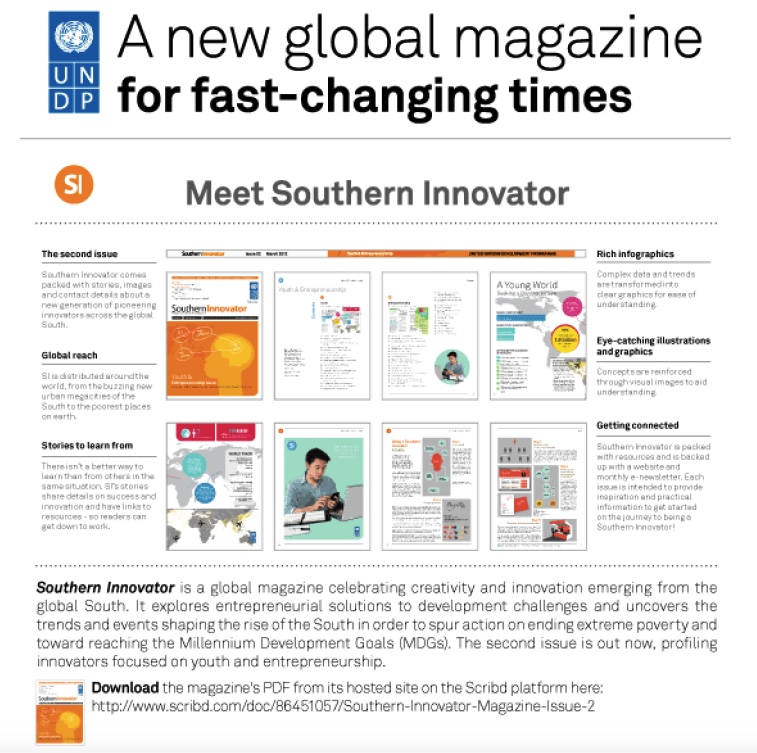
Development Challenges, South-South Solutions was launched as an e-newsletter in 2006 by UNDP’s South-South Cooperation Unit (now the United Nations Office for South-South Cooperation) based in New York, USA. It led on profiling the rise of the global South as an economic powerhouse and was one of the first regular publications to champion the global South’s innovators, entrepreneurs, and pioneers. It tracked the key trends that are now so profoundly reshaping how development is seen and done. This includes the rapid take-up of mobile phones and information technology in the global South (as profiled in the first issue of magazine Southern Innovator), the move to becoming a majority urban world, a growing global innovator culture, and the plethora of solutions being developed in the global South to tackle its problems and improve living conditions and boost human development. The success of the e-newsletter led to the launch of the magazine Southern Innovator.

Creative Commons License

This work is licensed under a
Creative Commons Attribution-Noncommercial-No Derivative Works 3.0 License.

ORCID iD: https://orcid.org/0000-0001-5311-1052.

© David South Consulting 2022

Categories
Archive Development Challenges, South-South Solutions Newsletters

African Innovators Celebrated in Prize

By David SouthDevelopment Challenges, South-South Solutions

SOUTH-SOUTH CASE STUDY

Innovation is increasingly being recognized as the key to tackling long-standing development problems in Africa, as well as across the developing and developed world. While it is easy to draw up a list of challenges facing the global South, it takes a special person to see not problems but solutions.

Innovation tends to mean fresh thinking brought to bear to old problems, or completely radical new technologies, insights and ways of doing things that are transformative.

The Oslo Manual for measuring innovation (http://www.oecd.org/innovation/inno/oslomanualguidelinesforcollectingandinterpretinginnovationdata3rdedition.htm) has defined four types of innovation: product innovation, process innovation, marketing innovation and organizational innovation (OECD).

Product innovation is a good or service that is new or significantly improved. This includes significant improvements in technical specifications, components and materials, software in the product, user friendliness or other functional characteristics. Process innovation is a new or significantly improved production or delivery method. This includes significant changes in techniques, equipment and/or software. Marketing innovation is defined as a new marketing method involving significant changes in product design or packaging, product placement, product promotion or pricing. And finally, organizational innovation is a new organizational method in business practices, workplace organization or external relations.

How quickly these can be brought to the marketplace, and the level of innovation in society, will be critical to a country’s success in the coming decade, according to the Organization for Economic Cooperation and Development (OECD). Importantly, innovation is being seen as the big driver of economic progress and well-being and the best way to deal with the plethora of challenges facing human health and the environment.

As an example, in the past decade, communications innovation has given more and more of the world’s population access to mobile phones and the Internet. This has led to the success of many new companies, from the search engine giant Google to multiple software innovations such as Kenya’s M-Pesa mobile phone banking application (http://www.safaricom.co.ke/personal/m-pesa/m-pesa-services-tariffs/relax-you-have-got-m-pesa), to small and innovative companies spreading the innovation bug such as Pico Crickets (http://www.picocricket.com/) or the Raspberry Pi (http://www.raspberrypi.org/).

As the OECD has said, “Not only has innovation moved to centre stage in economic policymaking, but there is a realization that a coordinated, coherent, ‘whole of government’ approach is required.

“Even countries that have generally refrained from active industrial policy in recent years now seek new ways to improve the environment for innovation in order to boost productivity and growth. Today, innovation performance is a crucial determinant of competitiveness and national progress.”

In the past, African innovators mostly went unacknowledged, unsupported and unrecognized. But this is changing, as new resources come online to support, finance, encourage and champion African innovators. Until very recently, people outside the continent heard little positive news about what was happening there. But the African innovator story is an inspiration to people around the world.

The Innovation Prize for Africa (http://innovationprizeforafrica.org), begun in 2011, awards US $100,000 for the top innovation that matches its criteria of marketability, originality, scalability, social impact and business potential.

The prize aims to encourage people to come up with practical solutions to the continent’s long-standing problems. This year’s prize received 900 applications from 45 countries.

The 2013 prize went to the South Africa-based AgriProtein (http://www.agriprotein.com) team for an innovation that uses waste and fly larvae to produce animal feed. The solution collects biodegradable waste and then feeds it to flies. The larvae the flies produce are then ground into a protein which is used as a feed for animals. Not only does this approach improve the nutritional quality of the feed, it also lowers the cost for African processors and farmers.

This year’s finalists offer a mixed bag of innovations, including creative ways to find new energy sources, improving access to clean water and preventing diseases.

Joining a clutch of other South African finalists, Dr. Dudley Jackson has created the SavvyLoo, a waterless toilet for use in rural areas and makeshift settlements. It separates the waste into liquids and solids to reduce the risk of disease, odour, and harm to the environment and eases waste removal.

Another South African, Professor Eugene Cloete, is the inventor of the TBag Water Filter that cleverly uses material recovered from tea bags to filter polluted water until it is completely safe to drink.

When it comes to the thorny issue of finding new energy sources for an energy-hungry continent, the prize unearthed some interesting solutions. One is Justus Nwaoga, a Nigerian finalist, who developed a way to turn a common weed into a source of renewable solar energy.

Nwaoga, a researcher from the Department of Pharmaceutical and Medicinal Chemistry at the University of Nigeria Nsukka (http://unn.edu.ng/), found the common tropical weed Mimosa pudica (http://en.wikipedia.org/wiki/Mimosa_pudica) surprisingly provides a way to tap into the sun’s energy.

The weed has leaves which fold in on themselves when touched, but spring quickly back into their normal form when exposed to daylight. The plant opens up in the morning and closes in the evening – an indicator of how sensitive it is to sunlight.

Nwaoga began to experiment with the plant, subjecting it to artificial light at night to see if the leaves would open up again. But they didn’t. He came to the conclusion there were properties in the leaves that only responded to natural, solar light. He further concluded it had something to do with electrical transmission in the leaves. He isolated the element that was making the leaves respond to solar light, finding it more sensitive than the silicon solar cell used in solar panels.

Other innovators recognized by the prize include a Tunisian research and development startup called Saphon Energy (http://www.saphonenergy.com/), which makes bladeless wind turbines, and Muna Majoud Mahoamed Ahmed from Sudan, who has created the Agroforestry Model Farm in Khartoum.

“We see a strong trend emerging of innovations that have significant social impact for Africa,” Dr.Francois Bonnici, director of the Bertha Centre for Social Innovation at the University of Cape Town’s Graduate School of Business, told Ventures Africa.

The call for applications for the 2014 Prize will be announced in July 2013.

Published: June 2013

Resources

1) Innovation Prize for Africa: Innovation Prize for Africa (IPA) is a joint initiative of the United Nations Economic Commission for Africa (ECA) and the African Innovation Foundation (AIF) started in 2011. Website: http://innovationprizeforafrica.org

2) Appfrica: Accelerating the Growth of Africa’s Tech Sector: Appfrica has launched “The Cheetah Code”, an ongoing web series documenting the African tech and creative space. The series is a collection of mini-documentaries chronicling Africa’s young entrepreneurs, creative class, and emerging technology sector. The goal is to record high-quality video content that is entertaining, educational, and inspirational all at once. You can find all of this content and more at tv.cheetahcode.com. Website: http://blog.appfrica.com/2013/05/12/a-web-series-about-africas-entrepreneurs-creatives-and-technologists/?utm_medium=twitter&utm_source=twitterfeed

3) Innovation and Growth: Rationale for an Innovation Strategy: Publisher: OECD. Website: http://www.oecd.org/science/inno/39374789.pdf

4) Reverse Innovation: Ideas from the Global South. Website: http://urbantimes.co/2012/09/reverse-innovation-ideas-from-the-global-south/

5) African Innovator Magazine: Technology insights for Africa’s decision makers. Website: http://www.africaninnovatormagazine.com/

Southern Innovator logo

London Edit

31 July 2013

Development Challenges, South-South Solutions was launched as an e-newsletter in 2006 by UNDP’s South-South Cooperation Unit (now the United Nations Office for South-South Cooperation) based in New York, USA. It led on profiling the rise of the global South as an economic powerhouse and was one of the first regular publications to champion the global South’s innovators, entrepreneurs, and pioneers. It tracked the key trends that are now so profoundly reshaping how development is seen and done. This includes the rapid take-up of mobile phones and information technology in the global South (as profiled in the first issue of magazine Southern Innovator), the move to becoming a majority urban world, a growing global innovator culture, and the plethora of solutions being developed in the global South to tackle its problems and improve living conditions and boost human development. The success of the e-newsletter led to the launch of the magazine Southern Innovator. 

Creative Commons License

This work is licensed under a
Creative Commons Attribution-Noncommercial-No Derivative Works 3.0 License.

ORCID iD: https://orcid.org/0000-0001-5311-1052.

© David South Consulting 2023

Categories
Archive Development Challenges, South-South Solutions Newsletters

Building an Interactive Radio Network for Farmers in Nigeria

By David SouthDevelopment Challenges, South-South Solutions

SOUTH-SOUTH CASE STUDY

As solar power technology has improved, new pioneers have emerged to exploit this innovation. Several decades ago, solar power was seen as too expensive for wide-scale roll out in poor countries and communities. But today, an army of solar technology pioneers has fanned out across the world to show the new wave of innovations and how they make solar power affordable.

More than 1.7 billion people around the world have no domestic electricity supply, of whom more than 500 million live in sub-Saharan Africa (World Bank). Without access to domestic electricity, these people need to fall back on expensive, battery-powered devices or use gas generators and lamps: a cost that eats into their income.  

More than 90 percent of Nigeria’s estimated 155 million people (US Census Bureau) live on just US $2 a day. Many of them are small farmers in remote areas. Access to information is very poor, especially critical information that can improve farming methods and boost incomes.

One of the most effective ways to communicate to a large number of people over a large territory is through radio.

A clever use of solar-powered battery radios has enabled the building of a low-cost, two-way communications network for rural farmers. The Smallholders Farmers Rural Radio (http://smallholdersfoundation.org) network broadcasts to 250,000 listeners with 10 hours of daily programming. The communications network reaches 3.5 million farmers in around 5,000 villages in Imo State (www.imostate.gov.ng), southeast Nigeria. The programming tackles issues from sustainable farming practices to HIV/AIDS and how to open a bank account . The clever part is the two-way dialogue between the listeners and the radio station. This is done through mobile radios known as AIR devices. They are small, solar-powered radios that let listeners send voice messages to the radio station. The message is stored on the radio station’s computers and later broadcast during a programme, allowing farmers to share their experiences, ask questions and receive answers in their own language.

The slim, hand-held silver-coloured radios have a small antenna and dials.

The network was created by Nnaemeka Ikegwuonu, who won a 2010 Rolex Laureate award (http://young.rolexawards.com/laureates/nnaemeka_ikegwuonu). The awards seek to foster innovation in the next generation. Launched in 2009, it looks for “visionary young men and women at a critical juncture in their careers, enabling them to implement inventive ideas that tackle the world’s most pressing issues in five areas: science and health, applied technology, exploration, the environment and cultural preservation.”  

Ikegwuonu hopes to bring the service to other parts of Nigeria.

His radio studio is the height of simplicity and sophistication: a laptop computer, a microphone, a headset and a small control board to manage the sound levels. The radio signal is broadcast through a 30-metre-high antenna.

Solar power is being creatively used in many countries to tackle energy poverty. This ranges from lamps and lights to cookers to small power packs for electronic devices, all the way to large hardware to power homes and communities.

In India, whole villages are already using solar energy and improving their standard of living. Various companies and projects are selling inexpensive solar appliances – from cooking stoves to lanterns and power generators – across the country.

A report by the International Finance Corporation called the sub-Saharan solar market the largest in the world – a market of 65 million potential customers, who could access off-grid lighting over the next five years (IFC). The report anticipated high growth rates of 40 to 50 percent for anyone entering the market, with less than one percent of the market currently being served.

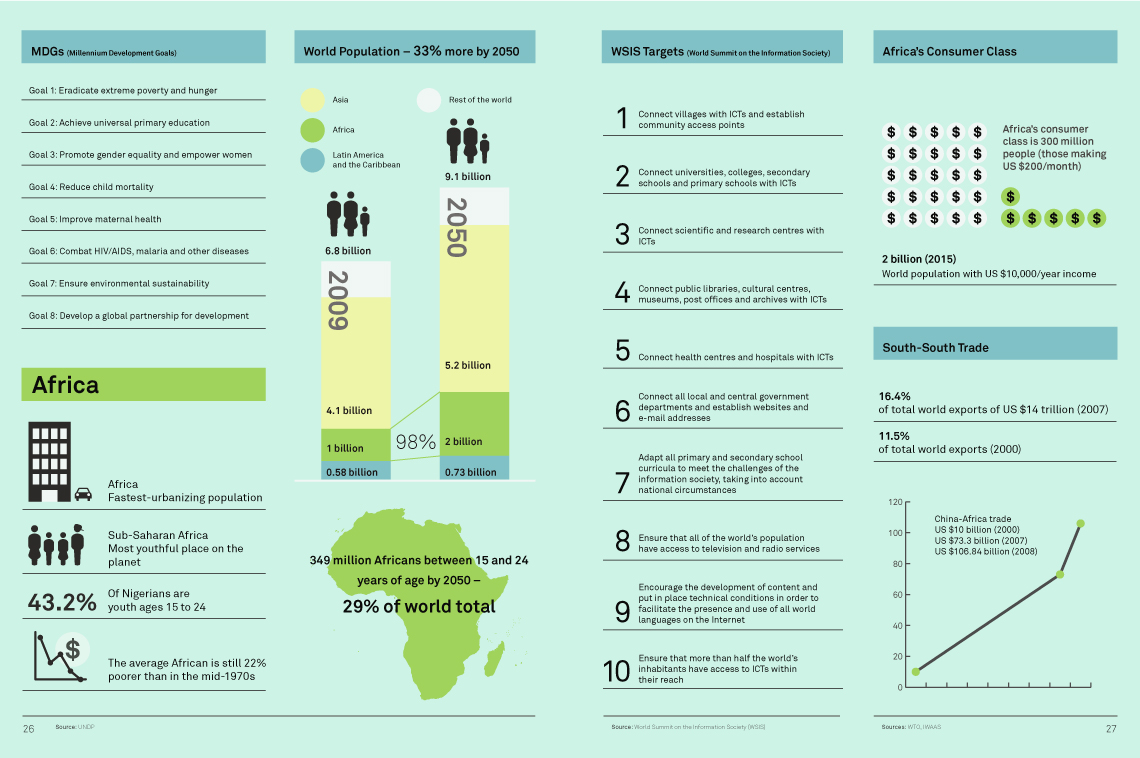
With a billion Africans using just four percent of the world’s electricity (The Economist), energy poverty is already harming further economic growth and development gains. As Africa’s population is expected to double to 2 billion by 2050, the gap between people’s needs and the power available will be stark: in Nigeria, out of 79 power stations, only 17 are working (The Economist). It will take innovators like Ikegwuonu to bring hope to this situation and transform lives despite the obstacles.

Published: December 2011

Resources

1) ToughStuff has developed a modular range of affordable solar powered energy solutions to the three main power needs of poor consumers in the developing world – lighting, mobile phones and radios. Website:www.toughstuffonline.com

2) Solar Power Answers is a one-stop-shop for everything to do with solar power. It has a design manual and guides to the complex world of solar power equipment. Website:www.solar-power-answers.co.uk/index.php

3) How We Made It Africa: A website detailing success stories on businesses investing in Africa and how people are making the most of opportunities on the continent. Website:www.howwemadeitinafrica.com

4) Solar Sister: A clever way to sell solar lamps and torches using a network of women. Website: www.solarsister.org

5) D.light Design: Their lights use LEDs (light emitting diodes) (http://en.wikipedia.org/wiki/LED_lamp) and are four times brighter than a kerosene lantern according to D.Light Design. Website: www.dlightdesign.com

6) Lighting Africa: Lighting Africa, a joint IFC and World Bank program, is helping develop commercial off-grid lighting markets in Sub-Saharan Africa as part of the World Bank Group’s wider efforts to improve access to energy. Lighting Africa is mobilizing the private sector to build sustainable markets to provide safe, affordable, and modern off-grid lighting to 2.5 million people in Africaby 2012 and to 250 million people by 2030. Website: www.lightingafrica.org

7) A list of Nigerian companies selling solar-powered equipment and devices. Website: http://posharp.com/solar-energy-service-companies-in-nigeria-in-alphabetic-order_renewable.aspx?ptype=solar&btype=service&gtype=country_NG&xtype=ntype

Development Challenges, South-South Solutions was launched as an e-newsletter in 2006 by UNDP’s South-South Cooperation Unit (now the United Nations Office for South-South Cooperation) based in New York, USA. It led on profiling the rise of the global South as an economic powerhouse and was one of the first regular publications to champion the global South’s innovators, entrepreneurs, and pioneers. It tracked the key trends that are now so profoundly reshaping how development is seen and done. This includes the rapid take-up of mobile phones and information technology in the global South (as profiled in the first issue of magazine Southern Innovator), the move to becoming a majority urban world, a growing global innovator culture, and the plethora of solutions being developed in the global South to tackle its problems and improve living conditions and boost human development. The success of the e-newsletter led to the launch of the magazine Southern Innovator. 

Creative Commons License

This work is licensed under a
Creative Commons Attribution-Noncommercial-No Derivative Works 3.0 License.

ORCID iD: https://orcid.org/0000-0001-5311-1052.

© David South Consulting 2023