As of 2007, the world became a majority urban place. The largest movements of people in human history are occurring right now, as vast populations relocate to urban and semi-urban areas in pursuit of a better quality of life, or because life has become intolerable where they currently live.
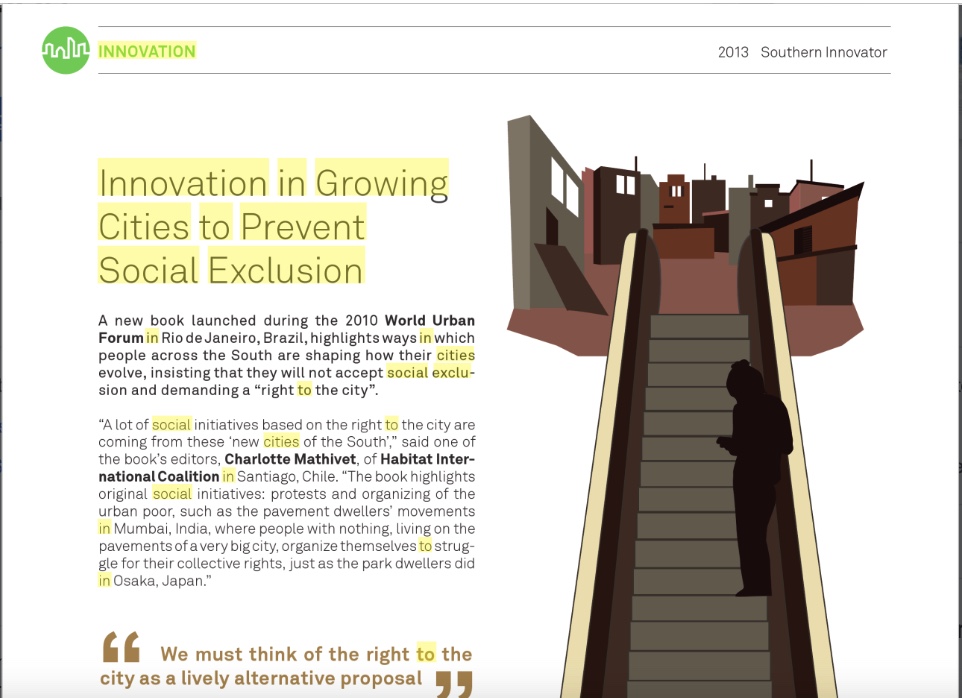
A new book launched during this year’s World Urban Forum in Rio de Janeiro, Brazil highlights ways in which people across the South are shaping how their cities evolve, insisting that they will not accept social exclusion and demanding a “right to the city.”
“A lot of social initiatives based on the right to the city are coming from these ‘new cities of the South,’ said one of the book’s editors, Charlotte Mathivet of Habitat International Coalition in Santiago, Chile. “The book highlights original social initiatives: protests and organizing of the urban poor, such as the pavement dwellers’ movements in Mumbai, India where people with nothing, living on the pavements of a very big city, organize themselves to struggle for their collective rights, just as the park dwellers did in Osaka, Japan.”
The book’s chapters span an eclectic mix of topics, from democracy in the world’s future cities to experiences in Africa’s cities, to how the 2008 Beijing Olympics affected the metropolis, to ways of involving children in urban planning.
One innovative case study included in the book is the children’s workshops in Santiago, Chile, which aim to make a more child-friendly city by including children in the planning process.
One example of the success of a child-friendly approach has been the work of the former mayor of Bogotá, Colombia, Enrique Peñalosa (http://www.pps.org/epenalosa-2/) . As mayor of the city of over 6.6 million people from 1998 to 2001, he put children to the fore in planning.
“In Bogotá, our goal was to make a city for all the children,” he told Yes! magazine. “The measure of a good city is one where a child on a tricycle or bicycle can safely go anywhere. If a city is good for children, it will be good for everybody else. Over the last 80 years we have been making cities much more for cars’ mobility than for children’s happiness.”
His term in office saw the establishment or refurbishing of 1,200 parks and playgrounds, the building of three large and 10 neighbourhood libraries and the opening of 100 nurseries for children under five. He also oversaw the creation of 300 kilometres of bike lanes, the largest such network in the developing world, created the world’s longest pedestrian street, at 17 kilometres, and turned land earmarked for an eight-lane highway into a 45 kilometre green belt path.
Cities for All’s publisher, Habitat International Coalition (HIC) (www.hic-net.org) , says it focuses on the link between “human habitat, human rights, and dignity, together with people’s demands, capabilities, and aspirations for freedom and solidarity.”
The group works towards the creation of a theoretical and practical framework for what it calls a “right to the city.”
The cities of Africa and Asia are growing by a million people a week. If current trends continue, megacities and sprawling slums will be the hallmarks of this majority urban world. Currently in sub-Saharan Africa, 72 percent of the population lives in slum conditions. And by 2015, there will be 332 million slum-dwellers in Africa, with slums growing at twice the speed of cities.
“The consequences have produced a deeper gap between the city and countryside and also within the city between the rich and poor,” said Mathivet.
“We must think of the right to the city as a lively alternative proposal,” Mathivet said, “a banner under which social movements, academics, and social organizations are struggling against the perverse effects of neo-liberalism in cities such as the privatization of land, public spaces and services, land speculation, gentrification, forced evictions, segregation, and exclusion.”
Published: July 2010
Resources
1) Model Village India: Drawing on self-organizing methods used in India since 1200 BC, the Model Village India is based around India’s democratic system of Panchayats: a village assembly of people stemming back to pre-colonial times. Website: www.modelvillageindia.org.in
2) More Urban, Less Poor: The first textbook to explore urban development and management and challenge the notion unplanned shanty towns without basic services are the inevitable consequence of urbanization. Website:www.earthscan.co.uk
3) Building and Social Housing Foundation: The Building and Social Housing Foundation (BSHF) is an independent research organisation that promotes sustainable development and innovation in housing through collaborative research and knowledge transfer. Website: http://www.bshf.org
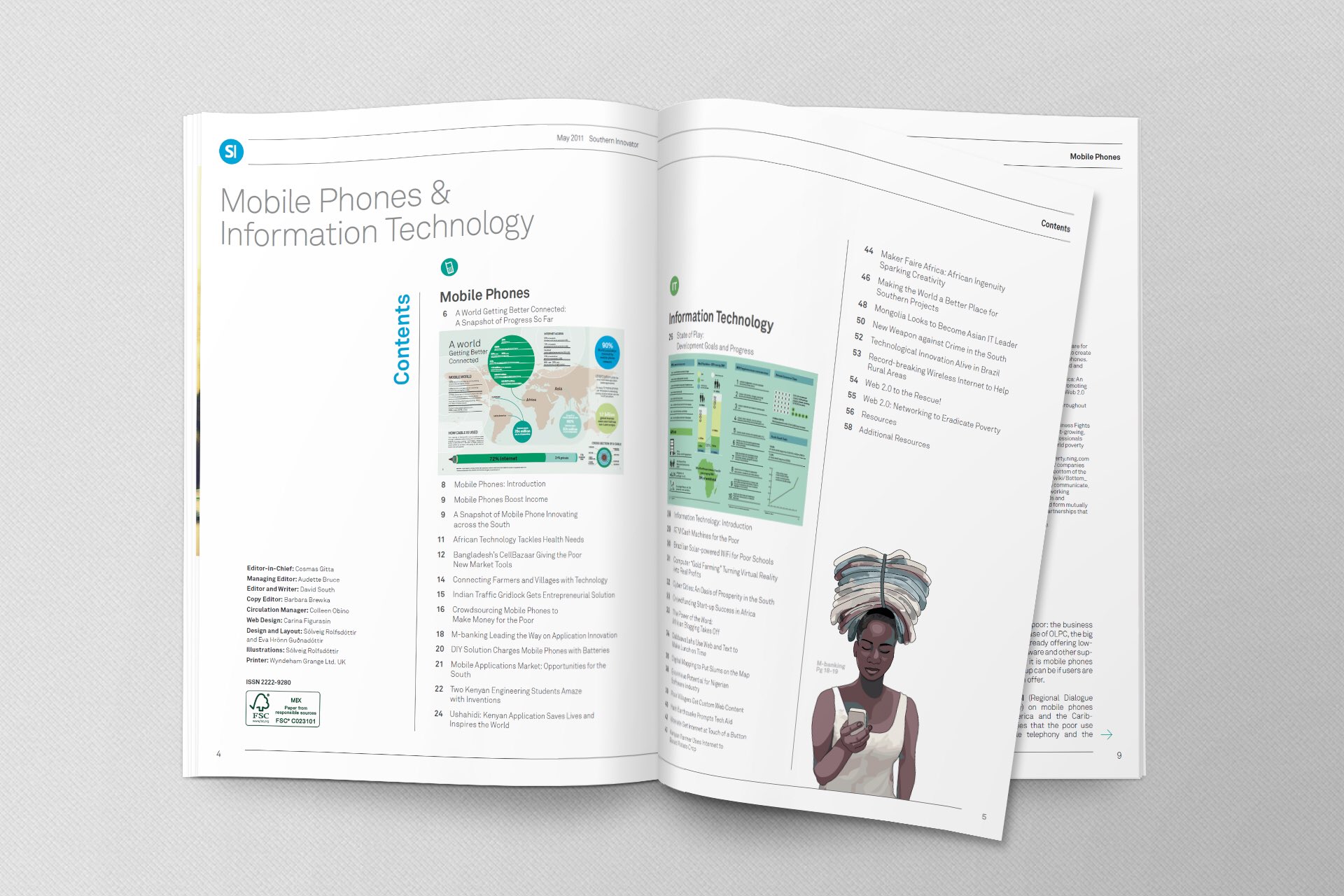
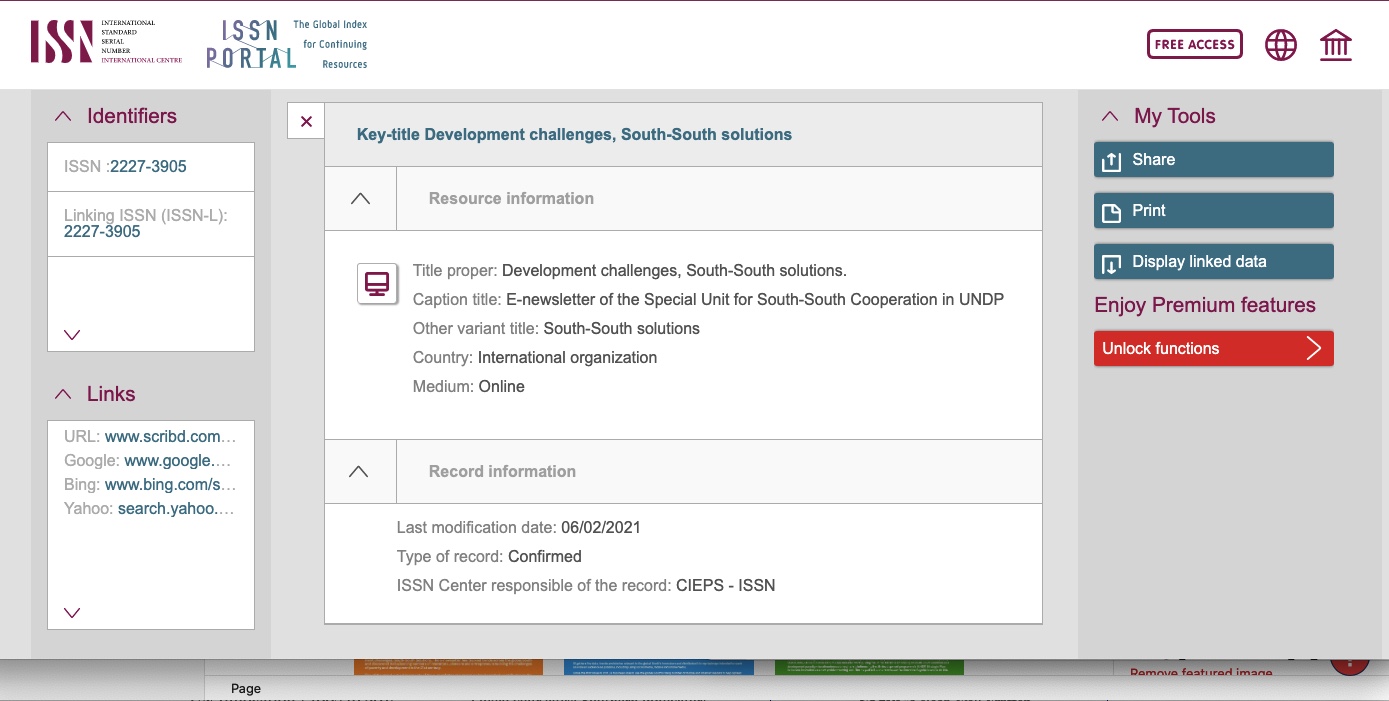
Development Challenges, South-South Solutions was launched as an e-newsletter in 2006 by UNDP’s South-South Cooperation Unit (now the United Nations Office for South-South Cooperation) based in New York, USA. It led on profiling the rise of the global South as an economic powerhouse and was one of the first regular publications to champion the global South’s innovators, entrepreneurs, and pioneers. It tracked the key trends that are now so profoundly reshaping how development is seen and done. This includes the rapid take-up of mobile phones and information technology in the global South (as profiled in the first issue of magazine Southern Innovator), the move to becoming a majority urban world, a growing global innovator culture, and the plethora of solutions being developed in the global South to tackle its problems and improve living conditions and boost human development. The success of the e-newsletter led to the launch of the magazine Southern Innovator.
“Cities for All, recently published by Habitat International Coalition, draws together thinkers and innovators in a compilation of case studies addressing the challenges of inclusive cities in the global South. The book seeks to articulate experiences of South-South cooperation and enhance the links between different regions. David South interviews the co-editor, Charlotte Mathivet.”
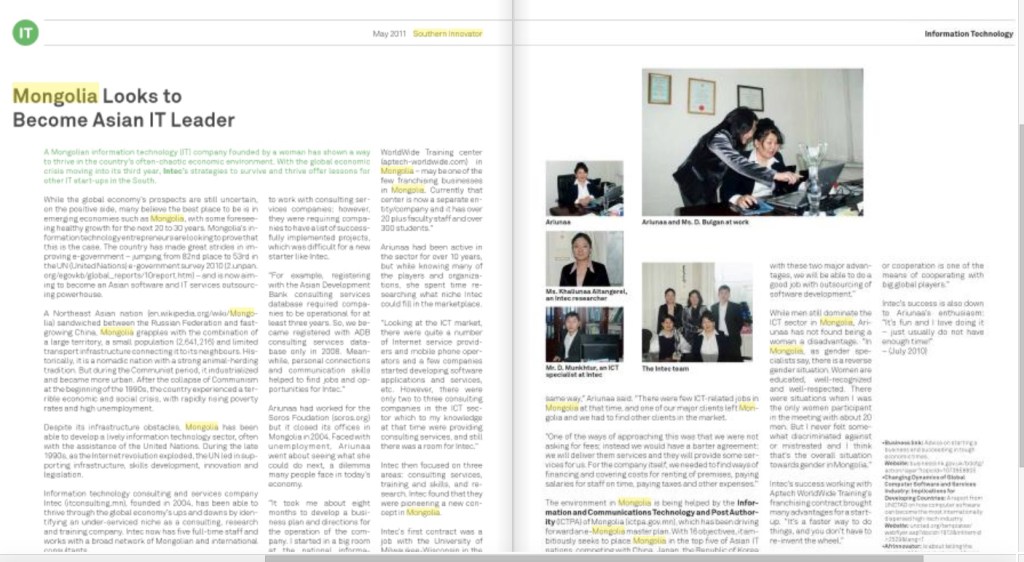
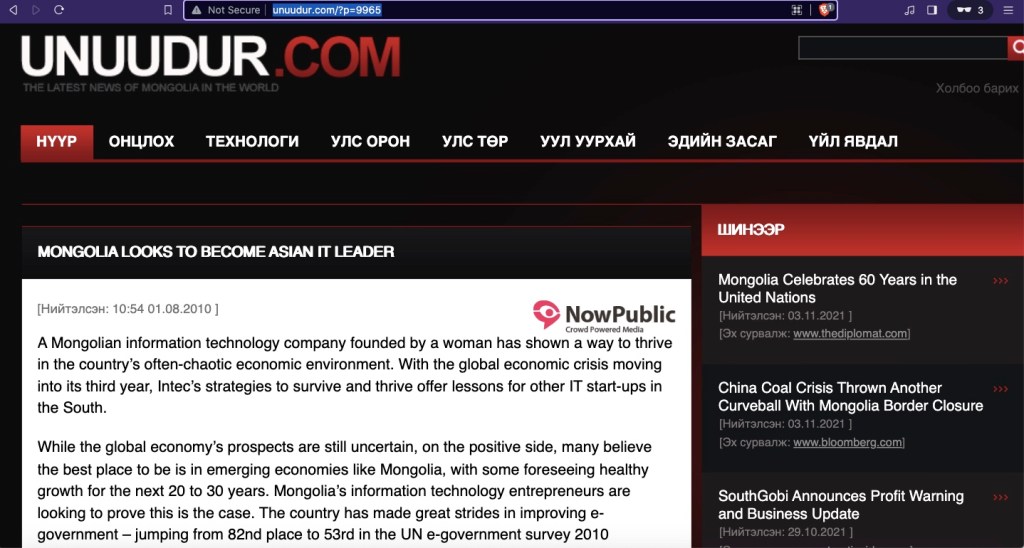
A Mongolian information technology company founded by a woman has shown a way to thrive in the country’s often-chaotic economic environment. With the global economic crisis moving into its third year, Intec’s strategies to survive and thrive offer lessons for other IT start-ups in the South.
While the global economy’s prospects are still uncertain, on the positive side, many believe the best place to be is in emerging economies like Mongolia, with some foreseeing healthy growth for the next 20 to 30 years. Mongolia’s information technology entrepreneurs are looking to prove this is the case. The country has made great strides in improving e-government – jumping from 82nd place to 53rd in the UN e-government survey 2010 (http://www2.unpan.org/egovkb/global_reports/10report.htm) – and is now aiming to become an Asian software and IT services outsourcing powerhouse.
A Northeast Asian nation (http://en.wikipedia.org/wiki/Mongolia) sandwiched between Russia and fast-growing China, Mongolia grapples with the combination of a large territory, a small population (2,641,216) and limited transport infrastructure connecting it to its neighbours. Historically, it is a nomadic nation with a strong animal herding tradition. But during the Communist period, it industrialized and became more urban. After the collapse of Communism at the beginning of the 1990s, the country experienced a terrible economic and social crisis, with rapidly rising poverty rates and high unemployment.
Despite its infrastructure obstacles, Mongolia has been able to develop a lively information technology sector, often with the assistance of the United Nations. During the late 1990s, as the internet revolution exploded, the UN led on supporting infrastructure, skills development, innovation and legislation.
Information technology consulting and services company Intec (www.itconsulting.mn) , founded in 2004, has been able to thrive through the global economy’s ups and downs by identifying an under-serviced niche as a consulting, research and training company. Intec now has five full-time staff and works with a broad network of Mongolian and international consultants.
As is often the case with new businesses, Intec initially found that many doors were closed to start-up enterprises.
“The major challenges which I faced were to make people understand about the consulting services,” said Intec’s founder, Lkhagvasuren Ariunaa. “The consulting services concept was new to Mongolia and Mongolians at that time and not many organizations were willing to work with consulting services. The international and donor organizations were keen to work with consulting services companies; however, they were requiring companies to have a list of successfully implemented projects, which was difficult for a new starter like Intec.
“For example, registering with the Asian Development Bank consulting services database required companies to be operational for at least three years. So, we got registered with ADB consulting services database only in 2008. Meanwhile, personal connections and communication skills helped to find jobs and opportunities for Intec.”
Ariunaa had worked for the Soros Foundation (http://www.soros.org/) but it closed its offices in Mongolia in 2004. Faced with unemployment, Ariunaa went about seeing what she could do next: a dilemma many people face in today’s economy.
“It took me about eight months to develop a business plan and directions of operation of the company. I started in a big room at the national information technology park building with one table, chair and computer.
“It has been quite challenging years for bringing a company to the market and finding niches for us. We have franchised the Indian Aptech WorldWide Training center (http://www.aptech-worldwide.com) in Mongolia – may be one of the few franchising businesses in Mongolia. Currently that center is now a separate entity/company and it has over 20 plus faculty staff and over 300 students.”
Ariunaa had been active in the sector for over 10 years, but while knowing many of the players and organizations, she spent time researching what niche Intec could fill in the marketplace.
“Looking at the ICT market, there were quite a number of internet service providers, mobile phone operators, a few companies started developing software applications, and services etc. However, there were only two to three consulting companies in the ICT sector which to my knowledge at that time were providing consulting services, and still there was a room for Intec.”
Intec then focused on three areas: consulting services, training and skills, and research. Intec found they were pioneering a new concept in Mongolia.
Intec’s first contract was a job with the University of Milwaukee-Wisconsin in the United States to organize a three week course for American students to learn about the digital divide in Mongolia. But the global economic crisis hit Mongolia hard in 2009.
“It was challenging to survive and continue working the same way,” Ariunaa said. “There were few ICT-related jobs in Mongolia at that time, and one of our major clients left Mongolia and we had to find other clients in the market.
“One of the ways of approaching this was that we were not asking for fees, instead we would have a barter agreement – we will deliver them services and they will provide some services for us. For the company itself, we needed to find ways of financing and covering costs for renting of premises, paying salaries for staff on time, paying taxes and other expenses.”
The environment in Mongolia is being helped by the Information and Communications Technology and Post Authority (ICTPA) of Mongolia (http://www.ictpa.gov.mn) , which has been driving forward an e-Mongolia master plan. With 16 objectives, it ambitiously seeks to place Mongolia in the top five of Asian IT nations, competing with South Korea, Singapore, Japan and China.
Ariunaa believes Mongolia has many competitive advantages. “Mongolia is known for a high-literacy rate and math-oriented training and education, and ICT specialists are targeting to become a software outsourcing country for other countries. Another advantage of Mongolians is that they can easily learn other languages: we are fluent in Russian, English, Japanese, Korean, German and we believe that with these two major advantages, we will be able to do a good job with outsourcing of software development.”
While men still dominate the ICT sector in Mongolia, Ariunaa has not found being a woman a disadvantage. “In Mongolia, as gender specialists say, there is a reverse gender situation. Women are educated, well-recognized and well-respected. There were situations, when I was the only women participant in the meeting with about 20 men. But I never felt somewhat discriminated or mis-treated and I think that’s the overall situation towards gender in Mongolia.”
Intec’s success working with Aptech WorldWide Training’s franchising contract brought many advantages for a start-up. “It’s a faster way to do things, and you don’t have to re-invent the wheel.”
As a Mongolian company, Intec has found it best to play to its local strengths. “National companies have knowledge, expertise and experience of local situations, know players and understand about legal, regulatory matters. … partnership or cooperation are one of the means of cooperating with big global players.”
Intec’s success is also down to Ariunaa’s enthusiasm: “It’s fun and I love doing it – just usually do not have enough time!”
2) Changing Dynamics of Global Computer Software and Services Industry: Implications for Developing Countries: A report from UNCTAD on how computer software can become the most internationally dispersed high-tech industry. Website:http://www.unctad.org/templates/webflyer.asp?docid=1913&intitemid=2529&lang=1
3) Afrinnovator: Is about telling the stories of African start-ups, African innovation, African made technology, African tech entrepreneurship and entrepreneurs. Their mission is to ‘Put Africa on the Map’ by covering these kinds of stories from all over Africa. As their website says, “if we don’t tell our own story, who will tell it for us?” Website:http://afrinnovator.com
4) TechMasai: Pan-African start-up news and reviews. Website: www.techmasai.com
Development Challenges, South-South Solutions was launched as an e-newsletter in 2006 by UNDP’s South-South Cooperation Unit (now the United Nations Office for South-South Cooperation) based in New York, USA. It led on profiling the rise of the global South as an economic powerhouse and was one of the first regular publications to champion the global South’s innovators, entrepreneurs, and pioneers. It tracked the key trends that are now so profoundly reshaping how development is seen and done. This includes the rapid take-up of mobile phones and information technology in the global South (as profiled in the first issue of magazine Southern Innovator), the move to becoming a majority urban world, a growing global innovator culture, and the plethora of solutions being developed in the global South to tackle its problems and improve living conditions and boost human development. The success of the e-newsletter led to the launch of the magazine Southern Innovator.
Launched in 1997 in a major crisis, the UN Mongolia Development Portal (www.un-mongolia.mn) became the country’s largest online bilingual publisher and an award-winning pioneer of web content. It proved Mongolia had the potential to innovate in digital.Story featured in the UN E-Government Knowledgebase and E-Government Survey in Media.Posted in 2010 on the Unuudur.com (“The latest news of Mongolia in the world”) website.
The screensaver on an Undercurrents researcher’s computer terminal bears a maxim that might strike a chord in a lot of CBC units these days: “Only the paranoid survive.”
The quirky media and technology show will fade to black at the end of March. Its cancellation raises a host of issues for a CBC deeply troubled by budget cuts, an ageing audience, a dearth of alternative programme concepts and an inability to plan for a future.
In the show’s pilot, Wendy Mesley – Undercurrents’ host and progenitor – set the tone for this accessible look at the relationship among technology, media and society: “Like it or not we are living in a wired world where OJ Simpson, Big Brother, even your bank machine, all converge … we’ll explore all the issues, the undercurrents of the information age.”
To those who loved it, Undercurrents was a program that satisfied a vital public need, and an ambitious concept for a public broadcaster that some say had grown a little musty. The show promised avant-garde production and investigative journalism that critically explored today’s new media and technology culture. Youngish researchers and producers were hired from outside the CBC. They brought with them experience and new ideas from specialty channels, TV Ontario and CTV. Some came straight out of journalism school.
Critical reaction to the first programs was mixed. John Doyle, a critic with the Globe and Mail’s Broadcast Week, lauded Undercurrents when it launched, calling it “a superb example of solid CBC-TV journalism and original reporting.” Others were less flattering. The Toronto Star’s Greg Quill accused the show of “flirting with infotainment.” At the Vancouver Sun, Alex Strachan wasn’t impressed by a report on a weekend conclave of computer geeks in the California desert for a kind of Hackerstock. “It sounds interesting,” he wrote, “but it isn’t.”
What hurt more was schedulers playing musicial chairs with the show’s slot. Switching Undercurrents from Tuesday at 7 pm to Friday at 7 pm midway through its life left viewers confused and sent ratings plummeting just as network programmers were casting about for places to apply a whopping 30 percent budget cut. As a result, some feel the show never had a fighting chance.
In the end, it was the show’s precarious financial arrangement that killed it. Undercurrents was never funded from the general current affairs budget. Instead, it drew on a special reserve of cash created by the network. When it came time to mete out the cuts in December, the special funding bubble burst. Rather than cut further into the budgets of flagship current affairs programs, executives chose to drop Undercurrents.
Executive producer Frances Mary (FM) Morrison acknowledges that gratitude for her program’s special funding obscured a recognition of its fragility. “That was really our Achilles heel,” she says. “We were just this little orphan that didn’t have its own money. We weren’t adopted into the larger family.”
With the network funding gone, Undercurrents’ budget (rumoured to be over a million dollars per season) was nowhere to be found. Discussions about chasing a corporate sponsor went nowhere because the show needed more money than any sponsor could have provided. “It was never an issue of $100,000 or $200,000,” says Morrison. “It was the issue of our entire budget. [CBC] would still have had to come up with the rest of it.”
CBC TV’s news, current affairs and Newsworld director Bob Culbert and former current affairs head Norm Bolen both say they wanted the show to stay on the air but couldn’t find a way to fund it withou seriously hurting programs like The Fifth Estate, Marketplace and Venture.
Bolen, now VP of programming at the History and Entertainment Network, says it came down to choosing between The Health Show and Undercurrents. The Health Show won because it had a “bigger audience, a broader demographic and was bringing in revenue from sales of programming to the specialty channels.”
Mesley has another theory. “The majority of people who worked on this programme are not traditional CBCers… They can’t bump, they don’t get huge severance packages. Of course, if you want a future, those are the wrong reasons for letting people go.”
With its intensive focus on issues like the abuse of computer-morphed images, surreptitious “data-mining” of consumer purchase records, or media “freebies,” there’s no question that Undercurrents has met a need in this media-saturated world. But controversy over the cancellation centres on the age-old question of CBC and the youth audience.
Morrison and Mesley both say they intended the show to appeal to a younger-than-usual CBC audience. But CBC executives weren’t convinced it was an audience the network could, or should, go after. According to Culbert, a youth mandate was something the production team brought to Undercurrents. “It started as a media ethics show targeted at a classic CBC audience. Nobody sat around one day and said ‘let’s invent the show that will go after younger viewers.’”
Bolen expresses a profound lack of faith in the under-30 audience. “People under 30 don’t watch information programming, okay? Let’s get that straight. I sure wouldn’t spend the rest of my life trying to get an audience that doesn’t watch a certain genre of programming. This is a business where you pay attention to reality. People under 30 watch trashy American sitcoms, which I’m not in the business of doing, and which the CBC isn’t in the business of doing.”
“I think that’s bullshit,” says Reid Willis, producer and director of CityTV’s Media Television. “People under 30 are interested in what’s going on in the media. The 20 to 30 group is more media savvy than the generation that preceded them.” But Willis thinks the lack of information programming pitched at a young audience is down to a lack of interest from advertisers.
Mesley and Morrison remain convinced Undercurrents did appeal to a younger audience, but felt it was sabotaged by the schedule shuffling. In the show’s first slot, Tuesdays at 7 pm, its average audience was 499,000. The biggest night came on Sunday, October 22, 1995 when a repeat aired at 9:30 pm got an audience of 865,000. But Undercurrents’ debut in the 96/97 season in its new 7 pm slot on Fridays was demoralizing for the crew. Morrison reports the audience for the season opener at 438,000 and 434,000 for a strong programme the following week.
She says the numbers built as audiences found the programme’s new location, peaking at 678,000 on December 6. According to CBC audience research figures, average minute audience for the 96/97 season to February 2 stood at 518,000 viewers.
“Friday at seven was not a good place for Undercurrents,” claims Morrison. “It’s an older audience. In fact the audience for Air Farce [which followed Undercurrents at 7:30] is quite old, surprisingly old. I was actually astonished to find out how old that audience was.”
CBC audience research bears Morrison out, reporting that the 18-34 demographic for both Air Farce and Undercurrents has been identical this season – a mere 14 percent of the total audience.
Fridays at seven is also a heavily competitive slot packed with overhyped American tabloid TV shows like Entertainment Tonight, Inside Edition, Hard Copy and A Current Affair. Morrison says focus groups told her that audiences in that time period surf around looking for stories they like and then switch around with no loyalty to a particular programme.
“People build a menu. We took a leaf out of the tabloid book in terms of our presentation in order to survive in the seven o’clock environment.”
Undercurrents’ jerky camera work and flashy graphics didn’t endear itself to everyone, a fact the show’s producers recognized early on. “I can point to stories where we sabotaged ourselves with stylistic extremes,” admits Morrison.
But Mesley bristles at accusations the show was all style and no content, or a clone of Media Television. “We are the antithesis of Media Television. Obviously everyone has adopted their style from rock videos. But they get nearly all their video as handouts. We are not saying, ‘This is hip.’ We are not saying, ‘This is the latest consumer thing you can add to your collection.’ We are saying ‘Think about this.’”
Undercurrents’producers express pride in the show’s innovations. They cite its lead role in web page design at the corporation., its efforts at promoting a more playful visual presentation, and its success in promoting an acceptance of media stories elsewhere in news and current affairs. But what seemed to enliven everyone interviewed for this story was a love of the public broadcasting ethos, where stories are told because they are important, not because advertisers say they are important. Many of the young researchers and producers at Undercurrents had done time at the privates, and appreciated the freedom and extensive resources offered by the CBC. But they felt they had come to a CBC whose values were in peril.
“It will be like C-SPAN here,” quipped an Undercurrents freelancer who has done time at the specialty channels.
Others who thrived in the upbeat atmosphere at Undercurrents say they’re not too keen to look for work elsewhere in the CBC. One such is 25-year-old researcher Bret Dawson. “It’s not a happy place,” he says.
It’s not clear what, if any, programming will replace Undercurrents. If the current trend prevails, it looks like any new programming will have to survive on a smaller budget, generate outside income and prove it can draw in viewers in short order. Under those conditions, people at Undercurrents and elsewhere wonder how long CBC’s commitment to innovative new programming can hold out.
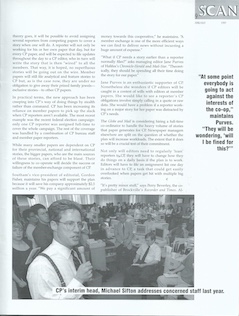
CBC TV’s Undercurrents host Wendy Mesley. Scan Magazine was published in the 1990s for Canadian media professionals.
In 2021 Wendy Mesley commented on the story in a Tweet.
Dabbawallahs Use Web and Text to Make Lunch on Time Development Challenges:The developing world’s rapidly growing cities are bringing with them whole new ways of living and working. One rapidly expanding category of citizen is the office worker. A symbol of growing prosperity, the office worker also tends to be a time-poor person who often must commute large distances between home and workplace.
Flurry of Anti-poverty Innovations Development Challenges: Innovation is key to transforming the lives of the world’s four billion poor. And it is at the core of much of the new thinking these days. While the world’s poor can’t rely on political developments, or wider macro-economic events to go their way, they can harness the power of invention, innovation and self-reliance to make big changes in the quality of their lives and increase income – and so can those who want to help them.
Local Animation: A Way Out of Poverty Development Challenges: One of the more remarkable creative developments since 2000 has been the explosion in animation production in the developing world, in particular Asia. Once seen as frivolous or unnecessary, animation is now acknowledged as a high-growth area and a critical component in the emerging economies being shaped by information technology.
Mobile Phones Bring the Next Wave of New Ideas from the South Development Challenges: The rapid growth in take-up has made mobile phones the big success story of the 21st century. With such reach, finding new applications for mobile phones that are relevant to the world’s poor and to developing countries is a huge growth area. It is estimated that by 2015, the global mobile phone content market could be worth over US $1 trillion: relegating basic voice phone calls to just 10 per cent of how people use mobile phones.
November
Mountain People: Innovative Ways to Help the World’s Most Vulnerable Development Challenges: Physically isolated and socially and politically marginalized, mountain dwellers are among the most vulnerable in the world, according to the Food and Agriculture Organization. A disproportionate number of the world’s 840 million chronically undernourished people live in highland areas — about 270 million mountain people lack food security, with 135 million suffering chronic hunger. Large numbers of additional people in lowland areas also depend on mountains.
Saving the Amazon Forest While Making a Living Development Challenges: The vast Amazon rainforest straddles Brazil (over half is there), and stretches over many countries, including Peru, Ecuador and Bolivia. It holds more than 2,500 tree species and 30 per cent of all known plant species – 30,000 in all. It contains the world’s largest tropical forest national park, Brazil’s Tumucumaque Mountains National Park(http://www.amazon-rainforest.org/places-of-interest.html).
Africa’s Fast-Growing Cities: A New Frontier of Opportunities Development Challenges: According to a new report by the International Institute for Environment and Development, Africa now has a larger urban population than North America and 25 of the world’s fastest growing big cities. Europe’s share of the world’s 100 largest cities has fallen to under 10 percent in the past century.
Turning Street Children into Entrepreneurs Development Challenges: The UN estimates that 500 million people around the world are homeless, and UNICEF estimates India alone has 11 million homeless children on its streets (though it is difficult to pin down the figure). In order to survive another day, these children will work in one way or another.
October
African Culture as Big Business Development Challenges: In the last decade the world’s creative industries (including crafts, fashion and design) have gained greater respect for being the spark that drives economic development and entrepreneurship. They are seen as fast growers and good job creators, and importantly, the lynch pin in cultural identity and cultural diversity.
Next Generation of Innovation for the Grassroots Development Challenges: Taking inspiration from science fiction sagas like the TV show Star Trek, the next generation of innovation is already taking shape in the South. A group of innovative facilities called Fab Labs (short for Fabrication Laboratory) in Ghana, India, Kenya, South Africa and Costa Rica are applying cutting-edge technology to address the everyday needs of people.
Ecotourism to Heal the Scars of the Past Development Challenges: The legacy of underdevelopment during the communist era in parts of Eastern Europe is now being seen as an advantage in the global tourism trade. Well off the beaten path for tourists, areas as diverse as Chechnya and Romania are working to turn their rustic rural hinterlands into a strategic advantage in grabbing the market for ecotourists.
Popular Characters Re-invent Traditional Carving Development Challenges: The popular cartoon characters from the long-running series The Simpsons are breathing new life into traditional African stone carvings.
September
African Breakthroughs To Make Life Better Development Challenges: In the last 50 years, the domestication of high technology – bringing cheaper access to everything from personal computers to digital cameras and applications like global positioning systems (GPS) – has transformed millions of lives and the way business is done. In the next 50 years, biotechnology is set to do the same.
Traditional Medicine is now a Proven Remedy Development Challenges: Once dismissed as old fashioned, ineffective and unscientific, traditional medicine is now seen as a key tool in bringing healthcare and healing to poor people bypassed by existing public and private health measures.
Mobile Phones: Engineering South’s Next Generation of Entrepreneurs Development Challenges: Technology is fuelling unprecedented growth in productivity in Asia, with sub-Saharan Africa languishing behind (International Labour Organization). But the growth in mobile phones could help close this gap, as home-grown entrepreneurs are stepping up to exploit this new opportunity.
Saving Water to Make Money Development Challenges: The world’s water supplies are running low, and according to the World Health Organisation (WHO), four out of every 10 people are already affected. But despite the gloomy reality of this problem, entrepreneurs in the South are rising to the challenge to save water.
August
Social Franchising Models Proving Poor Bring Profits Development Challenges: The four billion people in the world who live on less than US $2 a day have been described as the bottom of the economic pyramid, or BOP for short. In his book The Fortune at the Bottom of the Pyramid, Indian business consultant and professor CK Prahalad argues that this attitude must be turned on its head: rather than seeing the world’s poor as a burden, only worthy of charity, Prahalad sees nothing but opportunity and unmet needs that business can address.
Cooking up a Recipe to End Poverty Development Challenges: Like music, food has a powerful ability to jump across cultural and regional barriers and unite people in the sheer pleasure of the meal. Tapping the rich vein of regional culinary heritages is also a great way to make money. Promoting local recipes and foods has other benefits: as the global obesity (or globesity as WHO calls it) epidemic reaches into the urban areas of cities in the developing world, anything that pulls people away from fast food and high-fat foods is a good thing. Doctors have found home cooking keeps people thin and is better for them.
The Power of the Word: African Blogging and Books Development Challenges: “Culture is not a luxury … Culture is the spiritual backbone of society”: with these words Jan Kees van de Werk, the Dutch poet and long-standing advocate of African literature, summed up the importance of culture to Africa’s development. Two trends could significantly alter the prospects for African writers in 2007: the new wave of African bloggers and websites that are now emerging, and the increasing awareness of African literature.
Online Free Knowledge Sharing Development Challenges: UNESCO’s Kronberg Declaration on the Future of Knowledge Acquisition and Sharing is blunt: the future of learning will increasingly be mediated by technology, and traditional educational processes will be revolutionized. Acquiring factual knowledge will decrease and instead people will need to find their way around complex systems and be able to judge, organize and creatively use relevant information.
July
Banning of Plastic Bags and Containers Brings New Opportunities Development Challenges: This month, Uganda bans plastic bags, outlawing their import, manufacture and use and joining a growing list of African countries seeking to sweep cities of this menace. Uganda’s ban follows similar moves in Kenya and in Tanzania, where even plastic drinks containers will soon be banished.
Record-breaking Wireless Internet to Help Rural Areas Development Challenges: Many initiatives seek to bring inexpensive access to the internet to rural and remote regions around the world. One of the most successful ways to rapidly expand access is to offer wireless internet so that anyone can use a laptop computer, a PC or a mobile phone to quickly access the Net. Access to wireless internet is being rolled out in cities around the world with so-called ‘hot spots’, but the thornier issue of improving access in rural or remote regions could get better, thanks to a Venezuelan team.
A New House Kit for Slum Dwellers that is Safe and Easy to Build Develoment Challenges: By 2030, some 5 billion people around the world will live in cities. Next year, 2008, is predicted to be the tipping point, when urban dwellers (3.3 billion people) will outnumber rural residents for the first time. These are the conclusions of UNFPA’s State of the World Population 2007 Report. Even more strikingly, the cities of Africa and Asia are growing by a million people a week. And 72 percent of the population in sub-Saharan Africa live in slum conditions.
Afro Coffee: Blending Good Design and Coffee Development Challenges: The importance of good design and a strong brand in the success of a business cannot be emphasised enough. That extra effort and thought can take a business from local success to regional and even global success. As consultants KPMG make clear, “For many businesses, the strength of their brands is a key driver of profitability and cash flow “. Yet the majority of small businesses fail to think about their brand values or how design will improve their product or service.
June
African Entrepreneur Wants to Bring Order to Urban Chaos Development Challenges: All over the global South, urban and semi-urban areas are growing at a furious pace. Great swathes of mega-regions – places where large cities blend seamlessly into smaller towns and villages creating a giant economic hub – are becoming key economic and opportunity drivers in developing countries.
Entrepreneurs Use Mobiles and IT to Tackle Indian Traffic Gridlock Development Challenges: Around the world, traffic congestion is often accepted as the price paid for rapid development and economic dynamism. But as anyone who lives in a large city knows, a tipping point is soon reached where the congestion begins to harm economic activity by wasting people’s time in lengthy and aggravating commuting, and leaving them frazzled and burned out by the whole experience.
Web 2.0 to the Rescue! Using Web and Text to Beat Shortages in Africa Development Challenges: The beep-beep of a received text on a mobile phone is now becoming a much-needed lifeline to Africans. Zimbabweans, who continue to struggle every day with inflation that has shot to 3,731 percent (Zimbabwe Central Statistical Office), have usd African ingenuity and 21st century technology to survive another day.
Bio-ethanol From Sturdy and Once-Unwanted Indian Plant Development Challenges: With awareness of global warming at an all-time high – and governments seeking real-world solutions to solve this enormous problem – bioethanol fuel has risen up the agenda as a replacement for conventional fuel sources. At present, most bioethanol fuel is produced from either corn or sugar but a less known plant jatropha could be the real solution. Brazil has been a pioneer in producing bioethanol fuel from sugar, while the United States has focused on its substantial corn crop as a source, and both contribute more than half the world’s supply.
May
Youth Surge in the South A Great Business Opportunity Development Challenges: The world’s youth population (those between the ages of 12 and 24) has now reached a historical high of 1.5 billion – 1.3 billion of whom are in developing countries (World Development Report 2007). Nearly half of the world’s unemployed are youth, and the Middle East and North Africa alone must create 100 million jobs by 2020 to meet demand for work.
Old Adage Gets New Life Development Challenges: Education is recognized as critical for development and improving people’s lives. Universal primary education is a Millennium Development Goal and countries are now allocating more funds for primary education across the global South. However, the options available to youth after primary education are often very limited.
Safe Healthcare is Good Business and Good Health Development Challenges: Many people have been shocked by recent stories about the proliferation of counterfeit drugs and the rate at which they are killing and harming people in Nigeria. The International Narcotics Control Board found that up to 50 percent of medicines in developing countries are counterfeit. This has driven home the point that without the presence of legitimate players in the African drug market, the illegal sharks will step in to make large profits – and a literal killing.
April
Creative and Inventive Ways to Aid the Global Poor Development Challenges: As the saying goes, “necessity is the mother of invention”. Poverty can be a major spur to invention, and invention a route out of poverty – but only if the poor in the developing world can get the recognition, capital and support for navigating the legal and bureaucratic hurdles that will inevitably stand in their way. Thankfully many new initiatives acknowledge this.
Kiva: New Gateway of Loans for the PoorDevelopment Challenges: The rise of social networking websites has created new opportunities for the poor to gain access to much needed credit. Kiva.org is pioneering a new way for entrepreneurs in the South to obtain for their businesses unsecured, no-interest financing from lenders worldwide. By just a click of the mouse a person anywhere in the world can lend as little as $25 or more to aspiring entrepreneurs in developing countries.
Innovation from the Global South Development Challenges: A major study has documented a rising tide of scientific innovation coming from Asia’s fast-developing countries, especially India and China. Conducted over 18 months by UK-based think tank Demos, it challenges the conventional wisdom that scientific ideas come from the top universities and research laboratories of large companies based in Europe or the US. It found ideas emerging in unexpected places, flowing around the world conveyed by a mobile diaspora of knowledge workers from the South.
Creative Use of Wi-Fi to Reach the Poor Development Challenges: In 2003 former UN Secretary-General Kofi Annan called for greater access to wi-fi, or wireless internet networks, as a mechanism to help poorer regions catch up with the pace of technological change in developed countries. Wireless networks remove the need to lay costly wires and can quickly bring fast and convenient internet access to large populations currently denied access. By removing the need to lay lots of cables to get communities online, wireless could help poorer nations narrow the digital divide and catch up with countries where the technology has already taken hold. Social entrepreneurs are stepping in to fill the gap between the promise of wi-fi and the reality.
March
Trade to Benefit the Poor Up in 2006 and to Grow in 2007 Development Challenges: The global fair trade market – in which goods and services are traded under the Fairtrade logo, guaranteeing a minimum fair price to producers experienced unprecedented growth in 2006. In the UK alone, 2006 sales totalled £290 million – a jump of 46 percent from 2005. The Fairtrade Foundation predicts sales will reach UK £300 million in 2007.
Business as a Tool to Do Good Development Challenges: The United States’ fast-paced and highly inventive technology sector is re-shaping philanthropy and proving it is possible to do good and make money at the same time. The approach taken by these philanthropists is flavoured by their experiences in the cut-throat world of technology, where innovation is a necessity and where re-invention and risk are de rigeur. They share many of these qualities, counter intuitively, with millions of the world’s poor as they struggle day in and day out to survive and get ahead.
Social Networking Websites: A Way Out of Poverty Development Challenges: Social networking websites also known as, Web 2.0 – the name given to the new wave of internet businesses and websites such as YouTube and MySpace that are transforming the way people interact with the Web – has been dubbed the social web for its power to bring people together.
Fashion Closes Gap Between Catwalk and Crafts Development Challenges: The notion of doing right with fashion has been getting a make-over in the past few years. In the West, non-sweatshop clothing and crafts from developing countries have long been confined to a small niche in the marketplace. They were seen at best as garments for the eccentric or unconventional, and at worst as a poor substitute for clothing and accessories peddled by the major manufacturers. Organic or ethically produced products were often stigmatized as unfashionable and frumpy.
February
Dynamic Growth in African ICT is Unlocking Secrets of SME Treasure Trove Development Challenges: A newly released survey of 14 African countries in 2006 has documented the impact of Information and Communication Technology (ICT) on private sector development and how it is contributing to developing a vibrant Small Medium Enterprise (SME) sector in Africa. It discovered how dynamic the SME sector is, how it has rapidly adopted mobile phone technology (96 percent have it), and how if used properly in concert with this new technology, extraordinary economic growth is possible.
Grassroots Entrepreneurs Now Have Many Ways to Fund their EnterprisesDevelopment Challenges: In the past, African entrepreneurs were extremely limited in the options for funding their plans. They had to rely on often ineffective national banks or local networks based on political, tribal or family connections to secure funding for enterprises. That has now changed, and there is an explosion in new thinking on business start-ups and how best to help grassroots entrepreneurs.
African Tourism Leads the World and Brings New Opportunities Development Challenges: Tourism around the world is growing rapidly again after the setbacks caused by the September 11, 2001 terrorist attacks. Tourism is also finally acknowledging Africa – home to 888 million people (2005, UN) – and where 46 percent of sub-Saharan Africa’s people live on less than US$1 a day. Led by Kenya and South Africa, the continent has come out on top in world tourism growth according to the United Nations World Tourism Organisation (UNWTO) (http://www.unwto.org/). While global tourism is forecast to grow by four percent in 2007, Africa as a whole enjoyed growth of 10.6 percent in 2006.
Securing Land Rights for the Poor Now Reaping Rewards Development Challenges:The hotly debated issue of land rights for the poor has never been more relevant. There is mounting evidence that access to land rights can catapult the poor out of poverty and spur growth for the economy. Experience in India and China is now showing the economic power unleashed when the poor gain full legal rights over their land.
January
New Battery Back-up Technology Targeting Developing Countries and Remote Regions Development Challenges: Africa’s greater global engagement and economic growth in the past few years has started to draw attention back towards the continent’s dearth of reliable power sources and inadequate power infrastructure. While demand grows at a fast pace, sadly political instability and lack of security in many countries scares off foreign investors and multinational companies who could help to expand capacity.
Computing in Africa is Set to Get a Big Boost Development Challenges: The image of Africa as a technological laggard is set to be seriously challenged as a number of developments converge in 2007. Alongside the booming African mobile phone market – itself now getting global attention for innovation – the African computer scene will soon have both the software and hardware that acknowledge the continent’s unique needs while being affordable.
Ring Tones and Mobile Phone Downloads are Generating Income for Local Musicians in Africa Development Challenges: African musicians hoping to support themselves through their recordings have always had to contend with the added burden of poor copyright control over their work. While musicians in the West are supported by a highly regulated regime of copyright protection – ensuring some to become the richest people in their respective countries – most African musicians have had to stand back and watch their work being copied, sold and exchanged with little chance of seeing any royalties.
Carbon Credits Can Benefit African Farmers Thanks to New System Development Challenges: The global carbon credit trading schemes emanating from the Kyoto Protocol are now creating a multi-billion dollar market – the European carbon market was worth €14.6 billion in 2006 – and represents one of the fastest growing business opportunities in the world. Being green has finally come of age. Yet all the benefits of this are largely bypassing Africa despite more than 70 percent of the continent’s inhabitants earning a living off the land.
Development Challenges, South-South Solutions was launched as an e-newsletter in 2006 by UNDP’s South-South Cooperation Unit (now the United Nations Office for South-South Cooperation) based in New York, USA. It led on profiling the rise of the global South as an economic powerhouse and was one of the first regular publications to champion the global South’s innovators, entrepreneurs, and pioneers. It tracked the key trends that are now so profoundly reshaping how development is seen and done. This includes the rapid take-up of mobile phones and information technology in the global South (as profiled in the first issue of magazine Southern Innovator), the move to becoming a majority urban world, a growing global innovator culture, and the plethora of solutions being developed in the global South to tackle its problems and improve living conditions and boost human development. The success of the e-newsletter led to the launch of the magazine Southern Innovator.















 David South Consulting
You must be logged in to post a comment.