Categories
Archive Great Ormond Street Hospital for Children/Institute of Child Health

CASE STUDY 5: GOSH/ICH Child Health Portal | 2001 – 2003

Expertise: Strategy, vision, team leadership, managing suppliers, design vision, digital strategy, content creation, editing, project management, innovation, child health, public health, modernising large institutions. 

Location: London, UK 2001 to 2003

Project Manager: David South

Charity Content Coordinator: Ramita Navai

Abstract 

In 2001 I was hired to project manage and deliver a Child Health Web Portal for the prestigious Great Ormond Street Children’s Hospital NHS Trust (GOSH)/Institute of Child Health (ICH) based in London, UK.  

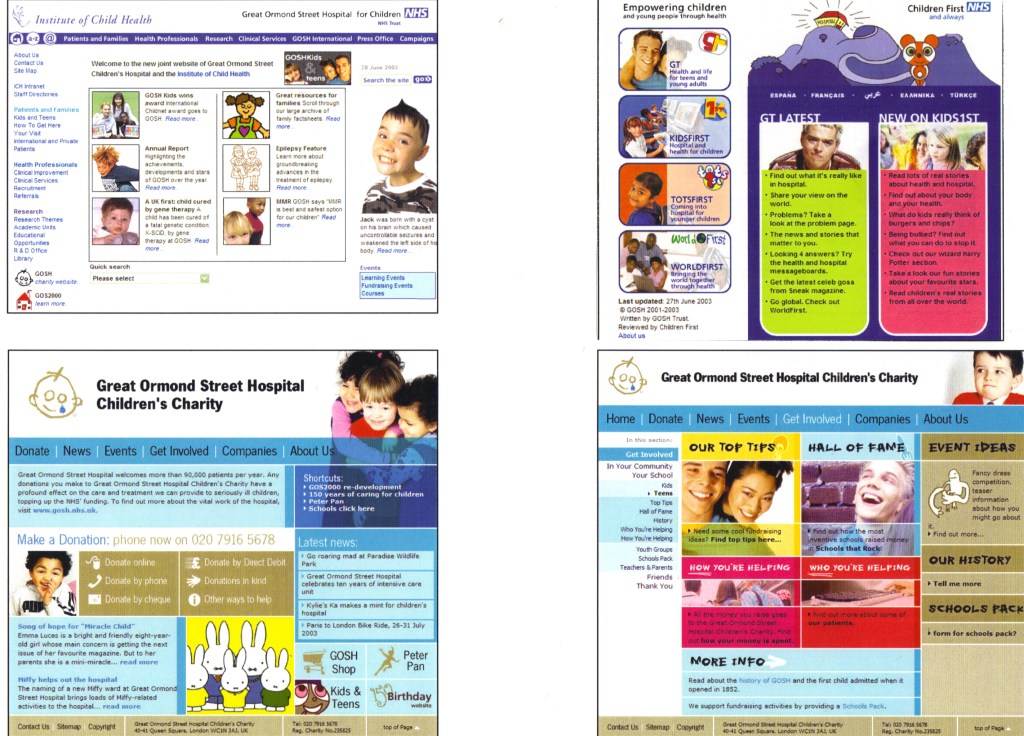
The project was intended to lead on innovation at the institutions and in the wider National Health Service (NHS) and was delivered in three phases. Screen grabs can be viewed below:  

Phase 1 

Phase 2

Phase 3

About

From the start, the project begged the question: Could we take a complex (and complicated) mandate and successfully achieve it in just two years? All under great public and media scrutiny (London being a world centre for media)? And how do you innovate for the 21st century in a major health care institution and build on its already high reputation?

Britain’s best-loved children’s hospital and charity, Great Ormond Street Hospital for Children NHS Trust (GOSH), contracted me to lead a two-year project to modernise the hospital’s web presence and take its brand into the 21st century. GOSH is both Britain’s first children’s hospital and a pioneering child health institution (along with its partner the Institute for Child Health). The hospital’s outstanding reputation meant the project was carried out under intense public, media and professional scrutiny, and required a keen awareness of new media developments and the needs of the hospital’s patients, their families and the public. It drew on an extensive public consultation and the NHS Modernisation Plan and the Information for Health strategy – which had identified strong demand for services and information to be made available online – to develop this innovative online offering. The NHS had also set the goal of having 25 per cent of all its services accessible via the web. 

From the start, the project represented a new phase in how the institutions communicated. An announcement in PR Week in April 2001 acknowledged this, declaring the role will deal “with what is increasingly becoming an important part of the press office and the hospital”. Prior to beginning the two-year project in 2001, the existing website was an amateurish affair and not suitable for an internationally renowned centre for paediatric treatment, training and research. 

The UK had become out of step with wider web developments at that time and had to do a lot of catching up. But there was a ready audience for better web content already established in the country. By 2001, data showed 3 million children in the UK were using the Internet and 33 million UK citizens could access it through work, school or home. 

By 2001, the Internet offered an estimated 100,000 health-related websites (most based in the United States, leaving a gap for high-quality information based on UK research and experience). Trust was key and this was a crucial part of the content strategy that was developed. 

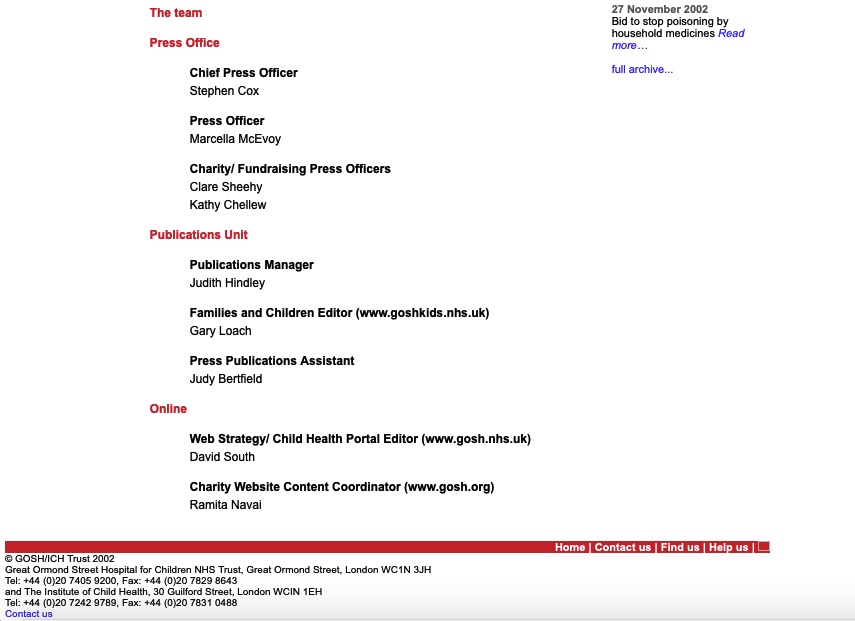
As lead staff member for the website, I was in charge of recruiting and managing staff and suppliers, liaising with stakeholders inside and outside the organisations, planning work and seeking opportunities and partnerships.

The project was developed in three, distinct phases. Screen grabs from these phases are available for download and evaluation. They also include web traffic statistics. This unique snapshot of a complex project as it unfolded, should prove useful for other e-health practitioners. 

As an innovator, the project became a catalyst for numerous online and offline initiatives across the institutions. The website made enormous strides, winning a number of national and international awards and leapfrogging to become one of the best NHS-linked sites in the UK. Areas radically improved included the design and navigation, patient information for families, press office, and the development and launch of the award-winning children’s website. 

Phase 1 

Phase 2 

Phase 3 

Each stage was transparently communicated and accompanied by high-profile publicity campaigns: a necessity because the hospital relies heavily on public trust and funding to function. 

The first phase involved getting buy-in on a new design vision, assembling a team, extensive work on migrating the very large legacy website into the new template, and exciting colleagues on the potential of the new child health portal vision. It was launched in September 2001.  

Ask Dr Jane Collins, a regular column written by the Chief Executive Dr. Jane Collins for The Times newspaper, was one of the more popular features of the child health portal. The portal was also directly connected to the NHS Direct service with its extensive online health encyclopedia.  

In 2001, the project launched an interactive Christmas child health advent calendar offering top tips from health professionals on how to have a safe holiday season. It showed what could be done with the improving web design and production skills of the team. The PDF can be viewed here: http://www.scribd.com/doc/44905926/Christmas-Advent-Calendar-for-GOSH-Child-Health-Portal-2001.

As another example, the hospital’s 150th birthday celebration on 14th February 2002, attended by Her Majesty the Queen (and celebrities, including Madonna), was accompanied by an online interactive history prepared by the project and was used to inform the wider public about the child health portal.  

Phase two involved the launching of new content developed by some of the world’s top child health experts and scientists, substantial new resources for sick children and their families, an online awareness-raising campaign to drive traffic to the health portal as a trusted and reliable resource, plus a wider media campaign. Based on user experience testing and user feedback, changes were made to the design and content structure to make the portal more user-friendly and to follow best practice in web design at that time.  

The overall child health portal also gave birth to a highly successful new resource, the award-winning Children First website in May 2002. This resource was a year in development and was calibrated by age to provide relevant resources to guide children through the hospital experience. It used high-quality animation and partnered with BBCi and BBC Science to create resources that would resonate with children and youth. It included high-profile elements such as the Write4GOSH children’s writing prize, attracting entries from around the world, with winners receiving prizes from Cherie Booth QC, Dannii Minogue and children’s writer Jacqueline Wilson.  

Children First attracted an average of 700,000 visitors each month with over 800 children in its first year contributing to the site. It addressed a gap in the online marketplace for health resources written for children rather than for their parents and families. It also gave birth to its own project: The Virtual Children’s Hospital (VCH). Funded by the PPP Foundation in August 2002, it worked with a team of psychologists to meet the social, psychological and information needs of ill children. 

In March 2003 the Commission for Health Improvement (CHI) in its review and assessment found, in answer to the question “What, if anything, did CHI find that the rest of the NHS can learn from?” at the hospital, it was the child health portal, because “The trust’s website has different sections for children and families as well as for health professionals. The website also has sections for children of different ages and a broad range of information leaflets is available to download. The website has 3.5 million hits per month.”  

In 2003, the UK’s Guardian newspaper called the Children First website one of the “three most admired websites in the UK public and voluntary sectors,” and a UK government assessment called the overall GOSH child health web portal a role model for the NHS. Children First also won the prestigious Cable and Wireless Childnet Award that year as well. And was short-listed for the New Stateman’s New Media Awards. 

The GOSH Child Health Portal team receive the Childnet Award in 2003 at London’s Science Museum (Photo: CBBC Newsround).
The Childnet Awards in 2003 were awarded by Trond Waage, the Norwegian Ombudsman for Children, at the Science Museum in London (and hosted by British media personality Carol Vorderman) (https://en.wikipedia.org/wiki/Carol_Vorderman).

In 2006, The Times of London called Children First the Top Child Health Website in its Wellbeing on the Web: The Best Portals survey (November 11, 2006). 

Phase three saw online traffic growing at a steady clip, the portal gaining accolades, awards and positive reviews; it also helped the hospital to gain the highest rating in a government review (5*), and Children First was awarded significant further funding so it could expand its resources. The award-winning team also re-developed thewww.gosh.org charity website (one of the highest profile charity brands in the UK) and launched it in 2003 as well.  

A great way to track the historical development of a web project is to use the Wayback Machine’s Internet archivehere (https://archive.org). By typing in the web address (for example, http://www.gosh.nhs.uk, and http://www.gosh.org), you can see a chronological history of the website by month. 

Timeline 

PR Week: “PUBLIC SECTOR: Great Ormond Street to get website editor.”

2001: Initial design vision articulated and team assembled. First phase of content creation and ‘soft launch’ of portal in September 2001. Begin experiments with new graphic design, including an online interactive Christmas advent calendar with health tips.  

2002: Launch new content during the hospital’s 150th anniversary celebrations; begin development work on Children First content. Partnering with BBCi and BBC Science to improve quality of child and youth resources. Significant new content is launched throughout the year as the portal sees month-on-month growth in web traffic. Awarding of further funding for Children First and the Virtual Children’s Hospital. 

2003: Winning of Childnet Award; launch of new GOSH Charity website. Record web traffic to the website.

“Hospital unveils international website for children”: The Guardian, 8 October 2003.
“The kids are alright”: The Guardian, 5 February 2003.
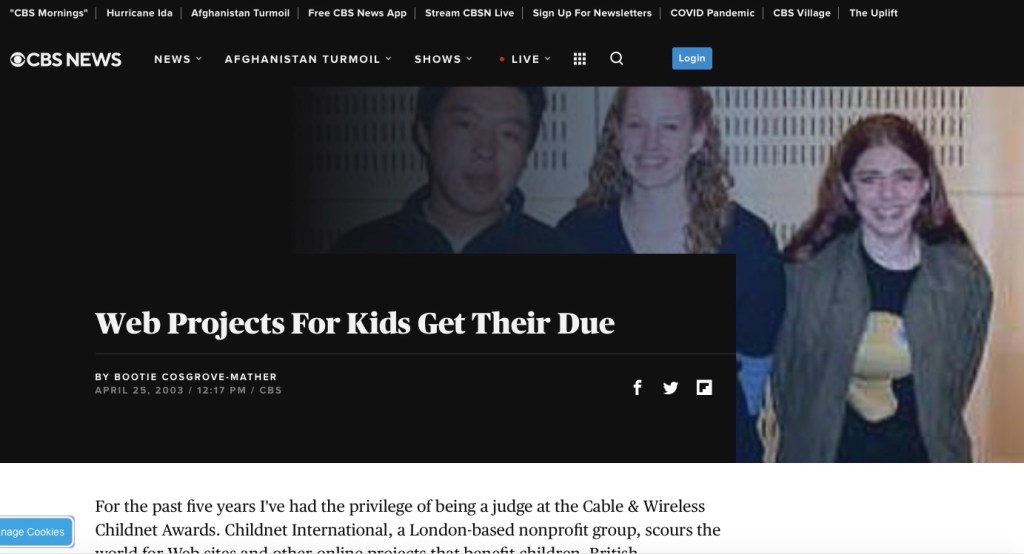
“Web Projects For Kids Get Their Due”: CBS News, April 25, 2003.
The GOSH Child Health Portal Team circa 2002.

Testimonials

“As a parent, I recognise how important it is to help your child understand all that they can about their stay in hospital and their care and treatment. Time spent in hospital can often be a very frightening experience. Making sure that your child has helpful, easy to read information will make a significant difference to their time in hospital. 

I am sure that this website will prove very useful for children and their families.” Prime Minister Tony Blair, May 2002

“A highly attractive website written by and with children at Britain’s biggest specialist hospital for children. The site is carefully segmented for different age groups and provides a powerful platform on which children can reach out from the confines of their hospital wards, share their experiences and learn about a range of medical issues as well as have access to fun interactive resources.” Childnet Award 2003

“I am glad you mentioned the web site. If you can access it and haven’t recently please have a look. It has vastly improved and both David Latchman and I (it is a joint site with ICH) are very pleased.” Dr Jane Collins, Chief Exec’s Corner, Roundabout newsletter, February 2002

“I never thought that GOSHKids would be so valuable to the hospital or, more importantly, to children and young people attending the hospital or simply interested in health matters. I think that this reflects my age, though!

“Many of us over 30, even if we use the internet ourselves, are surprised how much children and young people use it both as a source of information and for entertainment. 

“Even quite young children are using it routinely now and as an increasing number of families have access to it, either at home and/or at school or work, presumably more and more will do so. 

“There are over 42,000 hits per day (1,260,000 a month) on our GOSHKids website already. Of course, part of the success of the website is down to its design and content. I would like to take this opportunity to congratulate Gary Loach, David South and the whole team who have worked so hard to make it successful.” Dr Jane Collins, Chief Exec’s Corner, Roundabout newsletter, June 2003 

“The GOSH/ICH web site to date has been a notable success. Not only has it met a majority of its objectives as delineated in the PIN report of 2000 and achieved recognition as ‘exemplary’ among NHS resources, but it has also generated a number of spin-off projects, including Children First (as a successor to GOSHKids) and The Virtual Children’s Hospital.

“It has moved from providing a poor representation of the organisations, to above average for corporate web resources, and compares highly favourably with those of other NHS sites and departments. The most notable success lies in the resource it now provided for the public, especially GOSHKids.

“In a context in which less than 25% of all projects realise even 50% of their benefits, the satisfaction of 75% of the original objectives set out in the PIN report must rank as a significant achievement.” Website Project Audit by Passmasters Limited, 17 April 2003

“Great Ormond Street Hospital has launched this health site targeted specifically at childen, with a separate version aimed at young teenagers. The site aims to give young ‘uns information about health, illness and treatment in an easily digestable, non-threatening manner.” Internet Magazine, July 2002

“… it’s a good site and not just for those about to go into the hospital.” New Media Age, 20 June 2002

“The project was instrumental in pulling together a number of key strategies (including the NHS’s Modernisation Plan, and its Information for Health Strategy), and acting as a catalyst for numerous online and offline initiatives. Critical to these strategies is the need to provide information and services online and in an accessible way. The aim has not only been about serving the specific needs of the institutions, but also to become a broader child health portal.  

“The website in 2001 was an amateurish affair and a disgrace to an internationally renowned centre for paediatric treatment, training and research. Run largely from the Research Office it was focused on one particular audience, uninspiring in design, reactive in updating and made little use of the potential of the internet. We needed someone to take it forward …

David [South] was lead staff member for the website, recruiting and managing staff and suppliers, liaising with stakeholders inside and outside the organisations, planning work and seeking opportunities and partnerships. It is fair to say that the site made enormous strides under his leadership, winning a number of national and international awards, and leapfrogging to become one of the best NHS-linked sites in the UK. 

 “A number of areas were drastically improved, including design and navigation, patient information for families, press material, and the award-winning children’s site, which is now an international project with many different partners. David [South] project managed many projects in this time including linked sites for London IDEAS Genetics Knowledge Park, and the hospital charity site …” Stephen Cox, Chief Press Officer, Great Ormond Street Hospital for Children NHS Trust and the Institute of Child Health

Impact 

Micro

  • took public consultation and consultant’s report and crafted and developed a strategy to implement the GOSH Child Health Web Portal
  • assembled team across two institutions
  • set clear milestones and brought project management methodology previously deployed with the United Nations
  • led on teaching new ways of project management for results
  • took GOSH brand forward for the digital age
  • advised colleagues on digital publishing and design
  • awarded additional funding

Macro 

  • role model for NHS and government/charity sector. Awarded five stars in government review
  • Childnet Award
  • launched major milestones with well-known figures, including Her Majesty the Queen, Madonna, and pop stars
  • significant media coverage of project
  • attracted funding not only for the GOSH Child Health Portal but also for other projects at the institutions
  • grew web traffic month-on-month, becoming one of the top online child health resources
  • website cited in many other resources. One of the goals of the project was to increase access to high-quality child health resources and to have them cited in books etc.

Citations

The Great Ormond Street Hospital Manual of Children’s Nursing Practices by Susan Macqueen, Elizabeth Bruce and Faith Gibson, John Wiley & Sons, 2012

Help! My Child’s in Hospital by Becky Wauchope, Marbec Family Trust, 2012

Oxford Desk Reference: Nephrology by Jonathan Barratt, Peter Topham and Kevin P.G. Harris, Oxford University Press, 2008

Research Review 2001: A Year of Excellence and Innovation, Institute of Child Health and Great Ormond Street Hospital for Children NHS Trust, 2001

Research Review 2002: Building on Success, Institute of Child Health and Great Ormond Street Hospital for Children NHS Trust, 2002

Other Resources

GOSH Child Health Portal Phase 1a

GOSH Child Health Portal Phase 1b

GOSH Child Health Portal Phase 2a

GOSH Child Health Portal Phase 2b

GOSH Child Health Portal Phase 3 

GOSH Project Launch Brochure and Screen Grabs, 2001-2003

GOSH Child Health Portal 2001 to 2003 Resources

Further Reading:

Embedding Young People’s Participation in Health Services: New Approaches edited by Louca-Mai Brady, Policy Press, 7 October 2020

“There is increasing interest in young people’s participation in the design and delivery of health services. But young people’s views are not consistently sought or acknowledged, and they are still often marginalised in healthcare encounters. Drawing on original research and a diverse range of practice examples, Brady explores the potential for inclusive and diverse approaches to young people’s participation in health services from the perspectives of young people, health professionals and other practitioners. She presents a practical new framework, embedded in children’s rights, that shows how young people’s participation can be integrated into services in ways that are meaningful, effective and sustainable.”

DSC web address in green_mini (1)

ORCID iD: https://orcid.org/0000-0001-5311-1052.

© David South Consulting 2025

Categories
Archive Blogroll Ger Magazine UNDP Mongolia 1997-1999 United Nations Development Programme

Ger: Mongolia’s First Web Magazine (And A Pioneering Web Project For The United Nations) | 12 January 2016

Ger Magazine was hosted on the http://www.un-mongolia.mn website from 1998.
  • Editor-in-chief: David South (1998-1999)
  • Logo design: P. Davaa-Ochir

“The years 1998 and 1999 have been volatile ones for Mongolia, with revolving door governments, the assassination of a minister, emerging corruption, a banking scandal, in-fighting within the ruling Democratic Coalition, frequent paralysis within the Parliament, and disputes over the Constitution. Economically, the period was unstable and rife with controversies.” Mongolia in 1998 and 1999: Past, Present, and Future at the New Millennium by Sheldon R. Severinghaus, Asian Survey, Vol. 40, No. 1, A Survey of Asia in 1999 (Jan. – Feb., 2000). pp. 130-139 (Publisher: University of California)

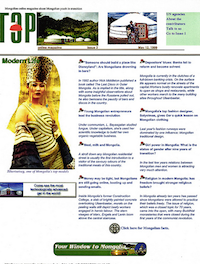
Ger Magazine was launched on September 9, 1998 (Ger is the Mongolian word for both the traditional tent dwelling and home). The theme of youth in the transition was explored by a combined team of Mongolian and foreign journalists. The Ger Magazine project had basically three goals: first, raise the quality of journalism in the country, secondly, introduce the country to a wider global audience and, thirdly, by being the country’s first online magazine, prove the internet was an effective way to communicate.

Issue 1

Issue 1 of the magazine investigated what life was like for youth during the transition years (post-1989). Stories tackled the struggle to find work in the free market, the booming pop music scene and how it is leading the way in business entrepreneurship, reproductive health, the basics on Mongolian culture, and vox pop views from Mongolian youth.

Issue 2

Issue 2 of the magazine investigated modern life in Mongolia during transition. The team of journalists were hitting their stride by this issue. Stories probed the proliferation of bars and the problem of alcoholism, corrupt banking practices and the loss of savings, how the young were the country’s leading entrepreneurs, Mongolia’s meat and milk diet, “girl power” and the strong role played by women, the burgeoning new media, the rise and rise of Buddhism, and Mongolia’s dynamic fashion designers (this article inspired foreign fashion designers to embrace the Mongolian ‘look’ in the next season’s designs).

Editor-in-Chief: David South, UNDP Communications Coordinator
EditorA. Delgermaa, UB Post newspaper
TranslationA. Delgermaa
Photography: N. Baigalmaa, David South
Design and layout: B. Bayasgalan, UN Homepage Webmaster

“This is the second issue of Ger. We have chosen the theme “Modern Life” to introduce people outside of Mongolia to the complexities of life in today’s Mongolia – the good, the bad and the ugly as a cowboy film once said. Ger is a project that draws upon the best journalists of this country. Under democracy Mongolia enjoys a flourishing free press, with over 800 officially registered newspapers for a population of 2.4 million! Ger has chosen A. Delgermaa of the UB Post newspaper to edit this issue. The UB Post is one of two English language newspapers in Mongolia and is owned by the Mongol News Company, a publisher of five newspapers, including the daily Today newspaper. Ger is a project to improve the quality of journalism in Mongolia, while introducing the people of the world to Mongolian journalists and this wonderful country. We hope you enjoy this issue of Ger. Please send us your comments. 

Ger is not an official UNDP publication but a project to improve the quality of journalism. Opinions expressed in the magazine do not necessarily reflect the official views or policies of the United Nations Development Programme. Articles may be freely reproduced so long as credit is given and the editors are notified. Ger is published in English and Mongolian. 

Contributors

Ms. A Delgermaa: A reporter with the UB Post English weekly newspaper, which enjoys a good reputation among readers. Delgermaa is a young journalist and started her career in 1997, after graduating from the English Department of the Foreign Service School, Mongolian National University. She is a regular contributor to UN publications and has been published by Inter Press Service. She thinks Mongolia needs more psychologists to give courage to those many who are yearning for a better life. Like many young Mongolians she also wants to study abroad, to learn how journalism is practised in other countries.

Ms. N. Oyunbayar: Also a reporter with the UB Post newspaper, Oyunbayar, is a graduate of Ekaterinburg University in Russia, where she qualified as a Russian language teacher. She left her pupils in Sukhbaatar aimag, where she was born, some years ago and decided to undertake a personal crusade against wrongdoing by becoming a journalist for the UB Post. She is an award-winning journalist and a member of the Mongolian Free Democratic Journalists Association. She loves to cook and enjoys learning about new cuisines. 

Ms. T. Mandala: A historian and journalist, she is a reporter with the “Weekend” weekly newspaper. She has been a journalist for two years, has written several interesting interviews with politicians, including the Mongolian parliamentary speaker R. Gonchigdorj and MPs Da. Ganbold and E. Bat-Uul. She explores issues like life after death and she wants to be a public defender in a court one day. 

She is a successor of her grandfather Khodoogiin Perlee, who is a famous historian in Mongolia. And studies religion, especially Buddhism and Shamanism. 

Mr. D. Dorjjav: A psychologist and a lecturer at the Administrative Management Department of Mongolian National University, he is married and has two girls and a boy. He is currently working on his doctoral thesis. His wish is to help people to open themselves up and discover their abilities. His plan for the future is to contribute to the psychological understanding of life in Mongolia. Dorjjav’s hobby is to talk to people and exchange opinions.

G. Enkhtuya: Born in the year of the pig (there are twelve years in the lunar calendar), a professional in marketing, trading, journalism, she is currently studying law in the Institute of Legal Studies, Mongolian National University. She is also a reporter for Odriin Sonin independent daily newspaper, once the largest state-owned newspaper until the start of 1999. She likes to cook when she is liberated from her official duties.

Jill Lawless: An Honourary Foreign Member of the Mongolian Free Democratic Journalists Association, Jill has been the editor of the UB Post newspaper since 1997. Jill regularly contributes to Agence France-Presse, Far Eastern Economic Review, Deutsche Welle and the Canadian Broadcasting Corporation. She is happiest riding camels in the Gobi desert. 

Michael Kohn: Michael is the editor of the Mongol Messenger and contributed to the first edition of Ger. He is a regular contributor to Associated Press and the Far Eastern Economic Review. Michael is an avid traveler and is an expert on hitchhiking across Mongolia.  

Ms. N. Baigalmaa: Photo journalist for Onoodor (Today) newspaper, the number one independent newspaper for three years. “Photo journalism is always interesting. I really enjoy taking action photos.” She is fed up of taking photos of static photos of people standing or sitting and has devoted her life to photo journalism. One never boring thing for her is her two sons and a girl. Sometimes she loses her sports jacket to her oldest son, now taller than her.”

Stories

Depositors’ blues: Banks fail to reform and become solvent.In the absence of a trustworthy formal banking system, Mongolians are sticking to an elaborate informal banking system driven by pawn shops

by G. Enkhtuya

“Mongolia is currently in the clutches of a full-blown banking crisis. On the surface life appears normal on the streets of the capital. Workers busily renovate apartments to open as shops and restaurants, while other workers march to the many building sites throughout Ulaanbaatar. But there is no doubting the situation is serious.”

Young Mongolian entrepreneurs lead the business revolution

By Michael Kohn

“Under communism, L. Bayasgalan studied fungus. Under capitalism, she’s used her scientific knowledge to build her own organic vegetable business. The 35-year-old is in the vanguard of a budding army of Mongolian entrepreneurs cashing in on the impoverished landlocked country’s nine year transformation from the world’s second oldest communist state to a free-market democracy.”

Meat, milk and Mongolia: 
Misunderstood and often maligned, the Mongolian diet does make sense

By N. Oyunbayar

“A stroll down any Mongolian residential street is usually the first introduction to a visitor of the savoury odours of the traditional meals of this country. If you are invited into somebody’s ger (or traditional tent dwelling) or apartment, you will probably have an opportunity of tasting buuz, khuushuur and bansh.

“These Mongolian national meals are made with minced meat seasoned with garlic or onion (it can be anything from mutton to beef to camel to horse to gazelle) covered with flour and steamed in boiling water, fried in oil and boiled in water. For many visitors to the country the vast quantities of meat consumed can at first be surprising. But it is not long before a visitor finds their favourite Mongolian food, be it buuz, khuushur or a number of other treats. A Canadian living in Ulaanbaatar once told me, “the Mongolian national food contains a lot of meat, but I like the buuz.

“The meat-dependent diet arises from the need for hearty food to stave off the cold and long winters. Traditionally nomadic herders, Mongolians have for centuries been dependent on mostly animal products for their dietary staples. Now after over nine years of transition, the traditional diet has been used as a shield against hunger and for the wealthy, subject to the influence of imported foreign foods and cuisine. When the Russians pulled the plug on Mongolia’s aid in 1991, the economy went into a severe crisis. For many Mongolians it was their first experience of serious hunger. The staple traditional diet of meat, milk and flour saw many people through this crisis, when food imports from the former Soviet Union dropped off.

“Mongolians traditionally have turned to foods that are high in protein and minerals, relying less on more seasonable foods like vegetables and fruits. This means a diet heavy on meat and dairy products, the latter when sour in the summer time thought to clean the stomach. It isn’t just about meat though. Mongolians do also eat cereal, barley and natural fruits and plants native to the country.

“Out of necessity Mongolians have found creative and ingenious ways to use the milk of all five of the domestic animals in the country: sheep, cattle, goats, camels and horses. Orom is the cream that forms on top of boiled milk; aaruul are dried curds and can be seen baking in the sun on top of gers in the summer; eetsgii is the dried cheese; airag is fermented milk of mares (female horses); nermel, is the home-brewed vodka that packs a punch; tarag, is the sour yogurt; shar tos, melted butter from curds and orom, and tsagaan tos, boiled orom mixed with sometimes flour, natural fruits or eesgii. The method of drying the dairy products is common in preparing them. The Mongolians prepare enough dairy products for the long winter and spring.

“The traditions of using, producing and preparing these foods are stronger outside the main cities, where the population is more reliant on the vast herds for food. B. Baljmaa (Mongolians generally use their first names), a dietitian and nutritionist at the National Nutrition Research Centre, says there is a genetic compatability for the food.

‘Before 1992 there wasn’t much research in this area. But now we know from our research that Mongolians are better able to absorb foods with more acid. So, traditional food should be kept in the country.’

“Since 1997 Mongolians have seen a substantial increase in the variety and quantity of imported foods, many of which were only thought of as exotic 10 years ago. Since the start of 1999 the Soviet-style market stalls now compete against western-style supermarkets, with trolleys and shelves proudly saying “Made in Mongolia.” In markets like Dalai Eej, Dorvon Uul, Food Land and Mercury it is possible to buy delicious prepared and canned foods, candies, biscuits, and unknown and unused before by Mongolians, products like oranges, bananas, plums and American chickens.

“On top of the canteens and cafes serving Mongolian food, there are now many restaurants, canteens, bakeries and tea shops which serve meals from Russia, Italy, India, China, Japan, Korea, England, France, Senegal and Turkey. Most of these restaurants are located in the capital, Ulaanbaatar. Mongolians have taken to the new tastes. “I think Mongolians like roasted chicken and fish when they go to the foreign sit-down restaurants, and hot dogs and pizzas in the fast foods shops,” says I. Narantsetseg and her husband J.Battulga. Both were dining in the Seoul restaurant, and are happy they can go out for food: “it is a very good thing that there are opening a lot of restaurants where friends and family can go and enjoy food in comfort.”

“Isobe Hiroshi, manager of Seketei, a high-end Japanese restaurant, told me “only 20 per cent of our customers are Mongolians. The vast majority of our clients are foreign, especially Japanese people who are working and traveling here. I think Mongolians have still not grown used to sushi and sashimi, the raw fish prepared in our restaurant. But I hope we will welcome more and more Mongolians in the future.”

“The traditional diet in the cities is more changed, more european. And with comes its own dangers for Mongolians says the Nutrition Centre’s Baljmaa:

‘There is a big problem of importing poisonous foods and food which probably will cause the nutrition-related diseases common in more developed countries,” she continues.”While the trend around the world amongst health-conscious people is towards natural products for their food, some Mongolians use some food which can cause troubles for their health. For example, fast food made with more oil, salt and sugar are considered the biggest dangers for human health. On the plus side prices for these imported foods are higher and only the wealthiest people can afford them; the poor people can’t buy and eat it no matter how much they desire. This means their poverty is protecting their health. We should boost our efforts to raise awareness on what foods protect your health.’

“Help in improving nutrition awareness a poster portraying a ger details the food habits of Mongolians and the nutritional value of common foods.

“Now I want to present to you recipes of processing and preparing some Mongolian national products and meals:

“From ancient times, Mongolians use abundant and peculiar methods of processing meat and preparing food.. One of the more popular methods of processing the meat is to prepare borts (dried meat) for use in winter. Borts is made from the meat of cows, goats and camels. Here is a recipe for camel borts presented by Dr. Sh. Tserenpuntsag who engages in the research of the meat.

1. Separate the meat from its layer of fat, as fat will spoil in drying.
2. Cut meat into strips about 20-30 centimeters long and two to five centimeters thick.
3. Hang to dry in a well-ventilated room.
4. Leave for four to five months.
5. Cut into small strips for use in any dish you like.

“If soaked in water, the meat will expand up to two and half times in size. It should then be cooked for 18 minutes.

“The main method of cooking the meals of the Mongolians is boiling and steaming, considered the most healthy method in cooking by researchers the world over. Here is a recipe for buuz from the Nutrition Centre. It is considered one of the national meals of the Mongolians and is cooked by steaming and is a good fast food.”

Girl power in Mongolia: What is the status of gender after nine years of transition?

By D. Dorjjav

“As American author Arthur Schlesinger once said, the main breaker of peace in our time is social differentiation. It is unfortunate that, despite developments in human civilisation, modern times have brought only new manifestations of this phenomenon, based on people’s mind, feeling, life style, goals and dreams.”

Money may be tight, but Mongolians are still going online, booting up and sending emails

By Jill Lawless

“Inside Mongolia’s former Construction College, a slab of brightly painted concrete overlooking Ulaanbaatar, murals on the peeling walls still depict beefy workers engaged in heroic labour. The stern visages of Marx, Engels and Lenin loom above the central staircase.

But students these days have neither communism nor construction on their minds. The building is now the School of Computer Science and Management of the Mongolian Technical University.”

The real Mongolian gets the nod from Western fashion designers. Mongolia’s top fashion designer, Solyolmaa, gives Ger a quick lesson on Mongolian clothing

By A. Delgermaa

“Last year’s fashion runways were dominated by one influence: Mongolian traditional design. If a designer wanted to show they were boldly embracing natural fibers and furs, then the refrain ” my show is all Mongolian” would be proudly boasted to the media. The country has become a synonym for sartorial flare and rugged beauty. It also doesn’t hurt that one of Mongolia’s top exports, cashmere wool, is in vogue, from Japan to Europe to the United States. After years of being isolated from the west under the umbrella of the Soviet Union, Mongolian fashion is proudly strutting the catwalks of the world.”

Cashmere is king but Mongolia still struggles to reap the benefit

By A. Delgermaa

A Mongolian cashmere designer once opined that Mongolians are lucky that most goats in the country are capable of producing fine cashmere. And while Chinese cashmere dominates the marketplace, Mongolian cashmere is by far the purest and finest.

About 30 cashmere companies contributes tens of millions of dollars a year to the country’s wealth (though nobody is quite sure how much because most cashmere sales go unreported to the government). But the revenue isn’t what it used to be due to problems in the domestic industry and a drop in the world price. Z. Ayur, chief secretariat of the Gobi company, thinks it doesn’t have to be that way. “Unfortunately we lose half of our raw cashmere to China,” he says.” The Chinese buy cashmere at a high price, not depending on the quality. This means national manufacturers lack raw cashmere to process into garments.” He thinks raw cashmere exports should be banned or subject to a duty of 100 to 150 per cent. Mongolia’s weak infrastructure plays a part as well. It is cheaper for herders to travel to the Chinese border with cashmere than to bring it to the capital, Ulaanbaatar. Often when they are at the border with China, they are subjected to some hard bargaining by Chinese brokers, who exploit the fact herders can’t afford to walk away empty handed. 

Cashmere has always been considered a luxury and expensive. But in the past two years it has lost its fusty image as only for old people. Trendy designs have attracted a vast market of younger cashmere consumers. “I guess in the past it was dear and expensive and designs weren’t very appealing to the younger set,” thinks Gerelmaa, the chief designer of Gobi company. 

The Gobi company is one of the few state enterprises left over from the socialist period that still makes money (and is due for privatization this year – a prime pick for foreign investors). 

In 1972 the United Nations funded projects to experiment with starting a cashmere garment industry in Mongolia. This innovative thinking led to a joint Japanese-Mongolian venture in 1981 to start the first cashmere manufacturer, Gobi. These days it still produces one third of the country’s cashmere products. 

Mongolian Wool and Cashmere Federation head Tsendmaa is optimistic about the drop in the world market price.” It will soon go back up again,” she says with confidence. “The reserve of cashmere in the world will run out soon. What happened with the drop in prices is typical of any industry when it overproduces.” What worries her most is the flood of Mongolian cashmere going to China, where Chinese workers process and knit the garments and reap the job benefits.

While cashmere is still known for its use in classic turtle, crew and v-neck jumpers, things have changed. “Before we mostly exported classic styles in off-white, brown, grey, black, bark, blue or dark red to Japan or Germany,” continues Tsendmaa. “Now Americans order more fashionable cashmere for the young. The designs of short jumpers that expose bare chests and waists are cheap to produce (less material) and suitable for young fashions.” 

Italian, French or Belgian customers are fussier and demand greater variety in designs. These countries determine the vogue for cashmere wear and use the most high tech knitting technology.

Contemporary cashmere fashion in France or Italy can combine fur or silk. Colours have also been revamped, with the young going for light blue, light pink, snow white, off-white and light green. Italians and Americans like metal grey with rose or pink. Mixing up the colours in sporty stripes and lines is also popular.

Cashmere is very practical, warm and light. “It is not suitable for the office,” says Gerelmaa.” Cashmere wear is more suitable to wear for a night out or just for hanging out. But of course it is not for sport!” 

Fashionable Mongolian cashmere is becoming a strong competitor to Chinese, Italian, Scottish or American cashmere. “The raw material is pure and the design is more fashionable.” And a happy Gerelmaa likes the sound the cash register makes in Japan: “In Japan classic Mongolian style is sold for more than US $1,200 in the Takashimaya Store, in GINZA.” Now if more of that kind of hard cash found its way back to Mongolia, the country would definitely be better off. 

Mongolians call them mannequins, but this model has something to say and a good head on her shoulders

Interview by A. Delgermaa

It could be said that there is no girl who does not dream of becoming a model. Many Mongolian girls, particularly Ulaanbaatar city girls, are flocking to attend courses in modeling in the last few years. Some say models are mushrooming in Mongolia, a country known for its fresh-faced people and robust physiques. 

Ger interviewed S. Ikhertsetseg, one of the twin top models of Mongolia.

When did you first appear on the fashion stage?

“When we were 15 we played piano for the state concert on International Women’s Day on March 8. The ( Best Fashion) company was in trouble and they did not have anyone to wear some leather fashions for the show in the concert. It was fortuitous that we were asked to be the models. We kept it secret from our parents until we received a prize from Mongolia’s top fashion show, Goyol (or beauty) , in 1988. That was a year after the state concert. Being a fashion model was not considered so desirable as it is now. We were busy studying at music school and our parents did not know what we were doing.”

What do you think of today’s models?

“In the early days of fashion shows in Mongolia in the 1980s, we did not have many competitors. These days there are many beautiful Mongolian models we have to compete with, but only a few are very good. If someone is lucky, they have the potential to compete at the world level. Personally, I don’t like models who are too trained by courses.”

Do you think becoming famous is pure luck?

“Of course it is luck. But that doesn’t mean it isn’t a lot of hard work. You must send photos to agencies, and then only then, will someone see your photo – that is luck.”

What about design and fashion in Mongolia? Are Mongolians fashion sensitive?

“I can not say Mongolians are sensitive to fashion. I think our designers should work harder. Design is not a dress or a suit. It is everything, the whole cornucopia of details. I do not think we are going to compete with Europe, which has a long history of making clothing, rich in colors or designs. There is a big difference between fashion in the West and in Mongolia.”

Mongolia has a lively free press who sometimes step over the line when it comes to gossip and scandal reporting. These so-called “yellow” newspapers have damaged many people’s reputations. This had also happened to you. Some newspapers called the two of you the Barbie girls in Beijing, earning a lot of money.

“Yes, they did say those bad things. We replied to them.”

Was it before the court?

“No, that is a personal question.”

What was the result?

“The newspapers didn’t do that again.”

What do you do now?

“Both of us keep up the fashion work and also teach piano. Music is our profession and love. We founded the Association of Models of Mongolia to protect their rights and strengthen their position in the society.”

Impact

The stories have been featured in many books on the country, and the magazine was recommended as a good resource by the Lonely Planet guidebook. 

This was not only the first publication of its kind in the UN, it was also a pioneering online venture and remarkable for a country lacking the advantages of wealthier countries.

An online survey of the state of Mongolia’s media and its history (www.pressreference.com/Ma-No/Mongolia.html), had this to say: “An interesting variation from some of the other publications available is Ger Magazine (published online with guidance from the United Nations Development Program, UNDP), which is concerned with Mongolian youth in cultural transition. The name of the magazine is meant to be ironic because a ger is the Mongolian word for yurt—a yurt being traditional nomadic housing—but the magazine is about urbanization and globalization of Mongolian youth.”

Citations

A Complete Guide on Celebrations, Festivals and Holidays around the World by Sarah Whelan, Asteroid Content, 2015

Gale Directory of Publications and Broadcast Media by Jeff Summer, Gale Group, 2001

In Search of Mongolian Barbecue by Debra McCown, Abingdon, Virginia, 2017

Mongol Survey, Issue 8, The Society, 2001

Mongolian Culture and Society in the Age of Globalization by Henry G. Schwarz (editor), Center for East Asian Studies, Western Washington University, 2006

Nations in Transition: Mongolia by Jennifer L. Hanson, Infobase Publishing, 2003

Teen Life in Asia by Judith J. Slater, Greenwood Publishing Group, 2004

World Press Encyclopedia: A Survey of Press Systems Worldwide, Volume 1 by Amanda C. Quick, Gale Group, 2003

Some of the team behind Ger:

Editor-in-Chief: David South

Logo Design: P. Davaa-Ochir

Layout and Online: B. Bayasgalan

Contributors: A. DelgermaaMichael KohnJill LawlessPeter Marsh, and N. Oyuntungalag.

Read the Wikipedia entry here: en.wikipedia.org/wiki/Ger_magazine

Read the full content by searching the www.archive.org wayback machine via the http://www.un-mongolia.mn website: https://web.archive.org/web/19990420090143/http://www.un-mongolia.mn/

Ger Magazine contributor Jill Lawless’ book Wild East: Travels in the New Mongolia here: https://wildeasttravelsinthenewmongolia.wordpress.com

This work is licensed under a Creative Commons Attribution 4.0 International License.

ORCID iD: https://orcid.org/0000-0001-5311-1052.

© David South Consulting 2021

Categories
Archive Development Challenges, South-South Solutions Newsletters

African Innovation Helps Make Banking Transactions Safer

By David SouthDevelopment Challenges, South-South Solutions

SOUTH-SOUTH CASE STUDY

As economies grow in Africa, more and more people are conducting their financial transactions electronically. This can be either through mobile phones and digital devices, or through the hole-in-the-wall of the automatic teller machine, or ATM.

These short cuts mean many people no longer have to endure long line-ups at banks to conduct day-to-day financial transactions. This convenience is revolutionizing banking for many millions of people, but there is a risk: fraud and theft. Both are rising, and are costing customers and banks, both in cash and in damage to the reputation of electronic banking.

Criminal gangs and lone individuals alike are behind this crime. Most notorious are the “carding” and “skimming” gangs, who plant devices on ATMs to read plastic bank cards and steal victims’ money. Mobile devices can also be “hacked” by sophisticated criminal gangs and the data stolen and used to plunder bank accounts. Lone thieves also take people hostage and force them to use their card to withdraw money. A crime victim is usually forced to give over his or her Personal Identification Number (PIN), which the thief then uses to withdraw cash from the ATM.

But just as thieves have become cleverer about the new opportunities created by digital financial transactions, enterprising start-ups are developing innovations to improve financial security.

One Kenyan start-up is hoping to be a pioneer in innovative financial safety software for mobile devices and ATMs.
Usalama Innovative Systems, LTD. (http://usalama.biz/), co-owned by graduate student and lead programmer Denis Karema (deniskarema.com), has already been singled out for a CIO magazine’s CIO100 Award in Enterprise Innovation in 2011 (http://www.cio.com/cio-awards/cio100).

Karema has been working in information technology since 2008 and has a background in computer science. He has built his experience while working on various information technology projects in East Africa.

The ambitious company says it wants to be “the leading provider of innovative solutions to financial entities in Africa by 2015.”
Usalama has developed various systems pending patents and copyrights and has built up experience in deploying enterprise information technology.

Usalama is seeking additional funding from investors for multiple innovations to protect customer financial transactions. One of them is an ATM solution, which the company claims can reduce theft by over 90 per cent. Speaking with the Business Daily Africa website, Karema explained the anti-fraud application, dubbed Safety Pin.

“When someone approaches you or when you are involved in a carjacking, or one of those unfortunate incidences, you give them your card or PIN as they ask for it, but when they get to the machine it does not treat them the same way as it does you,” Karema said.

The thief is presented with what looks like the victim’s bank account but actually only has 10 per cent of their cash on display. The thief will then withdraw this cash and think they have cleaned out the victim’s bank account.

It is a clever solution which doesn’t entirely block the thief from receiving money from the ATM, but just gives them a small portion of the amount in the account. The idea is to fulfil the psychological need of the thief to get some cash in the robbery attempt, so they will then release the hostage and go away.

“We are working on reducing the amounts that can be lost by up to 90 per cent, so it means if I have 100,000 shillings in my account, only 10,000 shillings can be lost through fraud,” Karema said.

The amount that is stolen can be covered by bank insurance policies so that the customer does not suffer a serious financial loss.

“(The) good thing about this application, first of all, is this hasn’t been done before,” Karema said. “People have come close to creating ATM anti-fraud measures, like asking you to put your PIN in reverse. But they don’t seem to work. For each of them, you are ending up having your money stolen and then following up with the fraudster. So our application prevents the money from being stolen in the first place. So our preventative measure is better than a curative one when money is involved. And also the application is applicable globally.

“We intend to have this implemented in each and every commercial bank, not only in Africa, but the rest of the world.

“A bank can recoup investment in our application within the first year [by avoiding the loss of clients and funds from fraud]. Aside from that, the bank is also able to receive complete and detailed reports each and every time a fraud occurs and so it makes it easier for the bank to monitor trends and also to know which of their outlets are having more and more fraud-related cases.”

Other innovations Usalama has been developing include Usalama Pin, which helps commercial banks monitor fraud in real time; Usalama Spy, which gives more detailed fraud reports and analyzes the information; Home Bank, a way to offer 24/7 banking to customers so they can deposit the money directly into savings accounts without delay; and Usalama Mobile, a mobile banking and money service solution.

Usalama believes the suite of solutions will help banks to retain current customers and make their financial transactions safer, attracting so-called “high net worth” clients. Usalama believes this will help banks in Africa grow their number of customers and cash reserves.

“We are always thinking about innovation because we feel that innovation is the key thing to developing sustainable enterprises,” Karema believes.

Published: March 2013

Resources

1) Sinapis: Sinapis’ mission is to empower aspiring entrepreneurs in the developing world with innovative, scalable business ideas by providing them with a rigorous business education, world-class consulting and mentoring services and access to seed capital. Website:http://www.sinapisgroup.org/entrepreneurs.php

2) DarkMarket: How Hackers Became the New Mafia: We live our lives online – banking, shopping, working, dating – but have we become complacent? Website:http://www.randomhouse.co.uk/editions/darkmarket-how-hackers-became-the-new-mafia/9780099546559

3) Usalama is seeking investors via the Venture Capital for Africa platform. Website:http://vc4africa.biz/members/254innovative/

4) University Student Launches Startup Kenya, A Crowdmap Of All Startups In Kenya. Website:http://techmoran.com/2013/01/22/university-student-launches-startup-kenya-a-crowdmap-of-all-startups-in-kenya/

5) Southern Innovator Magazine Issue 1: Mobile Phones and Information Technology. Website:http://www.scribd.com/doc/95410448/Southern-Innovator-Magazine-Issue-1-Mobile-Phones-and-Information-Technology

Southern Innovator logo

London Edit

31 July 2013

Creative Commons License

This work is licensed under a
Creative Commons Attribution-Noncommercial-No Derivative Works 3.0 License.

ORCID iD: https://orcid.org/0000-0001-5311-1052.

© David South Consulting 2023

Categories
Archive Development Challenges, South-South Solutions Newsletters Southern Innovator magazine

Citing Southern Innovator: Books And Papers | 29 November 2015

Southern Innovator was initially launched in 2011 with the goal of – hopefully – inspiring others (just as we had been so inspired by the innovators we contacted and met). The magazine seeks to profile stories, trends, ideas, innovations and innovators overlooked by other media. The magazine grew from the monthly e-newsletter Development Challenges, South-South Solutions published by the United Nations Office for South-South Cooperation (UNOSSC) since 2006. A selection of books and papers citing stories from the magazine are featured below to aid researchers, in particular those interested in health and human development and the role of innovators in international development. 

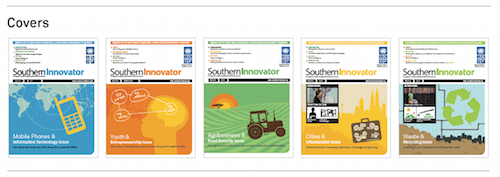
The first five issues of Southern Innovator from 2011 to 2014. Called a “Beautiful, inspiring magazine from UNDP on South-South innovation.”

Books

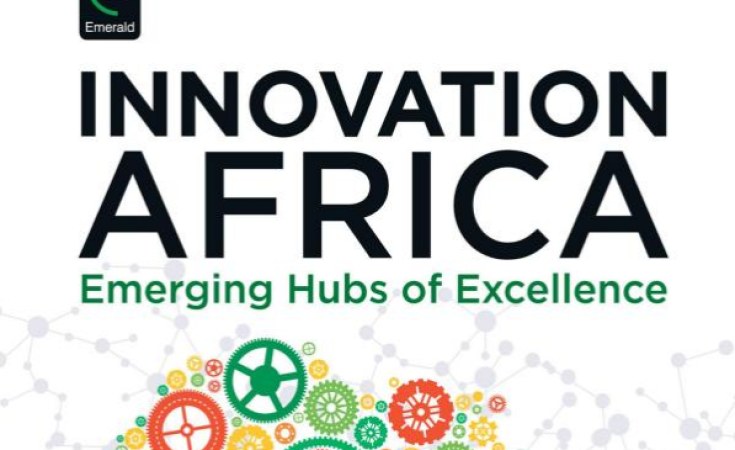
Innovation Africa: Emerging Hubs of Excellence edited by Olugbenga Adesida, Geci Karuri-Sebina and João Resende-Santos (Emerald Group Publishing: 2016)

“Innovation is critical to growth and development in Africa. In the context of a continent characterized by fast growing economies as well as an array of socioeconomic challenges, such as high levels of poverty and inequality, innovation in Africa must be understood in an encompassing manner. Africa needs to support the emergence of its own Silicon Valleys, but it must also foster the invention and adoption of cleaner technologies that limit respiratory illnesses, deforestation and combat climate change. This book contains a number of analytical case studies that examine the nature and origins of emerging high-end innovation hubs in Africa. These “hubs” or ecosystems are both understudied and little known inside and outside the continent. With this analysis, the book highlights and draws lessons from some of the most promising and successful innovation cases in Africa today, exploring the key factors driving their successful emergence, growth and future prospects. Relevant for scholars, policymakers, and business leaders, the book provides both inspiration and useful policy advice that can inform strategies and concrete measures to speed up the pace of innovation in Africa today.”

Innovation Africa: Emerging Hubs of Excellence.

Beyond Gated Communities edited by Samer Bagaeen and Ola Uduku (Routledge: 2015)

“Research on gated communities is moving away from the hard concept of a ‘gated community’ to the more fluid one of urban gating. The latter allows communities to be viewed through a new lens of soft boundaries, modern communication and networks of influence.

The book, written by an international team of experts, builds on the research of Bagaeen and Uduku’s previous edited publication, Gated Communities (Routledge 2010) and relates recent events to trends in urban research, showing how the discussion has moved from privatised to newly collectivised spaces, which have been the focal point for events such as the Occupy London movement and the Arab Spring.

Communities are now more mobilised and connected than ever, and Beyond Gated Communities shows how neighbourhoods can become part of a global network beyond their own gates. With chapters on Australia, Canada, Europe, South America, Asia, Africa and the Middle East, this is a truly international resource for scholars and students of urban studies interested in this dynamic, growing area of research.”

Chile in Transition: Prospects and Challenges for Latin America’s Forerunner of Development by Roland Benedikter and Katja Siepmann (Springer: 2015)

“The economic, political and social situation in Chile shows a country in transition. Some observers anticipate a broad “reboot” of the nation. While Chile is still seen by many as an example of progress in South America and of developmental potential in the global South, it faces a complex political constellation, particularly in the aftermath of the re-election of Michelle Bachelet. Many wonder how social and institutional innovations can be incepted without interrupting the country’s remarkable success over the past decades.

This book provides an interdisciplinary analysis of Chile’s situation and perspectives. In particular, it addresses the questions:

  • What is Chile’s real socio-political situation behind the curtains, irrespective of simplifications?
  • What are the nation’s main opportunities and problems?
  • What future strategies will be concretely applicable to improve social balance and mitigate ideological divisions?

The result is a provocative examination of a nation in search of identity and its role on the global stage.

Roland Benedikter, Dr., is Research Scholar at the Orfalea Center for Global and International Studies, University of California, Santa Barbara, Senior Research Scholar of the Council on Hemispheric Affairs Washington D.C., Trustee of the Toynbee Prize Foundation Boston and Full Member of the Club of Rome.

Katja Siepmann, MA, is Senior Research Fellow of the Council on Hemispheric Affairs Washington D.C., Member of the German Council on Foreign Relations, and Lecturer at the Faculty of Interdisciplinary Cultural Sciences of the European University Frankfurt/Oder.

The volume features a Foreword by Ned Strong, Executive Director of the David Rockefeller Center for Latin American Studies, Harvard University, and a Preface by Larry Birns, Director of the Council on Hemispheric Affairs, Washington D.C., and Former Senior Public Affairs Officer of the United Nations’ Economic Commission for Latin America (Santiago, Chile).”

A Sociological Approach to Health Determinants by Toni Schofield (Cambridge University Press: 2015)

“A Sociological Approach to Health Determinants investigates how the social works in determining health and health inequity. Taking a global perspective, the book shines a light on how experiences of health, illness and health care are shaped by a variety of complex social dynamics. Informed primarily by sociology, the book engages with the WHO’s social determinants of health approach and draws on contributions from history, political economy and policy analysis to examine issues such as class, gender, ethnicity and indigeneity, and the impact they have on health. A Sociological Approach to Health Determinants is a comprehensive resource that provides a new perspective on the influence of social structures on health, and how our understanding of the social can ensure improved health outcomes for people all over the globe. Toni Schofield is Associate Professor at the University of Sydney. She specialises in research and teaching in sociology, and public policy and administration.”

New Directions in Children’s and Adolescents’ Information Behavior Research edited by Dania Bilal and Jamshid Beheshti (Emerald Group Publishing: 2014)”This book comprises innovative research on the information behavior of various age groups. It also looks at special populations such as ethnic minorities, indigenous peoples, and users with disabilities. The book presents research and reflections on designing systems that help the new generation cope with a complex knowledge society.

Papers and Reports

Afro-futurism and the aesthetics of hope in Bekolo’s Les Saignantes and Kahiu’s Pumzi by Mich Nyawalo, Journal of the African Literature Association, Volume 10, 2016, Issue 2

Agribusiness strategy and rural development: A case study of Ihunga Sub County, Ntungamo District by Denis, Simpson Singahache, 2018

Autonomous Systems in the Intelligence Community: Many Possibilities and Challenges by Jenny R. Holzer, PhD, and Franklin L. Moses, PhD, Studies in Intelligence Vol 59, No. 1 (Extracts, March 2015)

Autonomous Systems in the Intelligence Community: Many Possibilities and Challenges by Jenny R. Holzer, PhD, and Franklin L. Moses, PhD, Studies in Intelligence Vol 59, No. 1 (Extracts, March 2015).

Decoding the Brand DNA: A Design Methodology Applied to Favela Fashion by Magali Olhats, Universidade Federal de Santa Catarina Florianopolis, 2012

Determinants of Capacity Utilization among Agribusiness Firms in Nigeria by Chukwuma Ume, Patience Ifeyinwa Opata, Kalu Uche Felix, Ukwuaba Charles Ikenna, Sunny Chukwuemeka Ume, Agu Amarachi Jacinta, Asian Journal of Managerial Science, Vol. 10 No. 2 (2021): July-December 2021 (DOI: https://doi.org/10.51983/ajms-2021.10.2.2926).

Determinants of Women Participation in Agribusiness Development Projects in Sotik Sub-County, Bomet County, Kenya by Caroline Chebet Koros, Dr. Moses M. M Otieno and John Bosco Kisimbii, International Journal of Advanced Engineering and Management Research (ISSN: 2456-3676), Vol. 2, Issue 6, 2017

Development of Luffa Cylindrica Nonwoven Structure and assessment of its suitability as a packaging and shopping bag material by C. Wetaka, Moi University School of Engineering, 2020

Economy Reports for APEC Economies on demographics, policies & ICT applications for people with Special Needs (Seniors and People with Disabilities), Asia-Pacific Economic Cooperation, APEC Telecommunications and Information Working Group, January 2013

Edible Insects and the Future of Food: A Foresight Scenario Exercise on Entomophagy and Global Food Security by Dominic Glover and Alexandra Sexton, Institute of Development Studies, King’s College London, Evidence Report No 149, September 2015

Evaluation of Kenyan Film Industry: Historical Perspective by Edwin Ngure Nyutho, School of Journalism and Mass Communication, University of Nairobi, 2015

Evaluation of the Regional Programme for Africa (2008-2013), UNDP Independent Evaluation Office, 2013

Evaluation of the Regional Programme for Africa (2008-2013), UNDP Independent Evaluation Office, 2013.

Evaluation of UNDP Contribution to South-South and Triangular Cooperation (2008-2011), Evaluation Office, UNDP 2013

Exploring the Concept of QR Code and the Benefits of Using QR Code for Companies, Ji Qianyu, School of Business and Culture Degree Programme in Business Information Technology, Lapin AMK Lapland University of Applied Sciences, 2014

Fashion: Tyranny and Revelation, Editor: Damayanthie Eluwawalage, Inter-Disciplinary Press, 2016

Financing Renewable Energy in Developing Countries: Analysis of Business Models and Best Practices, Resources Future Publication, Pakistan Office, July 2018

Gastrodiplomacy: foreign experience and potential of the republic of Uzbekistan by M. Abduazimov, International Relations: Politics, Economics, Law, 2017 

Guidance Note on Recovery: Environment, United Nations Development Programme

High-level Committee on South-South Cooperation Seventeenth Session: Framework of operational guidelines on United Nations support to South-South and triangular cooperation: Note by the Secretary-General22-25 May 2012, New York

Impact of Digital Strategy in Business for Small and Medium Enterprises in Developing Countries by Malik Mustafa, International Journal for Modern Trends in Science and Technology, 7 (09): 205-210, 2021

The Leapfrogging opportunity: role of education in sustainable development and climate change mitigation, Background paper prepared for the 2016 Global Education Monitoring Report: Education for people and planet: Creating sustainable futures for all, 2016

Local Economic Development and Growth Strategy for Prestea Huni-Valley Municipal Assembly by Dr. Steve Manteaw and Nicholas Adamtey, West Africa Governance and Economic Sustainability in Extractive Areas, Global Affairs Canada, World University Service of Canada (WUSC), April 2018

Milk Production Potential and Major Browse Species Consumed by Dromedary Camels in Tshabong by Katsane Kgaudi, Eyassu Seifu and Demel Teketay, A Special Issue on Botswana Notes and Records’ Golden Jubilee Volume in Honour of Sir Ketumile Masire, Volume 50, 2018

Mobilising Finance for Infrastructure: A Study for the UK Department for International Development (DFID), Cambridge Economic Policy Associates Ltd., August 2015

Modelo de Negocio para la Visibilizacion de Atributos Culturales Y Ambientales de Sistemas de Produccion Indigena. Caso de Estudio: Municipio de Puerto Narino – Amazonas (Colombia) by Juan Sebastian Romero Berbeo, Universidad Piloto de Colombia, Facultad de Ciencias Ambientales Programa en Administracion y Gestion Ambiental, 2016

The New Middle Class and Urban Transformation in Africa: A Case Study of Accra, Ghana by Komiete Tetteh, The University of British Colombia, 2016

Planet of slums by S. Cranby, Geodate, Volume 25, Issue 4, Pages 2-5, ISSN: 1835-5099, August 2012

Problems and Prospects of Development of Apitourism in Kazakhstan, Zh. N. Aliyeva, R. M. Baiburiyev, David D. Lorant, A. S. Shagyrbay, Z. K. Kaliaskarova, Al-Farabi Kazakh National University, Almaty, Kazakhstan, Eotvos Lorand University, Budapest, Hungary, Bulletin of National Academy of Sciences of the Republic of Kazakhstan, ISSN 1991-3494, Volume 6, Number 382 (2019), 45-53 (https://doi.org/10.32014/2019.2518-1467.144)

Propagating Gender Struggles Through Nollywood: Towards a Transformative Approach by Nita Byack George Iruobe, Geonita Initiative for Women and Child Development, 17 July 2015

Reberberation: Musicians and the Mobilization of Tradition in the Berber Culture Movement by TMG Wiedenkenner et al, The University of Arizona,  2013

Recasting ‘truisms’ of low carbon technology cooperation through innovation systems: insights from the developing world by Alexandra Mallett, Innovation and Development, 5:2, 297-311, DOI: 10.1080/2157930X.2015.1049851, Routledge Taylor & Francis Group, 2015

“Slam the Slums”: Understanding architecture through the poor by Malini Foobalan, November 26th, 2009

Song Lines: Mapping the South African Live Performance Landscape: Report of the CSA 2013 Live Mapping Project Compiled by Concerts South Africa, Samro Foundation, 2013 

Strategic Framework of the United Nations Office for South-South Cooperation, 2014-2017Executive Board of the United Nations Development Programme, the United Nations Population Fund and the United Nations Office for Project Services, 27 to 31 January 2014, New York

Taming the Tide: Stories from India by Claire Bentley, Vanessa Brombosz, Sofianne Gabrielli, Ga Eun Lee, Vaidehi Nafade, Lindsay Steele and Muhammad Wali, Global Health Case Studies: A Compilation from PPHS 511 Fundamentals of Global Health, McGill Global Health Programs, Case studies – Fall 2015, pages 23 to 32

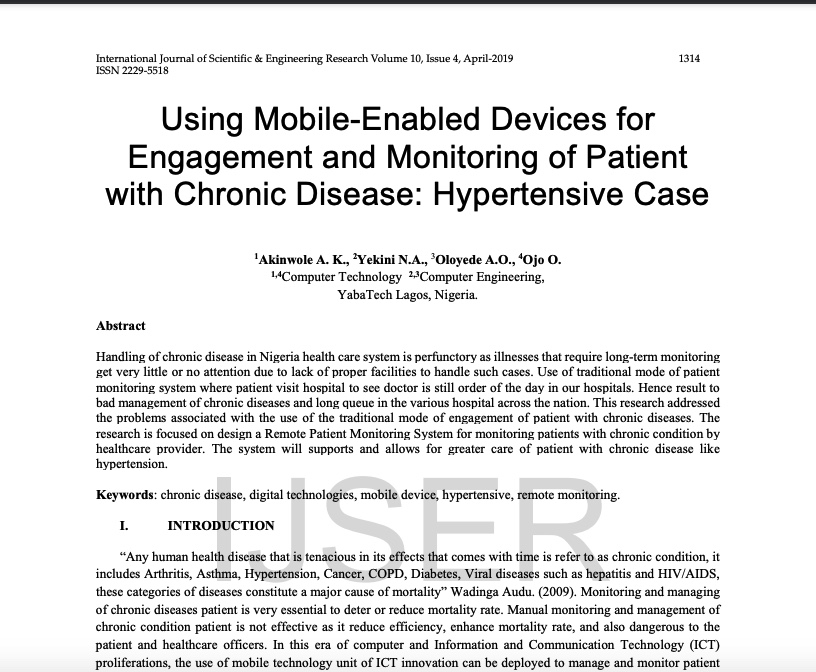
Using Mobile-Enabled Devices for Engagement and Monitoring of Patient with Chronic Disease: Hypertensive Case by Akinwole A. K., Yekini N.A., Oloyede A.O., Ojo O., International Journal of Scientific & Engineering Research, Volume 10, Issue 4, April 2019, ISSN 2229-5518


Wearing Your Map on Your Sleeve: Practices of Identification in the Creation and Consumption of Philippine Map T-shirts 
by Pamela Gloria Cajilig, paper presented at the 6th Global Conference (2014): Fashion: Exploring Critical Issues, Mansfield College, Oxford, United Kingdom, 15th to 18th September 2014

Young Girls’ Affective Responses to Access and Use of Information and Communication Technology (ICT) in Information-Poor Societies by Dania Bilal et al, New Directions in Children’s and Adolescents’ Information Behavior Research, Library and Information Science, Volume 10, Emerald Group Publishing Limited, 2014

Youth Empowered as Catalysts for Sustainable Human Development: UNDP Youth Strategy 2014-2017United Nations Development Programme, Bureau for Development Policy

Online References

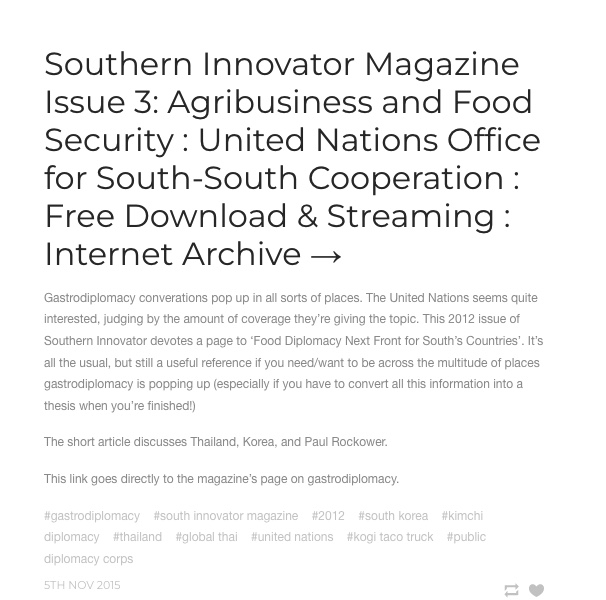
Gastrodiplomacynews: 5th November 2015

Online: https://archive.org/details/Httpsbooks.google.co.ukbooksidAQNt4YmhZagCdqsoutherninnovatorissue3sourcegbs_navlinks_s/page/n9/mode/2up?view=theater&q=gastrodiplomacy.

Southern Innovator can be read online here:

Scribd

Issue 1: http://www.scribd.com/doc/57980406/Southern-Innovator-Issue-1

Issue 2: http://www.scribd.com/doc/86451057/Southern-Innovator-Magazine-Issue-2

Issue 3: http://www.scribd.com/doc/106055665/Southern-Innovator-Magazine-Issue-3-Agribusiness-and-Food-Security

Issue 4: http://www.scribd.com/doc/128283953/Southern-Innovator-Magazine-Issue-4

Issue 5:  http://www.scribd.com/doc/207579744/Southern-Innovator-Magazine-Issue-5-Waste-and-Recycling

Google Books

Issue 1: https://books.google.co.uk/books?id=Q1O54YSE2BgC&dq=southern+innovator&source=gbs_navlinks_s

Issue 2: https://books.google.co.uk/books?id=Ty0N969dcssC&dq=southern+innovator&source=gbs_navlinks_s

Issue 3: https://books.google.co.uk/books?id=AQNt4YmhZagC&dq=southern+innovator&source=gbs_navlinks_s

Issue 4: https://books.google.co.uk/books?id=9T_n2tA7l4EC&dq=southern+innovator&source=gbs_navlinks_s

Issue 5: https://books.google.co.uk/books?id=6ILdAgAAQBAJ&dq=southern+innovator&source=gbs_navlinks_s

Southern Innovator is held in the following library collections:

Biblioteca Nationala a Republicii Moldova: http://cc.sibimol.bnrm.md/opac/bibliographic_view/399949;jsessionid=C516885A73E277718AE64598E869BC70

British Library: http://tinyurl.com/jfudl3z

Centre multimédia sur l’environnement et le développement Dakar, Senegal: http://www.enda-sigie.org/bases/sigie/format_liste.php?lang=fr&onglet=1&link=O&format=court&sort=Date%20DESC&Chp4=CONCEPTION+DE+BATIMENT

Library of Congress: http://catalog.loc.gov/vwebv/holdingsInfo?searchId=15784&recCount=25&recPointer=0&bibId=17462965

Malaysian Academic Library Union: http://malcat.uum.edu.my/kip/Record/ukm.vtls003513851

Princeton University Library: https://catalog.princeton.edu/catalog/9892864

Toronto Public Library: http://vc4kb8yf3q.search.serialssolutions.com/?V=1.0&N=100&L=VC4KB8YF3Q&S=AC_T_B&C=southern+innovator

Uganda Martyrs University: http://library.umu.ac.ug:81/cgi-bin/koha/opac-MARCdetail.pl?biblionumber=33335

United Nations Library Geneva: Issues 2, 4, 5: Click ‘Get It’: http://pmt-eu.hosted.exlibrisgroup.com/primo_library/libweb/action/search.do?SFGlobal=southern+innovator&submitGlobal=Go&fn=search&ct=search&initialSearch=true&mode=Basic&tab=default_tab&indx=1&dum=true&srt=rank&vid=41UNOG_V1&frbg=&vl%28freeText0%29=southern+innovator

Issue 1: http://pmt-eu.hosted.exlibrisgroup.com/primo_library/libweb/action/display.do?tabs=detailsTab&ct=display&fn=search&doc=41UNOG_Alma21105606680002391&indx=1&recIds=41UNOG_Alma21105606680002391&recIdxs=0&elementId=0&renderMode=poppedOut&displayMode=full&frbrVersion=&dscnt=0&frbg=&tab=default_tab&dstmp=1424959330694&srt=rank&mode=Basic&&dum=true&SFGlobal=southern+innovator&vl%28freeText0%29=southern%20innovator&vid=41UNOG_V1&submitGlobal=Go

Universiti Teknologi Malaysia Libraries: http://ent.library.utm.my/client/en_AU/main/search/detailnonmodal/ent:$002f$002fSD_ILS$002f820$002fSD_ILS:820407/ada?qu=Youth&rw=1200&ic=true&ps=300

University of Cape Town Libraries: http://aleph20.calico.ac.za/F/?local_base=uct01pub&func=find-b&find_code=OCLC&request=%28ocolc%29870179464

University of Saskatchewan: http://sundog.usask.ca/search/t?SEARCH=southern+innovator&sortdropdown=-&searchscope=8

If you would like hard copies of the magazine for distribution, then please contact the United Nations Office for South-South Cooperation: Website: https://unsouthsouth.org/2014/12/25/southern-innovator-magazine/.

If you would like to either sponsor an issue of Southern Innovator or place an advertisement in the magazine, then please contact southerninnovator@yahoo.co.uk.

We accept payments and donations. We use any funds received to keep content online, or to create new content. Thank you! https://www.paypal.me/davidsouthconsulting

Scan code with your phone and help us out.

ORCID iD: https://orcid.org/0000-0001-5311-1052

© David South Consulting 2023