Categories
Archive Development Challenges, South-South Solutions Newsletters Southern Innovator magazine

Turning African Youth on to Technology

By David SouthDevelopment Challenges, South-South Solutions

SOUTH-SOUTH CASE STUDY

An African NGO believes the Internet is the single biggest key to rapid development in Africa – and it is working to connect youth, women and rural populations to the web, and in turn, switch them on to the vast resources stored across the world’s Internet sites.

After initial successes with a youth project and with farmers, Voices of Africa (VOA) (http://www.voicesofafrica.info) is now seeking to scale up its work to fan out across Africa – and take its services to the world’s largest refugee camp, the Dadaab Refugee Camp in Kenya. 

The youth and technology empowerment NGO has developed a business model to deliver low-cost Internet access and e-resources to Africa’s slums and rural farmers.

VOA argues that “the digital divide, defined by a lack of access to information for a specific population, symbolizes the largest difference between developed and developing countries: the opportunity to obtain and utilize information.”

“The digital divide runs much deeper than hardware and software,” it says. “While equipment is necessary it is not sufficient. The real heart of the digital divide is that those without access to information resources often suffer needlessly while the solutions to their problems are floating in the air.”

But why is the Internet so important?

“The internet puts the choice of content at the fingertips of the user,” explains executive director Crystal Kigoni. “Traditional media is one way communications. Internet is bi-directional.

“Our NGO is completely grassroots. We train the people who train the people. It is an each one, teach one philosophy and is highly effective. We also design our projects to be self-sustainable after one year of successful implementation.”

The philosophy behind Voices of Africa – “Sustainable Development through Information Empowerment” – is to give people the information and resources to take better control of their lives.

Access to the Internet in Africa is patchy and, for the poor, an expensive resource. The penetration of mobile phones in Africa has been spectacular in the past five years. But there are limits to the resources people can afford to access with their phones. Issues abound about data costs, mobile phone networks, and mobile phone capability.

VOA targets youth and women in sub-Saharan Africa through online educational resources offered on their e-learning website (http://elearning.voicesofafrica.info/). The resources have been certified by Nazarene University (http://www.anu.ac.ke), a private university in Nairobi, Kenya.

The e-learning resources include high quality training videos, presentations and screencasts (http://en.wikipedia.org/wiki/Screencast) – like a movie, it is a digital recording of changes on a computer screen and is used to teach software – to share on the web. The resources are also shared through compact discs (CDs) and iPods (http://en.wikipedia.org/wiki/IPod).

Project coordinator Nick Kungu coordinates the staff working on the pilot Kenyan projects: a Rural Internet Kiosk; a Youth Empowerment Center; and KiberaNet, which launched in August 2011. VOA uses a part-time and volunteer staff of more than 20 Kenyans and four international ‘virtual’ volunteers.

The group is also working with farmers in Kutus, central Kenya, to help them get a better price for their products and introduce sustainable agriculture practices. This is done through online courses so the farmers do not need to travel. It is hoped by doing this they can improve the supply of food for the country.

The Youth Empowerment Center in Webuye constituency of the Western province of Kenya involves a partnership with the government of Kenya to teach computer basics, research and data collection, social media, ICT (information communication technology) for development, social business and community health.

In rural areas, the need for information cannot be overestimated. In the remote countryside, there are few schools with adequate resources and almost no community libraries. The lifesaving knowledge the people require has to date been completely beyond their grasp. As one rural woman in the Western province of Kenya exclaimed to VOA after encountering the resources on the Internet, “It is like being brought from the darkness into the light.”

Another project in development is SlumNet, which seeks to combine the Internet with low-cost devices like tablet computers and netbooks. Its pilot scheme, KiberaNet, launched this month in the Kibera slum of Nairobi, Kenya to test the business model. VOA hopes to then expand it to Uganda, Tanzania, Ghana, Nigeria and Sierra Leone. It is using a business model to bring low-cost Internet access to Africa’s slums that is fully funded by the local communities and the users.

It has identified the key needs of youth in slums that need to be met: a way to access the vast resources available on the Internet; a way to generate income, undertake low-cost learning, and organise for social justice; ways to overcome social, economic and political isolation; a way to access affordable equipment and resources to improve their quality of life in the short-term.

To make it a sustainable business model, the community takes a 60 percent stake in the incorporated entity. Voices of Africa will select six local civil society organisations to take another 10 percent stake in the business. VOA takes 10 percent and the remaining 30 percent will be open to outside investors.

It involves setting up a closed intranet system and Internet access covering the entire Kibera slum, which has an estimated population of 2 million, a majority under the age of 30.

KiberaNet hopes to act as a community hub for socialising, education and generating content. A key part is creating an atmosphere that is welcoming to novices. The business model is about delivering the bandwidth of Internet access and simultaneously generating a sustainable source of income to keep it going. Partners in the business include Promote Africa, Plexus Group and Future Optics Networks.

VOA also has been blogging about its time in Kenya’s Dadaab Refugee Camp (http://www.unhcr.org/cgi-bin/texis/vtx/page?page=49e483a16) at their website, www.voicesofafrica.info, and has been developing plans to expand services to the camp, home to over 400,000 refugees from drought and famine in Somalia. The camp was only designed to hold 90,000 people. The chronic food insecurity has caused a massive humanitarian crisis in the Horn of Africa, leaving over 10 million people in need of help.

“There are plenty of resources going in but it is aid business as usual,” claims Kigoni. “You see lots of waste in many areas, and a lack in others that would be extremely beneficial. Hence, why Voices of Africa has come up with the youth technology and empowerment plan that accompanies a general information and communications system, DadaabNet.”

DadaabNet will be a youth-run community Internet service and education service. VOA plans to use a wireless intranet, internal communications systems and low-cost internet access in the refugee camp.

The project is the first of its kind in Dadaab and a first in Kenya, claims VOA, allowing free educational content without needing to access the Internet

The intranet will host free educational videos that can be accessed by mobile phones and computers. The topics covered in the videos include health, nutrition, sanitation and computer training and how to use technology for sustainable development.

The curriculum is also approved by Nazerene University to certificate level.

The system is supervised and would be able to offer resources to other NGOs seeking to provide services to the camp’s residents. The intention is to open up opportunities for education and employment youth who are currently unemployed.

At present the youth in the camp, many of whom have not completed secondary school, get by ‘hustling’ for work, according to VOA. By being left to their own devices, there is a risk they will fall into negative behaviour like crime and drug use or be preyed upon by terrorist organisations operating in the area like al Shabaab, they maintain.

“In our dreams, everyone everywhere in the world can have the opportunity to develop their minds. It is through this creativity that Africa will rise,” concludes Kigoni.

Published: August 2011

Resources

1) The Impact of Mobile Phones on Profits from Livestock Activities by Roxana Barrantes. Website: http://www.mendeley.com/research/impact-mobile-phones-profits-livestock-activities-evidence-puno-peru-14/

2) 2011 UNHCR Country Operations Profile – Kenya. Website: http://www.unhcr.org/cgi-bin/texis/vtx/page?page=49e483a16

3) Southern Innovator magazine: New global magazine Southern Innovator’s first issue is out now and is about Mobile Phones and Information Technology in the global South. Website: http://www.scribd.com/doc/57980406/Southern-Innovator-Issue-1

Creative Commons License

This work is licensed under a
Creative Commons Attribution-Noncommercial-No Derivative Works 3.0 License.

ORCID iD: https://orcid.org/0000-0001-5311-1052.

© David South Consulting 2023

Categories
Archive

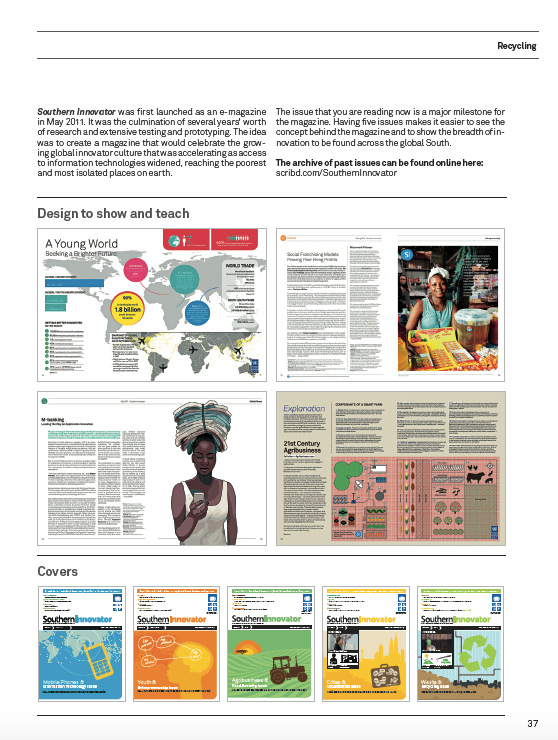
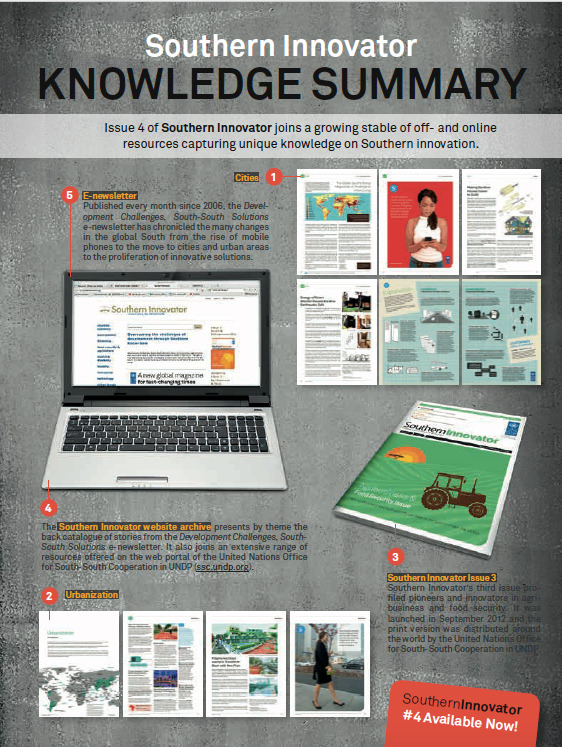
Southern Innovator As A Knowledge And Learning Tool | November 2017

Why even bother printing (on paper) Southern Innovator as a magazine? “What about the trees and we live in the digital age!”, some might say.

There is evidence and science supporting the need to always publish Southern Innovator in print as well as online. First, a study of the World Bank’s online publications came to a shocking conclusion: A survey in 2014 found a third of World Bank publications are never downloaded, 40 per cent were downloaded just 100 times, and only 13 per cent were downloaded more than 250 times in their lifetime (The Washington Post). As The Washington Post pointed out, these are publicly funded publications with the intention of contributing to policy debates and providing solutions to the world’s problems. So, if nobody is reading them, or just a handful are, that actually does matter if you care about positive change in the world.

Secondly, a Norwegian study in 2014 from the Stavanger University (part of Europe-wide research into the impact of digitisation on the reading experience), found “… that paper readers did report higher on measures having to do with empathy and transportation and immersion, and narrative coherence, than iPad readers,” according to lead researcher Anne Mangen (The Guardian).

An earlier study the researchers did also found “students who read texts in print scored significantly better on the reading comprehension test than students who read the texts digitally” and that “Studies with students, for instance, have shown that they often prefer to read on paper”, continued Mangen in The Guardian.   

Another issue is Internet shutdowns, outages and censorship. All of these have been on the increase, especially in Africa (africanews.com). To put it simply, you cannot electronically shutdown a piece of paper. 

Design to show and teach.
Innovations Summary.
A fast-changing world.
Knowledge Summary.
Knowledge Summary.
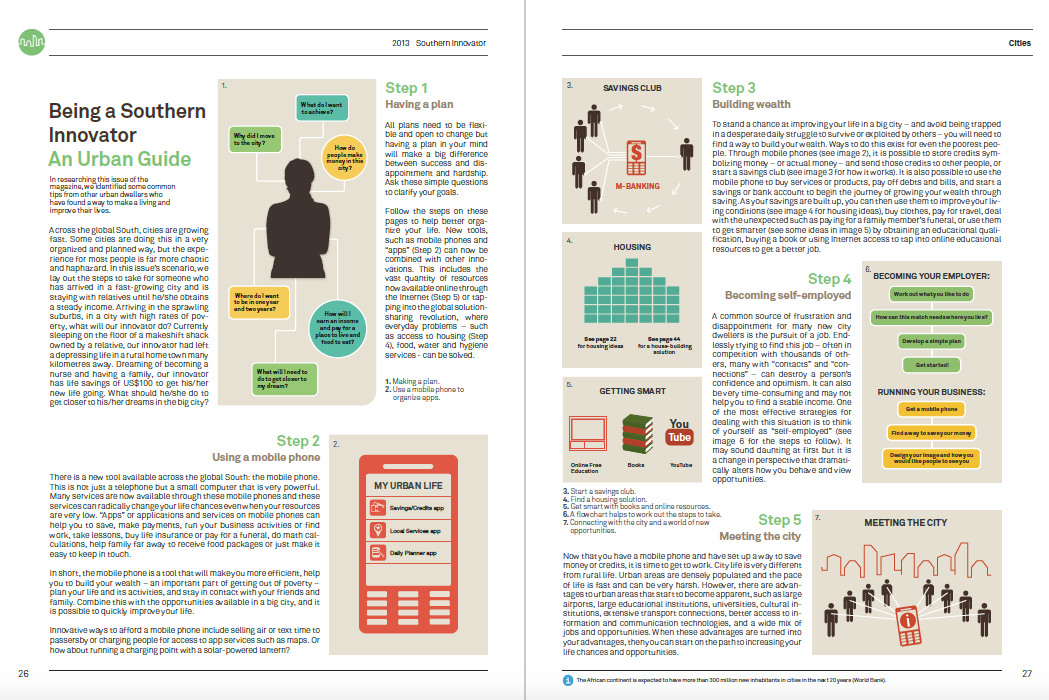
Being a Southern Innovator: An Urban Guide.
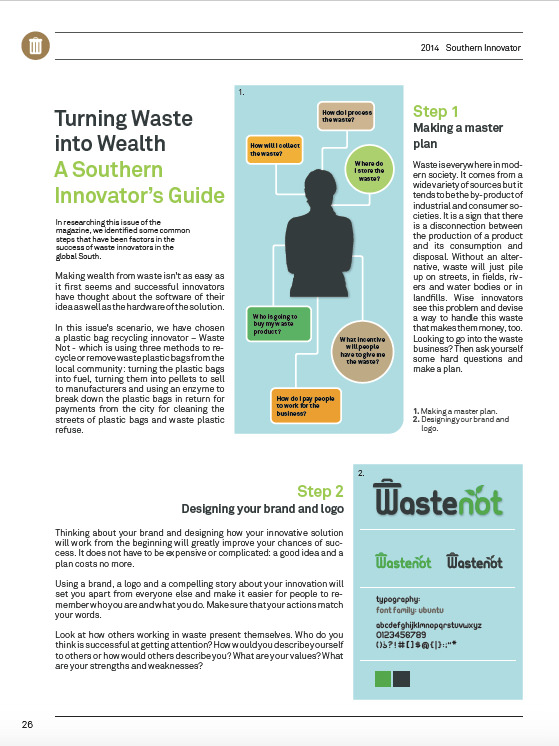
Turning Waste into Wealth: A Southern Innovator’s Guide.
Managing the workflow: Getting things done.

This work is licensed under a Creative Commons Attribution 4.0 International License.

ORCID iD: https://orcid.org/0000-0001-5311-1052.

© David South Consulting 2017

Categories
Blogroll Great Ormond Street Hospital for Children/Institute of Child Health

20 Years Ago

It was 20 years ago this month (September 2001) that the GOSH Child Health Portal was launched in London, UK. The award-winning website was called “One of the three most admired websites in the UK public and voluntary sectors”.

“Making sure that your child has helpful, easy-to-read information will make a significant difference to their time in hospital. I am sure that this website will prove very useful for children and their families.” Prime Minister Tony Blair.

Britain’s best-loved children’s hospital and charity, Great Ormond Street Hospital for Children NHS Trust (GOSH), contracted me to lead a two-year project to modernise the hospital’s web presence and take its brand into the 21st century. GOSH is both Britain’s first children’s hospital and a pioneering child health institution (along with its partner the Institute for Child Health). The hospital’s outstanding reputation meant the project was carried out under intense public, media and professional scrutiny, and required a keen awareness of new media developments and the needs of the hospital’s patients, their families and the public.

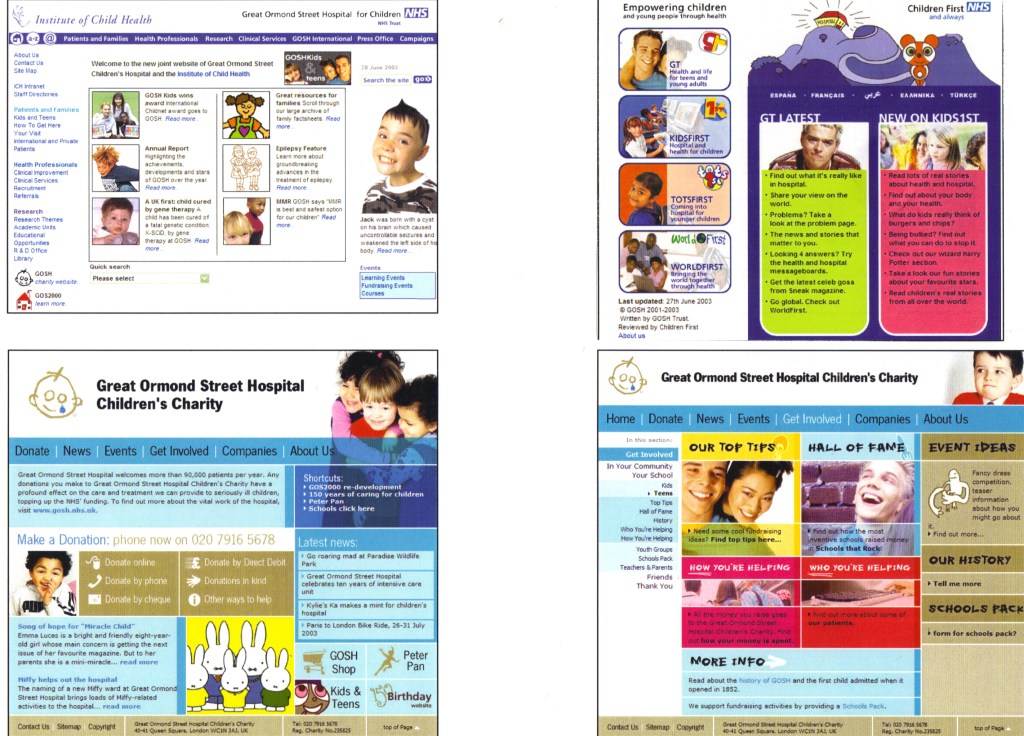
The project was developed in three, distinct phases. Screen grabs from these phases are now available for download and evaluation. They also include web traffic statistics. This unique snapshot of a complex project as it unfolded, should prove useful for other e-health practitioners.

Phase 1: www.scribd.com/doc/47241951/GOSH-Child-H ealth-Portal-Proj...
Phase 2: www.scribd.com/doc/47242473/GOSH-Child-H ealth-Portal-Proj...
Phase 3: www.scribd.com/doc/47242267/GOSH-Child-H ealth-Portal-Proj...

In 2001, the project also launched an interactive Christmas child health advent calendar offering top tips from health professionals on how to have a safe holiday season. The PDF can be viewed here: http://www.scribd.com/doc/44905926/Christmas-Advent-Calendar-for-GOSH-Child-Health-Portal-2001.

A great way to track the historical development of a web project is to use the Wayback Machine’s internet archive here. By typing in the web address (for example, www.gosh.nhs.uk, and www.gosh.org), you can see a chronological history of the website by month.

Content produced for the GOSH Child Health Portal (now MyGOSH) in 2003 on the ketogenic diet and how it can help with the treatment of epilepsy.
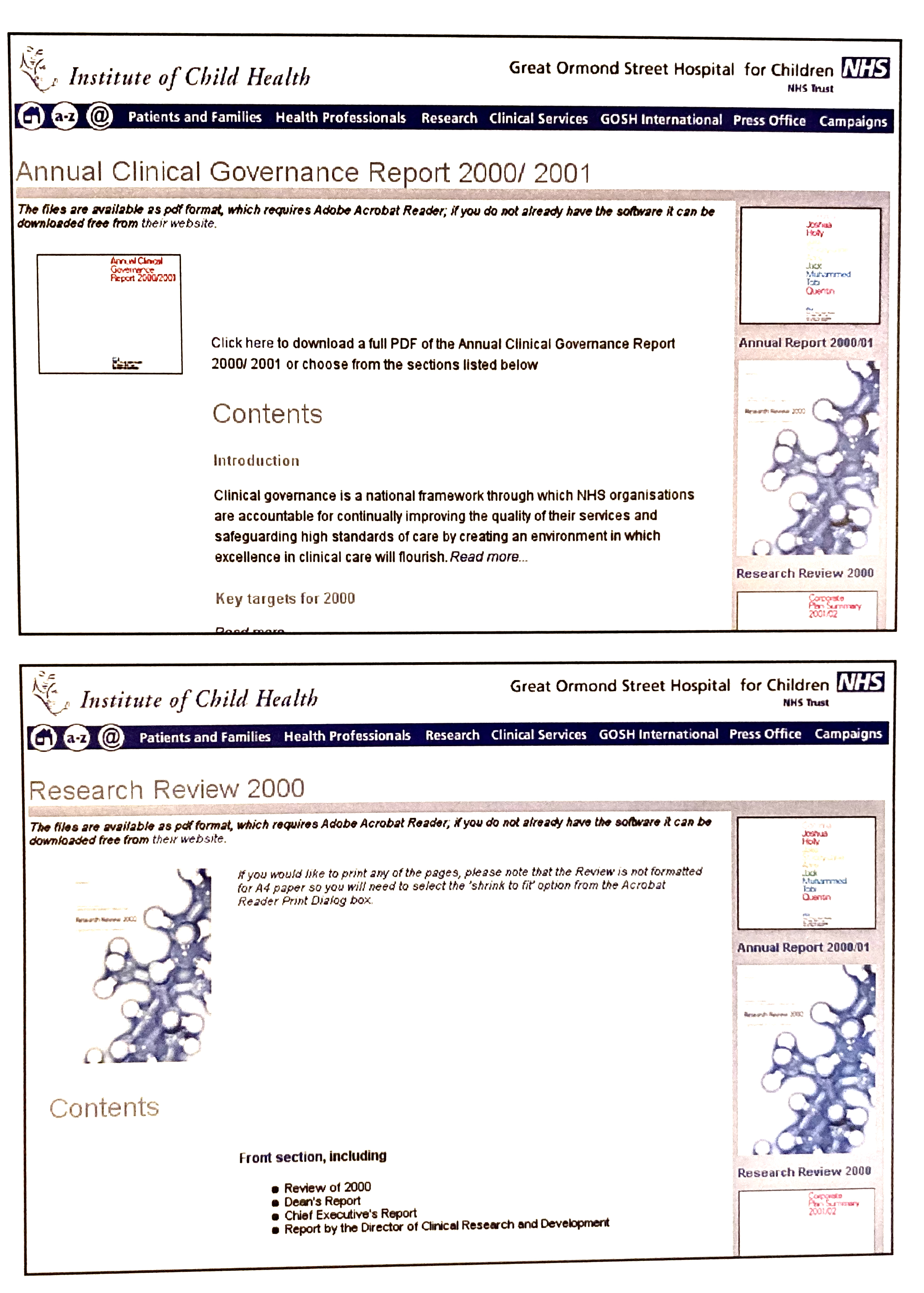
Annual Clinical Governance Report 2000/2001.

Read here about the child health portal project’s vision and strategy, its launch and overall impact. Or download a brief Powerpoint presentation here: GOSH Powerpoint.

In 2003, the UK’s Guardian newspaper called the Children First website one of the “three most admired websites in the UK public and voluntary sectors,” and a UK government assessment called the overall GOSH child health web portal a role model for the NHS.

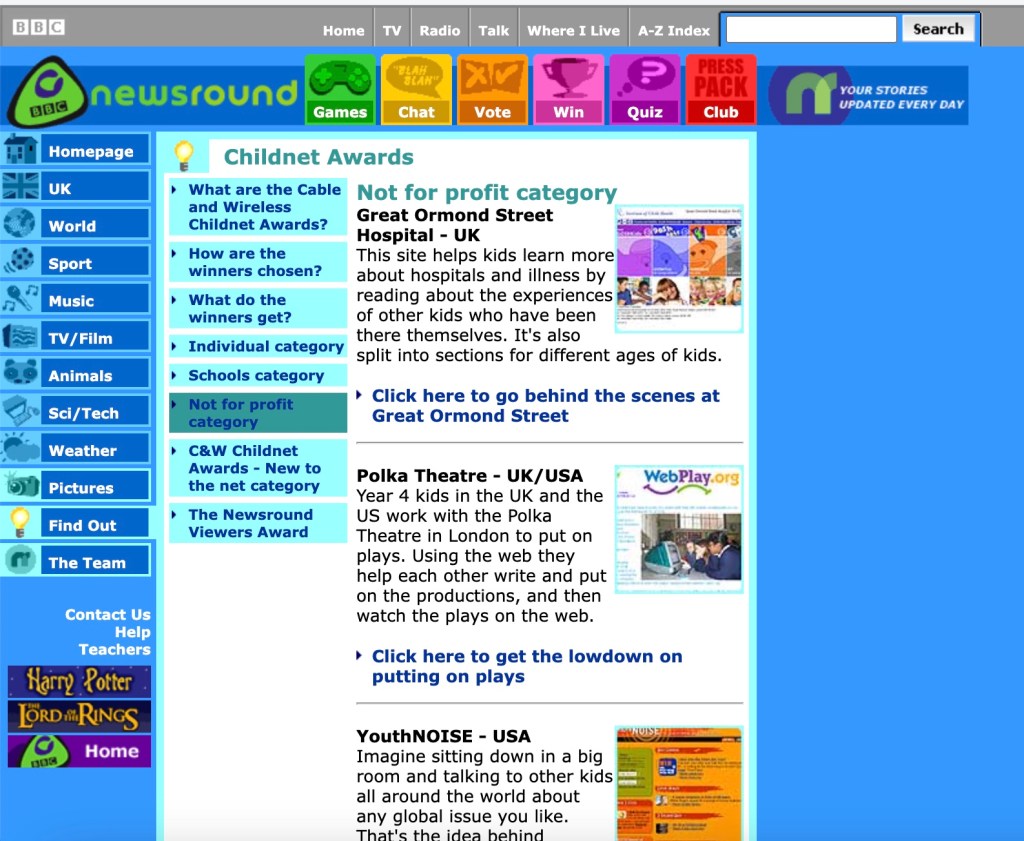
The GOSH Child Health Portal team receive the Childnet Award in 2003 at London’s Science Museum (Photo: CBBC Newsround).

In 2006, The Times of London called Children First the Top Child Health Website in its Wellbeing on the Web: The Best Portals survey (November 11, 2006).

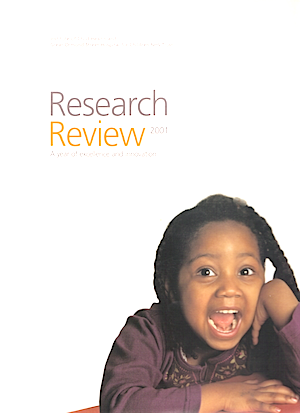
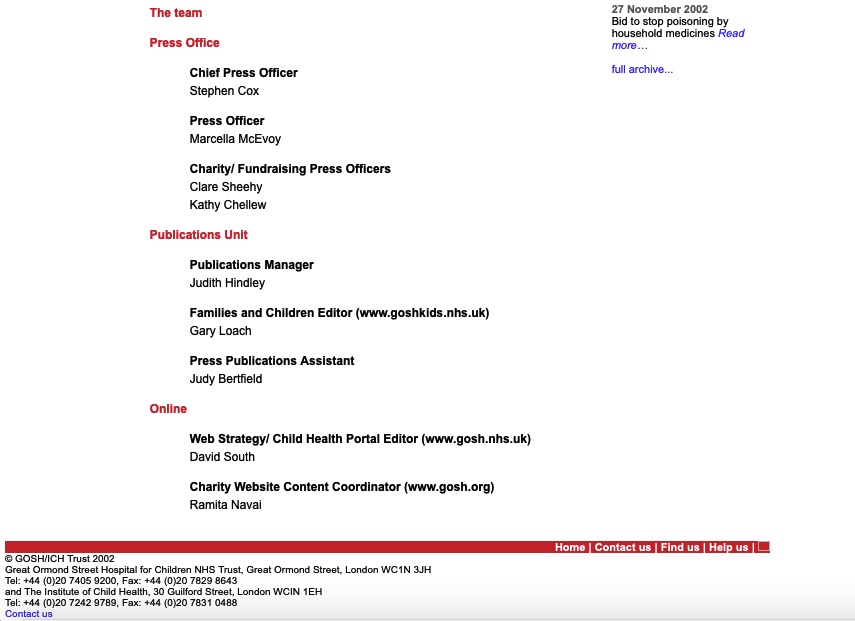
The GOSH Child Health Portal Team circa 2002.

What we did 10 Years Ago

This work is licensed under a Creative Commons Attribution 4.0 International License.

ORCID iD: https://orcid.org/0000-0001-5311-1052.

© David South Consulting 2024

Categories
Archive Development Challenges, South-South Solutions Newsletters

An Innovator’s ‘Big Chicken Agenda’ for Africa

By David SouthDevelopment Challenges, South-South Solutions

SOUTH-SOUTH CASE STUDY

Increasing the quantity and quality of food in Africa will be critical to improving the continent’s human development. And a key element in giving Africa a more secure food supply will be boosting science and knowledge on the continent and making sure it is focused on Africa’s needs and situation.

One pioneering scientist is looking to the humble chicken to tackle two big problems in Africa: food security and household incomes. By pumping up the weight and productivity of African chickens, she hopes to eradicate hunger and boost household incomes.

Kenyan scientist Sheila Ommeh (http://www.awardfellowships.org/participants/success-stories/108-sheilaommeh.html ) is showing how local knowledge can give farmers the edge when it comes to improving Africa’s animal stock. An animal geneticist, she is trying to create a disease-resistant African chicken that can also produce plenty of eggs.

Her pioneering work is about trailblazing “a big chicken agenda in Africa,” she explained to TrustLaw, a global hub for free legal assistance and information on good governance and women’s rights.  She grew up in an area – Mount Elgon in western Kenya – where raising chickens was the primary source of both income and food. Her family raised chickens and the income from this helped to pay for her schooling.

Raising chickens is common in rural Kenya, and many of the people doing it are women.

Based on her experience, she saw how virulent diseases kill chicken flocks and destroy family incomes and disrupt lives – diseases like Newcastle (http://www.avianbiotech.com/diseases/newcastle.htm) and Gumboro (gumboro.com).

She works at the International Livestock Research Institute (ilri.org) based in Nairobi, Kenya. The ILRI “works at the crossroads of livestock and poverty, bringing high-quality science and capacity-building to bear on poverty reduction and sustainable development” and conducts research in Africa, South and Southeast Asia and China.

“I’m really passionate about giving back to the community an improved chicken that will really help their lives,” she explains.

Another project she is working on is the development of a drought-tolerant chicken. This chicken could prove very helpful in parts of Africa suffering from drought and hunger, like in the Horn of Africa.

Women are considered to be the majority producers of food in Africa yet just one in four people working in agricultural research in Africa is a woman, according to TrustLaw.

Ommeh has a PhD in chicken genetics and is a staunch believer in seeking out solutions to Africa’s problems within Africa: “In my view = it’s about time Africa looked for solutions in Africa for Africa,” she told a group of British Members of Parliament.

She will continue her research by looking at native African chickens. She is worried indigenous African chickens are being wiped out by cross-breeding and the introduction into the continent of exotic breeds, which are making African chickens more susceptible to viruses.

Her goal is to produce a disease-resistant breed of chicken weighing four kilograms and laying 250 eggs a year. This would be a big increase on current average weights, and a trebling of the yield.

“Definitely the incomes of these households will increase and that will (create) a rippling effect that will trickle up … And we hope that in 10 to 15 years the poverty issue in Africa will not be so serious,” Ommeh said.

“Chicken is a small livestock but I believe it has the capacity to have a big impact.”

For female scientists working in agriculture, African Women in Agricultural Research and Development (AWARD) (http://awardfellowships.org/) is seeking researchers looking to boost their technical and leadership skills. It is hoped that supporting more women researchers will have the effect of turning research priorities towards the needs of smallholder farmers, who make up the majority of  farmers in Africa.

Published: May 2012

Resources

1) Artificial chicken: The contest to create artificial chicken meat offers a US $1 million prize. Website: http://www.guardian.co.uk/science/2012/jan/21/artificial-chicken-food-prize

2) Poultry Hub: “Poultry Hub can help you learn more about the amazing world of poultry and your place in it. Poultry is one of the world’s most technically advanced agricultural industries, offering rewarding career paths to talented young people in hundreds of countries.” The Hub includes the excellent “anatomy of the chicken” learning resource. Website: http://www.poultryhub.org/organisations/rural-industries-research-anddevelopment-corporation-rirdc-chicken-meat-program/

3) Poultry Research Centre: From the University of Alberta, the website offers resources and contacts on poultry sciences. Website: http://www.poultryresearchcentre.com/

4) Chickens: Basic information on chickens and their origins. Website: http://www.encyclopedia.com/topic/Chicken.aspx

https://davidsouthconsulting.org/2022/11/21/africa/

https://davidsouthconsulting.org/2022/11/21/agribusiness-food-security/

https://davidsouthconsulting.org/2022/09/27/avoiding-wasting-food-and-human-potential-with-icts/

https://davidsouthconsulting.org/2022/08/14/brazil-preserves-family-farms-keeping-food-local/

https://davidsouthconsulting.org/2022/10/10/cheap-farming-kit-hopes-to-help-more-become-farmers/

https://davidsouthconsulting.org/2020/04/25/china-pushing-frontiers-of-medical-research/

https://davidsouthconsulting.org/2021/03/08/the-dawn-of-the-genetics-revolution-2001-2003/

https://davidsouthconsulting.org/2021/03/04/food-diplomacy-next-front-for-souths-nations/

https://davidsouthconsulting.org/2022/02/10/food-inflation-ways-to-fight-it/

https://davidsouthconsulting.org/2022/10/14/indias-modernizing-food-economy-unleashing-new-opportunities/

https://davidsouthconsulting.org/2022/11/01/indonesian-food-company-helps-itself-by-making-farmers-more-efficient/

https://davidsouthconsulting.org/2022/05/04/insects-can-help-in-food-crisis/

https://davidsouthconsulting.org/2022/10/14/staple-foods-are-becoming-more-secure-in-the-south/

https://davidsouthconsulting.org/2021/03/20/texting-for-cheaper-marketplace-food-with-sokotext/

https://davidsouthconsulting.org/2022/11/11/urban-farming-to-tackle-global-food-crisis/

https://davidsouthconsulting.org/2022/10/10/us-1-trillion-opportunity-for-africas-agribusinesses-says-report/

https://davidsouthconsulting.org/2022/10/18/woman-wants-african-farming-to-be-cool/

Development Challenges, South-South Solutions was launched as an e-newsletter in 2006 by UNDP’s South-South Cooperation Unit (now the United Nations Office for South-South Cooperation) based in New York, USA. It led on profiling the rise of the global South as an economic powerhouse and was one of the first regular publications to champion the global South’s innovators, entrepreneurs, and pioneers. It tracked the key trends that are now so profoundly reshaping how development is seen and done. This includes the rapid take-up of mobile phones and information technology in the global South (as profiled in the first issue of magazine Southern Innovator), the move to becoming a majority urban world, a growing global innovator culture, and the plethora of solutions being developed in the global South to tackle its problems and improve living conditions and boost human development. The success of the e-newsletter led to the launch of the magazine Southern Innovator.

https://davidsouthconsulting.org/2021/03/05/southern-innovator-issue-1/

Creative Commons License

This work is licensed under a
Creative Commons Attribution-Noncommercial-No Derivative Works 3.0 License.

ORCID iD: https://orcid.org/0000-0001-5311-1052.

© David South Consulting 2021