Tag: innovation and innovators

  • Food Inflation: Ways to Fight It

    Food Inflation: Ways to Fight It

    By David SouthDevelopment Challenges, South-South Solutions

    SOUTH-SOUTH CASE STUDY

    Food inflation has taken off at the beginning of 2011. As the global economic crisis enters its next phase, both developed and developing countries are experiencing inflation. There are many factors fuelling the rise in prices – inefficient distribution and storage systems, lack of investment in agriculture, devaluing currencies, high demand, natural and man-made disasters, use of food products like corn to make biofuels – but there are also ways to counter the effects of food inflation that have been tried and tested across the South.

    The United Nations Conference on Trade and Development (UNCTAD) says the least developed countries spent US $9 billion on food imports in 2002. By 2008, that amount had risen to US $23 billion. Supachai Panitchpakdi, secretary general of UNCTAD, says “the import dependence has become quite devastating.”

    Worse, more people had less money to buy the food. The number of individuals living in extreme poverty “increased by 3 million per year during the boom years of 2002 and 2007,” reaching 421 million people in 2007.

    For millions of people, it is a matter of life and death that food remains affordable. The poor pay the largest share of their income on food. Raise that cost, and the poor quickly have little money left for other things, like housing, transport, clothing or education.

    Approached as a problem needing a solution, it is possible to deal with a bout of food inflation. Every food crisis has its origins and can be resolved. A staggering amount of food goes to waste every year, and a vast quantity can’t get from the farm to the market in time because of infrastructure problems.

    An Indian refrigerator – the ChotuKool fridge (http://www.godrej.com/godrej/godrej/index.aspx?id=1) – is designed to stay cool for hours without electricity and to use half the power of conventional refrigerators. Priced at US $69, it is targeted at India’s poor – a population of over 456 million, almost half the total Indian population (World Bank).

    Manufactured by Godrej and Boyce and weighing just 7.8 kilograms, it is designed around the stated needs of the poor, who wanted a fridge capable of cooling 5 to 6 bottles of water and 3 to 4 kilograms of vegetables. Portability was crucial as well, since needs to be moved when large family gatherings take place in small rooms.

    As a photo shows (http://innovation.hindustantimes.com/summit-photos/godrej/chotukool-3.php), the fridge looks more like a drinks cooler than the typical large refrigerator. It works by replacing the standard compressor motor found in most fridges with a battery-powered heat exchanger.

    In Ghana, a mobile phone-driven Internet marketplace is helping to improve efficiencies in farming and selling food. Esoko (esoko.com/#lang=en), tracks products including ground nuts, sesame, tomato, maize and white beans. It offers market information from Afghanistan, Benin, Burkina Faso, Cameroon, Cote d’Ivoire, Ghana, Madagascar, Mali, Mozambique, Nigeria, Sudan and Togo.

    India’s e-Choupal is making food distribution more efficient in a country experiencing high inflation. E-Choupal (http://www.echoupal.com) has developed a reputation for both controlling prices and increasing incomes for poor farmers. Started in 2000 by the major Indian company ITC Limited (http://www.itcportal.com), it links farmers to the latest prices for products including soybeans, wheat, coffee and prawns.

    E-Choupal works through computers set up in rural areas and has built one of the largest internet initiatives in rural India, reaching 4 million farmers in 40,000 villages.

    Brazil, over the last 30 years, has transformed itself from a food importer to one of the world’s major food exporters. It made these impressive achievements with few government subsidies. The agricultural success is down to Embrapa (http://www.embrapa.br/english) – short for Empresa Brasileira de Pesquisa Agropecuária, or the Brazilian Agricultural Research Corporation. A public company set up in 1973, it has turned itself into the world’s leading tropical research institution. It breeds new seeds and cattle and has developed innovations from ultra-thin edible wrapping paper for foodstuffs that turns colour when the food goes off to a nano-tech lab creating biodegradable ultra-strong fabrics and wound dressings.

    Another approach can be found with a farmer in Kenya, Zack Matere, who boosted his potato crop by turning to Facebook for help. On his farm in Seregeya, Matere used the internet to find a cure for his ailing potato crop.

    He uses his mobile phone to access the internet at a costs of about US 0.66 cents a day. One example of the kind of intelligence Matere is able to glean from the internet is reports of cartels deceiving farmers by buying potatoes in over-large 130 kg bags instead of 110 kg bags. Matere takes this information, translates it into Swahili and posts it on community notice boards.

    Another fast-growing solution is bringing farming to urban and semi-urban spaces, where the majority of the world’s population now lives.

    Urban farmers can take advantage of their close proximity to consumers, keeping costs down and profits up. They can also solve one of agriculture’s enduring problems – where to find water for irrigation by using existing waste water. Waste water is plentiful in urban environments, where factories usually pump out waste water into streams, rivers and lakes.

    In Accra, Ghana, more than 200,000 people depend on food grown with wastewater. In Pakistan, a full quarter of the grown vegetables use wastewater.

    Family farms are critical to weathering economic crises and ensuring a steady and secure food supply. The International Fund for Agricultural Development (IFAD) (www.ifad.org) called in 2008 for small family farms – which sustain the livelihoods of more than 2 billion people _ to be put at the heart of the global response to high food prices and uncertain food security.

    In Brazil, this call is being answered by a bold initiative to create a “social technology,” combining a house-building programme with diverse family farms.

    This is where the Brazilian farmer’s cooperative Cooperhaf: Cooperativa de Habitacao dos Agricultores Familiares (http://www.cooperhaf.org.br/) steps in.

    “We see the house as the core issue,” said Adriana Paola Paredes Penafiel, a projects adviser with the Cooperhaf. “The farmers can improve their productivity but the starting point is the house.

    “Family farming is very important for the country – 70 percent of food for Brazilians comes from family farming,” said Penafiel. “The government wants to keep people in rural areas.”

    Making farming more appealing is being shown as a great way to get ahead in modern Africa. One woman hopes more people will be attracted to farming and boost the continent’s food security and reduce costly imports.

    Cynthia Mosunmola Umoru’s company, Honeysuckle PTL Ventures (http://www.tootoo.com/d-c3015227-Honeysuckles_Ptl_Ventures/), is based in Lagos, the business capital of Nigeria.

    Leading by example, Umoru has set up a successful and modern agribusiness focusing on high-quality food products using modern packaging and fast delivery. She produces meat products, from seafood like shrimps and prawns to snails, beef, chicken, and birds. Her niche is to deliver the product however the customer wishes: fresh, frozen or processed.

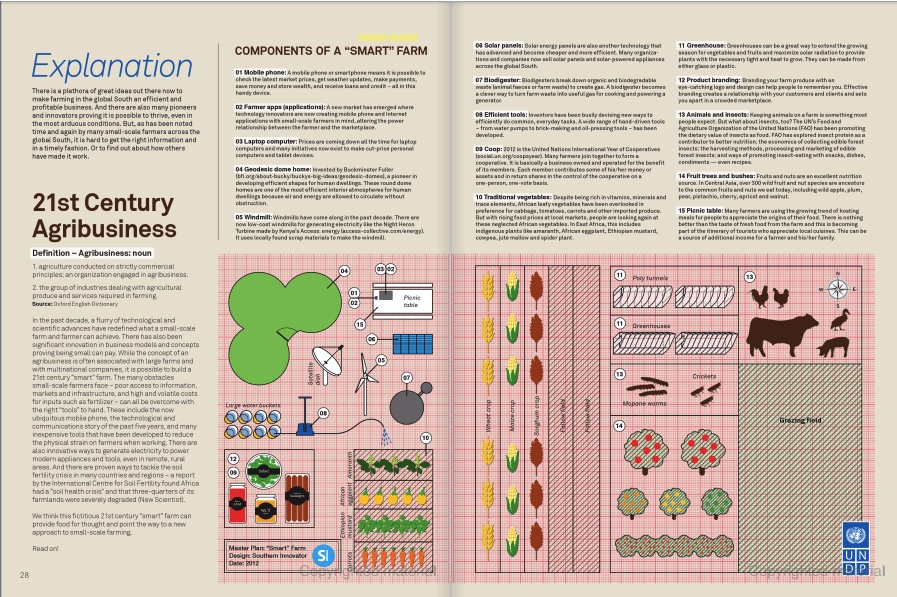
    Radical new food sources are also another option over time. The Food and Agricultural Organization (FAO) has explored insect protein as a contributor to better nutrition, the economics of collecting edible forest insects, methods of harvesting, processing and marketing edible forest insects, and ways of promoting insect eating with snacks, dishes, condiments — even recipes.

    The range of insects that can be tapped for food is huge, and includes beetles, ants, bees, crickets, silk worms, moths, termites, larvae, spiders, tarantulas and scorpions. More than 1,400 insect species are eaten in 90 countries in the South. Entrepreneurs in the South are making insects both palatable and marketable – and in turn profitable. These innovations are adding another income source for farmers and the poor, and supplying another weapon to the battle for global food security.

    Resources

    1) The global movement for slow food, which encourages organic production and appreciation of traditional foods and cooking. Website: www.SlowFood.com

    2) A video story by CNN on Tradenet/Esoko. Website: http://www.youtube.com/watch?v=s6z0ywkHPPQ

    3) Olam: The story of Olam – a global food supply company in ‘agri-products’ that got its start in Nigeria – shows how a Southern brand can grow and go global, and overcome the difficulties of cross-border trade. Website: http://www.olamonline.com/home/home.asp

    4) South African company Eat Your Garden: It provides urban dwellers and food businesses with their own food gardens bursting with juicy and tasty foods whilst at the same time reducing carbon footprints, and creating employment and provide training, helping poverty alleviation. Website: http://www.eatyourgarden.co.za/

    5) Vertical farming, where hothouses are piled one on top of the other, is an option being promoted as a solution to the food needs of urban dwellers. Website: http://www.verticalfarm.com/

    Follow @SouthSouth1

    Slideshare: http://www.slideshare.net/DavidSouth1/development-challengessouthsouthsolutionsnovember2010issue

    Southern Innovator Issue 1: https://books.google.co.uk/books?id=Q1O54YSE2BgC&dq=southern+innovator&source=gbs_navlinks_s

    Southern Innovator Issue 2: https://books.google.co.uk/books?id=Ty0N969dcssC&dq=southern+innovator&source=gbs_navlinks_s

    Southern Innovator Issue 3: https://books.google.co.uk/books?id=AQNt4YmhZagC&dq=southern+innovator&source=gbs_navlinks_s

    Southern Innovator Issue 4: https://books.google.co.uk/books?id=9T_n2tA7l4EC&dq=southern+innovator&source=gbs_navlinks_s

    Southern Innovator Issue 5: https://books.google.co.uk/books?id=6ILdAgAAQBAJ&dq=southern+innovator&source=gbs_navlinks_s

    Creative Commons License

    This work is licensed under a
    Creative Commons Attribution-Noncommercial-No Derivative Works 3.0 License.

    ORCID iD: https://orcid.org/0000-0001-5311-1052.

    © David South Consulting 2024
  • Press Release 3 | Southern Innovator

    Press Release 3 | Southern Innovator

    Press Release for General Distribution

    Southern Innovator’s Fifth Issue Profiles Innovators in Waste and Recycling

    United Nations, New York, USA, 28 April 2014

    • Fifth issue of Southern Innovator tackles ways to improve human development in a world with finite resources
    • 60-page color magazine offers a snapshot of our fast-changing world

    The fifth issue of Southern Innovator (SI) magazine is out now. It explores how innovation can tackle the challenges of improving human development on a planet with finite resources.

    SI researchers identified innovative, low-polluting options to the world’s energy needs. They found that it is possible to alter the way that things are made to reduce or eliminate waste and toxic pollutants harming human health and damaging the environment. And not only that: they also discovered that there are sustainable incomes to be made from the economy of waste reduction and recycling – an opportunity that has yet to be fully realized. The innovations shared here demonstrate that raising living standards in the global South and responsible use of the world’s resources are not necessarily incompatible.

    Some innovators are transforming attitudes towards fashion, proving that it does not have to be a wasteful industry. Others are turning commonly found waste – food waste, or human or animal excrement – into fuel for heating. The link between good design and the efficient use of resources is apparent in many of the innovators’ solutions. If a new, green economy is to work, then it must appeal to people’s aspirations and be something that they want in their lives and are willing to work to achieve.

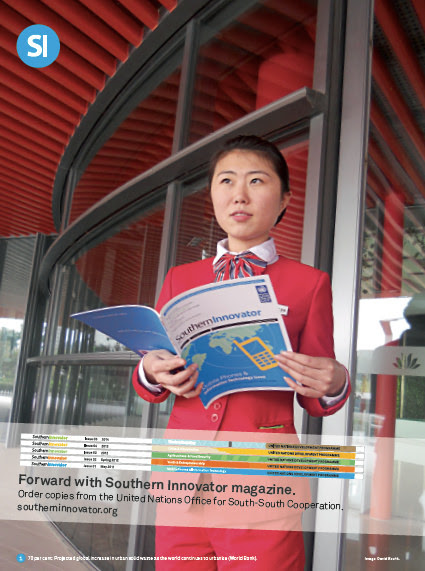
    Southern Innovator (southerninnovator.org) champions a 21st-century global innovator culture. It is based on intensive research and produced by the United Nations Office for South-South Cooperation in (UNOSSC) in UNDP. UNOSSC also organizes the annual Global South-South Development Expo (southsouthexpo.org), a traveling celebration bringing together Southern innovators, with previous venues in New York, Washington, D.C., Geneva, Rome,Vienna, Nairobi and Doha.

    We hope that you enjoy the magazine and find its content interesting and illuminating, a snapshot of a fast-changing world awash with innovators, creators and doers making their world a better place.

    For information on sponsoring issues of the magazine, either through helping to fund its print run, or through an insert relating to an issue’s theme with pertinent content for our readers, contact Cosmas Gitta at cosmas.gitta@undp.org.

    Online archives: southerninnovator.org; http://www.scribd.com/SouthernInnovator. Follow us @SouthSouth1

    Press Release 2

    Press Release 1

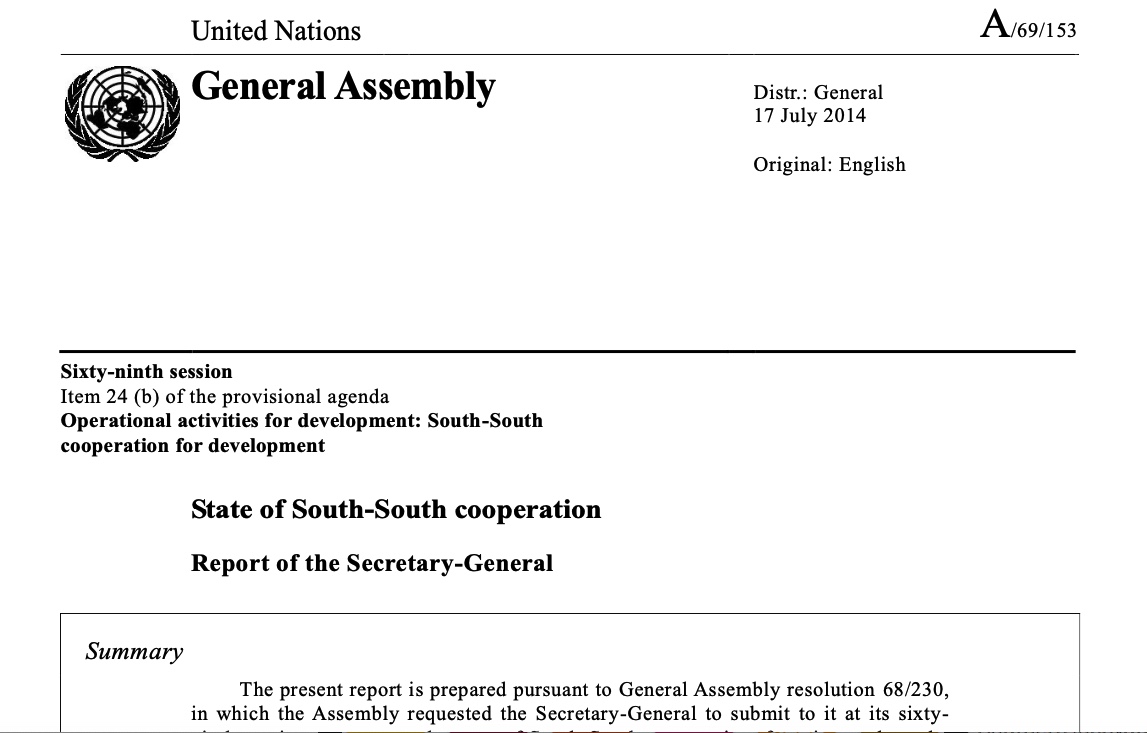
    United Nations General Assembly: Sixty-ninth session, Item 24 (b) of the provisional agenda, Operational activities for development: South-South cooperation for development, 17 July 2014.
    The research informing Southern Innovator Magazine played a part in the formulation of the UN’s post-2015 development agenda, including the Sustainable Development Goals (SDGs).

    https://davidsouthconsulting.org/southern-innovator-scale-up-fundraiser/

    ORCID iD: https://orcid.org/0000-0001-5311-1052.

    © David South Consulting 2022

  • Press Release 1 | Southern Innovator

    Press Release 1 | Southern Innovator

    Press Release for General Distribution

    New Magazine Targets Innovators in Global South

    United Nations, New York, 20 September 2011

    • Global magazine Southern Innovator profiles innovation culture ending poverty
    • 60-page color magazine gives snapshot of fast-changing world

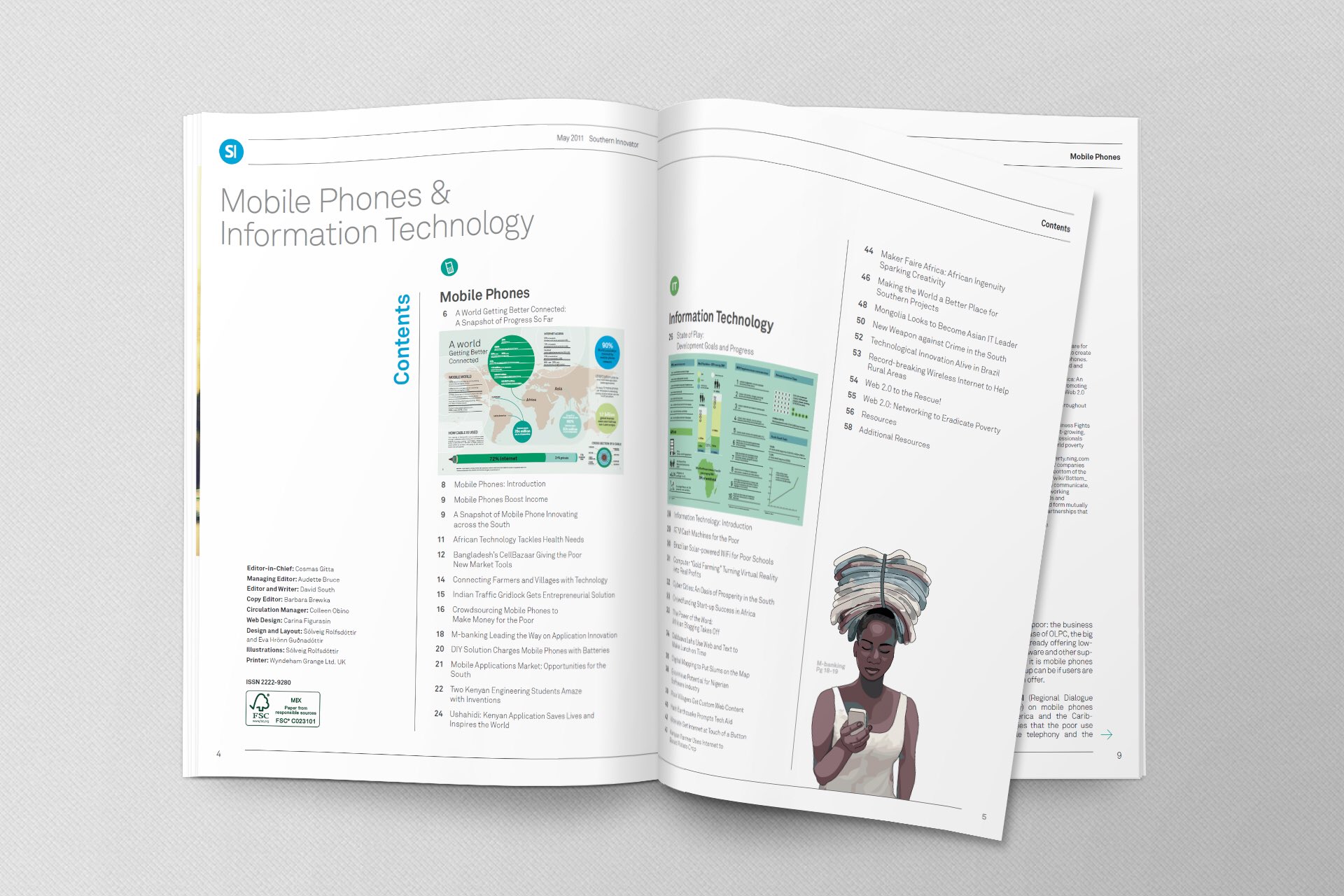
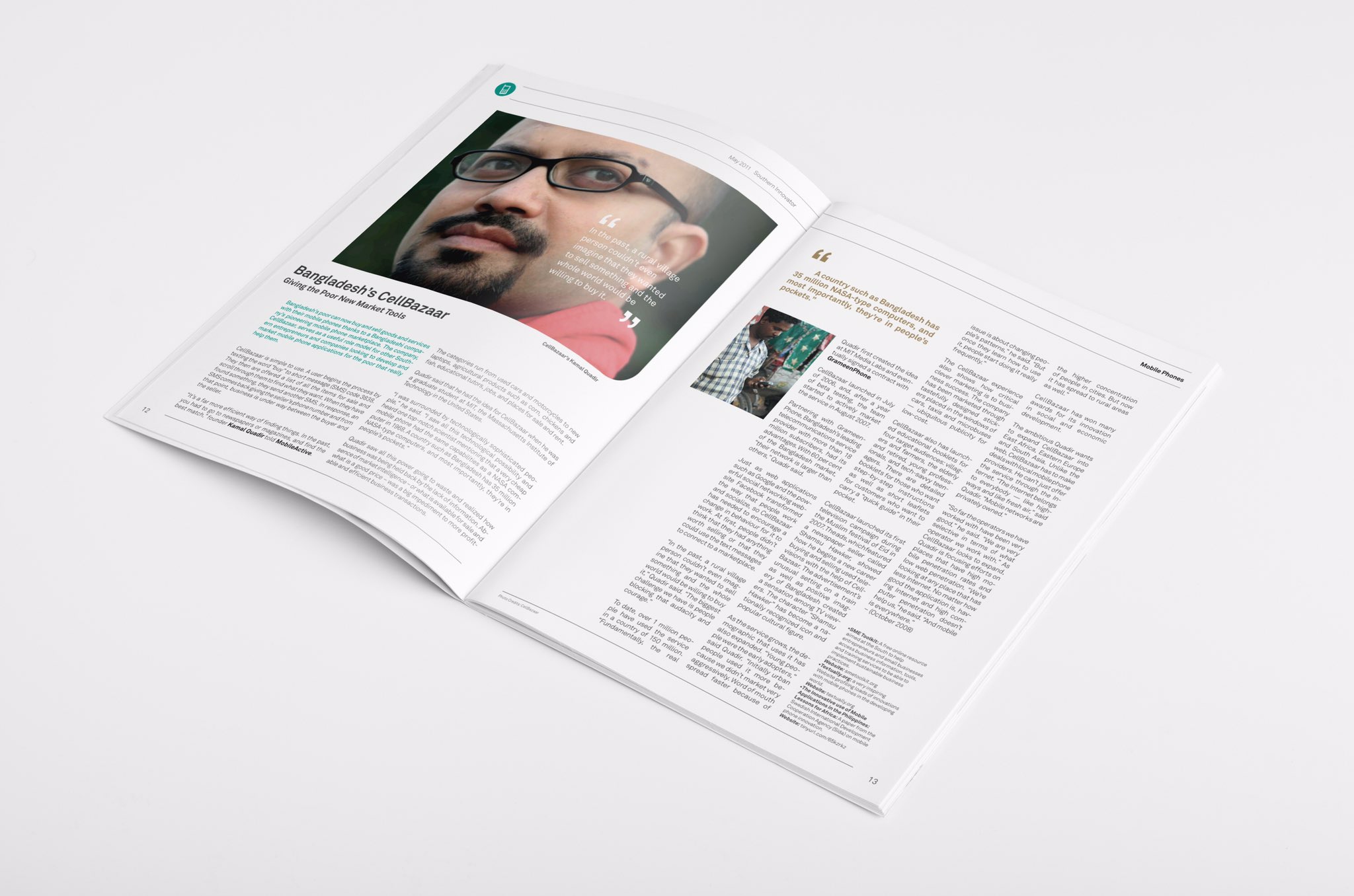
    Southern Innovator (SI) is a new magazine for a fast-changing world. It profiles and celebrates the innovators across the global South finding new ways to tackle poverty, create wealth and improve human development and achieve the millennium development goals (MDGs). In its first issue, Southern Innovator features the people who are re-shaping new technologies – from mobile phone ‘apps’ to Internet technologies – to overcome poverty and to improve the quality of life in some of the poorest places on earth.

    SI is based on intensive research and is produced by UNDP’s Special Unit for South-South Cooperation (www.southerninnovator.org). The Unit is the leading organisation in the world tasked with the goal of sharing knowledge across the global South. It organises events including the yearly South-South Expo (www.southsouthexpo.org), a roaming celebration and gathering of Southern innovators previously held in New York and Geneva, Switzerland. This year’s Expo will be held in Rome, Italy (5 to 9 December 2011).

    SI is being distributed around the world through the United Nations network and partners and reaches some of the poorest and remotest places as well as the vibrant but stressed growing global megacities. It is hoped the magazine will inspire budding innovators with its mix of stories, essential information, facts and figures, images and graphics. The magazine will evolve based on reader responses and this first issue is very much the beginning of a journey. As became clear while researching this first issue, many things can change in a short space of time. Few could have imagined the rapid take-up of mobile phones in Africa and how these phones have become integral to development goals across the continent.

    SI magazine is a quarterly publication and the next issues will launch in September and December of this year.

    A summary for publication is here:

    “Southern Innovator (ISSN 2222-9280) is a quarterly magazine published by the United Nations Development Programme’s Special Unit for South-South Cooperation. Launched in May 2011, SI is a new magazine celebrating creativity and innovation emerging from the global South. It explores entrepreneurial solutions to development challenges and uncovers the trends and events shaping the rise of the South in order to spur action on ending extreme poverty and toward reaching the Millennium Development Goals (MDGs).”

    We hope you enjoy the magazine and find its content interesting and illuminating: a snapshot of a fast-changing world awash, as we found out, with innovators, creators and do-ers making their world a better place.

    For more information on Southern Innovator contact Cosmas Gitta at cosmas.gitta@undp.org or editor David South at southerninnovator@yahoo.co.uk.

    United Nations General Assembly: Sixty-ninth session, Item 24 (b) of the provisional agenda, Operational activities for development: South-South cooperation for development, 17 July 2014.
    The research informing Southern Innovator Magazine played a part in the formulation of the UN’s post-2015 development agenda, including the Sustainable Development Goals (SDGs).

    https://davidsouthconsulting.org/southern-innovator-scale-up-fundraiser/

    ORCID iD: https://orcid.org/0000-0001-5311-1052.

    © David South Consulting 2022

  • Turning African Youth on to Technology

    Turning African Youth on to Technology

    By David SouthDevelopment Challenges, South-South Solutions

    SOUTH-SOUTH CASE STUDY

    An African NGO believes the Internet is the single biggest key to rapid development in Africa – and it is working to connect youth, women and rural populations to the web, and in turn, switch them on to the vast resources stored across the world’s Internet sites.

    After initial successes with a youth project and with farmers, Voices of Africa (VOA) (http://www.voicesofafrica.info) is now seeking to scale up its work to fan out across Africa – and take its services to the world’s largest refugee camp, the Dadaab Refugee Camp in Kenya. 

    The youth and technology empowerment NGO has developed a business model to deliver low-cost Internet access and e-resources to Africa’s slums and rural farmers.

    VOA argues that “the digital divide, defined by a lack of access to information for a specific population, symbolizes the largest difference between developed and developing countries: the opportunity to obtain and utilize information.”

    “The digital divide runs much deeper than hardware and software,” it says. “While equipment is necessary it is not sufficient. The real heart of the digital divide is that those without access to information resources often suffer needlessly while the solutions to their problems are floating in the air.”

    But why is the Internet so important?

    “The internet puts the choice of content at the fingertips of the user,” explains executive director Crystal Kigoni. “Traditional media is one way communications. Internet is bi-directional.

    “Our NGO is completely grassroots. We train the people who train the people. It is an each one, teach one philosophy and is highly effective. We also design our projects to be self-sustainable after one year of successful implementation.”

    The philosophy behind Voices of Africa – “Sustainable Development through Information Empowerment” – is to give people the information and resources to take better control of their lives.

    Access to the Internet in Africa is patchy and, for the poor, an expensive resource. The penetration of mobile phones in Africa has been spectacular in the past five years. But there are limits to the resources people can afford to access with their phones. Issues abound about data costs, mobile phone networks, and mobile phone capability.

    VOA targets youth and women in sub-Saharan Africa through online educational resources offered on their e-learning website (http://elearning.voicesofafrica.info/). The resources have been certified by Nazarene University (http://www.anu.ac.ke), a private university in Nairobi, Kenya.

    The e-learning resources include high quality training videos, presentations and screencasts (http://en.wikipedia.org/wiki/Screencast) – like a movie, it is a digital recording of changes on a computer screen and is used to teach software – to share on the web. The resources are also shared through compact discs (CDs) and iPods (http://en.wikipedia.org/wiki/IPod).

    Project coordinator Nick Kungu coordinates the staff working on the pilot Kenyan projects: a Rural Internet Kiosk; a Youth Empowerment Center; and KiberaNet, which launched in August 2011. VOA uses a part-time and volunteer staff of more than 20 Kenyans and four international ‘virtual’ volunteers.

    The group is also working with farmers in Kutus, central Kenya, to help them get a better price for their products and introduce sustainable agriculture practices. This is done through online courses so the farmers do not need to travel. It is hoped by doing this they can improve the supply of food for the country.

    The Youth Empowerment Center in Webuye constituency of the Western province of Kenya involves a partnership with the government of Kenya to teach computer basics, research and data collection, social media, ICT (information communication technology) for development, social business and community health.

    In rural areas, the need for information cannot be overestimated. In the remote countryside, there are few schools with adequate resources and almost no community libraries. The lifesaving knowledge the people require has to date been completely beyond their grasp. As one rural woman in the Western province of Kenya exclaimed to VOA after encountering the resources on the Internet, “It is like being brought from the darkness into the light.”

    Another project in development is SlumNet, which seeks to combine the Internet with low-cost devices like tablet computers and netbooks. Its pilot scheme, KiberaNet, launched this month in the Kibera slum of Nairobi, Kenya to test the business model. VOA hopes to then expand it to Uganda, Tanzania, Ghana, Nigeria and Sierra Leone. It is using a business model to bring low-cost Internet access to Africa’s slums that is fully funded by the local communities and the users.

    It has identified the key needs of youth in slums that need to be met: a way to access the vast resources available on the Internet; a way to generate income, undertake low-cost learning, and organise for social justice; ways to overcome social, economic and political isolation; a way to access affordable equipment and resources to improve their quality of life in the short-term.

    To make it a sustainable business model, the community takes a 60 percent stake in the incorporated entity. Voices of Africa will select six local civil society organisations to take another 10 percent stake in the business. VOA takes 10 percent and the remaining 30 percent will be open to outside investors.

    It involves setting up a closed intranet system and Internet access covering the entire Kibera slum, which has an estimated population of 2 million, a majority under the age of 30.

    KiberaNet hopes to act as a community hub for socialising, education and generating content. A key part is creating an atmosphere that is welcoming to novices. The business model is about delivering the bandwidth of Internet access and simultaneously generating a sustainable source of income to keep it going. Partners in the business include Promote Africa, Plexus Group and Future Optics Networks.

    VOA also has been blogging about its time in Kenya’s Dadaab Refugee Camp (http://www.unhcr.org/cgi-bin/texis/vtx/page?page=49e483a16) at their website, www.voicesofafrica.info, and has been developing plans to expand services to the camp, home to over 400,000 refugees from drought and famine in Somalia. The camp was only designed to hold 90,000 people. The chronic food insecurity has caused a massive humanitarian crisis in the Horn of Africa, leaving over 10 million people in need of help.

    “There are plenty of resources going in but it is aid business as usual,” claims Kigoni. “You see lots of waste in many areas, and a lack in others that would be extremely beneficial. Hence, why Voices of Africa has come up with the youth technology and empowerment plan that accompanies a general information and communications system, DadaabNet.”

    DadaabNet will be a youth-run community Internet service and education service. VOA plans to use a wireless intranet, internal communications systems and low-cost internet access in the refugee camp.

    The project is the first of its kind in Dadaab and a first in Kenya, claims VOA, allowing free educational content without needing to access the Internet

    The intranet will host free educational videos that can be accessed by mobile phones and computers. The topics covered in the videos include health, nutrition, sanitation and computer training and how to use technology for sustainable development.

    The curriculum is also approved by Nazerene University to certificate level.

    The system is supervised and would be able to offer resources to other NGOs seeking to provide services to the camp’s residents. The intention is to open up opportunities for education and employment youth who are currently unemployed.

    At present the youth in the camp, many of whom have not completed secondary school, get by ‘hustling’ for work, according to VOA. By being left to their own devices, there is a risk they will fall into negative behaviour like crime and drug use or be preyed upon by terrorist organisations operating in the area like al Shabaab, they maintain.

    “In our dreams, everyone everywhere in the world can have the opportunity to develop their minds. It is through this creativity that Africa will rise,” concludes Kigoni.

    Published: August 2011

    Resources

    1) The Impact of Mobile Phones on Profits from Livestock Activities by Roxana Barrantes. Website: http://www.mendeley.com/research/impact-mobile-phones-profits-livestock-activities-evidence-puno-peru-14/

    2) 2011 UNHCR Country Operations Profile – Kenya. Website: http://www.unhcr.org/cgi-bin/texis/vtx/page?page=49e483a16

    3) Southern Innovator magazine: New global magazine Southern Innovator’s first issue is out now and is about Mobile Phones and Information Technology in the global South. Website: http://www.scribd.com/doc/57980406/Southern-Innovator-Issue-1

    Creative Commons License

    This work is licensed under a
    Creative Commons Attribution-Noncommercial-No Derivative Works 3.0 License.

    ORCID iD: https://orcid.org/0000-0001-5311-1052.

    © David South Consulting 2023