Categories
Archive data Development Challenges, South-South Solutions Newsletters digital ID

India 2.0: Can the Country Make the Move to the Next Level?

By David SouthDevelopment Challenges, South-South Solutions

SOUTH-SOUTH CASE STUDY

With the global economic crisis threatening to cause turmoil in the emerging markets of the global South, it is becoming clear that what worked for the past two decades may not work for the next two.

For India, the legacy issues of poverty still need to be addressed, and the country’s impressive information technology (IT) industry – which has driven so much of India’s growth – will face stiff competition from other countries in the global South. Some argue that if the IT industry hopes to keep growing and contributing to India’s wealth, things will need to change.

Unlike China, where heavy investment in infrastructure and a strong link between government and the private sector has driven the impressive manufacturing boom in the country, in India the government has de-regulated and taken a back seat, leaving the private sector and entrepreneurs to drive the change and do the innovation.

Many believe various areas need urgent attention if India is to continue to enjoy good growth rates in the coming years. Areas in need of attention include infrastructure, healthcare and education (thesmartceo.in), in particular the knowledge to work in the information technology industry of the 21st century.

One of the founders of Indian outsourcing success Infosys (infosys.com), executive co-chairman Senapathy Gopalakrishnan, told Britain’s Telegraph newspaper, “So many people’s lives have been changed by IT in India.

“People from the middle class and lower middle class have become global employees and have the opportunity to work with some of the best companies in the world. But the challenge for India is that this industry can only create so many jobs. IT is not going to solve the unemployment problem in India.”

But the coming next wave of change in information technology is an opportunity to be seized to reduce unemployment if enough people are educated to handle it.

According to Gopalakrishnan: “I strongly believe, and it’s backed up by data, that there is a shortage of computer professionals everywhere in the world, including India. The application of computers is growing dramatically and will continue to grow dramatically over the next 20 to 30 years. We have to train and create the workforce necessary to grow this industry.”

Various media stories have called this next phase India 2.0. If India 1.0 was the highly successful information technology outsourcing industry developed in the late 1980s, through the 1990s and 2000s, then India 2.0 is the next wave of IT innovation being driven by Big Data, automation, robotics, smart technologies and the so-called “Internet of things.”

Big Data is defined as the large amounts of digital data continually generated by the global population. The speed and frequency with which data is produced and collected – by an increasing number of sources – is responsible for today’s data deluge (UN Global Pulse). It is estimated that available digital data will increase by 40 per cent every year. Just think of all those mobile phones people have, constantly gathering data.

Processing this data and finding innovative ways to use it will create many of the new IT jobs of the future.

“We are living in a world which is boundary-less when it comes to information, and where there is nowhere to hide,” continues Gopalakrishnan, “If you have a cellphone, somebody can find out exactly where you are. Through social networks you’re sharing everything about yourself. You are leaving trails every single moment of your life. Theoretically, in the future you’ll only have to walk through the door at Infosys and we’ll know who you are and everything about you.”

Unlike in the late 1980s, when India was the pioneer in IT outsourcing for large multinational companies and governments, competition is fierce across the global South. The mobile-phone revolution and the spread of the Internet have exponentially increased the number of well-educated people in the global South who could potentially work in IT. China, the Philippines, Kenya, Nigeria and Ghana are just some of the countries heavily involved in this area.

If India fails to meet the India 2.0 challenge, it risks seeing its successful companies and entrepreneurs leaving to work their magic elsewhere in Asia and the new frontiers of Africa, just as many of its best and brightest of the recent past became pioneers and innovators in California’s Silicon Valley.

India’s IT sector contributed 1.2 per cent to the country’s gross domestic product (GDP) in 1998; by 2012, this was 7.5 per cent (Telegraph). The IT industry employs 2.5 million people in India, and a further 6.5 million people indirectly. IT makes up 20 per cent of India’s exports and, according to the National Association of Software and Services Companies (nasscom.in), the industry has revenue of US $100 billion.

India is now the IT and outsourcing hub for more than 120 of the Fortune 500 companies in the United States.

Out of India’s 3.5 million graduates every year, 500,000 are in engineering – a large pool of educated potential IT workers. India produces the world’s third largest group of engineers and scientists, and the second largest group of doctors.

IT has become a route that catapults bright Indian youth into 21st-century businesses and science parks and to the corporations of the world.

One visible example of the prosperity brought by IT services in India is the booming technology sector based in the city of Bangalore (also called Bengaluru) (http://en.wikipedia.org/wiki/Bangalore).

Reflective of the contradictions of India, Bangalore has 10 per cent of its workforce now working in IT, but also 20 per cent of its population living in urban slums.

The nearby Electronics City (elcia.in) is considered “India’s own silicon valley and home to some of the best known global companies.”

To date, aspects of India 2.0 are already taking shape.

One company is called Crayon Data (crayondata.com). It uses Big Data and analytics to help companies better understand their customers and increase sales and deliver more personal choices.
Edubridge (http://acumen.org/investment/edubridge/) is helping to bridge the gap for rural youth with varied education backgrounds and long-term jobs. Edubridge trains youth for the real needs of employers to increase the chances they will get a job. This includes jobs in the IT business process outsourcing sector and banking and financial services.

Infosys is working on innovations for the so-called “Internet of things,” in which smart technologies connect everyday items to the grid and allow for intelligent management of resources and energy use. Infosys is developing sophisticated software using something called semantic analytics – which analyses web content (http://en.wikipedia.org/wiki/Semantic_analytics) – to sort through social media and the Internet to track customer responses to products.

Elsewhere, former Infosys Chief Executive Nanden Nilekani is involved in a Big Data innovation to address the problem of social and economic exclusion of India’s poor. Called Aadhaar (http://uidai.gov.in/), the government-run scheme is gathering biometric data on every Indian to build the world’s largest biometric database. After being enrolled and having fingerprints and iris scans taken, each individual is given a 12-digit identification number. So far 340 million people have been registered with the scheme, and it is hoped 600 million will be registered by the end of 2014.

The idea is to use a combination of access to mobile phones and these unique ID numbers to widen access to all sorts of products and services to poor Indians, including bank accounts for the millions who do not have one. Many people, lacking any identity or official acknowledgment they exist, were prevented from engaging with the formal economy and formal institutions. Being able to save money is a crucial first step for getting out of poverty and it is hoped information technology will play an important role in achieving this.

Published: March 2014

Resources

1) India 2.0 by Mick Brown. Website: http://s.telegraph.co.uk/graphics/india2.0/part-one#top

2) Electronic City Bangalore: Regional information portal for Electronic City, an industrial technology hub located in Bangalore South, India. This portal is becoming the most favourite haunt of ECitizens living and/or working in Electronic City. Website: http://www.electronic-city.in/

3) Electronics City Industries Association: Welcome to the Electronics City, India’s own silicon valley and home to some of the best known global companies. Located in Bangalore, the Electronics City was conceived way back in the mid-1970?s as an Industrial Estate exclusively for Electronics Industries. Today the industrial estate boasts is an oasis of large, medium and small industries spanning software services, hardware; high end telecommunications; manufacture of indigenous components; electronic musical instruments, just  to name a few. Website: elcia.in

4) Godrej E-City: Situated in Electronic city and connected through NICE road and the elevated expressway, Godrej E-City brings your workplace and other major conveniences within your immediate reach. Your travel times become shorter and hassle-free. You have more time for your family and yourself. It’s time to move closer to happiness. Website: https://www.godrejproperties.com/godrejecity/overview

5) Infosys: Infosys is a global leader in consulting, technology and outsourcing solutions. As a proven partner focused on building tomorrow’s enterprise, Infosys enables clients in more than 30 countries to outperform the competition and stay ahead of the innovation curve. Website: http://www.infosys.com/pages/index.aspx

6) Tech Hub Bangalore: partnering with the UK India Business Council to establish TechHub in Bangalore.TechHub is a community and workspace for technology entrepreneurs with 1000’s of members, building the most exciting startups in Europe. We have physical community spaces in London, Manchester, Bucharest, Swansea and Riga and have members from over 50 countries.The Bangalore site will be part of a wider scheme in partnership with other British firms such as Rolls Royce, ADS, Bangalore Cambridge Innovation Network, BAe and PA Consulting with the aim of forging stronger links between the UK and India. Website: http://www.techhub.com/blog/techhub-expands-to-bangalore/

https://davidsouthconsulting.org/2022/09/29/cheap-indian-tablet-seeks-to-bridge-digital-divide/

https://davidsouthconsulting.org/2022/02/17/digital-mapping-to-put-slums-on-the-map/

https://davidsouthconsulting.org/2022/10/09/entrepreneurs-use-mobiles-and-it-to-tackle-indian-traffic-gridlock/

https://davidsouthconsulting.org/2022/10/20/the-e-reader-battle-reaches-india/

https://davidsouthconsulting.org/2022/10/25/indian-city-slum-areas-become-newly-desirable-places-to-live/

https://davidsouthconsulting.org/2021/03/04/indian-id-project-is-foundation-for-future-economic-progress/

https://davidsouthconsulting.org/2022/11/01/indian-newspapers-thrive-with-economy/

https://davidsouthconsulting.org/2022/10/18/indians-fighting-inflation-with-technology/

https://davidsouthconsulting.org/2022/10/06/indian-solar-power-pack-powers-villages/

https://davidsouthconsulting.org/2021/03/31/new-weapon-against-crime-in-the-south/

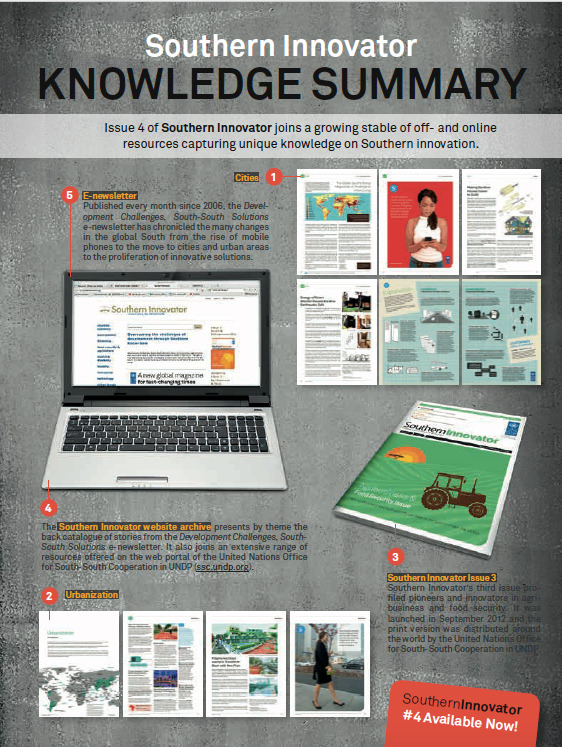
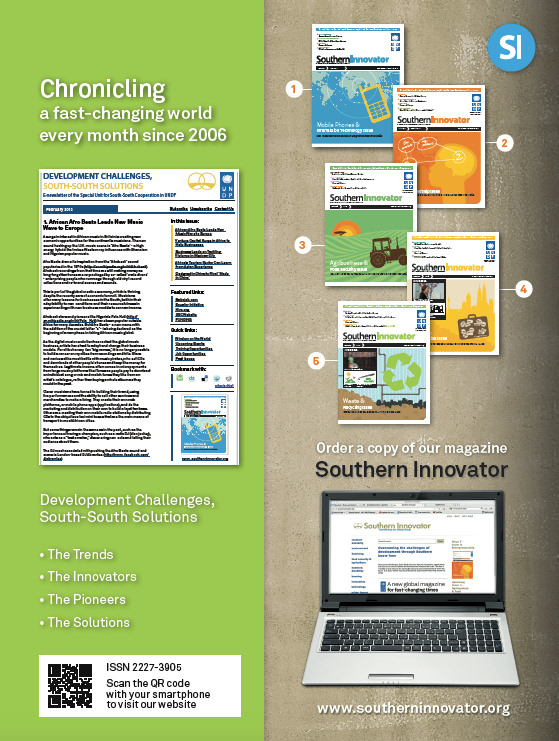
Development Challenges, South-South Solutions was launched as an e-newsletter in 2006 by UNDP’s South-South Cooperation Unit (now the United Nations Office for South-South Cooperation) based in New York, USA. It led on profiling the rise of the global South as an economic powerhouse and was one of the first regular publications to champion the global South’s innovators, entrepreneurs, and pioneers. It tracked the key trends that are now so profoundly reshaping how development is seen and done. This includes the rapid take-up of mobile phones and information technology in the global South (as profiled in the first issue of magazine Southern Innovator), the move to becoming a majority urban world, a growing global innovator culture, and the plethora of solutions being developed in the global South to tackle its problems and improve living conditions and boost human development. The success of the e-newsletter led to the launch of the magazine Southern Innovator.  

https://davidsouthconsulting.org/2021/03/05/southern-innovator-issue-1/

Creative Commons License

This work is licensed under a
Creative Commons Attribution-Noncommercial-No Derivative Works 3.0 License.

ORCID iD: https://orcid.org/0000-0001-5311-1052.

© David South Consulting 2022

Categories
Archive data Development Challenges, South-South Solutions Newsletters digital ID

African Health Data Revolution

By David SouthDevelopment Challenges, South-South Solutions

SOUTH-SOUTH CASE STUDY

A pioneering tool for gathering health data now being used in Kenya could herald a revolution in the way diseases are tracked and defeated around the world. It uses mobile phones to better connect patients with medical and health personnel, and allows data to be gathered in real-time and used to track health and improve the delivery of services, especially to remote and under-serviced areas.

In the past couple of years, Kenya has become a hotbed of mobile phone and information technology innovation. The now-famous Ushahidi crisis-mapping platform (www.ushahidi.com) is just one example. Social enterprise Data Dyne (www.datadyne.org) – with offices in Washington DC and Nairobi, Kenya – is offering its EpiSurveyor application (www.episurveyor.org) free to all to aid health data collection. It bills itself as “the first cloud-computing application for international development and global health … Think of it as like Gmail, but for data collection!”

EpiSurveyor claims to have more than 2,600 users around the world and is currently being upgraded to a second version.

“With the touch of a button I can see what’s going on across the country in real time,” Kenyan civil servant Yusuf Ibrahim told Britain’s Daily Telegraph newspaper. “It is amazing.”

Ibrahim works in Nairobi as the Kenyan Ministry of Health liaison to Data Dyne.

He uses maps and charts on mobile phones to track deadly disease outbreaks and vulnerable pregnancies.

The EpiSurveyor application works simply: A user logs into the website and builds and creates the sort of form they want. They then download it to a phone and start collecting data straight away.

Ibrahim gathers this data from mobile phones used by health care workers across the country.

“It used to take days, weeks or even a couple of months to find out about an outbreak of polio on the other side of the country,” he said. “Now we know almost instantly. The speed with which we can now collect information has catapulted healthcare and prevention to another level. It has completely changed healthcare and saved countless lives.”

He proudly points out Kenya’s mobile phone data collection system is “probably better than what they’ve got in the West.”

“Although we are a third world country, I’m pretty sure we’ve done this before

Western countries. While they are still collecting information in hard copy on clipboards, we are getting it instantly.”

Packed with data processing power, mobile phones are capable of an immense range of tasks and applications. Some see phones as key to a revolution in how healthcare is provided: the mobile phone becomes one-part clinic, another part mobile hospital dispensing advice and transmitting vital information back to healthcare professionals and scientists in hospitals and labs.

Despite dramatic improvements to the quality of hospitals in Africa and the number of qualified doctors, the continent’s healthcare services are still a patchwork, with rural and slum dwellers poorly served and the stresses of treating patients with contagious diseases like HIV/AIDS and malaria pushing resources to the limit.

The United Nations has a number of initiatives partnering with mobile phone manufacturers, networks and software developers as part of a global campaign to reduce HIV/AIDS, malaria and deaths in childbirth.

EpiSurveyor is being used by more than 15 countries’ ministries of health and is the adopted standard for the World Health Organization (www.who.int) (WHO) for electronic health data collection.

It began as a partnership with the United Nations Foundation, The Vodafone Group Foundation, WHO and the ministries of health of Kenya and Zambia in 2006 to pilot test the software for EpiSurveyor.

At the United Nations Foundation (www.unfoundation.org), chief executive Kathy Calvin equates the impact of mobile phones on global healthcare to the discovery of the antibiotic penicillin.

“Instead of building clinics and roads to remote towns and villages so that people can access healthcare, we are bringing healthcare directly to the people via mobile phones. You get a lot more healthcare for your money,” Calvin told the Telegraph.

Published: November 2010

https://davidsouthconsulting.org/2022/10/06/african-technology-tackles-health-needs/

https://davidsouthconsulting.org/2020/12/04/big-data-can-transform-the-global-souths-growing-cities/

https://davidsouthconsulting.org/2021/01/18/cheap-paper-microscope-to-boost-fight-against-diseases/

https://davidsouthconsulting.org/2020/12/04/data-surge-across-global-south-promises-to-re-shape-the-internet/

https://davidsouthconsulting.org/2022/10/18/indians-fighting-inflation-with-technology/

https://davidsouthconsulting.org/2022/10/12/lagos-traffic-crunch-gets-a-new-solution/

https://davidsouthconsulting.org/2022/10/31/mapping-beirut-brings-city-to-light/

https://davidsouthconsulting.org/2022/10/17/mapping-to-protect-kenyas-environment-the-emazingira-solution/

https://davidsouthconsulting.org/2022/03/08/mobile-phone-microscopes-to-revolutionize-health-diagnostics/

Development Challenges, South-South Solutions was launched as an e-newsletter in 2006 by UNDP’s South-South Cooperation Unit (now the United Nations Office for South-South Cooperation) based in New York, USA. It led on profiling the rise of the global South as an economic powerhouse and was one of the first regular publications to champion the global South’s innovators, entrepreneurs, and pioneers. It tracked the key trends that are now so profoundly reshaping how development is seen and done. This includes the rapid take-up of mobile phones and information technology in the global South (as profiled in the first issue of magazine Southern Innovator), the move to becoming a majority urban world, a growing global innovator culture, and the plethora of solutions being developed in the global South to tackle its problems and improve living conditions and boost human development. The success of the e-newsletter led to the launch of the magazine Southern Innovator.  

https://davidsouthconsulting.org/2021/03/05/southern-innovator-issue-1/

Follow @SouthSouth1

Slideshare: http://www.slideshare.net/DavidSouth1/development-challengessouthsouthsolutionsnovember2010issue

Southern Innovator Issue 1: https://books.google.co.uk/books?id=Q1O54YSE2BgC&dq=southern+innovator&source=gbs_navlinks_s

Southern Innovator Issue 2: https://books.google.co.uk/books?id=Ty0N969dcssC&dq=southern+innovator&source=gbs_navlinks_s

Southern Innovator Issue 3: https://books.google.co.uk/books?id=AQNt4YmhZagC&dq=southern+innovator&source=gbs_navlinks_s

Southern Innovator Issue 4: https://books.google.co.uk/books?id=9T_n2tA7l4EC&dq=southern+innovator&source=gbs_navlinks_s

Southern Innovator Issue 5: https://books.google.co.uk/books?id=6ILdAgAAQBAJ&dq=southern+innovator&source=gbs_navlinks_s

Creative Commons License
This work is licensed under a
Creative Commons Attribution-Noncommercial-No Derivative Works 3.0 License.

ORCID iD: https://orcid.org/0000-0001-5311-1052.

© David South Consulting 2022

Categories
Archive Development Challenges, South-South Solutions Newsletters

Vietnamese Google Rival Challenging Global Giant

By David South, Development Challenges, South-South Solutions

New UNOSSC banner Dev Cha 2013

SOUTH-SOUTH CASE STUDY 

Information technologies are creating new business opportunities across the global South. As more and more people gain access to the Internet in one form or another, opportunities to offer them services also increase.

A number of key trends show how the Internet’s profile is being reshaped by the growing number of users from the global South. One of those trends is language. English was the first language to dominate the Internet – but this is changing, according to the latest data.

China has the largest number of Internet users in the world (China Internet Network Information Center) and the Chinese language is the second-most often used online, behind English and before Spanish and Japanese (http://www.internetworldstats.com/stats7.htm).

While most English-language users turn to the giant Google search engine to look things up on the Internet, Google also has many rivals chasing its tail. In China, Baidu (baidu.com) offers searches in Mandarin using Chinese characters, making the Internet easier to navigate for Mandarin speakers. Elsewhere, Arabic language Internet users are being offered new services and urls using Arabic characters.

In short, the Internet is becoming multilingual, customized and local, and creating new opportunities with it.

One new business in Vietnam is challenging Google with its own locally tailored search engine. Called Coc Coc (http://coccoc.com/) – Knock Knock in English – it has already spent US $10 million to hire 300 staff at its Hanoi base, according to the Associated Press. Whether Coc Coc is successful or not in the long term, it is clear as a business it is already helping the local economy by hiring so many people and investing in Vietnam. Google currently does not have any staff in Vietnam because of its concerns about legal conflict with the government over censorship of content on the Internet, AP reports.

Coc Coc believes it has developed a system that better understands the grammar, syntax and nuances of the Vietnamese language. Another advantage it believes it has over Google is its large presence on the ground in Vietnam. With a headquarters in Hanoi, it can quickly make marketing deals and agreements with content providers. To further its local advantage, Coc Coc has dispatched camera crews and photographers to film and photograph streets and log the details of shops, cafes and businesses – all to make search results more accurate and richer in detail.

The headquarters is spread out over four floors of a downtown office block in Hanoi, and according to the Associated Press has a relaxed atmosphere similar to that found in many places in California’s technology start-up culture.

Coc Coc is a joint Russian-Vietnamese venture and is hoping to ride the fast-growing Asian Internet market by offering a search tool that understands the nuances of the Vietnamese language online. By using algorithms (https://en.wikipedia.org/wiki/Algorithm) it promises to give a faster and better search experience to Vietnamese-language users. It also uses its knowledge of the local scene to  tailor results to users’ needs.

The plan is to spend US $100 million during the next five years to lure 97 per cent of Vietnamese Internet users to make the switch from Google.

“When I came here, I had some understanding why Vietnam was a good market to beat Google,” said Mikhail Kostin, the company’s chief search expert. “But after living here for one year, I understand the language and market much more deeply. I’m sure it’s right.”

Having a local search engine tool can be a successful approach. The Yandex (http://www.yandex.com/) search engine in Russia beats Google in the Russian-speaking market. In South Korea, there is the Naver (naver.com) search engine.

Google battled it out with the Chinese search engine Baidu in 2010 before leaving the country when Google refused to abide by government censorship guidelines. Baidu in the meantime has become the number one search engine in China and is planning to expand to other markets throughout Asia.

“Google is a foreign company, and they are not here,” said one of the three founders of Coc Coc, Nguyen Duc Ngoc. “We can serve the interests of the local market better.”

Vietnam has been experiencing rapid economic growth since the introduction of the Doi Moi (https://en.wikipedia.org/wiki/Doi_Moi) economic reforms two decades ago in 1986.  Vietnam is fast becoming an Internet success story, with a third of its population of 88 million (World Bank) (http://www.worldbank.org/en/country/vietnam) now online. Many are accessing the Internet through their mobile phones and electronic devices.

Vietnam connected to the Internet in the 1990s and the infrastructure was built up in the mid-2000s. A national plan that kicked off in 2005 accelerated take-up of the Internet in the country as more and more people accessed the Internet through mobile phones, often at home, rather than just in public Internet centres. One study found 71 per cent of users in major cities were accessing the Internet at home (https://opennet.net/research/profiles/vietnam). One in three people in Vietnam now has access to the Internet. Significantly, the Internet has been an overwhelming success with youth in the main cities of Hanoi and Ho Chi Minh City, where 95 per cent of people in the 15-to-22 age group has Internet access.

Optimists point to Vietnam’s large youth population, fast-growing economy and its modern Internet infrastructure as advantages that will boost its Internet economy. This is attracting entrepreneurs and investors from across Asia and around the world working in the field of online content, e-payments systems and other online services.

With Vietnam’s Internet scene on fire, many people and companies are piling in to come up with the Next Big Thing online. Many have failed, but the same is true in every other country where new information technologies have been introduced. The nature of information technology innovation means ideas quickly rise or die depending on whether Internet users find the innovation useful or attractive. Despite great ideas, there are often far too many factors at play to guarantee any one person or company will have a success on their first try. As has happened elsewhere, ideas hatched by small start-ups, if good, are gobbled up by larger companies. Talented and skilled people usually find themselves being chased by other companies.

Resources

1) Techinasia: “Vietnam is Asia’s New Tech Manufacturing Hub”. Website: http://www.techinasia.com/vietnam-asias-tech-manufacturing-hub/

2) Allo’ Expat Vietnam: A list of Vietnam’s Internet Service Providers (ISPs). Website: http://www.vietnam.alloexpat.com/vietnam_information/internet_service_providers_vietnam.php

3) Telecommunications in Vietnam: A quick explanation from Wikipedia on the state of play in Vietnam. Website: http://en.wikipedia.org/wiki/Telecommunications_in_Vietnam

4) Vietnam Women’s Innovation Day 2013: Theme: “Women’s Economic Empowerment”. Website: http://www.worldbank.org/en/news/press-release/2013/03/13/vietnam-womens-innovation-day-2013-launched-themed-womens-economic-empowerment-8221

Creative Commons License

This work is licensed under a
Creative Commons Attribution-Noncommercial-No Derivative Works 3.0 License.

ORCID iD: https://orcid.org/0000-0001-5311-1052.

© David South Consulting 2022

Categories
Archive Development Challenges, South-South Solutions Newsletters Southern Innovator magazine

Ring Tones and Mobile Phone Downloads are Generating Income for Local Musicians in Africa

By David SouthDevelopment Challenges, South-South Solutions

SOUTH-SOUTH CASE STUDY

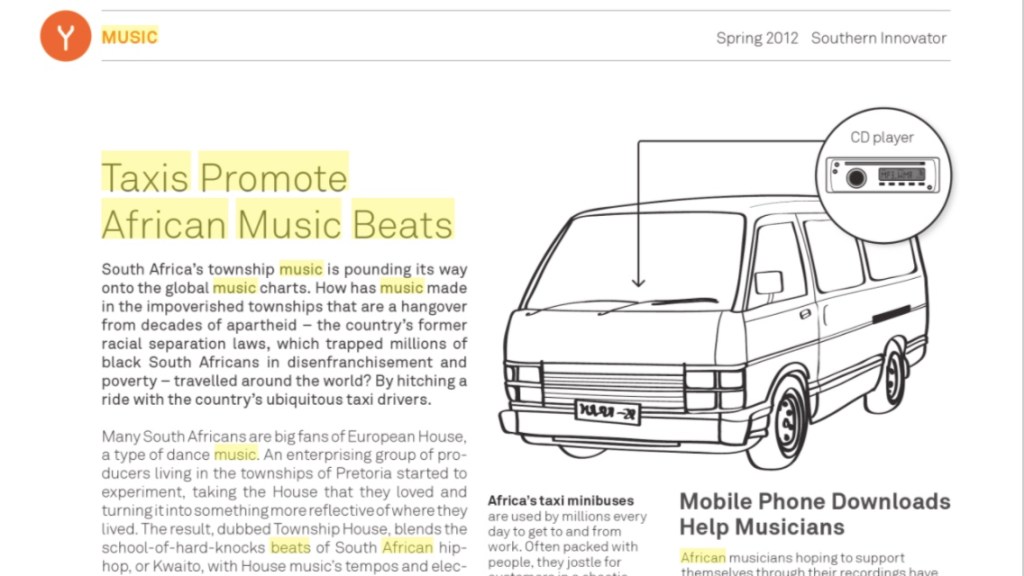
African musicians hoping to support themselves through their recordings have always had to contend with the added burden of poor copyright control over their work. While musicians in the West are supported by a highly regulated regime of copyright protection – ensuring some to become the richest people in their respective countries – most African musicians have had to stand back and watch their work being copied, sold and exchanged with little chance of seeing any royalties. Global audiences know of the success of artists like Fela Kuti, Youssou N’Dour, Manu Dibango and Miriam Makeba, but most African musicians can look forward to scant earnings from recording their music.

Anyone who has walked through the markets of Africa will know there are plenty of pirated CDs for sale, yet it is of no use to a musician who never sees the money. Poverty is endemic amongst African musicians as a result of this loss of income. While music is a global business worth US $40 billion according to the Recording Industry Association of America, pirated music in Africa is rampant – some estimates by the Recording Industry of South Africa put it at over 80 percent of available music. How much money is being lost can be judged from the estimated daily income of a pirate music vendor in Africa, ranging between Euro 762 and Euro 2,744.

But a solution to this problem is being pioneered in Botswana in southern Africa. A partnership between mobile phone provider Orange Botswana and Small House Records/Mud Hut Studios, ensures musicians get a slice of the profit pie. Managing director Solomon Monyame of Small House Records has signed a contract with Orange to share the profits from ring tone and song downloads to mobile phone subscribers. With more than 76.8 million people currently subscribing to mobile phone services in Africa, and the number growing by about 58 percent each year for the last five years, the potential royalties market for African musicians is vast if this initiative is replicated across the continent.

In the paper “Development Goes Wireless” to be published in the spring 2007 issue of the journal of the Institute of Economic Affairs, lead researcher Karol Boudreaux of George Mason University’s Mercatus Center and Enterprise Africa!, discovered mobile phones and mobile phone companies can give artists a new way to control royalties for their work. She found that in the absence of effective copyright control mechanisms – as is the case in many African countries – the mobile phone company can step in to save the day.

“When you walk through the markets there you see so much music available on the street, but there is little intellectual property rights protection,” she said.

“In other countries, like the UK, you have strong intellectual property rights protection, but this just isn’t the case in much of Africa. The mobile phones are a very good way to get around this problem as long as cell phone providers are willing to make the contracts. Botswana is very lucky in that they have a very good contract environment, but this isn’t necessarily the case in other countries. It is a win-win for music providers and mobile companies.”

The NetTel@Africa project started by USAID and the Center to Bridge the Digital Divide, in partnership with many African and US universities, is also championing copyright protection strategies.

How important creative industries are becoming to economic development is slowly being recognized. It is now seen as an important component of modern post-industrial, knowledge-based economies, but equally also a way for economically underdeveloped countries to generate wealth. Not only are they thought to account for higher than average growth and job creation, they are also vehicles of cultural identity and play an important role in fostering cultural diversity. Initiatives like UNESCO’s Global Alliance for Cultural Diversity attempt to document this phenomenon and back it up with hard numbers.

UNESCO also has a project to establish musicians’ cooperatives across Africa. As such, the musicians are able to pool their production resources, which are individually insufficient to ensure the economic viability of a small or medium-sized business. In Burkina Faso, a co-operative is working with the International Labour Organisation. Click here for more information.

Festivals like Mali’s annual Festival in the Desert in the oasis of Essakane, 65 kilometers from Timbuktu, is an example of how African musicians are finding their own way to reach audiences. Targeted above all to promote African and Malian Music inside the continent, the Festival has also boosted international tourism to the region and almost 10 percent of last year’s 6,000 visitors came from outside of Africa.

Another initiative for African musicians is the DigiArts Africa network. It was founded by UNESCO and aims to increase communication between artists, industries and educators, make musicians self-sustainable, use the ICT industries to support and contribute to cultural activities, and better promote African musicians within and outside Africa. Click here for more information.

Well-known Senegalese musician Thione Seck is blunt about the economic effect of piracy on his income.

“Were there no piracy, I could have bought an island, seeing the number of songs that I composed in more than 30 years of my career”, he told a local newspaper.

According to Abdoul Aziz Dieng, president of the Senegal Music Works Association (AMS) and Chairman of the Board of the Senegalese Copyright Office (BSDA) (www.mali-music.com), out of 10 Senegalese artists’ CDs available on the local market, “only two are legal”. For audio cassettes, the ratio is three pirate copies out of every five sold.

Opportunities to combat piracy and generate income are also not limited to just musicians. Filmmakers in Africa are starting to learn how to exploit the opportunities thrown up by the fast-expanding mobile phone networks on the continent. Already a phenomenon in South Africa (www.filmmaker.co.za), director Aryan Kaganof is in the process of releasing SMS Sugar Man, a feature length movie shot entirely with mobile devices. The movie will be beamed to cell phones in three-minute clips over 30 days.

What are the effects of Piracy?

  • Artist
    • No royalty payments, no money to live
  • Record companies
    • No return on investments. Staff retrenchments
  • Retailers
    • Cannot compete with low prices. Staff retrenchments
  • Consumers
    • Many copies are of inferior quality. If tracks are missing or the sound quality is poor, no exchange or refunds
    • May be contributing to “organized crime” syndicates which are heavily involved in international music piracy

Source: Recording Industry of South Africa

Published: January 2007

Resources

Lively website about African musicians

BBC website on African music

Further reading from UNESCO: African music: new challenges, new vocations: Click here

https://davidsouthconsulting.org/2022/10/02/african-afro-beats-leads-new-music-wave-to-europe/

https://davidsouthconsulting.org/2022/11/11/berber-hip-hop-helps-re-ignite-culture-and-economy/

https://davidsouthconsulting.org/2022/11/17/cashing-in-on-music-in-brazil/

https://davidsouthconsulting.org/2022/12/18/disabled-congolese-musicians-become-world-hit/

https://davidsouthconsulting.org/2021/11/09/mauritanian-music-shop-shares-songs-and-friendship/

https://davidsouthconsulting.org/2023/02/07/mongolian-rock-and-pop-book-mongolia-sings-its-own-song/

https://davidsouthconsulting.org/2020/12/17/mongolias-musical-entrepreneurs-led-way-out-of-crisis-2018/

https://davidsouthconsulting.org/2021/03/05/southern-innovator-issue-1/

https://davidsouthconsulting.org/2021/03/05/southern-innovator-issue-2/

https://davidsouthconsulting.org/2021/11/09/taxis-promote-african-music-beats/

Creative Commons License

This work is licensed under a
Creative Commons Attribution-Noncommercial-No Derivative Works 3.0 License.

ORCID iD: https://orcid.org/0000-0001-5311-1052.

© David South Consulting 2023