Categories
Archive Development Challenges, South-South Solutions Newsletters

Indonesia Best for Entrepreneurs

By David SouthDevelopment Challenges, South-South Solutions

SOUTH-SOUTH CASE STUDY

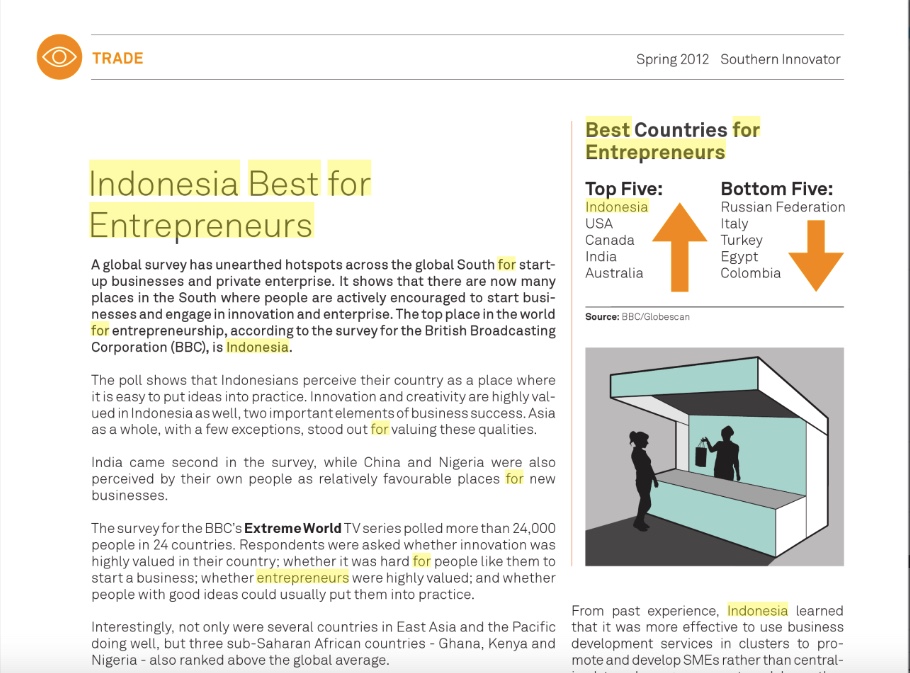
A global survey has unearthed hotspots across the global South for start-up businesses and private enterprise. It shows there are now many places in the South where people are actively encouraged to start businesses and engage in innovation and enterprise. The top place in the world for entrepreneurship, according to the survey for the British Broadcasting Corporation (BBC), is Indonesia.

The poll shows that Indonesians perceive their country as a place where it is easy to put ideas into practice. Innovation and creativity are highly valued in Indonesia as well, two important elements of business success. Asia as a whole, with a few exceptions, stood out for valuing these qualities.

India came second in the survey, while China and Nigeria were also perceived by their own people as relatively favourable places for new businesses.

The survey for the BBC’s Extreme World TV series polled more than 24,000 people across 24 countries (http://www.globescan.com/news_archives/bbc2011_entrepreneur/backgrounder.html). Respondents were asked whether innovation was highly valued in their country; whether it was hard for people like them to start a business; whether entrepreneurs were highly valued; and whether people with good ideas could usually put them into practice.

Interestingly, not only were several countries in East Asia and the Pacific doing well, but three sub-Saharan African countries – Nigeria, Kenya and Ghana – ranked above the global average.

The survey found work still needed to be done in Latin America. While Mexico and Peru scored highly, Brazil and Colombia ranked below average.

So, what are the things that make Indonesia so positive for entrepreneurs and private business? And what do they do – or not do – for small business start-ups?

According to Bali International Consulting Group, the Indonesian economy is highly dependent on small and medium-sized enterprises: they make up 99.95 percent of the total number of enterprises, and provide most of the country’s jobs. Authorities have identified a problem with the sector, however: productivity per worker is very low compared to large enterprises. Poor productivity matters because it means people are working very hard for low return and this affects the overall standard of living in the country and its human development.

The Indonesian government has set about boosting productivity in the sector, adopting a ‘clustering’ approach in partnership with non-governmental organizations (NGOs). Like-minded businesses tend to cluster together across the archipelago of islands that makes up the nation. By targeting these places with resources and support, it can use those resources more efficiently. The country has a dedicated ministry for small and medium enterprises (http://www.depkop.go.id) and a wide range of businesses and services targeting them. From dedicated trading and office facilities (http://www.smescoindonesia.com) to an online marketplace to display, trade and sell SME products (http://www.smescotrade.com), extensive resources are applied to give SMEs a boost and a competitive edge in the global marketplace.

From past experience, Indonesia learned it was more effective to use business development services in clusters to promote and develop SMEs, rather than centralised, top-down government models or other approaches.

As Bali International Consulting Group notes, “The government has introduced many models for promoting SMEs, including business incubators, business consulting clinics and technology centers. However, those sponsoring programs have not been productive and could not sustain themselves for a long time. The government then turned to supporting BDS (Business Development Services) providers to serve a certain cluster in a selected area.”

Developed countries like the United States significantly grew their wealth by allowing entrepreneurs and small and medium-sized enterprises to flourish. The USA’s highly innovative and globe-straddling high tech and information technology businesses would not have been so successful without entrepreneurs. Think of Bill Gates, one of the founders of Microsoft, or Steve Jobs, one of the pioneers behind the Apple computer brand.

China – the country that has seen the largest lifting of people out of poverty in our time – is awash with entrepreneurs. So successful at providing manufacturing services to foreign companies, China is fast on track to become the wealthiest country in the world. The International Monetary Fund recently issued a report predicting China would be number one within five years.

Entrepreneurs play a key role in any country’s economic strategy. The more they are encouraged to flourish – and build wealth and their businesses – the better a country can do. Large human development gains can come about when entrepreneurs are matched with a fair and transparent tax system, balancing between social and economic needs.

China is the source of one of the most successful aids to small business growth in the global South. Hong Kong-based Alibaba (http://www.alibaba.com) is an online trading and selling marketplace aimed at small businesses and start-ups. Packed with support, advice and inspiration, it makes it possible for people anywhere in the world to get trading and selling.

To help small businesses trade with each other, New Delhi, India-based Go4World Business.com (http://indonesia.go4worldbusiness.com) has for the past 12 years helped exporters and importers to explore new markets and increase their international business in a simple, cost effective manner.

The Internet has not only radically transformed how to trade and sell, it has also opened up many ways for small and medium-sized businesses to raise funds and borrow money. Examples include Zopa (www.zopa.com) – “Where people meet to lend and borrow money”; social lenders like Kiva (www.kiva.org)w, whose mission is to connect people, through lending, for the sake of alleviating poverty; and Betterplace (www.betterplace.org), an online marketplace for projects to raise funds. It is free to use, and it passes on 100 percent of the money raised on the platform to the projects. For those with a creative business idea, Kickstarter (http://www.kickstarter.com) is a funding platform for artists, designers, filmmakers, musicians, journalists, inventors, and explorers.

Published: June 2011

Resources

1) Small business guide: An online resource packed with advice and resources on starting a small business. Website: http://www.smallbusiness.co.uk/

2) The red dot logo stands for belonging to the best in design and business. The red dot is an internationally recognized quality label for excellent design that is aimed at all those who would like to improve their business activities with the help of design. Website: http://www.red-dot.de

3) Dutch Designers in Development: The Dutch NGO works with producers to develop skills and adapt producers’ products to present and future demands in Europe. By following this approach, Southern producers can reduce the risk of making products nobody wants, or that lack originality in the marketplace and thus won’t sell. Website: http://www.ddid.nl/english/index.html

4) SME toolkits abound: Here are two from Africa: SME Toolkit Kenya Website: http://kenya.smetoolkit.org/kenya/en and SME Toolkit South Africa: Website: http://southafrica.smetoolkit.org/sa/en

5) African Alliance for Capital Expansion: A management consultancy focused on private sector development and agribusiness in West Africa. Website: http://www.africanace.com/v3

6) World Business Fair: The World Business Fair is an international trade platform for global entrepreneurs and professionals. Website: http://www.worldbusinessfair.com

7) Small businesses looking to develop their brand can find plenty of free advice and resources here. Website: www.brandingstrategyinsider.com

8) Brandchannel: The world’s only online exchange about branding, packed with resources, debates and contacts to help businesses intelligently build their brand. Website: www.brandchannel.com

9) ZanaAfrica (ZanaA) is a non-profit whose mission is to craft tools from within Africa to slay the giants of poverty. The tools are in the nexus of health, education, and environment with a particular focus on gender and technology. These tools address root causes of poverty, and are primarily market-based solutions with a national and replicable scope to provide leveraged, lasting solutions with significant multiplier effects. Website: http://www.zanaa.org/

10) Small Business in Indonesia by Peter Van Diermen. Explores how critical families are to business success in Indonesia. Website: http://books.google.com/books/about/Small_business_in_Indonesia.html?id=WSu1AAAAIAAJ

11) SME Toolkit Indonesia: The SME Toolkit Indonesia offers a wide range of how-to articles, business forms, free business software, online training, self-assessment exercises, quizzes, and resources to help entrepreneurs, business owners, and managers in emerging markets and developing countries start, finance, formalize, and grow their businesses. Website: http://indonesia.smetoolkit.org/indonesia/en

12) The 3rd Indonesia International Conference on Innovation, Entrepreneurship, and Small Business 2011: From July 25 to 28, is aimed at challenging researchers, Indonesians in particular, to study and create local knowledge on Innovation, Entrepreneurship, and Small Business. Website: http://www.ciel-sbm-itb.com/iicies2011

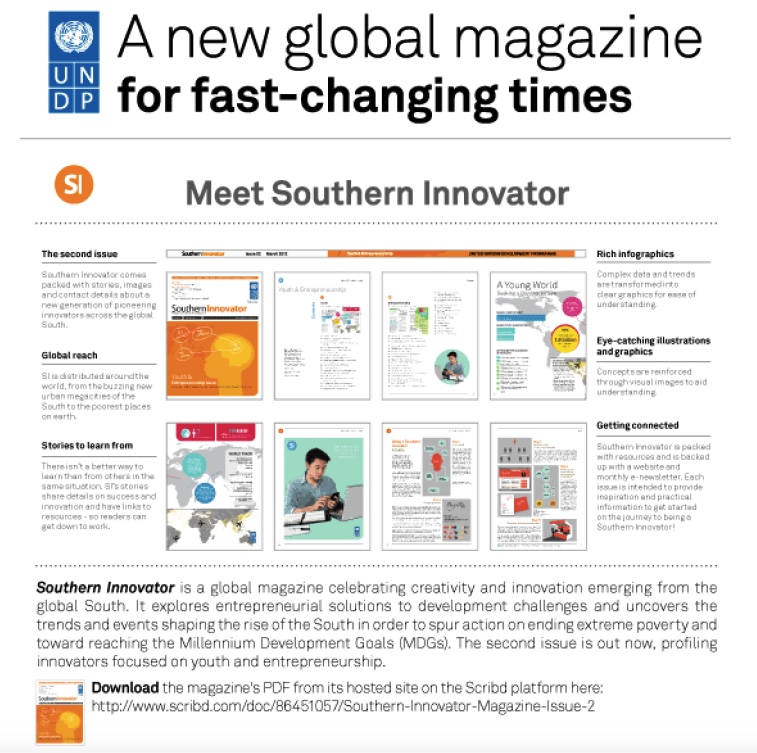
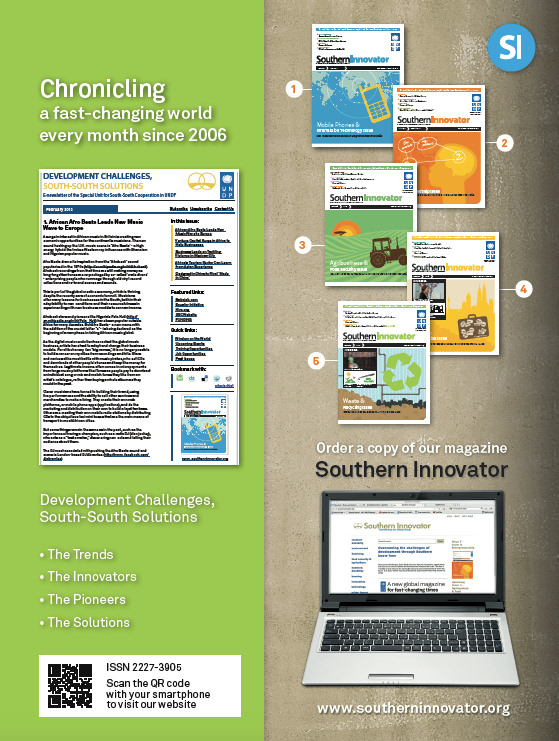
Development Challenges, South-South Solutions was launched as an e-newsletter in 2006 by UNDP’s South-South Cooperation Unit (now the United Nations Office for South-South Cooperation) based in New York, USA. It led on profiling the rise of the global South as an economic powerhouse and was one of the first regular publications to champion the global South’s innovators, entrepreneurs, and pioneers. It tracked the key trends that are now so profoundly reshaping how development is seen and done. This includes the rapid take-up of mobile phones and information technology in the global South (as profiled in the first issue of magazine Southern Innovator), the move to becoming a majority urban world, a growing global innovator culture, and the plethora of solutions being developed in the global South to tackle its problems and improve living conditions and boost human development. The success of the e-newsletter led to the launch of the magazine Southern Innovator. 

Creative Commons License

This work is licensed under a
Creative Commons Attribution-Noncommercial-No Derivative Works 3.0 License.

ORCID iD: https://orcid.org/0000-0001-5311-1052.

© David South Consulting 2023

Categories
Archive Development Challenges, South-South Solutions Newsletters Southern Innovator magazine

A Solution to Stop Garbage Destroying Tourism

By David SouthDevelopment Challenges, South-South Solutions

SOUTH-SOUTH CASE STUDY

Tourism is an essential source of income for countries across the South. But many put that livelihood in jeopardy when they lose control of garbage collection. A popular tourist spot can represent a ‘paradise’ to visitors, but when it becomes too popular and local garbage collection systems collapse under the burden, ‘paradise’ can soon turn to an environmental hell.

The small, tourist-friendly Indonesian island of Bali (http://en.wikipedia.org/wiki/Bali) – known for its idyllic pleasures of spas, surf and serenity – is being overwhelmed by garbage. A survey of tourists found two-thirds would not return to the island because of the problem.

Tourism took off on the island in the 1970s. The economic benefits are clear: the island went from being economically marginal to ranking second only to the country’s capital, Jakarta, in wealth creation. The island received more than 2.38 million tourists in 2009, up 14.5 percent compared with 2008, according to Ida Komang Wisnu, head of the provincial statistics office. But tourism produces on average five kilograms of waste a day per tourist – 10 times what the average Indonesian produces (Bali Fokus).

In the past, the traditional way of serving food in Indonesia was to wrap it in, or serve it on, a palm leaf: a biodegradable approach. But with the huge expansion in use of plastics and non-biodegradable packaging, the waste disposal problem is out of control.

In Indonesia, government garbage disposal services tend to collect between 30 and 40 percent of solid waste, most of this from high income communities. The majority poor population are left to fend for themselves when it comes to waste disposal.

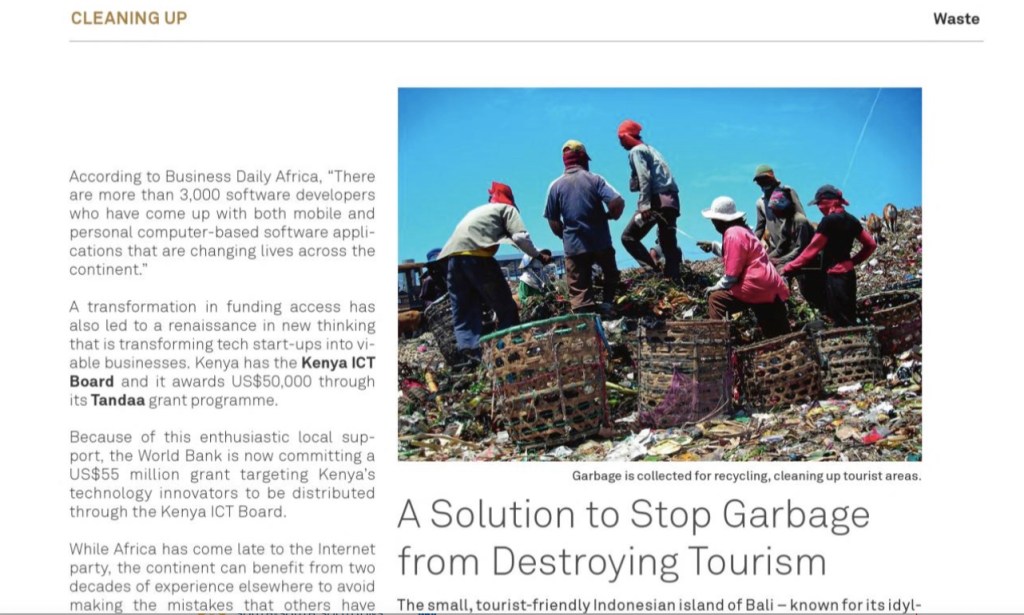
A solution by Yuyun Ismawati, an environmental engineer and consultant, has since 1996 focused on helping poor communities find ways to safely dispose of waste. In 2000, she started her own NGO – Bali Fokus (http://balifokus.asia/balifokus/) – and opened a waste management facility in the Bali village of Temesi. The recycling plant employs 40 people from the village, who sort garbage into recyclables, compost and residual waste. Income from the recycled waste and compost goes to helping local farmers.

She then expanded her concept to include households around Bali and elsewhere in Indonesia. She concentrated on housewives and targeted reducing the amount of household waste going to dump sites. A core team trains housewives in daily habits that separate waste and compost organic matter like vegetable and fruit scraps. Bali Fokus claims it has been able to reduce waste created by 50 percent in 500 homes. Some of the women sell their compost in local markets; recyclables are turned into sellable items.

From 2001 to 2003, Ismawati turned this approach into a replicable template called SANIMAS. By 2008, the SANIMAS template was being used in hundreds of communities across Indonesia.

Her solution to the deluge of tourist waste can be seen in the luxury Jimbaran Bay area of Bali. Traditionally, the area’s hotels would sell their waste to pig farmers. While the pigs feasted on the fancy scraps, the rest of the waste was put in plastic bags and thrown away in mangrove forests.

“I told hotels: Your job is to sell rooms, not to sell garbage,” Ismawati recalls. “We have to protect Bali or else tourists won’t want to come here anymore.”

Ismawati cleverly turned the relationship around: rather than a pig farmer paying for scraps, she convinced one of them there was money to be made recycling and sorting garbage. For this, the hotels would pay the farmer.

A network of 25 hotels now pays to have their garbage taken away and sorted by hand: an important source of full-time jobs.

The workers sort through paper, plastics, glass, aluminium, food scraps and vegetables. Each week, 140 trucks deliver waste to the facility. Only 10 leave with waste that has to go to a dump site.

Food leftovers are bought by local pig farmers and grass clippings and other organic matter is composted (http://www.recyclenow.com/home_composting/), and eventually makes its way back to the hotels and is distributed in the flower beds.

This system has created 400 jobs where the pig farmer once only employed 10 people.

“If you want a hi-tech solution in a developing country you will wait and wait and wait until you get the money, or big donors to fund it,” Ismawati told the Telegraph newspaper. “And even then it may not work.”

A graphic example of this is a donated waste recycling machine given by the local government. It can’t be used because the electricity to power it costs too much. Human labour is a cheaper option.

Bali Fokus’ successful approach has now been replicated in six other sites on the nearby island of Java. And the government of Indonesia has promised to help create 15 more each year.

In 2009 Ismawati won the Goldman Award (http://www.goldmanprize.org/), which honors grassroots environmental heroes from the six inhabited continental regions: Africa, Asia, Europe, Islands and Island Nations, North America, and South and Central America.

She is also working on using decentralized grassroots approaches to bringing sewage disposal and clean water to communities.

Published: March 2010

Resources

https://davidsouthconsulting.org/2022/11/19/african-culture-as-big-business/

https://davidsouthconsulting.org/2022/10/20/african-tourism-leads-the-world-and-brings-new-opportunities/

https://davidsouthconsulting.org/2022/10/20/africas-tourism-sector-can-learn-from-asian-experience/

https://davidsouthconsulting.org/2022/11/18/bolivia-grabs-world-media-attention-with-salt-hotel/

https://davidsouthconsulting.org/2022/02/07/boosting-tourism-in-india-with-surfing-culture/

https://davidsouthconsulting.org/2022/09/27/caribbean-island-st-kitts-goes-green-for-tourism/

https://davidsouthconsulting.org/2022/11/20/ecotourism-to-heal-the-scars-of-the-past/

https://davidsouthconsulting.org/2022/11/21/from-warriors-to-tour-guides/

https://davidsouthconsulting.org/2022/11/11/havanas-restaurant-boom-augers-in-new-age-of-entrepreneurs/

https://davidsouthconsulting.org/2022/11/15/indonesia-best-for-entrepreneurs/

https://davidsouthconsulting.org/2022/11/01/indonesian-food-company-helps-itself-by-making-farmers-more-efficient/

https://davidsouthconsulting.org/2022/11/15/indonesian-middle-class-recycle-wealth-back-into-domestic-economy/

https://davidsouthconsulting.org/2021/06/11/indonesian-wooden-radio-succeeds-with-good-design/

https://davidsouthconsulting.org/2022/11/23/kenyan-safari-begins-minutes-from-airport/

https://davidsouthconsulting.org/2022/10/26/south-gets-reading-bug-with-more-festivals/

https://davidsouthconsulting.org/2021/03/05/southern-innovator-issue-2/

https://davidsouthconsulting.org/2021/03/05/southern-innovator-issue-5/

https://davidsouthconsulting.org/2022/11/18/tourist-passion-for-quirky-holidays-helps-south/

Development Challenges, South-South Solutions was launched as an e-newsletter in 2006 by UNDP’s South-South Cooperation Unit (now the United Nations Office for South-South Cooperation) based in New York, USA. It led on profiling the rise of the global South as an economic powerhouse and was one of the first regular publications to champion the global South’s innovators, entrepreneurs, and pioneers. It tracked the key trends that are now so profoundly reshaping how development is seen and done. This includes the rapid take-up of mobile phones and information technology in the global South (as profiled in the first issue of magazine Southern Innovator), the move to becoming a majority urban world, a growing global innovator culture, and the plethora of solutions being developed in the global South to tackle its problems and improve living conditions and boost human development. The success of the e-newsletter led to the launch of the magazine Southern Innovator.  

Creative Commons License

This work is licensed under a
Creative Commons Attribution-Noncommercial-No Derivative Works 3.0 License.

ORCID iD: https://orcid.org/0000-0001-5311-1052.

© David South Consulting 2023
Categories
Archive Blogroll

A Local Drink Beats Global Competition

By David SouthDevelopment Challenges, South-South Solutions

SOUTH-SOUTH CASE STUDY

For many decades, strong American and multinational food brands have penetrated markets in the South. This is a global business success story for those companies, but the downside has been the marginalizing of local alternatives. This not only reduces wealth-creating opportunities for local entrepreneurs, but also leads to products like sugary soda pops (http://tinyurl.com/yzwal98) pushing aside healthier, local alternatives like tea.

But one company in Indonesia has been pioneering a healthy local drinks empire while also seeing off aggressive foreign rivals. Teh Botol Sosro, a tea drink in Indonesia bottled by family-owned business Sosro, was not only the first bottled tea brand in the country, but also in the world, it claims. The company started bottling the jasmine-flavoured black tea drink in the 1970s.

The Indonesian company has shown that it is possible for local flavours to beat powerful international brands like Coca Cola in the battle for drinkers’ palates. While Coca Cola has tried to sell many bottled tea drinks in the Indonesian market, they have not been able to push aside the local product, The Teh Botol Sosro. Brewed by the Sinar Sosro company, it has captured 70 percent of the non-carbonated drinks market.

It is a drink of cool, black, sweetened tea with a hint of jasmine. Invented by the Indonesian family of Sosrodjojos, Sosro (http://www.sosro.com/) was founded in central Java in the 1940s.

Culturally, Indonesians have either coffee or tea with their meals. The brand’s marketing slogan plays on this: “Whatever you eat, you drink Teh Sosro.”

The company has aggressively fought off competition not only from local rivals, but also from Coca Cola’s Frestea brand and Pepsi Cola’s Tekita. The company stayed sharp in its business strategy, never letting a rival product take hold. Just as a rival would introduce a new product, Sosro would reply with a new drink attuned to Indonesian tastes. This ability to not be complacent about the company’s success, and to use its knowledge of local tastes to always outsmart foreign competition, has kept the company where it is today.

Sosro pioneered bottled drinking tea with its launch in 1970 and started with a dried tea only distributed in Central Java.

The journey to cold, bottled tea is an amusing one. The company first wanted to promote its tea in Jakarta, the capital, by having public tastings. But by brewing the tea on the spot, the too-hot tea took too long to drink for impatient Jakartens. The solution was to not brew the tea on the spot, but instead to brew it off-site and deliver to markets in big pans on trucks. But the bad roads made this a bit of a mistake as well: the tea would spill on the journey.

The ‘aha’ moment came when the idea arose to store the brewed tea in bottles. The bottles were eye-catching and have evolved in design over the years.

The drink now comes in various packages, from a returnable glass bottle (220 ml) to a Tetra Pak (1 litre, 250 ml, and 200 ml) and a 230 ml pouch.

The Botol Sosro (http://www.sosro.com/teh-botol-sosro.php) is not the company’s only product: it also brews Fruit Tea, The Botol Kotak and S-Tee. The economic benefits of these popular brands stay local, as Sosro gets the tea from PT Gunung Slamet, which operates three tea estates covering 1,587 hectares in Indonesia.

Published: March 2010

Resources

1) Just Food is a web portal packed with the latest news on the global food industry and packed with events and special briefings to fill entrepreneurs in on the difficult issues and constantly shifting market demands. Website:http://www.just-food.com

2) Brandchannel: The world’s only online exchange about branding, packed with resources, debates and contacts to help businesses intelligently build their brand. Website:http://www.brandchannel.com

3) Small businesses looking to develop their brand can find plenty of free advice and resources here. Website: http://www.brandingstrategyinsider.com

4) Growing Inclusive Markets, a web portal from UNDP packed with case studies, heat maps and strategies on how to use markets to help the poor. Website:http://www.growinginclusivemarkets.org

5) Tea Genius: A website from Taiwan packed with information on tea, its health benefits and rituals. Website: http://www.teagenius.com/

Cited

As cited in Export Now: Five Keys to Entering New Markets by Frank Lavin and Peter Cohan (Wiley).

Creative Commons License

This work is licensed under a
Creative Commons Attribution-Noncommercial-No Derivative Works 3.0 License.

ORCID iD: https://orcid.org/0000-0001-5311-1052.

© David South Consulting 2022