Categories
Archive Development Challenges, South-South Solutions Newsletters

Boosting Tourism in India with Surfing Culture

By David SouthDevelopment Challenges, South-South Solutions

SOUTH-SOUTH CASE STUDY

Tourism has experienced decades of growth and diversification and is now considered one of the fastest-growing economic sectors in the world. According to the UNWTO – the United Nations World Tourism Organization – modern tourism is “a key driver for socio-economic progress.”

The scale of global tourism means it rivals other sectors, such as oil exports, food products and automobiles in terms of economic clout. With such an important role to play in global commerce, it has become a top income source for developing countries in the global South.

International tourist arrivals grew by 4 per cent in 2012, reaching a record 1.035 billion worldwide (UNWTO). Emerging economies led the growth in tourism, with Asia and the Pacific showing the strongest gains. Tourism outpaced growth in the wider world economy in 2012, contributing US $2.1 trillion to global GDP and supporting 101 million jobs (WTTC).

“2012 saw continued economic volatility around the globe, particularly in the Eurozone. Yet international tourism managed to stay on course” said UNWTO Secretary-General Taleb Rifai. “The sector has shown its capacity to adjust to the changing market conditions and, although at a slightly more modest rate, is expected to continue expanding in 2013. Tourism is thus one of the pillars that should be supported by governments around the world as part of the solution to stimulating economic growth.”

One country that has found tourism becoming a key contributor to its national income is India. The country’s travel and tourism industry is now three times larger than its automotive manufacturing industry, and generates more jobs than chemical manufacturing, communications and the mining sector combined (World Travel and Tourism Council).

Indian Tourism Minister Subodh Kant Sahai called for the sector to create 25 million new jobs over the next five years and it is hoping to grow the market by 12 per cent by 2016 (The Economic Times).

Travel and tourism now contributes 6.7 billion rupees (US $124 million) – or 6.4 per cent – of the country’s total GDP (gross domestic product). The sector supports 39 million jobs directly and indirectly.

But competition for global tourist dollars is fierce. As more flight routes open up – Africa for example, is seeing new airlines and routes emerge every year – a person looking for somewhere to holiday has an ever-growing range of options to choose from. Will it be Africa this year, or shall we go to Asia?
One way to attract tourists and gain an extra edge in the global travel marketplace is to show imagination and innovation. Being different and novel can be the clincher for a tourist, especially one who is widely travelled and is searching for new experiences.

In Southern India, the state of Kerala is well known for its ayurvedic medicine (http://en.wikipedia.org/wiki/Ayurveda) and food tradition going back centuries, combined with its laid-back beach culture. It is a heady combination that successfully attracts many people, who come to relax and boost their health.
Now, Kerala is offering a new dimension to this experience: surfing. Surfing is a water sport involving a person riding ocean waves (https://en.wikipedia.org/wiki/Surfing), usually on a long board. India has enormous and mostly untapped potential as a surfing destination, with its hot weather and 7,000 kilometres of coastline.

Soul and Surf (http://soulandsurf.com) in Golden Beach, Varkala is within walking distance of the Varkala Cliff tourist area and an hour away from the closest major airport, Trivandrum International Airport.

The founders of Soul and Surf, Ed and Sofie Templeton, were captivated by “surfing warm, empty waves, eating wonderful fresh, cheap seafood, practicing yoga and receiving ayurvedic treatments”, according to their website.

“Enchanted by India’s magical, spiritual atmosphere, the warmth of the local people and the raw natural beauty of the area,” they set up a combined surfing and yoga retreat in 2010.

They have become part of a growing surfing scene in Kerala, and an increasing awareness in the country that its long ocean coastline is perfect for water sports.

As surfing grows in India, the owners wanted to create a business that supported the local area, particularly coastal fishing communities surrounding Varkala.

They have also expanded to run a luxury surf and yoga retreat in Sri Lanka and guided trips to the Andaman Islands.

Soul and Surf was inspired by the Surfing India Surf Ashram (surfingindia.net), a 12-hour trip up the coast from Surf and Soul in Karnataka.

Their so-called “Surfing Swamis” have discovered the best places to surf in India and are spirited champions of the whole surfing lifestyle. A swami (http://en.wikipedia.org/wiki/Swami) is a Hindu male religious teacher.
Surfing India promotes adventure sport in India and was started in 2004. At the time, surfing in India had a very low profile. Surfing India offers a sophisticated experience to travellers, including Wi-Fi Internet access, vegetarian food and all the equipment required.

All the staff are volunteers and work for room and board. Profits are plowed back into keeping the surf ashram going and helping its activities, which include adventure tours, a surf camp, surf school, yoga retreat, bodyboarding, snorkelling and wakeboarding.

The Surfing Swamis Foundation is a non-profit organization whose goal is to “teach surfing and environmental awareness to children, orphans, and handicapped persons of any age or gender.”

It also sponsors the All India Surf Team for boys and girls across India.

Published: April 2013

Resources

1) India Surf Festival: Taking place at the beginning of the year. Website: http://www.surfingindia.net/random-stuff/india-surf-festival-2013

2) A guide to the best places to surf in India. Website:http://www.surfingindia.net/india-surf-spots

3) Surfing Federation of India. Website:http://www.surfingfederationofindia.org/

4) United Nations World Tourism Organization: The World Tourism Organization (UNWTO) is the United Nations agency responsible for the promotion of responsible, sustainable and universally accessible tourism. Website: unwto.org

Southern Innovator logo

London Edit

31 July 2013

https://davidsouthconsulting.org/2022/10/20/african-tourism-leads-the-world-and-brings-new-opportunities/

https://davidsouthconsulting.org/2022/10/20/africas-tourism-sector-can-learn-from-asian-experience/

https://davidsouthconsulting.org/2022/09/27/caribbean-island-st-kitts-goes-green-for-tourism/

https://davidsouthconsulting.org/2022/11/20/ecotourism-to-heal-the-scars-of-the-past/

https://davidsouthconsulting.org/2022/11/23/kenyan-safari-begins-minutes-from-airport/

https://davidsouthconsulting.org/2022/10/10/a-solution-to-stop-garbage-destroying-tourism/

Creative Commons License

This work is licensed under a
Creative Commons Attribution-Noncommercial-No Derivative Works 3.0 License.

ORCID iD: https://orcid.org/0000-0001-5311-1052.

© David South Consulting 2023

Categories
Archive Development Challenges, South-South Solutions Newsletters

Disaster Recovery, Ten Years After: The Gujarat, India Experience

By David SouthDevelopment Challenges, South-South Solutions

SOUTH-SOUTH CASE STUDY

In the past decade, there have been many devastating natural disasters, from Iran’s 2003 Bam earthquake and the Asian tsunami of 2004 to Hurricane Katrina in the United States in 2005 and the earthquakes in Chile and Haiti in 2010. All of these events received extensive media attention and drew a large aid response. Those who track natural disasters have noticed a serious increase in frequency over the past decade (http://www.marketoracle.co.uk/Article26290.html).

But rapid aid and media attention do not necessarily lead to long-term recovery. More than a year after the earthquake in Haiti, pace of recovery remains slow. Numerous media stories highlighted the lack of progress.

For the people caught up in these tragedies, quickly returning to a normal life is paramount for psychological and physical health. But this is often the hardest part. Some countries do this well and others do not.

On January 26, 2001, an earthquake laid waste to a large region of the Indian state of Gujarat (http://en.wikipedia.org/wiki/2001_Gujarat_earthquake). Ten years later there is a remarkable recovery that has taken place. So how did they do it?

The 7.9-magnitude quake killed an estimated 20,000 people, injured 150,000, made a million homeless, and destroyed around 8,000 villages. It devastated the Kutch district capital, Bhuj, and other major towns.

In the decade since the earthquake, the state has averaged double-digit growth. Despite having only five percent of the country’s population, Gujarat racks up impressive economic achievements: it has a fifth of India’s exports and a sixth of its industrial production. It has a long-standing entrepreneurial culture based on trade. It can draw on a well-connected global diaspora that ensures a steady inflow of new thinking and investment. Members of this diaspora also contributed to the US $130 million in aid that poured into the region after the quake.

One of the factors contributing to the successful recovery is effective government action.

The disaster has been turned into an opportunity to jolt the region out of the “Middle Ages and into the modern world,” NGO worker Navin Prasad told the BBC.

All the media attention, support and cash at the time forced the Indian government to pay attention to a region it had ignored in the past.

The army came in to help with the emergency and the Indian government allocated US $2 billion to the reconstruction that followed.

Aid was used well and in the first two years many of the damaged villages were rebuilt. And not just rebuilt to what they were, but completely modernized. New houses were constructed to high standards, with more rooms and lots of light. They also came with running water and a toilet. New facilities like medical centres and communal areas were put in place.

The district capital of Bhuj was levelled in the earthquake. But new plans for the city were drafted in the following years. Now Bhuj has two new ring roads, a new airport, parks and shops. Streets were widened and new water and sewage works installed.

But along with the new infrastructure and plenty of cash, came something more important for the region’s long-term recovery: economic growth. The Indian government created tax-free zones drawing in private investment. An astonishing US $10 billion in private investment has come in with US $7 billion more to come, according to the BBC.

One miraculous turnaround is in the former tiny fishing port of Mundra. Prior to the earthquake, it sat in the middle of a salt marsh. It is now India’s largest private port and rivals Mumbai with its Mundra Port and Special Economic Zone (http://www.portofmundra.com/), incorporated in 2003. The Adani Group, a very large Indian private company with global interests (http://www.adanigroup.com/index.html), owns the port now worth US $7 billion, hiring many people once dependent on aid agencies for income.

The head of the Adani Foundation the charitable wing of the Adani Group, Sushma Oza, told the BBC how the company is spending its profits on further developing the area: “Our own budget for social development in this region is $6m a year, so you can imagine how we are trying to change the lives of people to live in a better way,” she said.

In the western portion of the state, in the administrative district of Kutch which is home to Bhuj, around 300 businesses have been established, including the Welspun towel factory (http://www.welspun.com/content.asp?Link=Y&SubmenuID=24). The biggest towel factory in the world, it was built in just nine months and makes 250,000 towels a day. An ambitious firm, it bought the British company Christy (http://www.christy-towels.com/), maker of the official Wimbledon Lawn Tennis Championship towels.

So why towels in Kutch? Welspun chairman Balkrishan Goenka laid down the incentives to the BBC: “There were no local taxes for the first five years and no excise duties. Nor were there indirect taxes to government – they were exempted for five years.”

“Those were the primary benefits,” he said. “More than that there was huge support from the local government so industry can come faster.”

Since the earthquake, 110,000 jobs have been created in Kutch alone. More importantly for the area’s future, it is has gone from neglected backwater to a significant pillar of the Indian economy.

Another driver of recovery was the growth of the dairy industry. The Bhuj dairy plant collapsed in the earthquake and was then rebuilt by the National Dairy Development Board (http://www.nddb.org/). The plant can now process 50,000 litres of milk a day and is run by the Gujarat Cooperative Milk Marketing Federation (http://www.amul.com/organisation.html), India’s largest food products marketing organization. It has 2.9 million producer members and represents 15,322 village societies.

Not everyone has turned their lives around, however. Aid workers estimate thousands are still living in temporary shelters. They defecate in the open and few have clean water. Just getting two meals a day is a problem.

There are complaints about the landless and tenants not receiving the same help.

“Many are tribal, others are low-caste communities, some are Muslims – but they all have one thing in common: poverty,” Bharat Parmer, program coordinator for ActionAid International in Kutch, told Alertnet.

“A large number of these people were tenants and did not own land and so it has been much harder for them to claim their rights as rehabilitation was very much focused on home and land owners.”

But local authorities say rehabilitation schemes have been comprehensive, covering all those who were hit by the quake.

“I don’t think that there are people who did not get what they were due – there may be a rare case here and there but we have rehabilitated all that were in need,” said Gunvant Vaghela, the second-most senior civil servant in Kutch district.

Published: February 2011

Resources

1) How to activate support from the global technology community in a disaster. Website: http://crisiscommons.org/

2) UNICEF: Community-Based Disaster Preparedness Projects (CBDPs) in India have been helping communities restructure to survive when disaster strikes. Website: http://www.unicef.org.uk/campaigns

3) The US Government has extensive resources online on how to prepare for a wide variety of natural and man-made disasters. Website: http://www.fema.gov/areyouready/

4) The magazine Popular Mechanics has excellent resources on how anyone can prepare their family and community for disasters. Website: http://www.popularmechanics.com/survival/

5)  Telecoms Sans Frontiers: Focuses on providing communications in the first days after an emergency. Website: http://www.tsfi.org/

Associated Press

On the ground reporting from the Associated Press (AP) Archive: India: Earthquake Aftermath Update 

Development Challenges, South-South Solutions was launched as an e-newsletter in 2006 by UNDP’s South-South Cooperation Unit (now the United Nations Office for South-South Cooperation) based in New York, USA. It led on profiling the rise of the global South as an economic powerhouse and was one of the first regular publications to champion the global South’s innovators, entrepreneurs, and pioneers. It tracked the key trends that are now so profoundly reshaping how development is seen and done. This includes the rapid take-up of mobile phones and information technology in the global South (as profiled in the first issue of magazine Southern Innovator), the move to becoming a majority urban world, a growing global innovator culture, and the plethora of solutions being developed in the global South to tackle its problems and improve living conditions and boost human development. The success of the e-newsletter led to the launch of the magazine Southern Innovator.  

Follow @SouthSouth1

Google Books: https://books.google.co.uk/books?id=p03–n51i44C&dq=development+challenges+april+2008&source=gbs_navlinks_s

Slideshare: http://www.slideshare.net/DavidSouth1/development-challengessouthsouthsolutionsapril2008issue

Southern Innovator Issue 1: https://books.google.co.uk/books?id=Q1O54YSE2BgC&dq=southern+innovator&source=gbs_navlinks_s

Southern Innovator Issue 2: https://books.google.co.uk/books?id=Ty0N969dcssC&dq=southern+innovator&source=gbs_navlinks_s

Southern Innovator Issue 3: https://books.google.co.uk/books?id=AQNt4YmhZagC&dq=southern+innovator&source=gbs_navlinks_s

Southern Innovator Issue 4: https://books.google.co.uk/books?id=9T_n2tA7l4EC&dq=southern+innovator&source=gbs_navlinks_s

Southern Innovator Issue 5: https://books.google.co.uk/books?id=6ILdAgAAQBAJ&dq=southern+innovator&source=gbs_navlinks_s

More on disaster resilience here:

From southasiadisasters.net:

Southern Innovator in Southasiadisasters.net

https://davidsouthconsulting.org/2021/02/23/southern-innovator-in-southasiadisasters-net/

Innovations In Green Economy: Top Three Agenda

https://davidsouthconsulting.org/2021/10/22/innovations-in-green-economy-top-three-agenda/

Lima To Delhi: What Can Be Learned On Urban Resilience?

https://davidsouthconsulting.org/2021/10/22/lima-to-delhi-what-can-be-learned-on-urban-resilience/

South–South Cooperation For Cities In Asia

https://davidsouthconsulting.org/2021/10/22/south-south-cooperation-for-cities-in-asia/

A New House Kit for Slum Dwellers that is Safe and Easy to Build

https://davidsouthconsulting.org/2021/10/03/a-new-house-kit-for-slum-dwellers-that-is-safe-and-easy-to-build/

Haiti Earthquake Prompts Tech Aid

https://davidsouthconsulting.org/2021/09/01/haiti-earthquake-prompts-tech-aid/

Rebuilding After Chinese Earthquake: Beautiful Bamboo Homes

https://davidsouthconsulting.org/2021/02/12/rebuilding-after-chinese-earthquake-beautiful-bamboo-homes/

Creative Commons License

This work is licensed under a
Creative Commons Attribution-Noncommercial-No Derivative Works 3.0 License.

ORCID iD: https://orcid.org/0000-0001-5311-1052.

© David South Consulting 2022

Categories
Archive

Indian Entrepreneur Brings Dignity to Poor Women

By David South, Development Challenges, South-South Solutions

SOUTH-SOUTH CASE STUDY

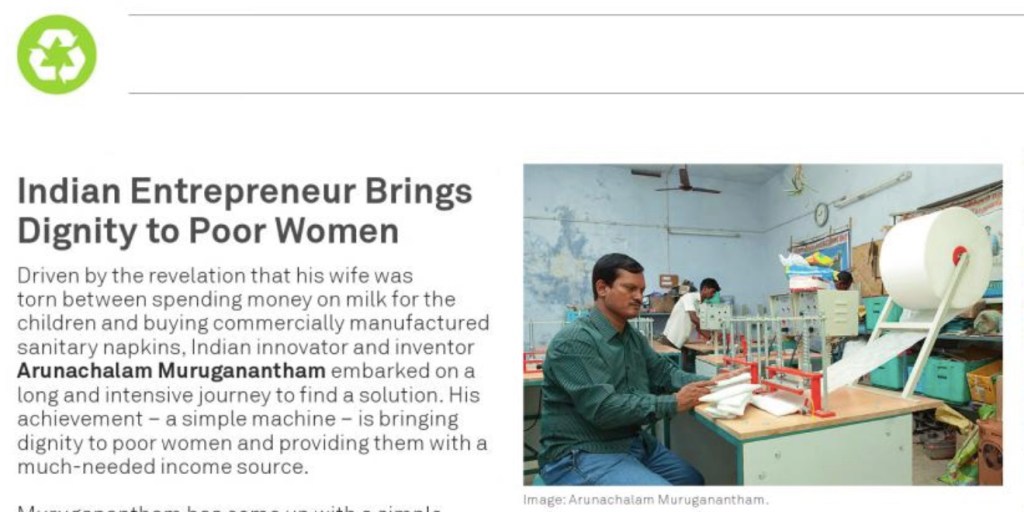
Driven by the revelation that his wife was torn between spending money on milk for the children and buying commercially manufactured sanitary napkins, Indian innovator and inventor Arunachalam Muruganantham embarked on a long and intensive journey to find a solution. His achievement – a simple machine – is bringing dignity to poor women and providing them with a much-needed income source.

This is a story of a man who was considered crazy for his persistence and made many personal sacrifices to achieve his goal. The innovation is both a technological and a business solution. Muruganantham has come up with a simple machine to manufacture affordable hygienic sanitary napkins for poor women. It works by turning the pulp of pine wood into the flat, white sanitary pads (http://en.wikipedia.org/wiki/Sanitary_napkin) commonly used by women during their monthly menstruation. The machine’s simplicity means it can be expanded easily to other communities and is designed to fit well with the way women’s cooperatives work and help them earn an income.

Muruganantham sees it is a business model that “can deliver livelihood, hygiene and dignity to poor women, and help them strengthen society,” according to his website.

The manufacturing process produces the sanitary napkins in just five steps. This simple intervention is revolutionizing women’s health in India by giving them an alternative to using found and unhygienic rags every month when they menstruate.

It took Muruganantham four years of research to create a patented machine that sells for between US $1,332 and US $5,330. It can make 120 sanitary pads an hour. Each one sells for 10 rupees (US 18 cents). By comparison, the multinational company Procter & Gamble sells its product for 30 rupees (US 54 cents) a packet.

Two multinationals dominate the marketplace for sanitary napkins in India: Procter & Gamble and Johnson & Johnson, with the Stayfree and Carefree brands.

Muruganantham’s machine was awarded the best innovation national award by the former President of India, Prathiba Patil, in 2009.

Like many innovators and inventors, his work at first was little understood by others and meant he had to plough a lonely furrow. But his persistence paid off and is now receiving attention from countries across the global South.

Apart from its technological simplicity, the idea is to make it easy for women to form cooperatives and businesses to boost their incomes. India has seen the concept of so-called Ladies Self Help Groups (SHGs) (http://en.wikipedia.org/wiki/Self-help_group_%28finance%29) become more popular as a source of income. One of the problems they encounter is finding a successful business to undertake. The machine invented by Muruganantham is being seen as a good business model for the SHGs to follow. The key is the simplicity of operating the machine, the growing and stable market for the product, and its affordable and competitive price.

Typical businesses that can be set up using the machine can employ 10 women.

Muruganantham set up his main business, Jayaashree Industries (motto: ‘new inventions… small is beautiful’) (http://newinventions.in/aboutus.aspx), after his education was disrupted due to family problems and he took up a job in a welding shop.

At first, he had a difficult time convincing people of the utility of the machine. He enlisted his wife to help with the marketing of the new napkins to nearby women. He says the advantage of his business model is that it turns the making of the napkins into a sustainable, grassroots activity. It provides an essential commodity for poor women at an affordable price, removing middlemen and using a simple, non-chemical technology.

It also cuts down on expensive transport costs by keeping manufacturing local.

Over 225 machines have been delivered to 14 Indian states and also to Nigeria, Ethiopia, Kenya, Uganda, Nepal and Bangladesh.

And while Muruganantham is focused on making the machine a success, he is already looking forward to working on his next big invention. The only question is: what will it be?

Resources

1) Women’s Health: A website packed with facts and advice from the UK’s National Health Service. Website: http://www.nhs.uk/livewell/women1839/Pages/Women1839home.aspx

Creative Commons License

This work is licensed under a
Creative Commons Attribution-Noncommercial-No Derivative Works 3.0 License.

ORCID iD: https://orcid.org/0000-0001-5311-1052.

© David South Consulting 2021

Categories
Archive

Solar Powered Village Kick-Starts Development Goals

By David South, Development Challenges, South-South Solutions

More than 1.7 billion people around the world have no domestic electricity supply, of whom more than 500 million live in sub-Saharan Africa (World Bank). Without electricity, many development goals remain dreams that will never be achieved.

But in a first for India, a village is now entirely powered by solar energy, kick-starting its development and reversing the decline common to many villages.

Rampura village in the state of Uttar Pradesh (http://en.wikipedia.org/wiki/Uttar_Pradesh) had previously been without electricity. But its move to solar power has boosted school performance, brought new economic opportunities for women, and even made the buffalo produce more milk! By getting up early, the buffalo can be fed more before day breaks.

Being able to see at night unleashes a vast range of possibilities, but for the very poor, lighting is often the most expensive household expense, soaking up 10 to 15 percent of income.

There’s a direct link between lighting and economic development. Each 1 per cent increase in available power will increase GDP by an estimated 2 to 3 per cent.

In India, 600,000 villages still lack electricity. Despite the country’s impressive economic gains – growth of over 9 percent per year for the last three years, although that rate is now slowing – the levels of poverty in the country’s villages have driven millions to flee to the sprawling slum zones of India’s cities.

Rampura was set up with solar power by a project of Development Alternatives (http://www.devalt.org/), a New Delhi-based NGO working on promoting “sustainable national development”. Using US $1,406,000 from Norwegian solar power company Scatec Solar (http://www.scatecsolar.no/), it installed 60 solar panels to power 24 batteries. The village’s 69 houses are directly connected to the solar plant.

According to Greenpeace (http://www.greenpeace.org/international/), India could generate 10 percent of its electricity from solar power by 2030.

Manoj Mahata, the project’s programme director, said half of India’s 600,000 villages without electricity can now have the option of solar power.

A steady electricity supply means children are extending their study time past daylight hours. Nine-year-old Aja told the Sunday Times: “I like watching television and the light at night means I can read.”

For women, the light brought by electricity means they can take on new business opportunities to boost income. “I want to start a sewing business with other women to make tablecloths and blouses,” said mother of three Gita Dave.

“Even the buffalo are producing more milk because people can feed before dawn,” said Ghanshyam Singh Yadav, president of Rampura’s energy committee.

“This is not rocket science. This is simple,” says Katja Nordgaard, director for off-grid projects at Scatec.

“The model is relatively cheap, and it is easy to operate and maintain. It can be built in three to four weeks, and can easily be scaled up if the demand for electricity increases.

“People in India are already paying when they need to charge cell phones, and for the kerosene they use in their lamps. The willingness to pay for energy is relatively high here, especially when that energy is reliable.”

In Bangladesh, more than 230,000 households are now using solar power systems thanks to the government’s Infrastructure Development Company Ltd. (IDCOL), giving rise to opportunities for a whole new generation of entrepreneurs to make use of this new power supply for the poor. IDCOL is run by the Ministry of Finance, and is on course to install 1 million Solar Household Systems (SHS) using solar panels by 2012. The Bangladeshi government is hoping to bring electricity to all its citizens by 2020 – meaning this is now a prime time for entrepreneurs specializing in providing energy efficient products to the poor.

Another initiative to boost development in India’s rural villages is the concept of the Model Village India (www.modelvillageindia.org.in), previously profiled by Development Challenges (November 2008).

Resources

Creative Commons License

This work is licensed under a
Creative Commons Attribution-Noncommercial-No Derivative Works 3.0 License.

ORCID iD: https://orcid.org/0000-0001-5311-1052.

© David South Consulting 2021