

By David South, Development Challenges, South-South Solutions

The United States’ fast-paced and highly inventive technology sector is re-shaping philanthropy and proving it is possible to do good and make money at the same time. The approach taken by these philanthropists is flavoured by their experiences in the cut-throat world of technology, where innovation is a necessity and where re-invention and risk are de rigeur. They share many of these qualities, counter intuitively, with millions of the world’s poor as they struggle day in and day out to survive and get ahead.
Differing from the Fairtrade movement – whose origins are in NGOs seeking guaranteed fair price for goods – so-called ‘venture philanthropists’ and ‘social entrepreneurs’ focus more on profit and growth. They draw their inspiration from the online networks that have rocked the business world in the past few years, and look to apply a model of constant innovation.
The past ten years have seen non-profits more and more adopt the language and methods of business. For ‘venture philanthropists’ and ‘social entrepreneurs’, business is the tool to do good. By breaking out of the narrow view of philanthropy as about giving away money, it becomes possible to see the connections between doing good and making good money, venture philanthropists argue. And as more people think this way, more tools are emerging to make it easier and easier to do.
The highly successful online auction house Ebay’s founders Jeff Skoll and Pierre Omidyar are part of a wave of new thinking from California’s high-tech Silicon Valley that is shaping the way huge sums of private capital get invested in social change.
‘Venture philanthropists’ focus on a small portfolio of grantees that make the most of the investment. By giving them large, long commitments, including money for infrastructure such as staff and computers, they don’t spend all their time fundraising. And unlike traditional philanthropists, they get in their offices and work with them like partners instead of waiting for annual reports, and they hold the grantees to quantifiable goals.
The success of Nobel Prize winner Mohammed Yunus and his microcredit bank, Grameen, has spawned an even more ambitious venture. The Omidyar Network – led by billionaire Omidyar – calculated it would take between US $50 and US $60 billion to provide micro-lending services to the entire world’s poor. The Network is currently putting together the financing to launch this new micro-lending facility across the world. According to Omidyar, private capital is functionally limitless. Look at it that way, he said recently to the Los Angeles Times, and “$60 billion is nothing.”
Billing itself as a nonprofit venture capital firm, the Acumen Fund uses the principles of design to solve the problems of the poor. Just as the Procter & Gambles (PG) and Motorolas (MOT) of the corporate world conduct extensive ethnographic research on consumers, Acumen finances companies that create systems from the bottom up. “Start with the individuals,” said founder Jacqueline Novogratz. “Build systems from their perspective. Really pay attention, and then see if they can scale.”
Under Novogratz’s leadership, the New York-based fund manages $20 million in investments in companies that fall within three portfolios: health, water, and housing. It’s not a lot of money compared with any of the traditional venture funds in Silicon Valley. But Acumen’s goal is not to launch initial public offerings. Rather, Novogratz and her team are building prototypes for new business models that measure returns in social benefits as well as monetary rewards.
“We are betting on entrepreneurs, we look for a strong management team,” said Brian Trelstad, Chief Investment Officer of the Acumen Fund. “We currently have US $20 million in investments in six countries. We hope to take that to US $100 million in the next five years. We are beginning to see a really rich pipeline developing in our investment countries and more high quality investment opportunities coming our way. We are looking for people who are passionate about their approach and who continue to build their business from the perspective of the people in need.”
Larry Page and Sergey Brin, the founders of the successful search engine Google, started their philanthropic wing, Google.org, following Ebay’s example. They endowed Google.org with stock now worth about US $1 billion. Then they followed Omidyar’s example and set themselves up as a for-profit network.
“In the old American business model, the relationships between a firm and its investors, bank, suppliers and customers tended to be very arm’s length,” says Annalee Saxenian, dean of UC Berkeley’s School of Information. “You would make a deal and report back after some specified period of time. The new business model is much more engaged. Everyone learns from one another, and there is a continuous flow of information. The firms are more specialized, but they see each other as collaborators.”
The approach, just like in the pell mell pace of the computer industry, is relentless. Just as computer software and hardware manufacturers follow a constant improvement and innovation cycle, so can social entrepreneurs.
Published: March 2007
Resources
- The Skoll Centre for Social Entrepreneurship at Oxford’s Said Business School, hosts the Skoll World Forum every year to promote entrepreneurial solutions to social problems.
- Ashoka: Ashoka is the global association of the world’s leading social entrepreneurs. It identifies and invests in leading social entrepreneurs with innovative and practical ideas at the launch stage. They then receive a living stipend for three years to focus on their ideas.
- Social Ventures Partners: While only focused on the Seattle, USA area, SVP offers a model that can be applied throughout the global South. The vision of the founders was to build a philanthropic organization using a venture capital model, where partners actively nurture their financial investments with guidance and resources.
- Generation Investment Management: Started in 2004 with former US vice president Al Gore, they only focus on investments that are long-term, sustainable and that they really believe in.
- Omidyar Network: Started by Ebay’s founders, it funds for-profits and non-profits who promote equal access to information, tools and opportunities, and encourage shared interests and a sense of ownership among participants.
- Skoll Foundation: The mission of the Foundation is to seek out social entrepreneurs who are already implementing successful programs on a small scale, and then through three-year awards, support the continuation, replication or extension of the program. Issues funded are: tolerance and human rights, health, environmental sustainability, economic and social equity, institutional responsibility, and personal security.
- SV2: Silicon Valley Social Venture Fund: A partnership of successful technology entrepreneurs, it pools funds to support social entrepreneurs by giving money and giving time – venture philanthropy.
- Google.org: It uses the talent, technology and financial resources of the successful search engine to tackle global poverty.
- Acumen Fund: A non-profit venture fund that invests in market-based solutions to global poverty. The Fund supports entrepreneurial approaches to developing affordable goods and services for the 4 billion people in the world who live on less than $4 a day.
- TechnoServe: Helps budding entrepreneurs turn good business ideas into thriving enterprises. With funding from the Google Foundation, they are launching a Business Plan Competition and an Entrepreneurship Development Program in Ghana.

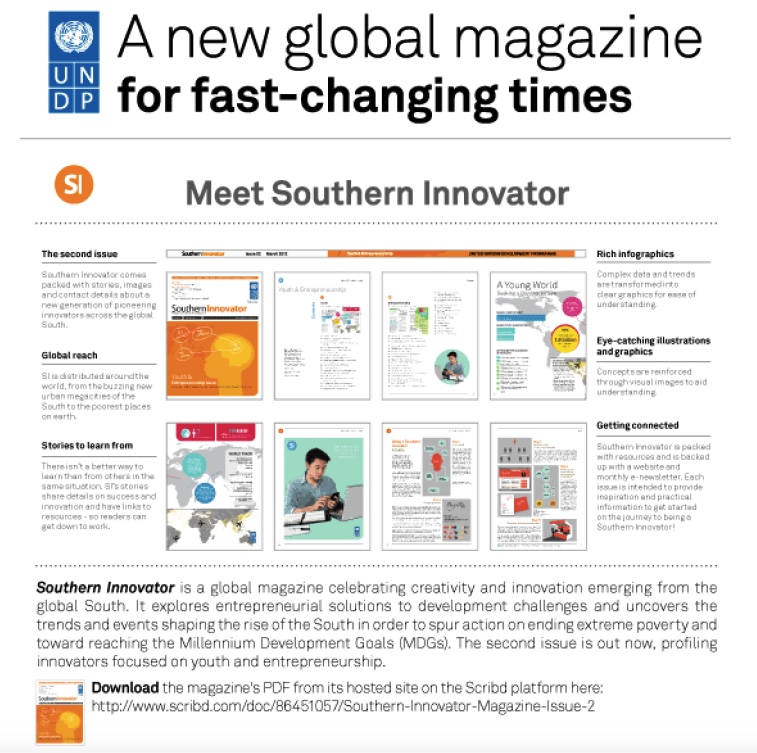
Development Challenges, South-South Solutions was launched as an e-newsletter in 2006 by UNDP’s South-South Cooperation Unit (now the United Nations Office for South-South Cooperation) based in New York, USA. It led on profiling the rise of the global South as an economic powerhouse and was one of the first regular publications to champion the global South’s innovators, entrepreneurs, and pioneers. It tracked the key trends that are now so profoundly reshaping how development is seen and done. This includes the rapid take-up of mobile phones and information technology in the global South (as profiled in the first issue of magazine Southern Innovator), the move to becoming a majority urban world, a growing global innovator culture, and the plethora of solutions being developed in the global South to tackle its problems and improve living conditions and boost human development. The success of the e-newsletter led to the launch of the magazine Southern Innovator.


This work is licensed under a
Creative Commons Attribution-Noncommercial-No Derivative Works 3.0 License.
ORCID iD: https://orcid.org/0000-0001-5311-1052.
© David South Consulting 2023

 David South Consulting
You must be logged in to post a comment.