
By David South, Development Challenges, South-South Solutions

Learning how to thrive in a market economy does not necessarily come naturally. But for young people who have grown up under a different economic system or known nothing but economic chaos, learning business skills can give them the tools to get on in life.
With youth unemployment rates high around the world, it is clear many young people may never get the jobs they expect unless they start businesses themselves.
In 2013, 73.4 million young people were out of work, an increase of 3.5 million from 2007. A report by the International Labour Organization (ilo.org) found persistent unemployment around the world in the wake of the global economic crisis, a proliferation of temporary jobs and growing youth discouragement in advanced economies; and poor quality, informal, subsistence jobs in developing countries. School-to-work transition surveys of developing countries showed that youth are far more likely to land low-quality jobs in the informal economy than jobs paying decent wages and offering benefits.
High youth unemployment often has nothing to do with poor educational achievement (many unemployed youth have high school educations or university degrees), but is often caused by other factors, including lack of access to capital, rigid labour markets, skills mismatched to demand in the economy (for example construction and building trades), or a gap between personal aspirations and the true state of the country’s economic development.
But rather than despair, it is possible to show youth how to turn things around and use business skills to re-shape economies in their favor. Youth tend to bring to the economy energy and drive combined with new ideas and experiences calibrated to the demands of the 21st century. By harnessing this, youth can find a unique space in the marketplace. In turn, young people can lead in reviving damaged economies and making their countries wealthier and healthier. Many youth have grown up around the emerging digital economy and the use of mobile phones. Being comfortable with the 21st century digital economy will unleash many economic opportunities that favor youth.
The British Council says that “creative entrepreneurship is considered the most efficient model for youth in the developing world who are facing huge difficulties in finding employment”. The entrepreneurship or creative investment industry is one of the fastest-growing sectors in the world.
Understanding what works for youth business entrepreneurship has become a specialty in its own right. Using the media to teach skills and inspire youth to action is one proven approach.
One recent example is a successful television programme from the Republic of the Sudan. Called Mashrouy (mashrouy.com), it is modeled on reality TV programmes such as The Apprentice, which features serial U.S. entrepreneur Donald Trump (http://www.bbc.co.uk/programmes/b00q3fkq) and the BBC’s Dragon’s Den (http://www.bbc.co.uk/programmes/b006vq92), where contestants pitch their ideas to a panel of judges to see if they can get funding for their business idea.
In Mashrouy, 12 contestants battled it out to see who had the best business idea. They undertook various challenges and the original 12 were whittled down to three contestants. Live on air in December 2013, viewers voted for their favorite contestant and the winner (https://www.facebook.com/Mashrouy) received a prize of 200,000 SDG (US $35,211), while the second prize winner received 150,000 SDG (US $26,408) and the third prize winner received 100,000 SDG (US $17,605). All three were then taken to London in the United Kingdom to meet other creative entrepreneurs and receive valuable business advice.
The Sudanese show (http://sudan.britishcouncil.org/our-work/mashrouy) is supported by the British Embassy and the British Council, and is working with the Sudanese Young Businessmen Association and major Sudanese companies to spread the idea of entrepreneurship among the youth of Sudan.
Sudan suffered a brutal civil war on and off throughout the 2000s, leading to the partition of the original country into the Republic of the Sudan and the new nation of South Sudan in 2011.
Faced with Sudan’s serious youth unemployment – as high as 34 per cent – and a fragile economy, the TV show’s producers wanted to encourage youth to start businesses.
The contest was aimed at youth between 18 and 40 and appeared on the Blue Nile (http://bnile.tv/blue.html) channel.
“At a time of national economic hardship, it has kindled the imagination of Sudanese youth,” wrote journalist Isma’il Kushkush (https://twitter.com/ikushkush) in The New York Times.
For the show, a panel of experts picked 12 projects out of 2,500 applications. Each of the 12 finalists was given a chance to do a “pitch,” giving a quick summary of their business idea and trying to get the panel excited about the idea and its potential. The idea that generated the most excitement won.
The 12 pitches included an idea for an ostrich farm and a plan to export spicy peanut butter. The winner, 32-year-old Samah al-Gadi, wants to use a locally available weed-like river plant to make bags and furniture. She said she got up the courage to be on the show from a supportive mother.
“Amid ululations, screams and clapping, a jubilant Ms. Gadi raised both hands above her scarf-covered head, flashing victory signs,” The New York Times said. “Her mother, sitting at a dinner table, was brought to tears.”
The women-owned social enterprise Making Cents International (makingcents.com), based in Washington, D.C., USA, has been gathering resources on youth entrepreneurship since 1999. It has put together a custom “curricula to develop the mindset, skillset, and toolset that enable entrepreneurs and enterprises to participate in profitable markets; financial institutions to serve new populations; and individuals to obtain meaningful work”. This is available in 25 languages. It also hosts the Global Youth Economic Opportunities Conference in Washington, DC, held this year from 6 to 8 October 2014 (http://youtheconomicopportunities.org/conference).
Published: April 2014
Resources
1) Khartoum Teaching Centre: The British Council is a world leader in English language training and teaching. It offers general English courses for adult learners of all levels, totaling 60 hours of tuition over 10 weeks. Website: http://sudan.britishcouncil.org/learn-english/courses
2) Start-up Chile innovation fund: Start-Up Chile is a program created by the Chilean Government, executed by Corfo via InnovaChile, that seeks to attract early stage, high-potential entrepreneurs to bootstrap their startups in Chile, using it as a platform to go global. Website: startupchile.org
3) Global Youth Economic Opportunities Conference 2014: From 6 to 8 October Youth entrepreneurship conference in Washington, D.C., USA. Website: youtheconomicopportunities.org/conference
4) Making Cents International: The Youth Economic Opportunities learning platform is the first community of practice and knowledge exchange portal developed by and for the youth economic opportunities sector. Website: youtheconomicopportunities.org
5) Mongolian Rock Pop book: A book published by UNDP in the Mongolian language on how the country’s rock and pop musicians led on business innovation using creative marketing and publicity during the country’s turbulent transition during the 1990s. Website: http://tinyurl.com/p25scqq

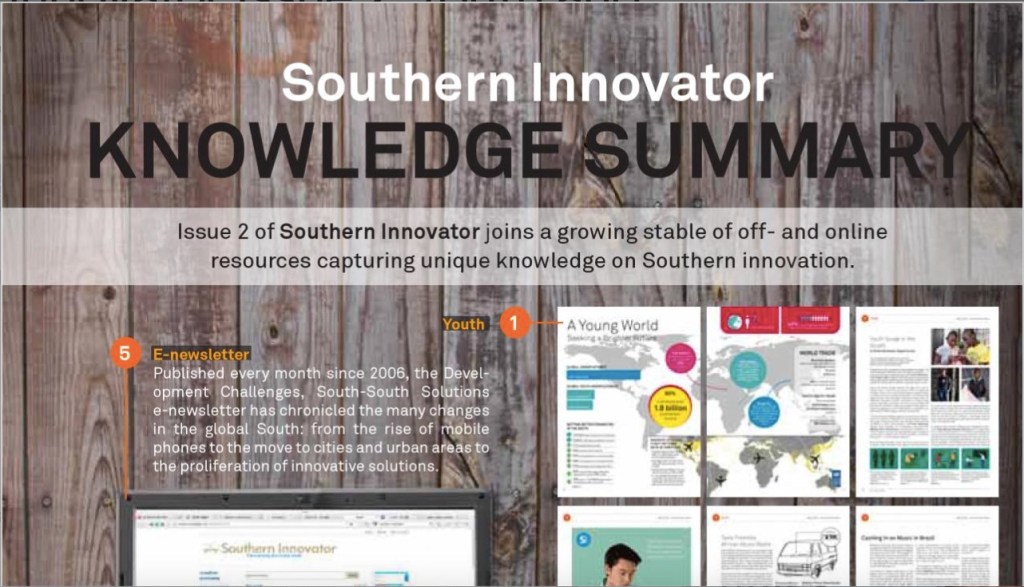
Development Challenges, South-South Solutions was launched as an e-newsletter in 2006 by UNDP’s South-South Cooperation Unit (now the United Nations Office for South-South Cooperation) based in New York, USA. It led on profiling the rise of the global South as an economic powerhouse and was one of the first regular publications to champion the global South’s innovators, entrepreneurs, and pioneers. It tracked the key trends that are now so profoundly reshaping how development is seen and done. This includes the rapid take-up of mobile phones and information technology in the global South (as profiled in the first issue of magazine Southern Innovator), the move to becoming a majority urban world, a growing global innovator culture, and the plethora of solutions being developed in the global South to tackle its problems and improve living conditions and boost human development. The success of the e-newsletter led to the launch of the magazine Southern Innovator.

https://davidsouthconsulting.org/2021/03/05/southern-innovator-issue-2/

This work is licensed under a
Creative Commons Attribution-Noncommercial-No Derivative Works 3.0 License.
ORCID iD: https://orcid.org/0000-0001-5311-1052.
© David South Consulting 2023




 David South Consulting
You must be logged in to post a comment.