Categories
Archive Development Challenges, South-South Solutions Newsletters Southern Innovator magazine

Biogas Digester-in-a-Bag Brings Portability

By David SouthDevelopment Challenges, South-South Solutions

SOUTH-SOUTH CASE STUDY

Securing energy sources that are cheap (or free) and renewable can significantly reduce the cost of living for the world’s poor. The cost of fuel for essentials such as cooking and lighting can quickly eat up household incomes.

Gaining access to an inexpensive gas source that is also renewable can help people divert their income into other things, such as education and health care, improving individuals’ well-being and helping boost wealth.

Biogas (http://en.wikipedia.org/wiki/Biogas) is fuel made from biodegradable organic material such as kitchen, animal or human waste. It can be converted into gas either by being heated or using anaerobic bacteria to break down the material and turn it into combustible methane gas (http://en.wikipedia.org/wiki/Methane).

Most biogas systems are complex and large, involving an enormous domed biodigester.

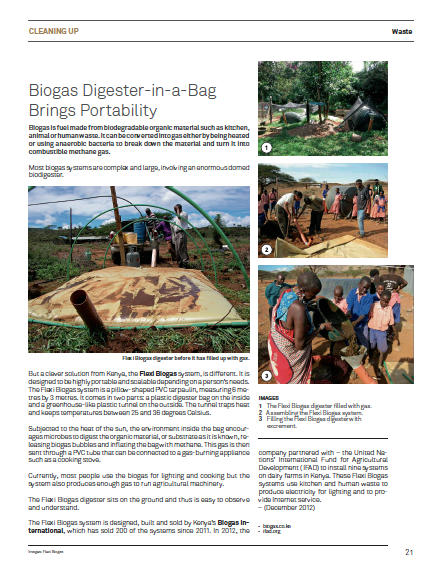
But a clever solution from Kenya, the Flexi Biogas system (biogas.co.ke), is different. It is designed to be highly portable and scalable depending on a person’s needs. The Flexi Biogas system is a pillow-shaped PVC tarpaulin, measuring 6 metres by 3 metres. It comes in two parts: a plastic digester bag on the inside and a greenhouse-like plastic tunnel on the outside. The tunnel traps heat and keeps temperatures between 25 and 36 degrees Celsius.

Subjected to the heat of the sun, the environment inside the bag encourages microbes to digest the organic material – or substrate (http://en.wikipedia.org/wiki/Enzyme_substrate_%28biology%29) as it is known, releasing biogas bubbles and inflating the bag with methane. This gas is then sent through a PVC tube that can be connected to a gas-burning appliance such as a cooking stove.

Currently, most people use the biogas for lighting and cooking but it also produces enough gas to run agricultural machinery.

The Flexi Biogas digester sits on the ground and so is easy to observe and understand.

The Flexi Biogas system is designed, built and sold by Kenya’s Biogas International, which has sold 200 of the systems since 2011. In 2012, the company partnered with IFAD – the United Nations’ International Fund for Agricultural Development (ifad.org) – to install nine systems on dairy farms in Kenya. These Flexi Biogas systems use kitchen and human waste to produce electricity for lighting and to provide Internet service.

Cows produce 15 to 30 kilograms of dung a day (IFAD). By placing 20 kilograms of fresh cow dung into a Flexi Biogas digester it is possible to produce 1,000 litres of cooking gas – enough gas for a family of five to seven people. This amount of cow dung could also produce enough gas to run a 5 horsepower engine for one hour. The engine could also be connected to a car alternator to generate electricity to run lights, a computer or a television set.

A Flexi Biogas system costs US $410, including installation by technicians and all the extras including inlet and outlet pipes and a 15 metre gas pipe.

The cost of the system increased from the first prototypes. Initially, inexpensive plastic was used for the bags and the total cost for the system was US $180. But the makers encountered a problem with durability – the systems were prone to tearing and needed to be replaced after two years. Since then, they have moved to a more expensive PVC tarpaulin bag designed to last 10 years.

The makers point out that access to high-quality plastic and rubber in Kenya is difficult and the system’s costs could be brought down if they were manufactured in China or India.

The makers argue there are several reasons why the Flexi Biogas solution is suited to Africa. One is the difficulty of securing land tenure, necessary for the building of a permanent structure like a biodigester dome. It can also be a challenge to find skilled labour and get access to complex parts such as gas pressure regulators.

In a comparison between the conventional dome biogas digester and the Flexi Biogas system, IFAD found the average cost in Kenya for a dome system was US $1,000, compared to US $410 for the Flexi Biogas system. A fixed dome takes 21 days on average to set up while a Flexi Biogas system can be set up in a day. The Flexi Biogas system also turns the substrate into biogas faster and can operate at higher temperatures. IFAD found various advantages and disadvantages to the Flexi Biogas solution: it is relatively inexpensive, lightweight (10 kilograms), very portable, quick and simple to set up, and easy to operate. The disadvantages include being costly to make, easy to steal, and a relatively short lifespan.

Weighing it all up, IFAD still concluded that “the Flexi Biogas system is an affordable solution that provides household energy while making use of waste products that would otherwise add to emissions.”

Published: December 2012

LINKS:

1) The official portal on anaerobic digestion. Website: http://www.biogas-info.co.uk/

2) REA Biogas: REA Biogas has been championing the cause of anaerobic digestion (AD) and has been the unifying force which has helped to bring the industry forward. Website: http://www.biogas.org.uk/

3) Practical Action: Various renewable energy solutions including biogas. Website: http://practicalaction.org/biogas_expertise

4) Future Biogas: Future Biogas specialise in the construction and operation of biogas plants for the UK. Website: http://www.futurebiogas.com/

https://davidsouthconsulting.org/2022/11/21/africa/

https://davidsouthconsulting.org/2022/08/02/african-fuel-pioneer-uses-crisis-to-innovate/

https://davidsouthconsulting.org/2022/11/19/agricultural-waste-generating-electricity/

https://davidsouthconsulting.org/2022/11/22/bio-ethanol-from-sturdy-and-once-unwanted-indian-plant/

https://davidsouthconsulting.org/2022/02/11/egyptian-youth-turns-plastic-waste-into-fuel/

https://davidsouthconsulting.org/2022/10/25/indian-toilet-pioneer-champions-good-ideas/

https://davidsouthconsulting.org/2023/03/27/pay-for-pee-keeps-indian-town-clean/

https://davidsouthconsulting.org/2022/06/23/recycling-waste-to-boost-incomes-and-opportunities/

https://davidsouthconsulting.org/2022/11/19/saving-water-to-make-money/

https://davidsouthconsulting.org/2022/11/18/successful-fuel-efficient-cookers-show-the-way/

https://davidsouthconsulting.org/2022/11/18/toilet-malls-make-going-better/

https://davidsouthconsulting.org/2022/08/13/turning-animal-waste-into-paper/

https://davidsouthconsulting.org/2021/09/30/turning-human-waste-to-fertilizer-an-african-solution/

https://davidsouthconsulting.org/2022/02/10/urban-farmers-gain-from-waste-water/

Follow @SouthSouth1

Slideshare: http://www.slideshare.net/DavidSouth1/development-challengessouthsouthsolutionsnovember2010issue

Southern Innovator Issue 1: https://books.google.co.uk/books?id=Q1O54YSE2BgC&dq=southern+innovator&source=gbs_navlinks_s

Southern Innovator Issue 2: https://books.google.co.uk/books?id=Ty0N969dcssC&dq=southern+innovator&source=gbs_navlinks_s

Southern Innovator Issue 3: https://books.google.co.uk/books?id=AQNt4YmhZagC&dq=southern+innovator&source=gbs_navlinks_s

Southern Innovator Issue 4: https://books.google.co.uk/books?id=9T_n2tA7l4EC&dq=southern+innovator&source=gbs_navlinks_s

Southern Innovator Issue 5: https://books.google.co.uk/books?id=6ILdAgAAQBAJ&dq=southern+innovator&source=gbs_navlinks_s

Creative Commons License

This work is licensed under a
Creative Commons Attribution-Noncommercial-No Derivative Works 3.0 License.

ORCID iD: https://orcid.org/0000-0001-5311-1052.

© David South Consulting 2023

Categories
Archive Development Challenges, South-South Solutions Newsletters

Food Inflation: Ways to Fight It

By David SouthDevelopment Challenges, South-South Solutions

SOUTH-SOUTH CASE STUDY

Food inflation has taken off at the beginning of 2011. As the global economic crisis enters its next phase, both developed and developing countries are experiencing inflation. There are many factors fuelling the rise in prices – inefficient distribution and storage systems, lack of investment in agriculture, devaluing currencies, high demand, natural and man-made disasters, use of food products like corn to make biofuels – but there are also ways to counter the effects of food inflation that have been tried and tested across the South.

The United Nations Conference on Trade and Development (UNCTAD) says the least developed countries spent US $9 billion on food imports in 2002. By 2008, that amount had risen to US $23 billion. Supachai Panitchpakdi, secretary general of UNCTAD, says “the import dependence has become quite devastating.”

Worse, more people had less money to buy the food. The number of individuals living in extreme poverty “increased by 3 million per year during the boom years of 2002 and 2007,” reaching 421 million people in 2007.

For millions of people, it is a matter of life and death that food remains affordable. The poor pay the largest share of their income on food. Raise that cost, and the poor quickly have little money left for other things, like housing, transport, clothing or education.

Approached as a problem needing a solution, it is possible to deal with a bout of food inflation. Every food crisis has its origins and can be resolved. A staggering amount of food goes to waste every year, and a vast quantity can’t get from the farm to the market in time because of infrastructure problems.

An Indian refrigerator – the ChotuKool fridge (http://www.godrej.com/godrej/godrej/index.aspx?id=1) – is designed to stay cool for hours without electricity and to use half the power of conventional refrigerators. Priced at US $69, it is targeted at India’s poor – a population of over 456 million, almost half the total Indian population (World Bank).

Manufactured by Godrej and Boyce and weighing just 7.8 kilograms, it is designed around the stated needs of the poor, who wanted a fridge capable of cooling 5 to 6 bottles of water and 3 to 4 kilograms of vegetables. Portability was crucial as well, since needs to be moved when large family gatherings take place in small rooms.

As a photo shows (http://innovation.hindustantimes.com/summit-photos/godrej/chotukool-3.php), the fridge looks more like a drinks cooler than the typical large refrigerator. It works by replacing the standard compressor motor found in most fridges with a battery-powered heat exchanger.

In Ghana, a mobile phone-driven Internet marketplace is helping to improve efficiencies in farming and selling food. Esoko (esoko.com/#lang=en), tracks products including ground nuts, sesame, tomato, maize and white beans. It offers market information from Afghanistan, Benin, Burkina Faso, Cameroon, Cote d’Ivoire, Ghana, Madagascar, Mali, Mozambique, Nigeria, Sudan and Togo.

India’s e-Choupal is making food distribution more efficient in a country experiencing high inflation. E-Choupal (http://www.echoupal.com) has developed a reputation for both controlling prices and increasing incomes for poor farmers. Started in 2000 by the major Indian company ITC Limited (http://www.itcportal.com), it links farmers to the latest prices for products including soybeans, wheat, coffee and prawns.

E-Choupal works through computers set up in rural areas and has built one of the largest internet initiatives in rural India, reaching 4 million farmers in 40,000 villages.

Brazil, over the last 30 years, has transformed itself from a food importer to one of the world’s major food exporters. It made these impressive achievements with few government subsidies. The agricultural success is down to Embrapa (http://www.embrapa.br/english) – short for Empresa Brasileira de Pesquisa Agropecuária, or the Brazilian Agricultural Research Corporation. A public company set up in 1973, it has turned itself into the world’s leading tropical research institution. It breeds new seeds and cattle and has developed innovations from ultra-thin edible wrapping paper for foodstuffs that turns colour when the food goes off to a nano-tech lab creating biodegradable ultra-strong fabrics and wound dressings.

Another approach can be found with a farmer in Kenya, Zack Matere, who boosted his potato crop by turning to Facebook for help. On his farm in Seregeya, Matere used the internet to find a cure for his ailing potato crop.

He uses his mobile phone to access the internet at a costs of about US 0.66 cents a day. One example of the kind of intelligence Matere is able to glean from the internet is reports of cartels deceiving farmers by buying potatoes in over-large 130 kg bags instead of 110 kg bags. Matere takes this information, translates it into Swahili and posts it on community notice boards.

Another fast-growing solution is bringing farming to urban and semi-urban spaces, where the majority of the world’s population now lives.

Urban farmers can take advantage of their close proximity to consumers, keeping costs down and profits up. They can also solve one of agriculture’s enduring problems – where to find water for irrigation by using existing waste water. Waste water is plentiful in urban environments, where factories usually pump out waste water into streams, rivers and lakes.

In Accra, Ghana, more than 200,000 people depend on food grown with wastewater. In Pakistan, a full quarter of the grown vegetables use wastewater.

Family farms are critical to weathering economic crises and ensuring a steady and secure food supply. The International Fund for Agricultural Development (IFAD) (www.ifad.org) called in 2008 for small family farms – which sustain the livelihoods of more than 2 billion people _ to be put at the heart of the global response to high food prices and uncertain food security.

In Brazil, this call is being answered by a bold initiative to create a “social technology,” combining a house-building programme with diverse family farms.

This is where the Brazilian farmer’s cooperative Cooperhaf: Cooperativa de Habitacao dos Agricultores Familiares (http://www.cooperhaf.org.br/) steps in.

“We see the house as the core issue,” said Adriana Paola Paredes Penafiel, a projects adviser with the Cooperhaf. “The farmers can improve their productivity but the starting point is the house.

“Family farming is very important for the country – 70 percent of food for Brazilians comes from family farming,” said Penafiel. “The government wants to keep people in rural areas.”

Making farming more appealing is being shown as a great way to get ahead in modern Africa. One woman hopes more people will be attracted to farming and boost the continent’s food security and reduce costly imports.

Cynthia Mosunmola Umoru’s company, Honeysuckle PTL Ventures (http://www.tootoo.com/d-c3015227-Honeysuckles_Ptl_Ventures/), is based in Lagos, the business capital of Nigeria.

Leading by example, Umoru has set up a successful and modern agribusiness focusing on high-quality food products using modern packaging and fast delivery. She produces meat products, from seafood like shrimps and prawns to snails, beef, chicken, and birds. Her niche is to deliver the product however the customer wishes: fresh, frozen or processed.

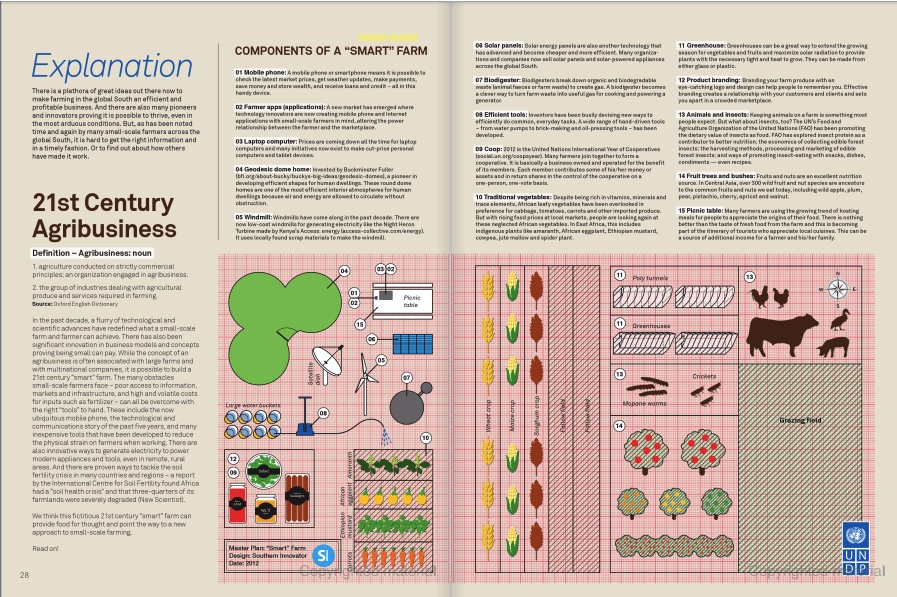
Radical new food sources are also another option over time. The Food and Agricultural Organization (FAO) has explored insect protein as a contributor to better nutrition, the economics of collecting edible forest insects, methods of harvesting, processing and marketing edible forest insects, and ways of promoting insect eating with snacks, dishes, condiments — even recipes.

The range of insects that can be tapped for food is huge, and includes beetles, ants, bees, crickets, silk worms, moths, termites, larvae, spiders, tarantulas and scorpions. More than 1,400 insect species are eaten in 90 countries in the South. Entrepreneurs in the South are making insects both palatable and marketable – and in turn profitable. These innovations are adding another income source for farmers and the poor, and supplying another weapon to the battle for global food security.

Resources

1) The global movement for slow food, which encourages organic production and appreciation of traditional foods and cooking. Website: www.SlowFood.com

2) A video story by CNN on Tradenet/Esoko. Website: http://www.youtube.com/watch?v=s6z0ywkHPPQ

3) Olam: The story of Olam – a global food supply company in ‘agri-products’ that got its start in Nigeria – shows how a Southern brand can grow and go global, and overcome the difficulties of cross-border trade. Website: http://www.olamonline.com/home/home.asp

4) South African company Eat Your Garden: It provides urban dwellers and food businesses with their own food gardens bursting with juicy and tasty foods whilst at the same time reducing carbon footprints, and creating employment and provide training, helping poverty alleviation. Website: http://www.eatyourgarden.co.za/

5) Vertical farming, where hothouses are piled one on top of the other, is an option being promoted as a solution to the food needs of urban dwellers. Website: http://www.verticalfarm.com/

Follow @SouthSouth1

Slideshare: http://www.slideshare.net/DavidSouth1/development-challengessouthsouthsolutionsnovember2010issue

Southern Innovator Issue 1: https://books.google.co.uk/books?id=Q1O54YSE2BgC&dq=southern+innovator&source=gbs_navlinks_s

Southern Innovator Issue 2: https://books.google.co.uk/books?id=Ty0N969dcssC&dq=southern+innovator&source=gbs_navlinks_s

Southern Innovator Issue 3: https://books.google.co.uk/books?id=AQNt4YmhZagC&dq=southern+innovator&source=gbs_navlinks_s

Southern Innovator Issue 4: https://books.google.co.uk/books?id=9T_n2tA7l4EC&dq=southern+innovator&source=gbs_navlinks_s

Southern Innovator Issue 5: https://books.google.co.uk/books?id=6ILdAgAAQBAJ&dq=southern+innovator&source=gbs_navlinks_s

Creative Commons License

This work is licensed under a
Creative Commons Attribution-Noncommercial-No Derivative Works 3.0 License.

ORCID iD: https://orcid.org/0000-0001-5311-1052.

© David South Consulting 2024