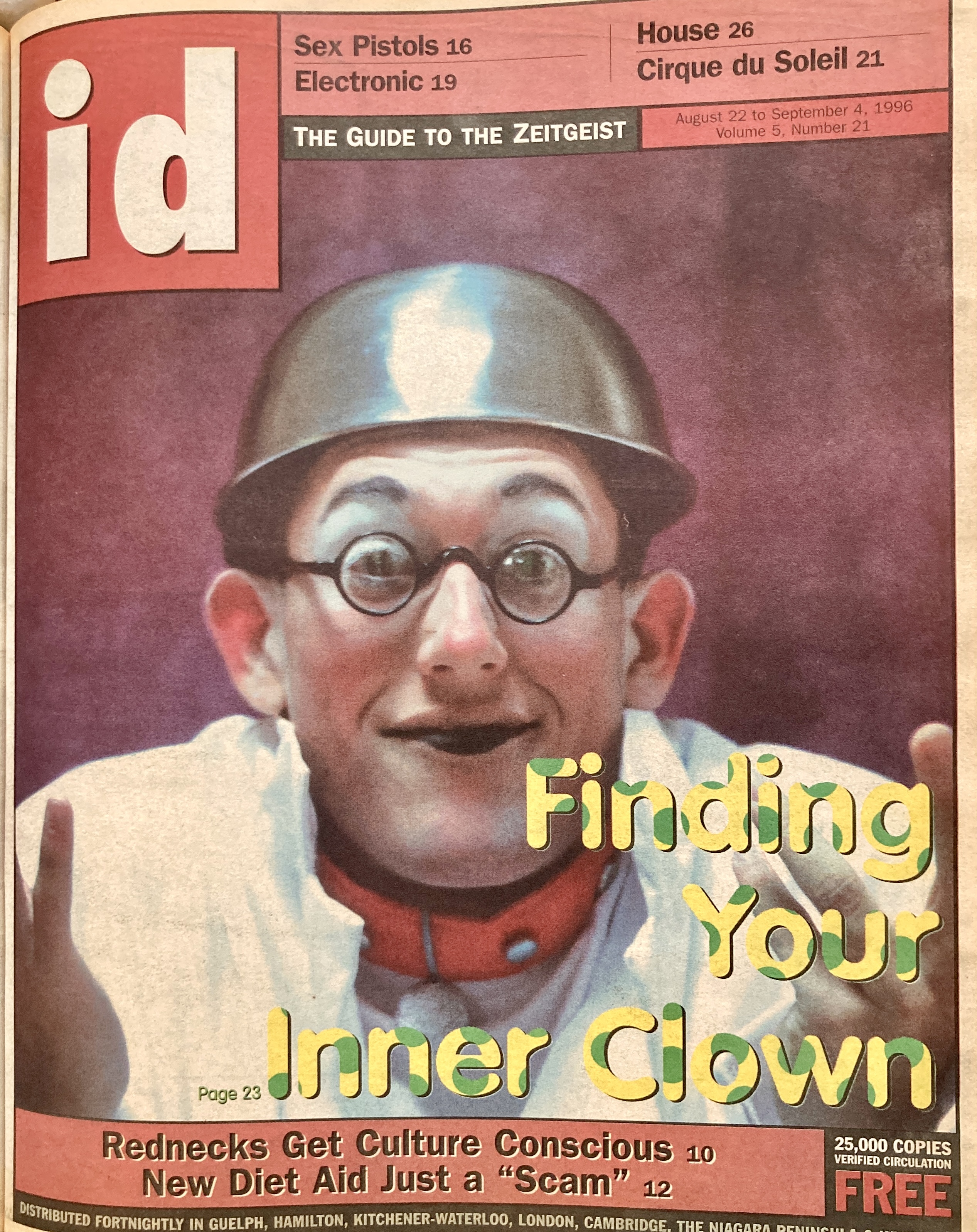
What happens when rednecks pick up a lesson or two from the world of identity politics? Mostly ridiculed by smug urbanites, or just plain ignored by the general population at large as cultural fads come and go, angry rednecks are standing tall in these conservative times.
Part Mark Twain-like satire, reverence and condescension, a cottage industry promoting the southern American redneck lifestyle is starting to resemble past struggles for cultural pride.
Just think of the gay rights movement in the 70s and 80s, which turned the derogatory word queer into a touchstone of homosexual pride.
In the 90s, dismissing rednecks as a bunch of dumb crackers can not only ensure free dental work in many an American bar, it can also be seen as an affront to white American values. But while some want to stereotype this culture as the heart and soul of white working-class American ideals, it is hard not to be disturbed by this phenomenon. Can God, beer, the American Constitution and guns weave together a stable lifestyle?
Author, radio personality and Redneck Olympics MC Bo Whaley was interviewed in a phone booth across from the bomb site at Atlanta’s Centennial Olympic park. During the interview Bo was kicked out of the phone booth by Atlanta police for talking too long. He picked up the interview from a truckstop near Dublin, Georgia.
id: What is a redneck?
Bo: A redneck to me is a lifestyle, that’s what it is. I relate rednecks to people who work hard, men of the soil. They look for the common things in life. They enjoy the outdoors, enjoy hunting and fishing. They aren’t too interested in status or setting the world on fire. They like to do their own thing. Real close to being what we call a good ole boy. They enjoy life – they work hard and they party hard.
There is nothing put on by them. They are down to earth. I really enjoy them, they are on the level. If you ask them a question they will tell you the truth. They aren’t trying to impress anybody, just trying to be themselves.
Go to the local bar and they are listening to the juke-box, smoking cigarettes and drinking beer. We can make fun of ourselves down here, we enjoy it. We laugh at ourselves. Poke a lot of fun. I’m having fun with people who live on farms, live in small towns. Like to hunt, like to fish. They drink beer. I have lived in the south for 24 years. I try to look at people and write what I see. I also wrote The Field Guide to Southern Women.
id: I heard the Redneck Olympics didn’t go down so well with the city council.
The chamber of commerce was concerned about the image. We attract a lot of industry to the town, they were afraid what was going out was a negative image of the lifestyle that is going on in Dublin.
We didn’t know it was going to catch on like it did. At the opening ceremony we were expecting maybe 250 maybe 350 people – and we had 4,000! The national and international media has got into it.
id: Are rednecks all right-wing?
On the right of the political spectrum, yeah. Happy with Newt Gingrich. I don’t think we take politics as seriously as up north. (Former U.S. president) Jimmy Carter is not very popular with the rural people here in Georgia. Well, I think when he went to Washington his values changed. I can name many, many people including me, who don’t like him. Right now I’m five minutes from the Carter Centre in Atlanta. I’ve never been to it. Not really interested in what Carter is doing.
He is trying to solve all the problems of the world. He looks at himself as more of a missionary than an ex-president. He goes to Haiti, he goes to South Africa, Bosnia. He calls these peace conferences and by-passes the established government in the United States to try to do his own thing. It’s a self-serving thing.
id: What do you think about the militia movement?
I do not agree with them. Right now I’m standing across from Olympic park where they had the bomb go off. People that I talked to have no sympathy for the militia, they say let the established investigators handle it and they don’t have any use for (the militia) at all.
id: Do you think the militias are a symbol of the frustration a lot of rednecks are feeling?
I agree. But they do a lot more talking than they do acting.
id: Why do they distrust the federal government and imagine black helicopters are helping the U.N. to set up a totalitarian state?
I think what they feel is that they know more about handling a situation than the government does and they want to do it on their own. I don’t agree with that. The government’s not perfect here nor in Canada. As long as it is the government I’m going to support it. I was not a Clinton fan but once he was elected he became my president. I have to support him until he gets out. But I don’t support everything he does.
id: Is the redneck style locked in the 70s?
The redneck symbol is more popular than it has ever been. A lot of people in offices in stuffed shirts and ties who would love to get out and live this way but they can’t do it on account of losing their jobs. They like to get in a jeep or ride on a motorcycle and say “whee” and to the heck with it. Everybody in the world needs some quiet time, time to yourself to do what you want to do.
id: Do you think rednecks are in danger of extinction in the age of the Internet?
They are on the increase. They don’t know about high-tech stuff. They haven’t even got into electric typewriter yet – they are still on manual typewriter.
id: Do they have any heroes or heroines?
They are beer people, and if they have any drug they smoke marijuana.
id: I mean heroes.
Many are country music fans, like Garth Brooks and Hank Williams Jr. They are big on country music. Female rednecks admire shows like Designing Women.
Oh lord, they love T-shirts. The T-shirts say “Opry land,” “Dollywood,” “Get your heart in America or get your ass out.” They don’t like plain T-shirts.
id: Can you give an estimate of the number of rednecks in the U.S.?
I travel more in the South Eastern states. In my hometown, in my home county, there are 37,000 people. Most of the people there, I’d say 75 per cent are working people, they either farm or work in factories. Out of those people, I’d say 20 to 25 per cent fall in the category of what I call redneck – they work hard all day and they play hard all night. Nationwide, I have no idea. I can tell you towns that have a lot of rednecks. Chattanooga, Tennessee – lot of rednecks. Columbus, Georgia, it’s a military town. In Montgomery, Alabama they work real hard at being rednecks.
id: Is there a problem with blurring rednecks with more negative elements like the Ku Klux Klan?
No, I really don’t see that. Most of the people I know can’t stand the Klan. They give country people a bad name.
id: Some guy at the Redneck Olympics had a Klan T-shirt on.
I’m not surprised by that. The main thing you are going to see them wearing if they have anything to do with a symbol of patriotism is a Confederate flag saying “God bless America” and “God bless the South.”
id: What about the rebel flag?
They do not want to give it up. There is some legislator in Atlanta who is trying to ban it, and this has to do with trying to appease a faction for their votes. But you get out into rural Georgia, rural Alabama, they want to keep that flag. To be truthful it has a lot to do with the civil rights movement.
id: That it means it’s an affront to the civil rights movement?
Yeah.
id: Are there yuppie rednecks?
I know a neuro-surgeon living in Birmingham, Alabama, I met him through his wife while I was signing books. She came up and said “I’ve got to have one of those Redneck Handbooks,” and I said “Why?” She said, “Because my husband is a neuro-surgeon and he’s from Arkansas and all day long on in his office he’s got his blue buttoned-down shirt, his navy blue suit and his spit shine shoes and driving his Mercedes. When he gets home in the afternoon he puts on his blue jeans, and denim shirt gets the pick-up truck, the dog gets in back and he starts riding in the woods.” He’s a Dr. Jekyll and Mr. Hyde type. I see a lot of that. They kind of let their hair down. It’s a release for them.
id: Do you see the redneck lifestyle as a different kind of leisure lifestyle, a more working-class leisure lifestyle?
I think so, David. They put on ragged jeans, say to the world “I am a redneck.”
What they like to do is go fishing. They will go to the coast and go deep sea fishing. Especially they like to go to stock car races. Big stock car fans. The faster that car goes the better they like it, and the more wrecks they have the better they like it.
The screensaver on an Undercurrents researcher’s computer terminal bears a maxim that might strike a chord in a lot of CBC units these days: “Only the paranoid survive.”
The quirky media and technology show will fade to black at the end of March. Its cancellation raises a host of issues for a CBC deeply troubled by budget cuts, an ageing audience, a dearth of alternative programme concepts and an inability to plan for a future.
In the show’s pilot, Wendy Mesley – Undercurrents’ host and progenitor – set the tone for this accessible look at the relationship among technology, media and society: “Like it or not we are living in a wired world where OJ Simpson, Big Brother, even your bank machine, all converge … we’ll explore all the issues, the undercurrents of the information age.”
To those who loved it, Undercurrents was a program that satisfied a vital public need, and an ambitious concept for a public broadcaster that some say had grown a little musty. The show promised avant-garde production and investigative journalism that critically explored today’s new media and technology culture. Youngish researchers and producers were hired from outside the CBC. They brought with them experience and new ideas from specialty channels, TV Ontario and CTV. Some came straight out of journalism school.
Critical reaction to the first programs was mixed. John Doyle, a critic with the Globe and Mail’s Broadcast Week, lauded Undercurrents when it launched, calling it “a superb example of solid CBC-TV journalism and original reporting.” Others were less flattering. The Toronto Star’s Greg Quill accused the show of “flirting with infotainment.” At the Vancouver Sun, Alex Strachan wasn’t impressed by a report on a weekend conclave of computer geeks in the California desert for a kind of Hackerstock. “It sounds interesting,” he wrote, “but it isn’t.”
What hurt more was schedulers playing musicial chairs with the show’s slot. Switching Undercurrents from Tuesday at 7 pm to Friday at 7 pm midway through its life left viewers confused and sent ratings plummeting just as network programmers were casting about for places to apply a whopping 30 percent budget cut. As a result, some feel the show never had a fighting chance.
In the end, it was the show’s precarious financial arrangement that killed it. Undercurrents was never funded from the general current affairs budget. Instead, it drew on a special reserve of cash created by the network. When it came time to mete out the cuts in December, the special funding bubble burst. Rather than cut further into the budgets of flagship current affairs programs, executives chose to drop Undercurrents.
Executive producer Frances Mary (FM) Morrison acknowledges that gratitude for her program’s special funding obscured a recognition of its fragility. “That was really our Achilles heel,” she says. “We were just this little orphan that didn’t have its own money. We weren’t adopted into the larger family.”
With the network funding gone, Undercurrents’ budget (rumoured to be over a million dollars per season) was nowhere to be found. Discussions about chasing a corporate sponsor went nowhere because the show needed more money than any sponsor could have provided. “It was never an issue of $100,000 or $200,000,” says Morrison. “It was the issue of our entire budget. [CBC] would still have had to come up with the rest of it.”
CBC TV’s news, current affairs and Newsworld director Bob Culbert and former current affairs head Norm Bolen both say they wanted the show to stay on the air but couldn’t find a way to fund it withou seriously hurting programs like The Fifth Estate, Marketplace and Venture.
Bolen, now VP of programming at the History and Entertainment Network, says it came down to choosing between The Health Show and Undercurrents. The Health Show won because it had a “bigger audience, a broader demographic and was bringing in revenue from sales of programming to the specialty channels.”
Mesley has another theory. “The majority of people who worked on this programme are not traditional CBCers… They can’t bump, they don’t get huge severance packages. Of course, if you want a future, those are the wrong reasons for letting people go.”
With its intensive focus on issues like the abuse of computer-morphed images, surreptitious “data-mining” of consumer purchase records, or media “freebies,” there’s no question that Undercurrents has met a need in this media-saturated world. But controversy over the cancellation centres on the age-old question of CBC and the youth audience.
Morrison and Mesley both say they intended the show to appeal to a younger-than-usual CBC audience. But CBC executives weren’t convinced it was an audience the network could, or should, go after. According to Culbert, a youth mandate was something the production team brought to Undercurrents. “It started as a media ethics show targeted at a classic CBC audience. Nobody sat around one day and said ‘let’s invent the show that will go after younger viewers.’”
Bolen expresses a profound lack of faith in the under-30 audience. “People under 30 don’t watch information programming, okay? Let’s get that straight. I sure wouldn’t spend the rest of my life trying to get an audience that doesn’t watch a certain genre of programming. This is a business where you pay attention to reality. People under 30 watch trashy American sitcoms, which I’m not in the business of doing, and which the CBC isn’t in the business of doing.”
“I think that’s bullshit,” says Reid Willis, producer and director of CityTV’s Media Television. “People under 30 are interested in what’s going on in the media. The 20 to 30 group is more media savvy than the generation that preceded them.” But Willis thinks the lack of information programming pitched at a young audience is down to a lack of interest from advertisers.
Mesley and Morrison remain convinced Undercurrents did appeal to a younger audience, but felt it was sabotaged by the schedule shuffling. In the show’s first slot, Tuesdays at 7 pm, its average audience was 499,000. The biggest night came on Sunday, October 22, 1995 when a repeat aired at 9:30 pm got an audience of 865,000. But Undercurrents’ debut in the 96/97 season in its new 7 pm slot on Fridays was demoralizing for the crew. Morrison reports the audience for the season opener at 438,000 and 434,000 for a strong programme the following week.
She says the numbers built as audiences found the programme’s new location, peaking at 678,000 on December 6. According to CBC audience research figures, average minute audience for the 96/97 season to February 2 stood at 518,000 viewers.
“Friday at seven was not a good place for Undercurrents,” claims Morrison. “It’s an older audience. In fact the audience for Air Farce [which followed Undercurrents at 7:30] is quite old, surprisingly old. I was actually astonished to find out how old that audience was.”
CBC audience research bears Morrison out, reporting that the 18-34 demographic for both Air Farce and Undercurrents has been identical this season – a mere 14 percent of the total audience.
Fridays at seven is also a heavily competitive slot packed with overhyped American tabloid TV shows like Entertainment Tonight, Inside Edition, Hard Copy and A Current Affair. Morrison says focus groups told her that audiences in that time period surf around looking for stories they like and then switch around with no loyalty to a particular programme.
“People build a menu. We took a leaf out of the tabloid book in terms of our presentation in order to survive in the seven o’clock environment.”
Undercurrents’ jerky camera work and flashy graphics didn’t endear itself to everyone, a fact the show’s producers recognized early on. “I can point to stories where we sabotaged ourselves with stylistic extremes,” admits Morrison.
But Mesley bristles at accusations the show was all style and no content, or a clone of Media Television. “We are the antithesis of Media Television. Obviously everyone has adopted their style from rock videos. But they get nearly all their video as handouts. We are not saying, ‘This is hip.’ We are not saying, ‘This is the latest consumer thing you can add to your collection.’ We are saying ‘Think about this.’”
Undercurrents’producers express pride in the show’s innovations. They cite its lead role in web page design at the corporation., its efforts at promoting a more playful visual presentation, and its success in promoting an acceptance of media stories elsewhere in news and current affairs. But what seemed to enliven everyone interviewed for this story was a love of the public broadcasting ethos, where stories are told because they are important, not because advertisers say they are important. Many of the young researchers and producers at Undercurrents had done time at the privates, and appreciated the freedom and extensive resources offered by the CBC. But they felt they had come to a CBC whose values were in peril.
“It will be like C-SPAN here,” quipped an Undercurrents freelancer who has done time at the specialty channels.
Others who thrived in the upbeat atmosphere at Undercurrents say they’re not too keen to look for work elsewhere in the CBC. One such is 25-year-old researcher Bret Dawson. “It’s not a happy place,” he says.
It’s not clear what, if any, programming will replace Undercurrents. If the current trend prevails, it looks like any new programming will have to survive on a smaller budget, generate outside income and prove it can draw in viewers in short order. Under those conditions, people at Undercurrents and elsewhere wonder how long CBC’s commitment to innovative new programming can hold out.
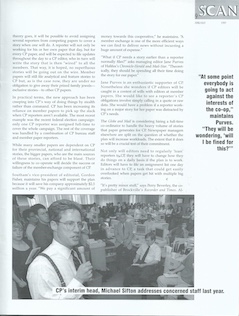
CBC TV’s Undercurrents host Wendy Mesley. Scan Magazine was published in the 1990s for Canadian media professionals.
In 2021 Wendy Mesley commented on the story in a Tweet.
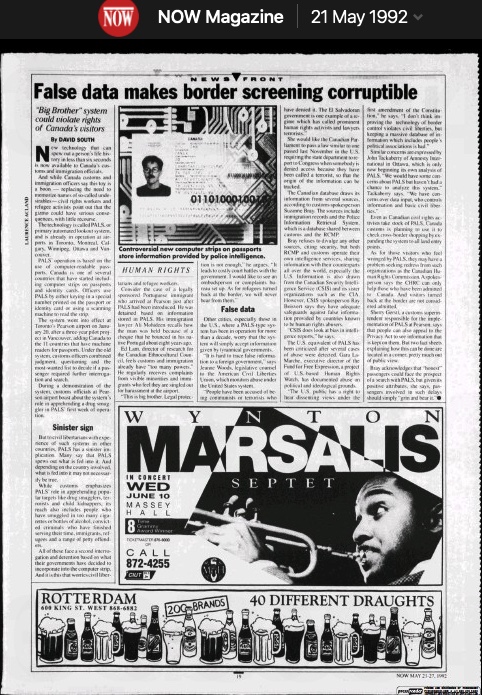
New technology that can spew out a person’s life history in less than six seconds is now available to Canada’s customs and immigration officials.
And while Canada customs and immigration officers say this toy is a boon – replacing the need to memorize names of so-called undesirables – civil rights workers and refugee activists point out that the gizmo could have serious consequences, with little recourse.
The technology is called PALS, or primary automated look out system, and is already in operation at airports in Toronto, Montreal, Calgary, Winnipeg, Ottawa and Vancouver.
PALS’ operation is based on the use of computer-readable passports. Canada is one of several countries that have started including computer strips on passports and identity cards. Officers use PALS by either keying in a special number printed on the passport or identity card or using a scanning machine to read the strip.
The system went into effect at Toronto’s Pearson airport on January 20, after a three-year pilot project in Vancouver, adding Canada to the 11 countries that have machine readers for passports. Under the old system, customs officers combined judgement, questioning and the most-wanted list to decide if a passenger required further interrogation and search.
During a demonstration of the system, customs officials at Pearson airport boast about the system’s role in apprehending a drug smuggler in PALS’ first week of operation.
Sinister sign
But to civil libertarians with experience of such systems in other countries, PALS hasa sinister implication. Many say that PALS spews out what is fed into it. And depending on the country involved, what is fed into it may not necessarily be true.
While customs emphasizes PALS’ role in apprehending popular targets like drug smugglers, terrorists and child kidnappers, its reach also includes people who have smuggled in too many cigarettes or bottles of alcohol, convicted criminals who have finished serving their time, immigrants, refugees and a range of petty offenders.
All of these face a second interrogation and detention based on what their governments have decided to incorporate into the computer strip. And it is this that worries civil libertarians and refugee workers.
Consider the case of a legally sponsored Portuguese immigrant who arrived at Pearson just after PALS had been introduced. He was detained based on information stored in PALS. His immigration lawyer Ali Mohideen recalls how the man was held because of a cheque that he bounced in his native Portugal about eight years ago.
Ed Lam, director of research for the Canadian Ethnocultural Council, feels customs and immigration already have “too many powers.” He regularly receives complaints from visible minorities and immigrants who feel they are singled out for harassment at the airport.
“This is big brother. Legal protection is not enough,” he argues. “It leads to costly court battles with the government. I would like to see an ombudsperson or complaints bureau set up. As for refugees turned back at the border, we will never hear from them.”
False data
Other critics, especially those in the US, where a PALS-type system has been in operation for more than a decade, worry that the system will simply accept information given by tyrannical governments.
“It is hard to trace false information to a foreign government,” says Jeanne Woods, legislative counsel to the American Civil Liberties Union, which monitors abuse under the United States system.
“People have been accused of being communists or terrorists who have denied it. The El Salvadoran government is one example of a regime which has called prominent human rights activists and lawyers terrorists.”
She would like the Canadian Parliament to pass a law similar to one passed last November in the US requiring the state department to report to Congress when somebody is denied access because they have been called a terrorist, so that the origin of the information can be tracked.
“People have been accused of being communists or terrorists who have denied it. The El Salvadoran government is one example of a regime which has called prominent human rights activists and lawyers terrorists.”
The Canadian database draws its information from several sources, according to customs spokesperson Suzanne Bray. The sources include immigration records and the Police Information Retrieval System, which is a database shared between customs and the RCMP.
Bray refuses to divulge any other sources, citing security, but both RCMP and customs operate their own intelligence services, sharing information with their counterparts all over the world, especially the US. Information is also drawn from the Canadian Security Intelligence Service (CSIS) and its sister organizations such as the CIA. However, CSIS spokesperson Ray Boisvert says they have adequate safeguards against false information provided by countries known to be human rights abusers.
“CSIS does look at bias in intelligence reports,” he says.
The US equivalent of PALS has been criticized after several cases of abuse were detected. Gara LaMarche, executive director of the Fund for Free Expression, a project of US-based Human Rights Watch, has documented abuse on political and ideological grounds.
“The US public has a right to hear dissenting views under the first amendment of the Constitution,” he says. “I don’t think improving the technology of border control violates civil liberties, but keeping a massive database of information which includes people’s political associations is bad.”
Similar concerns are expressed by John Tackaberry of Amnesty International in Ottawa, which is only now beginning its own analysis of PALS. “We have concerns over data input, who controls information and basic civil liberties.”
Even as Canadian civil rights activists take stock of PALS, Canada customs is planning to use it to check cross-border shopping by expanding the system to all land entry points.
As for those visitors who feel wronged by PALS, they may have a problem seeking redress from such organizations as the Canadian Human Rights Commission. A spokesperson says the CHRC can only help those who have been admitted to Canada. And visitors turned back at the border are not considered admitted.
Sherry Gerstl, a customs superintendent responsible for the implementation of PALS at Pearson, says that people can also appeal to the Privacy Act to see information that is kept on them. But two fact sheets explaining how this can be done are located in a corner, pretty much out of public view.
Bray acknowledges that “honest” passengers could face the prospect of a search with PALS, but given its positive attributes, she says, passengers involved in such delays should simply “grin and bear it.”
Facial recognition AI software triangulates facial features to produce a recognition match.“Computers Track Travellers” by David South. Now Magazine published investigative journalism from David South, Naomi Klein and others in the early 1990s.













 David South Consulting
You must be logged in to post a comment.