Tag: id magazine

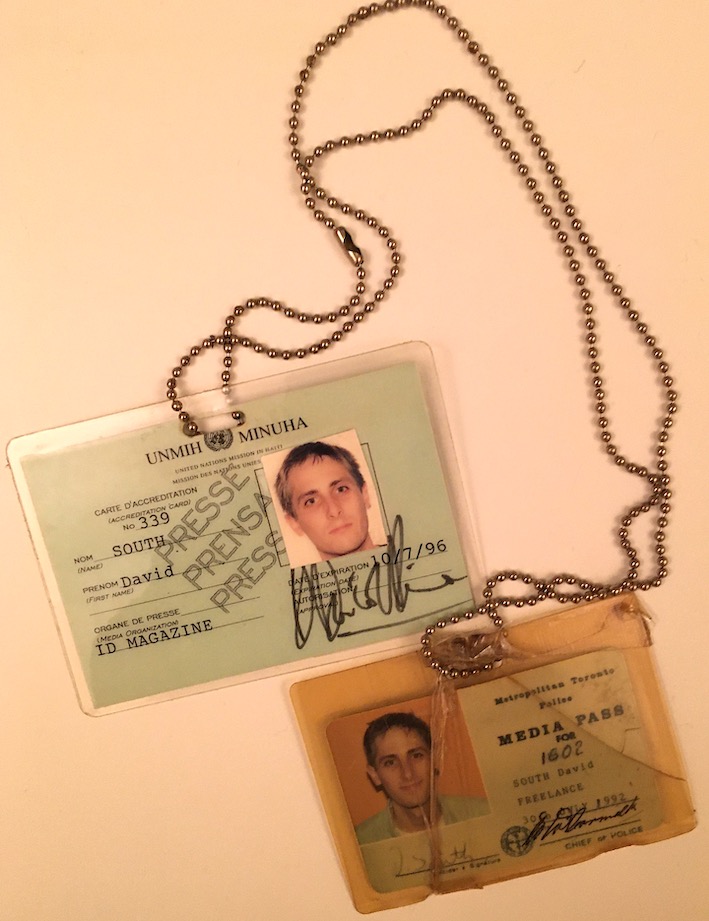
Id Magazine (known as id magazine) – “The Guide to the Zeitgeist” – was published in Guelph, Canada in the 1990s.

  • Swing Shift: Sexual liberation is back in style

    Swing Shift: Sexual liberation is back in style

    By David South

    Id Magazine (Canada), October 3-16, 1996

    Deep in the bedrooms (and living rooms) of the home-owning classes, the sexual liberation movement marches on: swingers’ parties are back. Those libidinous libertines many thought were lost in a 70s disco haze, according to a Toronto swinger, are back in greater numbers than in those polyester days. 

    In contrast to the many people (mostly men) looking for the anonymous and on-demand buzz of escort agencies, porn videos and sex toys, it seems to me swinging is the most idealistic camp in the army of sexual liberation. There isn’t any sneaking around behind your spouse’s back – in fact, you bring them along for the good times. 

    Swingers were usually the subject of the porn movies I watched at the base cinema during my army days. They weren’t real people, but some sort of myth from more electric times. 

    Ron Michaels, 41, is an unabashed proselytizer for swinging. A strip-club DJ and erotic and commerical photographer, he’s also co-owner, along with his wife, of swingers’ club Eros. A confident and articulate spokesperson, he has been swinging since he was 17. 

    “We believe honesty is the cornerstone of our lifestyle – that makes it work,” he says. “The people engaging in back-alley sex are being dishonest. It’s the same with having an affair – wanting your cake but not being able to share it with the rest of us. 

    “Swinging is a moral alternative to having affairs.” 

    The divorce rate among swingers, Michaels maintains, is only five per cent, compared to 51 per cent for the general population. The one wrinkle in this impressive “fact” is Michaels’ other admission that many swingers are on their second “married relationship”.

    Interviewing Michaels, I feel like I’m talking to a Rotary Club member or a boy scout leader, not a swinger. The talk is about clubs, memberships ($69 a year per couple), trips. It’s a hobby, sport and lifestyle to many swingers, claims Michaels. 

    “We have regular weekly functions throughout the year. Some of them are organized by the members. We organize trips and holidays. Weekends in the Caribbean. Like any other social club.”

    That can’t be wife/husband swapping he’s talking about, can it?

    Michaels’ Toronto Beaches home leaves no doubt as to its occupant’s lifestyle choices: “If you don’t swing, don’t ring,” says a brass plaque nailed to the door. 

    Michaels is very proud of swinging’s growth in the 90s. His group has grown from 300 member-couples 14 years ago to 1,800 today. Michaels ambitiously estimates that between 100,000 and 200,000 Southern Ontarians are into swinging, between 20 and 25 million across North America. 

    So, how does swinging in the 90s work?

    Michaels says most clubs operate more as matchmaking parties than full-out orgies. Couples get to know each other and make the arrangements to meet away from the club’s party. Michaels is quick to disassociate his club from drop-in style swingers parties. 

    “Canadians are much more conservative than Americans. In New York they are more hardcore, less selective of their partners. When they get there they are more like, ‘let’s find the first available body and get to it,’ whereas people at social clubs want to get to know you. We are talking about four-way compatability here.”

    According to Michaels, the big victory for Canadian swingers took place in 1992. “Our Mississauga club was raided back in ’92 and we took it through the courts for a year. We were acquitted and set a legal precedent, making swingers’ clubs legal.”

    To many men, the whole swinging thing seems like the best of both worlds: you keep your wife and get to taste the fruits of other trees at the same time. But Michaels says this male teenage fantasy doesn’t pan out in reality. 

    “That wears off pretty quickly. Let’s face it, men have a much lower capacity for sex than women do. Men need a longer recovery period and don’t have as many orgasms in a night. Women can just go and go. Guys can’t compete with that. After a while the fantasy wears thin, and it’s the guy that wants to drop out of the lifestyle.” 

    And what about that other most-asked-question: what’s it like to see your spouse having the time of their life with your neighbour?

    “They don’t get into those kinds of comparisons. How can I describe this? It’s not a competitive thing where you try to outperform each other. Most swingers appreciate each other as being unique and different, rather than this is bigger, this is harder, this is faster, this is better. Each new experience is taken at face value, ‘Hey, it’s a good time’. You move on to the next one or you go back to your regular partner.”

    Read more on the 1990s sex economy here: From Special Report: Sexual Dealing: Today’s Sex Toys Are Credit Cards & Cash: A Report On The Sex-For-Money Revolution
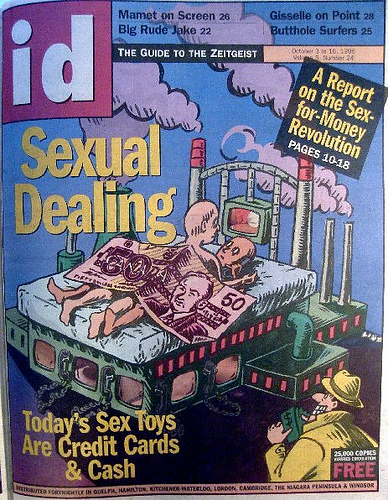
    Special Report: Sexual Dealing: Today’s Sex Toys Are Credit Cards & Cash: A Report On The Sex-For-Money Revolution.

    Read more on the 1990s sex economy here: From Special Report: NMM (New Media Markets) Spotlight On The Emergence Of Satellite Porn Channels In The UK

    Update: It is over 20 years since this Special Report was published. It forecast the significant role the Internet was to play in the growth of sex content and the sex industry and vice versa. Here is an interesting overview of the situation in 2020. The Internet is for Porn – It always was, it always will be.

    “One of the biggest and most interesting things happening in the consumer web right now is running almost completely under the radar. It has virtually zero Silicon Valley involvement. There are no boastful VCs getting rich. It is utterly absent from tech’s plethora of twitters, fora and media (at least, as they say, “on main”). Indeed, the true extent of its incredible success has gone almost completely unnoticed, even by its many, many, many customers.

    I’m talking, of course, about OnlyFans.”

    ORCID iD: https://orcid.org/0000-0001-5311-1052.

    © David South Consulting 2021
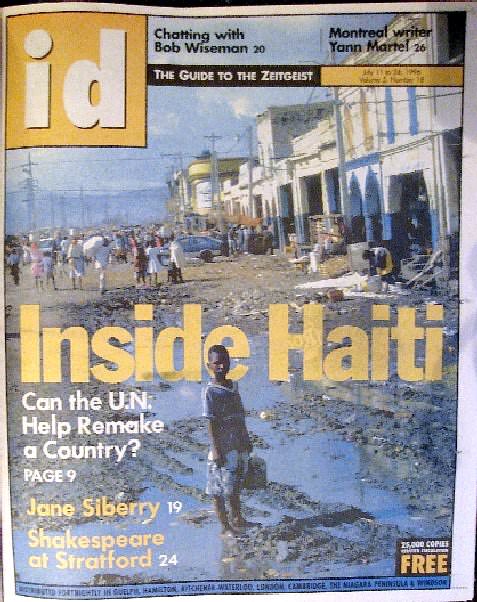
  • U.S. Elections Update: Clinton is using Canada to keep control of Haiti

    U.S. Elections Update: Clinton is using Canada to keep control of Haiti

    By David South

    Id Magazine (Canada), October 31 to November 13, 1996

    Canadian troops are not only on the frontline of peacekeeping in Haiti but also the frontline of U.S. foreign policy – a policy that is unravelling during the run-up to the November 5 presidential election. While the living standards of Haitians in the poorest country in the Western Hemisphere continue to decline despite free elections, Canadian troops are charged with keeping the island nation peaceful. It’s a task that is proving more and more difficult as Haiti suffers a crime wave and violent political unrest. 

    While American president Bill Clinton tries to snatch another victory from a grumpy U.S. electorate, his advisors are desperately trying to keep the lid on his foreign policy “victories” in Bosnia and Haiti. 

    Things are so bad, Clinton sent his secretary of state, Strobe Talbott, and his national security advisor, Anthony Lake, to Haiti on August 30 in response to high-profile assassinations of right-wing leaders. 

    “The administration are hoping, with fingers crossed, nothing will happen before November 5,” says Larry Birn of the Washington-based Centre for Hemispheric Affairs. “What the United States would like to do is cryogenically freeze all its foreign policy engagements so they don’t produce any problems. But we are losing very valuable time in Haiti because of Washington’s paralysis over negative developments occurring there. 

    “Washington didn’t realize an economic success story had to be bred there in a couple of years. The USAID programme is a scandal waiting for an investigation.”

    There is also another election-year factor: Republicans are not fond of anything that whiffs of a humanitarian approach to Haiti. Since they dominate Congress, this is also Clinton’s problem. 

    Given the history of American support for dictatorships in Haiti, the Clinton administration has chosen a low-key approach. After the 1994 invasion, the Americans pulled out the vast majority of their troops within a year, handing over responsibility for internal security to a UN peacekeeping force. But the U.S. never fully cut itself off from interfering in Haiti, keeping a military base operating in the country’s only industrial park in Port-au-Prince. 

    And Canada is key to U.S. plans because of that sour legacy. Canadians are seen as free from the burden of colonialism, and as a plus, our 700 mostly French-speaking troops can communicate better with the local population. 

    This policy has gone as far as hiring a Canadian public relations company to promote structural adjustment programmes that are conditional upon Haiti receiving any foreign aid from the International Monetary Fund and the World Bank, both based in Washington. 

    Gilles Morin is co-ordinating manager for Montreal firm Gervais-Gagnon-Covington Associates, who won the contract. Morin says, while his company did win the contract, like many other things to do with Haiti, they have heard nothing since Fall 1995 because of disorganization.  

    “On a personal basis there was a strong anti-American feeling among the population because of the past,” says Morin. “A lot of the financial institutions are based in Washington and they needed international support because banks in Washington are seen as American.”

    But there is a risk that a switch in U.S. priorities during the heat of an election will endanger Canadian troops.

    “If the president feels he has political risk in Haiti, he’s not going to take Canadian concerns into consideration,” warns Birns. “The UN mission gets caught up in the wake of U.S. efforts and it’s not able to define an independent course. Right now, the problem really is the USAID mission in Haiti is a total failure. The international donor function, you couldn’t exaggerate how disappointing it’s been in terms of almost no relief. The unemployment rate of 80 per cent is exactly what the unemployment rate was when the UN arrived.”

    On August 28, American troops from the 82nd Airborne plopped down on the streets of Port-au-Prince to spend a week patrolling. Many observers questioned the motives for this intervention. Was it to say to Haitians the UN isn’t the real deal, and if they get out of line, the Americans will kick their butts? Why doesn’t Canada protest the U.S. undermining the credibility of our peacekeeping mission?

    To Birn, sending in the 82nd was the foreign-policy equivalent of fast-food. “Sending in the 82nd Airborne merely aimed at getting a one-day headline,” he says. “The administration’s position has been staked on the fact there has been a number of foreign policy wins. But each of these victories is held together by corn starch and could unravel at any moment.”

    Birn sees an escalation in political violence just around the corner. He fears the current economic crisis will help the formation of a violent left-wing guerrilla movement to rival existing right-wing paramilitaries. 

    “Without former president Jean Bertrand Aristide,” he explains, “there is growing apprehension that president Rene Preval will not be able to project a sufficient leadership to keep the average Haitian, who is sacrificing with no expectation of an improved standard of living, happy.”

    While it has been almost two years since Haiti was the media’s darling, observers point out the cycle of violence has returned to the country’s streets despite the presence of UN peacekeepers and American troops. 

    When id reported from the Haitian capital of Port-au-Prince in July (id July 11 to 24, Number 18), it was obvious no progress had been made to improve the standard of living or rebuild the country’s crumbling infrastructure. 

    In an ironic twist, attempts to step up deportations of Haitian-Americans convicted of crimes in the U.S. has led to an increase in killings in Haiti according to the October 22 issue of New York weekly, The Village Voice

    More and more, the UN troops are propping up an increasingly unpopular government. A government that is seen by many Haitians to be getting its orders from Washington, not Port-au-Prince. Canadian troops lead the UN mission in Haiti and make up 700 of the 1500 soldiers stationed there (the rest are from Pakistan and Bangladesh).

    There is a serious danger Canadian troops will be caught in the crossfire of any uprising or coup attempt, since Canadian troops shadow president Rene Preval 24 hours a day and also guard the National Palace, which was attacked August 20, killing two Haitians.

    “U.S. Elections Update: Clinton is using Canada to control Haiti”.

    Read a 1996 report on the UN mission in Haiti here: State Of Decay: Haiti Turns To Free-Market Economics And The UN To Save Itself 

    ORCID iD: https://orcid.org/0000-0001-5311-1052.

    © David South Consulting 2021

  • Pulling The Plug On Hate Rock | 1996

    Pulling The Plug On Hate Rock | 1996

    Publisher: Id Magazine

    Date: June 13 to June 27 1996

    Features Editor: David South

    Investigative Reporter: Jayson MacLean

    Cover: Gareth Lind

    Illustrations: Charles George

    White Noise: Musical Hatemongers Target the Mainstream

    Pulling the Plug on Hate Rock (id magazine, June 13 to 27, 1996).

    More Id Magazine investigations here:

    From Special Report: Sexual Dealing: Today’s Sex Toys Are Credit Cards & Cash: A Report On The Sex-For-Money Revolution

    ORCID iD: https://orcid.org/0000-0001-5311-1052.

    © David South Consulting 2017 

  • Redneck Renaissance: A Coterie Of Journalists Turn Cracker Culture Into A Leisure Lifestyle

    Redneck Renaissance: A Coterie Of Journalists Turn Cracker Culture Into A Leisure Lifestyle

    By David South

    Id Magazine (Canada), August 22 to September 4, 1996 

    What happens when rednecks pick up a lesson or two from the world of identity politics? Mostly ridiculed by smug urbanites, or just plain ignored by the general population at large as cultural fads come and go, angry rednecks are standing tall in these conservative times. 

    Part Mark Twain-like satire, reverence and condescension, a cottage industry promoting the southern American redneck lifestyle is starting to resemble past struggles for cultural pride. 

    Just think of the gay rights movement in the 70s and 80s, which turned the derogatory word queer into a touchstone of homosexual pride. 

    In the 90s, dismissing rednecks as a bunch of dumb crackers can not only ensure free dental work in many an American bar, it can also be seen as an affront to white American values. But while some want to stereotype this culture as the heart and soul of white working-class American ideals, it is hard not to be disturbed by this phenomenon. Can God, beer, the American Constitution and guns weave together a stable lifestyle? 

    Author, radio personality and Redneck Olympics MC Bo Whaley was interviewed in a phone booth across from the bomb site at Atlanta’s Centennial Olympic park. During the interview Bo was kicked out of the phone booth by Atlanta police for talking too long. He picked up the interview from a truckstop near Dublin, Georgia. 

    id: What is a redneck? 

    Bo: A redneck to me is a lifestyle, that’s what it is. I relate rednecks to people who work hard, men of the soil. They look for the common things in life. They enjoy the outdoors, enjoy hunting and fishing. They aren’t too interested in status or setting the world on fire. They like to do their own thing. Real close to being what we call a good ole boy. They enjoy life – they work hard and they party hard. 

    There is nothing put on by them. They are down to earth. I really enjoy them, they are on the level. If you ask them a question they will tell you the truth. They aren’t trying to impress anybody, just trying to be themselves. 

    Go to the local bar and they are listening to the juke-box, smoking cigarettes and drinking beer. We can make fun of ourselves down here, we enjoy it. We laugh at ourselves. Poke a lot of fun. I’m having fun with people who live on farms, live in small towns. Like to hunt, like to fish. They drink beer. I have lived in the south for 24 years. I try to look at people and write what I see. I also wrote The Field Guide to Southern Women

    id: I heard the Redneck Olympics didn’t go down so well with the city council. 

    The chamber of commerce was concerned about the image. We attract a lot of industry to the town, they were afraid what was going out was a negative image of the lifestyle that is going on in Dublin. 

    We didn’t know it was going to catch on like it did. At the opening ceremony we were expecting maybe 250 maybe 350 people – and we had 4,000! The national and international media has got into it. 

    id: Are rednecks all right-wing? 

    On the right of the political spectrum, yeah. Happy with Newt Gingrich. I don’t think we take politics as seriously as up north. (Former U.S. president) Jimmy Carter is not very popular with the rural people here in Georgia. Well, I think when he went to Washington his values changed. I can name many, many people including me, who don’t like him. Right now I’m five minutes from the Carter Centre in Atlanta. I’ve never been to it. Not really interested in what Carter is doing. 

    He is trying to solve all the problems of the world. He looks at himself as more of a missionary than an ex-president. He goes to Haiti, he goes to South Africa, Bosnia. He calls these peace conferences and by-passes the established government in the United States to try to do his own thing. It’s a self-serving thing. 

    id: What do you think about the militia movement? 

    I do not agree with them. Right now I’m standing across from Olympic park where they had the bomb go off. People that I talked to have no sympathy for the militia, they say let the established investigators handle it and they don’t have any use for (the militia) at all. 

    id: Do you think the militias are a symbol of the frustration a lot of rednecks are feeling? 

    I agree. But they do a lot more talking than they do acting. 

    id: Why do they distrust the federal government and imagine black helicopters are helping the U.N. to set up a totalitarian state? 

    I think what they feel is that they know more about handling a situation than the government does and they want to do it on their own. I don’t agree with that. The government’s not perfect here nor in Canada. As long as it is the government I’m going to support it. I was not a Clinton fan but once he was elected he became my president. I have to support him until he gets out. But I don’t support everything he does. 

    id: Is the redneck style locked in the 70s? 

    The redneck symbol is more popular than it has ever been. A lot of people in offices in stuffed shirts and ties who would love to get out and live this way but they can’t do it on account of losing their jobs. They like to get in a jeep or ride on a motorcycle and say “whee” and to the heck with it. Everybody in the world needs some quiet time, time to yourself to do what you want to do. 

    id: Do you think rednecks are in danger of extinction in the age of the Internet? 

    They are on the increase. They don’t know about high-tech stuff. They haven’t even got into electric typewriter yet – they are still on manual typewriter. 

    id: Do they have any heroes or heroines? 

    They are beer people, and if they have any drug they smoke marijuana. 

    id: I mean heroes. 

    Many are country music fans, like Garth Brooks and Hank Williams Jr. They are big on country music. Female rednecks admire shows like Designing Women

    Oh lord, they love T-shirts. The T-shirts say “Opry land,” “Dollywood,” “Get your heart in America or get your ass out.” They don’t like plain T-shirts. 

    id: Can you give an estimate of the number of rednecks in the U.S.? 

    I travel more in the South Eastern states. In my hometown, in my home county, there are 37,000 people. Most of the people there, I’d say 75 per cent are working people, they either farm or work in factories. Out of those people, I’d say 20 to 25 per cent fall in the category of what I call redneck – they work hard all day and they play hard all night. Nationwide, I have no idea. I can tell you towns that have a lot of rednecks. Chattanooga, Tennessee – lot of rednecks. Columbus, Georgia, it’s a military town. In Montgomery, Alabama they work real hard at being rednecks. 

    id: Is there a problem with blurring rednecks with more negative elements like the Ku Klux Klan? 

    No, I really don’t see that. Most of the people I know can’t stand the Klan. They give country people a bad name. 

    id: Some guy at the Redneck Olympics had a Klan T-shirt on. 

    I’m not surprised by that. The main thing you are going to see them wearing if they have anything to do with a symbol of patriotism is a Confederate flag saying “God bless America” and “God bless the South.” 

    id: What about the rebel flag? 

    They do not want to give it up. There is some legislator in Atlanta who is trying to ban it, and this has to do with trying to appease a faction for their votes. But you get out into rural Georgia, rural Alabama, they want to keep that flag. To be truthful it has a lot to do with the civil rights movement.

    id: That it means it’s an affront to the civil rights movement? 

    Yeah. 

    id: Are there yuppie rednecks? 

    I know a neuro-surgeon living in Birmingham, Alabama, I met him through his wife while I was signing books. She came up and said “I’ve got to have one of those Redneck Handbooks,” and I said “Why?” She said, “Because my husband is a neuro-surgeon and he’s from Arkansas and all day long on in his office he’s got his blue buttoned-down shirt, his navy blue suit and his spit shine shoes and driving his Mercedes. When he gets home in the afternoon he puts on his blue jeans, and denim shirt gets the pick-up truck, the dog gets in back and he starts riding in the woods.” He’s a Dr. Jekyll and Mr. Hyde type. I see a lot of that. They kind of let their hair down. It’s a release for them. 

    id: Do you see the redneck lifestyle as a different kind of leisure lifestyle, a more working-class leisure lifestyle? 

    I think so, David. They put on ragged jeans, say to the world “I am a redneck.” 

    What they like to do is go fishing. They will go to the coast and go deep sea fishing. Especially they like to go to stock car races. Big stock car fans. The faster that car goes the better they like it, and the more wrecks they have the better they like it. 

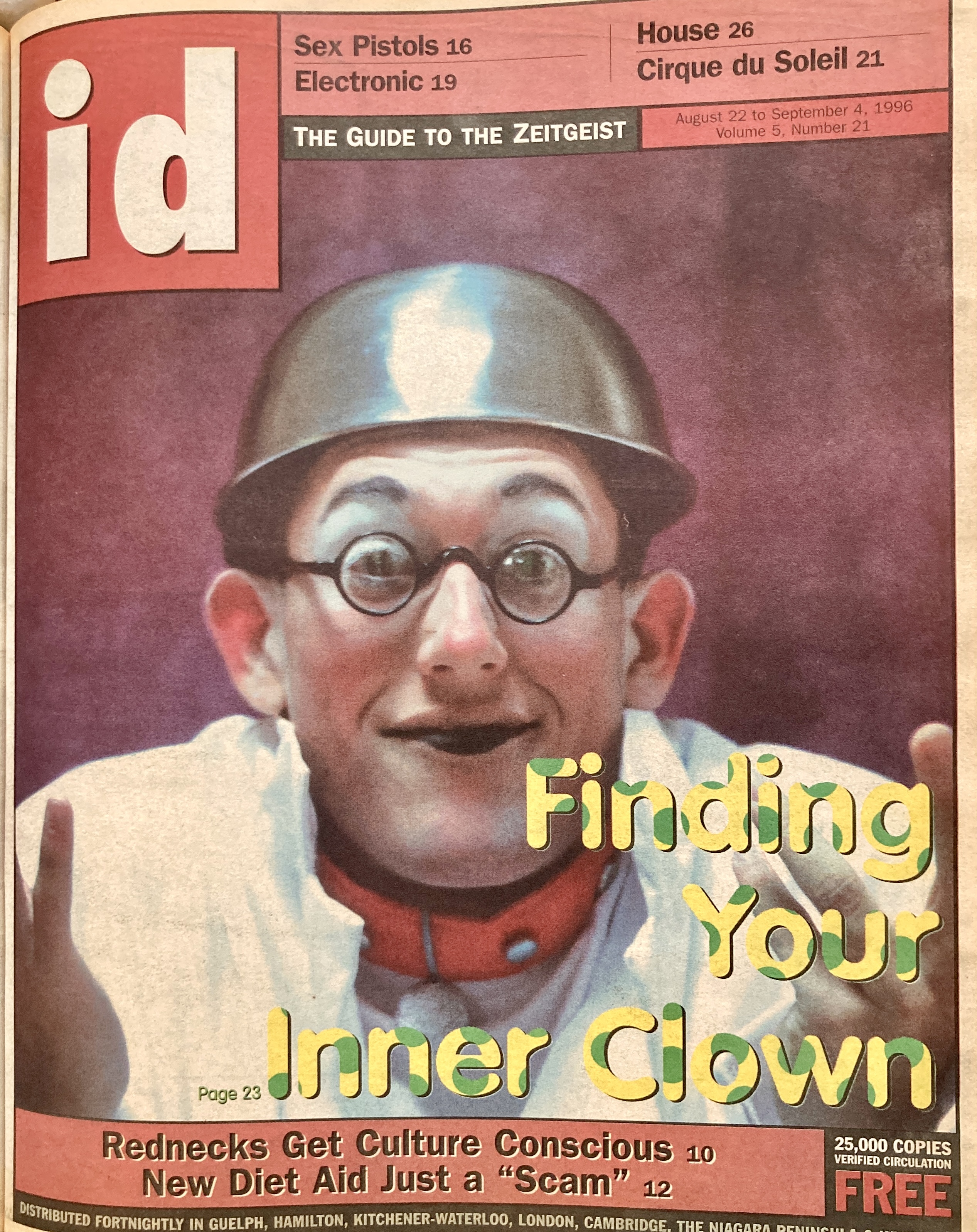
    “Finding Your Inner Clown”: Id Magazine (Canada), August 22 to September 4, 1996 . Id Magazine was published in Guelph, Canada in the 1990s.
    Creative Commons License

    This work is licensed under a
    Creative Commons Attribution-Noncommercial-No Derivative Works 3.0 License.

    ORCID iD: https://orcid.org/0000-0001-5311-1052.

    © David South Consulting 2024