Categories
Archive id magazine

Truckus Maximus: The Big Boys With The Big Toys Do Some Hardcore Pogo At Monster Truck Show

“I got laid off too many times. Now, I work harder for less money. But I get to do what I want to do. Not many people get that.”

By David South

Id Magazine (Canada), February 6 to 19, 1997

The little tiger-striped four-by-four is definitely going too fast. In an instant, the diminutive Suzuki stands balanced, its front wheels squashed at 90 degrees. A millisecond later, it’s on its back like a ladybug flipped over by the wind. The cacophony of the crowd reaches a crescendo. But the noise had been building; the Skydome crowd saw the writing on the wall for the little jeep. 

Frantic helpers pry open the door of the jeep, wrestling free the driver, Dwayne Robichaud. He emerges in an orange jump suit and prances around, looking vaguely like the Oklahoma bomber. The audience lets out an even louder cheer as he walks away, smug and happy. 

Half an hour earlier, two monster trucks, Young Gun and Samson, line up behind a pile of crushed cars, with a dirt ramp at each end. The methanol engines let out a roar like the mother of all hairdryers. The revving turns into a drag race. The pulsating white noise rattles the cavernous Dome. The effect on the audience is almost sexual: the stomach rattles, the heart skips a few beats. It is a short buzz, but it is good. And the noise? I begin to notice that everyone around me has ear plugs and I realize I’m going to regret this in 20 years. 

The exhaust fumes are starting to reach toxic levels 40 minutes into the rally. I shake my head and feel the motion a few seconds later. I’m getting a CO2 buzz, too. It’s the USA Motor Spectacular monster truck derby at Toronto’s Skydome. But monster trucks are just a small part of the show, there for the crowd to ogle while they get off on the noise. There is the amateur truck rally involving the tippy Suzuki and other monster-truck wannabees, and a ridiculous car-eating, fire-breathing robot called Robosaurus for the kids. The metal bashing of the demolition derby serves to satiate the audience’s thirst for damage – and is truly the highlight of the night. 

I can’t get out of my mind comparisons to spectacles in Roman times. Titans of spectacle, the Romans set the benchmark by which all other public entertainment must be judged. On the spectacular scale, Roman bloodsports involving gladiators, wild animals and the sacrificing of Christians definitely rate a 10 – anything else falls below. I figure monster trucks rate about 4. Watching pick-up trucks with over-sized $10,000 tractor tires crush cars can’t match the gore and death of ancient Rome but it will do for now. 

If monster trucks join professional wrestling and American Gladators as today’s answer to blood sports, why does this spectacle seem to lack that je ne sais quoi? Maybe it’s the sanitization of risk. The cabin of a monster truck coddles the driver. There are cushioned seats, a kidney brace, a five-point racing harness, neck braces, helmet restraints and a roll bar. Several drivers tell me that the job only looks dangerous. At half time, Young Gun’s Saskatoon-based driver, Kevin Weenks, tells me he doesn’t seek out danger. “I think some of those (amateur) guys are nuts and want to do the crowd a big favour [die]. You don’t want to run it hard. A win isn’t worth flipping over.” 

Derby destruction

Thirty demolition derby wrecks crawl into the centre of the Skydome. The flag is dropped and an orgy of car crushing begins. It goes on for half an hour. Now I’m not bored. Cars are still driving despite engine fires and rear-ends that stand at 45 degrees. It is down to two cars: one more or less intact, the other driving on its hubs, engine on fire, half its back a mangled piece of crumpled paper. The driver doesn’t give up. His engine stops, then starts again. This is repeated three times until, exhausted, he concedes defeat. 

After the derby it’s time for Robosaurus. The press release claims the hunk of grey metal stands five stories tall and costs $2.1 million. The driver flicks on the switch on a very expensive stereo system and Robosaurus starts to growl like Godzilla. Two guys with radio headsets help direct the beast onto the floor. It burps and farts for a while before picking up a pre-cut car. It crushes it, drops it to the floor and incinerates it with a flame thrower. The crowd roars.

It seems things haven’t changed with spectacles. The Romans drew on slaves, freed men, foreigners and the lower social orders to provide fodder for their spectacles. Monster trucks are driven by farmers hired for six months at a time. The amateur drivers are a hodgepodge of laid-off workers, farm labourers and guys who make a meagre living fixing four-by-fours. 

Wearing a waist-length monogrammed racing jacket is Don Frankish. The shy and patient Alberta grain farmer owns two of the four monster trucks in Canada. He has been racing for seven years and divides his year 50/50 between farming and tours on the monster truck circuit, which mostly takes him through the U.S. 

He is definitely attracted to the excitement of the stadium, but not necessarily a love of death-defying acts. “It’s the rush of the crowd as they get behind you, talking to the kids who look at you as a superhero,” he says. “I like the speed, the unpredictability. We know the risks. There is a danger to it. But the Monster Truck Racing Association makes sure we have a killer radio to shut off the engines if the truck is out of control. The worst I’ve ever seen is a truck going end over end three times – it just destroyed the truck.” I ask him about insurance and he laughs. “We can’t get insurance!”

Pit boys

Down in the pit, the air is thick with exhaust fumes. The pit boys are milling about, patting each other on the back. A sprinkling of pit girls hang around, with hairstyles straight out of Xena: Warrior Princess. The dress for today is black: black t-shirts and black jeans. Don McGuire, 32-year-old partner in the Three Stooges four-by-four shop in Brampton, sports a mischievous grin as he tells me with pride about his chosen vocation: mud bog racing. It’s the messier outdoor version of tonight’s amateur truck rally. McGuire has been a mud bog racer for 10 years and isn’t doing it for the money. “First prize is just $200 – I spring for more money than I would ever win,” he says. “We do this for the pure adrenaline. It’s just heart and soul. It takes bucks per cubic inch to win in this business,” he says resentfully, looking across the Skydome to where the monster trucks are parked. Big Foot’s sponsorship by Ford seems to be a sore point with racers who spend thousands of their own dollars to come here. 

McGuire gave up a $700 a week job to earn $300 a week and race. “I got laid off too many times. Now, I work harder for less money. But I get to do what I want to do. Not many people get that.”

“We do this for the pure adrenaline. It’s just heart and soul. It takes bucks per cubic inch to win in this business”

https://davidsouthconsulting.org/2021/07/20/case-study-3-id-magazine-1996-1997-2/

https://davidsouthconsulting.org/2020/06/16/casino-calamity-one-gambling-guru-thinks-the-province-is-going-too-far/

https://davidsouthconsulting.org/2020/11/17/land-of-the-free-home-of-the-bored/

https://davidsouthconsulting.org/2021/03/17/province-for-sale-step-right-up-for-an-opportunity-to-buy-what-you-already-paid-for/

https://davidsouthconsulting.org/2021/01/20/pulling-the-plug-on-hate-rock-1996/

https://davidsouthconsulting.org/2021/01/16/redneck-renaissance-a-coterie-of-journalists-turn-cracker-culture-into-a-leisure-lifestyle/

https://davidsouthconsulting.org/2021/01/14/from-special-report-sexual-dealing-todays-sex-toys-are-credit-cards-cash-a-report-on-the-sex-for-money-revolution/

https://davidsouthconsulting.org/2021/02/03/swing-shift-sexual-liberation-is-back-in-style/

https://davidsouthconsulting.org/2020/04/22/state-of-decay-haiti-turns-to-free-market-economics-and-the-un-to-save-itself/

https://davidsouthconsulting.org/2020/12/11/tvs-moral-guide-in-question-again/

Creative Commons License

This work is licensed under a
Creative Commons Attribution-Noncommercial-No Derivative Works 3.0 License

ORCID iD: https://orcid.org/0000-0001-5311-1052.

© David South Consulting 2023

Categories
Archive id magazine

Will Niagara Falls Become The Northern Vegas?

By David South

Id Magazine (Canada), May 16-29, 1996

Niagara Falls – Niagara Falls has always been a town that attracted big dreamers with even bigger schemes. The beauty of the Falls has intoxicated many with grand ideas. Towards the turn of the century, the inventor of the Gillette safety razor, King Camp Gillette, tried to transform the American side into a Utopian paradise, planning to house most of the US population in a community of beehive-style high-rises covering an area 135 miles long and 45 miles wide.

Given the long history of grand schemes to remake both sides of Niagara Falls, it is hard not to see the hyperbole surrounding the planned casnio, slated to open by the end of the year, as another over-hyped dream. Just as Gillette spoke of untold riches, the government-owned Ontario Casino Corporation also sees Utopia ready to be born at the edge of the Falls. As provincial tourism minister Doug Saunderson said last month, “The casino and tourist development will provide Niagara with a kick start into the 21st century… I believe they will move Niagara to the very top of the list of destinations for world travellers.”

Those expectations sound even more impressive if you believe the government’s estimates for job creation. In a city of 76,000, the government projects between 3,000 and 9,000 jobs will result from the casino and its spin-offs. With numbers like that, it is hard to find many people who will say no.

Everywhere in Niagara Falls’ tourist district roads are being ripped up. Tourists from New York, Japan and Quebec tread through the clouds of gravel dust to see the Falls. But it isn’t just the government which is dreaming big for Niagara Falls.

Three dreams are fighting in this town for the hearts and souls of its residents, and depending on your perspective, have their merits. One, a scheme being championed by a group of local church leaders, is to build a wholesome theme park based around the exploits of local heroine Laura Secord during the War of 1812. Another more flamboyant scheme that has been on and off again since 1993, involves building a $1.4 billion theme park dedicated to transcendental meditation. So far, the casino is winning hands down.

The casino on its own is helping to raise another dream, phoenix-like, from the ashes. In 1979, the DiCenzo family built Maple Leaf Village as a joint shopping mall/theme park attraction. Now it sits derelict, waiting for renovations by the Buttcon construction company to turn it into the temporary site for the casino.

The run-down Maple Leaf Village, with its old-world European facade resembling a castle, became known for tacky attractions like the JFK Assassination Museum, the Elvis Presley Museum and the Nightmares Therapy Centre.

Judy MacCarthy has fought plans to build a casino since they were first discussed. She helped put together a coalition of church groups called the Try Another Way Committee. MacCarthy’s dream involves a theme park extolling the virtues of Laura Secord, whose claim to fame was snitching on the American invaders, having them ambushed by Indians near Niagara Falls.

MacCarthy says the provincial government has shown some interest in the project, even sending officials from Toronto to meet with her.

As for the more ambitious transcendental meditation theme park, it looks as if the whole project hangs on securing enough funds to get it off the ground.

In 1993, Maharishi Veda Land’s chair, the effervescent magician Doug Henning, told the media that Niagara Falls had to make up its mind: choose between the transcendental theme park, with its centre-piece floating bridge, or the moral decadence of a casino.

Three years later, what many thought to be a project even less tangible than Henning’s metaphysical musings, seems to still have some life left. Tucked away on the 13th floor of a Bay Street office tower in Toronto, Maharishi Veda Land Inc. – Enlightenment, Knowledge, Entertainment – continues to run with a handful of staff. As three office workers scatter behind closed doors, a secretary tells me the theme park is still a go, but refuses to give any more details. But MVL has told a Florida newspaper it isn’t going to build a theme park on property the company owns there.

Tucked away on the 13th floor of a Bay Street office tower in Toronto, Maharishi Veda Land Inc. – Enlightenment, Knowledge, Entertainment – continues to run with a handful of staff. As three office workers scatter behind closed doors, a secretary tells me the theme park is still a go, but refuses to give any more details.

Ted Cook, the former vice-president of PCL Eastern, the construction company Henning contracted to build the park, says there was a change in attitude: “Henning’s position softened as time passed (over the casino). He became less opposed on moral grounds, and it was now ‘maybe we can make it work’.”

If there was an epicentre to the Niagara dream machine, it is the office of its mayor, Wayne Thompson.

Dean Iorfida is the mayor’s executive assistant. For Iorfida, the casino is a matter of turning a seasonal economy dependent on summer-time tourists into a viable year-round attraction. Even when they do come to Niagara Falls, he says, the average tourist’s stay is just four hours.

Iorfida is dreaming large, imagining the permanent site will include an auditorium, convention centre and amusement park. “Vegas has gone that way,” he says.

But he also wants to see the whole city transformed by the casino. “We have to spread it around or you get a black hole effect: too much in one location.”

As for the complaints that the casino will only add to the tacky reputation of Niagara Falls, Iorfida believes “the city doesn’t want anything that turns people off, but we can’t stop private enterprise. We are talking about one location, I don’t think it will be like Vegas where casinos try to out-garish each other.”

Many associated with the traditional tourist attractions in Niagara are banking on seeing some of the casino cash. Merchants on Clifton Hill, “The street of fun at the falls,” are hoping they can complement the casino rather than compete.

So far, the tourist trap, despite the shabby strip of Clifton Hill with its wax museums and fudge shops, or even the block after block of cheap hotels and motels, has been able to avoid turning into a seedier form of sleaze – it is still a family atmosphere. In fact, the declasse’ tone of the city hides an impressive stability and prosperity that makes the residents of Niagara Falls, New York jealous. For many opposed to the casino, it is this stability that is at stake.

Overhead is the dayglo pink and turquoise marquee of the Movieland Wax Museum, where one can see wax likeness’ of such luminaries as Jim Carrey. Guy Paone, the general manager of the museum, says he is happy about the casino, hoping it will bring year-round business.

“We get families down here,”he says. “If dad wants to go to the casino, then mom and the kids can come here.”

Paone isn’t expecting any business from the die-hard gamblers though. “The hard-core gamblers didn’t come here any way. You know how it is – in Vegas some people don’t eat or sleep.”

As for some of the doom and gloom about increasing crime scaring off the family tourists, Paone doesn’t buy it. “We are pretty tight on petty crime here. I don’t think the casino will affect the family reputation.”

Paone does have a sobering thought he leaves me with, “we are the suicide capital.”

All the hope has already spawned new jobs teaching the unemployed how to gamble. Frank Cricenti, black jack course co-ordinator at the National Casino Academy, joins a growing number of people employed in the lucrative business of teaching the unemployed casino skills. According to Cricenti, casino schools “are just popping up.” At government employment centres, staff are anticipating more than 100,000 applications to flood in chasing the 3,000 jobs being offered. Such a yawning chasm between expectations and reality means times are good for the adult education business.

At the 47-room Cataract Motel, the casino is an excuse to spiff the place up. “We have painted and renovated the rooms so that they look like they’re brand new,” says the motel’s manager, who will only give his name as B. John.

Other property owners are banking on the casino rescuing them from the slump. Eva Klein of Klein Developments, wants to especially unload her pricier properties. “There has been a little bit of change in the rental market, some casino people are moving into town,” Klein tells id. “We’ve had a high vacancy of higher-end rentals in Niagara Falls and we’re expecting these to be filled by a new influx from the casino.”

For Niagara Falls, the casino looks set to turn the city into a smaller, more Canadian Las Vegas. For a city desperate for more work, that doesn’t sound too bad. For the provincial government’s travelling road show, the next stop is to move the existing Windsor casino’s management over to staff the new casino at Niagara Falls.

Casino Calamity: One Gambling Guru Thinks The Province Is Going Too Far

https://davidsouthconsulting.org/2020/06/16/casino-calamity-one-gambling-guru-thinks-the-province-is-going-too-far/

CASE STUDY 3: Id Magazine | 1996 – 1997

https://davidsouthconsulting.org/2021/07/20/case-study-3-id-magazine-1996-1997-2/

A visionary ahead of his time, we now see the Channel Zero concept everywhere, from You Tube to Tik Tok.

https://davidsouthconsulting.org/2021/02/07/cock-tales-too-much-for-hamilton/

https://davidsouthconsulting.org/2020/11/17/land-of-the-free-home-of-the-bored/

https://davidsouthconsulting.org/2020/12/22/man-out-of-time-the-world-once-turned-on-the-ideas-of-this-guelph-grad-but-does-the-economist-john-kenneth-galbraith-know-the-way-forward/

https://davidsouthconsulting.org/2021/01/20/pulling-the-plug-on-hate-rock-1996/

https://davidsouthconsulting.org/2021/01/16/redneck-renaissance-a-coterie-of-journalists-turn-cracker-culture-into-a-leisure-lifestyle/

https://davidsouthconsulting.org/2021/01/14/from-special-report-sexual-dealing-todays-sex-toys-are-credit-cards-cash-a-report-on-the-sex-for-money-revolution/

https://davidsouthconsulting.org/2020/12/11/tvs-moral-guide-in-question-again/

Creative Commons License

This work is licensed under a
Creative Commons Attribution-Noncommercial-No Derivative Works 3.0 License.

ORCID iD: https://orcid.org/0000-0001-5311-1052.

© David South Consulting 2023

Categories
Archive Blogroll id magazine

Swing Shift: Sexual liberation is back in style

By David South

Id Magazine (Canada), October 3-16, 1996

Deep in the bedrooms (and living rooms) of the home-owning classes, the sexual liberation movement marches on: swingers’ parties are back. Those libidinous libertines many thought were lost in a 70s disco haze, according to a Toronto swinger, are back in greater numbers than in those polyester days. 

In contrast to the many people (mostly men) looking for the anonymous and on-demand buzz of escort agencies, porn videos and sex toys, it seems to me swinging is the most idealistic camp in the army of sexual liberation. There isn’t any sneaking around behind your spouse’s back – in fact, you bring them along for the good times. 

Swingers were usually the subject of the porn movies I watched at the base cinema during my army days. They weren’t real people, but some sort of myth from more electric times. 

Ron Michaels, 41, is an unabashed proselytizer for swinging. A strip-club DJ and erotic and commerical photographer, he’s also co-owner, along with his wife, of swingers’ club Eros. A confident and articulate spokesperson, he has been swinging since he was 17. 

“We believe honesty is the cornerstone of our lifestyle – that makes it work,” he says. “The people engaging in back-alley sex are being dishonest. It’s the same with having an affair – wanting your cake but not being able to share it with the rest of us. 

“Swinging is a moral alternative to having affairs.” 

The divorce rate among swingers, Michaels maintains, is only five per cent, compared to 51 per cent for the general population. The one wrinkle in this impressive “fact” is Michaels’ other admission that many swingers are on their second “married relationship”.

Interviewing Michaels, I feel like I’m talking to a Rotary Club member or a boy scout leader, not a swinger. The talk is about clubs, memberships ($69 a year per couple), trips. It’s a hobby, sport and lifestyle to many swingers, claims Michaels. 

“We have regular weekly functions throughout the year. Some of them are organized by the members. We organize trips and holidays. Weekends in the Caribbean. Like any other social club.”

That can’t be wife/husband swapping he’s talking about, can it?

Michaels’ Toronto Beaches home leaves no doubt as to its occupant’s lifestyle choices: “If you don’t swing, don’t ring,” says a brass plaque nailed to the door. 

Michaels is very proud of swinging’s growth in the 90s. His group has grown from 300 member-couples 14 years ago to 1,800 today. Michaels ambitiously estimates that between 100,000 and 200,000 Southern Ontarians are into swinging, between 20 and 25 million across North America. 

So, how does swinging in the 90s work?

Michaels says most clubs operate more as matchmaking parties than full-out orgies. Couples get to know each other and make the arrangements to meet away from the club’s party. Michaels is quick to disassociate his club from drop-in style swingers parties. 

“Canadians are much more conservative than Americans. In New York they are more hardcore, less selective of their partners. When they get there they are more like, ‘let’s find the first available body and get to it,’ whereas people at social clubs want to get to know you. We are talking about four-way compatability here.”

According to Michaels, the big victory for Canadian swingers took place in 1992. “Our Mississauga club was raided back in ’92 and we took it through the courts for a year. We were acquitted and set a legal precedent, making swingers’ clubs legal.”

To many men, the whole swinging thing seems like the best of both worlds: you keep your wife and get to taste the fruits of other trees at the same time. But Michaels says this male teenage fantasy doesn’t pan out in reality. 

“That wears off pretty quickly. Let’s face it, men have a much lower capacity for sex than women do. Men need a longer recovery period and don’t have as many orgasms in a night. Women can just go and go. Guys can’t compete with that. After a while the fantasy wears thin, and it’s the guy that wants to drop out of the lifestyle.” 

And what about that other most-asked-question: what’s it like to see your spouse having the time of their life with your neighbour?

“They don’t get into those kinds of comparisons. How can I describe this? It’s not a competitive thing where you try to outperform each other. Most swingers appreciate each other as being unique and different, rather than this is bigger, this is harder, this is faster, this is better. Each new experience is taken at face value, ‘Hey, it’s a good time’. You move on to the next one or you go back to your regular partner.”

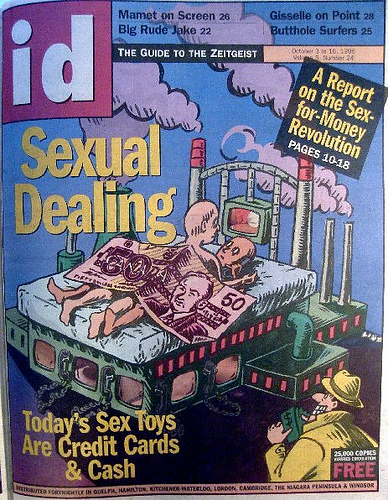
Read more on the 1990s sex economy here: From Special Report: Sexual Dealing: Today’s Sex Toys Are Credit Cards & Cash: A Report On The Sex-For-Money Revolution

Special Report: Sexual Dealing: Today’s Sex Toys Are Credit Cards & Cash: A Report On The Sex-For-Money Revolution.

Read more on the 1990s sex economy here: From Special Report: NMM (New Media Markets) Spotlight On The Emergence Of Satellite Porn Channels In The UK

Update: It is over 20 years since this Special Report was published. It forecast the significant role the Internet was to play in the growth of sex content and the sex industry and vice versa. Here is an interesting overview of the situation in 2020. The Internet is for Porn – It always was, it always will be.

“One of the biggest and most interesting things happening in the consumer web right now is running almost completely under the radar. It has virtually zero Silicon Valley involvement. There are no boastful VCs getting rich. It is utterly absent from tech’s plethora of twitters, fora and media (at least, as they say, “on main”). Indeed, the true extent of its incredible success has gone almost completely unnoticed, even by its many, many, many customers.

I’m talking, of course, about OnlyFans.”

ORCID iD: https://orcid.org/0000-0001-5311-1052.

© David South Consulting 2021

Categories
Archive Blogroll id magazine

TV’s Moral Guide In Question – Again

By David South

Id Magazine (Canada), November 28-December 11, 1996

Television programmers are under attack once again. Thanks to Guelph activist Patricia Herdman’s Coalition for Responsible Televsion (CORT), two violent television shows – Poltergeist (CTV) and Millennium (Fox/Global) – have lost several advertisers in recent weeks due to pressure from CORT. It’s just another wave in a new assault on the immorality of television.

Positive Entertainment Alternatives for Children Everywhere (PEACE), a Montreal group founded after the murder of 14 young women in that city in 1989, staged a press conference last week, complete with sweet-faced children, to announce its “Toxic TV” list. Who is toxic? Old favourites like Bugs Bunny, Batman and Robin and The Simpsons. PEACE also produced a list of “Positive” TV shows. It included a wrist-slashing selection of insipid programming, such as Barney and Friends, Fresh Prince of Bel-Air and Kratt’s Creature.

But critics of television overlook the strong and often simplistic moral messages that infuse most programming. Some even argue the mostly Judeo-Christian morality comes at the expense of atheistic and agnostic perspectives.

University of Guelph philosophy professor Jay Newman argues that religious moralists are making television the scapegoat for all of society’s ills.

He argues television, rather than being a moral vacuum, is heavily influenced by Judeo-Christain values – often in shows many people don’t suspect.

Newman sharply criticizes religious moralists, who he says, neglect to observe the same contradictions in their own beliefs that they see in television.

In Newman’s view, religion shares many sins with television. Religion promotes passivity (“The meek shall inherit the earth”), disrupts family life (who needs to talk to that “immoral” gay brother/sister?), does a questionable job of moral education, invents celebrities (the saints), sacrifices spiritual wisdom for meaningless ritual and entertainment (the Mass), and promotes violent behaviour (who can forget the Crusades or the Spanish Inquisition?).

Leaning back in his chair at his University of Guelph office, the irascible New York-born Newman enthusiastically defends television.

“When we assess TV as bad,” he says, “I’m not convinced religion is the only moral teacher, and it has not been the best moral teacher. Religion has been a very important force of hatred, whereas Star Trek teaches us to respect other cultures.

“TV has been of great value in promoting pluralism and an increase in tolerance.”

Newman isn’t talking about gore-soaked TV like Poltergeist and Millennium, shows he says speak more about their producers than about the medium of television. “Wanton slaughter can’t be blamed on TV. But I do agree with psychologists that some television inures us to violence.”

He sees Star Trek as a moral force for both pluralism and tolerance, strong values that are essential to democracies with many ethnic, cultural and racial groups. “This show promotes tolerance towards people who appear different. It shows aliens have aspirations and desires just like us.”

Newman does take offence to one race of aliens on the popular series: the Ferengi. While the Ferengi are supposed to be the equivalent of used car dealers in Star Trek’s universe, they draw criticism from Newman for their anti-semitic undertones. But even here, says Newman, TV can’t beat the pantheon of Christain anti-semites.

As for the bumbling antics of Bart Simpson and his dad Homer, Newman says The Simpsons also contain positive morals. “The Simpsons teaches us to accept the foibles of others and empathize. It does it in a gentle way without passing a very austere judgement.”

Newman even sees hope in the dreamy world of daytime soap operas. They teach people to develop empathy. They also use negative role models to show that hatred and contempt backfire on people; that promiscuity and adultry don’t come without a cost.”

As for Seinfeld, a sitcom about a group of friends who seem to never do anything, Newman says, “I’m a New Yorker and I can’t sit through it.”

Newman, an expert on religious fanaticism and hypocrisy, has responded to religious critics of television in his new book, appropriately titled Religion vs. Television. Newman sees religious critics of television as at best hypocrites, at worst specious claimants to higher moral ground.

“[Religious leaders] make judgements to show the usefulness of their institutions in an attempt to restore the lustre of religious authority.”

Newman believes the debate surrounding violence on TV is misguided. He believes the root causes of violence should be dealt with first.

“Television is a convenient scapegoat. Its criticism parallels religious bigotry. They don’t focus on the individual, just the medium. And this is accepted by people who call themselves liberal!”

TV immoral?

But critics of TV say any decent moral messages that slip through are undermined by television’s subservience to a higher God: consumerism. For Rose Anne Dyson of Canadians Concerned About Violence in Television (C-CAVE), this corrupted morality can’t be ignored. “There is only one over-riding religion today: consumerism. Its main purveyor is TV.

“Television is a major socializer today. Parents and teachers are key to modifying that influence. But most of television is very bad and just teaches consumer-driven values. There isn’t a single children’s programme that isn’t infused with commercial values.”

Dyson believes the negative effects aren’t just psychological. “Watching too much TV is bad – it causes obesity and hyperactivity.”

Dyson’s claims were recently backed up by a new study showing unhealthy minds may lead to unhealthy bodies. A study conducted by Columbia University claimed the more that children watched TV, the fatter they got. Researcher Dr Barbara Dennison found children who watched 14 hours of television a week had diets with 35 per cent of their calories from fat. The study blamed the high representation of junk food in television ads and the fact they promoted couch potato dining. Canadian children on average watch 18 hours a week of television.

Dyson does agree with Newman’s criticism of organized religions’ spurious claims to higher ground. “Judeo-Christian religions have gotten us into a lot of trouble!”

To control this morally wayward TV, Dyson looks forward to more entertainment conglomerates self-regulating their programming. “The cornerstone of democracy is to obey rules.

“A lot of cultural studies people tend to underestimate the impact of TV – there is too much of a value-free approach.”

Id was published in Guelph, Ontario, Canada in the 1990s.

Further Reading:

Channel Regulation: Swedes Will Fight Children’s Advertising All The Way

From Special Report: NMM (New Media Markets) Spotlight On The Emergence Of Satellite Porn Channels In The UK

Undercurrents: A Cancellation At CBC TV Raises A Host Of Issues For The Future

https://davidsouthconsulting.org/2021/02/05/channel-regulation-swedes-will-fight-childrens-advertising-all-the-way/

https://davidsouthconsulting.org/2021/02/03/do-tv-porn-channels-degrade-and-humiliate/

https://davidsouthconsulting.org/2021/03/03/kommunikation-total-der-siebte-kontinent/

https://davidsouthconsulting.org/2021/12/08/new-media-markets-and-screen-finance/

https://davidsouthconsulting.org/2022/04/21/nsd-partners-in-bitter-row-over-choice-of-satellite-as-brussels-deadline-nears/

https://davidsouthconsulting.org/2021/02/01/playboy-is-not-for-sad-and-lonely-single-men/

https://davidsouthconsulting.org/2022/11/22/popular-characters-re-invent-traditional-carving/

https://davidsouthconsulting.org/2022/10/27/reality-television-teaches-business-skills-in-sudan/

https://davidsouthconsulting.org/2021/01/14/from-special-report-nmm-new-media-markets-spotlight-on-the-emergence-of-satellite-porn-channels-in-the-uk/

https://davidsouthconsulting.org/2021/02/01/uk-laws-on-satellite-porn-among-toughest-in-europe/

https://davidsouthconsulting.org/2020/12/11/undercurrents-a-cancellation-at-cbc-tv-raises-a-host-of-issues-for-the-future/

Creative Commons License

This work is licensed under a
Creative Commons Attribution-Noncommercial-No Derivative Works 3.0 License.

ORCID iD: https://orcid.org/0000-0001-5311-1052.

© David South Consulting 2023