Categories
Archive Blogroll Development Challenges, South-South Solutions Newsletters

Haitian Coffee Becoming a Hit with American Connoisseurs

By David SouthDevelopment Challenges, South-South Solutions

SOUTH-SOUTH CASE STUDY

The Caribbean country of Haiti has had to deal with the twin challenges of recovering from a devastating earthquake in 2010 while also pulling itself out of the economic and social chaos that has resulted in its status as the poorest place in the Western hemisphere.

Violence has also led to a number of UN peacekeeping missions in Haiti over the years, and there is now a substantial international presence in the country to aid in stabilization and economic recovery (http://www.un.org/en/peacekeeping/missions/minustah/).

Haiti has a lot of potential when it comes to agriculture, but this would require substantial changes in the way land and agriculture are managed.

Haiti is ranked 77 out of 79 countries in the 2012 Global Hunger Index. Access to sufficient quantities of nutritious food remains an issue for millions of Haitians. An estimated 3.8 million Haitians, or 38 per cent of the population, is food insecure (WFP 2012). Despite its fertile potential, Haiti is dependent on food aid and imports to meet its food security needs.

Fifty per cent of the country’s food requirements are imported, and food prices have been rising since the end of 2010, the year of Haiti’s devastating earthquake. This increase has led to an overall loss of purchasing power for the majority of Haitians. Low agricultural productivity and urban encroachment on arable land provide additional challenges for Haiti’s rural populations. Eighty per cent of farms fail to produce enough to feed their households (http://www.foodsecurityportal.org/haiti/resources).

But some are trying to create a new market for Haiti’s agricultural products to help boost farmers and farming as an occupation and an industry.

It’s hard to imagine now, but Haiti was once the world’s largest producer of coffee in the 18th century when it was a French colony. Today Haiti produces less than 1 per cent of the world’s coffee.

The targeting of niche coffee drinkers in the United States has introduced a new market to the special taste of the Haitian brew. While the market at present is small, some are hoping, with the right measures, it could be grown significantly, boosting both the country’s revenue from agricultural exports and incomes for coffee farmers.

Several US-based companies are carving out a market for Haitian coffee and boosting awareness about the country’s unique coffee beans. La Colombe Coffee Roasters (http://lacolombe.com/), based in the city of Philadelphia, has already been able to export four shipping containers of Haitian coffee to the United States since 2010. The company supplies high-end chefs such as Eric Ripert and Daniel Boulud.

In Florida, Kafe Pa Nou (kafepanou.com) – “our coffee” in Haitian Creole – is owned by Haitian-American Jean René Faustin and sells online coffee from Haitian suppliers Rebo and Cafe Selecto.

So far, Haitian coffee has not been able to gain wider distribution through mass buyers such as Starbucks because it has not been possible to supply the quantities required to fulfill such a contract.

Haiti would need to boost its current average coffee yield of 250 kilograms per hectare to double or triple that yield to gain large-scale contracts.

“Haiti was for a brief moment in time the biggest producer of coffee for export in the world,” Gilbert Gonzales, Vice President of coffee exporter Rebo (http://rebo.ht/The%20Technics.htm), told Medium for Haiti (https://medium.com/medium-for-haiti). But “right now, most people would say it’s impossible” for Haiti’s coffee sector to return to international prominence.

“We’re not saying that it’s possible in the next two years, maybe not even in the next 12 years,” he said. “But it is possible.”

The coffee cherries used to make the popular beverage are processed in one of two ways: a dry process and a wet process. In Haiti, the dry process is more commonly used to form a hard cocoon on the outside of the coffee cherries to help preserve them for a year or more.

This enables farmers to preserve the coffee cherries so they can keep a portion of the crop back as a safety reserve.

The wet processed beans are first immersed in water and then the pulp is washed away before the beans are dried (http://coffee.wikia.com/wiki/Wet_process). The superior flavor this creates has attracted fans in the United States, especially in the trendy neighbourhoods of Brooklyn, New York and San Francisco, California. By bucking the traditional Haitian dry processing method for the beans, it is possible to earn three times the market price by selling wet-processed beans.

Haiti’s history of coffee growing goes back to the 1700s. At the time, the country grew half the world’s coffee. This helped to make the French colony highly profitable.

This long heritage has left the country with a unique asset: original Arabica typica coffee trees first imported by Europeans to Haiti. These coffee trees are considered to be heirloom because they are so old and untainted by modern breeding methods. According to Douglas Weiner in Medium for Haiti, “when you drink coffee from Haiti, it’s like drinking coffee from 200 years ago.”

Weiner is part of a family business, Geo Weiner (http://selectohaiti.com/home/), which has been selling Haitian coffee for four generations and is one of the few surviving coffee exporters in the country.

The country has an estimated 200,000 coffee farmers. Because their methods have not changed much, they are effectively organic (https://en.wikipedia.org/wiki/Organic_food). Most farmers can not afford chemical fertilizers and pesticides.

The coffee farms are located in mountain areas with a rich biodiversity of plants and trees. This stands in stark contrast with much of the rest of the country, where deforestation has left the country with just 2 per cent of virgin forest left. Coffee-producing areas are lush and green because coffee is one of the few cash crops that makes enough money to keep it worthwhile to preserve the trees and foliage. In other parts of the country, many are making money from turning trees into charcoal for cooking fuel, the most common fuel for most of the country’s population.

Haiti’s coffee growers have had a hard time coping with the rise and fall of world coffee prices. The world market price for coffee dropped in the early 2000s as the markets were flooded with coffee from Brazil and Vietnam. In response, farmers then cut down the coffee trees and replaced them with subsistence crops such as corn and beans.

With the amount of coffee grown in Haiti dropping quickly, the number of exporters in the country plummeted from 20 companies to two companies today, Geo Weiner and Rebo.

Jobert Angrand, Executive Coordinator of the National Institute of Coffee (http://www.icefda.org/), believes coffee production declined in Haiti because of a wide range of problems, from diseases and pests to aging trees, too-small plots and inefficient production methods. Per-hectare coffee yields are as low as one-tenth of production in Latin America.

The Vice President of coffee exporter Rebo says these problems are holding things back. “I don’t think today we’re looking into going mainstream,” said Gilbert Gonzales. “We can’t. There is not enough volume for that.”

Because production will be small, Gonzales believes Haiti would be wise to target the higher end of the marketplace with American grocery stores such as Trader Joe’s and Whole Foods: “It’s looking into the higher-end gourmet shops, things like that,” he said, “so that we could really share with the rest of that world the quality available from Haiti.”

Significant purchases of Haitian coffee have been made by various overseas companies, which does give hope that this plan could work. Irish coffee company Java Republic bought 97 tonnes of Haitian coffee from the Rebo exporter in 2010.

Published: August 2013

Resources

1) National Coffee Association: Ten Steps to Coffee. Website: http://www.ncausa.org/i4a/pages/index.cfm?pageid=69

2) International Coffee Organization: The International Coffee Organization (ICO) is the main intergovernmental organization for coffee, bringing together exporting and importing governments to tackle the challenges facing the world coffee sector through international cooperation. Its member governments represent 97 per cent of world coffee production and over 80 per cent of world consumption. Website: http://www.ico.org/

3) Coffee Research: Growing Coffee Beans at Home. Website: http://www.coffeeresearch.org/coffee/homegrowing.htm

4) Puro Fairtrade Coffee: Puro is a leading brand of Fairtrade and Fair Trade Organic coffee that works in partnership with the World Land Trust to purchase and protect areas of precious rainforest in South America. Website: http://www.purocoffee.com/

More on Haiti here: State Of Decay: Haiti Turns To Free-Market Economics And The UN To Save Itself

https://davidsouthconsulting.org/2021/10/28/ending-gang-violence-while-cleaning-the-streets-in-haiti/

https://davidsouthconsulting.org/2021/09/01/haiti-earthquake-prompts-tech-aid/

https://davidsouthconsulting.org/2021/10/28/milk-co-operatives-help-hungry-haiti/
https://davidsouthconsulting.org/2020/04/22/state-of-decay-haiti-turns-to-free-market-economics-and-the-un-to-save-itself/

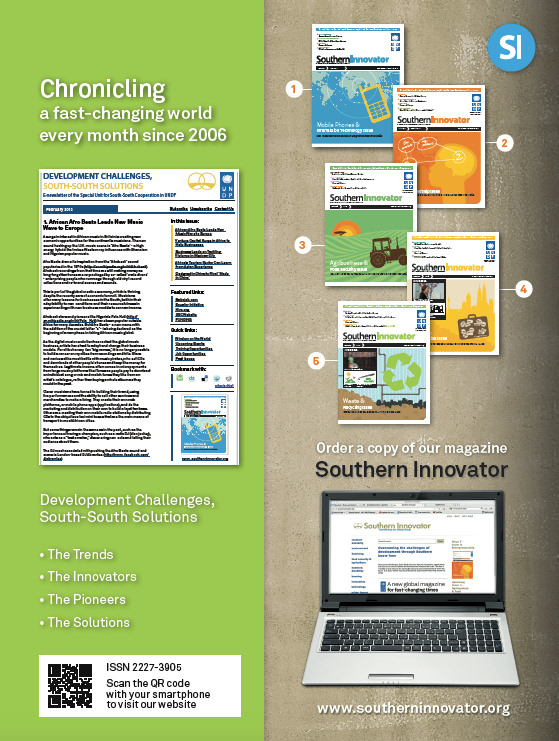
Development Challenges, South-South Solutions was launched as an e-newsletter in 2006 by UNDP’s South-South Cooperation Unit (now the United Nations Office for South-South Cooperation) based in New York, USA. It led on profiling the rise of the global South as an economic powerhouse and was one of the first regular publications to champion the global South’s innovators, entrepreneurs, and pioneers. It tracked the key trends that are now so profoundly reshaping how development is seen and done. This includes the rapid take-up of mobile phones and information technology in the global South (as profiled in the first issue of magazine Southern Innovator), the move to becoming a majority urban world, a growing global innovator culture, and the plethora of solutions being developed in the global South to tackle its problems and improve living conditions and boost human development. The success of the e-newsletter led to the launch of the magazine Southern Innovator.

https://davidsouthconsulting.org/2021/03/05/southern-innovator-issue-1/

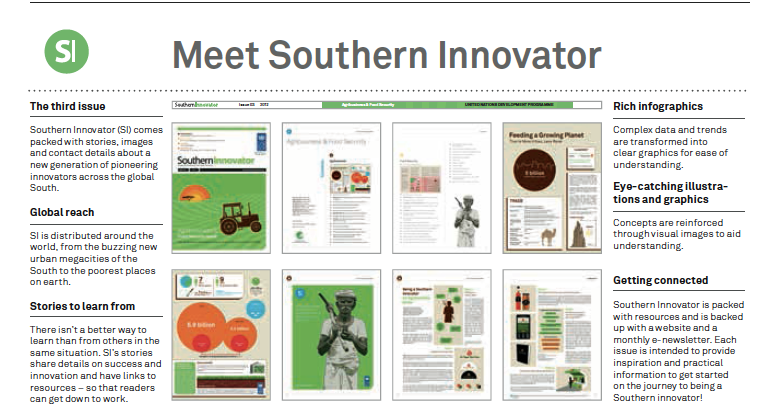
https://davidsouthconsulting.org/2021/03/05/southern-innovator-issue-3/

Creative Commons License

This work is licensed under a
Creative Commons Attribution-Noncommercial-No Derivative Works 3.0 License.

ORCID iD: https://orcid.org/0000-0001-5311-1052.

© David South Consulting 2023

Categories
Archive Development Challenges, South-South Solutions Newsletters Southern Innovator magazine

Two-stroke Engine Pollution Solution

By David SouthDevelopment Challenges, South-South Solutions

SOUTH-SOUTH CASE STUDY

Cities across the South choke on the pollution made by the small two-stroke engines (http://www.howstuffworks.com/two-stroke.htm) powering motor scooters, motorcycles, auto rickshaws, tuk-tuks and other vehicles. People choose these vehicles to get around because they are cheap, powerful and easy to fix. But the environment – and human health – suffers as a result. And as cities balloon and populations grow, the number of journeys and two-stroke engines grows with it.

In large cities across Asia, 1 million three-wheeled auto-rickshaws form an important means of daily transportation, and a source of income for their drivers. And the Asian Development Bank estimates there are over 100 million vehicles using two-stroke engines in Southeast Asia. But these vehicles cause serious air pollution and emissions of carbon dioxide (CO2), which contributes to global warming.

Because two-stroke engines burn an oil-gasoline mixture, they also emit more smoke, carbon monoxide, hydrocarbons and particulate matter than the gas-only, four-stroke engines found in newer vehicles.

In the Philippines, auto rickshaw drivers are pioneering specially adapted two-stroke engines that reduce particulate emissions by 70 percent and carbon dioxide emissions by 76 percent.

Tim Bauer, the 31-year-old American mechanical engineer who developed the technology, said auto rickshaws “play an essential role in the social and economic fabric. But their impact on public health is disastrous.”

Motorized tricycles produce an astonishing amount of pollution: each one is equivalent to 50 cars. In Bangkok, Thailand, two-stroke engines contribute 47 percent of pollution particulates in the air.

The World Health Organization (www.who.org) ranks urban outdoor air pollution as the 13th greatest contributor to disease burden and death worldwide. It has been estimated that the air pollution leads to the deaths of more than half a million people a year. About two-thirds of the residents of Delhi and Calcutta suffer from respiratory symptoms such as common cold and dry and wet cough, much of this caused by two-stroke engine emissions.

Two-stroke engines are highly inefficient users of fuel: up to 40 percent of the fuel and oil goes out of the exhaust pipe unburned. This exhaust is packed with oxides of carbon, nitrogen, sulphur, hydrocarbons and fine dust – all toxic contributors to air pollution.

But the attraction of these engines remains strong. “They are powerful, simple, reliable and robust,” said Bauer, “and spare parts are easy to find. They also have a long lifetime.”

Bauer faced some strict constraints in developing the technology.

“It had to substantially reduce emissions without impairing the engine’s performance. It had to be installed without machining the engine crankcase, and with only a basic tool set. Of course, it also had to be affordable for Filipino drivers.”

Using off-the-shelf components, Bauer developed a kit that turns two-stroke engines into fuel-injection machines. This adjustment reduced particulate emissions by 70 percent and carbon dioxide emissions by 76 percent. He now sells the kits through Envirofit, a non-profit organization (http://www.envirofit.org/). It has been pilot tested at two Filipino holiday resorts, Vigan and Puerto Princesa.

Auto-rickshaw drivers tend to be poor and earn on average US $3 to US $4 a day. The cost of fitting vehicles with Bauer’s new technology is met by microcredit.

“Drivers earn money daily, so it’s easy for them to pay back their loan, and 90 percent of them do it in less than a year,” he said. Over 260 taxi drivers have already installed the new kit.

“These drivers are at the base of the economic pyramid and these tricycles are a testament to their ingenuity and work ethic. At the end of the day, we can improve their lives with a cylinder head, a few brackets and, of course, hard work.”

Bauer pioneered his solution while working on fuel injection in snowmobiles at the Engines and Energy Conservation Lab at Colorado State University. He started to market the solution in Asia in 2004. Bauer has won a Rolex Award for Enterprise to pay for the distribution of the kits throughout Asia.

There is, of course, another solution: an outright ban or measures to push the vehicles off the road. In the Philippines’ San Fernando City, economic incentives were what drove the transition from two-stroke to four-stroke (less polluting) tricycles. In 2001, three-quarters of the city’s 1,600 registered tricycles ran on two-stroke engines. But after a city council mandate to totally phase out the vehicles by 2004, and offers of interest-free loans for down-payments on four-stroke models, more than 400 four-stroke tricycles had replaced the older two-stroke models.

When Bangkok toughened up vehicle inspections and emissions standards in 2000, two-wheelers made up over 96 percent of the city’s traffic. But by March 2004, they made up only 40 percent, according to Supat Wangwongwatana, deputy director general of Thailand’s Pollution Control Department.

Published: December 2008

Resources

  • Tukshop is a website selling auto rickshaws and tuk-tuks.  Website:http://www.tukshop.biz/
  • A wide range of auto rickshaws for sale.  Website: http://www.auto-rickshaw.com/ 
  • The Hybrid Tuk Tuk Battle is a competition to come up with less polluting auto rickshaws, clean up the air in Asian cities, and improve the economic conditions for auto rickshaw drivers. 
    Website:http://hybridtuktuk.com/
  • The Clean Air Initiative for Asian Cities promotes and demonstrates innovative ways to improve the air quality of Asian cities through partnerships and sharing experiences. It is run by the Asian Development Bank together with the World Bank and the US Agency for International Development. 
    Website: http://www.cleanairnet.org/

https://davidsouthconsulting.org/2023/02/03/environmental-public-awareness-handbook-case-studies-and-lessons-learned-in-mongolia/

https://davidsouthconsulting.org/2021/01/02/a-undp-success-story-grassroots-environmental-campaign-mobilizes-thousands-in-mongolia-1998/

https://davidsouthconsulting.org/2022/10/26/tackling-chinas-air-pollution-crisis-an-innovative-solution/

Creative Commons License

This work is licensed under a
Creative Commons Attribution-Noncommercial-No Derivative Works 3.0 License.

A new book launched in April 2019 by journalist Beth Gardiner (@Gardiner_Beth), “Choked: The Age of Air Pollution and the Fight for a Cleaner Future” (Granta) (University of Chicago Press), explores today’s global air pollution crisis in the world’s cities. Gardiner is an environmental journalist who writes for The New York Times, The Guardian and other publications (bethgardiner.com).  

Called “One of the Guardian’s Best Books of 2019“. The UK cover for Choked: The Age of Air Pollution and the Fight for a Cleaner Future (Granta, 2019).
Creative Commons License

This work is licensed under a
Creative Commons Attribution-Noncommercial-No Derivative Works 3.0 License.

ORCID iD: https://orcid.org/0000-0001-5311-1052.

© David South Consulting 2022

Categories
Archive Blogroll

David South Consulting Online For Seven Years | November 2017

DS Consulting logo copy

When it first launched in 2010, the David South Consulting(davidsouthconsulting.com) website was beautiful but sparse. Designed by one of Iceland’s top graphic designers and illustrators, Solveig Rolfsdottir, it was basically an online CV (curriculum vitae). 

A lot has happened since: the new global magazine Southern Innovator was launched, the Millennium Development Goals (MDGs) came to an end in 2015, the Sustainable Development Goals (SDGs) launched, and the UN adopted an innovation and South-South agenda, and so did many other countries, including China. And the content of the website has expanded to reflect this. The entire archive of the influential United Nations e-newsletter Development Challenges, South-South Solutions can be found here, as well as many resources chronicling the international development journey from the late 1990s.   

We even moved to a new studio and headquarters next to a bird sanctuary and nature reserve (matching our green words with green actions)!

David South Consulting November 2017_mini
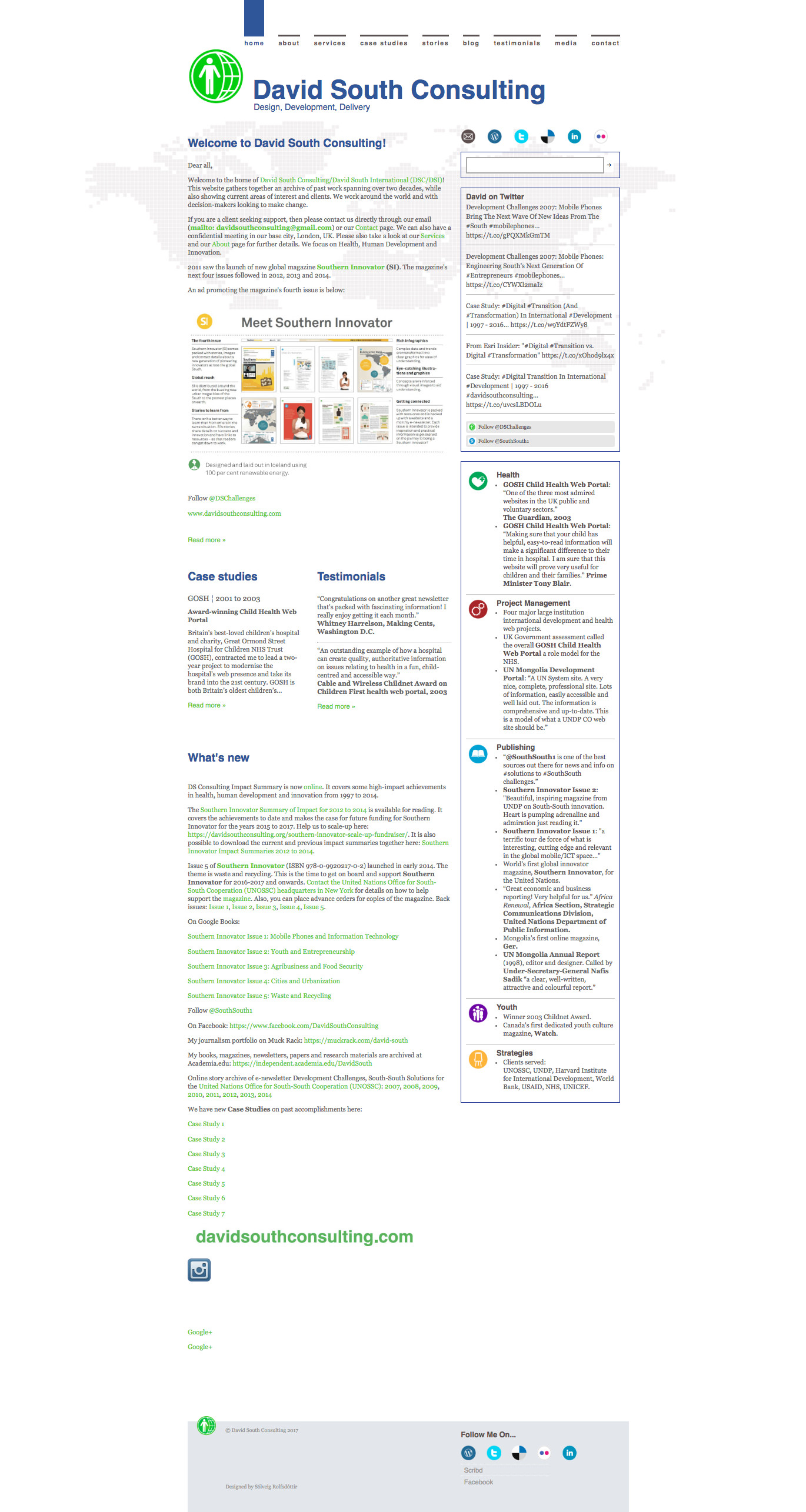
The front page of the David South Consulting website.
About David South Consulting_mini
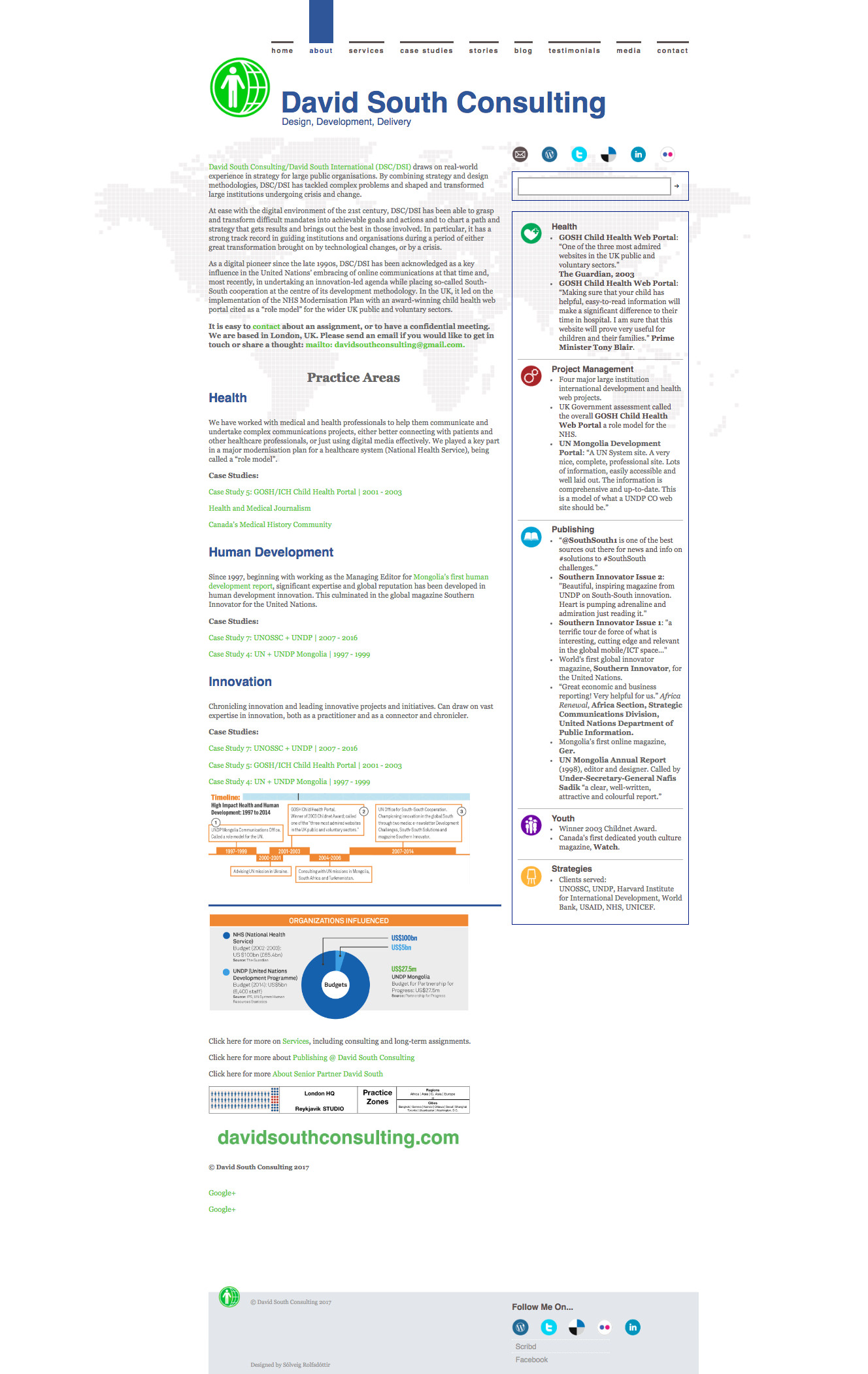
About David South Consulting.
Services David South Consulting_mini
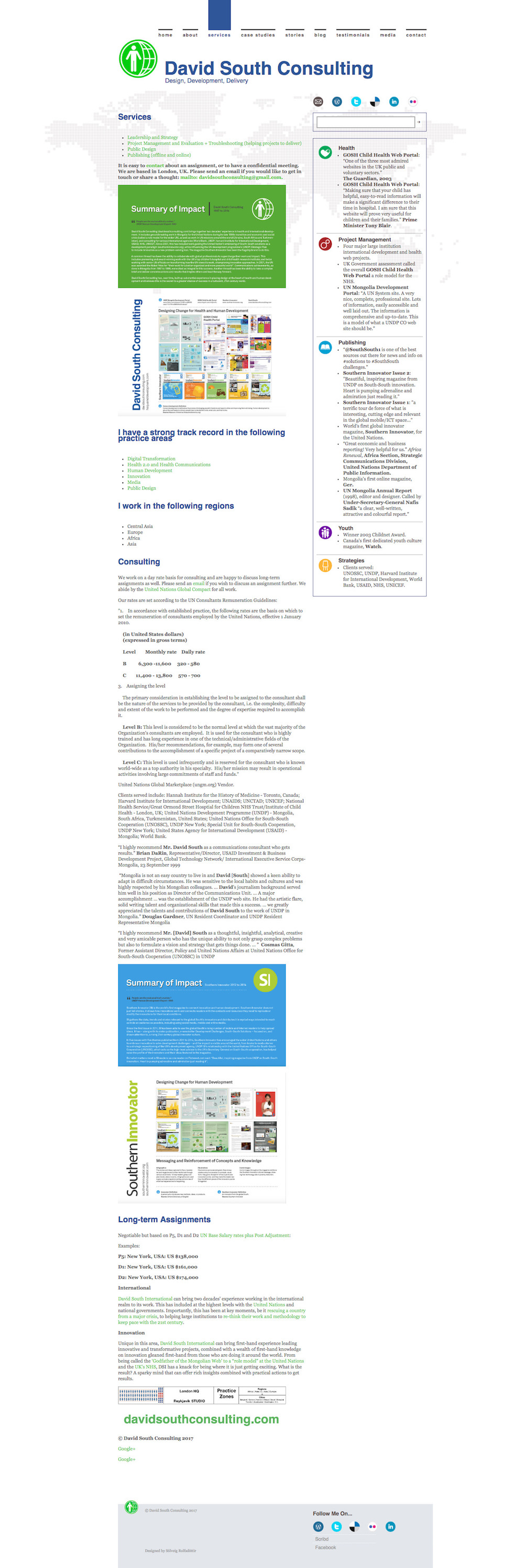
Services at David South Consulting. 
DSC client map 2017
David South Consulting international clients.
 
Categories
Archive Blogroll Development Challenges, South-South Solutions Newsletters Southern Innovator magazine

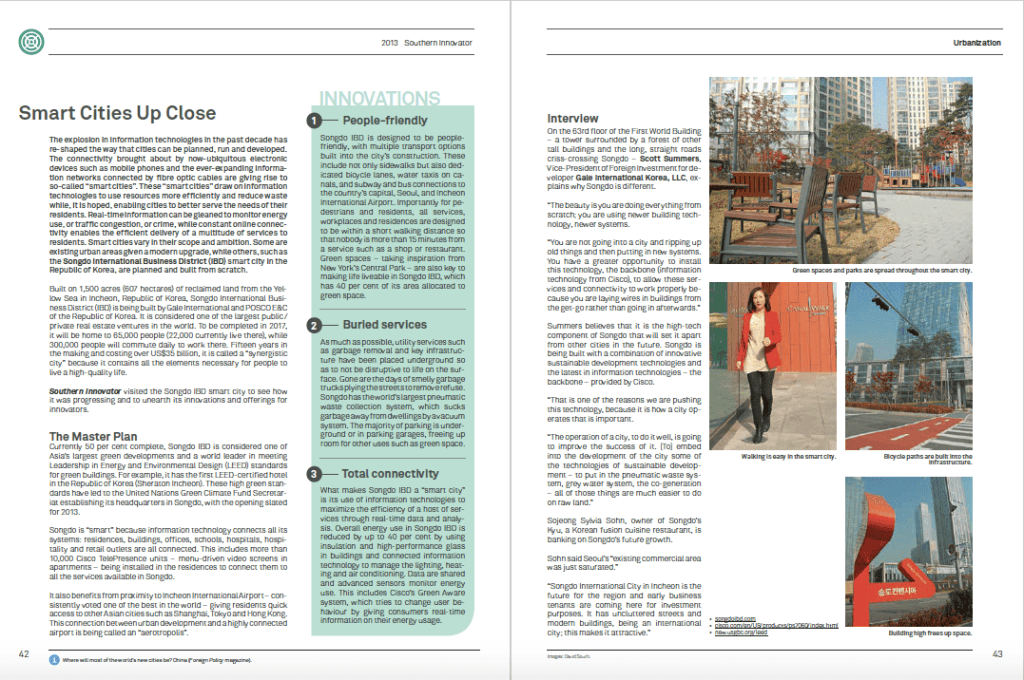
Smart Cities Up Close | 2013

DS Consulting logo copy

Story: David South

Design and Layout: Solveig Rolfsdottir

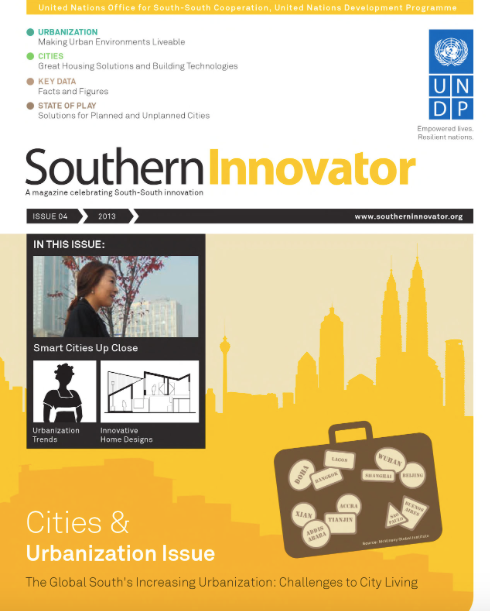
Publication: Southern Innovator Issue 4: Cities and Urbanization

Publisher: United Nations Office for South-South Cooperation (UNOSSC)

Date: 2013

Page 42 SI Issue 4 Smart cities-min
Smart Cities Up Close in Southern Innovator Issue 4.
Smart city infographic Issue 4
An infographic from Issue 4. 
Contents Issue 4.png
Southern Innovator Issue 4 contents.
Meet Southern Innovator Issue 4_mini
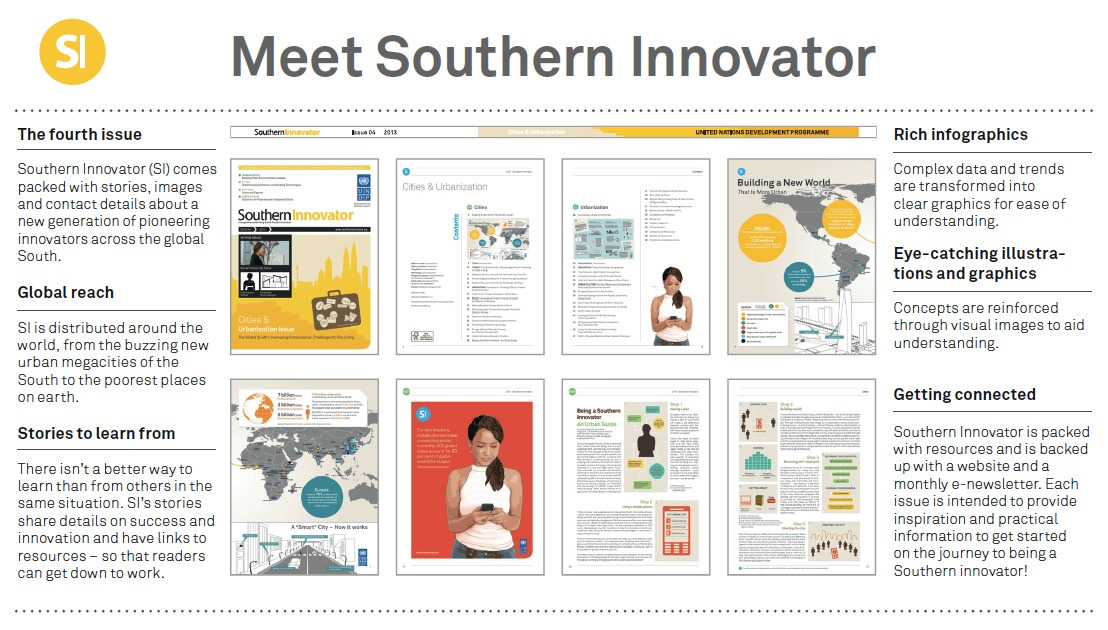
Meet Southern Innovator.
Issue 4
Southern Innovator Issue 4: Cities and Urbanization is published by the United Nations Office for South-South Cooperation (UNOSSC).
Editor and Writer, David South. 
Graphic Designer and Illustrator, Solveig Rolfsdottir. 

https://davidsouthconsulting.org/2022/10/06/africas-fast-growing-cities-a-new-frontier-of-opportunities/

https://davidsouthconsulting.org/2020/12/04/big-data-can-transform-the-global-souths-growing-cities/

https://davidsouthconsulting.org/2022/10/19/chinese-building-solution-for-rapidly-urbanizing-global-south/

https://davidsouthconsulting.org/cities-urbanization/

https://davidsouthconsulting.org/2021/10/21/cities-for-all-shows-how-the-worlds-poor-are-building-ties-across-the-global-south/

https://davidsouthconsulting.org/2020/12/11/cyber-cities-an-oasis-of-prosperity-in-the-south/

https://davidsouthconsulting.org/2017/11/08/eco-cities-up-close-2013/

https://davidsouthconsulting.org/2022/03/20/global-south-eco-cities-show-how-the-future-can-be/

https://davidsouthconsulting.org/2021/11/12/global-souths-rising-megacities-challenge-idea-of-urban-living/

https://davidsouthconsulting.org/2022/11/16/housing-innovation-in-souths-urban-areas/

https://davidsouthconsulting.org/2020/12/14/innovation-in-growing-cities-to-prevent-social-exclusion/

https://davidsouthconsulting.org/2022/09/28/model-cities-across-the-south-challenge-old-ways/

https://davidsouthconsulting.org/2022/03/29/model-city-to-test-the-new-urbanism-concept-in-india/

https://davidsouthconsulting.org/2022/10/10/more-futuristic-african-cities-in-the-works/

https://davidsouthconsulting.org/2021/11/12/new-cities-offering-solutions-for-growing-urban-populations/

https://davidsouthconsulting.org/2021/10/22/south-south-cooperation-for-cities-in-asia/

https://davidsouthconsulting.org/2021/03/05/southern-innovator-issue-4/

https://davidsouthconsulting.org/2022/09/26/3d-home-printing-landmark-10-houses-in-a-day/

https://davidsouthconsulting.org/2022/11/17/tiny-homes-to-meet-global-housing-crisis/

Creative Commons License

This work is licensed under a
Creative Commons Attribution-Noncommercial-No Derivative Works 3.0 License.

ORCID iD: https://orcid.org/0000-0001-5311-1052.

© David South Consulting 2023