

By David South, Development Challenges, South-South Solutions

There is a trend occurring across the global South that some are calling the next great wave of innovation. It has different names but many are dubbing it ‘frugal innovation’. Frugal innovation is basically innovation done with limited resources and investment. In short, innovation on the cheap but packing a big punch.
The phenomenon has several strands. One involves innovators and companies from the developed world setting up in the developing world and beta testing their inventions and innovations there. Another strand involves innovators in companies and governments in the global South increasingly targeting the so-called ‘BOP’ – bottom of the pyramid – market of the poor.
Another strand is focused on capitalizing on innovations for tackling the problems of the poor that are coming from the poor. Many of these innovations are improvised solutions. They may not be slick but they solve a problem.
And finally, there are companies and entrepreneurs in the global South taking their innovations to the markets of the wealthy, developed countries and finding a welcome reception from price-savvy consumers.
In the global South, frugal innovation is transforming lives – and it is finding its way into developed, wealthy countries too. It has been celebrated in the new book Jugaad Innovation: A Frugal and Flexible Approach to Innovation for the 21st Century (http://jugaadinnovation.com/) by Navi Radjou, Jaideep Prabhu and Simone Ahuja. The authors are innovation experts with a wide mix of backgrounds, from an academic to a Silicon Valley “thought leader and strategic consultant” to the founder of a marketing and strategy consultancy specialising in emerging markets innovation.
The authors propose “jugaad innovation” as a solution to the urgent need to innovate quickly and efficiently in a fast-changing world where little can be taken for granted. This breed of frugal innovation comes from India. Jugaad is a Hindi word (http://en.wikipedia.org/wiki/Jugaad) and basically means a work-around, improvised solution to a problem because it is cheaper. This is commonly used to describe makeshift vehicles people construct in India (http://wheels.blogs.nytimes.com/2011/03/25/jugaad-cheaper-than-a-nanobut-watch-for-splinters/).
As champions of the jugaad philosophy, the authors proclaim the old innovation paradigm is obsolete. The idea that throwing more capital and more resources at a problem will boost innovation, no longer works, they contend. Better results can come from being frugal and flexible. Being more creative allows for a fluid and improvised innovation culture to develop.
“In today’s interconnected world powered by social media, top-down R&D (research and development) systems struggle to open up and integrate the bottom-up input from employees and customers,” the authors say on their website.
“Jugaad on the other hand is flexible, frugal and democratic: it is often bottomup rather than top-down and involves a much larger number of people beyond those who are typically tasked with doing innovation in corporations. The strength of jugaad innovators lies in their ability to get more from less,experiment continually, and creatively engage people who are typically left out of the innovation process.”
And they have a message for the Western, developed nations. They must look to “places like India, China, and Africa for a new, bottom-up approach to frugal and flexible innovation,” if they want to experience continuing prosperity in the 21st century.
For global South inventors, entrepreneurs and manufacturers, this will prove a great opportunity. As debt-laden Western consumers deal with their lower spending power and incomes, they will be looking for products that cost less and yet tackle problems and improve their standard of living with minimal expenditure.
The Indian company Mahindra and Mahindra (http://www.mahindra.com/What-We-Do/automotive) sells its small tractors to American hobby farmers. The Chinese company Haier (http://www.haier.net/en/about_haier/haier_global/china/) has a range of frugal products that have become popular sellers. They include air conditioners, washing machines and wine coolers. Haier is so successful with these products it has been able to capture 60 per cent of the market in these categories in the United States.
Some of the hallmarks of frugal products are their efficient production, rapid development cycle, lower price point, and appeal to poorer customers.
The book argues that adopting a “jugaad” mindset will enable people and companies to innovate “faster, better and cheaper,” “generate breakthrough growth” and “outperform competition.”
“Jugaad innovation has three major benefits. First, it is frugal: it enables innovators to get more with less. Second, it is flexible: it enables innovators to keep experimenting and rapidly change course when needed. Third: it is democratic: it can therefore tap into the wisdom of otherwise marginalized customers and employees.”
“In contrast to the traditional structured approach to innovation, jugaad is inherently more customer-centric rather than technology or product centric.
Because jugaad innovators seek to solve a customer problem first and then develop a suitable solution, jugaad is more market-based than more structured approaches (that may be driven by the motivation to develop technology for technology’s sake) are.”
There are so many of these innovations and inventions happening, a culture has emerged to gather and document them and share them with others.
A good advocate of jugaad innovators in India is the Honey Bee Network (http://www.sristi.org/hbnew/). It has been building a database of grassroots innovation and knowledge (http://www.sristi.org/hbnew/augment_innovation.php).
But this dynamic innovators culture is not limited to India. Across Africa,information technology hubs and start-ups have been sprouting up. One of the more well-known is the iHub in Nairobi, Kenya (http://ihub.co.ke/pages/home.php) but there are centres of information technology innovation in Ghana, South Africa, Uganda and Nigeria.
One of the more outstanding and pioneering chroniclers of this frugal innovation culture in Africa has been the Afrigadget website (afrigadget.com).
It is packed with home-grown inventions. These include a young Kenyan boy using a rigged network of light bulbs to ward of lions from the cattle herd, a mobile phone security system for cars, and a home-made remote control toy car for children. Another great way to see this movement in action is at the Maker Faire Africa (http://makerfaireafrica.com/) which has been bringing together every year “handcrafters from Africa’s tiniest villages to her most expansive urban burgs”.


Published: May 2012
https://davidsouthconsulting.org/2022/10/05/african-innovation-eco-system-taking-shape/
https://davidsouthconsulting.org/2022/10/24/flurry-of-anti-poverty-innovations/
https://davidsouthconsulting.org/2022/11/16/housing-innovation-in-souths-urban-areas/
https://davidsouthconsulting.org/2022/11/11/innovation-cairos-green-technology-pioneers/
https://davidsouthconsulting.org/2020/04/27/innovation-from-the-global-south/
https://davidsouthconsulting.org/2022/04/28/innovation-in-the-slums-can-bring-peace-and-prosperity/
https://davidsouthconsulting.org/2021/10/22/innovations-in-green-economy-top-three-agenda/
https://davidsouthconsulting.org/2022/10/27/kenyan-mobile-phone-innovations/
https://davidsouthconsulting.org/2022/10/09/next-generation-of-innovation-for-the-grassroots/
https://davidsouthconsulting.org/2021/03/05/southern-innovator-issue-1/
https://davidsouthconsulting.org/2021/03/05/southern-innovator-issue-2/
https://davidsouthconsulting.org/2021/03/05/southern-innovator-issue-3/
https://davidsouthconsulting.org/2021/03/05/southern-innovator-issue-4/
https://davidsouthconsulting.org/2021/03/05/southern-innovator-issue-5/
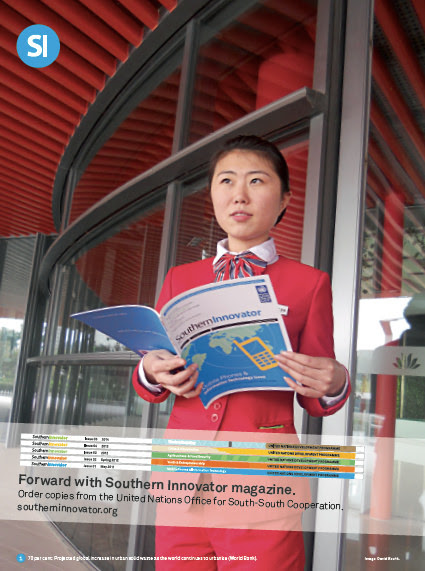
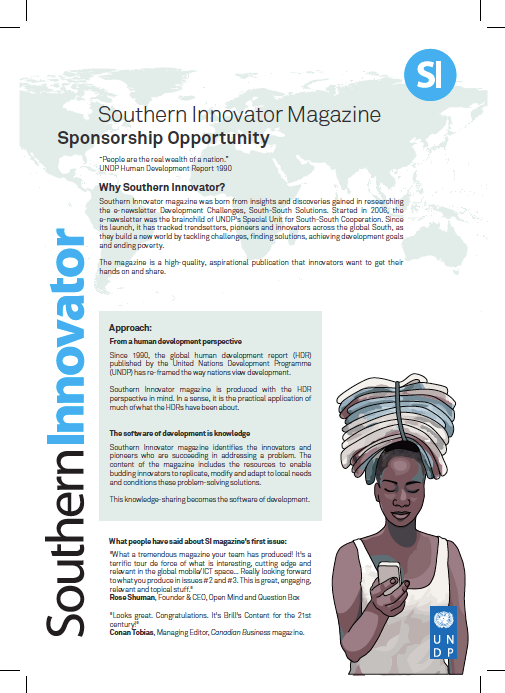
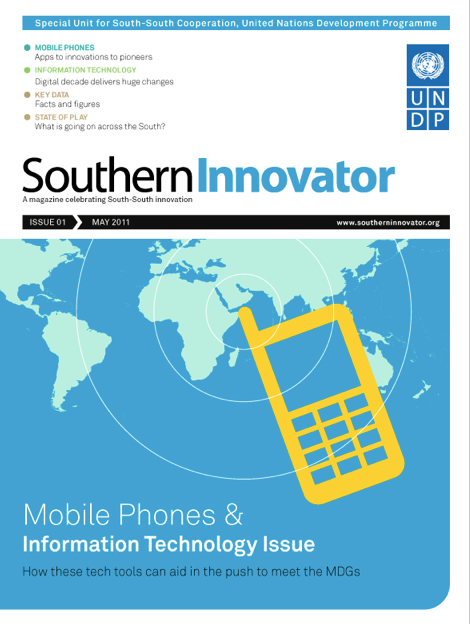
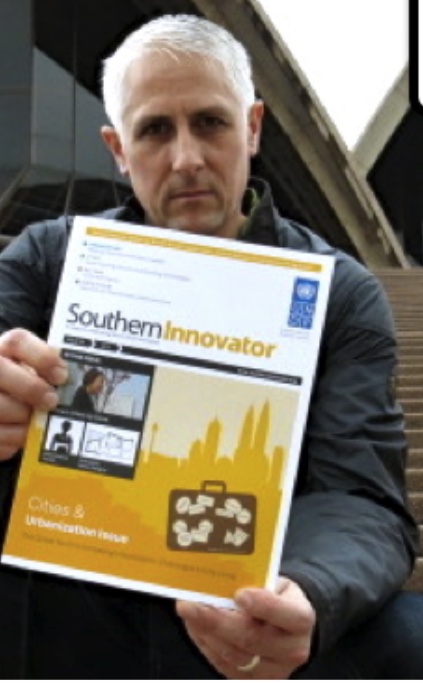
Development Challenges, South-South Solutions was launched as an e-newsletter in 2006 by UNDP’s South-South Cooperation Unit (now the United Nations Office for South-South Cooperation) based in New York, USA. It led on profiling the rise of the global South as an economic powerhouse and was one of the first regular publications to champion the global South’s innovators, entrepreneurs, and pioneers. It tracked the key trends that are now so profoundly reshaping how development is seen and done. This includes the rapid take-up of mobile phones and information technology in the global South (as profiled in the first issue of magazine Southern Innovator), the move to becoming a majority urban world, a growing global innovator culture, and the plethora of solutions being developed in the global South to tackle its problems and improve living conditions and boost human development. The success of the e-newsletter led to the launch of the magazine Southern Innovator.
Follow @SouthSouth1
Google Books: https://books.google.co.uk/books?id=m5GYBgAAQBAJ&dq=development+challenges+may+2012&source=gbs_navlinks_s
Slideshare: http://www.slideshare.net/DavidSouth1/development-challengessouthsouthsolutionsmay2012issue
Southern Innovator Issue 1: https://books.google.co.uk/books?id=Q1O54YSE2BgC&dq=southern+innovator&source=gbs_navlinks_s
Southern Innovator Issue 2: https://books.google.co.uk/books?id=Ty0N969dcssC&dq=southern+innovator&source=gbs_navlinks_s
Southern Innovator Issue 3: https://books.google.co.uk/books?id=AQNt4YmhZagC&dq=southern+innovator&source=gbs_navlinks_s
Southern Innovator Issue 4: https://books.google.co.uk/books?id=9T_n2tA7l4EC&dq=southern+innovator&source=gbs_navlinks_s
Southern Innovator Issue 5: https://books.google.co.uk/books?id=6ILdAgAAQBAJ&dq=southern+innovator&source=gbs_navlinks_s


This work is licensed under a
Creative Commons Attribution-Noncommercial-No Derivative Works 3.0 License.
ORCID iD: https://orcid.org/0000-0001-5311-1052.
© David South Consulting 2023



















 David South Consulting
You must be logged in to post a comment.