Categories
Archive Development Challenges, South-South Solutions Newsletters

Online Education Could Boost African Development

By David SouthDevelopment Challenges, South-South Solutions

SOUTH-SOUTH CASE STUDY

Education is recognized as a major catalyst for human development. During a high-level meeting on the Millennium Development Goals (MDGs) (http://www.undp.org/content/undp/en/home/mdgoverview.html) in 2010, UNESCO – the United Nations Educational, Scientific and Cultural Organization – pointed out the necessity of making rapid gains in education if all the MDGs are to be achieved. The goals deadline is 2015 – just two years away.

Two of the eight goals are directly related to education systems. MDG2 focuses on boosting universal primary education by 2015, and MDG3 calls for the elimination of barriers to primary and secondary education for women and girls.

UNESCO found that between 2000 and 2007, the share of total government education expenditure devoted to primary education across sub-Saharan Africa fell from 49 per cent to 44 per cent (Rawle, 2009). It also found total aid for education was on the decline and foreign aid for basic education began to stagnate in 2008. This contrasted, UNESCO stated, with the “strong advances made over the past decade.”

Overall, in the countries of sub-Saharan Africa, resources for education fell by US $4.6 billion a year on average in 2009 and 2010 (UNESCO, 2010).

With funding for education dependent on fluctuating factors such as foreign aid, government budgets and the state of the global economy, alternatives are needed to retain the gains made in education and to improve them even further.

Thankfully, one new innovative learning tool, dubbed massive open online courses (MOOCs) (http://en.wikipedia.org/wiki/Massive_open_online_course), is about to have a major impact in Africa. Rapid improvements in access to the Internet in Africa means that online learning tools could be a growing solution to the education deficit.

MOOCs mean people will have access to a global treasure trove of free online courses in science, technology, engineering and math. Many believe the leapfrog into digital education will do for education what mobile phones have done for African’s ability to communicate and do business.

These online courses vary in approach – some have set start and finish dates and can last from six to 10 weeks, while others are more loosely structured. But they all offer students the ability to learn from online video lectures and use online forums as a replacement for seminars, debates and question-asking.

According to a recent paper by Harvard University Professor of International Development Calestous Juma, “There is a real possibility for Africa to dramatically improve its teaching – especially in science, technology, engineering, and math – through the deployment of MOOCs.”

The diffuse nature of the Internet means many of the drivers behind promoting this trend in Africa will be found at the regional rather than the national level. The Internet helps remove the dependence on national governments and their education policies and funding – or lack thereof – to further education goals. This means the ability to make the most of the powerful new resource of MOOCs will be amplified by innovators within Africa, from entrepreneurs to information technology pioneers.

Their solutions will help make it easier to access these learning resources.

MOOCs are a variation on OpenCourseWare (http://en.wikipedia.org/wiki/OpenCourseWare) university courses, created for free distribution on the Internet. MOOCs bypass the hazard in the past of digital courses going missing or being mislaid: they are online and always available. Nobody can mislay the content by accident.

The Khan Academy (khanacademy.org) is one of the best-known popular MOOCs pioneers. It was founded in the United States in 2008 by Salman Khan, who quit his job as a hedge fund manager to run the business full time. Khan is academically highly accomplished – he has three degrees from MIT and an MBA from Harvard University. The Khan Academy targets mainly secondary school students and claims to have 5.5 million unique users a month. It is run as a not-for-profit and receives donations to keep it going.

It does this with a staff of just 37: proof of how much can be achieved when the power of the Internet is leveraged to pass on knowledge.

The Khan Academy platform greets readers with questions such as “What is the eccentricity of an ellipse?” or “What if there’s a negative exponent?” And if you do not know, you better get cracking doing their problem sets. Students can practice their math skills, answer other students’ questions or watch a video walk-through of the services on offer on the website. The main categories are math, science and economics, computer science, the humanities and help with preparing for various standardized tests such as the GMAT (Graduate Management Admission Test). There are over 4,000 videos on offer on the website.

“Each video is a digestible chunk, approximately 10 minutes long, and especially purposed for viewing on the computer,” the website states.

“I teach the way that I wish I was taught. The lectures are coming from me, an actual human being who is fascinated by the world around him,” states Khan.

MOOCs offer not just course materials, videos, readings and problem sets but also discussion forums for the students, professors/teachers and tutorial assistants to build a community. This is considered an ideal model for reaching students over great distances and in remote regions. So-called “open” educational resources are used and often no fees or tuition are charged.

The OpenCourseWare (OCW) (http://ocw.mit.edu/index.htm) project at the Massachusetts Institute of Technology (MIT) seeks to “publish all of our course materials online and make them widely available to everyone,” according to Dick K.P. Yue, Professor at MIT’s School of Engineering.

Through its website, it offers nearly all of MIT’s course content, a treasure trove from one of the top research universities in the world, a long-standing home for pioneers and innovators in science and technology.

By way of the Internet, anybody anywhere in the world can access this resource. The most visited courses online as of February 2013 included undergraduate “Introduction to Computer Science and Programming,” “Physics I: Classical Mechanics,” “Introduction to Electrical Engineering and Computer Science I,” “Principles of Microeconomics,” “Introduction to Algorithms,” and “Principles of Chemical Science.” There are 2,150 courses and so far 125 million visitors to the website.

Having access to the courses allows teachers to gain new insights into the subjects they teach and benefit from the impressive resources of MIT.

MIT also sees it as a way to aid people to tackle the big development issues of our time, including climate change and health problems such as cancer.

Other MOOCs providers include Peer-to-Peer University (https://p2pu.org/en/), Udemy (udemy.com), Coursera (coursera.org), Udacity (udacity.com), and
edX (edx.org), a not-for-profit partnership between Harvard and MIT to develop courses for interactive study on the Internet.

In the United Kingdom, the Open University (open.ac.uk) and Futurelearn (http://futurelearn.com/) also offer online courses, as does Open2Study (http://www.open.edu.au/open2study) in Australia.

Boosting access to MOOCs presents a great business opportunity for Africa’s mobile phone entrepreneurs and its mushrooming information technology (IT) hubs (https://africahubs.crowdmap.com/).

“I view online learning as a rising tide that will lift all boats,” Anant Agarwal, professor of electrical engineering and computer science at MIT and president of edX, told The Financial Times. “It will not only increase access, it will also improve the quality of education at all our universities.”

All of this matters because it means Africans will increasingly have the tools to participate in the global marketplace of ideas and products and services on a more level playing field. By far the biggest obstacle to competing is the lack of timely information and knowledge about what is happening in the global economy. It is a frequent complaint, from the farmer desperate for the latest news on market prices and trends and innovations, to the strivers in the growing megacities of the continent who have their sights set on global success.

Published: May 2013

Resources

1) African Union’s High Level Panel on Science, Technology and Innovation. Website: http://belferinthenews.wordpress.com/2012/08/03/calestous-juma-to-co-chair-new-au-panel-on-science-technology-and-innovation/

2) Queen Elizabeth Prize for Engineering: The Queen Elizabeth Prize for Engineering is a new global engineering prize that will reward and celebrate an individual (or up to three individuals) responsible for a ground-breaking innovation in engineering that has been of global benefit to humanity. Website: http://www.qeprize.org/

3) Belfer Center for Science and International Affairs: The Belfer Center is the hub of the Harvard Kennedy School’s research, teaching, and training in international security affairs, environmental and resource issues, and science and technology policy. Website: http://belfercenter.ksg.harvard.edu/

4) A place to host MOOC news and information. Website: http://mooc.ca/

5) OpenCourseWare Consortium: The OpenCourseWare Consortium is a collaboration of higher education institutions and associated organizations from around the world creating a broad and deep body of open educational content using a shared model.  Website: http://www.ocwconsortium.org/

6) Engineering the Future by Calestous Juma, Professor of the Practice of International Development at Harvard Kennedy School. Website: http://www.technologyandpolicy.org/2013/03/18/engineering-the-future/#.UUeWY1fm8
g4

7) Hiobo MoPC: Joining the ongoing push to drive down the price of personal computers in Africa is the latest offering from Mauritian information technology company, Hiobo. Website: http://www.hiobo.com/mopc/

Southern Innovator logo

London Edit

31 July 2013

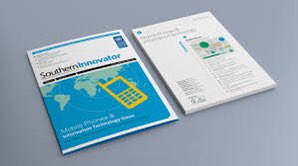
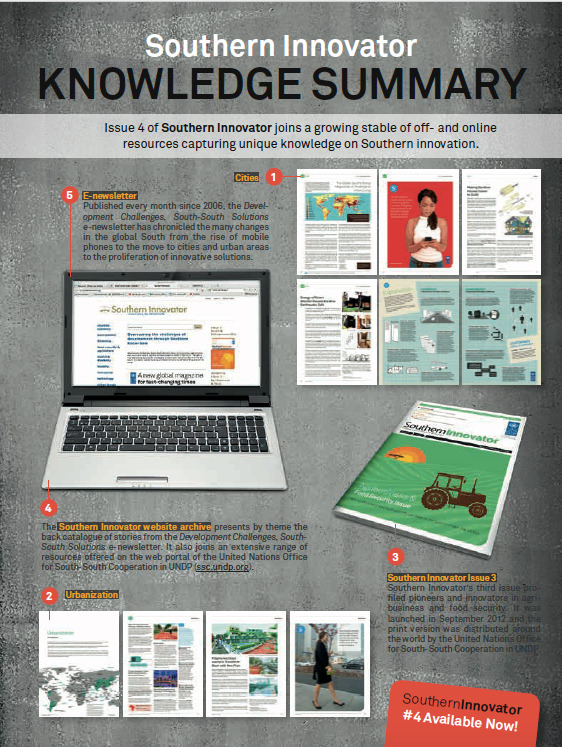
Development Challenges, South-South Solutions was launched as an e-newsletter in 2006 by UNDP’s South-South Cooperation Unit (now the United Nations Office for South-South Cooperation) based in New York, USA. It led on profiling the rise of the global South as an economic powerhouse and was one of the first regular publications to champion the global South’s innovators, entrepreneurs, and pioneers. It tracked the key trends that are now so profoundly reshaping how development is seen and done. This includes the rapid take-up of mobile phones and information technology in the global South (as profiled in the first issue of magazine Southern Innovator), the move to becoming a majority urban world, a growing global innovator culture, and the plethora of solutions being developed in the global South to tackle its problems and improve living conditions and boost human development. The success of the e-newsletter led to the launch of the magazine Southern Innovator. 

Creative Commons License

This work is licensed under a
Creative Commons Attribution-Noncommercial-No Derivative Works 3.0 License.

ORCID iD: https://orcid.org/0000-0001-5311-1052.

© David South Consulting 2023

Categories
Archive

Picking Money from the Baobab Tree 

By David South, Development Challenges, South-South Solutions

SOUTH-SOUTH CASE STUDY

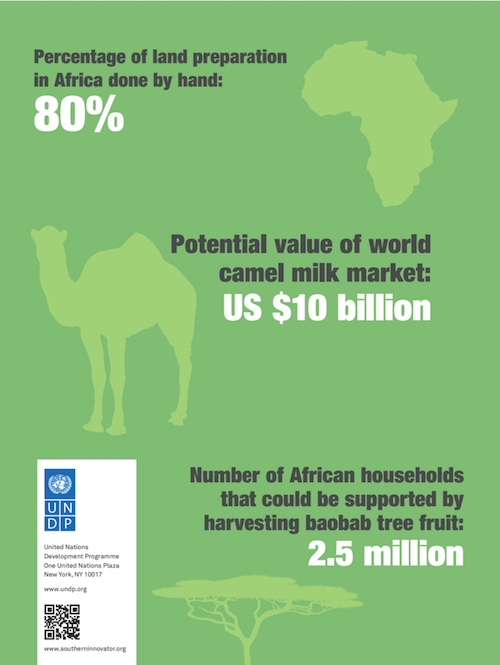
The fruit of the highly revered African baobab tree is being seen as a great new opportunity for the poor, after a recent decision by the European Commission to allow its importation. According to one study, gathering the fruit has the potential to earn an extra US $1 billion a year for Africa, and bring work and income to 2.5 million households, most of them African bush dwellers (Britain’s Natural Resources Institute).

The fruit of the African baobab tree is mostly collected in the wild from the ancient trees, which can live for 500 years, with some as old as 5,000 years. The baobob enjoys the veneration and respect traditionally accorded to age in Africa, and features in many stories and myths.

The fruit is seen as highly nutritious and a new taste option for the European market. This could be a major potential boost to Africa; the European Union is the world’s biggest trader, accounting for 20 percent of global imports and exports, and a major trading partner of most African countries. South Africa alone exports Euro 20.9 billion a year to Europe (2007).

But serious concerns have been raised about how the harvesting of the fruit will be done, and under what conditions. Getting this right is critical if the sustainability of the fruit is to be maintained, local populations are to benefit, and local use of this food source — eaten by both people and animals — does not suffer.

European food and drink companies are looking to use the fruit of the tree to flavour a large range of products, from cereal to drinks.

Baobab fruit is valued for its alleged medicinal properties in treating fevers and diarrhoea, and as a calcium supplement.

“The potential is huge … We’re quite confident that it’s going to represent significant returns for rural producers,” Dr. Lucy Welford, marketing manager of PhytoTrade Africa, a trade organisation that campaigns for the sustainable use of African natural products, told Reuters.

“I’d say it’s somewhere between grapefruit and tamarind as a kind of flavour,” said Welford, who expects baobab fruit to be used at first to flavour smoothies and cereal bars. It could also be used in juices, ice-creams and jams or bakery products.

PhytoTrade works with South African firm Afriplex, which supplies baobab fruit pulp and extracts.

A refreshing juice made from baobab fruit pulp, known as “bouye” is widely served.

“The tart flavour, the interesting vitamin and nutrition profile and the sexy story that goes with it — that it’s wild harvested from a very lovely tree — these things add value to the existing products,” said marketing economist Ben Bennet, who wrote the 2007 Natural Resources Institute’s report.

In the baobab forests around Tandene village in Senegal, local farmers said they looked forward to earning much more from the trees. Prices for a kilo of baobab fruit varied between 40 US cents and a dollar, they said.

“If people know (that European consumers will buy the product) then they’ll look after the trees better and feed them less to their animals,” said farmer Alassane Sy.

Chido Makunike, an active commentator on food and agricultural issues in Africa, raises some serious concerns about how this is handled. “Being a non-cultivated forest product, who ‘owns’ the baobab fruit? Can anybody just take a truck into the forest, collect the fruit and export it? Obviously the sudden dramatic change in the economic importance of the baobab will open up many questions that will need regulation.”

He worries the fruit will just be exported in its raw form, and processed into products in Europe – leaving Africa and Africans the ones who benefit least economically.

“Yet baobab is a dry, not-easily perishable, easy to process fruit,” he said. “It would not be difficult to have the smoothies and cereal bars that are being contemplated for its use made in Africa and exported as finished product, producing many downstream benefits and keeping more of the wealth to be generated within the continent.”

Published: October 2008

Resources

  • The Chamber of Commerce for Switzerland is specially targeting trade deals with Africa and its entrepreneurs. Website: www.swisscham-africa.ch
  • Food Safety – From the Farm to the Fork is the European Commission’s guidelines on food safety and how to prepare food for import into the European Community. Website: http://ec.europa.eu/food/international/trade/index_en.htm
  • EMN Europe is a company that organises all logistics for importing goods into Europe, including making sure all legal requirements are met.
    Website: www.eurotradeconcept.nl
  • The Baobab Fruit Company Senegal has been producing organic baobab products for the nutrition and cosmetics industries.
    Website: http://www.baobabfruitco.com/
  • The Fairtrade Labelling Organization sets the standards for fair-trade and is the place to go to receive official certification.
    Website: www.fairtrade.org.uk
  • Just Food is a web portal packed with the latest news on the global food industry and packed with events and special briefings to fill entrepreneurs in on the difficult issues and constantly shifting market demands. Websitehttp://www.just-food.com
Creative Commons License

This work is licensed under a
Creative Commons Attribution-Noncommercial-No Derivative Works 3.0 License.

ORCID iD: https://orcid.org/0000-0001-5311-1052.

© David South Consulting 2022

Categories
Archive

E-Books

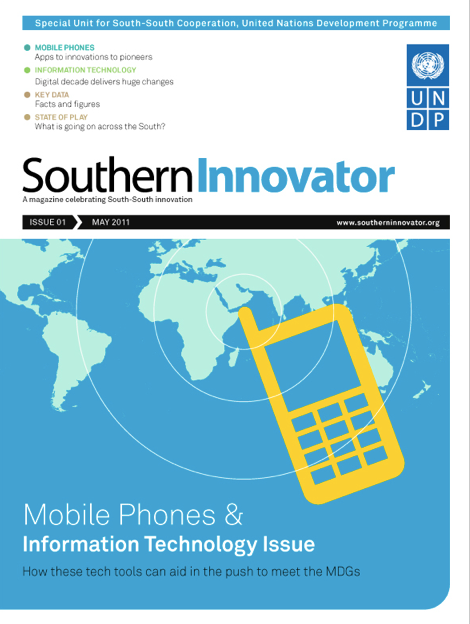
MOST READ! Southern Innovator Issue 1: Mobile Phones and Information Technology: http://www.scribd.com/doc/57980406/Southern-Innovator-Magazine-Issue-1

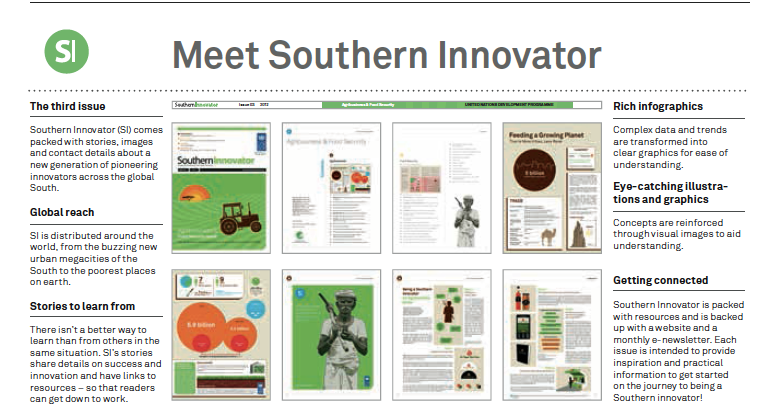
Southern Innovator Issue 2: Youth and Entrepreneurship: http://www.scribd.com/doc/86451057/Southern-Innovator-Magazine-Issue-2

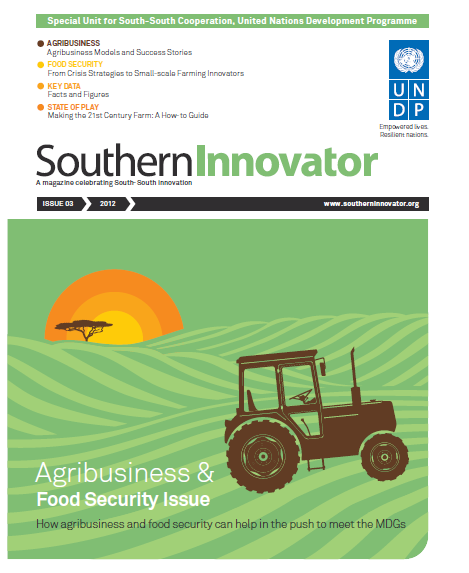
Southern Innovator Issue 3: Agribusiness and Food Security: http://www.scribd.com/doc/105746025/Southern-Innovator-Magazine-Issue-3

Southern Innovator Issue 4: Cities and Urbanization:  http://www.scribd.com/doc/128283953/Southern-Innovator-Magazine-Issue-4

NEW! Southern Innovator Issue 5: Waste and Recycling: http://www.scribd.com/doc/207579744/Southern-Innovator-Magazine-Issue-5-Waste-and-Recycling

AWARD-WINNING! GOSH e-Health Project Launch Brochure and Screen Grabs: http://www.scribd.com/doc/20857167/GOSH-e-Health-Project-Launch-Brochure-and-Screen-Grabs

Environmental Public Awareness Handbook: Case Studies and Lessons Learned in Mongolia: http://www.scribd.com/doc/28633063/Environmental-Public-Awareness-Handbook-Case-Studies-and-Lessons-Learned-in-Mongolia-Part-One

In their own words: Selected writings by journalists on Mongolia, 1997-1999: http://www.scribd.com/doc/24832935/In-their-own-words-Selected-writings-by-journalists-on-Mongolia-1997-1999

Mongolian Rock and Pop Book: http://www.scribd.com/doc/23917535/Mongolian-Rock-and-Pop-Book

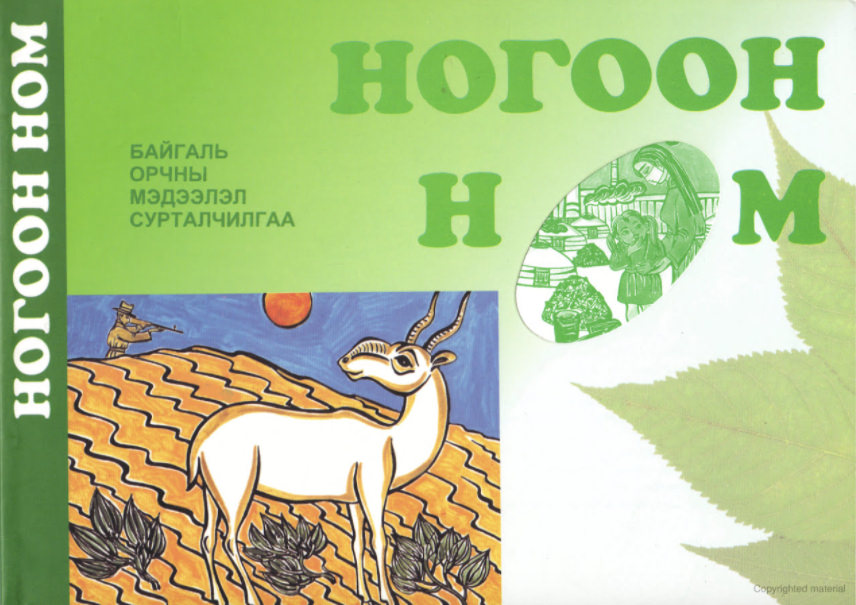
Mongolian Green Book: http://www.scribd.com/doc/20889227/Mongolian-Green-Book

Mongolia Update 1998 Book: http://www.scribd.com/doc/20864541/Mongolia-Update-1998-Book

Human Development Report Mongolia 1997: http://www.scribd.com/doc/20793173/Human-Development-Report-Mongolia-1997

Creative Commons License

This work is licensed under a
Creative Commons Attribution-Noncommercial-No Derivative Works 3.0 License.

ORCID iD: https://orcid.org/0000-0001-5311-1052.

© David South Consulting 2022

Categories
Archive data Development Challenges, South-South Solutions Newsletters Southern Innovator magazine

Indian Mobile Phone Application Innovators Empower Citizens

By David SouthDevelopment Challenges, South-South Solutions

SOUTH-SOUTH CASE STUDY

With mobile phones becoming ubiquitous across the global South, the opportunity to make money – and possible fortunes – by providing ‘apps’ for these devices is now a reality.

Apps (http://en.wikipedia.org/wiki/Application_software) – applications which allow users of new mobile phones to do everything from running a business to banking to navigating chaotic cities – have quickly become a very creative space and a dynamic market for innovators and entrepreneurs. Because they are pieces of software and are relatively inexpensive to create, requiring only time and hard work, an individual working out of their home can develop an app, introduce it to the online marketplace and see if it will succeed.

The only limit is the imagination.

They are also a great way to solve people’s problems and possibly make some money in the process. As economies and cities grow across the South, many everyday difficulties can be tackled with these apps.

Apps are revolutionary because they solve the problem of how to view websites on mobile phones and smartphones (http://en.wikipedia.org/wiki/Smartphone). Apps are designed for a small screen and have simple functionality and design. They often can function without any constant connection to the Internet, updating themselves sporadically when the phone can connect with phone networks or the Internet. They are also either free or inexpensive, using micro-payments to make a profit. The essence of the micro-payment business model is to charge a small amount and turn this into a large amount by having large numbers of people download the app. It is a successful business formula that has made many vast fortunes throughout the age of the mass consumer market, which began in the late 19th century.

Bart Decrem, co-founder of Tapulous, a maker of apps for the iPhone (http://tapulous.com), told The Economist: “Apps are nuggets of magic.”

Apps are sold in online stores run by companies like Apple (http://itunes.apple.com/us/genre/ios/id36?mt=8), Google, Sweden’s GetJar (http://www.getjar.com), and South Korea’s SK Telecom. Apple’s store has over 425,000 apps and Google’s Android Market has more than 250,000. Other stores include Mobihand, PocketGear, Mobango, Handango, Blackberry App World and Handster (http://www.handster.com).

Research firm Gartner (http://www.gartner.com/technology/home.jsp) estimated that 18 billion apps have been downloaded since Apple opened its first app store in 2008. Remarkably, it forecasts this number could rise to 49 billion by 2013. The most popular topics include games, weather forecasts, social networks, maps, music and news.

The dynamic documented so far for apps seems to follow the way music charts work. A few apps, out of the many on offer, become big sellers and popular favourites, getting the most users. Partly this reflects the difficulty of quickly searching through all the apps available in the world to find the right one, a process that favours well-marketed apps.

The recent TechSparks 2011 App4India (http://www.facebook.com/techspark) contest showcased the creative thinking about apps now happening in India.

One Indian success story is the 1000Lookz (http://www.vdime.com/pro1.htm) app, developed by Vasan Sowriraj (http://www.vdime.com/about.htm), which helps women perform a virtual beauty makeover. A woman can check what shades work best for her skin tone by using her own photos uploaded to the app. The user adds features like foundation, blush, gloss, eye-shadow, eye-liner and lipstick. The app uses facial recognition and skin tone detection technology to assist the virtual makeover. It was developed by VDime Innovative Works headquarterd in Atlanta, Georgia, with its technology developed by its Indian division.

1000Lookz’ mission is to create “innovative products that bring cheer to consumers’ faces.”

Sowriraj got his experience from working as a key member of the team developing special image processing for the Indian Space and Research Organisation (http://www.isro.org).

The same team has also developed another service enabling users to transform standard emoticons – those cartoons used in electronic communications to convey emotions – into emoticons using your own face image. It is called Humecons (http://www.humecons.com), and its slogan is “Emote Yourself”.

The India TV Guide, based in Bangalore, India’s software hub (http://en.wikipedia.org/wiki/International_Tech_Park,_Bangalore), is a mobile phone application developed by Jini Labs (http://www.jinilabs.com) offering programme listings for 150 television channels broadcast in India, and allows viewers to save reminders for favourite shows and build favourites lists.

Jini Labs also makes Jini Books (http://itunes.apple.com/in/app/jinibooks/id404988026?mt=8), a clever app to display books, magazines and journals that are hard to find in conventional shops. It is free and promises to have “indie book authors and publishers – including small size, mid-size independent publishers, university presses, e-book publishers, and self-published authors.”

A very useful app improving people’s lives is the Indian Railway Lite app. India’s railways are a critical part of the country’s economy, and the world’s largest railway system. The complexity of trying to work out the train schedule has been made easier with the app.

Founded by Srinath Reddy, the app’s chief technology officer at RSG Software Services (http://www.rsgss.com), the app enables users to discover train connections between stations, and find which trains pass through stations, while navigating the Indian Railways website. It is a good example of how an app can quickly become a big hit. It became the second most popular on the Apple India app store and is downloaded more than 1,000 times a day.

One of the advantages of the app is its ability to function without access to the Internet. It draws on its own database of information and offers a friendlier user interface than the Indian State Railways website.

“This feature has proved to be very popular as users can access train information even while they are travelling and are out of network range,” Reddy told Yourstory.in. “We update the app at regular intervals and the user has to download a new version of the app to get updated information. Trains are generally added once in a few months and the timetable does not change significantly, so the user can use the same version until the next one is released.”

The app’s creators initially found it difficult to get information and updates from Indian Railways.

“We took around four to five months to build the app,” Reddy said. “Significant effort went into compiling the train and station data as this was not easily available. Refining the UI (user interface) took quite some time as well.”

The company saw a market for the app because there were so many iPhone (http://en.wikipedia.org/wiki/IPhone) users in India. The app was downloaded 45,000 times between June and September, and other versions, including one for Google Android (www.android.com) are in the works to broaden access to people without an iPhone.

The company has its headquarters in Ranchi, India and has four development centers in India located in Delhi, Pune, Ranchi and Hyderabad. Currently, the company has approximately 250 employees with core competencies in Apple, Filemaker and Open Source technologies.

The Tuk Tuk 2 app is a clever and practical application for users of India’s ubiquitous motorized and bicycle rickshaws. They are an important part of the country’s transport infrastructure – but a journey in one can be a stressful experience for many reasons. This app seeks to lesson the stress.

Tuk Tuk 2 app (https://market.android.com/details?id=com.mindhelix.tuktuk2&hl=en) is designed to introduce fairness to the auto rickshaw marketplace. It empowers travellers to track where they are on a journey, check the fare and find the distance covered. It helps to reduce exploitation of travellers and makes sure they know where they are at all times: a powerful resource in crowded, busy and confusing cities.

It was developed by Mind Helix Technologies (http://www.mindhelix.com), founded in 2009 as a dedicated application development company with a mission to empower people with its apps. And that is really what apps are all about!

Published: October 2011

Resources

1) Mobile phone boot camp: Entrepreneurial Programming and Research on Mobiles: Website: http://www.media.mit.edu/ventures/EPROM/entrepreneurship.html

2) Mobile Active: MobileActive.org connects people, organizations, and resources using mobile technology for social change. Website: http://mobileactive.org/

3) Teams of motorcyclists with mobile phones in Lagos, Nigeria take pictures of traffic gridlock and open road, send it to central control, who grade it “slow”, “moving” or “free” and in turn send the message to subscribers. Website: http://www.traffic.com.ng

4) Southern Innovator magazine: New global magazine’s first issue tackles the boom in mobile phone and information technologies across the global South. Website: www.scribd.com/doc/57980406/Southern-Innovator-Issue-1

Creative Commons License

This work is licensed under a
Creative Commons Attribution-Noncommercial-No Derivative Works 3.0 License.

ORCID iD: https://orcid.org/0000-0001-5311-1052.

© David South Consulting 2023