UNDP Mongolia Communications Coordinator (1997-1999):David South
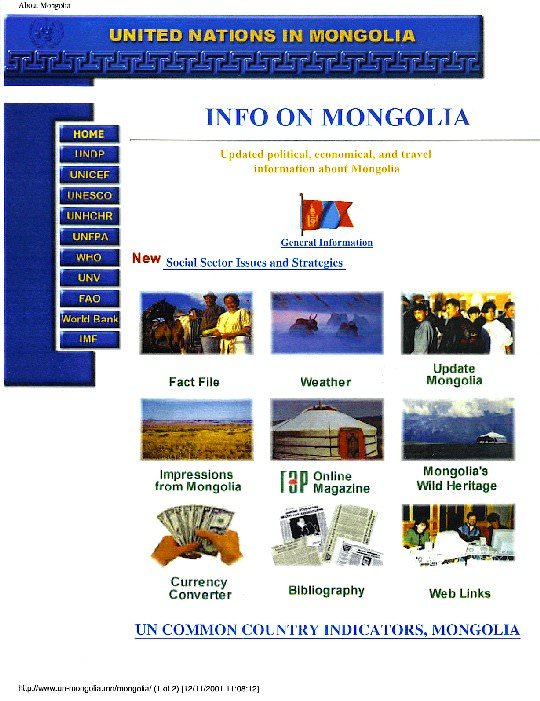
I launched this portal in 1997, in the middle of a major economic crisis in Mongolia. This award-winning (winner in 1998 of the People’s Choice WebSite 500 award and the CyberTeddy Top 500 Website award) and pioneering United Nations Mongolia development web portal was singled out by UN headquarters as an example of what a country office website should be like.
At this time, Mongolia was still recovering from the chaotic and turbulent transition from Communism to free markets and democracy begun at the start of the 1990s, called by some “one of the biggest peacetime economic collapses ever” (Mongolia’s Economic Reforms: Background, Content and Prospects, Richard Pomfret, University of Adelaide, 1994). There was a thirst for information: access to the Internet was still limited and access to mobile phones was just the preserve of the rich. As a legacy of the past, information, especially that about the outside world and the country’s true economic and social conditions, was restricted. During the years of Communism, even simple travel from one place to the next was strictly regulated.
While today we can take it for granted the world’s information arrives in seconds via the Internet on mobile and smart phones and devices, this just was not the case in the late 1990s in Mongolia.
The UN/UNDP Mongolia development web portal addressed the urgent need to communicate what was happening in the country during a major crisis, and to transparently show what the UN was doing to address the crisis. It made critical data on the country’s development easy to find, and informed the wider world about the country and its people and culture. While the Internet had only just arrived in Mongolia, from the start the UNDP Mongolia Communications Office was experimenting with this powerful new technology to reach a global audience. This included Mongolia’s first web magazine, Ger (launched in 1998).
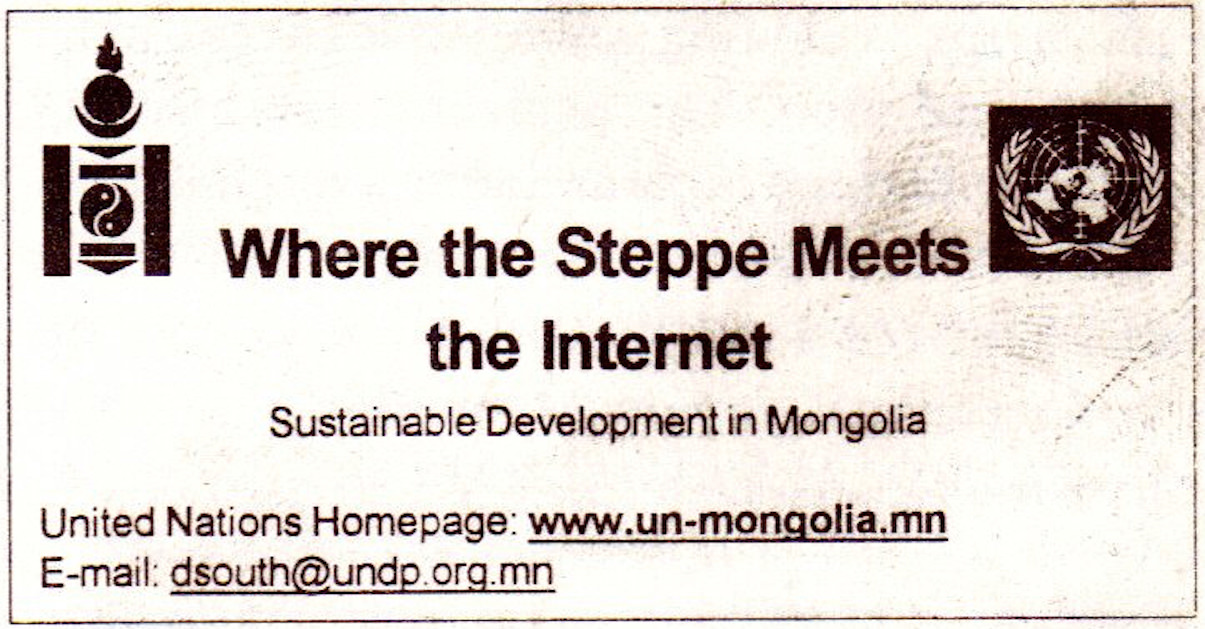
After the http://www.un-mongolia.mn website launched in 1997, a media campaign began to inform readers of its presence. This ad appeared regularly in magazines, newsletters and newspapers.
Ger Magazine was launched on September 9, 1998 (Ger is the Mongolian word for both the traditional tent dwelling and home). The theme of youth in the transition was explored by a combined team of Mongolian and foreign journalists. The Ger Magazine project had basically three goals: first, raise the quality of journalism in the country, secondly, introduce the country to a wider global audience and, thirdly, by being the country’s first online magazine, prove the Internet was an effective way to communicate.
Issue 1 of the magazine investigated what life was like for youth during the transition years (post-1989). Stories tackled the struggle to find work in the free market, the booming pop music scene and how it is leading the way in business entrepreneurship, reproductive health, the basics on Mongolian culture, and vox pop views from Mongolian youth.Issue 2 of the magazine investigated modern life in Mongolia during transition. The team of journalists were hitting their stride by this issue. Stories probed the proliferation of bars and the problem of alcoholism, corrupt banking practices and the loss of savings, how the young were the country’s leading entrepreneurs, Mongolia’s meat and milk diet, “girl power” and the strong role played by women, the burgeoning new media, the rise and rise of Buddhism, and Mongolia’s dynamic fashion designers (this article inspired foreign fashion designers to embrace the Mongolian ‘look’ in the next season’s designs).
The UN/UNDP Mongolia homepage quickly became the top resource for development news on Mongolia in the late 1990s.“A UN System site. A very nice, complete, professional site. Lots of information, easily accessible and well laid out. The information is comprehensive and up-to-date. This is a model of what a UNDP CO web site should be.”
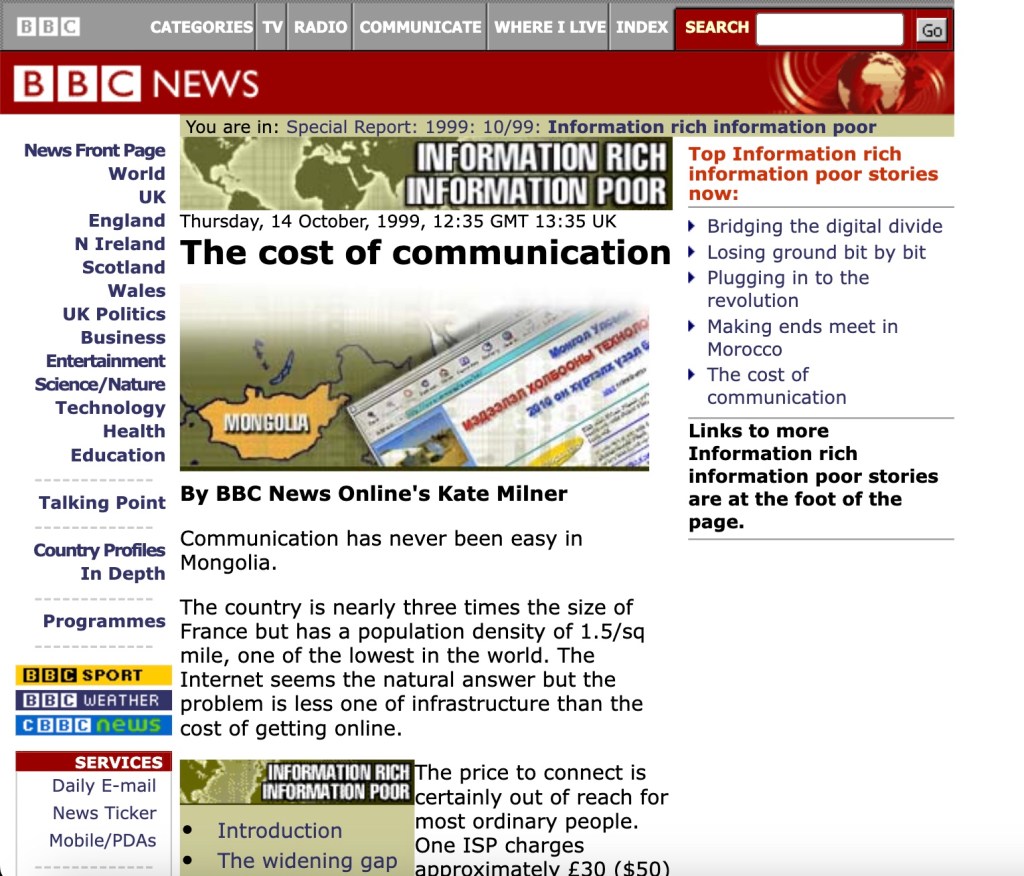
“Information Rich Information Poor: The cost of communication”, BBC News Online, Thursday, 14 October 1999.
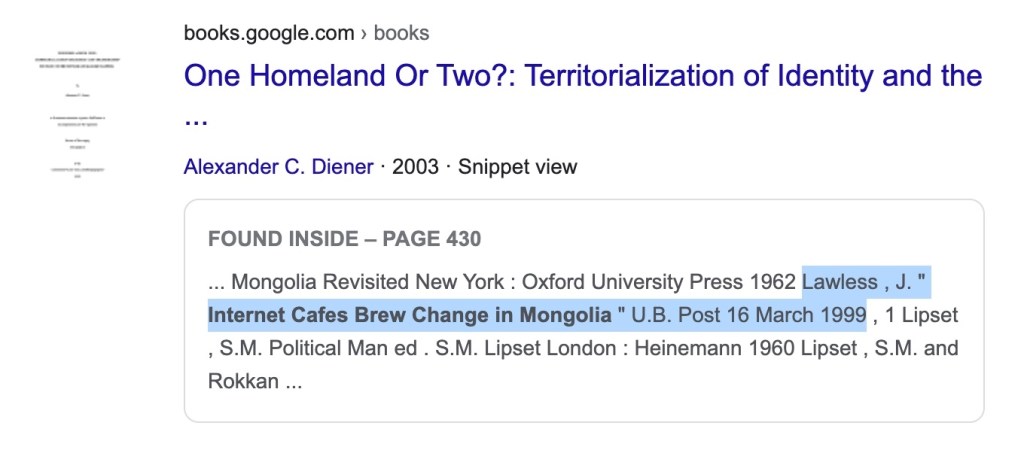
“Internet Cafes Brew Change in Mongolia”, UB Post 16 March 1999 by Jill Lawless, cited in One Homeland or Two?: Territorialization of Identity and the Migration Decision of the Mongolian-Kazakh Diaspora by Alexander C. Diener, 2003.
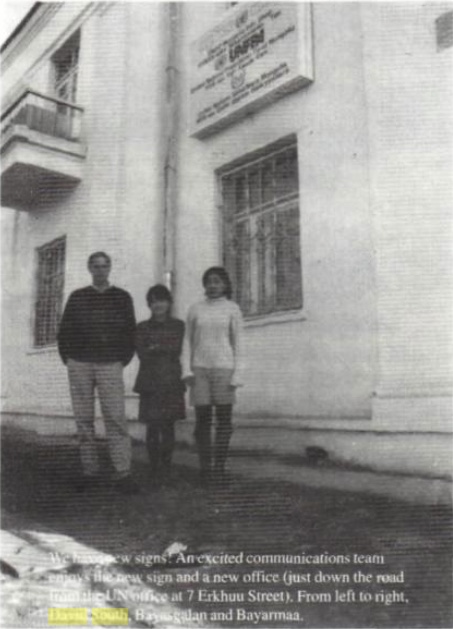
United Nations Cyber Center Ulaanbaatar, Mongolia: UNDP Mongolia established the first public internet cafe in its former headquarters as part of the UNDP Mongolia Communications Office hub in the late 1990s.
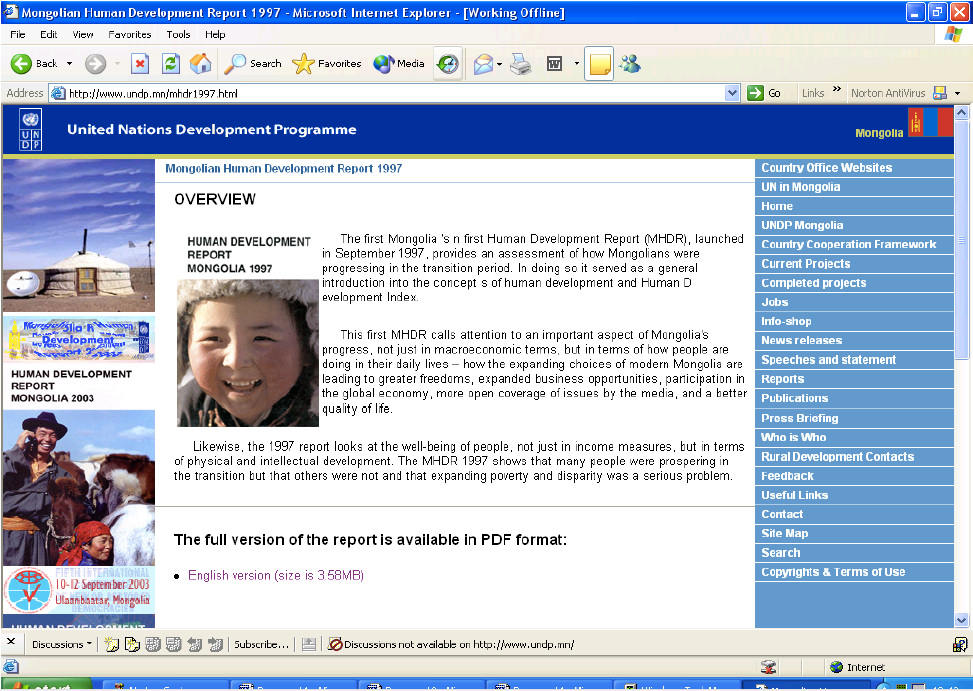
In 2000, the Kiev-based UN Ukraine team had to improve the design and capability of the mission website to handle new content and online services. There was a strong demand for information on country conditions and how to support the UN’s work (for example, on HIV/AIDS). It was a dangerous time to be involved in any online communications and the media and online communicators were routinely threatened with violence and even death.Whilst with a UK-based international development consultancy, I worked on the drafting and online launch in 2000 of the World Bank’s Task Force on Higher Education and Society report, Higher Education in Developing Countries: Peril and Promise. At the time, it was still rare to see reports made user friendly for the world’s web audience. As a survey in 2014 discovered, a shocking third of the Bank’s publications are never downloaded, 40 per cent were downloaded just 100 times, and only 13 per cent were downloaded more than 250 times in their lifetime (The Washington Post).As the Millennium Development Goals (MDGs) were being communicated, the link between the powerful new digital and mobile/information technologies and development goals became explicit in information materials. The cleaner and more modern design introduced with Mongolia’s first human development report in 1997, continued in future publications and online, as can be seen in this screen grab from 2003 and that year’s human development report. The first use of infographics was also introduced in a report on the MDGs for UNDP Mongolia in 2005. Importantly, a country that had been isolated from the non-Communist world for decades, was now routinely using the Internet to tell its stories and post development data.
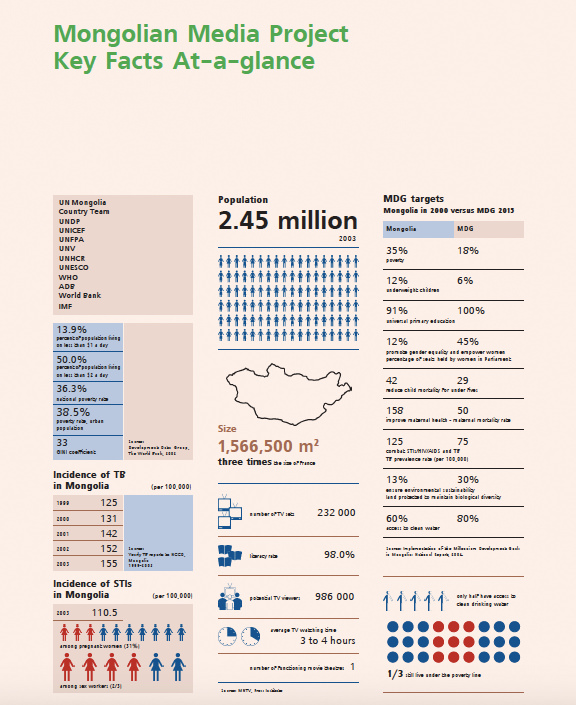
Human Development Infographics: Infographics have proven a useful visual aid for communicating human development concepts. This example was created for a UNDP Mongolia report during missions undertaken in 2005.
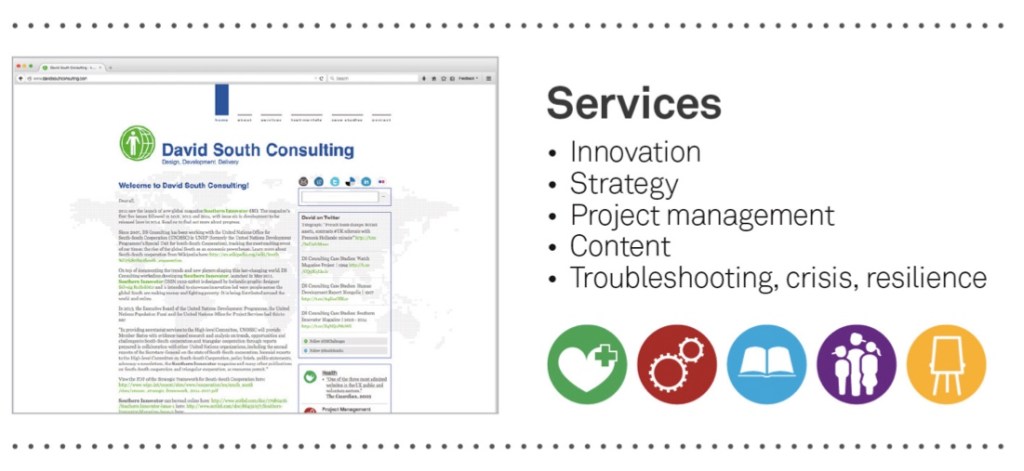
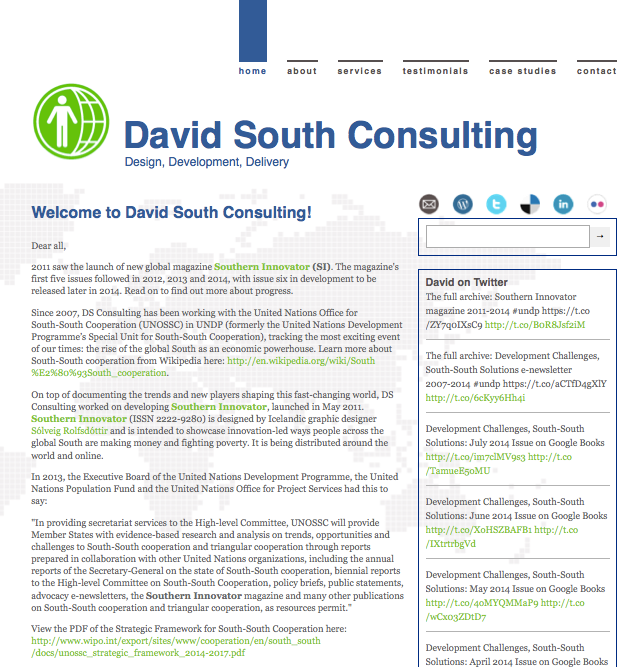
Five years prior to the MDGs deadline in 2015, the David South Consulting website went live (2010). Featuring a new branding and design, it signaled a new design phase more comfortable with developments in social media and online and mobile content sharing. Designed by Solveig Rolfsdottir, one of Iceland’s top graphic designers and illustrators, the website’s design was intentially made compatible with the new global magazine, Southern Innovator (also designed by Solveig Rolfsdottir).The online story archive for Southern Innovator was launched by the United Nations Office for South-South Cooperation (UNOSSC) in 2011. Organized by theme, the stories were cited in blogs, books and reports around the world.
The new template for the United Nations e-newsletter Development Challenges, South-South Solutions was launched in 2011 and designed by Solveig Rolfsdottir. It included a QR code for mobile and smartphone users to connect to the Southern Innovator website.
In 2016 the mobile-friendly version of the David South Consulting website was launched.
Trade hubs can prove to be decisive in boosting regional growth. Trade hubs are places where commerce congregates, for a mix of geographical, cultural and economic reasons. Like a bicycle wheel, a trade hub sits at the centre as the spokes of trade routes travel towards it. Throughout history, trade hubs have emerged, from the outposts of the Silk Route running through Asia and Central Asia to the Hanseatic League cities of Northern Europe in the Middle Ages.
Trade is critical to increasing prosperity, and the more efficient trade becomes – and the greater the variety of goods and affordable prices – the higher the standard of living for the nations doing the trading.
With South-South trade the great economic success story of the past decade, new trade hubs are emerging. World Trade Organization (WTO) (www.wto.org) figures show South-South trade accounted for 16.4 percent of the US $14 trillion in total world exports in 2007, up from 11.5 percent in 2000. While the global economic crisis has slowed things down, the overall trend is firmly established.
One country hoping to become a key 21st century trade hub is the tiny African nation of Djibouti, which sits strategically between the Red Sea and the Gulf of Aden. It is surrounded by the nations of Eritrea, Ethiopia and Somalia and is across the Bab al Mandab Strait from Yemen.
It is at the nexus of Africa and Asia. Some of the busiest shipping lanes in the world float by the country’s coastline. Much of the oil shipped to Europe and the United States passes by.
“Djibouti is perfectly positioned to become a services and logistics hub,” said Jerome Martins Oliveira, chief executive officer of Djibouti port, operated by a subsidiary of Dubai World.
PwC (PriceWaterhouseCoopers) (http://www.pwc.co.uk), which recently published its third Transportation & Logistics 2030 Report, predicts that global trade hubs and routes will shift to emerging markets within the next 20 years.
“Trade volumes will move towards emerging markets such as Africa or Asia and competition for future large transport contracts will be determined within the next few years,” said Akhter Moosa, PwC’s South African Transport and Logistics Leader.
This underscores the growing importance of emerging markets. The majority of global trade is forecast to shift to emerging markets by 2030. As the trade shifts, so new trade routes emerge. PwC sees strong links between Asia and Africa and Asia and South America, as well as trade within Asia, transforming global supply chains.
Hot spots for trade are showing impressive growth. Trade between Asia and the former Soviet states grows at 42 percent a year. The volume of trade between South America and Africa is growing by double digits.
“China already owns seven of the world’s twenty largest ports,” said Christopher Siewierski, associate director in Corporate Finance at PwC. “India, Russia and South Africa are also expected to play a significant role as logistics giants.”
Respondents to the Transportation & Logistics 2030 Report (http://www.pwc.com/gx/en/transportation-logistics/tl2030/tl2030-pub.jhtml ) believe it is unlikely that companies from emerging countries will seek further growth in the developed European and North American markets. Instead, they will concentrate on domestic markets and the strong growing neighbouring countries.
All of this is good news for Djibouti. At present, the population of Djibouti (http://en.wikipedia.org/wiki/Djibouti) is small at around 864,202 people (2009 World Bank).
Ancient Djibouti traded hides and skins for the perfumes of Egypt, India and China: a classic South-South trade heritage. Djibouti became a French colony and gained its independence from France in 1977.
The geography is harsh: a rocky semi desert of plateaus and highlands. Djibouti has few resources, apart from its large salt reserves – the country has a long history of salt mining. Djibouti must depend on foreign assistance – or innovative trade.
Djibouti has to be clever in increasing income opportunities: the country has an estimated unemployment rate of between 40 and 50 percent. The country is heavily dependent on imports for food and fuel, and over the past decade has experienced recession – in the wake of a 1991 to 1994 civil war – and a growing population.
For years, the tiny state was overlooked and development had proceeded at a slow pace. But now investment from Dubai is pouring in to upgrade the port to make it a regional gateway.
The Djibouti Free Zone (http://www.djiboutifz.com/) was set up in the wake of the country being designated a free-export processing zone in 1995. In practice, this means a company or business working to export products can be designated as an Export Processing Company (EPC).
It was created to re-shape the landscape in Africa when it comes to trade. Push out the red tape, and bring efficiency and plenty of services: the prime habitat for business to flourish free of restrictions. Prospective businesses can find modern offices, distribution, storage and light manufacturing facilities.
Djibouti provides services as both a transit port for the region and an international trans shipment and refuelling center.
And even more ambitious plans are afoot: a multi-billion dollar, 29-kilometre bridge across the Red Sea has been proposed. The Bridge of the Horns (http://en.wikipedia.org/wiki/Bridge_of_the_Horns) will link Djibouti with Yemen and two new cities will be built on either side of the bridge. The new Noor City on the Djibouti side will become the “financial, educational, and medical hub of Africa” according to its developers.
Elsewhere, the United States is funding and operating four regional trade and competiveness hubs in sub-Saharan Africa. They aim to assist, enhance and broaden the flow of trade between the United States and the region, both inside and outside the terms of the historic African Growth and Opportunity Act (AGOA) (http://www.agoa.gov/). The four trade hubs — located in Ghana, Senegal, Botswana and Kenya — provide information and technical expertise to enhance and expand bilateral trade between the United States and Africa.
Published: December 2010
Resources
Port Management Association of Eastern and Southern Africa: Is a regional organisation for the ports and maritime sector in Eastern and Southern Africa. It seeks to promote and nurture best practices among member ports by creating an enabling environment for exchange of information and capacity building to contribute to the economic development of the region. Website:http://www.pmaesa.org/welcome.htm
Dubai World: Global holding company Dubai World “focuses on the strategic growth areas of Transport & Logistics, Drydocks & Maritime, Urban Development, Investment & Financial Services. Our portfolio contains some of the world’s leading companies in their industries, including Drydocks World, Economic Zones World, Istithmar World, Nakheel and majority ownership of DP World.” Website: http://www.dubaiworld.ae/
West Africa Trade Hub: The USAID West Africa Trade Hub uses a market-driven approach to increase exports from the region – making West Africa competitive in world markets. The Trade Hub provides direct assistance to hundreds of companies in six value chains. That work is complemented by teams tackling problems in transportation, telecommunications, access to finance and business environment that make it difficult for West African companies to compete. Website:http://www.watradehub.com/
Biz Community.com: Africa’s Leading Daily Retail News: Where the action is on Africa’s fast-growing retail markets. Website: http://www.bizcommunity.com/196/160.html












 David South Consulting
You must be logged in to post a comment.