Categories
Archive Development Challenges, South-South Solutions Newsletters Southern Innovator magazine

Energy-Efficient Wooden Houses are also Earthquake Safe

By David SouthDevelopment Challenges, South-South Solutions

SOUTH-SOUTH CASE STUDY

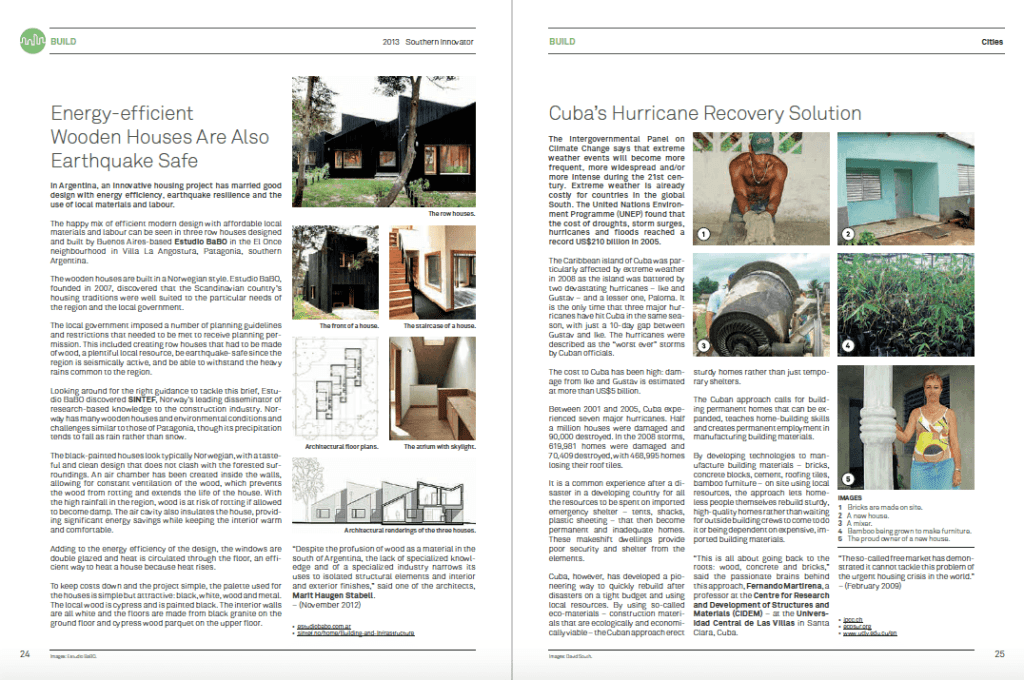
In Argentina, an innovative housing project has married good design with energy efficiency, earthquake resilience and the use of local materials and labour. As energy resources continue to be stretched around the global South, innovative building designs will be critical to the creation of sustainable housing for the future.

The happy mix of efficient modern design with affordable local materials and labour can be seen in three row houses designed and built by Buenos Aires-based Estudio BaBO (estudiobabo.com.ar) in the El Once neighbourhood in Villa La Angostura, Patagonia, southern Argentina.

The wooden houses are built in a Norwegian style. Estudio BaBO, founded in 2007, discovered that the Scandinavian nation’s housing traditions were well suited to the particular needs of the region and the local government.

The local government imposed a number of planning guidelines and restrictions that needed to be met to receive planning permission. This included creating row houses which must be made of wood – a plentiful local resource. They also had to be earthquake-safe since the region is seismically active and be able to withstand the heavy rains common to the region.

Looking around for the right guidance to tackle this brief, Estudio BaBO discovered SINTEF – Norway’s leading disseminator of research-based knowledge to the construction industry (http://www.sintef.no/home/Building-and-Infrastructure/). The Nordic nation has many wooden homes and also has similar environmental conditions and challenges to Patagonia – though its precipitation tends to fall as rain, rather than snow.

The black-painted homes look typically Norwegian, with a tasteful and clean design that does not clash with the forested surroundings. An air chamber has been created inside the homes’ walls allowing for constant ventilation of the wood, which prevents the wood from rotting and extends the life of the house. With the high rainfall of the region, wood is at risk of rotting if allowed to become damp. The air cavity also insulates the house, providing significant energy savings while keeping the interior warm and comfortable.

Adding to the energy efficiency of the design, the windows are double glazed and heat is also circulated through the floor – an efficient way to heat a home because heat rises.

To keep costs down and the project simple, the palette used for the homes is simple but attractive: black, white, wood and metal. The local wood is cypress and is painted black. The interior walls are all white and the floors are made from black granite on the ground floor and cypress wood parquet on the upper floor. The rest of the woodwork in the house is also made of cypress.

Using locally sourced materials also helps to keep costs down.

The project was initially conceived in 2009 and the houses were built in 2010-2011. While wood is plentiful in Patagonia, traditionally the use of wood in construction was rudimentary and local labour skill levels were low. This meant the design had to be simple and easy to build.

“Despite the profusion of wood as a material in the south of Argentina, the lack of specialized knowledge and of a specialized industry narrow its uses to isolated structural elements and interior and exterior finishes,” said one of the architects, Marit Haugen Stabell.

The three units of two-storey row houses each come with a living room, dining room, kitchen, toilet, two bedrooms and a laundry room. Each home also has an outdoor patio. The homes are designed to receive maximum natural light. Deploying this energy efficient design is considered unusual for Argentina and Estudio BaBO has set a new standard for sustainable housing in the country.

It looks like the CLF Houses could inspire others to look again at wood as a building material.

Published: November 2012

Resources

1) A story on how researchers are perfecting wooden home designs to withstand heavy earthquakes. Website:http://inhabitat.com/wooden-house-can-withstand-severe-earthquakes/

2) A website packed with photographs of wooden and other houses for inspiration and lesson learning. Website:http://www.trendir.com/house-design/wood_homes/

3) A step by step slideshow on how a Norwegian wooden house was re-built. Website:http://www.dwell.com/articles/norwegian-wood.html

4) Inspirational wooden home decorating ideas from across Scandinavia. Website:http://myscandinavianhome.blogspot.cz/

https://davidsouthconsulting.org/2022/10/19/chinese-building-solution-for-rapidly-urbanizing-global-south/

https://davidsouthconsulting.org/2021/09/01/disaster-recovery-ten-years-after-the-gujarat-india-experience/

https://davidsouthconsulting.org/2021/09/01/haiti-earthquake-prompts-tech-aid/

https://davidsouthconsulting.org/2017/10/27/information-accelerates-crisis-recovery-and-development-1997/

https://davidsouthconsulting.org/2021/02/12/rebuilding-after-chinese-earthquake-beautiful-bamboo-homes/

https://davidsouthconsulting.org/2021/02/23/southern-innovator-in-southasiadisasters-net/

https://davidsouthconsulting.org/2022/09/26/3d-home-printing-landmark-10-houses-in-a-day/
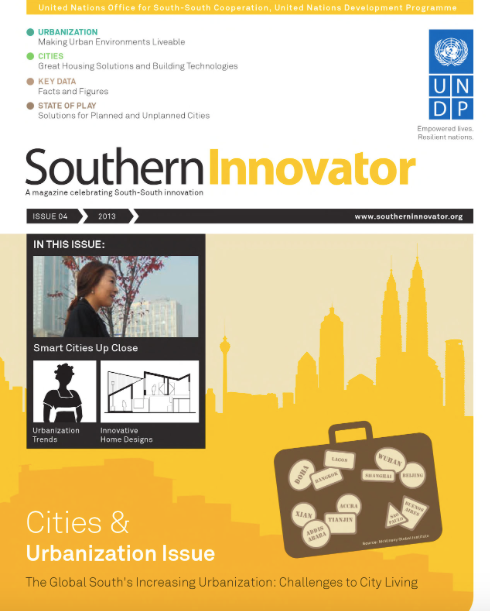
https://davidsouthconsulting.org/2021/03/05/southern-innovator-issue-4/

Development Challenges, South-South Solutions was launched as an e-newsletter in 2006 by UNDP’s South-South Cooperation Unit (now the United Nations Office for South-South Cooperation) based in New York, USA. It led on profiling the rise of the global South as an economic powerhouse and was one of the first regular publications to champion the global South’s innovators, entrepreneurs, and pioneers. It tracked the key trends that are now so profoundly reshaping how development is seen and done. This includes the rapid take-up of mobile phones and information technology in the global South (as profiled in the first issue of magazine Southern Innovator), the move to becoming a majority urban world, a growing global innovator culture, and the plethora of solutions being developed in the global South to tackle its problems and improve living conditions and boost human development. The success of the e-newsletter led to the launch of the magazine Southern Innovator.

Creative Commons License

This work is licensed under a
Creative Commons Attribution-Noncommercial-No Derivative Works 3.0 License.

ORCID iD: https://orcid.org/0000-0001-5311-1052.

© David South Consulting 2023

Categories
Archive Development Challenges, South-South Solutions Newsletters Southern Innovator magazine

A New House Kit for Slum Dwellers that is Safe and Easy to Build

By David SouthDevelopment Challenges, South-South Solutions

SOUTH-SOUTH CASE STUDY

By 2030, some 5 billion people around the world will live in cities. Next year, 2008, is predicted to be the tipping point, when urban dwellers (3.3 billion people) will outnumber rural residents for the first time. These are the conclusions of UNFPA’s State of the World Population 2007 Report. Even more strikingly, the cities of Africa and Asia are growing by a million people a week. And 72 percent of the population in sub-Saharan Africa live in slum conditions.

But as populations grow — and most will be poor, unemployed and under 25 — it becomes critical that effective solutions are found to ensure people can live with dignity and comfort. And design is being used more and more to overcome this challenge.

George Martine, author of the UNFPA report, is blunt: “We’re at a crossroads and can still make decisions which will make cities sustainable. If we don’t make the right decisions the result will be chaos,” he told the UK newspaper The Independent.

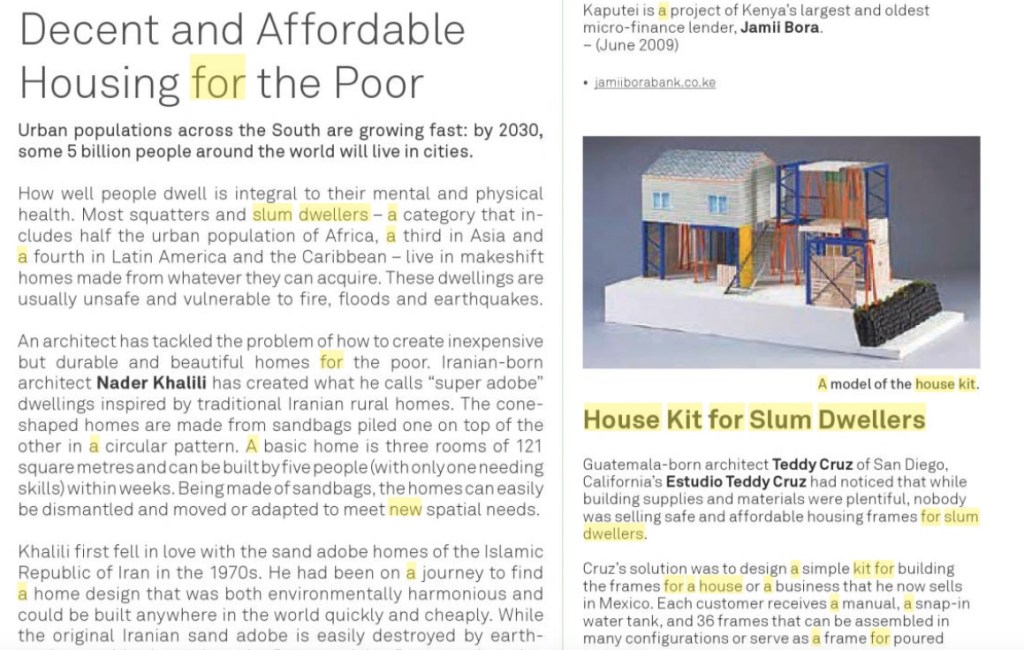
Guatemala-born architect Teddy Cruz of Estudio Teddy Cruz in San Diego, California, joins a small but growing number of socially responsible architects. He applies a concept more associated with middle class shoppers at the furniture design emporium Ikea to the world’s estimated one billion urban slum dwellers (UN-Habitat). Without legal title to the land they live on, packed tightly into densely overcrowded shantytowns, most squatters and slum dwellers live in makeshift homes made from whatever they can get their hands on. This is estimated to include half the urban population of Africa, a third of Asia and a fourth of Latin America and the Caribbean (Click here for more information).

The ad-hoc shelters and houses they build can be dangerously unstable, and vulnerable to natural disaster from flash floods to earthquakes. Cruz had noticed that while building supplies and materials were plentiful, nobody was selling safe and affordable housing frames for slum dwellers. According to the International Labor Organization, formal housing markets in developing countries rarely supply more than 20 percent of housing stock.

Cruz’s solution was to design a simple kit for building the frames for a house or a business that he now sells in Mexico. Each customer receives a manual, a snap-in water tank, and 36 frames that can be assembled in many configurations, or serve as a frame for poured concrete. These sturdy frames can also be added to with locally found materials. Cruz said he was inspired by “the resourcefulness of poverty” and by the cheap and affordable pre-fabricated homes that once were sold by catalogue by the American retailer Sears.

Cruz has been testing the structures in Tijuana, Mexico – a rapidly growing city on the border with the United States and a destination for Mexico’s poor. His work as an architect has centred on exploring how informal settlements grow faster than the cities they surround. These settlements, he says, break the rules and blur the boundaries between what is urban, suburban and rural. Cruz’s frame kits can be used to build a home, or combination of home and business, acknowledging the fact many people need to use their home as a business for a livelihood.

“These start-up communities gradually evolve,” said Cruz., ”or violently explode out of conditions of social emergency, and are defined by the negotiation of territorial boundaries, the ingenious recycling of materials, and human resourcefulness.”

Published: July 2007

Resources

There are many ways to play around with your dwelling and architecture ideas. Here are some products available online:

  1. Arckit: Arckit is a tangible and hands-on design tool for spontaneously bringing your architectural ideas to life right before your eyes. Website: https://www.arckit.com
  2. SmartLab Archi-TECH Electronic Smart House: Build your house and power it up! This creative STEAM toy allows aspiring architects and engineers to design and build modular structures – and then power them up with lights, sounds, sensors, and motorized parts! Website: https://www.mastermindtoys.com/products/smart-lab-archi-tech-electronic-smart-house

Development Challenges, South-South Solutions was launched as an e-newsletter in 2006 by UNDP’s South-South Cooperation Unit (now the United Nations Office for South-South Cooperation) based in New York, USA. It led on profiling the rise of the global South as an economic powerhouse and was one of the first regular publications to champion the global South’s innovators, entrepreneurs, and pioneers. It tracked the key trends that are now so profoundly reshaping how development is seen and done. This includes the rapid take-up of mobile phones and information technology in the global South (as profiled in the first issue of magazine Southern Innovator), the move to becoming a majority urban world, a growing global innovator culture, and the plethora of solutions being developed in the global South to tackle its problems and improve living conditions and boost human development. The success of the e-newsletter led to the launch of the magazine Southern Innovator.  

Follow @SouthSouth1

Like this story? Here is a dirty secret: this website is packed with stories about global South innovators. We spent 7 years researching and documenting these stories around the world. We interviewed the innovators to learn from them and we visited them to see how they did it. Why not use the Search bar at the top and tap in a topic and see what stories come up? So, stick around and read some more!    

Archive.org: https://archive.org/details/Httpwww.slideshare.netDavidSouth1development-challengessouthsouthsolutionsjuly2007issue

Slideshare: http://www.slideshare.net/DavidSouth1/development-challengessouthsouthsolutionsjuly2007issue

Southern Innovator Issue 1: https://books.google.co.uk/books?id=Q1O54YSE2BgC&dq=southern+innovator&source=gbs_navlinks_s

Southern Innovator Issue 2: https://books.google.co.uk/books?id=Ty0N969dcssC&dq=southern+innovator&source=gbs_navlinks_s

Southern Innovator Issue 3: https://books.google.co.uk/books?id=AQNt4YmhZagC&dq=southern+innovator&source=gbs_navlinks_s

Southern Innovator Issue 4: https://books.google.co.uk/books?id=9T_n2tA7l4EC&dq=southern+innovator&source=gbs_navlinks_s

Southern Innovator Issue 5: https://books.google.co.uk/books?id=6ILdAgAAQBAJ&dq=southern+innovator&source=gbs_navlinks_s

Creative Commons License

This work is licensed under a
Creative Commons Attribution-Noncommercial-No Derivative Works 3.0 License.

ORCID iD: https://orcid.org/0000-0001-5311-1052.

© David South Consulting 2023

Categories
Archive Development Challenges, South-South Solutions Newsletters Southern Innovator magazine

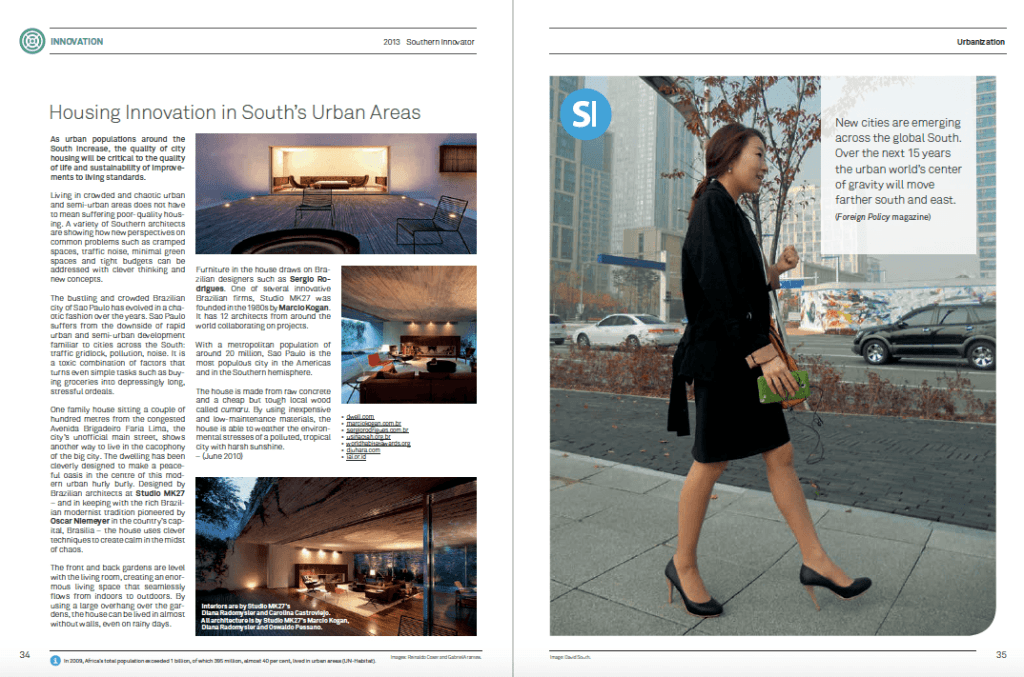
Brazilian Design For New Urban, Middle-Class World

By David SouthDevelopment Challenges, South-South Solutions

SOUTH-SOUTH CASE STUDY

Countries across the global South are experiencing rapid urbanization as people move to cities for better economic opportunities — and this massive social change is creating new business opportunities. Those who recognize how fundamentally people’s lifestyles are changing will be those who will benefit from this big shift in populations.

Finding ways to live well in urban areas will be critical to determining whether this move repeats past urban failures — from the favelas of Brazil to the slums of India — or introduces a new way of living that is exciting and colorful. Design and designers will be critical to this change.

One young design company in Brazil, Sao Paulo-based furniture studio NUUN  (nuun.nu), is attempting to resolve a dilemma common across the rapidly urbanizing global South: How to create a design aesthetic that fits with the new way of living and being?

The company consists of designer and founder João Eulálio Kaarah and architects Renato Périgo and Carolina Sverner.

Périgo specializes in furniture and interior design, while Carolina Sverner worked with respected Japanese architect, Shigeru Ban (shigerubanarchitects.com), who is well known for designing buildings and houses made from paper and for creating easy-to-build homes for people after a disaster has struck (http://www.ted.com/talks/shigeru_ban_emergency_shelters_made_from_paper).

A collaboration among upcoming artists, designers and architects, NUUN tries to infuse its designs with a sense of “brazilianness”. Brazilianness is a modern aesthetic, made for modern lifestyles in the new urban landscape, that draws on aspects of Brazil’s culture and environment.

The young studio’s first collection of furniture offers simplicity. Called Eos, it tries to blend urban cosmopolitanism with raw nature. Brazil is known for its jam-packed urban cities as well as its vast expanse of Amazon rainforest. In practice, NUUN’s look is a mix of contrasts redolent of what used to be called brutalism: concrete mixed with glass, steel, wood and semi-precious gems. NUUN takes inspiration from NASA’s Earth Observation System (EOS): the collection vibes off of space satellites, antennae and the dry soil of the backwoods. NUUN says that “despite its Martian features, [the collection] is as Brazilian as it comes”. There is the modular Panorama sofa (http://nuun.nu/products/panorama) in five colors, capable of being re-shaped to fit a variety of living arrangements. A glass-topped coffee table with a concrete base and a side table with a carbon steel metallic structure to complement the sofa.

Elsewhere in the world of Brazilian design, footwear brand Grendene S.A. (http://ri.grendene.com.br/EN/Company/Profile) has become one of the world’s largest producers of footwear and made one of its founders a billionaire. And Grendene has boosted its international success by turning to another Brazilian success: supermodel Gisele Bündchen (giselebündchen.com.br).

Grendene began in 1971 and owns various successful shoe brands, including Melissa (melissa.com.br/en/), Grendha, Ilhabela, Zaxy, Cartago, Ipanema, Pega Forte, Grendene Kids and Grendene Baby.

It has six industrial zones with 13 footwear factories and can produce 240 million pairs of shoes a year. It undertakes all areas of production— from making its own moulds for the shoes to creating PVC (polyvinyl chloride) (http://en.wikipedia.org/wiki/Polyvinyl_chloride) – and handles its own distribution.

While Grendene is already a well-known shoe brand in Brazil, it wanted to expand its presence overseas to increase profits. Named after the two brothers who founded the company, Alexandre Grendene Bartelle and Pedro Grendene Bartelle, Grendene started working with supermodel Gisele Bündchen in 2002 to help her launch her own line of affordable flip-flops, iPanema (ipanemaflipflops.co.uk). The brightly colored sandals with elaborate patterns became an instant success.

But do celebrity endorsements really work? In the case of Bündchen and Grendene, the answer is yes. According to Forbes, 25 million pairs of the flip-flops and sandals are sold every year, accounting for 60 per cent of Grendene’s annual exports of about US $250 million.

Brazil was able to produce 864 million pairs of shoes in 2012, up 5.5 per cent from 2011.

Of these, 113 million pairs were exported to the United States, Argentina and France.

Brazil, like many other countries, has had to work out how it could compete with cheaper shoe imports from China. The strategy it chose was to target the growing number of middle-class people both in Brazil and elsewhere, as well as the high end of the market.

In 1979, Grendene created the Melissa brand, which has now become a coveted style leader. It collaborates with top design names such as Karl Lagerfeld and architect Zaha Hadid.

Making a partnership with Bündchen is part of the company’s strategy to reach higher-income buyers.

And it is working: Grendene increased its export revenue by 50 per cent in 2013.

Co-founder Alexandre Grendene Bartelle became a billionaire according to Forbes World’s Billionaires list and is worth US $1.4 billion. He owns 41 per cent of Grendene S.A. and close to 40 per cent of the Dell Anno brand.

This is a critical lesson for manufacturers in the global South. Grendene had achieved strong market dominance at home, and was already benefiting from growing wealth among Brazil’s middle classes. But it was the overseas market that had the potential to clinch even more profits for the company.

Bündchen’s high brand profile has enabled the company to compete head-to-head with the well-known Brazilian flip-flop brand, Havaianas (havaianas-store.com).

Another modern design leader owned by Grendene, Dell Anno (lojasdellanno.com.br), is a maker of modernist cabinets and furniture.

Dell Anno only use wood from renewable forest sources, to protect and preserve the Amazon and other native forests. Dell Anno tries to recycle as much as possible: up to 80 per cent of the water used in manufacturing is recycled, and byproducts from the production process such as a sawdust, wood, plastic and cardboard are also reused.

Dell Anno makes a full range of furniture for kitchens, bedrooms, closets, home theatres, home offices, service areas, restrooms and commercial environments. Dell Anno uses research and development to study trends and advise customers on the best options. The brand offers its staff training to help standardize customer service, and also has an excellent blog covering developments in modern design around the world (http://www.lojasdellanno.com.br/blog/).

Published: May 2014

Development Challenges, South-South Solutions was launched as an e-newsletter in 2006 by UNDP’s South-South Cooperation Unit (now the United Nations Office for South-South Cooperation) based in New York, USA. It led on profiling the rise of the global South as an economic powerhouse and was one of the first regular publications to champion the global South’s innovators, entrepreneurs, and pioneers. It tracked the key trends that are now so profoundly reshaping how development is seen and done. This includes the rapid take-up of mobile phones and information technology in the global South (as profiled in the first issue of magazine Southern Innovator), the move to becoming a majority urban world, a growing global innovator culture, and the plethora of solutions being developed in the global South to tackle its problems and improve living conditions and boost human development. The success of the e-newsletter led to the launch of the magazine Southern Innovator.  

Follow @SouthSouth1

Google Books: https://books.google.co.uk/books?id=NhQ9BQAAQBAJ&dq=development+challenges+may+2014&source=gbs_navlinks_s

Slideshare: http://www.slideshare.net/DavidSouth1/may-2014-development-challenges

Southern Innovator Issue 1: https://books.google.co.uk/books?id=Q1O54YSE2BgC&dq=southern+innovator&source=gbs_navlinks_s

Southern Innovator Issue 2: https://books.google.co.uk/books?id=Ty0N969dcssC&dq=southern+innovator&source=gbs_navlinks_s

Southern Innovator Issue 3: https://books.google.co.uk/books?id=AQNt4YmhZagC&dq=southern+innovator&source=gbs_navlinks_s

Southern Innovator Issue 4: https://books.google.co.uk/books?id=9T_n2tA7l4EC&dq=southern+innovator&source=gbs_navlinks_s

Southern Innovator Issue 5: https://books.google.co.uk/books?id=6ILdAgAAQBAJ&dq=southern+innovator&source=gbs_navlinks_s

Creative Commons License
This work is licensed under a
Creative Commons Attribution-Noncommercial-No Derivative Works 3.0 License.

ORCID iD: https://orcid.org/0000-0001-5311-1052.

© David South Consulting 2023

Categories
Archive Blogroll Development Challenges, South-South Solutions Newsletters Southern Innovator magazine

Rebuilding After Chinese Earthquake: Beautiful Bamboo Homes

By David SouthDevelopment Challenges, South-South Solutions

SOUTH-SOUTH CASE STUDY

It has been a year since the May 12, 2008 Sichuan earthquake in China that killed more than 70,000 people.

China’s strongest earthquake for more than half a century, with a magnitude of 8.0 (en.wikipedia.org), it devastated large parts of the province of Sichuan. More than 10 million people were made homeless, most of them poor and elderly villagers (cities were not badly damaged).

Getting Sichuan back to normal is critical for not only the province’s people, but for all of China. Sichuan is China’s rice bowl, growing more food than any other province. But despite the abundance of food, Sichuan remains poor and has seen its working age population move away for work. If it is to have a viable future then its communities need to get back to normal as fast as possible – and its farming economy back to full production.

The unprecedented media coverage of the disaster meant people across China saw the scenes of devastation and have since contributed large donations to help with the reconstruction. The Chinese government has pledged to spend US $151 billion on reconstruction projects.

Finding ways to re-house people after large disasters has become an urgent issue over the last five years. From the Asian tsunami to Hurricane Katrina in the United States and multiple hurricane disasters in the Caribbean, restoring communities is critical for the health of the people and the economies they rely on. Experience has shown that temporary shelters have many drawbacks, being usually of poor quality for long-term habitation and a source of health problems.

The temporary shelters erected for the Sichuan homeless are unsuitable for long-term housing: the 12 square metre grey boxes – two sheets of aluminium sandwiching a polystyrene core for insulation – have no heating. The occupants roast inside in the summer and freeze in the winter. They are also located away from the main source of income: the farms.

The dilemma is how to build new, long-term houses that will not cost too much. Inflation has increased the costs of conventional building materials: bricks, cement and steel.

But the use of traditional building materials and home designs offers an alternative. By drawing on the abundant bamboo and wood in Sichuan and by building to traditional designs, cheaper but sturdy and beautiful homes can be built.

An average home now costs around 80,000 yuan (US $11,688). The Chinese government estimates the price is now 820 yuan per square meter for a new home: bamboo homes cost between 300 and 400 yuan per square meter. Government compensation is between 16,000 yuan (US $2,337) and 23,000 yuan (US $3,360) per family. The bamboo houses range in size from 75 to 200 square metres, and in cost from 22,500 yuan to 80,000 yuan for a very large home.

In Daping village, Pengzhou Town, original homes destroyed by the earthquake sit at the edge of a forested hill. Their frames are more or less intact, but the walls and roofs have collapsed. The new houses replacing them are large, two stories high and have solid grey clay tile roofs. The beauty of the designs stands out and sits in stark contrast to the temporary shelters and concrete buildings.

“There are 43 houses and two public buildings being rebuilt in this project,” says team member Hu Rong Rong of the Green Building Research Centre of Xi’an University of Architecture and Technology. “The design and the main building material are based on the ecological and sustainable habitat idea. The place (Sichuan) is rich in bamboo and wood. These natural materials are cheap and friendly to the environment. In some buildings we use light steel which can be also recycled.”

The new homes are built to earthquake resistance standards. Led by Professor LiuJiaping, a team of 15 people from the research centre and two from a design institute developed the home designs and supervised the training of local people. They were joined by 10 people from an NGO called Global Village of Beijing, who managed the project to completion.

“All the designs were discussed with the local people,” continues Hu. “We trained a local construction team, which means the local people would build their own houses by themselves. Both our research center and the local people were involved in developing the home design.

“To get the trust from the local people is a challenge in the project. We resolved it by showing our respect to the local people. Before we started our design we discussed with the local people many times to know what kind of house they like. We built the first house to make them believe us.”

Hu believes it is possible to replicate the homes across Sichuan.

“The design is suitable for other villages in Sichuan which have a similar climate and culture with this village. To rebuild sustainable houses after a disaster we should know well about the local life, environment and culture – try to find the useful technique which was used in their traditional houses and upgrade the traditional house to meet the need of their modern life.”

Others have not been as lucky as these villagers. In the village of Yuan Bao, Chen Jingzhong, 66, has had to build a makeshift shack: “They wanted to get us to build our own houses but they didn’t give us enough money,” Chen told the Telegraph Magazine. “All we could afford was this shack, which we built ourselves, with our own hands and without any help from anyone.”

Published: May 2009

Resources

Architecture for Humanity: By tapping a network of more than 40,000 professionals willing to lend time and expertise to help those who would not otherwise be able to afford their services, they bring design, construction and development services where they are most critically needed. Website: www.architectureforhumanity.org

Chinese Red Cross: The Red Cross Society of China is accepting donations for disaster reconstruction and is coordinating rebuilding efforts in Sichuan Website: http://www.redcross.org.cn/ywzd/

Gerd Niemoeller has developed flat pack, cardboard homes that can be deployed quickly after a disaster and can become permanent homes.Website: http://tinyurl.com/6t6jtf and the company
Website: http://www.wall.de/en/home

Global Greenhouse Warming is a website that tracks extreme weather events around the world: drought, flooding, severe storms, severe winter, tropical cyclone, wildfires, and extreme heat waves.Website: www.global-greenhouse-warming.com

The Building and Social Housing Foundation: An independent research organization promoting sustainable development and innovation in housing through collaborative research and knowledge transfer. Website: www.bshf.org

https://davidsouthconsulting.org/2021/09/01/disaster-recovery-ten-years-after-the-gujarat-india-experience/

https://davidsouthconsulting.org/2021/11/12/energy-efficient-wooden-houses-are-also-earthquake-safe/

https://davidsouthconsulting.org/2021/09/01/haiti-earthquake-prompts-tech-aid/

https://davidsouthconsulting.org/2021/02/12/rammed-earth-houses-china-shows-how-to-improve-and-respect-traditional-homes/

https://davidsouthconsulting.org/2022/09/26/3d-home-printing-landmark-10-houses-in-a-day/

Development Challenges, South-South Solutions was launched as an e-newsletter in 2006 by UNDP’s South-South Cooperation Unit (now the United Nations Office for South-South Cooperation) based in New York, USA. It led on profiling the rise of the global South as an economic powerhouse and was one of the first regular publications to champion the global South’s innovators, entrepreneurs, and pioneers. It tracked the key trends that are now so profoundly reshaping how development is seen and done. This includes the rapid take-up of mobile phones and information technology in the global South (as profiled in the first issue of magazine Southern Innovator), the move to becoming a majority urban world, a growing global innovator culture, and the plethora of solutions being developed in the global South to tackle its problems and improve living conditions and boost human development. The success of the e-newsletter led to the launch of the magazine Southern Innovator.

https://davidsouthconsulting.org/2021/03/05/southern-innovator-issue-4/

Creative Commons License

This work is licensed under a
Creative Commons Attribution-Noncommercial-No Derivative Works 3.0 License.

ORCID iD: https://orcid.org/0000-0001-5311-1052.

© David South Consulting 2023