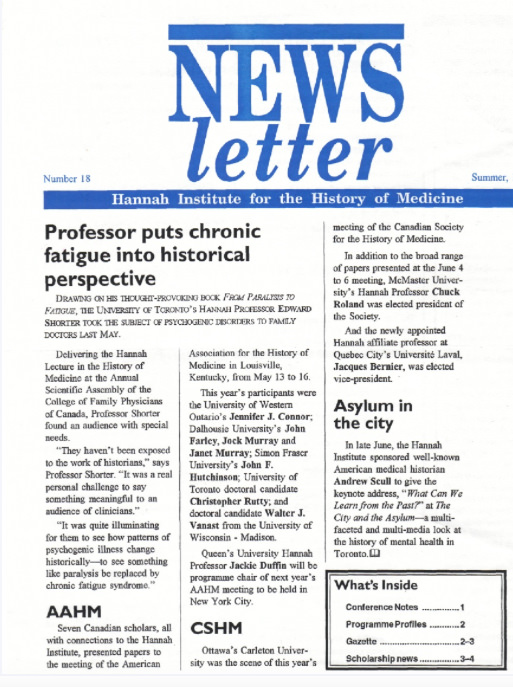
Drawing on his thought-provoking book From Paralysis to Fatigue, the University of Toronto’s Hannah Professor Edward Shorter took the subject of psychogenic disorders to family doctors last May.
Delivering the Hannah Lecture in the History of Medicine at the Annual Scientific Assembly of the College of Family Physicians of Canada, Professor Shorter found an audience with special needs.
“They haven’t been exposed to the work of historians,” says Professor Shorter. “It was a real personal challenge to say something meaningful to an audience of clinicians.
“It was quite illuminating for them to see how patterns of psychogenic illness change historically – to see something like paralysis be replaced by chronic fatigue syndrome.”
I worked as Editor and Writer for the newsletter of the Hannah Institute for the History of Medicine (under the direction of the Editor-in-Chief and Hannah Executive Director Dr. J.T. H. Connor) in the early 1990s. Located close to the University of Toronto and within a neighbourhood claiming a long association with medical and scientific discovery (Sir Frederick Banting, co-developer of insulin for the treatment of diabetes, lived at 46 Bedford Road,), the goal was to better connect Canada’s medical history community of scholars and raise the profile of the funding resources available to further the study of medical history in Canada.
Expertise: Project evaluation, strategy, project management, project delivery, UN system, MDGs, research papers, media strategies and digital media strategies.
Locations: Ulaanbaatar, Mongolia, Kiev, Ukraine, Pretoria, South Africa, Ashgabat, Turkmenistan 2000 to 2006
From 1999, I worked as a consultant for United Nations (UN) missions in Africa, Asia, Central Asia and Eastern Europe, for USAID Mongolia and for a UK-based international development consultancy.
About
Was the United Nations being effective and reflecting the potential for change in the mobile and information technology age? What needed to change? Who were the policy innovators?
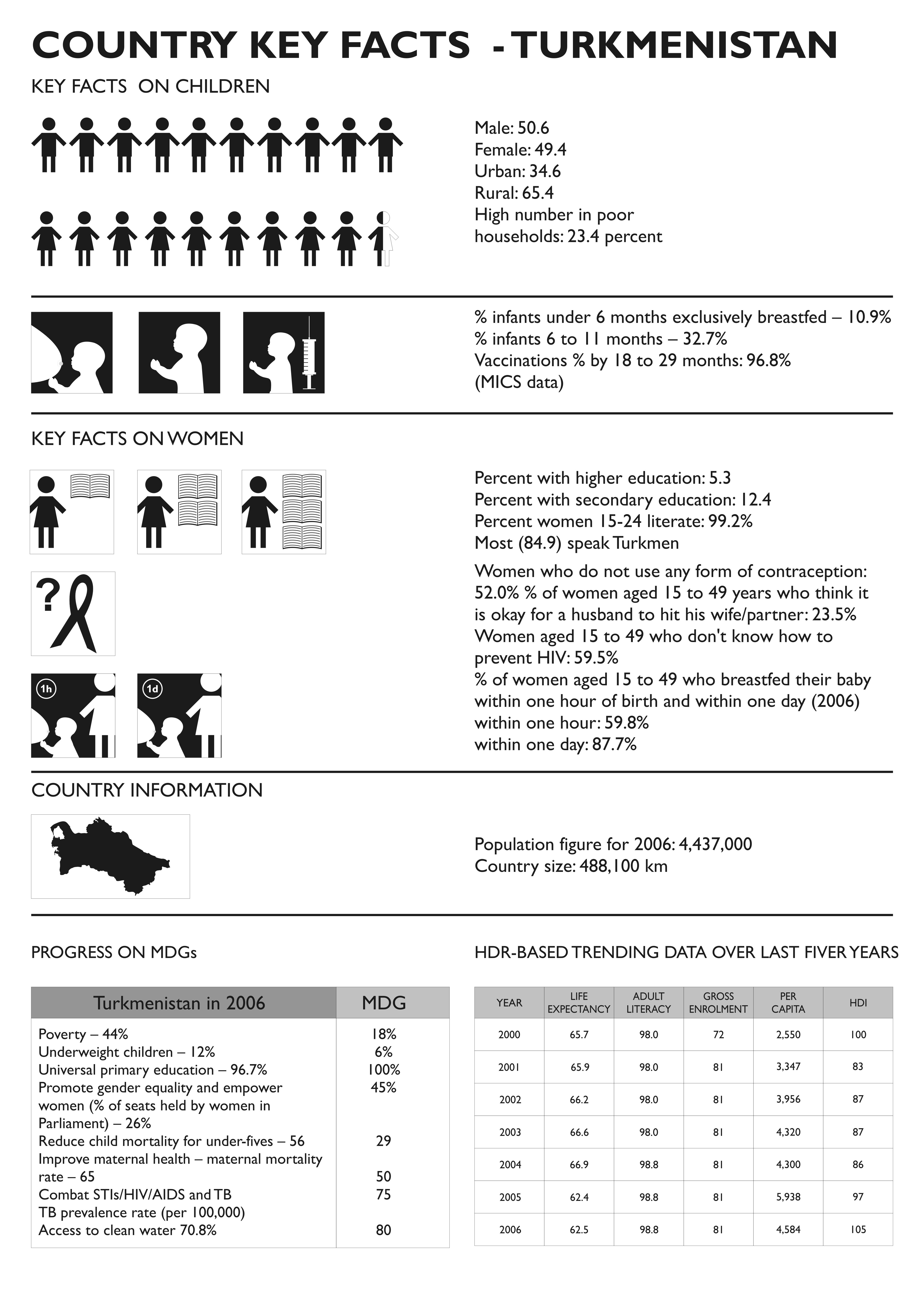
This work included overseeing various digital media projects, including the strategic re-development of the UN Ukraine web portal, aiding in the rolling out of the media campaign for the Millennium Development Goals (MDGs) in Mongolia, including the first use of infographics in the Mongolia UN mission, advising on strategies for youth engagement in development goals in South Africa, and support to the UN mission in Turkmenistan as it finalised its United Nations Development Assistance Framework (UNDAF) with the government and also work with UNICEF there. What I learned during this period proved crucial to the insights and thinking reflected in two highly influential United Nations publications, e-newsletter Development Challenges, South-South Solutions, and Southern Innovator magazine (developed in 2010).
This period was particularly advantageous because I had a front-row seat to the unfolding digital and mobile information technology revolution sweeping across the emerging markets and the global South. I also had insight into what worked and didn’t in international development as well as the UN system. I also learned a great deal about development challenges first-hand in highly varied countries, how the Millennium Development Goals (MDGs) were actually being rolled out, and met amazing people who were challenging existing precepts on how to do development. All of this work proved very useful later on.
I have either travelled to, or worked and lived, in many countries, enhancing my global perspective and affording me a valuable trove of knowledge that has in turn informed my work in international development. I have always paid attention to the level of development in the country, how it has organized itself, the quality of its design, and how it interacts with other countries for trade and relations. The countries visited to date include: Antigua and Barbuda, Australia, Azerbaijan, Belgium, Canada, China, Cuba, Denmark, Domenica, Finland, France, Germany, Greece, Guadalupe, Haiti, Hong Kong, Iceland, Ireland, Israel, Italy, Japan, Kenya, Luxembourg, Malaysia, Mexico, Monaco, Mongolia, Montseratt, Morocco, the Netherlands, Norway, Philippines, Portugal, Russia, Singapore, South Africa, South Korea, Spain, Sweden, Switzerland, Thailand, Tunisia, Turkey, Turkmenistan, Ukraine, the United Kingdom, the United States of America, Vatican City. A fascinating mix of countries – some holders of top place on the UN’s Human Development Index – and others where human development is at its worst. Seeing with your own eyes what works and what does not is highly illuminating, while knowing first-hand how human development can be improved is critical for giving informed advice.
Timeline
1999/2000: USAID Mongolia (design and publicity strategy for business development brochure, US Mongol (Mongolia) Construct and US tour, work with Riverpath Associates in the UK on communications strategies and the drafting of papers for the American Foundation for AIDS Research, the Global Fund to Fight AIDS, Tuberculosis and Malaria, UNCTAD, Harvard Institute for International Development, and the preparation of the report and launch strategy for the World Bank’s Task Force on Higher Education.
2000: UN Ukraine: strategic re-development of the UN Ukraine web portal and incorporation of the Millennium Development Goals (MDGs).
2004: UN Mongolia (media campaign for MDGs) and UN South Africa (evaluation of youth NGO associated with the University of Pretoria and its projects and providing a strategic marketing plan).
2005: UN Mongolia (media campaign for MDGs) and UN Turkmenistan (finalising its United Nations Development Assistance Framework – UNDAF).
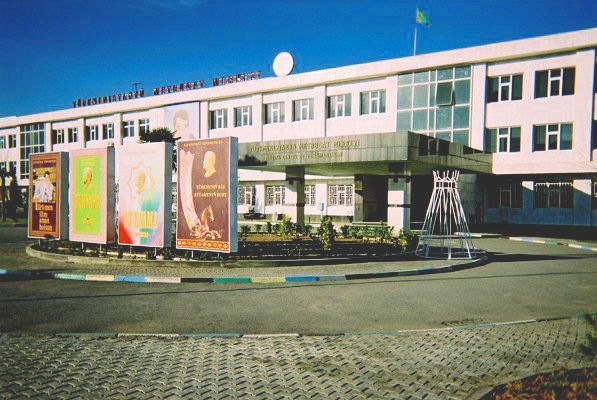
Rukhnama publishers in Turkmenistan’s capital, Ashgabat (2005). Photo: David SouthAn infographic commissioned for UN Turkmenistan MDGs report (2006).
“I highly recommend Mr. David South as a communications consultant who gets results.” Brian DaRin, Representative/Director, USAID Investment & Business Development Project, Global Technology Network/ International Executive Service Corps-Mongolia, 23 September 1999
Impact
Micro
working as a communications consultant for UN missions – Ukraine, South Africa, Mongolia, Turkmenistan
redeveloping mission websites, preparing content, reports, advising on communications strategy
working with local designers on new ways to present development data through inforgraphics (2005/2006)
Macro
in the course of travel and work, seeing the unfolding impact of the global communications revolution, in particular the rapid roll-out and take-up of mobile technologies, and the urgent need for the UN system to take this on board. Also witnessed firsthand the grassroots solutions revolution brought about by information and mobile technologies and the Internet, which needed to be fully embraced by the UN
Resources
A Marketing and e-Marketing Strategy – the New SASVO, Prepared from December 2004 to February 2005 for the Southern African Student Volunteers (University of Pretoria).
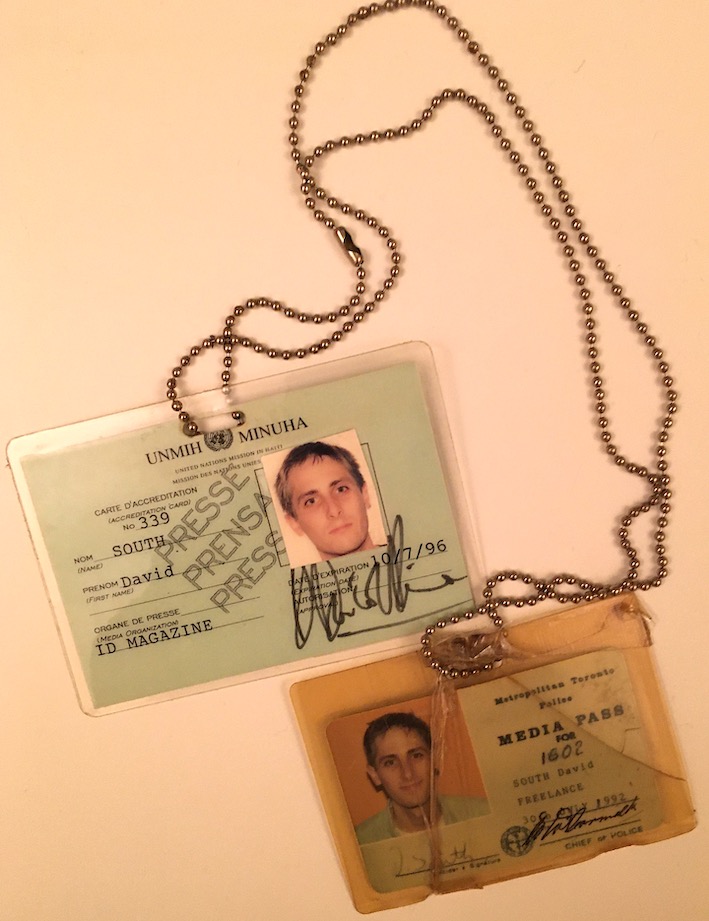
In 1996 I was hired as Features Editor for Id Magazine, a bi-weekly alternative magazine in Guelph, Ontario, Canada.
About
In 1996 Id Magazine, an Ontario, Canada alternative biweekly, was expanding and needed to improve the quality of its journalism, while also making the difficult shift to being a more consistently professional offering. I was hired as Features Editor and set about swiftly assembling a team of investigative journalists. My strategy involved targeting stories overlooked by Canadian newspapers and TV news. In the 1990s, it was often the case the best journalism and the best investigative journalism in Canada could be found in the country’s alternative media. This led to a number of firsts, including an extensive investigation into Canada’s flourishing sex industry, the government’s addiction to casinos to boost revenues, unearthing a plot by neo-nazis to infiltrate Ontario high schools with hate rock, university students’ catastrophic debt culture, reporting from the streets of Port-au-Prince, Haiti on Canada’s UN mission, and probing the government’s public services privatisation plans (including being invited to debate this topic on CBC TV’s programme, Face Off). With a keen eye for new media trends, the magazine covered the fast-rising Internet economy, early experiments with digital currencies and smart cards (Mondex) (Canadian Town Tries Out Cash Cards) being carried out in Guelph, Ontario, and concerns about data privacy.
There clearly was a gap in the news marketplace Id could better fill with solid investigative journalism and features writing aimed at a younger demographic.
How large a market gap can be confirmed by various analyses on the state of the Canadian media at the time and since. According to the book The Missing News: Filters and Blind Spots in Canada’s Press (Robert A. Hackett and Richard S. Garneau, Canadian Centre for Policy Alternatives, University of Toronto Press 2000), Canada’s media was in a mess in the 1990s resulting from declining resources, staff layoffs and media closures reducing the breadth and depth of news coverage.
My challenge: Could I bring together a talented, young team and improve the quality and consistency of journalism for a start-up magazine seeking to grow? The proof came in the form of improved audited pick-up of the magazine by readers, the magazine’s confident push to expand on the Internet, and the fact many from that original team have gone on to not only have successful careers in the media and film, but also to be influential in their own right – proof the original belief in their talent was correct.
Pressure on journalists to toe the line and not upset advertisers was also increasing in the context of ongoing high unemployment, a stagnant economy in a recession, and government austerity. Canadian media as whole also has a “great dependence on advertising, which accounts for more than 70% of daily newspaper revenues, about 64% of magazine revenues,” which means there is enormous pressure to only publish stories that do not upset advertisers. And monopolies exert great control over news content in Canada: “In the United States, ten companies control 43.7% of total daily newspaper circulation. By contrast, in Canada since 1996, one single company controls a comparable share of the media pie.”
Quoting Jeffrey Simpson in the book, newspapers are “shrinking in size, personnel, ambition and, as a consequence, in their curiosity,” …. “I believe the result has been a diminution in quality.” (p64)
Fast forward to “Today, we have a crisis in the journalism industry unprecedented in scope. A media implosion. Newspapers being reduced to digital editions, large numbers losing their jobs, circulation falling, ad revenues plunging, near monopoly ownership of big-city dailies, the old business model in a state of collapse.” (Canada’s media: A crisis that cries out for a public inquiry by Lawrence Martin, The Globe and Mail, Feb. 02, 2016).
Brief descriptions of sample issues are below:
Can Harris be Stopped? Cover
My first Id Magazine cover. It was thrown together in a few days after being hired. While a work of resourcefulness under pressure, it did capture the spirit of the times as multiple demonstrations and strikes tried to bring down the much-hated Conservative government in Ontario.
“Can the UN Help Remake a Country?” Cover
This cover photo by Phillip Smith was taken in the market area of Port-au-Prince, Haiti. I had never seen such squalor and desperation in my life. It got worse as we visited the city’s morgue, packed to the rafters with the dead and mutilated bodies of children and adults. It was a tough assignment and one that was captured with professionalism by Phillip’s camera.
Christmas Issue Cover
Back in 1996, the Thatcher thirst for privatisation came to Ontario with a vengeance. In this issue, we asked if it showed a lack of imagination to just sell publicly paid for assets to wealthy investors. We offered other ownership models and I debated this topic on CBC TV’s Face Off.
“Pulling the Plug on Hate Rock” Cover
This excellent cover by Gareth Lind was, as far as I know, the first use of pop art on a biweekly magazine cover in Ontario at that time (I certainly hadn’t seen anyone else do it). It sold the excellent investigation into skinhead rock bands infiltrating Ontario high schools very well. It was timed for release during the North-by-Northeast music festival in Toronto, and had zero returns (as in all issues were picked up).
Sarah Polley Cover
A regular contributor to Id, Canadian actor and director Sarah Polley challenged the stale Canadian left with her spiky views. In this issue we tackled the decline in the quality of TV programmes and asked if it was a moral vacuum being hoovered up by consumerism.
Student Issue Cover
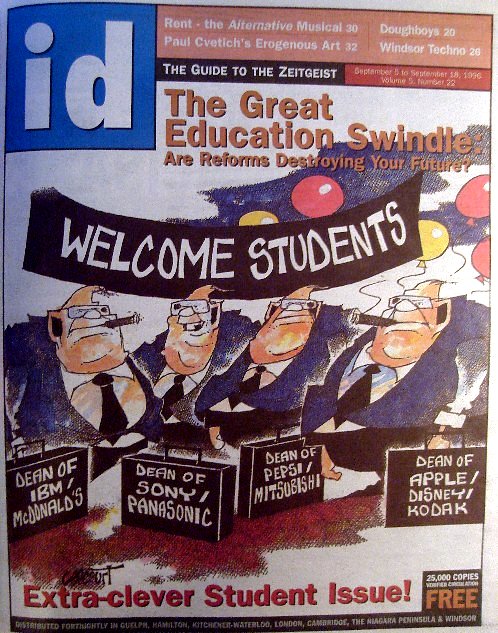
This cover is by great Canadian political cartoonist and illustrator Jack Lefcourt. Always funny, Jack captures well the corporate take-over of the country’s universities and the introduction of the catastrophic debt culture that leaves so many students in a financial pickle. It was also Id’s first student issue.
“The Great Education Swindle: Are Reforms Destroying Your Future?”
“Today’s Sex Toys are Credit Cards and Cash” Cover
As Ontario’s economy experienced year-after-year of high unemployment and stagnant salaries, its sex economy flourished. In another first, the Id team tackled all aspects of the growth of the sex economy and changing attitudes to sexual behaviour. Beating the big papers to this story, they wrote with honesty and verve and made a refreshing break from the limp journalism of most Canadian newspapers.
Timeline
1996: Hired as Features Editor and assembled editorial and creative team.
1997: Id Magazine begins to simultaneously publish its content online, a pioneering move at the time.
Impact
Micro
reducing returns and boosting audited pick-ups of the free magazine – a key metric for a publication reliant on local advertising
assembled talented investigative team and graphic design and photo team
introduced pop art front covers
increased news coverage, especially impact of austerity in Canada
increased foreign coverage, including on Canada’s United Nations mission in Haiti
introduced high-profile contributors, including actor and director Sarah Polley
debated stories on other media, including CBC TV’s Face Off
Macro
most of the team have gone on to very successful careers in the media
magazine still receives good comments on Facebook many years after its closure
one of the first Canadian magazines to embrace the Internet and publish simultaneously online
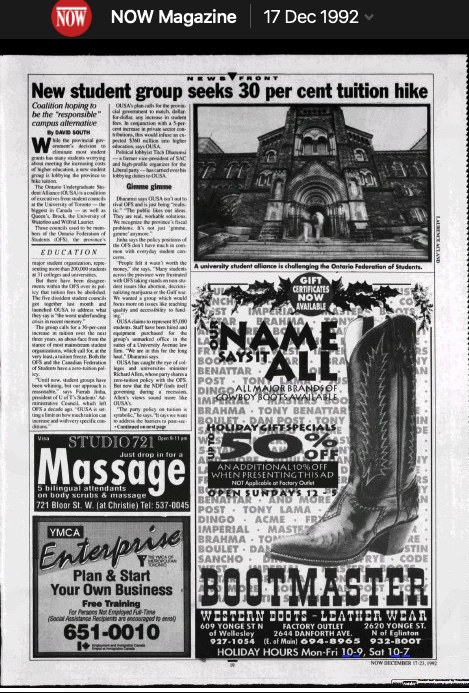
While the provincial government’s decision to eliminate most student grants has many students worrying about meeting the increasing costs of higher education, a new student group is lobbying the province to hike tuition.
The Ontario Undergraduate Student Alliance (OUSA) is a coalition of executives from student councils at the University of Toronto – the biggest in Canada – as well as Queen’s, Brock, the University of Waterloo and Wilfred Laurier.
Those councils used to be members of the Ontario Federation of Students (OFS), the province’s major student organization, representing more than 200,000 students at 31 colleges and universities.
But there have been disagreements within the OFS over its policy that tuition fees be abolished. The five dissident student councils got together last month and launched OUSA to address what they say is “the worst underfunding crisis in recent memory.”
The group calls for a 30-per-cent increase in tuition over the next three years, an about-face from the stance of most mainstream student organizations, which call for, at the very least, a tuition freeze. Both the OFS and the Canadian Federation of Students have a zero-tuition policy.
“Until now, student groups have been whining, but our approach is reasonable,” says Farrah Jinha, president of U of T’s Students’ Administrative Council, which left OFS a decade ago. “OUSA is setting a limit on how much tuition can increase and with very specific conditions.”
OUSA’s plan calls for the provincial government to match, dollar-for-dollar, any increase in student fees. In conjunction with a 5-per-cent increase in private sector contributions, this would infuse an expected $360 million into higher education, says OUSA.
Political lobbyist Titch Dharamsi – a former vice-president of SAC and high-profile organizer for the Liberal party – has carried over his lobbying duties to OUSA.
Gimme gimme
Dharamsi says OUSA isn’t out to rival OFA and is just being “realistic.” “The public likes our ideas. They are real, workable solutions. We recognize the province’s fiscal problems. It’s not just ‘gimme, gimme’ anymore.”
Jinha says the policy positions of the OFS don’t have much in common with everyday student concerns.
“People felt it wasn’t worth the money,” she says. “Many students across the province were frustrated with OFS taking stands on non-student issues like abortion, decriminalizing marijuana or the Gulf war. We wanted a group which would focus more on issues like teaching quality and accessibility to funding.”
OUSA claims to represent 85,000 students. Staff have been hired and equipment purchased for the group’s unmarked office in the suites of a University Avenue law firm. “We are in this for the long haul,” Dharamsi says.
OUSA has caught the eye of colleges and universities minister Richard Allen, whose party shares a zero-tuition policy with the OFS. But now that the NDP finds itself governing during a recession, Allen’s views sound more like OUSA’s.
“The party policy on tuition is symbolic,” he says. “It says we want to address barriers to post-secondary education.”
Student quits
One student representative on U of T’s Students’ Administrative Council, Jason Zeidenberg, resigned when SAC decided to join OUSA.
“The process hasn’t involved students,” says Zeidenberg. “It is a policy for student politicians, not students. OUSA has no constitution, no financial structure, no mechanism for individual students to bring questions forward. It is an undemocratic, fly-by-night institution.
“Until they justify their expenditures, they are under suspicion of being a front group to legitimize policies like raising tuition.”
OUSA isn’t legally obliged to incorporate itself or provide a constitution or accountable executive. The group operates much like a club, with member council executives making decisions collectively, and funds coming out of member unions’ budgets.
Joining OFS requires a student referendum, but because of OUSA’s quasi-ad-hoc status, no such vote is needed to join the new group.
Dharamsi says this approach is cost-effective and flexible. He says OUSA has spent around $10,000 to date, but can’t offer a fixed budget.
Zeidenberg hs organized several college and faculty student unions at U of T to demand that SAC hold a referendum about membership in OUSA.
Craft doesn’t feel that OUSA is a threat. “I’m not losing sleep over it,” he says. “We’re considered the representatives of students in Ontario.”
Recently, however, the University of Western Ontario pulled out of OFS and is currently negotiating with OUSA about joining. Western’s departure takes another 20,000 students and precious dollars with them, and funding cuts have led OFS to lay off staff.
This cover is by great Canadian political cartoonist and illustrator Jack Lefcourt. Always funny, Jack captures well the corporate take-over of the country’s universities and the introduction of the catastrophic debt culture that leaves so many students in a financial pickle. It was also Id’s first student issue. Id Magazine: Student Issue, “The guide to the zeitgeist”, Ontario, 1996, Features Editor: David South.













 David South Consulting
You must be logged in to post a comment.