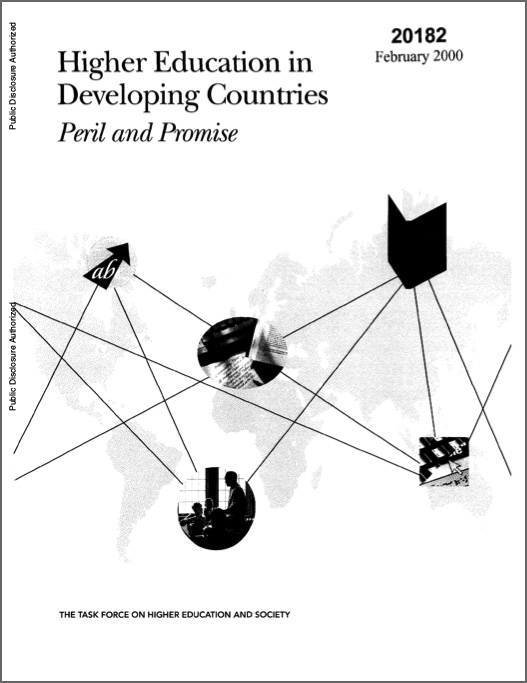
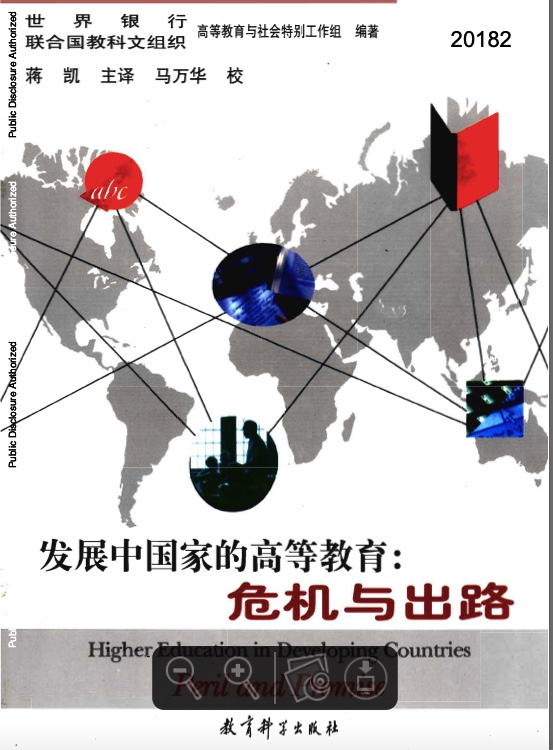
“This publication reports on 18 months of research, debate, and deliberation by the Task Force on Higher Education and Society, convened by the World Bank and UNESCO, to bring together experts from 13 countries to explore the future of higher education in developing nations.”
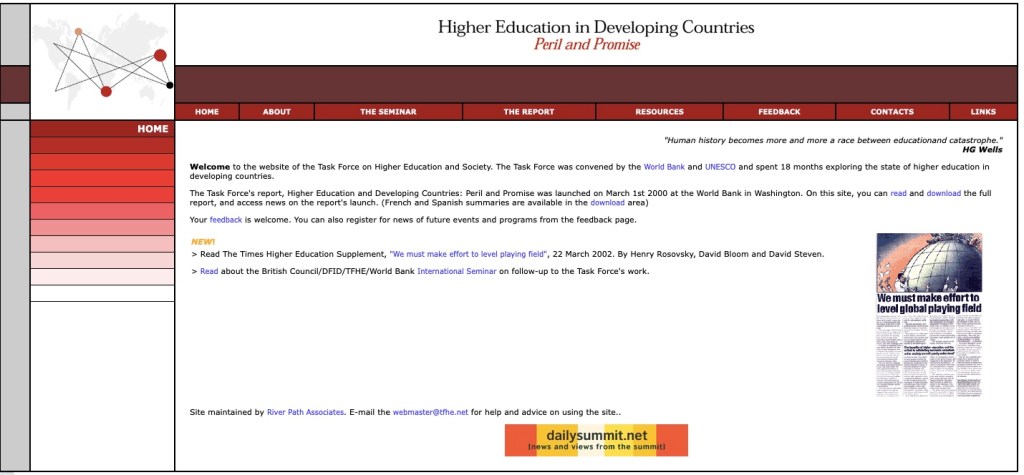
In 1999 I began work on the communications strategy as well as editing the expert contributions for the Task Force on Higher Education and Society’s report, Higher Education in Developing Countries: Peril and Promise (2000). The brief was to unpack the report and present its findings in a web-friendly format. At the time, it was still rare to see reports made user friendly for the world’s web audience. As a survey in 2014 discovered, a shocking third of the World Bank’s publications are never downloaded, 40 per cent were downloaded just 100 times, and only 13 per cent were downloaded more than 250 times in their lifetime (The Washington Post).
Expertise: Project evaluation, strategy, project management, project delivery, UN system, MDGs, research papers, media strategies and digital media strategies.
Locations: Ulaanbaatar, Mongolia, Kiev, Ukraine, Pretoria, South Africa, Ashgabat, Turkmenistan 2000 to 2006
From 1999, I worked as a consultant for United Nations (UN) missions in Africa, Asia, Central Asia and Eastern Europe, for USAID Mongolia and for a UK-based international development consultancy.
About
Was the United Nations being effective and reflecting the potential for change in the mobile and information technology age? What needed to change? Who were the policy innovators?
This work included overseeing various digital media projects, including the strategic re-development of the UN Ukraine web portal, aiding in the rolling out of the media campaign for the Millennium Development Goals (MDGs) in Mongolia, including the first use of infographics in the Mongolia UN mission, advising on strategies for youth engagement in development goals in South Africa, and support to the UN mission in Turkmenistan as it finalised its United Nations Development Assistance Framework (UNDAF) with the government and also work with UNICEF there. What I learned during this period proved crucial to the insights and thinking reflected in two highly influential United Nations publications, e-newsletter Development Challenges, South-South Solutions, and Southern Innovator magazine (developed in 2010).
This period was particularly advantageous because I had a front-row seat to the unfolding digital and mobile information technology revolution sweeping across the emerging markets and the global South. I also had insight into what worked and didn’t in international development as well as the UN system. I also learned a great deal about development challenges first-hand in highly varied countries, how the Millennium Development Goals (MDGs) were actually being rolled out, and met amazing people who were challenging existing precepts on how to do development. All of this work proved very useful later on.
I have either travelled to, or worked and lived, in many countries, enhancing my global perspective and affording me a valuable trove of knowledge that has in turn informed my work in international development. I have always paid attention to the level of development in the country, how it has organized itself, the quality of its design, and how it interacts with other countries for trade and relations. The countries visited to date include: Antigua and Barbuda, Australia, Azerbaijan, Belgium, Canada, China, Cuba, Denmark, Domenica, Finland, France, Germany, Greece, Guadalupe, Haiti, Hong Kong, Iceland, Ireland, Israel, Italy, Japan, Kenya, Luxembourg, Malaysia, Mexico, Monaco, Mongolia, Montseratt, Morocco, the Netherlands, Norway, Philippines, Portugal, Russia, Singapore, South Africa, South Korea, Spain, Sweden, Switzerland, Thailand, Tunisia, Turkey, Turkmenistan, Ukraine, the United Kingdom, the United States of America, Vatican City. A fascinating mix of countries – some holders of top place on the UN’s Human Development Index – and others where human development is at its worst. Seeing with your own eyes what works and what does not is highly illuminating, while knowing first-hand how human development can be improved is critical for giving informed advice.
Timeline
1999/2000: USAID Mongolia (design and publicity strategy for business development brochure, US Mongol (Mongolia) Construct and US tour, work with Riverpath Associates in the UK on communications strategies and the drafting of papers for the American Foundation for AIDS Research, the Global Fund to Fight AIDS, Tuberculosis and Malaria, UNCTAD, Harvard Institute for International Development, and the preparation of the report and launch strategy for the World Bank’s Task Force on Higher Education.
2000: UN Ukraine: strategic re-development of the UN Ukraine web portal and incorporation of the Millennium Development Goals (MDGs).
2004: UN Mongolia (media campaign for MDGs) and UN South Africa (evaluation of youth NGO associated with the University of Pretoria and its projects and providing a strategic marketing plan).
2005: UN Mongolia (media campaign for MDGs) and UN Turkmenistan (finalising its United Nations Development Assistance Framework – UNDAF).
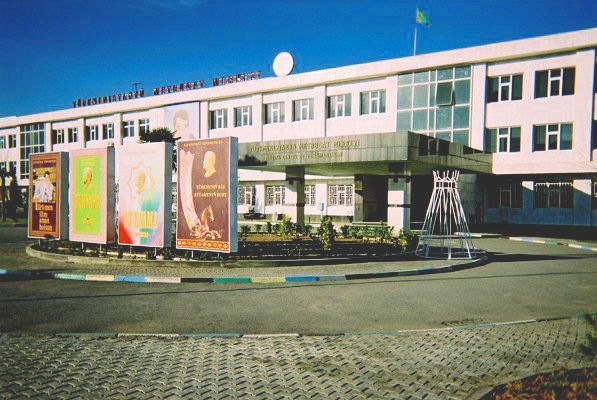
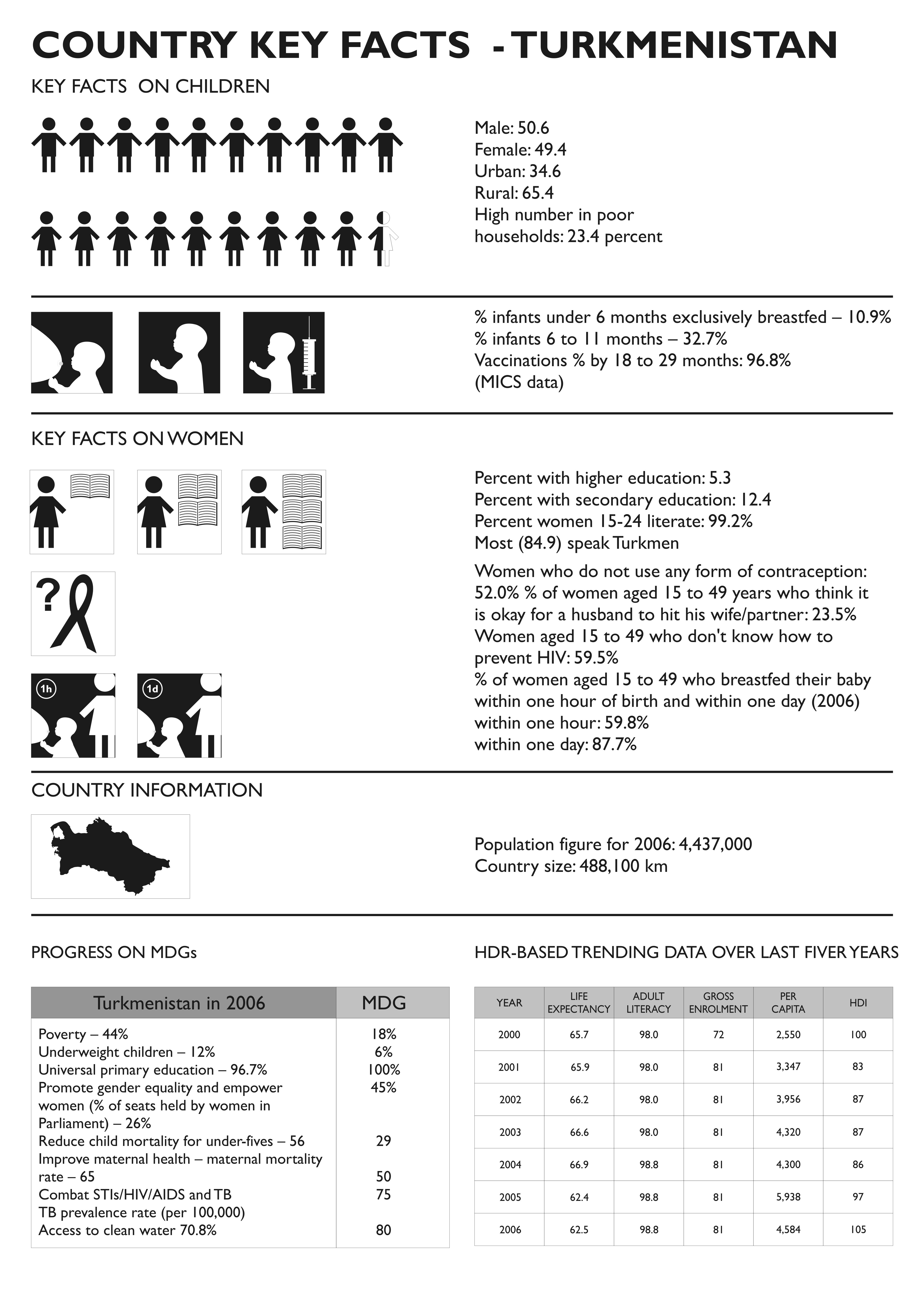
Rukhnama publishers in Turkmenistan’s capital, Ashgabat (2005). Photo: David SouthAn infographic commissioned for UN Turkmenistan MDGs report (2006).
“I highly recommend Mr. David South as a communications consultant who gets results.” Brian DaRin, Representative/Director, USAID Investment & Business Development Project, Global Technology Network/ International Executive Service Corps-Mongolia, 23 September 1999
Impact
Micro
working as a communications consultant for UN missions – Ukraine, South Africa, Mongolia, Turkmenistan
redeveloping mission websites, preparing content, reports, advising on communications strategy
working with local designers on new ways to present development data through inforgraphics (2005/2006)
Macro
in the course of travel and work, seeing the unfolding impact of the global communications revolution, in particular the rapid roll-out and take-up of mobile technologies, and the urgent need for the UN system to take this on board. Also witnessed firsthand the grassroots solutions revolution brought about by information and mobile technologies and the Internet, which needed to be fully embraced by the UN
Resources
A Marketing and e-Marketing Strategy – the New SASVO, Prepared from December 2004 to February 2005 for the Southern African Student Volunteers (University of Pretoria).








 David South Consulting
You must be logged in to post a comment.