Categories
Archive Blogroll Now Magazine

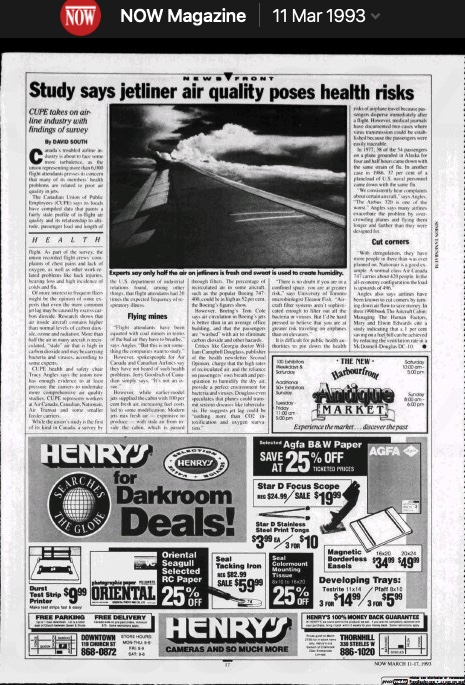
Study Says Jetliner Air Quality Poses Health Risks: CUPE Takes On Airline Industry With Findings Of Survey

By David South

Now Magazine (Toronto, Canada), March 11-17, 1993

Canada’s troubled airline industry is about to face some more turbulence, as the union representing more than 6,000 flight attendents presses its concern that many of its members’ health problems are related to poor air quality in jets.

The Canadian Union of Public Employees (CUPE) says its locals have compiled data that paints a fairly stale profile of in-flight air quality and its relationship to altitude, passenger load and length of flight. As part of the survey, the union recorded flight crews’ complaints of chest pains and lack of oxygen, as well as other work-related problems like back injuries, hearing loss and high incidence of colds and flu.

Of more interest to frequent fliers might be the opinion of some experts that even the more common jet lag may be caused by excess carbon dioxide, ozone and radiation. More than half the air in many aircraft is recirculated, “stale” air that is high in carbon dioxide and may be carrying bacteria and viruses, according to some experts.

CUPE health and safety chair Tracy Angles says the union now has enough evidence to at least pressure the carriers to undertake more comprehensive air quality studies. CUPE represents workers at Air Canada, Canadian, Nationair, Air Transat and some smaller feeder carriers.

While the union’s study is the first of its kind in Canada, a survey by the US department of industrial relations found, among other things, that flight attendents had 20 times the expected frequency of respiratory illness.

Flying mines

“Flight attendants have been equated with coal miners in terms of the bad air they have to breathe,” says Angles. “But this is not something the companies want to study.”

However, spokespeople for Air Canada and Canadian Airlines say they have not heard of such health problems. Jerry Goodrich of Canadian simply says, “It’s not an issue.”

However, while earlier-model jets supplied the cabin with 100 per cent fresh air, increasing fuel costs led to some modification. Modern jets mix fresh air – expensive to produce – with stale air from inside the cabin, which is passed through filters. The percentage of recirculated air in some aircraft, such as the popular Boeing 747-400, could be as high as 52 per cent, Boeing’s figures show.

Boeing’s Tom Cole says air circulation in Boeing’s jets is better than in an average office building, and that the passengers are “washed” with air to eliminate carbon dioxide and other hazards.

Critics like Georgia doctor William Campbell Douglass, publisher of the health newsletter Second Opinion, charge that the high rates of recirculated air, and the reliance on passengers’ own breath and perspiration to humidify the dry air, provide a perfect environment for bacteria and viruses. Douglass even speculates that planes could transmit serious diseases like tuberculosis. He suggests jet leg could be “nothing more than CO2 intoxification and oxygen starvation.”

“There is no doubt if you are in a confined space, you are at greater risk,” says University of Toronto microbiologist Eleanor Fish. “Aircraft filter systems aren’t sophisticated enough to filter out all the bacteria and viruses. But I’d be hard pressed to believe that you are at greater risk traveling on airplanes than on elevators.”

It is difficult for public health authorities to pin down the health risks of airplane travel because passengers disperse immediately after a flight. However, medical journals have documented two cases where virus transmission could be established because the passengers were easily traceable.

In 1977, 38 of the 54 passengers on a plane grounded in Alaska for a four and a half hours came down with the same strain of flu.

“We consistently hear complaints about certain aircraft,” says Angles. “The Airbus 320 is one of the worst.”

Angles says many airlines exacerbate the problem by over-crowding planes and flying them longer and farther than they were designed for.

Cut corners

“With deregulation, they have more people in there than was ever planned on. Nationair is a good example. A normal class Air Canada 747 carries about 420 people. In the all-economy configuration the load is upwards of 496.”

Angles also says airlines have been known to cut corners by turning down air flow to save money. In their 1990 book The Aircraft Cabin: Managing the Human Factors, Mary and Elwin Edwards cite a study indicating a 1 per cent saving on a fuel bill can be achieved by reducing the ventilation rate in a McDonnel-Douglas DC-10.


More resources: 

April 2021

Airqualitynews.com Terror at 20,000 feet

A new global campaign and film asks whether the air we breathe on commercial flights is as safe as we think it is.

Another issue, which frequently gets overlooked, is the quality of the air passengers breathe onboard

In February, a global campaign was launched by the Global Cabin Air QualityExecutive (GCAQE), which called for the mandatory introduction of effective filtration and warning systems, to be installed on all commercial passenger jet aircraft.

According to the GCAQE, there have been 50 recommendations and findings made by 12 air accident departments globally over the last 20 years, directly related to contaminated air exposures on passenger jet aircraft.

However, commercial aircraft continue to fly, with no contaminated air warning systems to inform passengers and crews when the air they are breathing is contaminated.”

Jetliner Cabins Are Quickly Cleared of Virus, Pentagon Says

“Particles the size of the new coronavirus are quickly purged from a commercial aircraft cabin, according to a U.S. Defense Department study touted by United Airlines Holdings Inc. in its effort to reassure wary travelers.

Filtration systems and rapid air-exchange rates mean that only about 0.003% of infected particles entered a masked passenger’s breathing zone, said the report, released Thursday.”

Aircraft Air Quality – Protecting Against Contaminants, Association of Flight Attendants

“On October 5, 2018, a 5-year FAA bill became law. Included in the bill is a study on technologies to combat contaminated bleed air. This is significant progress!”

‘Contaminated air’ on planes linked to health problems, 21 June 2017

AEROTOXIC SYNDROME: A NEW OCCUPATIONAL DISEASE?, Public Health Panorama, Volume 3, Issue 2, June 2017

Influenza Air Transmission, Influenza A (H1N1) Blog, September 28, 2009

“What does this tell us? Aerosols, very small particles of saliva containing the virus we exhale when we sneeze or even when we breathe if we have the flu, probably have an important role in the transmission of influenza. In addition to that we have public transportation, with a great number of people circulating in a place that may be closed and badly ventilated at times and we may have a notion of the importance of public campaigns that promote education and awareness of contaminated people to avoid leaving their homes when they have the flu and that they cover their mouth and nose with a disposable tissue when they sneeze and discard it right after that.”

2006

Tuberculosis and Air Travel: Guidelines for Prevention and Control

“The revised International Health Regulations, adopted in 2005, provide a legal framework for a more effective coordinated international response to emergencies caused by outbreaks of infectious diseases. A number of provisions are relevant to the detection and control of TB during air travel, strengthening the authority of WHO and of national public health authorities in this domain. Because of these important developments since the original guidelines were issued in 1998, WHO has prepared this revised version to take account of current public health risks that may arise during air travel and new approaches to international collaboration in dealing with them. The guidelines were developed with the collaboration of international experts in air travel medicine and other authorities. Implementing the recommendations will help to reduce the spread of dangerous pathogens across the globe and decrease the risk of infection among individual travellers.

An outbreak of influenza aboard a commercial airliner, American Journal of Epidemiology, Volume 110, Issue 1, July 1979

“A Jet airliner with 54 persons aboard was delayed on the ground for three hours because of engine failure during a takeoff attempt. Most passengers stayed on the airplane during the delay. Within 72 hours, 72 per cent of the passengers became III with symptoms of cough, fever, fatigue, headache, sore throat and myalgia. One passenger, the apparent Index case, was III on the airplane, and the clinical attack rate among the others varied with the amount of time spent aboard. Virus antigenlcally similar to A/Texas/1/ (H3N2) was Isolated from 8 of 31 passengers cultured, and 20 of 22 ill persons tested had serologic evidence of infection with this virus. The airplane ventilation system was inoperative during the delay and this may account for the high attack rate.”

The Airliner Cabin Environment and the Health of Passengers and Crew.

“At the end of its review of health data in the 1986 report The Airliner Cabin Environment: Air Quality and Safety, the National Research Council (NRC) committee concluded that “available information on the health of crews and passengers stems largely from ad hoc epidemiologic studies or case reports of specific health outcomes [and] conclusions that can be drawn from the available data are limited to a great extent by self-selection…and lack of exposure information” (NRC 1986). This chapter reviews data on possible health effects of exposure to aircraft cabin air that have emerged since the 1986 report and the emergence of data resources (e.g., surveillance systems) and studies that have particular relevance for the evaluation of potential health effects related to aircraft cabin air quality. Selected earlier sources are also reviewed. The decision to ban tobacco-smoking on domestic airline flights in 1987 and on flights into and out of the United States in 1999 reduces the relevance of some studies of exposures and reported signs and symptoms that clearly could have been related to the products of tobacco smoke.” 

ORCID iD: https://orcid.org/0000-0001-5311-1052.

© David South Consulting 2021

Categories
Archive Blogroll Hospital News

Changing Health Care Careers A Sign Of The Times

By David South

Hospital News (Canada), June 1992

Ontario’s health care system is in the midst of a big change. But where are the new jobs going to be and how can health care workers prepare for the coming crunch?

“Anybody who thought they could progress through the health care system until retirement is in for a shock,” said Ruth Robinson, a national health care consultant for Peat Marwick Stevenson and Kellogg management consultants. 

Radical changes are taking place in the health care system and it looks like traditionally safe occupations are in for a shake-up. 

“Hospitals are being pressured to change fundamentally,” said Ms. Robinson. “The net effect is fewer jobs. A lot of people will have to think about new careers.”

In the Ministry of Health working document entitled Goals and Strategic Priorities, released in January, the fundamental shift from treatment to disease prevention and health promotion is laid out in generalities. 

The goals range from health equity for aboriginals, women, children and AIDS patients to better management of costs to development of a stronger health care industry that will jump start the economy. And they range from the reorganization of professional responsibilities to promotion of services outside institutions with the goal of keeping people out of hospitals. 

One thing is clear, the talk is about big changes. But talk is cheap to laid-off health care workers looking for new jobs. 

The provincial government’s recently passed, but yet to be proclaimed, Regulated Health Professions Act will have serious repercusions for all health care providers. 

“Traditionally, doctors have an exclusive domain over a wide area,” said Charlie Bigenwald, executive director of health human resources planning at the Ministry of Health. “Even though other people could do things, they had to be delegated by a doctor. With the legislation, we have pushed back what doctors can do. This means there will be more opportunity for a wider variety of health care workers to get into those areas.”

Midwifery is one of the benefactors of changes in regulations. The Ministry of Health is looking into having a university-based program for midwives. 

Ms. Robinson predicted nurses and middle management will suffer the most in the change to community-based health care. 

“Nurses will need to get a bachelor degree if they hope to compete for jobs,” she said. 

As for middle managers, who often have clinical skills, they will have to reconsider staying in health care, she said. “They will disappear significantly. They can advance themselves by getting back to clinical skills or consider management positions in non-health care areas.

“There is nothing to be ashamed of about career changes these days,” she added. 

In the shift towards community-based care, opportunities will arise for health care workers who can offer creative solutions to improve service delivery. 

“For nurses, we currently have something called the Nursing Innovation Fund where individuals can apply for a wide variety of developmental things like attending workshops, conferences and training programs. We process 2,500 applications a year,” said Mr. Bigenwald. 

The Ministry of Health hopes the future sees a health care system that adds to the province’s economy rather than drains it. 

“We spend $17 billion a year on health care. We never looked at the health care system as an economic motor in the past. The question we are asking right now is ‘why can’t an Ontario firm make the carpets, beds, sutures etc?’, said Mr. Bigenwald. 

Ms. Robinson said “Governments are running out of money and can’t increase funding. They will be looking for more partnerships in the private sector. In this climate, creative solutions to health care delivery have a great opportunity.” 

Creative Commons License

This work is licensed under a
Creative Commons Attribution-Noncommercial-No Derivative Works 3.0 License.

ORCID iD: https://orcid.org/0000-0001-5311-1052.

© David South Consulting 2023

Categories
Archive Blogroll UB Post UNDP Mongolia 1997-1999

Philippine Conference Tackles Asia’s AIDS Crisis

Mongolians attend for first time

By David South

UB Post (Ulaanbaatar, Mongolia), October 28, 1997

Manila, Philippines – More than 2,500 delegates have gathered in the steamy hot Philippine capital to renew the fight against HIV and AIDS.

Working up a sweat alongside other participants at the Fourth International Congress on AIDS in Asia and the Pacific are nine Mongolians – a first that isn’t going unnoticed.

The Congress opened Saturday (October 25) to the pounding beat of a theme song performed by teenagers, championing defiance of death and celebration of life.

That tone was echoed by Dr Peter Piot, executive director of UNAIDS, the Joint United Nations Programme on HIV/AIDS. He said the epidemic can be slowed down with the right public health measures – a positive message for Mongolia as it grapples with an STD crisis that many believe leaves the country at risk of an HIV/AIDS epidemic.

The magnitude of that epidemic outside Mongolia is startling. Around the world, 23 million people are infected with HIV, the virus that causes AIDS. Between 5 and 7 million of them live in the Asia/Pacific region.

“The point is that prevention is feasible,” Piot told the Congress. “The results can be seen in those countries in the Asia-Pacific region where the epidemic has stalled or is in retreat.

“A good indicator for unsafe sexual behaviour is the STD rate. I am impressed at the sustained decline in STD rates in Australia, Hong Kong, Singapore and Thailand over the past decade.

“But I am concerned actual declines in HIV in this region have occurred only in Australia, New Zealand and Thailand.”

The countries to Mongolia’s immediate south and north are experiencing exploding health crises. In China, HIV/AIDS is increasing at a rapid rate due to factors including growing prostitution, drug use and travel – all by-products of a booming economy. The infected population is estimated at 400,000 and is expected to reach 1.2 million by the year 2000, according to China’s national AIDS committee.

To the north in Russia, a complete collapse in the public health system has dramatically slashed life expectancy and led to an upsurge in many diseases, including tuberculosis and HIV/AIDS.

With many Mongolians doing business in both these countries, there are numerous opportunities for AIDS to enter the country.

A wide range of topics is under discussion at the gathering, with women, youth and STD-control measures of particular interest to the Mongolian delegates.

For the Mongolians, the Congress is an opportunity to learn from other countries’ successes and failures in the fight against AIDS.

Mongolia’s nine-member delegation includes four doctors – Dr K. Davaajav, head of the AIDS/STD Department of the Research Centre for Infectious Diseases, Health Ministry representative Dr S. Enkhbat. Medical University director Dr Lkhagvasuren and Dr Darisuren from the United Nations Population Fund.

Also in the team are Democrat MPs B. Delgermaa and Saikhanbileg, UNICEF’s B. Bayarmaa and two representatives from women’s NGOs: S. Tsengelmaa from the Women’s Information and Research Centre and N. Chinchuluun, executive director of the Mongolian Women Lawyers Association.

On Sunday, several presentations focused on the difficulties of getting people to use condoms.

In Fiji, studies found the majority of the population was aware of AIDS and had access to condoms, but still chose not to use them.

Lisa Enriquez, a Filipino woman who is HIV-positive, gave a sobering speech on the epidemic.

“One of the most important things I’ve learned from the epidemic is human nature. AIDS is such a humanizing disease. It reminds us of being human, complete with all the weaknesses and imperfections of being human.

“Let us not kid ourselves: changing behaviour is not easy. One doesn’t change because somebody tells him or her to do so.

“We will need to get our act together, institutionalize our efforts and continue working harder with passion and perserverance.”

The Congress continues until October 30.

More on the Congress here: Fourth International Congress on AIDS in Asia and the Pacific

“The Fourth International Congress on AIDS and Asia in the Pacific convened 3,000 scientists, people working in the communities, and people living with HIV/AIDS to discuss the state of AIDS in Asia and the Pacific and how the problem is being addressed now and into the future. The following topics addressed at the Congress are explored: the extent of the HIV epidemic, HIV risk behaviors, women and HIV, clinical manifestations of HIV infection, antiretroviral therapy, and perinatal HIV transmission. HIV is spread differently among these countries and a nation’s wealth largely determines its ability to execute prevention programs and patient access to therapy. Most patients in Asia pay for their own medications. It is hoped that more prosperous and technologically advanced nations will demonstrate stronger leadership and commitment in the fight against AIDS in the region.” Phanuphak P. Fourth International Congress on AIDS in Asia and the Pacific. J Int Assoc Physicians AIDS Care. 1998 Feb;4(2):22-5. PMID: 11365085.

More on HIV/AIDS:

https://davidsouthconsulting.org/2020/12/18/feds-call-for-aids-blood-system-inquiry-some-seniors-infected/

https://davidsouthconsulting.org/2020/12/17/lamas-against-aids/

https://davidsouthconsulting.org/2017/08/15/mongolian-aids-bulletin/

https://davidsouthconsulting.org/2022/10/31/rainforest-rubbers-save-lives/

Creative Commons License

This work is licensed under a
Creative Commons Attribution-Noncommercial-No Derivative Works 3.0 License.

ORCID iD: https://orcid.org/0000-0001-5311-1052.

© David South Consulting 2023

Categories
Archive Development Challenges, South-South Solutions Newsletters Southern Innovator magazine

Two-stroke Engine Pollution Solution

By David SouthDevelopment Challenges, South-South Solutions

SOUTH-SOUTH CASE STUDY

Cities across the South choke on the pollution made by the small two-stroke engines (http://www.howstuffworks.com/two-stroke.htm) powering motor scooters, motorcycles, auto rickshaws, tuk-tuks and other vehicles. People choose these vehicles to get around because they are cheap, powerful and easy to fix. But the environment – and human health – suffers as a result. And as cities balloon and populations grow, the number of journeys and two-stroke engines grows with it.

In large cities across Asia, 1 million three-wheeled auto-rickshaws form an important means of daily transportation, and a source of income for their drivers. And the Asian Development Bank estimates there are over 100 million vehicles using two-stroke engines in Southeast Asia. But these vehicles cause serious air pollution and emissions of carbon dioxide (CO2), which contributes to global warming.

Because two-stroke engines burn an oil-gasoline mixture, they also emit more smoke, carbon monoxide, hydrocarbons and particulate matter than the gas-only, four-stroke engines found in newer vehicles.

In the Philippines, auto rickshaw drivers are pioneering specially adapted two-stroke engines that reduce particulate emissions by 70 percent and carbon dioxide emissions by 76 percent.

Tim Bauer, the 31-year-old American mechanical engineer who developed the technology, said auto rickshaws “play an essential role in the social and economic fabric. But their impact on public health is disastrous.”

Motorized tricycles produce an astonishing amount of pollution: each one is equivalent to 50 cars. In Bangkok, Thailand, two-stroke engines contribute 47 percent of pollution particulates in the air.

The World Health Organization (www.who.org) ranks urban outdoor air pollution as the 13th greatest contributor to disease burden and death worldwide. It has been estimated that the air pollution leads to the deaths of more than half a million people a year. About two-thirds of the residents of Delhi and Calcutta suffer from respiratory symptoms such as common cold and dry and wet cough, much of this caused by two-stroke engine emissions.

Two-stroke engines are highly inefficient users of fuel: up to 40 percent of the fuel and oil goes out of the exhaust pipe unburned. This exhaust is packed with oxides of carbon, nitrogen, sulphur, hydrocarbons and fine dust – all toxic contributors to air pollution.

But the attraction of these engines remains strong. “They are powerful, simple, reliable and robust,” said Bauer, “and spare parts are easy to find. They also have a long lifetime.”

Bauer faced some strict constraints in developing the technology.

“It had to substantially reduce emissions without impairing the engine’s performance. It had to be installed without machining the engine crankcase, and with only a basic tool set. Of course, it also had to be affordable for Filipino drivers.”

Using off-the-shelf components, Bauer developed a kit that turns two-stroke engines into fuel-injection machines. This adjustment reduced particulate emissions by 70 percent and carbon dioxide emissions by 76 percent. He now sells the kits through Envirofit, a non-profit organization (http://www.envirofit.org/). It has been pilot tested at two Filipino holiday resorts, Vigan and Puerto Princesa.

Auto-rickshaw drivers tend to be poor and earn on average US $3 to US $4 a day. The cost of fitting vehicles with Bauer’s new technology is met by microcredit.

“Drivers earn money daily, so it’s easy for them to pay back their loan, and 90 percent of them do it in less than a year,” he said. Over 260 taxi drivers have already installed the new kit.

“These drivers are at the base of the economic pyramid and these tricycles are a testament to their ingenuity and work ethic. At the end of the day, we can improve their lives with a cylinder head, a few brackets and, of course, hard work.”

Bauer pioneered his solution while working on fuel injection in snowmobiles at the Engines and Energy Conservation Lab at Colorado State University. He started to market the solution in Asia in 2004. Bauer has won a Rolex Award for Enterprise to pay for the distribution of the kits throughout Asia.

There is, of course, another solution: an outright ban or measures to push the vehicles off the road. In the Philippines’ San Fernando City, economic incentives were what drove the transition from two-stroke to four-stroke (less polluting) tricycles. In 2001, three-quarters of the city’s 1,600 registered tricycles ran on two-stroke engines. But after a city council mandate to totally phase out the vehicles by 2004, and offers of interest-free loans for down-payments on four-stroke models, more than 400 four-stroke tricycles had replaced the older two-stroke models.

When Bangkok toughened up vehicle inspections and emissions standards in 2000, two-wheelers made up over 96 percent of the city’s traffic. But by March 2004, they made up only 40 percent, according to Supat Wangwongwatana, deputy director general of Thailand’s Pollution Control Department.

Published: December 2008

Resources

  • Tukshop is a website selling auto rickshaws and tuk-tuks.  Website:http://www.tukshop.biz/
  • A wide range of auto rickshaws for sale.  Website: http://www.auto-rickshaw.com/ 
  • The Hybrid Tuk Tuk Battle is a competition to come up with less polluting auto rickshaws, clean up the air in Asian cities, and improve the economic conditions for auto rickshaw drivers. 
    Website:http://hybridtuktuk.com/
  • The Clean Air Initiative for Asian Cities promotes and demonstrates innovative ways to improve the air quality of Asian cities through partnerships and sharing experiences. It is run by the Asian Development Bank together with the World Bank and the US Agency for International Development. 
    Website: http://www.cleanairnet.org/

https://davidsouthconsulting.org/2023/02/03/environmental-public-awareness-handbook-case-studies-and-lessons-learned-in-mongolia/

https://davidsouthconsulting.org/2021/01/02/a-undp-success-story-grassroots-environmental-campaign-mobilizes-thousands-in-mongolia-1998/

https://davidsouthconsulting.org/2022/10/26/tackling-chinas-air-pollution-crisis-an-innovative-solution/

Creative Commons License

This work is licensed under a
Creative Commons Attribution-Noncommercial-No Derivative Works 3.0 License.

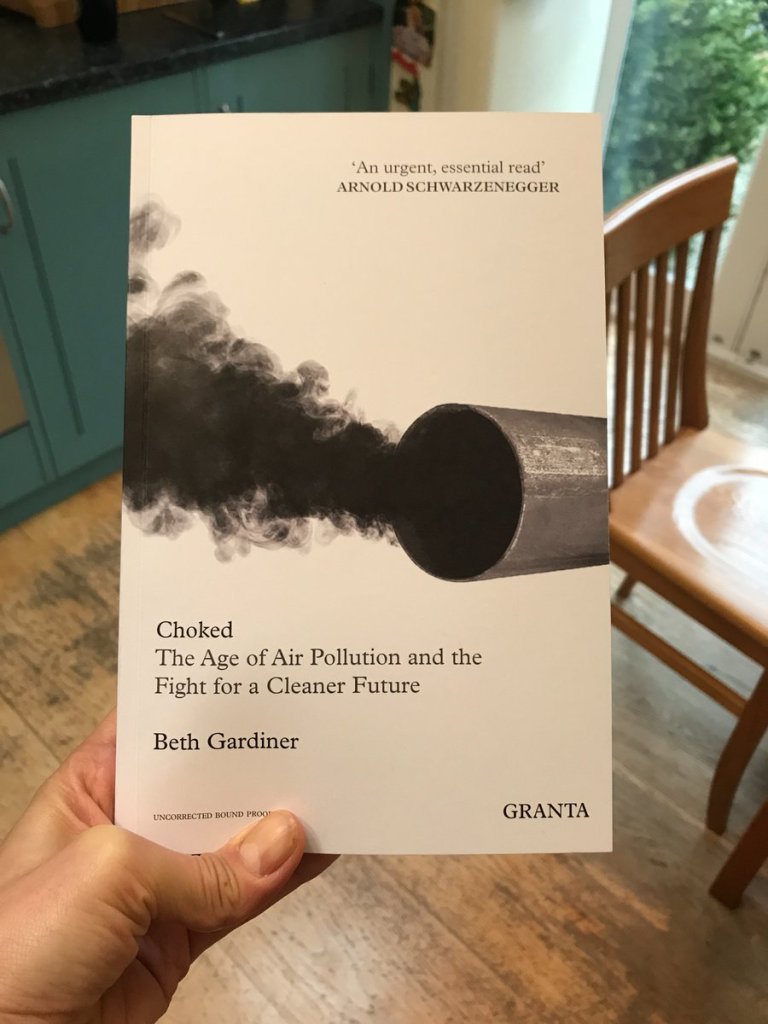
A new book launched in April 2019 by journalist Beth Gardiner (@Gardiner_Beth), “Choked: The Age of Air Pollution and the Fight for a Cleaner Future” (Granta) (University of Chicago Press), explores today’s global air pollution crisis in the world’s cities. Gardiner is an environmental journalist who writes for The New York Times, The Guardian and other publications (bethgardiner.com).  

Called “One of the Guardian’s Best Books of 2019“. The UK cover for Choked: The Age of Air Pollution and the Fight for a Cleaner Future (Granta, 2019).
Creative Commons License

This work is licensed under a
Creative Commons Attribution-Noncommercial-No Derivative Works 3.0 License.

ORCID iD: https://orcid.org/0000-0001-5311-1052.

© David South Consulting 2022