Tag: health

  • Indian Toilet Pioneer Champions Good Ideas

    Indian Toilet Pioneer Champions Good Ideas

    By David SouthDevelopment Challenges, South-South Solutions

    SOUTH-SOUTH CASE STUDY

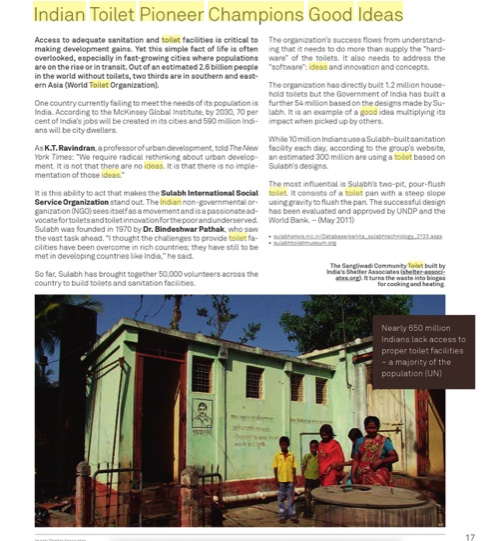
    Access to adequate sanitation and toilet facilities is critical to making development gains. Yet this simple fact of life often gets overlooked, especially in fast-growing cities where populations are on the rise or in transit. Out of an estimated 2.6 billion people in the world without toilets, two-thirds are in southern and eastern Asia (World Toilet Organization).

    It is easy to take toilet technology for granted in developed countries, but in the fast-growing urban world of the global South, increasing access will be the dividing line between a future of good human health and dignity, or misery and poor health. The biggest gains in human health always come about once people have access to clean water and sanitation. Yet this proven fact gets lost in many places for a wide variety of reasons.

    One country currently failing to meet the needs of its population is India. According to the McKinsey Global Institute, by 2030, 70 percent of India’s jobs will be created in its cities, and 590 million Indians will be city-dwellers. An enormous infrastructure task lies ahead for India: a city the size of Chicago needs to be built every year. But so far this challenge is not being met, leaving the country with the largest number of urban slum dwellers anywhere in the world. Housing is just not keeping up with populations’ needs.

    As K.T. Ravindran, a professor of urban development, told the New York Times: “We require radical rethinking about urban development. It is not that there are no ideas. It is that there is no implementation of those ideas.”

    It is this ability to act that makes the Sulabh International Social Service Organization stand out. The Indian non-governmental organization (NGO) sees itself as a movement and is a passionate advocate for toilets and toilet innovation for the poor and underserved.

    Sulabh was founded in 1970 by Dr. Bindeshwar Pathak, who saw the vast task ahead. “I thought the challenges to provide toilet facilities have been overcome in rich countries; it has still to be met in developing countries like India,” he said.

    So far, Sulabh has brought together 50,000 volunteers across the country to build toilets and sanitation facilities.

    The organization’s success flows from understanding that it needs to do more than supply the ‘hardware’ of the toilets; it also needs to address the ‘software’: ideas and innovation and concepts.

    The organization has directly built 1.2 million household toilets – but the government of India has built a further 54 million toilets based on the designs made by Sulabh. It’s an example of a good idea multiplying its impact when picked up by others.

    While 10 million Indians use a Sulabh-built sanitation facility each day, according to the group’s website, an estimated 300 million are using a toilet based on Sulabh’s designs.

    Most influential is Sulabh’s two-pit, pour-flush toilet (www.sulabhenvis.nic.in/Sulabhtechnology.htm). It consists of a toilet pan with a steep slope using gravity to flush the pan. Water is poured in to the pan to flush the toilet and the waste goes into either one of two pits. As one pit fills up with waste, waste is diverted to the second pit. After around 18 months, the first, filled pit’s waste becomes a safe, organic fertiliser suitable for agriculture and the fertiliser’s value covers the cost of emptying the pit. The successful design has been evaluated and approved by UNDP and the World Bank.

    Sulabh has also been designing ways to get power and energy from toilets, building 200 biogas plants that turn the gas generated from the human excrement deposited in the toilets into a source of energy. Biogas (http://en.wikipedia.org/wiki/Biogas) is a clean-burning gas that can be made from animal, plant and human waste with the right technology and is a green solution to the need for gas to cook and run electricity generators.

    Pride of place for the NGO is its vast toilet and bath complex at the holy shrine of Shri Sai Baba in Shirdi, Maharashtra (http://en.wikipedia.org/wiki/Maharashtra). Millions flock to the shrine every year, but it lacked proper sanitation facilities. To solve this problem Sulabh’s local branch has built a vast complex occupying two acres. The brightly coloured and palace-like facility has 120 toilets, 108 bathing cubicles, six dressing rooms, and urinals and can serve 30,000 people a day. There are telephones and 5,000 lockers for tourists to keep possessions safe.

    There are also three biogas plants connected to the facility, generating electricity and hot water for bathing used by the toilet and bath complex. This solves the puzzle of how to fund the utilities. Water discharged from the facility is used to irrigate the surrounding green spaces.

    Sulabh has also built a museum dedicated to toilets and toilet technology (http://www.sulabhtoiletmuseum.org). The museum places the toilet as a critical part of human civilisation and shows how it fits in with the cultural context of India. Toilets and toilet designs from around the world and throughout history are gathered together and make a fascinating journey through this essential human need.

    Published: May 2011

    Resources

    1) World Toilet Organization: World Toilet Organization (WTO) is a global non- profit organization committed to improving toilet and sanitation conditions worldwide. Website: http://www.worldtoilet.org

    2) World Toilet Day: On November 19 every year, this event draws attention to the lack of access for 2.6 billion people. Website: http://www.worldtoilet.org

    3) Dirt: The Filthy Reality of Everyday Life: An exhibit by the prestigious Wellcome Collection on the human relationship with dirt and hygiene in history. Website:http://www.wellcomecollection.org/whats-on/exhibitions/dirt.aspx

    4) World Toilet College: Established in 2005, the World Toilet College (WTC) started as a social enterprise, with the belief that there is need for an independent world body to ensure the best practices and standards in Toilet Design, Cleanliness, and Sanitation Technologies are adopted and disseminated through training. Website:http://worldtoilet.org/ourwork3.asp

    Development Challenges, South-South Solutions was launched as an e-newsletter in 2006 by UNDP’s South-South Cooperation Unit (now the United Nations Office for South-South Cooperation) based in New York, USA. It led on profiling the rise of the global South as an economic powerhouse and was one of the first regular publications to champion the global South’s innovators, entrepreneurs, and pioneers. It tracked the key trends that are now so profoundly reshaping how development is seen and done. This includes the rapid take-up of mobile phones and information technology in the global South (as profiled in the first issue of magazine Southern Innovator), the move to becoming a majority urban world, a growing global innovator culture, and the plethora of solutions being developed in the global South to tackle its problems and improve living conditions and boost human development. The success of the e-newsletter led to the launch of the magazine Southern Innovator. 

    Creative Commons License

    This work is licensed under a
    Creative Commons Attribution-Noncommercial-No Derivative Works 3.0 License.

    ORCID iD: https://orcid.org/0000-0001-5311-1052.

    © David South Consulting 2023

  • Dodging the health insurance minefield

    Dodging the health insurance minefield

    By David South

    Today’s Seniors (Canada), 1992

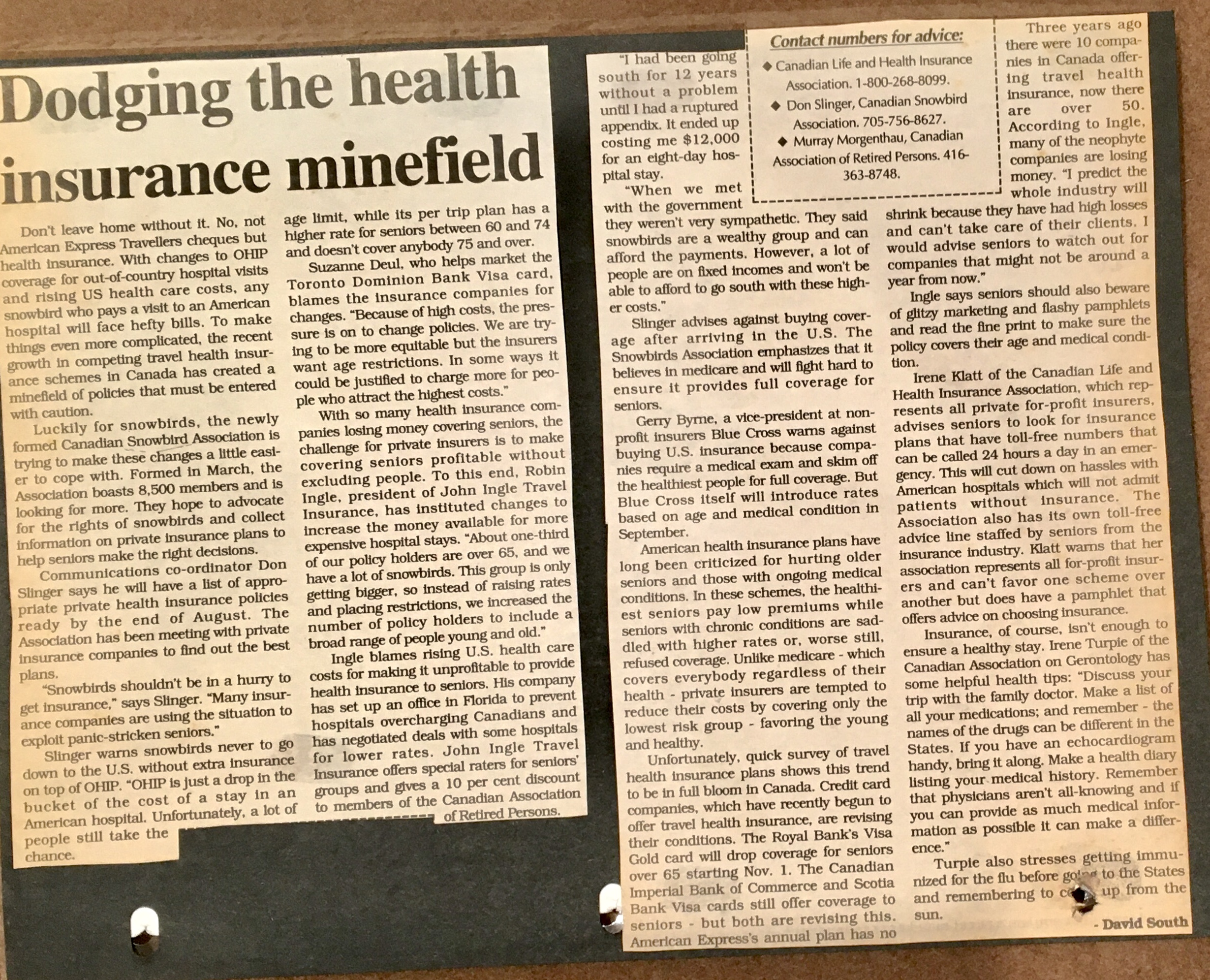
    Don’t leave home without it. No, not American Express Travellers cheques but health insurance. With changes to OHIP coverage for out-of-country hospital visits and rising U.S. health care costs, any snowbird who pays a visit to an American hospital will face hefty bills. To make things even more complicated, the recent growth in competing travel health insurance schemes in Canada has created a minefield of policies that must be entered with caution.

    Luckily for snowbirds, the newly formed Canadian Snowbird Association is trying to make these changes a little easier to cope with. Formed in March, the Association boasts 8,500 members and is looking for more. They hope to advocate for the rights of snowbirds and collect information on private insurance plans to help seniors make the right decisions.

    Communications co-ordinator Don Slinger says he will have a list of appropriate private health insurance policies ready by the end of August. The Association has been meeting with private insurance companies to find out the best plans.

    “Snowbirds shouldn’t be in a hurry to get insurance,” says Slinger. “Many insurance companies are using the situation to exploit panic-stricken seniors.”

    Slinger warns snowbirds never to go down to the U.S. without extra insurance on top of OHIP. “OHIP is just a drop in the bucket of the cost of a stay in an American hospital. Unfortunately, a lot of people still take the chance.

    “I had been going south for 12 years without a problem until a ruptured appendix. It ended up costing me $12,000 for an eight-day hospital stay.

    “When we met with the government they weren’t sympathetic. They said snowbirds are a wealthy group and can afford the payments. However, a lot of people are on fixed incomes and won’t be able to afford to go south with these higher costs.”

    Slinger advises against buying coverage after arriving in the U.S. The Snowbirds Association emphasizes that it believes in medicare and will fight hard to ensure it provides full coverage for seniors.

    Gerry Byrne, a vice-president at non-profit insurers Blue Cross warns against buying U.S. insurance because companies require a medical exam and skim off the healthiest people for full coverage. But Blue Cross itself will introduce rates based on age and medical conditions in September.

    American health insurance plans have long been criticized for hurting older seniors and those with ongoing medical conditions. In these schemes, the healthiest seniors pay low premiums while seniors with chronic conditions are saddled with higher rates or, worse still, refused coverage. Unlike medicare – which covers everybody regardless of their health – private insurers are tempted to reduce their costs by covering only the lowest risk group – favouring the young and healthy.

    Unfortunately, a quick survey of travel health insurance plans shows this trend to be in full bloom in Canada. Credit card companies, which have recently begun to offer travel health insurance, are revising their conditions. The Royal Bank’s Visa Gold card will drop coverage for seniors over 65 starting Nov. 1. The Canadian Imperial Bank of Commerce and Scotia Bank Visa cards still offer coverage to seniors – but both are revising this. American Express’s annual plan has no age limit, while its per trip plan has a higher rate for seniors between 60 and 74 and doesn’t cover anybody 75 and over.

    Suzanne Deul, who helps market the Toronto Dominion Bank Visa card, blames the insurance companies for changes. “Because of high costs, the pressure is on to change policies. We are trying to be more equitable but the insurers want age restrictions. In some ways it could be justified to charge more for people who attract higher costs.”

    With so many health insurance companies losing money covering seniors, the challenge for private insurers is to make covering seniors profitable without excluding people. To this end, Robin Ingle, president of John Ingle Travel Insurance, has instituted changes to increase the money available for more expensive hospital stays.

    “About one-third of our policy holders are over 65, and we have a lot of snowbirds. This group is only getting bigger, so instead of raising rates and placing restrictions, we increased the number of policy holders to include a broad range of people young and old.”

    Ingle blames rising U.S. health care costs for making it unprofitable to provide health insurance to seniors. His company has set up an office in Florida to prevent hospitals overcharging Canadians and has negotiated deals with some hospitals for lower rates. John Ingle Travel Insurance offers special rates for seniors’ groups and gives a 10 per cent discount to members of the Canadian Association of Retired Persons.

    Three years ago there were 10 companies in Canada offering travel insurance; now there are over 50.

    According to Ingle, many of the neophyte companies are losing money. “I predict the whole industry will shrink because they have had high losses and can’t take care of their clients. I would advise seniors to watch out for companies that might not be around a year from now.”

    Ingle says seniors should also beware of glitzy marketing and flashy pamphlets and read the fine print to make sure the policy covers their age and medical condition.

    Irene Klatt of the Canadian Life and Health Insurance Association, which represents all private for-profit insurers, advises seniors to look for insurance plans that have toll-free numbers that can be called 24 hours a day in an emergency. This will cut down on hassles with American hospitals which will not admit patients without insurance. The Association also has its own toll-free advice line staffed by seniors from the insurance industry. Klatt warns that her association represents all for-profit insurers and can’t favor one scheme over another but does have a pamphlet that offers advice on choosing insurance.

    Insurance, of course, isn’t enough to ensure a healthy stay. Irene Turple of the Canadian Association on Gerontology has some helpful health tips: “Discuss your trip with the family doctor. Make a list of all your medications; and remember – the names of the drugs can be different in the States. If you have an echocardiogram handy, bring it along. Make a health diary listing your medical history. Remember that physicians aren’t all-knowing and if you can provide as much medical information as possible it can make a difference.”

    Turple also stresses getting immunized for the flu before going to the States and remembering to cover up from the sun.

    Creative Commons License

    This work is licensed under a
    Creative Commons Attribution-Noncommercial-No Derivative Works 3.0 License.

    ORCID iD: https://orcid.org/0000-0001-5311-1052.

    © David South Consulting 2022

  • Time-Tested Iranian Solutions to Cool and Refrigerate

    Time-Tested Iranian Solutions to Cool and Refrigerate

    By David SouthDevelopment Challenges, South-South Solutions

    SOUTH-SOUTH CASE STUDY

    Keeping food cool is critical for human health. No matter what the climate, a cool environment will prolong food preservation, stave off spoilage and lower the risk of food poisoning. This is crucial for the poor because it means they can reduce food waste and avoid illnesses caused by food poisoning. Diarrhea is a common problem when people do not have access to refrigeration for their food.

    Food security is also enhanced, as more can be stored and less thrown away as waste. Keeping food cool also means less need for preservation techniques, such as using salt, spices or smoke. Salt and smoke both can have adverse affects on human health. Salt increases sodium in the diet, which leads to high blood pressure, and smoke is a carcinogen which can lead to various forms of cancer.

    It is healthier to keep food in its natural state – and keep it cool.

    While the invention of the electric refrigerator was a major breakthrough, it requires a steady supply of electricity, which is expensive and difficult for many people.

    Various pre-electric refrigeration technologies have been developed over the centuries. Among them was a pioneering technology used in Persia (modern-day Iran) as far back as the 11th century (http://en.wikipedia.org/wiki/Avicenna). And now, it is being looked to once again today as a sustainable refrigeration solution that does not damage the environment.

    Iran’s solution involves creating a domed ice house made from earth bricks. Many ancient ice houses have been discovered on the edge of deserts, where ice was scarce and supplies remote. The solution was to create a dugout channel at the rear of a domed house and then flood the channel with water. When the temperature dropped at night in the desert, the water would freeze into ice.

    Rising early in the morning, the resident would break up the ice into blocks and store them inside the ice house. This was repeated night after night until there was enough ice in the house that it could last the summer months.

    The water was drawn from elaborate irrigation systems used for farming.

    The ice houses were cone and dome-shaped and included some with underground structures. To date, a project headed by Dr. Hemming Jorgensen has documented 129 centuries-old ice houses at the fringe areas of large deserts in Iran. Jorgensen, from the University of Copenhagen in Denmark, has documented the use of these structures on his “Ice Houses of Iran” website (http://www.hemmingjorgensen.com/).

    In 18th and 19th century England, ice houses were also common place in country estates to keep food cool in kitchens. Today, there are growing numbers of people around the world who are turning to technologies such as ice houses to find sustainable, non-electric, low-carbon alternatives to electric refrigeration.

    Another environmentally friendly cooling solution from Iran involves using wind catchers to circulate air during the hotter months. Called bagdir wind towers, or windcatchers (http://en.wikipedia.org/wiki/Windcatcher), they have been used in Yadz, Iran since the 19th century.

    Profiled in Green Building Magazine (http://www.greenbuildingpress.co.uk/product_details.php?category_id=10&item_id=235), the wind towers are made of stone, and channel wind down into a shaft to cool or heat the rooms below. It is an air circulation solution that does not take any energy – because it uses the wind – and is carbon neutral. In summer, the wind is drawn down into a stone chimney by low air pressure zones in the ventilation system. It is cooled, and then is circulated through the dwelling, rising as it warms up through the house. This is combined with a strategy of moving rooms depending on how hot or cool they are, adjusting clothing based on the temperature, or even placing water on the floor to cool the air.

    In Nigeria in West Africa, a cooler called the zeer (http://practicalaction.org/zeer-pots) has been developed. It works like this: two ceramic earthenware pots of different sizes are arranged one inside the other. The space between the pots is filled with wet sand and kept moist. The user then places drinks or vegetables inside and covers it with a damp cloth. As the water from the moist sand evaporates (http://en.wikipedia.org/wiki/Evaporation), the air inside the centre pot is cooled several degrees, enough to preserve some foods and drinks.

    Published: June 2013

    Resources

    1) ChotuKool fridge: The ChotuKool fridge is designed to stay cool for hours without electricity and to use half the power of conventional refrigerators. Priced at US $69, it is targeted at India’s poor. Website: (http://www.new.godrej.com/godrej/godrej/index.aspx?id=1)

    2) Ice house designs from the 18th and 19th century in the United Kingdom. Website: http://www.icehouses.co.uk/petworth.htm

    3) The High Desert Chronicles: “Sometimes you need to look back to move forward!”. Details use of contemporary ice houses in the desert for refrigeration. Website: http://www.highdesertchronicles.com/2012/10/ice-in-the-high-desert-without-electricity-or-refrigeration/

    4) History Magazine: The Impact of Refrigeration: The role played by refrigeration throughout human history. Website: http://www.history-magazine.com/refrig.html

    5) Methods of Alternative Refrigeration: Three solutions in detail. Website: http://www.provident-living-today.com/Alternative-Refrigeration.html

    Southern Innovator logo

    London Edit

    31 July 2013

    https://davidsouthconsulting.org/2022/10/05/cool-food-for-the-poor/

    https://davidsouthconsulting.org/2022/06/23/innovative-ways-to-collect-water-from-air/

    https://davidsouthconsulting.org/2022/10/24/iranian-savings-funds-to-tackle-loan-drought/

    https://davidsouthconsulting.org/2021/03/05/southern-innovator-issue-4/

    https://davidsouthconsulting.org/2021/03/05/southern-innovator-issue-5/

    https://davidsouthconsulting.org/2021/02/05/study-says-jetliner-air-quality-poses-health-risks-cupe-takes-on-airline-industry-with-findings-of-survey/

    https://davidsouthconsulting.org/2022/10/26/tackling-chinas-air-pollution-crisis-an-innovative-solution/

    Development Challenges, South-South Solutions was launched as an e-newsletter in 2006 by UNDP’s South-South Cooperation Unit (now the United Nations Office for South-South Cooperation) based in New York, USA. It led on profiling the rise of the global South as an economic powerhouse and was one of the first regular publications to champion the global South’s innovators, entrepreneurs, and pioneers. It tracked the key trends that are now so profoundly reshaping how development is seen and done. This includes the rapid take-up of mobile phones and information technology in the global South (as profiled in the first issue of magazine Southern Innovator), the move to becoming a majority urban world, a growing global innovator culture, and the plethora of solutions being developed in the global South to tackle its problems and improve living conditions and boost human development. The success of the e-newsletter led to the launch of the magazine Southern Innovator.  

    Creative Commons License

    This work is licensed under a
    Creative Commons Attribution-Noncommercial-No Derivative Works 3.0 License.

    ORCID iD: https://orcid.org/0000-0001-5311-1052.

    © David South Consulting 2023
  • Cashing in on Old Wisdom

    Cashing in on Old Wisdom

    By David SouthDevelopment Challenges, South-South Solutions

    SOUTH-SOUTH CASE STUDY

    India’s traditional weavers, heirs to a 2,000-year-old textile industry, are turning to the ancient practice of ayurvedic medicine to make their products more appealing and boost sales. Drawing on recipes once used by weavers to the Indian royal courts, clothes are woven and infused with ayurvedic, herb-and-spice medicinal recipes to address various health problems. Strange as it may sound, the health-giving properties of the clothes have been backed up by clinical trials at the Government Ayurveda College in Thiruvanathapuram, southern India.

    The college claims the trials were successful for 40 patients with rheumatism, allergies, hypertension, diabetes, psoriasis and other skin ailments. It is believed the healing properties of the herb-and-spice-infused clothes enter the skin and contribute to healing.

    Modern India’s founding father, Mahatma Gandhi, championed hand-spun cloth and weaving. But India’s weavers have been hit hard by the rise in the rupee against the dollar and an inability to compete internationally. They are facing stiff competition from a flood of machine-made cheap clothing. According to Siddique Hassan of the Weaver and Artisans Rights Front (WARF), 1 million of India’s 5 million weavers have lost their jobs because of competition (Deutsche Presse-Agentur).

    But rising interest in sustainability and natural healing is creating a growing global market for organic clothes – sales are set to triple to US $2.6 billion in 2008 (Organic Exchange).

    Against this backdrop, local governments have turned to traditional ayurvedic medicine to help save the livelihoods of handloom weavers and develop a market niche for their eco-friendly fabrics.

    In the technique called Ayurvastra, the clothes are dyed with herbal essences, infusing the cotton with the medicine. More than 200 herbs are used, mostly taken from roots, flowers, leaves, seeds and bark. Most of the clothes are made with cotton and silk, and some with wool and jute. A dress is marketed to people who suffer from hypertension. There are bedcovers, pillow covers, nightgowns, and even suits. It is believed the healing effect is best when the patient is sleeping.

    The clothes are made in Balaramapuram, home to traditional weaving in Kerala, southern India, and sell for between 1,000 and 1,800 rupees (US $25 to US $45). Ayurvastra clothing is currently being exported to the Middle East, the US, Italy, Germany, Britain, Singapore, Malaysia and Jordan.

    Acknowledging traditional medicine as a useful development tool goes back to the World Health Organisation’s Alma-Ata Declaration in 1978, which urged governments for the first time to include traditional medicine in their primary health systems and recognise traditional medicine practitioners as health workers. During the last 30 years there has been a considerable expansion in the use of traditional medicine across the world. Despite their ancient origins, it is still critical these medicines do meet efficacy and health standards and are proven to work.

    Ayurvastra is a branch of the 5,000-years-old Indian ayurveda health system. Ayur means health in Sanskrit, veda means wisdom, and vastra is cloth or clothing. There are no synthetic chemicals and toxic irritants and the technique uses organic cotton that has been hand loomed.

    “The entire process is organic,” said K. Rajan, chief technician at the Handloom Weavers Development Society in India, to Zee News. “The cloth is bleached with cow’s urine, which has high medicinal value. The dyeing gum too is herbal. It does not pollute like synthetic dye. And the waste is used as bio manure and to generate bio gas.”

    Chaitanya Arora of Penchant Traders, an Indian company promoting and exporting ayurvastra cloth and clothing, tells how it works: “usage of the cloth is based on the principle of touch. By coming in contact with ayurvastra, the body loses toxins and its metabolism is enhanced.”

    One clothes buyer, T D Kriplani, told Zee News, “Basically, I have read about the concept in newspapers… I was inquisitive and have also heard that it is in direct touch with body pores. I have come here after reading about it and hope it will benefit people.” It is even claimed the clothes can keep people cool.

    Another seller of ayurvastra, Hitesh, is enthusiastic about its impact: “The medicinal clothes that we have launched is a new revolution in the textile industry. In there, we dye the clothes with ayurvedic dyes and the clothes have medicinal qualities, which hopefully are good for diseases.”

    Published: February 2008

    Resources

    • Think! Clothing: A stylish UK-based designer using fair-trade, hand woven clothes from Indian women from the ‘untouchable’ caste.
    • An online shopping site based in Kerala, India offers a wide range of the ayurvastra clothing: http://www.ayurvastraonline.com/
    • Fibre2Fashion: An excellent web portal can be found here to connect weavers with the wider fashion industry – basically an online marketplace for making deals.
    • Asia-Pacific Traditional Medicine and Herbal Technology Network: an excellent first stop for any entrepreneur, where they can find out standards and regulations and connect with education and training opportunities: www.apctt-tm.net

    Creative Commons License

    This work is licensed under a
    Creative Commons Attribution-Noncommercial-No Derivative Works 3.0 License.

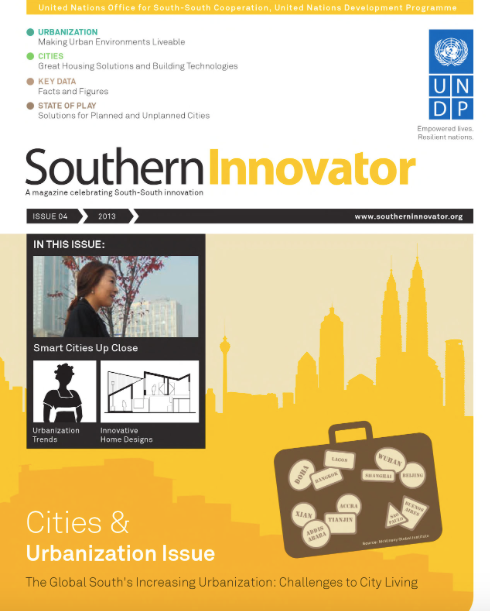
    Southern Innovator was initially launched in 2011 with the goal of inspiring others (just as we had been so inspired by the innovators we contacted and met). The magazine seeks to profile stories, trends, ideas, innovations and innovators overlooked by other media. The magazine grew from the monthly e-newsletter Development Challenges, South-South Solutions published by the United Nations Office for South-South Cooperation (UNOSSC) since 2006.

    Issue 6’s theme has been decided on: it will focus on Science, Technology and Innovation. For this issue, Southern Innovator is seeking invitations from cutting-edge knowledge and science innovators in the global South to view their work. Time is tight, so don’t miss this opportunity to let the whole global South know about your work. In the past, Southern Innovator has visited green pioneers in Cuba, a smart city in South Korea and an eco-city in China.

    Contact me if you wish to receive a copy/copies of the magazine for distribution. Follow @SouthSouth1.

    Southern Innovator Issue 1

    Southern Innovator Issue 2

    Southern Innovator Issue 3

    Southern Innovator Issue 4

    Southern Innovator Issue 5

    Southern Innovator Issue 6

    Innovator Stories and Profiles

    Citing Southern Innovator

    Finding Southern Innovator

    Press Release 1

    Press Release 2

    Press Release 3

    Southern Innovator Impact Summaries | 2012 – 2014

    ORCID iD: https://orcid.org/0000-0001-5311-1052.

    © David South Consulting 2021