Categories
Archive Today's Seniors

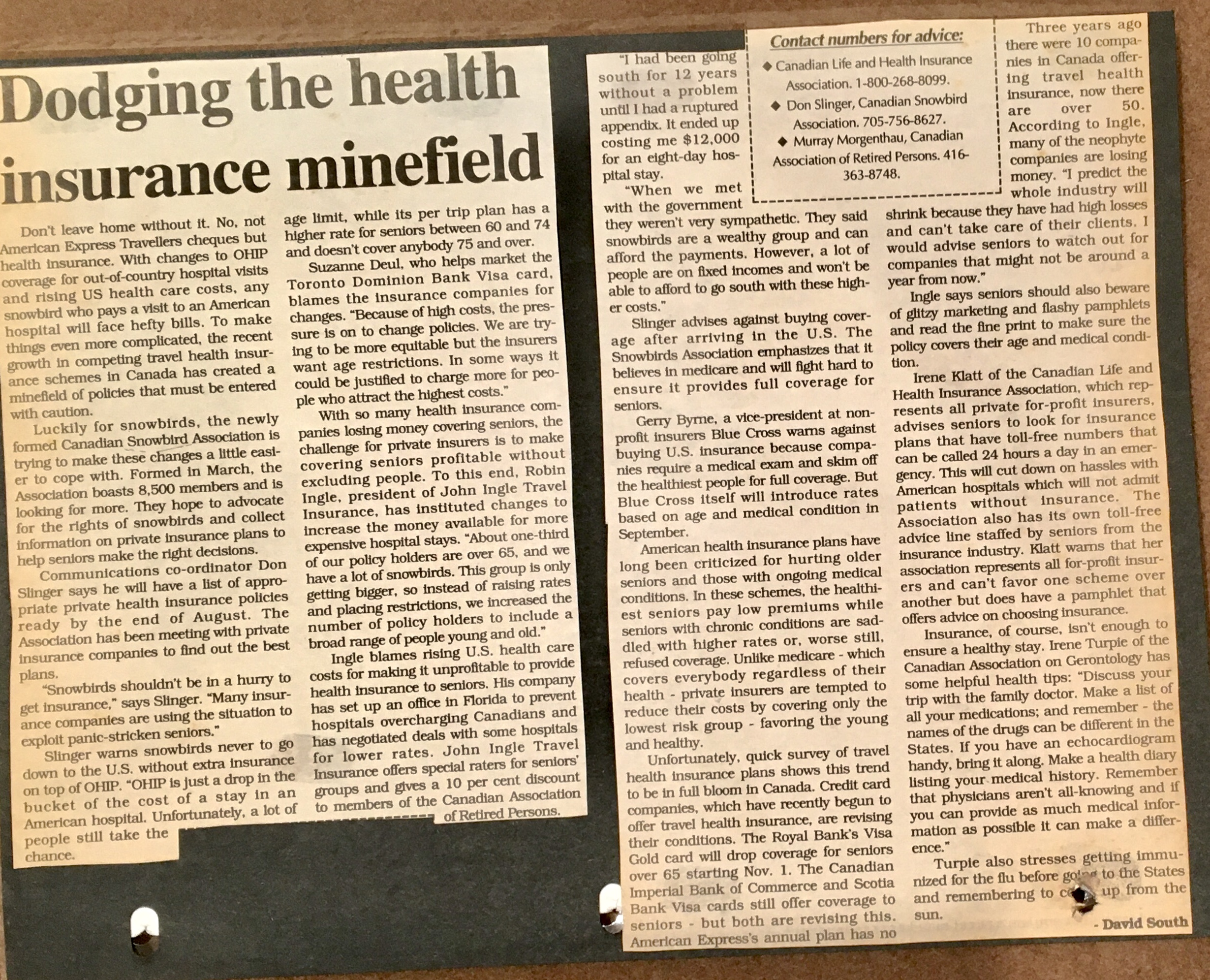
Dodging the health insurance minefield

By David South

Today’s Seniors (Canada), 1992

Don’t leave home without it. No, not American Express Travellers cheques but health insurance. With changes to OHIP coverage for out-of-country hospital visits and rising U.S. health care costs, any snowbird who pays a visit to an American hospital will face hefty bills. To make things even more complicated, the recent growth in competing travel health insurance schemes in Canada has created a minefield of policies that must be entered with caution.

Luckily for snowbirds, the newly formed Canadian Snowbird Association is trying to make these changes a little easier to cope with. Formed in March, the Association boasts 8,500 members and is looking for more. They hope to advocate for the rights of snowbirds and collect information on private insurance plans to help seniors make the right decisions.

Communications co-ordinator Don Slinger says he will have a list of appropriate private health insurance policies ready by the end of August. The Association has been meeting with private insurance companies to find out the best plans.

“Snowbirds shouldn’t be in a hurry to get insurance,” says Slinger. “Many insurance companies are using the situation to exploit panic-stricken seniors.”

Slinger warns snowbirds never to go down to the U.S. without extra insurance on top of OHIP. “OHIP is just a drop in the bucket of the cost of a stay in an American hospital. Unfortunately, a lot of people still take the chance.

“I had been going south for 12 years without a problem until a ruptured appendix. It ended up costing me $12,000 for an eight-day hospital stay.

“When we met with the government they weren’t sympathetic. They said snowbirds are a wealthy group and can afford the payments. However, a lot of people are on fixed incomes and won’t be able to afford to go south with these higher costs.”

Slinger advises against buying coverage after arriving in the U.S. The Snowbirds Association emphasizes that it believes in medicare and will fight hard to ensure it provides full coverage for seniors.

Gerry Byrne, a vice-president at non-profit insurers Blue Cross warns against buying U.S. insurance because companies require a medical exam and skim off the healthiest people for full coverage. But Blue Cross itself will introduce rates based on age and medical conditions in September.

American health insurance plans have long been criticized for hurting older seniors and those with ongoing medical conditions. In these schemes, the healthiest seniors pay low premiums while seniors with chronic conditions are saddled with higher rates or, worse still, refused coverage. Unlike medicare – which covers everybody regardless of their health – private insurers are tempted to reduce their costs by covering only the lowest risk group – favouring the young and healthy.

Unfortunately, a quick survey of travel health insurance plans shows this trend to be in full bloom in Canada. Credit card companies, which have recently begun to offer travel health insurance, are revising their conditions. The Royal Bank’s Visa Gold card will drop coverage for seniors over 65 starting Nov. 1. The Canadian Imperial Bank of Commerce and Scotia Bank Visa cards still offer coverage to seniors – but both are revising this. American Express’s annual plan has no age limit, while its per trip plan has a higher rate for seniors between 60 and 74 and doesn’t cover anybody 75 and over.

Suzanne Deul, who helps market the Toronto Dominion Bank Visa card, blames the insurance companies for changes. “Because of high costs, the pressure is on to change policies. We are trying to be more equitable but the insurers want age restrictions. In some ways it could be justified to charge more for people who attract higher costs.”

With so many health insurance companies losing money covering seniors, the challenge for private insurers is to make covering seniors profitable without excluding people. To this end, Robin Ingle, president of John Ingle Travel Insurance, has instituted changes to increase the money available for more expensive hospital stays.

“About one-third of our policy holders are over 65, and we have a lot of snowbirds. This group is only getting bigger, so instead of raising rates and placing restrictions, we increased the number of policy holders to include a broad range of people young and old.”

Ingle blames rising U.S. health care costs for making it unprofitable to provide health insurance to seniors. His company has set up an office in Florida to prevent hospitals overcharging Canadians and has negotiated deals with some hospitals for lower rates. John Ingle Travel Insurance offers special rates for seniors’ groups and gives a 10 per cent discount to members of the Canadian Association of Retired Persons.

Three years ago there were 10 companies in Canada offering travel insurance; now there are over 50.

According to Ingle, many of the neophyte companies are losing money. “I predict the whole industry will shrink because they have had high losses and can’t take care of their clients. I would advise seniors to watch out for companies that might not be around a year from now.”

Ingle says seniors should also beware of glitzy marketing and flashy pamphlets and read the fine print to make sure the policy covers their age and medical condition.

Irene Klatt of the Canadian Life and Health Insurance Association, which represents all private for-profit insurers, advises seniors to look for insurance plans that have toll-free numbers that can be called 24 hours a day in an emergency. This will cut down on hassles with American hospitals which will not admit patients without insurance. The Association also has its own toll-free advice line staffed by seniors from the insurance industry. Klatt warns that her association represents all for-profit insurers and can’t favor one scheme over another but does have a pamphlet that offers advice on choosing insurance.

Insurance, of course, isn’t enough to ensure a healthy stay. Irene Turple of the Canadian Association on Gerontology has some helpful health tips: “Discuss your trip with the family doctor. Make a list of all your medications; and remember – the names of the drugs can be different in the States. If you have an echocardiogram handy, bring it along. Make a health diary listing your medical history. Remember that physicians aren’t all-knowing and if you can provide as much medical information as possible it can make a difference.”

Turple also stresses getting immunized for the flu before going to the States and remembering to cover up from the sun.

Creative Commons License

This work is licensed under a
Creative Commons Attribution-Noncommercial-No Derivative Works 3.0 License.

ORCID iD: https://orcid.org/0000-0001-5311-1052.

© David South Consulting 2022

Categories
Archive Blogroll Today's Seniors

Health Care On The Cutting Block: Ministry Hopes For Efficiency With Search And Destroy Tactics

By David South

Today’s Seniors (Canada), August 1993

It’s search and destroy time at Ontario’s ministry of health: search out savings and destroy inefficiency and waste. But many remain apprehensive that not all the cuts are going to be logical and fear the province’s health and well-being will be affected. 

As part of the social contract deal, the Ontario Medical Association must find $20 million in cuts from the list of services covered by OHIP. The OMA and the provincial government are currently haggling over which procedures and examinations will be cut. 

“We look at services that aren’t medically necessary,” says health ministry spokesperson Layne Verbeek. “Because we were wealthier in the past, we were able to cover some services. We aren’t in that position now. But I don’t see how eliminating medically unnecessary treatments will affect the population.”

The fallout of the Rae government’s attempts to reign in costs and recover lost revenues may take years to unfold, but it is already apparent that Ontarians will be paying more. 

“Access to necessary treatment should not depend on a person’s ability to pay,” says health policy critic Carol Kushner. “What disturbs me about any delisting program is that virtually every medical service could be termed medially necessary. There are very few services that are an out-and-out waste of time.

“We often point to the fact that Ontario spends $200 million a year treating the common cold. Well, most of that is a waste of time. But delisting even that kind of service would be a detriment to the public’s health, because a small group of patients really do need to see a doctor when they have a cold.”

OMA spokesperson Jean Chow says it’s too early to pin down the exact cuts that will be made. “It’s a little premature to try and speculate what the final list will be.”

The newly-created Non-Tax Revenue Group is hard at work finding fees, fines and penalities the government can add or hike to boost revenue from this source from $5 billion to $10 billion a year. 

The spring budget saw the first hit, with the addition of $240 million in non-tax revenue. 

A radical reshaping of medicare is taking place. Private sector services – for which consumers pay directly or through insurance companies – now make up 34 per cent of Ontario’s health care funding, compared to 42 per cent in the United States, according to a recent study by the Canadian Medical Association. 

Health minister Ruth Grier has also floated the idea of widespread hospital closures. Both the Toronto and Windsor district health councils (DHCs) are carrying out feasibility studies on “reconfiguration.” The ministry is remaining tight-lipped about which hospitals will get the chop. 

“One suspects there’s room for efficiency – there are a lot of empty beds in a number of different places,” says ministry spokesperson Verbeek. 

“All hospitals are being reviewed, with a view to closing one or two hospitals,” says health planner Lisa Paolatto, who is working on a feasibility study on “reconfiguration” for the Essex County District Health Council, along with Toronto’s DHC. 

Closing hospitals could present a serious political hot potato for the government. In Britain, the Conservative government is still recovering from the bad feelings surrounding proposals to close world-renowned hospitals in the London area. The public feels great loyalty to local hospitals, a feeling that has been further fostered by hospital charities that raise millions a year from the communities’ good will. 

“This is going to open up new discussions of money between doctors and patients,” says Kushner. “Seniors are a unique group in Canada because they remember what it was like before medicare – what it was like not to be able to pay for the doctor, to forgo treatment that they thought was necessary. They understand the financial hardship that could occur if they were unlucky enough to have a family member who needs expensive medical treatment.” 

All Posts

More from Canada’s Today’s Seniors

Feds Call For AIDS, Blood System Inquiry: Some Seniors Infected

Government Urged To Limit Free Drugs For Seniors

Health Care On The Cutting Block: Ministry Hopes For Efficiency With Search And Destroy Tactics

New Seniors’ Group Boosts ‘Grey Power’: Grey Panthers Chapter Opens With A Canadian Touch

Seniors Falling Through The Health Care Cost Cracks

ORCID iD: https://orcid.org/0000-0001-5311-1052.

© David South Consulting 2021

Categories
Archive Blogroll Hospital News

Changing Health Care Careers A Sign Of The Times

By David South

Hospital News (Canada), June 1992

Ontario’s health care system is in the midst of a big change. But where are the new jobs going to be and how can health care workers prepare for the coming crunch?

“Anybody who thought they could progress through the health care system until retirement is in for a shock,” said Ruth Robinson, a national health care consultant for Peat Marwick Stevenson and Kellogg management consultants. 

Radical changes are taking place in the health care system and it looks like traditionally safe occupations are in for a shake-up. 

“Hospitals are being pressured to change fundamentally,” said Ms. Robinson. “The net effect is fewer jobs. A lot of people will have to think about new careers.”

In the Ministry of Health working document entitled Goals and Strategic Priorities, released in January, the fundamental shift from treatment to disease prevention and health promotion is laid out in generalities. 

The goals range from health equity for aboriginals, women, children and AIDS patients to better management of costs to development of a stronger health care industry that will jump start the economy. And they range from the reorganization of professional responsibilities to promotion of services outside institutions with the goal of keeping people out of hospitals. 

One thing is clear, the talk is about big changes. But talk is cheap to laid-off health care workers looking for new jobs. 

The provincial government’s recently passed, but yet to be proclaimed, Regulated Health Professions Act will have serious repercusions for all health care providers. 

“Traditionally, doctors have an exclusive domain over a wide area,” said Charlie Bigenwald, executive director of health human resources planning at the Ministry of Health. “Even though other people could do things, they had to be delegated by a doctor. With the legislation, we have pushed back what doctors can do. This means there will be more opportunity for a wider variety of health care workers to get into those areas.”

Midwifery is one of the benefactors of changes in regulations. The Ministry of Health is looking into having a university-based program for midwives. 

Ms. Robinson predicted nurses and middle management will suffer the most in the change to community-based health care. 

“Nurses will need to get a bachelor degree if they hope to compete for jobs,” she said. 

As for middle managers, who often have clinical skills, they will have to reconsider staying in health care, she said. “They will disappear significantly. They can advance themselves by getting back to clinical skills or consider management positions in non-health care areas.

“There is nothing to be ashamed of about career changes these days,” she added. 

In the shift towards community-based care, opportunities will arise for health care workers who can offer creative solutions to improve service delivery. 

“For nurses, we currently have something called the Nursing Innovation Fund where individuals can apply for a wide variety of developmental things like attending workshops, conferences and training programs. We process 2,500 applications a year,” said Mr. Bigenwald. 

The Ministry of Health hopes the future sees a health care system that adds to the province’s economy rather than drains it. 

“We spend $17 billion a year on health care. We never looked at the health care system as an economic motor in the past. The question we are asking right now is ‘why can’t an Ontario firm make the carpets, beds, sutures etc?’, said Mr. Bigenwald. 

Ms. Robinson said “Governments are running out of money and can’t increase funding. They will be looking for more partnerships in the private sector. In this climate, creative solutions to health care delivery have a great opportunity.” 

Creative Commons License

This work is licensed under a
Creative Commons Attribution-Noncommercial-No Derivative Works 3.0 License.

ORCID iD: https://orcid.org/0000-0001-5311-1052.

© David South Consulting 2023

Categories
Archive Blogroll Today's Seniors

Cut Services To Elderly, Says Doctors’ Survey… But Leave Our Salaries Alone!

“With a guaranteed income and job security, I don’t know one doctor who has suffered in the recession…”

By David South

Today’s Seniors (Canada), January 1993

If the results of a nation-wide survey of doctors are right, Canadian physicians love medicare but abhor government attempts to make them accountable for its costs. It also suggests that doctors are more willing to talk about cutting services to seniors and people with “unhealthy lifestyles” than to discuss cutting their own wages to save money. 

However, according to some doctors, physicians’s anger with the provincial government is founded on ignorance and poor analysis of the larger forces affecting health care. 

The survey, Breaking the Wall of Silence: Doctors’ Voices Heard at Last, was commissioned by The Medical Post, a national newspaper for doctors. It sent questionnaires to 12,000 doctors, receiving 3,087 responses. The Post also conducted in-person interviews to better gauge the mood of doctors. 

The survey’s title is somewhat misleading, considering that doctors have been making noise over a number of issues this year; targets included proposed right-to-treatment legislation, cuts to the Drug Benefit Plan, capping of yearly billings at $450,000, and inquiries into charges of sexual abuse by doctors. And most significantly, the last conference of the Canadian Medical Association passed a resolution calling for a two-tier health system in which those with money can hop the queue. 

Post editor Diana Swift says the poll shows fairly strong support for limiting services to the elderly, although the survey question is short on details: “I feel it is reasonable that access to high-cost services such as transplants should be rationed according to such parameters as the patient’s age and/or unhealthy habits.”

Yet just under 70 per cent of doctors opposed any capping of their salaries, despite 56 per cent of the public supporting this measure according to a 1991 Globe and Mail-CBC poll. 

When questioned, Health Minister Francis Lankin expressed surprise that doctors felt so strongly, and denied the government is considering rationing services to seniors. Lankin feels the volatile mood of doctors is a reaction to the rapid changes taking place in health care. 

Dr. Michael Rachlis, health care critic and author of the book Second Opinion, says the survey’s low response rate means that the answers reflect “redneck physicians, who are more likely to respond.” Swift admits to a high response rate from young male physicians, who since the 1986 doctors’s strike in Ontario, have been considered the profession’s most militant. 

One response which some may find alarming was towards the “Oregon model.” In that American state, medical procedures are rationed to seniors and individuals covered by medicare. Anybody needing uncovered emegency treatment has to pay for it themselves. A disturbing 65 per cent of survey respondents supported such a move. 

Dr. Gerry Gold, associate registrar at the College of Physicians and Surgeons of Ontario, feels that some doctors lack perspective. “The complaints are a reflection of frustration with increasing involvement of government. But if physicians understood the role of the government in the U.S., they would realize they, along with insurance companies, intervene far more.”

Gold says doctors have had the same complaints ever since the beginnings of medicare. “Many front-line doctors lack the information to make informed comment,” he says. “They aren’t being consulted or informed by the government.”

Rachlis says many doctors fail to realize how privileged they are. “Canadian physicians don’t realize medicare has protected their autonomy more than in the U.S.,” he says. “Doctors are always angry because they have large chips on their shoulders from being brutalized in their training. They don’t realize the government has given them a privileged monopoly over health services. With a guaranteed income with job security, I don’t know one doctor who has suffered in this recession.”

Gold doesn’t foresee strikes or job actions by doctors, but predicts further government cuts, and more services being de-insured by OHIP. A recent example involved removing coverage for third-party medical exams such as those requested by employers or insurance companies. As medical procedures end up outside of OHIP, Gold foresees physicians charging whatever they like. 

A perennial idea is the user fee. This is one of the few ideas that gathers support from a majority of doctors and the general population alike. But Rachlis feels these measures are meanspirited and avoid the real problems plaguing health care. “When Saskatchewan introduced user fees for physician and hospital care in 1968,” he says, “health costs remained the same and it discouraged the elderly, the poor and people with large families from seeking service. 

“When providers are allowed to charge users for care, as in the United States, where more than 20 per cent of health care costs are paid our of pocket, overall costs go up.” 

More from Canada’s Today’s Seniors

Feds Call For AIDS, Blood System Inquiry: Some Seniors Infected

Government Urged To Limit Free Drugs For Seniors

Health Care On The Cutting Block: Ministry Hopes For Efficiency With Search And Destroy Tactics

New Seniors’ Group Boosts ‘Grey Power’: Grey Panthers Chapter Opens With A Canadian Touch

Seniors Falling Through The Health Care Cost Cracks

ORCID iD: https://orcid.org/0000-0001-5311-1052.

© David South Consulting 2021