Categories
Archive Blogroll

Seniors Falling Through The Health Care Cost Cracks

By David South

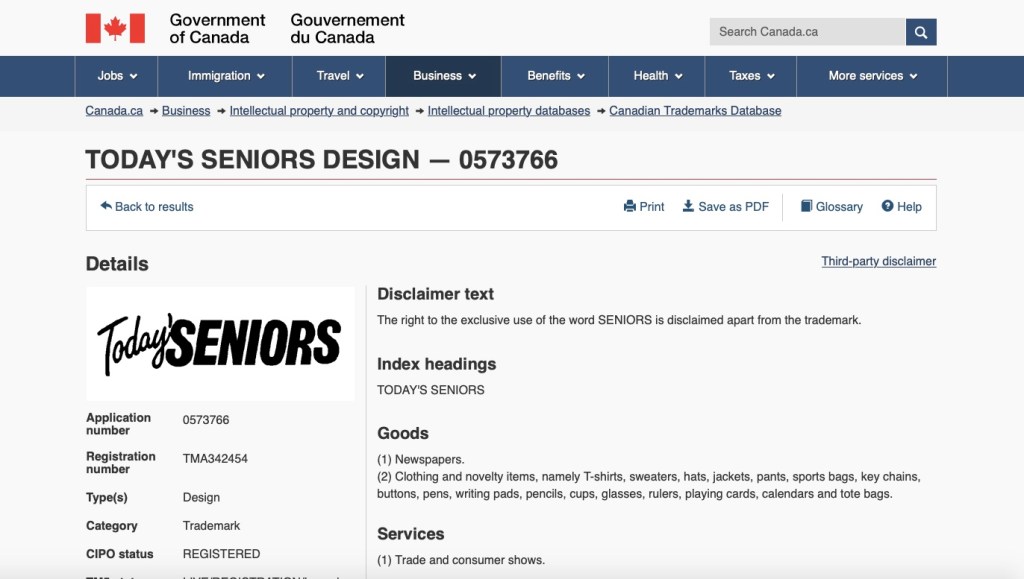
Today’s Seniors (Canada), December 1993

When Orangeville senior Donald Potter was told he was too old to receive a bone marrow transplant, he paid $150,000 to get one in the United States. 

His case, recently made public by provincial Conservative leader Mike Harris, has raised the disturbing issue of health care rationing for seniors. 

Potter, who has Hodgkin’s lymphoma, says he was told the cut-off age is 55; since he was 64 at the time he needed a transplant, he was told last February it was too risky to obtain the procedure. Faced with a few months to live, he went to Rochester, New York, where bone marrow transplants were done on patients into their late 70s. 

Money

Potter believes the real issue is money. The government doesn’t have enough, so he couldn’t get the treatment that could save his life. 

Cost-cutting resulting from the provincial government’s social contract and expenditure control plans has left physicians with the quandary of serving more people with less money. This dilemma has led them to prioritize who gets services, though physicians maintain such decisions are based on many factors other than age, including lifestyle, prognosis and effectiveness of the therapy. 

Transplants

Bone marrow transplants are a particularly emotional issue for Premier Bob Rae, who in early October was driven to tears handling questions regarding rationing of this service. His brother died of lymphatic cancer in 1989 after a failed bone marrow transplant for which Premier Rae was the donor. 

“I can’t knock the system that hard, I just don’t feel the government spends the money properly,” says a calm and unresentful Potter.

Many seniors are frightened when they hear the government needs to make cuts, fearing they could be the first to go when it comes to allocating rationed services. 

“From the perspective of seniors it is a very scary time right now,” says David Kelly of Toronto’s Senior Link, a community social service agency. “Everything is being questioned, all our social services. Instead of looking at how to solve the problems, we’re just going to cut out things, and that’s going to be our solution. It doesn’t necessarily work.”

The issue of rationing services based on age is a dicey one. Ministry of Health spokesperson Layne Verbeek says the schedule of benefits makes no mention of age; and he’s right, because that would be unconstitutional. But when a doctor is presented with a fixed budget and a bulging sack of patients, the physician on the hospital ward has to decide who gets treated and with what. How a physician does this is theoretically based on a combination of factors, but doctors also have prejudices and misconceptions. 

Rationing

Many argue such queuing is a dangerous departure from the belief that the sick deserve to be treated. 

“Part of the problem is that few would admit to rationing on the basis of age alone,” says bioethicist Eric Meslin of Toronto’s Sunnybrook Health Science Centre. “Most clinicians I’ve spoken with and worked with recognize that age alone is not a relevant criterion. But most clinicians would agree age does play a role in thinking about limiting care.”

Meslin admits the idea of denying health services based upon age alone has been making the rounds among health care professionals. 

Ethics

“There has been a debate in the last seven years in North America over whether age-based rationing is ethically acceptable,” says Meslin. “There is of course a spectrum of views, including the very extreme that says after a certain number of years you have obtained your benefit from society and you should step aside and allow others to make use of those resources.”

Meslin doesn’t feel good about going through any kind of health care rationing without a public debate over society’s values and what to expect from the health care system. 

And he is adamant that anybody who focuses solely on attacking the high costs of high-tech medicine and an aging population is making a value judgement about how society should spend its money, not stating a fact.

“A clinician who chooses to discriminate based on age alone is not only unethical, but unconstitutional. Having said that, no clinician worth their salt would be telling the truth if they did not consider who the patient was in the fullest sense of the term, including their age. However, not giving treatment because they are 80 is a numbers game; there isn’t good enough data to support it.” 

Meslin suggests a public debate on rationing services needs to take place. 

Needs

“We need to ask the elderly population what they want. It may be that they don’t want the kind of things the researchers and clinicians believe they want.”

Kelly at Senior Link believes cuts to free drugs are already one example of rationing. 

“There are a lot of ways we can go about changing our social services without cutting income support or access to medication. The same goes for what procedures will be performed,” says Kelly. 

Potter’s case graphically shows the human cost of the heavy hand of bureaucrats in a public system trying to save money. But the high cost of U.S. health care also leaves a bad taste in Potter’s mouth. 

“In the States, the cost is horrendous. At least we have that protection. But I happen to be one of the unfortunate ones that fell into the wrong slot. And there’s a lot of people like me.” 

My background: 

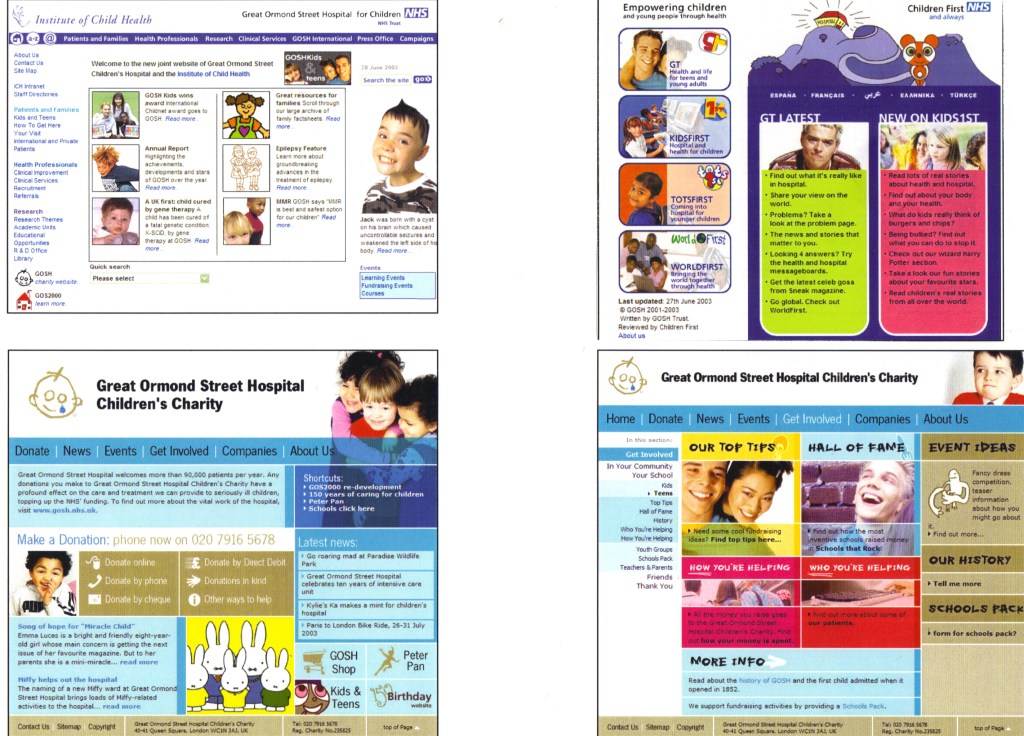
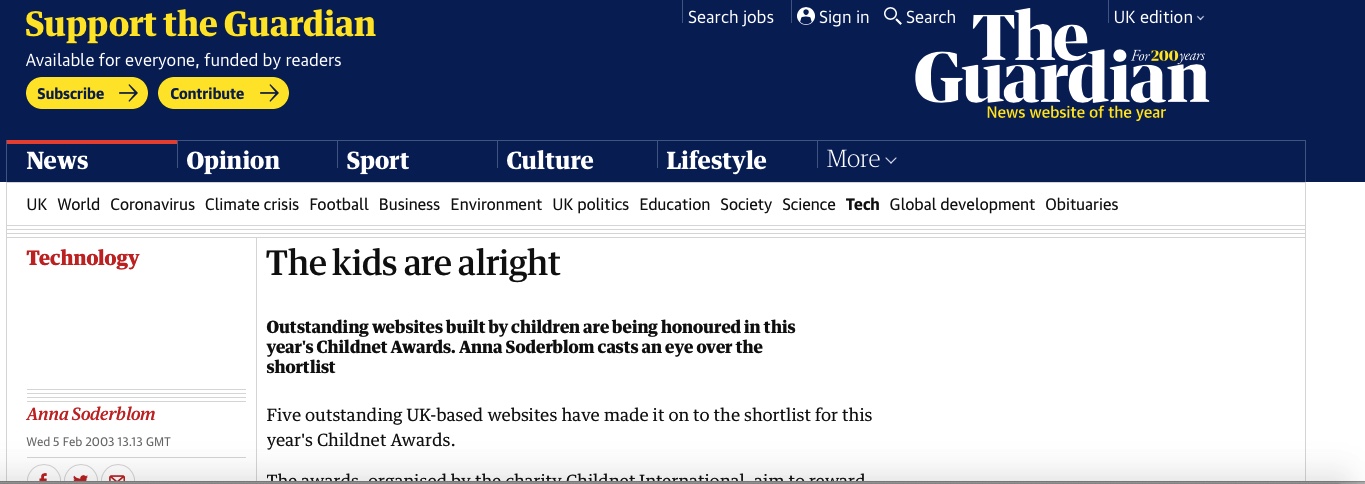
CASE STUDY 5: GOSH/ICH Child Health Portal | 2001 – 2003

Hannah Institute For The History Of Medicine | 1992 – 1994
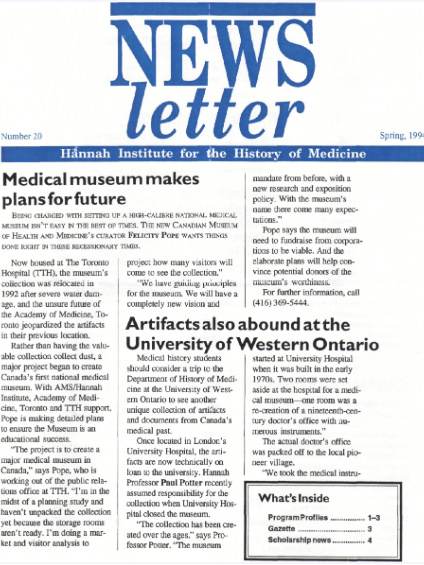
The archive for the Hannah Institute for the History of Medicine newsletter is held at the Wellcome Collection library in London, UK.

ORCID iD: https://orcid.org/0000-0001-5311-1052.

© David South Consulting 2017 

Categories
Archive Blogroll Today's Seniors

Government Urged To Limit Free Drugs For Seniors

By David South

Today’s Seniors (Canada), May 1993

Another blow may be coming to seniors on top of last August’s cuts to the Ontario Drug Benefit Plan (ODBP). Health minister Ruth Grier has been advised to terminate the policy offering free drugs for Ontario residents over 65. 

Assistant deputy health minister Mary Catherine Lindberg says the 13-page report from the Ontario Drug Reform Secretariat urges the government to replace universal coverage with a system based on income. 

The government argues that fiscal problems, a desire to make wealthy seniors pay, and a need to extend the program to the working poor has driven them to consider the move, while critics argue it will hurt modest-to-lower-income seniors. They say costs could be better contained by keeping universal coverage and attacking the source of escalating costs: pharmaceutical manufacturers and doctors who over-prescribe or misprescribe. 

Concession

If implemented, the cuts will represent a concession by the NDP on the once-sacred principle of universality. Just last year, former health minister Francis Lankin said, “I believe strongly in universality, and we’re not looking at ending it for drug coverage of seniors.”

The proposed plan calls for single people, regardless of age, who earn over $20,000 a year, and families earning over $40,000, to pay a premium of up to $300 for drug coverage. 

Those earning less than that amount will have to pay for their own drugs until they reach a limit tied to their income to become eligible for free drugs. 

The government says this changes qualifying for coverage from age to income-based. 

In a recent interview, health minister Ruth Grier wouldn’t be specific about what plan she would go for. But she agrees with the report’s authors that the drug plan needs reform. 

“While the drug plan makes drugs available in an open-ended way to everybody over 65,” says Grier. “In many cases it doesn’t help the low-income family with parents in minimum wage jobs and has a child needing constant drugs. And when we reform the system we aren’t just looking at how we can contain costs, but also how we can make it fairer. The underlying principle of all that we are doing is equity and fairness.”

The drug benefit plan, which also covers welfare recipients, hit $1.2 billion last year out of an almost $17 billion health budget. That was an increase of 13.8 per cent from 1991, but lower than the 18.1 per cent average for the last 10 years. 

David Kelly at Toronto’s multi-service agency Senior Link suggests the government go after the drug industry for wasting money promoting drugs and duplicating research projects. 

According to the industry advocate Pharmaceutical Manufacturers Association of Canada’s own statistics, drug companies spent $186 million on “marketing” in 1990 while $286 million actually went to research and development. 

The federal government’s own Patent Medicine Prices Review Board, in an internal study leaked to The Globe and Mail, found Canada to have some of the highest drug prices among the seven industrialized nations. 

Anger

Seniors organizations and agencies almost overwhelmingly expressed anger over the report, seeing it as another attack on universality of medicare. They feel the government isn’t being creative enough solving fiscal problems. 

“I strongly disapprove,” says Sara Wayman, chairperson of the Ontario board of Canadian Pensioners Concerned. “The concept of universality when it comes to services is a basic democratic principle we support strongly. People who earn $20,000 a year are still struggling to make ends meet. This would represent a real hardship. 

“We also feel strongly that the high medical costs that everybody is talking about aren’t really due to universality. They are really due to the high cost of drugs, and because there has been a restraint of generic drugs by our legislature.

“They are tip toeing around the medical profession. I hope people will speak out.”

Kelly feels savings could be reaped by taxing back any benefits given to wealthy seniors, while maintaining the universality of programs. 

“The group they are talking about is very tiny,” says Kelly. “And so the cost savings to the government are going to be really minimal. A whole process will have to be set up to decide who gets free drugs, and what you get is another layer of bureaucracy everyone has to go through. Studies have shown this adds to the net costs of government in the long run.”

Creative Commons License

This work is licensed under a
Creative Commons Attribution-Noncommercial-No Derivative Works 3.0 License.

ORCID iD: https://orcid.org/0000-0001-5311-1052.

© David South Consulting 2022

Categories
Archive Blogroll

Interviews for the GOSH Child Health Portal 2001-2003 | 14 April 2016

Roundabout, November 2001 Issue No. 18

Joint Website Launched

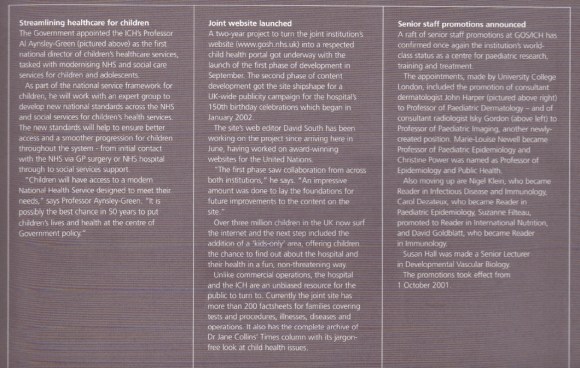
A two-year project to turn our joint institution’s website (www.gosh.nhs.uk) into a respected child health portal got underway with the launch of the first phase of development in September. The second phase of content development will get the site ship shape for a UK-wide publicity campaign as the hospital’s 150th birthday celebrations begin in January.

The site’s web editor, David South, has been working on the project since arriving here in June, having worked on award-winning websites for the United Nations.

“The first phase saw collaboration from staff across both institutions,” he says. “An impressive amount was done, and we have now laid the foundations for future improvements to the content on the site. I really want to offer more for children. Over three million children in the UK now surf the internet.”

The opportunity for both institutions is enormous. As the internet has evolved, it has become increasingly clear that the future of its development lies in the public sphere. US government sites now outstrip commercial operations, selling far more books than the largest online bookseller, amazon.com. Here in the UK, the http://www.ukonline.gov.uk site is working to offer one-stop access to all government services, including health care.

Unlike commercial operations, the hospital and the Institute are an unbiased resource for the public to turn to. Currently, the joint site has more than 180 factsheets for families covering tests and procedures, illnesses and diseases and operations. It also has the complete archive of Dr. Jane Collins’ Times column, with its jargon-free look at child health issues.

“This being London, we have the unique advantage of being at the centre of so many developments, and having the opportunity to communicate this through our website,” says David South.

Across the NHS the Modernisation Plan involves the largest data collection exercise in its history. More and more resources will be offered online, and the content produced by individual trusts like ours will be linked with national sites like NHS Direct.

New GOSH/ICH website

With over three million children in the UK now using the internet, and a total of 33 million UK citizens accessing it through work, school or the home, no organisation can afford not to make the most of this valuable communications tool. Estimates vary, but some put the number of health-related websites at more than 100,000. Trust is an even more important issue, as users search for accurate information. It is in this context that the new hospital and ICH website, http://www.gosh.nhs.uk, launched in September. Web editor David South puts us in the picture.

The new site reflects the hard work and collaboration of staff across both institutions, and it is hoped it will quickly make its mark as a trusted resource on complex child health issues. The site also becomes one of the most visible signs of our on-going modernisation programme, and can uniquely tie together the breadth of our work in a way that no other medium can. The site development project spans two years and will fit in with the wider move across the NHS to offer a wide range of services online.

The next phase of the site’s development is aimed at getting the site ready for a larger publicity campaign slated to coincide with the hospital’s 150th birthday celebrations with start in January. In preparation for this public launch, a number of improvements will be made to the site’s content, interactivity, platform and design. To put it simply, the site should become a critical first stop for anybody seeking our services, or wanting to learn more about the latest research and care developments in the field of complex child issues.

The joint site will also be available via Gosweb for staff in the hospital who don’t already have internet access.

As the project evolved, regular updates were communicated to colleagues and the public through the media.
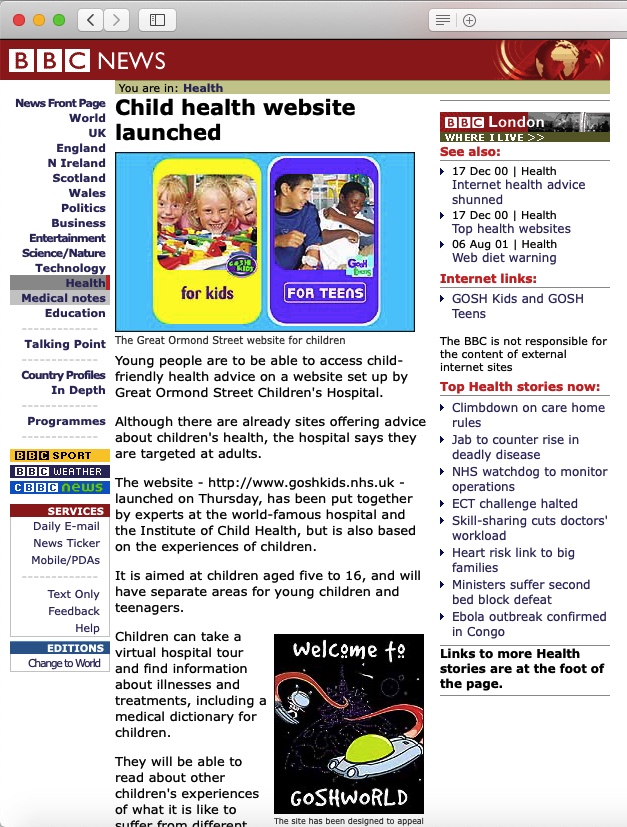
The BBC story from 2002’s launch of the GOSH Child Health Portal’s children’s content (www.gosh.nhs.uk).
Creative Commons License

This work is licensed under a
Creative Commons Attribution-Noncommercial-No Derivative Works 3.0 License.

ORCID iD: https://orcid.org/0000-0001-5311-1052.

© David South Consulting 2022