Categories
Archive Blogroll Hospital News

Changing Health Care Careers A Sign Of The Times

By David South

Hospital News (Canada), June 1992

Ontario’s health care system is in the midst of a big change. But where are the new jobs going to be and how can health care workers prepare for the coming crunch?

“Anybody who thought they could progress through the health care system until retirement is in for a shock,” said Ruth Robinson, a national health care consultant for Peat Marwick Stevenson and Kellogg management consultants. 

Radical changes are taking place in the health care system and it looks like traditionally safe occupations are in for a shake-up. 

“Hospitals are being pressured to change fundamentally,” said Ms. Robinson. “The net effect is fewer jobs. A lot of people will have to think about new careers.”

In the Ministry of Health working document entitled Goals and Strategic Priorities, released in January, the fundamental shift from treatment to disease prevention and health promotion is laid out in generalities. 

The goals range from health equity for aboriginals, women, children and AIDS patients to better management of costs to development of a stronger health care industry that will jump start the economy. And they range from the reorganization of professional responsibilities to promotion of services outside institutions with the goal of keeping people out of hospitals. 

One thing is clear, the talk is about big changes. But talk is cheap to laid-off health care workers looking for new jobs. 

The provincial government’s recently passed, but yet to be proclaimed, Regulated Health Professions Act will have serious repercusions for all health care providers. 

“Traditionally, doctors have an exclusive domain over a wide area,” said Charlie Bigenwald, executive director of health human resources planning at the Ministry of Health. “Even though other people could do things, they had to be delegated by a doctor. With the legislation, we have pushed back what doctors can do. This means there will be more opportunity for a wider variety of health care workers to get into those areas.”

Midwifery is one of the benefactors of changes in regulations. The Ministry of Health is looking into having a university-based program for midwives. 

Ms. Robinson predicted nurses and middle management will suffer the most in the change to community-based health care. 

“Nurses will need to get a bachelor degree if they hope to compete for jobs,” she said. 

As for middle managers, who often have clinical skills, they will have to reconsider staying in health care, she said. “They will disappear significantly. They can advance themselves by getting back to clinical skills or consider management positions in non-health care areas.

“There is nothing to be ashamed of about career changes these days,” she added. 

In the shift towards community-based care, opportunities will arise for health care workers who can offer creative solutions to improve service delivery. 

“For nurses, we currently have something called the Nursing Innovation Fund where individuals can apply for a wide variety of developmental things like attending workshops, conferences and training programs. We process 2,500 applications a year,” said Mr. Bigenwald. 

The Ministry of Health hopes the future sees a health care system that adds to the province’s economy rather than drains it. 

“We spend $17 billion a year on health care. We never looked at the health care system as an economic motor in the past. The question we are asking right now is ‘why can’t an Ontario firm make the carpets, beds, sutures etc?’, said Mr. Bigenwald. 

Ms. Robinson said “Governments are running out of money and can’t increase funding. They will be looking for more partnerships in the private sector. In this climate, creative solutions to health care delivery have a great opportunity.” 

Creative Commons License

This work is licensed under a
Creative Commons Attribution-Noncommercial-No Derivative Works 3.0 License.

ORCID iD: https://orcid.org/0000-0001-5311-1052.

© David South Consulting 2023

Categories
Archive Blogroll Now Magazine

US Health Care Businesses Chasing Profits Into Canada

Some fear corporate health care will kill equality of treatment

By David South

Now Magazine (Toronto, Canada), April 8-14, 1993

American-style private health care is slipping across the Canadian border under the noses of three provincial NDP governments, say researchers representing an association of health care workers.

Jackie Henwood and Colleen Fuller of the 7,500-member Health Sciences Association of British Columbia charge in a recent report that a combination of free trade and tightfisted government spending is undermining the universality of medicare and ushering in the beginnings of a two-tier system.

While the health care industry created more jobs than any other sector of the economy between 1984 and 1991, they point out, things have changed dramatically since the Canada-US free trade agreement came into effect in 1989. Now much of this growth is clustering in the private sector.

And they expect that this trend will continue under the forthcoming North American free trade agreement.

“NAFTA will accelerate trends towards a privatized, nonunion and corporate dominated system of health care in Canada,” says the report.

Binding provisions

Chapter 14 of the Canada-US free trade agreement opened competition for health-care facilities management services to US companies. Certain NAFTA provisions will bind all levels of government to consider for-profit health care companies on equal footing with public providers when bidding for services, and entitles them to compensation if they can prove to an arbitration board that they’ve been wronged.

“That represents a substantial encroachment on the democratic right of local, provincial and federal governments to make decisions,” says Cathleen Connors, who chairs the Canadian Health Coalition, which includes labour activists, nurses, doctors and other health-care workers.

This, in combination with health care cutbacks – both federal and provincial – is resulting in service and job cuts, bed closures, increased drug costs and an increase in privatization, the report says.

In the area of home care, for example – visiting nurses, physiotherapists, homemakers and other services – private firms now take in close to half of all OHIP billings. Many of their clients pay out of their own pockets for services.

The Ontario ministry of health doesn’t keep statistics on the private home health care sector in the province, but the Ontario Home Health Care Providers’ Association, a trade group, estimates that private firms in the industry now employ 20,000 people.

The industry is dominated by a small number of large firms, including Paramed, Comcare and Med+Care.

“It’s a market situation,” says Henwood. “If the services aren’t available to people within the public sector, they will go outside of it.

“We’ve seen this in other countries like England, where they had a public system and now have a parallel private system. If you erode a system enough that people get pissed off, they are going to start to look for alternatives, and the people with the greatest liberty are those with money.”

Connors says that because the Canada Health Act only covers the provision of hospital and physician services, the prinicples of universality and comprehensiveness don’t extend down to community-based services like home care.

The study also found that giant US private health insurers are positioning themselves to reap profits in the fertile Canadian market.

Last week, Wisconsin-based American Medical Security Inc. announced it will begin offering American hospital insurance to Ontario residents this month, citing a demand in Canada to bypass lengthening waiting lists for medical treatment.

Giant US west-coast insurer Kaiser Permanente declared in the March 1992 issue of Fortune magazine that they have targeted Canada as the next growth market. And American Express membership now offers the privilege of health insurance.

With private health care services sprouting up like spring weeds, says Henwood, provinces are placing yearly limits on the number of private services covered under provincial health plans, thus preventing people shopping around for services, no matter what their income.

Sheila Corriveau, corporate relations coordinator at Toronto-based Dynacare, Canada’s largest full-range private health care company – which operates labs, retirement homes, homecare services and consulting services – is enthusiastic about expansion plans, and says that removing patients from hospitals into their homes has been a boon for private health-care services.

“I think the health system will benefit, because what you are really doing is off-loading the cost from the public sector and from the treasury to private enterprise,” says Harry Shapiro of Dynacare. “Private enterprise depends on its own ingenuity for survival and its own levels of efficiency.”

But advocates of the public system say the free-market option now looming is being ushered in by the very parties that Canadians have come to rely on to defend medicare.

Medicare stance

Ontario’s new health minister, Ruth Grier, however, denies her government is jeopardizing medicare.

“I want to disagree with that as profoundly as I can,” she says, fidgeting with an ashtray during a recent interview. “Our government has reaffirmed its commitment to medicare. Over the last decade, under conservative and liberal governments, health care costs have increased in double-digit figures. The system would have collapsed at that rate of growth.

“I guess I haven’t found a way of blaming free trade for failures of the health care system at this point,” she says.

But critics say in the last year alone, Ontario’s ministry of health has capped health coverage for travellers abroad, removed coverage for physical exams requested by employers, chopped hospital beds and cut back the number of drugs covered on the provincial drug plan.

Grier says that the government’s vision relies on a new view of medical care seekers as consumers who are going to take more responsibility for their own health care

“Government can’t do it all,” she says.

Now Magazine (Toronto, Canada), April 8-14, 1993.

More investigative journalism by David South for Toronto’s Now Magazine:

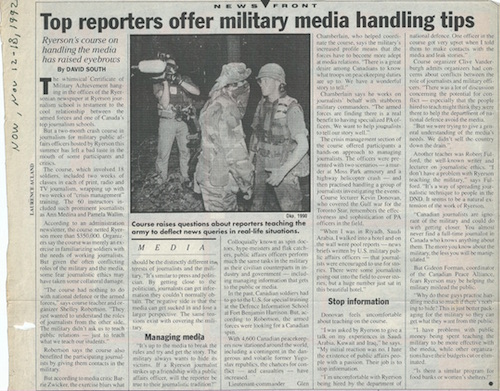
Now Magazine (Toronto, Canada), November 12-18, 1992.

More healthcare reporting by David South from Canada’s Today’s Seniors

Feds Call For AIDS, Blood System Inquiry: Some Seniors Infected

Government Urged To Limit Free Drugs For Seniors

Health Care On The Cutting Block: Ministry Hopes For Efficiency With Search And Destroy Tactics

New Seniors’ Group Boosts ‘Grey Power’: Grey Panthers Chapter Opens With A Canadian Touch

Seniors Falling Through The Health Care Cost Cracks

ORCID iD: https://orcid.org/0000-0001-5311-1052.

© David South Consulting 2021

Like our content? Help contribute to the costs of keeping it online.

Scan code with your phone and help us out.
Creative Commons License

This work is licensed under a
Creative Commons Attribution-Noncommercial-No Derivative Works 3.0 License.

ORCID iD: https://orcid.org/0000-0001-5311-1052.

© David South Consulting 2022

Categories
Archive Blogroll Today's Seniors

Feds Call For AIDS, Blood System Inquiry: Some Seniors Infected

By David South

Today’s Seniors (Canada), July 1993

HIV-tainted blood transfusions given in the early 1980s have left some seniors with AIDS, but it is feared many are unaware of their HIV-positive status. 

Between 1979 and 1985 – before testing of blood products for HIV became mandatory – 266 transfusion recipients and over 677 hemophiliacs are known to have been infected in Canada, according to the Centre for AIDS Statistics. 

But the final numbers are unkown – estimates range from 400 to 1,000 cases of HIV transmission among the 1.5 million Canadians given blood products during this time. 

This uncertainty is fueling public concern. With such a serious public health danger, many are shocked by the confusing messages being sent by governments, the Canadian Red Cross Society and hospitals. 

But it took the report of an all-party Parliamentary subcommittee on health, released at the end of May, to shock the federal government into calling for a public inquiry into the blood system. The report is highly critical of the decision-making process involved in blood collection and distribution. 

“We have members of our group who are seniors,” says Jerry Freise, spokesperson for advocacy organization HIV-BT (Blood Transfusion) Group, whose wife was infected with HIV due to a blood transfusion. “And many of them went for years being misdiagnosed and treated for something other than HIV. Others have gotten sick, and one died without knowing it because nobody told him. 

“A classic case is Kenneth Pittman who was infected in 1984. The Red Cross found out in 1985 and they allegedly took two years to tell The Toronto Hospital. The hospital took two years to tell his doctor, and his doctor decided not to tell anybody. 

Infected

“Another couple, a lady of 59 and a man of 64, called us April 1. She found she was infected, and the reason she took a test is because her husband turned out to be HIV-positive three weeks before a transfusion in 1983. He had gone for years without a diagnosis from doctors.” 

This runs counter to the Red Cross’s story. 

“Whenever a blood donor tests positive for HIV antibodies, we go back and trace the prior donations,” says spokesperson Angela Prokoptak at the Society’s national office. “The Red Cross supplies blood to hospitals, so we know which units went to which hospital. But the hospital must go through their records to find who they transfused. 

“After identifying the recipient, the hospital contacts the recipient’s physician, and then they have them tested. There are of course limitations.

“Since 1987, the Red Cross has been advising people who may be concerned to consult their physician for counselling and advice.”

But subcommitte member Chris Axworthy, an NDP MP, found that hospitals and the Red Cross hesitated to notify former patients for fear of lawsuits. He says the federal government should show some leadership and stop passing the buck to other agencies and departments. 

Only two hospitals in Ontario – Toronto’s Hospital for Sick Children and Princess Margaret Hospital – have tried systematically to contact former patients. 

Ontario health ministry spokesperson Layne Verbeek says it is a laborious and costly task for hospitals to notify former patients. “We’ve always informed people if they are thought to be at risk, but many hospitals aren’t in the position to trace. If people are at risk or have doubts, they should be tested.”

Verbeek says recent media coverage has caused an increase in the number of people seeking HIV blood tests – requests for the test doubled after the Sick Kids hospital went public. The provincial government’s lab went from 700 tests per day to 1,300, but Verbeek says that has started to taper off. 

The ministry of health is happy with the number of people coming forward to be tested, says Verbeek. 

But Friese says the different players are more concerned about lawsuits than informing the public. He is especially upset at the Red Cross for not taking a leadership role in disseminating information. 

“The Red Cross and the medical system have failed miserably to contact people. Even today they are reticent to tell people they were part of a risk group and should get treated.” Friese feels the various governments and the Red Cross are leaving the job of informing the public to his group and the Canadian Hemophiliacs Society. 

Beat the drums

“It’s my job to beat the drums for the media while I’m dealing with my wife being infected? That’s my job, when these are the ministers of health?”, Friese says with anger.

The effect of AIDS on seniors isn’t new to US-based National Institute on Aging researcher Marcia Ory. She and colleagues helped sound the alarm back in 1989 with the book “AIDS In An Aging Society: What We Need To Know.” In the US, over 10 per cent of AIDS cases have occurred in people over 50. 

“Surprisingly, people have ignored older people and the AIDS issue,” says Ory. “You had older people in hospitals who might have complained about fatigue which was thought to be age-related. Older people aren’t as likely to be diagnosed as early because of the assumption that they are not at risk from AIDS.

“We don’t want older people in general to be overly fearful, but we want them to acknowledge the possibility, and to engage in good preventative practices if they are at risk.” 

Ron deBurger, director of AIDS prevention for the Canadian Public Health Association, would like assurances that the security of the blood supply has improved. 

“The subcommittee came to the right conclusion asking for a public inquiry,” says deBurger. “I would hope the terms of reference are broad enough to take a look at the whole issue of the safety of the blood supply, not only in terms of what happened in the past, but, more importantly, what’s happening today.”

Other than hemophiliacs, who require large quantities of blood, deBurger believes anybody who received one transfusion has a small risk. “If you had blood once, I think the odds are pretty long that you are going to end up with tainted blood. But AIDS does take eight to 10 years to manifest itself, and we might still be picking up pieces for the next four to five years that we don’t know about yet.” 

Friese recommends that anybody who received blood or blood products between 1979 and 1985 get an HIV test. If their doctor says it isn’t necessary, they should call the AIDS Hotline about anonymous testing. 

Anybody who has tested positive for HIV and would like support and counselling can call Robert St-Pierre of the Canadian Hemophilia Society at 1-800-668-2686.

For information on anonymous testing call the Ontario government’s AIDS Hotline in Toronto at 416-392-2437. For support write HIV-BT Group, 257 Eglinton Avenue W., Suite 206, Toronto, Ont., M4R 1B1. 

Read more of David South’s 1990s health and medical journalism here: 

https://davidsouthconsulting.org/2022/06/24/can-we-talk-hannah-promotes-communication-between-medical-schools/

https://davidsouthconsulting.org/2021/02/05/changing-health-care-careers-a-sign-of-the-times/

https://davidsouthconsulting.org/2017/10/18/hannah-institute-for-the-history-of-medicine-1992-1994/

https://davidsouthconsulting.org/2022/04/28/health-care-in-danger/

https://davidsouthconsulting.org/2020/12/17/lamas-against-aids/

https://davidsouthconsulting.org/2017/08/15/mongolian-aids-bulletin/

https://davidsouthconsulting.org/2020/12/17/philippine-conference-tackles-asias-aids-crisis/

https://davidsouthconsulting.org/2022/06/24/professor-puts-chronic-fatigue-into-historical-perspective/

https://davidsouthconsulting.org/2021/02/05/study-says-jetliner-air-quality-poses-health-risks-cupe-takes-on-airline-industry-with-findings-of-survey/

https://davidsouthconsulting.org/2020/04/20/take-two-big-doses-of-humanity-and-call-me-in-the-morning/

Taking Medicine To The People: Four Innovators In Community Health

https://davidsouthconsulting.org/2021/02/05/us-health-care-businesses-chasing-profits-into-canada/

More from Canada’s Today’s Seniors

https://davidsouthconsulting.org/2021/02/05/critics-blast-government-long-term-care-reforms/

https://davidsouthconsulting.org/2022/10/08/dodging-the-health-insurance-minefield/

https://davidsouthconsulting.org/2020/06/14/government-urged-to-limit-free-drugs-for-seniors/

Health Care On The Cutting Block: Ministry Hopes For Efficiency With Search And Destroy Tactics

https://davidsouthconsulting.org/2021/02/05/health-care-on-the-cutting-block-ministry-hopes-for-efficiency-with-search-and-destroy-tactics/

New Seniors’ Group Boosts ‘Grey Power’: Grey Panthers Chapter Opens With A Canadian Touch

https://davidsouthconsulting.org/2021/02/20/private-firms-thrive-as-ndp-reinvents-medicare/

https://davidsouthconsulting.org/2020/06/14/psychiatric-care-lacking-for-institutionalised-seniors/

Seniors Falling Through The Health Care Cost Cracks

https://davidsouthconsulting.org/2020/06/14/specialists-want-cancer-treatments-universally-available/

ORCID iD: https://orcid.org/0000-0001-5311-1052.

© David South Consulting 2023

Categories
Archive Blogroll Today's Seniors

Specialists Want Cancer Treatments Universally Available

By David South

Today’s Seniors (Canada), December 1993

A newly-formed group representing cancer doctors says it is fed up with the inhumane and bureaucratic approach to cancer care in Ontario. 

Dr. Shailendra Verma of Access to Equal Cancer Care in Ontario (AECCO) says he’s had enough. 

“My group has served the government notice that we’re fighting on our patients’ behalf,” says Verma, who faces gut-wrenching quandaries every day in his growing Ottawa practice. “In a public health system, I’m damned if I’m going to be divided into giving one set of patients a Cadillac treatment and the other Hyundai-type treatment; I don’t think that’s why we have a public health system.”

Verma says cutbacks to health care funding have meant that doctors must leap increasingly high hurdles to get the drugs their patients need. 

In jeopardy

While chemotherapy drugs administered in hospitals are still free, he says the important drugs necessary for patient comfort and treatment effectiveness are in jeopardy. 

These drugs were once free under the Ontario Drug Benefit Plan (ODBP), but now their status is tenuous. One drug, GCSF – which is crucial in helping patients between treatments of chemotherapy – is now listed under Section 8 of the ODBP and requires doctors to plead with the government each time for coverage. Often the bureaucracy moves so slowly that the course of chemotherapy is seriously disrupted, Verma says. 

“As an oncologist I’m particularly interested in ensuring everyone has access to all treatment. I think we are at a very sensitive crossroads. Over the last three or four decades we’ve developed certain treatments for diseases that more often kill than cure. And now we are at a point where we’ve got new treatments that can make the older treatments more effective. Or we’ve got brand new treatments that we are hoping to apply, and the one thing that is holding us back is cost.”

Cost

“The decisions are not based on science, they’re based on cost. It would not be an issue if treatments cost a penny a shot.”

Verma says colleagues can’t introduce some new drugs because the costs would be too high to offer it to everyone. So no one gets it.

“We have patients who walk in and say they would like to pay for it,” continues Verma. “Ethically, as a physician do you allow a patient to pay for it while sitting next to a similar patient who can’t afford it?”

Update: Cancer drugs that stay one step ahead may give patients 40 years of life (The Sunday Times, November 15 2020)

https://davidsouthconsulting.org/2022/06/24/can-we-talk-hannah-promotes-communication-between-medical-schools/

https://davidsouthconsulting.org/2021/02/05/changing-health-care-careers-a-sign-of-the-times/

https://davidsouthconsulting.org/2021/06/02/case-study-5-gosh-ich-child-health-portal-2001-2003/

https://davidsouthconsulting.org/2017/10/18/hannah-institute-for-the-history-of-medicine-1992-1994/

https://davidsouthconsulting.org/2021/07/13/health-human-development-communicator-1991-2017/

https://davidsouthconsulting.org/2022/04/28/health-care-in-danger/

https://davidsouthconsulting.org/2022/06/24/professor-puts-chronic-fatigue-into-historical-perspective/

https://davidsouthconsulting.org/2020/04/20/take-two-big-doses-of-humanity-and-call-me-in-the-morning/

https://davidsouthconsulting.org/2020/04/17/taking-medicine-to-the-people-four-innovators-in-community-health/

https://davidsouthconsulting.org/2021/02/05/us-health-care-businesses-chasing-profits-into-canada/

More from Canada’s Today’s Seniors

https://davidsouthconsulting.org/2021/02/05/critics-blast-government-long-term-care-reforms/

Feds Call For AIDS, Blood System Inquiry: Some Seniors Infected

https://davidsouthconsulting.org/2020/12/18/feds-call-for-aids-blood-system-inquiry-some-seniors-infected/

Government Urged To Limit Free Drugs For Seniors

https://davidsouthconsulting.org/2020/06/14/government-urged-to-limit-free-drugs-for-seniors/

Health Care On The Cutting Block: Ministry Hopes For Efficiency With Search And Destroy Tactics

https://davidsouthconsulting.org/2021/02/05/health-care-on-the-cutting-block-ministry-hopes-for-efficiency-with-search-and-destroy-tactics/

New Seniors’ Group Boosts ‘Grey Power’: Grey Panthers Chapter Opens With A Canadian Touch

https://davidsouthconsulting.org/2022/05/29/new-seniors-group-boosts-grey-power-grey-panthers-chapter-opens-with-a-canadian-touch/

https://davidsouthconsulting.org/2021/02/20/private-firms-thrive-as-ndp-reinvents-medicare/

https://davidsouthconsulting.org/2020/06/14/psychiatric-care-lacking-for-institutionalised-seniors/

Seniors Falling Through The Health Care Cost Cracks

https://davidsouthconsulting.org/2020/06/14/seniors-falling-through-the-health-care-cost-cracks/

ORCID iD: https://orcid.org/0000-0001-5311-1052.

© David South Consulting 2023