

By David South, Development Challenges, South-South Solutions

Cuba, the Caribbean island nation known for its 1959 revolution and its tourism industry, is undergoing a shift in its economic strategy. The country has had heavy state control of its industries and business activities since the country adopted the official policy of state socialism and joined the Communist economic sphere headed by the Soviet Union.
When the Soviet Union fell apart in 1991, Cuba was pitched into an economic crisis as it lost access to preferential trade subsidies. This period is known as the ‘Special Period’ (http://en.wikipedia.org/wiki/Special_Period) and was marked by a severe reduction in access to fuel as supplies and subsidies from the Soviet Union disappeared. Some of the iconic images of the time include people abandoning their cars and turning to bicycles to get around, or using make-shift truck-buses packed with workers. Exports collapsed and slashed the size of the economy by a third.
Fast-forward to today, and tourism is booming. A record 2.7 million tourists went to Cuba in 2011, earning the country US $2.3 billion. And it is catering to this tourism market that probably offers the best near-term opportunities. With wages still just 50 per cent of what they were in 1989 many are taking up this new opportunity to become entrepreneurs.
To become an entrepreneur, Cubans need to apply for a pink identification card with their name and photo and the words “Autorizacion Para Ejercer el Trabajo por Cuenta Propria.” This gives authority “to work for your own account.” With the card, a person can start a business, hire staff and pay them what they like.
Cuba’s economy has been through many phases since the revolution, swinging between loosening up the ability of people to establish private businesses – and pulling back, restricting private enterprise. But since 2008, there has been a significant shift to encouraging greater private enterprise, entrepreneurship and the ownership of private property – once banned – to stimulate the economy.
“This is the most important thing to happen in Cuba since the revolution in 1959,” Juan Triana, senior fellow at the Centre for the Study of the Cuban Economy at Havana University, told The Sunday Times Magazine.
One visible sign of this change is the flourishing of what is called locally ‘paladar’ (http://en.wikipedia.org/wiki/Paladar), or privately run restaurants.
Paladares are usually located in a person’s home and staffed by family members. Their customers are a mix of tourists, expatriates living in Cuba, and Cubans with a high enough income to be able to afford restaurant meals.
The cost of a meal in these restaurants can run from US $40 to US $60 for two people.
Stocking the kitchen is not easy. Cuba experiences food shortages and there is still rationing for many. Basics like eggs can be hard to find. As for exotic, imported ingredients, many chefs rely on visitors to stock their larders.
Cuba will have to re-build its food sector to make this a lasting improvement.
The agriculture sector has declined and, where Cuba once provided a third of the world’s sugar harvest, the country now has to import half of its food supply. Measures are in the works to change this, with smallholder farmers now able to own 165 acres of land and sell their produce to private customers and hotels.
One restaurant owner, Héctor Higuera Martinez, told The New York Times:“You dream up a recipe that you’d like to make but then you can’t find the ingredients.
“One day you go out to get salt and there’s no salt. And I mean no salt,Anywhere.”
Martinez trained with a well-known Cuban chef and did a stint in Paris before returning to Havana. He has turned a 19th-century mansion into the restaurant Le Chansonnier (http://www.cubajunky. com/havana/restaurant_le_chansonnier.html) and decorated the walls with the work of local artists.
Martinez sees the paladares as a turning point in changing Cuba’s reputation for having boring food. “I believe we can play an important role in revolutionizing Cuban cuisine.”
Cuba is making the difficult shift from having an economy where 80 per cent of activity is in the state sector, to a mixed model balanced between private and public ownership.
Havana’s historic district offers tourists renovated colonial architecture mixed with shops, restaurants and bars. As a tourist strolls from the renovated district, they quickly come across the rest of Havana, which has beautiful buildings from the colonial period, 1950s American-influenced architecture with its fading retro signage, and more utilitarian Soviet-era architecture.
While charming and home to most of the city’s residents, much of it is rundown and crowded and in need of investment and renovation.
But things are changing fast. Oyaki Curbelo and Cedric Fernando use spices brought in by visitors for Bollywood, their restaurant in the Nuevo Vedado area (http://cubantripadvisor.com/destinations/havana-cityoutskirts/bollywood-paladar/). It has a small menu of Indian and Sri Lankan dishes, including shrimp curry with ginger and tamarind. The restaurant sources its curry leaves from a tree located in the Sri Lankan Embassy.
Another restaurant, Atelier (http://www.cubaabsolutely.com/articles/travel/article_travel.php?landa=70),located in a mansion in the Vedado neighbourhood, serves European Continental food and has a roof terrace letting diners enjoy the a view of the Havana skyline.
The restaurant Doña Eutimia (https://www.facebook.com/paladardona.eutimia) serves up Cuban favourites off the Cathedral Square. Specialties include a dish made of shredded beef with garlic, tomato, oregano and bay leaves.
At Vistamer (http://www.stay.com/havana/restaurant/4249/paladar-vistamar/),diners can enjoy garlic-laden lobster tails and lemon meringue pie. At the paladar Café Laurent (http://www.cubaabsolutely.com/articles/travel/article_travel.php?landa=71), the menu includes meatballs with sesame seeds and mustard in red-wine and tarragon sauce, according to The New York Times.
Habana Chef in the Vedado district (http://cubantripadvisor.com/destinations/havana-city-outskirts/habana-chefpaladar/) was started by Joel Begue and chef Ivan Rodriguez. Begue gained his experience in the state restaurant sector and took the opportunity to get a licence when the government offered them in 2011. He borrowed US $25,000 to start the restaurant and has been able to pay back half so far. His current success is prompting him to look into opening a second restaurant in the capital.
An enthusiastic Andrew Macdonald, who is looking for investment opportunities for a half a billion dollar fund held by the Escencia Anglo-Cuban firm, told The Sunday Times magazine, “Cuba is the top emerging tourism market in the Caribbean by a mile, and it’s in the top five emerging markets globally.”
Published: May 2012
Resources
1) Advice on starting a restaurant and links to additional resources. Website: runarestaurant.co.uk
2) How to start a restaurant: From Entrepreneur magazine, a guide to the planning required to start a successful restaurant. Website: http://www.entrepreneur.com/article/73384
3) AlaMesa: A directory of restaurants in Cuba. Website: alamesacuba.com
4) Southern Innovator: Youth and Entrepreneurship Issue: The new global magazine is launching its second issue and is packed with innovative entrepreneurs and youth using business to tackle poverty. Website: http://www.scribd.com/doc/86451057/Southern-Innovator-Magazine-Issue-2
https://davidsouthconsulting.org/2022/11/10/brazilian-restaurant-serves-amazonian-treats/
https://davidsouthconsulting.org/2022/11/19/cooking-up-a-recipe-to-end-poverty/
https://davidsouthconsulting.org/2022/10/24/latin-american-food-renaissance-excites-diners/

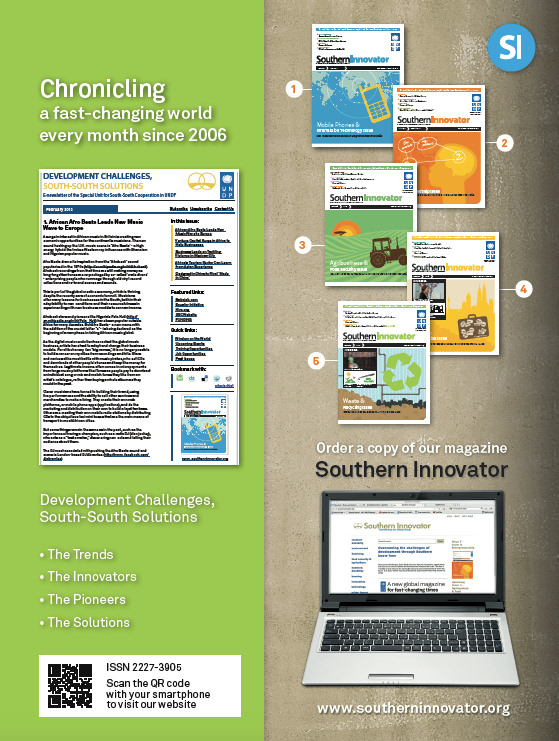
Development Challenges, South-South Solutions was launched as an e-newsletter in 2006 by UNDP’s South-South Cooperation Unit (now the United Nations Office for South-South Cooperation) based in New York, USA. It led on profiling the rise of the global South as an economic powerhouse and was one of the first regular publications to champion the global South’s innovators, entrepreneurs, and pioneers. It tracked the key trends that are now so profoundly reshaping how development is seen and done. This includes the rapid take-up of mobile phones and information technology in the global South (as profiled in the first issue of magazine Southern Innovator), the move to becoming a majority urban world, a growing global innovator culture, and the plethora of solutions being developed in the global South to tackle its problems and improve living conditions and boost human development. The success of the e-newsletter led to the launch of the magazine Southern Innovator.

https://davidsouthconsulting.org/2021/03/05/southern-innovator-issue-3/

This work is licensed under a
Creative Commons Attribution-Noncommercial-No Derivative Works 3.0 License.
ORCID iD: https://orcid.org/0000-0001-5311-1052.
© David South Consulting 2023



 David South Consulting
You must be logged in to post a comment.