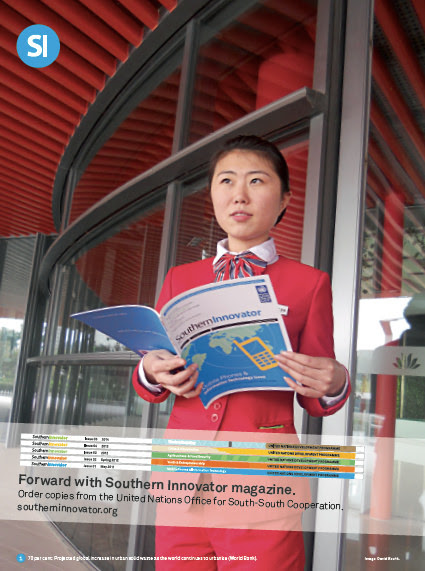
Launched in May 2011, the new global magazine Southern Innovator (ISSN 2222-9280) is about the people across the global South shaping our new world, eradicating poverty and working towards the achievement of the Millennium Development Goals (MDGs).
Ethiopia and Djibouti are the latest global South countries to make a significant commitment to developing geothermal energy – a green energy source that draws on the heat below the earth’s surface (http://en.wikipedia.org/wiki/Geothermal_energy) – to meet future development goals.
Ambitiously, Ethiopia also hopes to build Africa’s largest geothermal power plant.
It joins Kenya, which in 2012, announced projects to expand its geothermal capacity further. Currently, Kenya is Africa’s largest geothermal producer and has geothermal resources concentrated near a giant volcanic crater in the Great Rift Valley with 14 fields reaching from Lake Magadi to Lake Turkana. There are also low temperature fields in Homa Hills and Massa Mukwe (http://www.gdc.co.ke/index.php?option=com_content&view=article&id=191&Itemid=163). Around 1,400 steam holes are being drilled.
Cooperating with Reykjavik Geothermal (rg.is), a US-Icelandic private developer, Ethiopia will spend US $4 billion to build a 1,000 megawatt geothermal plant at Corbetti (http://www.volcano.si.edu/volcano.cfm?vn=221290). It is expected to be ready in eight to 10 years. The country wants to be carbon neutral by 2025.
Drilling will need to go down as deep as 3 kilometers to tap the source. This is expensive and a technological challenge, thus the need for international expertise. The country hopes to develop this source of energy and then export electricity to neighboring African countries.
Another plant, Aluto Langano 7, is being built 201 kilometers south of Addis Ababa, the capital, by a partnership between the Japanese government, Ethiopia and the World Bank.
Ethiopia has enormous potential for geothermal energy, according to a paper in the journal Geothermics: “Ethiopia holds an enormous capacity to generate geothermal energy in the volcano-tectonically active zones of the East African Rift System (http://www.sciencedirect.com/science/article/pii/S0375650513000023).”
At present, 70 per cent of people in sub-Saharan Africa, some 600 million, are without a domestic electricity supply (USAID). Electricity and other sources of energy are required if living standards are to be raised for millions of the world’s poor. The danger of this, however, is to the planet if the energy comes from polluting sources.
In March 2013 the World Bank announced a significant push to increase development of geothermal resources around the world, and in particular in energy-hungry, fast-developing countries.
“Geothermal energy could be a triple win for developing countries: clean, reliable, locally produced power,” the bank says. “And once it is up and running, it is cheap and virtually endless.”
The bank joined forces with Iceland to make a pledge to secure US $500 million in financing to get geothermal projects up and running. The announcement was made at the Iceland Geothermal Conference (http://geothermalconference.is/) in Reykjavík, the Icelandic capital.
Few countries have such easy access to geothermal energy as Iceland, with its plentiful volcanoes, geysers and hot springs bursting through the surface. But it is there, under the ground, and through the Global Geothermal Development Plan (GGDP), it is hoped this plentiful energy source will become the norm for countries around the world.
The World Bank believes at least 40 countries can get into geothermal on a significant scale with the correct investment. Many developing world regions are rich in geothermal resources, including East Africa, Southeast Asia, Central America, and the Andean region.
Just 11 gigawatts of geothermal capacity is currently being tapped in the world. Nuclear power, for example, generates 370 gigawatts a year (2012) (EIA). What has held back many countries has been the high upfront costs involved in getting projects going. A site must be found, drilled and tested to see if it is viable.
The GGDP plan is to raise US $500 million from donors and others to fund geothermal exploration and development. The GGDP will identify promising sites and then acquire funding to pay for drilling to identify commercially viable projects.
The World Bank has increased financing for geothermal development from US $73 million in 2007 to US $336 million in 2012. It comprises 10 per cent of the Bank’s renewable energy lending.
The Icelandic International Development Agency (iceida.is) signed a partnership in September 2013 with the government of Ethiopia to undergo geothermal surface exploration and to build Ethiopia’s capacity to develop this energy source. The World Bank estimates that Ethiopia has the potential to generate 5,000 megawatts (MW) of energy from geothermal sources.
The Geological Survey of Ethiopia (GSE) and the Ethiopian Electric Power Corporation (EEPCO) will undertake exploration at sites in Tendaho Alalobeda and Aluto Langano.
It fits in with a wider push by Ethiopia to develop its renewable energy resources. The country is also increasing investment in hydro-electric power.
The Ethiopia project is part of the wider World Bank-Iceland compact to develop global geothermal energy capacity. It is the second such arrangement, with the first already underway in Rwanda.
Djibouti is also moving into geothermal, with a new agreement with the World Bank to develop a site at Lake Assal. The World Bank will provide US $6 million to evaluate its commercial potential. Djibouti tried to develop its geothermal resources privately but was not successful.
Overall, geothermal power has the potential to help reduce Djibouti’s electricity production costs by 70 per cent, boost access to electricity for the population and alleviate the country’s energy dependency. The country hopes to have 100 per cent green energy by 2020.
Joining forces on helping boost geothermal in Africa is USAID’s Power Africa fund, which is providing US $7 billion in financial support and loan guarantees for energy projects.
Apart from generating electricity, what else can this powerful resource do? Countries such as Iceland now use hot geothermal water to heat homes and provide domestic hot water. Iceland also has an extensive network of swimming pools and spas in each town. The Blue Lagoon (bluelagoon.com) is a good example of how geothermal power generation can have lots of side benefits. The giant, steamy blue-colored lagoon is the consequence of an accident in 1976 at the nearby geothermal power plant; it’s now a spa and one of the country’s main tourist attractions.
The geothermal-heated pools and spas play a key role in keeping the cold north Atlantic country healthy – Iceland ranked number one on the UNDP human development index in 2007 – and provide a recreational source even in the depths of winter.
Published: December 2013
Resources
1) Iceland Review: A great way to learn about life on an island powered by geothermal energy. Website: icelandreview.com
2) Nordic Development Fund: The Nordic Development Fund (NDF) is the joint development finance institution of the five Nordic countries. The objective of NDF’s operations is to facilitate climate change investments in low-income countries. Website: ndf.fi
3) Icelandic International Development Agency (ICEIDA): The Icelandic International Development Agency (ICEIDA) is an autonomous agency under the Ministry of Foreign Affairs and is responsible for the implementation of official Icelandic bilateral development cooperation. It follows the Icelandic government’s Act on Development Cooperation No 121/2008, which is in keeping with the UN Millennium Development Goals and other international commitments, such as the Monterrey Consensus on Financing for Development and the Paris Declaration on Aid Effectiveness. Website: iceida.is
4) Geothermal Exploration Project, NDF: The main objective of the Geothermal Exploration Project is to assist countries in East Africa to enhance geothermal knowledge and capacity in order to enable further actions on geothermal energy development in the respective countries. The project could extend to 13 countries in the East Africa Rift Valley: Burundi, Comoros, Djibouti, DR Congo, Eritrea, Ethiopia, Kenya, Malawi, Mozambique, Rwanda, Tanzania, Uganda and Zambia. Website: http://www.iceida.is/iceida-projects/nr/1488
5) Power Africa: Power Africa – an initiative to double the number of people with access to power in sub-Saharan Africa. Power Africa will achieve this goal by unlocking the substantial wind, solar, hydropower, natural gas, and geothermal resources in the region to enhance energy security, decrease poverty, and advance economic growth. Website: http://www.usaid.gov/powerafrica
6) Geological Survey of Ethiopia: The GSE has been generating , collecting and managing geoinformation of the country for the last 4 decades. Website: http://www.gse.gov.et/index.php
Like geothermal energy? Then we think you will like our Southern Innovator Magazine. Designed and laid out in Iceland using 100% renewable energy (much of which is geothermal).
China is the world’s largest manufacturer (Euromonitor) and the largest clothing maker, producing a quarter of all textiles and clothing. It is a global fashion production hub, and many major global clothing brands have their products made there – whether they admit it or not.
Although most people probably do not give it a second thought, the fashion and clothing industries can be highly polluting and exploitive. The use of toxic fertilizers to boost cotton yields leaves behind a legacy of contaminated soil and water tables. Dyes used to colour clothing also can be toxic and pollute water. For people working in this industry – many of whom are women – conditions can vary widely and include low pay and high stress.
According to the Ethical Fashion Forum, “it is difficult for companies sourcing from China to be sure of fair working practices. There have been many reports of low wages, long hours, and unfair working conditions in factories in China.”
But one innovative fashion brand is out to transform the way the garment business works in China and to develop a template that could be used in other places such as Africa.
The design duo of Hans Martin Galliker and Amihan Zemp has set up their clothing brand’s studio in one of Beijing’s historic hutong (alley) neighbourhoods – narrow streets of low-rise buildings that were the traditional urban dwelling environments for generations of Chinese people. The NEEMIC (neemic.com) brand, founded in 2011, makes sustainable fashions and champions green production methods in China.
The business’s belief is that the world has enough fabric already to meet the clothing needs of the population. In response, NEEMIC makes its clothing from a mix of recycled natural materials and new organic materials. According to its website, NEEMIC collaborates “with young designers from London to Tokyo to create a particular metropolitan aesthetic.”
“We use the finest natural fabrics for a perfectly comfortable feel,” Galliker said. “We pick the finest natural materials from leftovers of the industry, recycle used clothes, and strive to order new fabrics only from certified organic producers.”
Hans Martin Galliker began as a farming apprentice in his native Switzerland, and brings a practical bent to his approach to fashion. He draws on his knowledge of farming and agriculture to create a unique eco-conscious fashion product in China.
Galliker got his start in fashion working for a brand in Shenzhen, southern China. He worked with the organic farms there, and this inspired him to explore sustainability in fashion design and ways of introducing the principles of fair trade to the fashion and textile industries in China.
Galliker is passionate about taking a different attitude to fashion: “There are many fashion brands and many of them are … meaningless,” he told the China Daily newspaper. “They do fashion which looks more or less … the same, which has no creativity and does a lot of harm to the environment.
“Growing cotton is highly chemicals and labour-intensive, which degrades the soil and pays people very low salaries. And the dyeing and colouring processes pollute rivers and people receive low salaries but have to work long hours. The whole textile industry is really bad for the environment.”
NEEMIC has completed three collections of clothing since it was founded in 2011.
“We started selling some of our designs at a boutique in Beijing that focuses on upcycling fashion. People like it and want to buy more,” said Galliker.
And to counter any negative perceptions that organic cotton clothing can only ever be unfashionable, Galliker is out to prove it is possible to create stylish organic clothing.
On top of building the brand, Galliker also works to educate the industry and change ways. He is also setting up a branch in China of the Hong Kong Organic Textile Association (http://neemic.asia/organic), which encourages fashion designers to jointly buy organic materials. He also publishes a website on sustainable agricultural practices in China, with details on current policies on organic farming.
“It is very normal for Chinese farmers to use many fertilizers, but the environment is going bad and consumers do not like this kind of farming,” Galliker points out. “For farmers, it’s not meaningful to produce only to make money to live a decent life. It should be more than that.”
The NEEMIC operation is lean: the Beijing studio does all the designing of the clothes, programming of the multilingual websites and runs the online shopping and payment sites.
For now, the goal is to not only increase the use of organically grown materials but also to introduce the fair trade concept into China.
“In two years we want to do fair trade production,” Galliker said.
And he has Africa in his sights with his green fashion template.
“In the long term we will have many successful projects here or non-profit companies … a lot of creative force and investment so that we can help rural regions in Africa to do sustainable agriculture projects.”
Published: December 2012
Resources
1) Ethical Fashion Forum: The Ethical Fashion Forum is the industry body dedicated to a sustainable future for fashion. A not for profit organisation, EFF aims to make it easy for fashion professionals to integrate sustainability at the heart of what they do. Website: http://www.ethicalfashionforum.com/
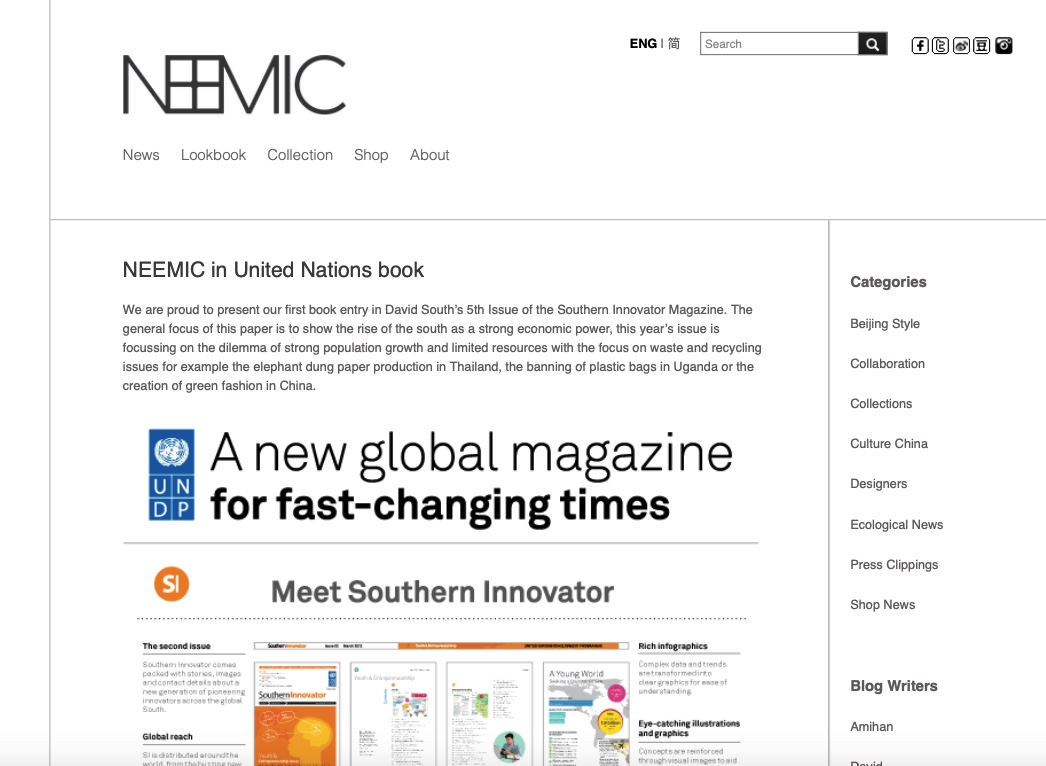
“We are proud to present our first book entry in David South’s 5th Issue of the Southern Innovator Magazine. The general focus of this paper is to show the rise of the south as a strong economic power, this year’s issue is focussing on the dilemma of strong population growth and limited resources with the focus on waste and recycling issues for example the elephant dung paper production in Thailand, the banning of plastic bags in Uganda or the creation of green fashion in China.” https://neemic.asia/ecological-news/neemic-southern-innovator-book
Development Challenges, South-South Solutions was launched as an e-newsletter in 2006 by UNDP’s South-South Cooperation Unit (now the United Nations Office for South-South Cooperation) based in New York, USA. It led on profiling the rise of the global South as an economic powerhouse and was one of the first regular publications to champion the global South’s innovators, entrepreneurs, and pioneers. It tracked the key trends that are now so profoundly reshaping how development is seen and done. This includes the rapid take-up of mobile phones and information technology in the global South (as profiled in the first issue of magazine Southern Innovator), the move to becoming a majority urban world, a growing global innovator culture, and the plethora of solutions being developed in the global South to tackle its problems and improve living conditions and boost human development. The success of the e-newsletter led to the launch of the magazine Southern Innovator.









 David South Consulting
You must be logged in to post a comment.