Categories
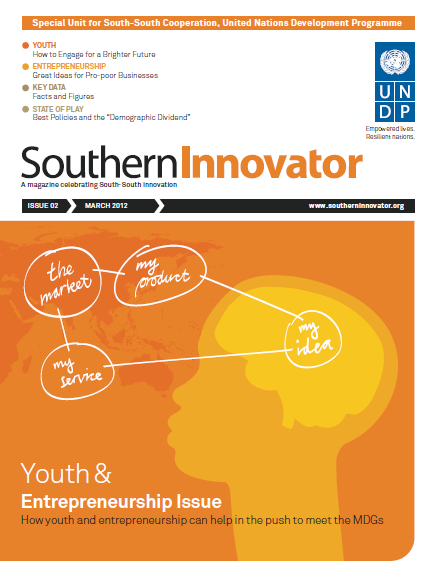
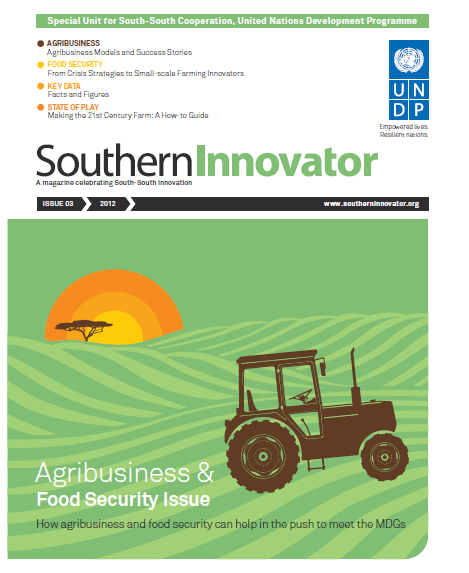
Archive Blogroll Development Challenges, South-South Solutions Newsletters Southern Innovator magazine

All-in-One Solar Kiosk Business Solution for Africa

By David SouthDevelopment Challenges, South-South Solutions

SOUTH-SOUTH CASE STUDY

Kiosks are ubiquitous throughout commercial areas in the global South. These highly efficient little business outlets enable small-scale entrepreneurs to sell necessary products without the expense of renting and running a shop.

While they are a great solution for entrepreneurs and customers alike, they often lack connection to municipal services such as electricity and water. That means kiosk owners need to use batteries or a generator if they need a refrigerator to cool food and drink – an expensive proposition.

A new product launched this year in Addis Ababa, Ethiopia offers a solution.

Created by a team of German architects, the Solarkiosk (solarkiosk.eu) is an autonomous business unit designed for remote, off-grid areas. With solar panels across the top of the kiosk, it generates its own electricity and is basically a mini solar power plant. Inside, it is just like a conventional kiosk, with display shelves for products and a counter in the front with a flap – which can feature advertising and messages – that can be opened up for business and locked shut when the kiosk is closed.

The kiosk captures solar energy and the electricity generated can be used to run a computer, lights or a refrigerator. That makes the Solarkiosk capable of offering a wide range of services needing electricity, from Internet access to car-battery charging and mobile phone recharging – a now essential service as mobile phone use explodes across Africa.

The first kiosk was prototyped in November 2011 and the makers incorporated their first subsidiary, Solarkiosk Solutions PLC, in Addis Ababa, Ethiopia in March 2012.

According to Solarkiosk 1.5 billion people worldwide have no regular supply of electricity – 800 million of them in Africa. The makers of Solarkiosk consider this a huge market and hope to make the most of it.

The kiosk comes in a kit form ready for assembly. The kit is designed to be easy to transport and is light enough and compact enough to be transported on the back of a donkey, its makers claim.

Solarkiosk operators receive training in running and managing a kiosk. They learn about solar technology and how to maintain the kiosks and run a sustainable business. Once the operators are trained and up and running, they typically hire others to help with running the kiosk and offer the services at convenient times for the customers. The Solarkiosk then, potentially, becomes an income and employment generator for the local community.

The kiosk is designed to be durable, secure and difficult to tamper with from the outside. The kiosks have been designed to suit many environments and requirements. There is a basic platform that can be added to or expanded depending on local needs and a series of models depending on the customer’s needs. Cleverly, the largest kiosk model is powerful enough to provide electricity to telecom towers. This has proven attractive to mobile telephone companies who can power a telecom tower and make money from running the kiosk as well.

The Solarkiosk is especially useful for countries near the equator where nights are long (12 hours) and the kiosk can help people get light to read, study and work.

Solarkiosk is targeting off-grid customers who are using up to 40 per cent of their household income on electricity substitutes. According to Solarkiosk, people in off-grid households collectively spend more every year (US $30 billion) lighting their homes – using candles for example – than do all the people living in electricity grid connected countries (US $20 billion).

Solar technology is becoming more affordable at the same time as demand in developing countries for electricity and the products powered by electricity is on the rise. Mobile phones are now essential tools for doing business and staying connected – and all of them need to be kept charged up.

Solarkiosk believes it can save the average off-grid household US $10 per month, while each kiosk could supply solar electricity services to between 200 and 5,000 households.

For now, Solarkiosk is available in Ethiopia. It is based in Berlin, Germany and receives money from the German government. The kiosks themselves were designed and built by Graft Architects (http://www.graftlab.com).

Published: November 2012

Resources

1) How to maintain a solar panel. Website: http://www.ehow.com/how_2005490_maintain-solar-panel.html

2) How to start a kiosk business. Website: http://www.entrepreneur.com/article/63012

3) Kiosk Innova: A Turkish pioneer of hi-tech kiosks for retail services. Website: http://www.kioskinnova.com/english

Southern Innovator was designed and laid out in Iceland using 100% renewable energy, much of which is from geothermal sources. 
Creative Commons License

This work is licensed under a
Creative Commons Attribution-Noncommercial-No Derivative Works 3.0 License.

ORCID iD: https://orcid.org/0000-0001-5311-1052.

© David South Consulting 2023

Categories
Archive Blogroll Development Challenges, South-South Solutions Newsletters Southern Innovator magazine

Geothermal Energy to Boost Global South’s Development

By David SouthDevelopment Challenges, South-South Solutions

SOUTH-SOUTH CASE STUDY

The geothermal heat produced by the earth’s molten core is a resource receiving more and more attention across the global South. Properly harnessed, geothermal energy (http://en.wikipedia.org/wiki/Geothermal_energy) offers a low-cost, non-polluting source of power and hot water that does not harm the environment or contribute to climate change (http://en.wikipedia.org/wiki/Climate_change).

The country that has made the most of this resource is the Scandinavian island nation of Iceland (http://www.visiticeland.com/), one of the world’s most volcanically active places.

The country was once one of the poorest in Europe, dependent on fishing as its main income source. But by 2007-2008, Iceland was ranked as having the highest level of human development in the world.

One of the contributors to this impressive improvement in human development is the tapping of the country’s geothermal energy reserves (http://www.geothermal.is/).

According to the Geothermal Energy Association (GEA), “Iceland is widely considered the success story of the geothermal community. The country of just over 300,000 people is now fully powered by renewable forms of energy, with 17 per cent of electricity and 87 per cent of heating needs provided by geothermal energy.”

Worldwide, geothermal energy supplies power to 24 countries, producing enough electricity to meet the needs of 60 million people (GEA).

The Philippines generates 23 per cent of its electricity from geothermal energy, and is the world’s second biggest producer behind the U.S.  Geothermal energy is also helping provide power in Indonesia, Guatemala, Costa Rica and Mexico.

Energy is critical to advances in human development. Electricity enables the introduction of lighting in homes, the use of washing machines and other modern appliances and of communications tools such as computers and televisions.

Geothermally heated water can be used to heat homes, provide hot water for bathing, heat swimming pools and bathing places and power electricity turbines. Industry can benefit from the low-cost energy, giving a boost to economic development.

And, crucially, it does not harm the natural environment like conventional energy sources such as coal, gas or nuclear power with its legacy of radioactive waste.

While not all countries are as well positioned as volcanically active Iceland or the Philippines, many can find a way to tap this natural resource.

Interest in this power source is increasing in Central and South America, whose energy consumption is forecast to increase by 72 per cent by 2035 (International Energy Outlook 2011).

South America currently relies heavily on hydro-electric power, but this is proving insufficient to meet the growing demand (http://www.esmap.org/esmap/node/1136). A World Bank study says “Latin American and Caribbean countries could boost region-wide electricity supply by 30 percent by 2030 by diversifying the energy mix to include hydropower, natural gas, and renewable energy” (ESMAP).

The report estimates the region has the potential to generate 300 terawatts of geothermal energy per year, roughly equivalent to the output of fifty 1,000-megawatt power plants or the emission of 210 million metric tons of carbon greenhouse gases (ARPA).

The areas best placed to tap this resource are located along the Pacific Rim from Mexico to Chile, and in parts of the Caribbean.

The 2012 Geothermal International Market Overview Report by the Geothermal Energy Association (GEA) (http://www.geo-energy.org/reports.aspx) found Argentina, Chile and Peru are moving ahead with plans.

In Argentina, Earth Heat Resources (http://www.earthheat.com.au/) is developing geothermal energy in the volcanic Copahue region in partnership with Xtrata Pachon SA (http://www.xstratacopper.com/EN/Operations/Pages/ElPachon.aspx).

Because of government support and legislation, there are now 83 geothermal exploration concessions under review in Chile, according to Renewable Energy World.com.

The Renewable Energy Center (http://www.ecpamericas.org/initiatives/?id=23) has been established in Chile and is the fruit of a partnership between the US Department of Energy (DOE) and the Chilean National Energy Commission. It is being used to gather data on global best practices and techniques to be adapted for use in Chile, and hopes to become a knowledge source for the region. A law is also in place to oblige power utilities with a capacity above 200 megawatts (MW) to have 10 per cent of their energy come from renewable sources.

Central America has already enthusiastically embraced geothermal resources, according to the report by the GEA.

Currently, El Salvador and Costa Rica derive 24 per cent (204 MW) and 12 per cent (163 MW) of their electricity production from geothermal energy. Nicaragua and Guatemala are also generating a portion of their electricity from geothermal energy.

And Central America has still more geothermal potential it can tap. Estimates place this between 3,000 megawatts and 13,000 megawatts at 50 identified geothermal sites.

Published: October 2012

Resources

1) Geothermal Basic from the Geothermal Energy Association. Website: http://www.geo-energy.org/currentUse.aspx

2) Geothermal information for children. Website: http://www.eia.gov/kids/energy.cfm?page=geothermal_home-basics

3) Geoexchange: A website connecting contractors, manufacturers , drilling contractors, ground loop installers, engineers, designers, distributors, architects, builders, utilities, training, financing, software and suppliers. Website: http://www.geoexchange.org/

4) Iceland Geothermal: Icelandic geothermal cluster mapping, geothermal energy consumption. Website: http://www.icelandgeothermal.is/index.php/e-samstarfsverkefni/data-collection.html

5) Iceland Geothermal Conference 2013: An international conference on geothermal will be held 5-8 March 2013 at Harpa Conference Centre in Reykjavik, Iceland and is hosted by the Iceland Geothermal initiative. Website:http://geothermalconference.is/

https://davidsouthconsulting.org/2021/02/01/ethiopia-and-djibouti-join-push-to-tap-geothermal-sources-for-green-energy/

https://davidsouthconsulting.org/2022/03/20/global-south-eco-cities-show-how-the-future-can-be/

https://davidsouthconsulting.org/2021/02/01/kenya-turns-to-geothermal-energy-for-electricity-and-growth/

https://davidsouthconsulting.org/2021/03/05/southern-innovator-issue-5/

https://davidsouthconsulting.org/2022/11/01/southern-innovator-magazine-2010-2014/

https://davidsouthconsulting.org/2021/09/07/10-years-ago/

https://davidsouthconsulting.org/2021/10/28/2012-development-challenges-south-south-solutions/

Creative Commons License

This work is licensed under a
Creative Commons Attribution-Noncommercial-No Derivative Works 3.0 License.

ORCID iD: https://orcid.org/0000-0001-5311-1052.

© David South Consulting 2023

Categories
Archive Blogroll Development Challenges, South-South Solutions Newsletters Southern Innovator magazine

Ethiopia and Djibouti Join Push to Tap Geothermal Sources for Green Energy

By David SouthDevelopment Challenges, South-South Solutions

SOUTH-SOUTH CASE STUDY

Ethiopia and Djibouti are the latest global South countries to make a significant commitment to developing geothermal energy – a green energy source that draws on the heat below the earth’s surface (http://en.wikipedia.org/wiki/Geothermal_energy) – to meet future development goals.

Ambitiously, Ethiopia also hopes to build Africa’s largest geothermal power plant.

It joins Kenya, which in 2012, announced projects to expand its geothermal capacity further. Currently, Kenya is Africa’s largest geothermal producer and has geothermal resources concentrated near a giant volcanic crater in the Great Rift Valley with 14 fields reaching from Lake Magadi to Lake Turkana. There are also low temperature fields in Homa Hills and Massa Mukwe (http://www.gdc.co.ke/index.php?option=com_content&view=article&id=191&Itemid=163). Around 1,400 steam holes are being drilled.

Cooperating with Reykjavik Geothermal (rg.is), a US-Icelandic private developer, Ethiopia will spend US $4 billion to build a 1,000 megawatt geothermal plant at Corbetti (http://www.volcano.si.edu/volcano.cfm?vn=221290). It is expected to be ready in eight to 10 years. The country wants to be carbon neutral by 2025.

Drilling will need to go down as deep as 3 kilometers to tap the source. This is expensive and a technological challenge, thus the need for international expertise. The country hopes to develop this source of energy and then export electricity to neighboring African countries.

Another plant, Aluto Langano 7, is being built 201 kilometers south of Addis Ababa, the capital, by a partnership between the Japanese government, Ethiopia and the World Bank.

Ethiopia has enormous potential for geothermal energy, according to a paper in the journal Geothermics: “Ethiopia holds an enormous capacity to generate geothermal energy in the volcano-tectonically active zones of the East African Rift System (http://www.sciencedirect.com/science/article/pii/S0375650513000023).”

At present, 70 per cent of people in sub-Saharan Africa, some 600 million, are without a domestic electricity supply (USAID). Electricity and other sources of energy are required if living standards are to be raised for millions of the world’s poor. The danger of this, however, is to the planet if the energy comes from polluting sources.

In March 2013 the World Bank announced a significant push to increase development of geothermal resources around the world, and in particular in energy-hungry, fast-developing countries.

“Geothermal energy could be a triple win for developing countries: clean, reliable, locally produced power,” the bank says. “And once it is up and running, it is cheap and virtually endless.”

The bank joined forces with Iceland to make a pledge to secure US $500 million in financing to get geothermal projects up and running. The announcement was made at the Iceland Geothermal Conference (http://geothermalconference.is/) in Reykjavík, the Icelandic capital.

Few countries have such easy access to geothermal energy as Iceland, with its plentiful volcanoes, geysers and hot springs bursting through the surface. But it is there, under the ground, and through the Global Geothermal Development Plan (GGDP), it is hoped this plentiful energy source will become the norm for countries around the world.

The World Bank believes at least 40 countries can get into geothermal on a significant scale with the correct investment. Many developing world regions are rich in geothermal resources, including East Africa, Southeast Asia, Central America, and the Andean region.

Just 11 gigawatts of geothermal capacity is currently being tapped in the world. Nuclear power, for example, generates 370 gigawatts a year (2012) (EIA). What has held back many countries has been the high upfront costs involved in getting projects going. A site must be found, drilled and tested to see if it is viable.

The GGDP plan is to raise US $500 million from donors and others to fund geothermal exploration and development. The GGDP will identify promising sites and then acquire funding to pay for drilling to identify commercially viable projects.

The World Bank has increased financing for geothermal development from US $73 million in 2007 to US $336 million in 2012. It comprises 10 per cent of the Bank’s renewable energy lending.

The Icelandic International Development Agency (iceida.is) signed a partnership in September 2013 with the government of Ethiopia to undergo geothermal surface exploration and to build Ethiopia’s capacity to develop this energy source. The World Bank estimates that Ethiopia has the potential to generate 5,000 megawatts (MW) of energy from geothermal sources.

The Geological Survey of Ethiopia (GSE) and the Ethiopian Electric Power Corporation (EEPCO) will undertake exploration at sites in Tendaho Alalobeda and Aluto Langano.

It fits in with a wider push by Ethiopia to develop its renewable energy resources. The country is also increasing investment in hydro-electric power.

The Ethiopia project is part of the wider World Bank-Iceland compact to develop global geothermal energy capacity. It is the second such arrangement, with the first already underway in Rwanda.

Djibouti is also moving into geothermal, with a new agreement with the World Bank to develop a site at Lake Assal. The World Bank will provide US $6 million to evaluate its commercial potential. Djibouti tried to develop its geothermal resources privately but was not successful.

Overall, geothermal power has the potential to help reduce Djibouti’s electricity production costs by 70 per cent, boost access to electricity for the population and alleviate the country’s energy dependency. The country hopes to have 100 per cent green energy by 2020.

Joining forces on helping boost geothermal in Africa is USAID’s Power Africa fund, which is providing US $7 billion in financial support and loan guarantees for energy projects.

Apart from generating electricity, what else can this powerful resource do? Countries such as Iceland now use hot geothermal water to heat homes and provide domestic hot water. Iceland also has an extensive network of swimming pools and spas in each town. The Blue Lagoon (bluelagoon.com) is a good example of how geothermal power generation can have lots of side benefits. The giant, steamy blue-colored lagoon is the consequence of an accident in 1976 at the nearby geothermal power plant; it’s now a spa and one of the country’s main tourist attractions.

The geothermal-heated pools and spas play a key role in keeping the cold north Atlantic country healthy – Iceland ranked number one on the UNDP human development index in 2007 – and provide a recreational source even in the depths of winter.

Published: December 2013

Resources

1) Iceland Review: A great way to learn about life on an island powered by geothermal energy. Website: icelandreview.com

2) Nordic Development Fund: The Nordic Development Fund (NDF) is the joint development finance institution of the five Nordic countries. The objective of NDF’s operations is to facilitate climate change investments in low-income countries. Website: ndf.fi

3) Icelandic International Development Agency (ICEIDA): The Icelandic International Development Agency (ICEIDA) is an autonomous agency under the Ministry of Foreign Affairs and is responsible for the implementation of official Icelandic bilateral development cooperation.  It follows the Icelandic government’s Act on Development Cooperation No 121/2008, which is in keeping with the UN Millennium Development Goals and other international commitments, such as the Monterrey Consensus on Financing for Development and the Paris Declaration on Aid Effectiveness. Website: iceida.is

4) Geothermal Exploration Project, NDF: The main objective of the Geothermal Exploration Project is to assist countries in East Africa to enhance geothermal knowledge and capacity in order to enable further actions on geothermal energy development in the respective countries. The project could extend to 13 countries in the East Africa Rift Valley: Burundi, Comoros, Djibouti, DR Congo, Eritrea, Ethiopia, Kenya, Malawi, Mozambique, Rwanda, Tanzania, Uganda and Zambia. Website: http://www.iceida.is/iceida-projects/nr/1488

5) Power Africa: Power Africa – an initiative to double the number of people with access to power in sub-Saharan Africa. Power Africa will achieve this goal by unlocking the substantial wind, solar, hydropower, natural gas, and geothermal resources in the region to enhance energy security, decrease poverty, and advance economic growth. Website: http://www.usaid.gov/powerafrica

6) Geological Survey of Ethiopia: The GSE has been generating , collecting  and managing geoinformation of the country for the last 4 decades. Website: http://www.gse.gov.et/index.php

7) Home geothermal: A feature from Popular Mechanics on how geothermal can work in the home. Website: http://www.popularmechanics.com/science/energy/hydropowergeothermal/4331401

Like geothermal energy? Then we think you will like our Southern Innovator Magazine. Designed and laid out in Iceland using 100% renewable energy (much of which is geothermal). 


This work is licensed under a Creative Commons Attribution 4.0 International License.

ORCID iD: https://orcid.org/0000-0001-5311-1052.

© David South Consulting 2023

Categories
Archive

Development Challenges, South-South Solutions Newsletter

By David SouthDevelopment Challenges, South-South Solutions

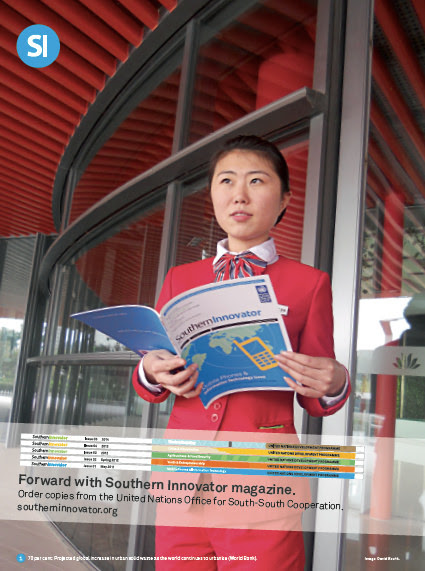
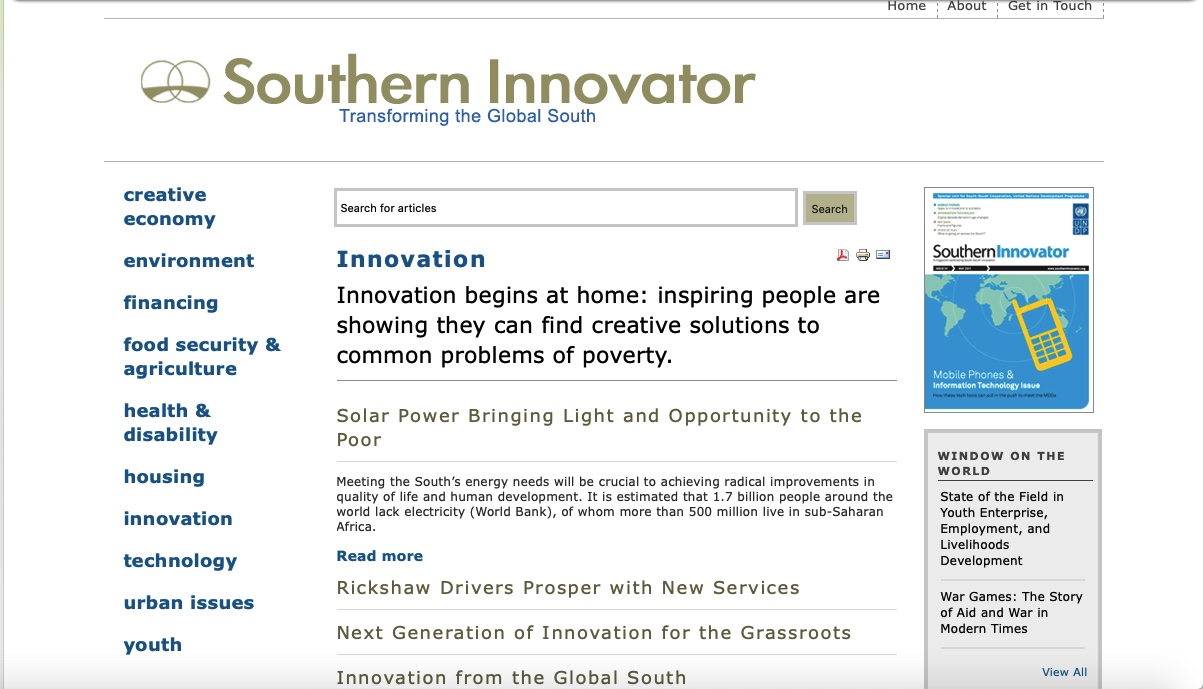
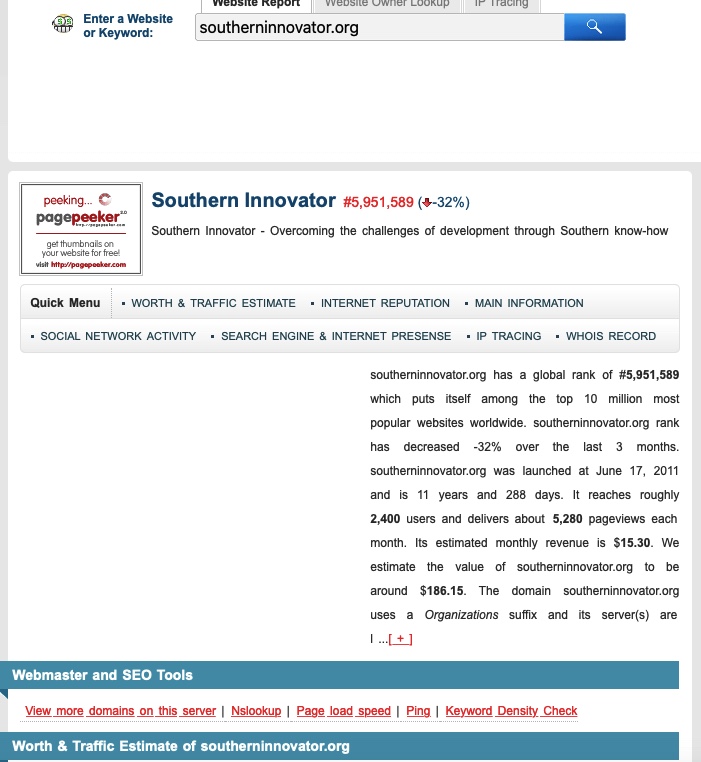
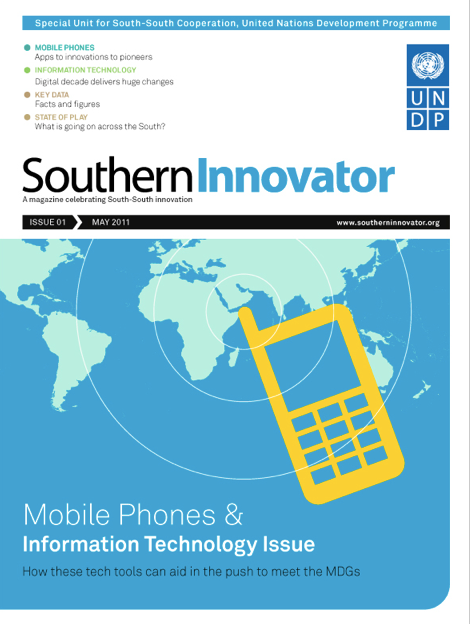
The original southerninnovator.org website launched in 2011, in tandem with the first issue of Southern Innovator Magazine, and ranked midway in the top 10 million most popular websites in the world. Its content has been cited in books, scholarship and strategic plans.

ISSN 2227-3905

Development Challenges, South-South Solutions is the monthly e-newsletter for the United Nations Office for South-South Cooperation in UNDP (formerly the United Nations Development Programme’s South-South Cooperation Unit). I research and write all stories (since January 2007). You can view the original website here. The stories are in English, French and Spanish.

The original WordPress website for Development Challenges, South-South Solutions (southsouthnews.wordpress.com). It was launched in 2006 and eventually became southerninnovator.org in 2011. The magazine Southern Innovator was also launched in New York in 2011.
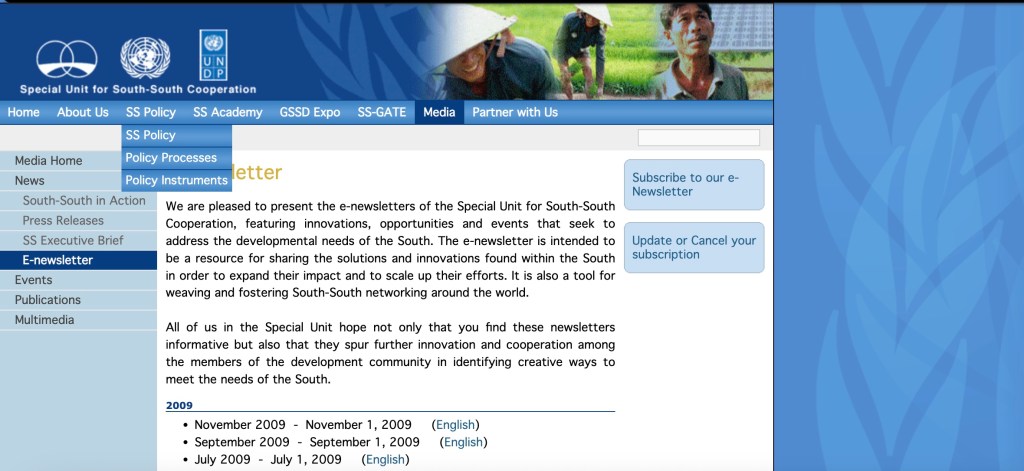
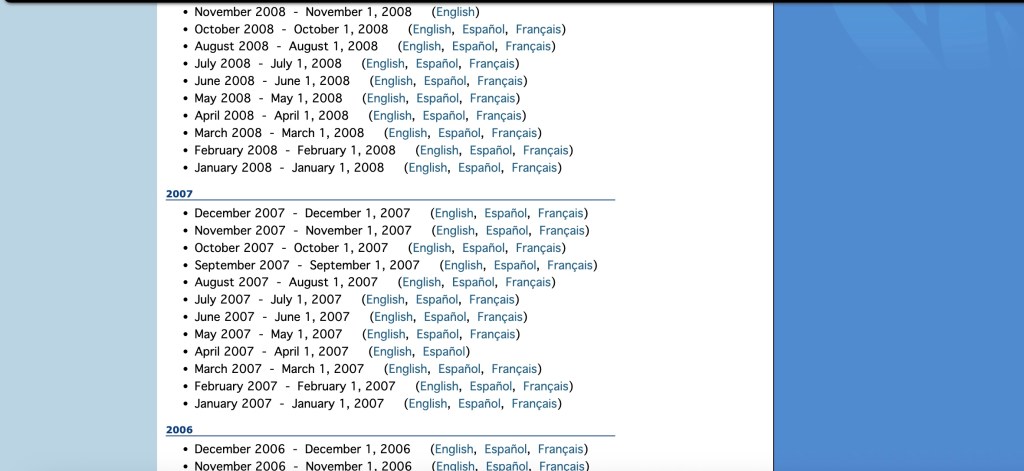
The newsletter archive on the website for UNDP’s Special Unit for South-South Cooperation circa 2011 (including issues in English, French and Spanish). 2011 was an important year as the e-newsletter Development Challenges, South-South Solutions scaled into a dedicated web archive, http://southerninnovator.org, a sister magazine, Southern Innovator (https://unsouthsouth.org/2014/12/25/southern-innovator-magazine/), and pollinated its content across multiple platforms, capitalising on the platform and social media explosion of the time.

Here is a good background article on the rise of South-South cooperation, how it is altering global trade and power relationships, and what the future holds: South-South Cooperation Defies the North. And here is some historical background from Wikipedia: South-South Cooperation.

Development Challenges, South-South Solutions reaches a global audience of influential decision-makers on the frontlines of international development in the South. More than 2,000 subscribers read the newsletter every month (academic institutions, UN agencies, private sector companies, UNDP Country Offices, financial institutions including the IMF and World Bank, inter-governmental organisations, UNDP knowledge networks around the world, and all South-South focal points in West Africa).

Remember to think of Development Challenges, South-South Solutions when you have a Southern innovation to share with the world. You can read our archive of stories online here: http://ssc.undp.org/index.php?id=66

From Special Unit for South-South Cooperation: 2008 Reflections: “As part of the strategy to foster South‐South cooperation within and across regions, the Division has continued to invigorate and re‐enforce a South‐South cooperation focal point system. These efforts included the publication and distribution of a monthly e‐newsletter, Development Challenges: South-South Solutions, which presents a briefing for South‐South focal points, Southern academics and development professionals on practical solutions to development challenges found throughout the South. Over the course of 2008, twelve e‐newsletters were released via e‐mail and published on the website of the Special Unit.”

What are people saying about Development Challenges, South-South Solutions? Read some comments here.

Contact me by email about the newsletter here: developmentchallenges@googlemail.com.

Contact me by email about the new global magazine Southern Innovator here: southerninnovator@yahoo.co.uk

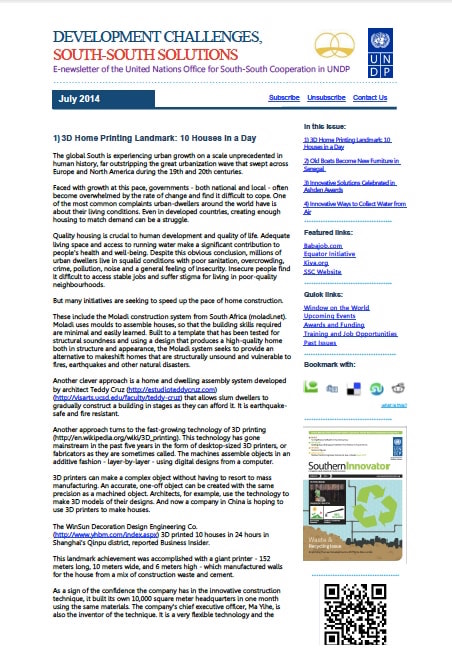
July 2014 issue of Development Challenges, South-South Solutions: The last issue is available online for download. Support the e-newsletter for 2017: we are seeking additional funding so we can improve the reader experience and frequency of the e-newsletter. Since first launching in 2006, we often heard from readers how they valued the stories in the e-newsletter and how it has helped in raising the profile of innovators across the global South (“Congratulations on another great newsletter that’s packed with fascinating information! I really enjoy getting it each month.”). Additional resources would enable us to improve the way readers can access and receive the e-newsletter, enable the e-newsletter’s contributors to travel and report on developments, and allow us to offer daily and weekly updates and a wider range of resources online and on mobile platforms. Additional funds help in maintaining the quality of the e-newsletter, something that has been appreciated by readers (“Great economic and business reporting! Very helpful for us.” Africa Renewal). It will also allow the e-newsletter to spin-off quality resources for innovators, such as the influential magazine Southern Innovator. Contact the United Nations Office for South-South Cooperation if you wish to support the e-newsletter for 2017: UNOSSC.

“What a tremendous magazine your team has produced! It’s a terrific tour de force of what is interesting, cutting edge and relevant in the global mobile/ICT space… This is great, engaging, relevant and topical stuff.” Rose Shuman, Founder & CEO, Open Mind and Question Box, Santa Monica, CA, U.S.A.

“Great economic and business reporting! Very helpful for us.” Africa Renewal, Africa Section, Strategic Communications Division, United Nations Department of Public Information

“The reviewer observed that, although the Policy and UN Coordination Unit had produced all of the reports requested by intergovernmental bodies, especially for the High-level Committee, it had not been able to produce many of the publications (evidence-based analytical reports) that had previously been within its purview. Such publications included Southern Innovator magazine and the monthly e-newsletter “Development Challenges, South-South Solutions”. In the case of Southern Innovator, one issue (No. 5 on waste and recycling) was published during the four-year period of the framework but did not have wide online distribution, and issue No. 6 was awaiting funds for publication. The e-newsletter was last issued in July 2014 even though the reviewer found it a good way to communicate with focal points at the national and inter-agency levels. In fact, the shortage of funds for those knowledge products was the main reason that they had ceased being produced during the evaluation period.”  Final evaluation of the performance of the United Nations Office for South-South Cooperation  under its strategic framework, 2014-2017, in light of the adoption of the 2030 Agenda for Sustainable Development

Note: Unfortunately, the reason for “the shortage of funds” was down to suspension of funding to the UNOSSC in 2015 and 2016 pending two internal UN audit investigations after arrests made in 2015 by the Federal Bureau of Investigation (FBI) revealed a bribery and money laundering network targeting the United Nations via various NGOs, including the UN-based news organisation South-South News. The case eventually made its way to the Supreme Court of the United States.

Back Issues

Development Challenges, South-South Solutions Newsletter | 2011-2014

2014

Development Challenges, South-South Solutions Newsletter | 2007-2010

2013

https://www.slideshare.net/DavidSouth1/development-challenges-july-2013-issue

2012

https://www.slideshare.net/DavidSouth1/development-challenges-july-2012-issue

2011

https://www.slideshare.net/DavidSouth1/development-challengessouthsouthsolutionsdecember2011issue

2010

2009

2008

https://www.slideshare.net/DavidSouth1/development-challenges-may-2008-issue

2007

“Beautiful, inspiring magazine from UNDP on South-South innovation. Heart is pumping adrenaline and admiration just reading it.”

This work is licensed under a Creative Commons Attribution 4.0 International License.

ORCID iD: https://orcid.org/0000-0001-5311-1052.

© David South Consulting 2025