Finding ways to generate low-cost or free light has captured the imagination of innovators across the global South. The desire for light is strong: Light gives an immediate boost to income-making opportunities and quality of life when the sun goes down or in dark homes with few windows.
More than 1.7 billion people around the world have no domestic electricity supply, of whom more than 500 million live in sub-Saharan Africa (World Bank). Without a source of electricity, it is difficult to use conventional technology to switch the lights on.
While it is possible to run lights using batteries or diesel generators, these are expensive options that are not possible for many poor people. The more of a slim income that is spent on light, heat or cooking fuel, the less there is left for better-quality food, clothing, transport or education and skills development.
Low-cost light is great, but free light is even better – and one Brazilian solution is offering this.
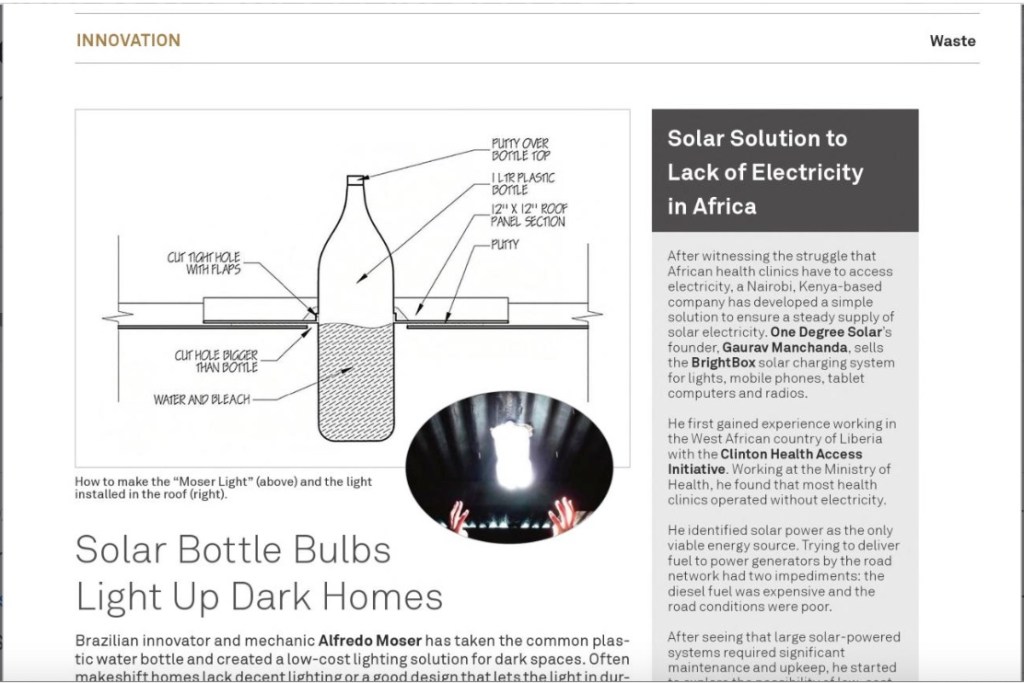
Brazilian innovator and mechanic Alfredo Moser has taken the common plastic water bottle and created a low-cost lighting solution for dark spaces. Often makeshift homes lack decent lighting or a good design that lets the light in during the day. This means it may be a bright, sunny day outside, but inside the home or workplace, it is very dark and reading or working is difficult.
Moser came upon the idea during regular blackouts in his home city of Uberaba (http://www.uberaba.mg.gov.br/portal/principal) in southern Brazil during 2002. During the blackouts, only factories were able to get electricity, leaving the rest of the population in the dark.
The “Moser Light” involves taking plastic bottles, which are usually just thrown away or recycled, and filling them with water and bleach to draw on a basic physical phenomenon: the refraction of sunlight when it passes through a water-based medium.
It is a simple idea: Holes are drilled in the ceiling of a room and the bottles placed in the holes. The liquid-filled bottle amplifies the existing sunlight (or even moonlight) and projects it into the dark room. This turns the plastic bottle into a very bright lightbulb that does not require any electricity.
Moser uses a solution of two capfuls of bleach added to the water to prevent anything growing in the water such as algae because of the exposure to sunlight.
“The cleaner the bottle, the better,” he said.
Polyester resin is used to seal the hole around the plastic bottle and make it watertight from rain.
Moser claims his bottle innovation can produce between 40 and 60 watts of light.
Moser uses recycled plastic bottles, so the carbon footprint is minimal compared to the manufacture of one incandescent bulb, which takes 0.45 kilograms of CO2 (UN). Running a 50 Watt incandescent light bulb for 14 hours a day for a year, around the same light as produced by the bottle bulb, produces a carbon footprint of nearly 200 kilograms of CO2.
“There was one man who installed the lights and within a month he had saved enough to pay for the essential things for his child, who was about to be born. Can you imagine?” Moser told the BBC.
The plan is to try and get as many as a million homes fitted with the lighting system by the end of 2013.
In many poor areas, it is common to live in makeshift or rudimentary dwellings. These are often built to crude designs and, in order to keep costs down and boost security, will have few or no windows. These dwellings will consequently be very dark inside, even on the brightest days. This leaves people having to turn to a source of artificial light if they want to do something indoors like read or work. And this costs money. Be it electricity from a mains, or battery-powered lamps or gas-powered lanterns, the cost will eat into a person’s tight income. This is where Moser’s simple solution saves the day and saves pennies: it is free light once the bottle lamp system is installed.
Placing the bottle lights in the ceiling transforms the ceiling into something akin to the night sky, with many points of light shining down into the room like stars. It also means the occupant of the room does not just have to strain to see with the use of a single light but now has many lights illuminating the room from all angles.
“It’s a divine light,” Moser told the BBC World Service. “God gave the sun to everyone, and light is for everyone. Whoever wants it saves money. You can’t get an electric shock from it, and it doesn’t cost a penny.”
It has not been a road to riches for Moser. He has made some money installing the system in a local supermarket and nearby homes, and he has inspired a charity to install the lighting system and to train people to do the installation and make an income from it.
The MyShelter Foundation in the Philippines was inspired by Moser’s invention and has installed the system in some 140,000 homes there, the BBC reported.
“We want him to know that there are a great number of people who admire what he is doing,” MyShelter Executive Director Illac Angelo Diaz said of Moser.
Using bottle bulbs instead of electricity or generators means families can save US $6 per month, according to Diaz (CNN). The Philippines is reported to have the most expensive electricity in Asia and slum homes usually do not have electricity.
It is estimated 15 other countries also have homes using the Moser system. The MyShelter Foundation believes 1 million homes worldwide have used the Moser system as of 2013.
Liter of Light (http://aliteroflight.org), run by the MyShelter Foundation, offers instructions on how to install the lighting system on its website.
Published: September 2013
Resources
1) D-Lab: MIT: Development through Dialogue, Design and Dissemination: D-Lab is building a global network of innovators to design and disseminate technologies that meaningfully improve the lives of people living in poverty. The program’s mission is pursued through interdisciplinary courses, technology development, and community initiatives, all of which emphasize experiential learning, real-world projects, community-led development, and scalability. Website: http://d-lab.mit.edu/
2) d.light Solar: d.light is a for-profit social enterprise whose purpose is to create new freedoms for customers without access to reliable power so they can enjoy a brighter future. d.light design manufacture and distribute solar light and power products throughout the developing world. Website: http://www.dlightdesign.com/
3) Liter of Light: It brings the eco-friendly bottle light to communities living without electricity. Website: http://aliteroflight.org
4) Solar Sister: Solar Sister eradicates energy poverty by empowering women with economic opportunity. They combine the breakthrough potential of solar technology with a deliberately woman-centered direct sales network to bring light, hope and opportunity to even the most remote communities in rural Africa. Website: http://www.solarsister.org/
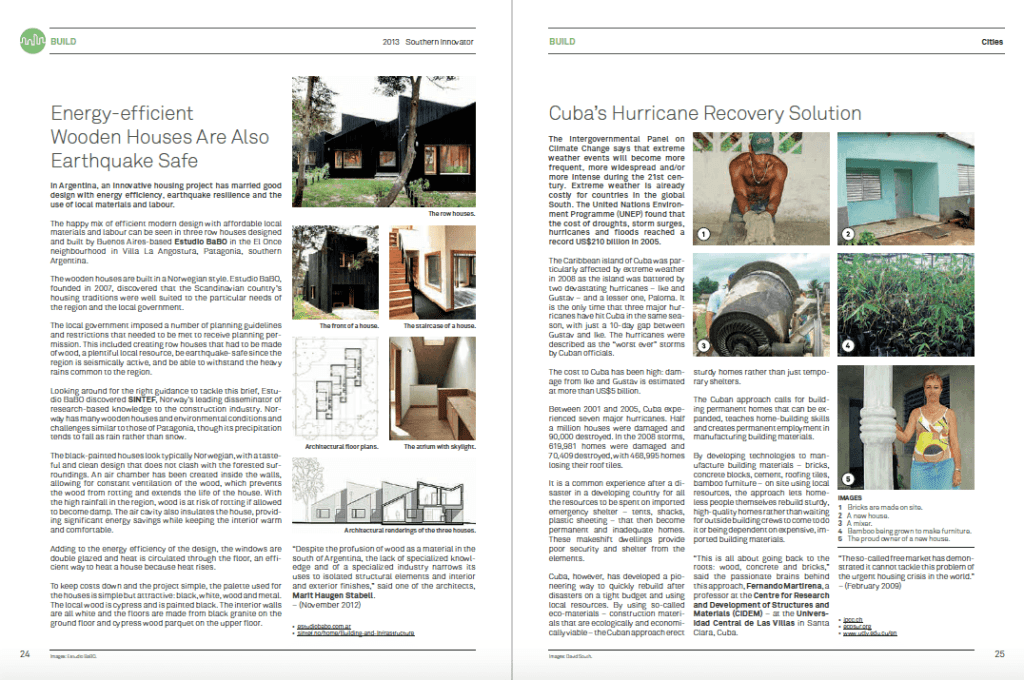
In Argentina, an innovative housing project has married good design with energy efficiency, earthquake resilience and the use of local materials and labour. As energy resources continue to be stretched around the global South, innovative building designs will be critical to the creation of sustainable housing for the future.
The happy mix of efficient modern design with affordable local materials and labour can be seen in three row houses designed and built by Buenos Aires-based Estudio BaBO (estudiobabo.com.ar) in the El Once neighbourhood in Villa La Angostura, Patagonia, southern Argentina.
The wooden houses are built in a Norwegian style. Estudio BaBO, founded in 2007, discovered that the Scandinavian nation’s housing traditions were well suited to the particular needs of the region and the local government.
The local government imposed a number of planning guidelines and restrictions that needed to be met to receive planning permission. This included creating row houses which must be made of wood – a plentiful local resource. They also had to be earthquake-safe since the region is seismically active and be able to withstand the heavy rains common to the region.
Looking around for the right guidance to tackle this brief, Estudio BaBO discovered SINTEF – Norway’s leading disseminator of research-based knowledge to the construction industry (http://www.sintef.no/home/Building-and-Infrastructure/). The Nordic nation has many wooden homes and also has similar environmental conditions and challenges to Patagonia – though its precipitation tends to fall as rain, rather than snow.
The black-painted homes look typically Norwegian, with a tasteful and clean design that does not clash with the forested surroundings. An air chamber has been created inside the homes’ walls allowing for constant ventilation of the wood, which prevents the wood from rotting and extends the life of the house. With the high rainfall of the region, wood is at risk of rotting if allowed to become damp. The air cavity also insulates the house, providing significant energy savings while keeping the interior warm and comfortable.
Adding to the energy efficiency of the design, the windows are double glazed and heat is also circulated through the floor – an efficient way to heat a home because heat rises.
To keep costs down and the project simple, the palette used for the homes is simple but attractive: black, white, wood and metal. The local wood is cypress and is painted black. The interior walls are all white and the floors are made from black granite on the ground floor and cypress wood parquet on the upper floor. The rest of the woodwork in the house is also made of cypress.
Using locally sourced materials also helps to keep costs down.
The project was initially conceived in 2009 and the houses were built in 2010-2011. While wood is plentiful in Patagonia, traditionally the use of wood in construction was rudimentary and local labour skill levels were low. This meant the design had to be simple and easy to build.
“Despite the profusion of wood as a material in the south of Argentina, the lack of specialized knowledge and of a specialized industry narrow its uses to isolated structural elements and interior and exterior finishes,” said one of the architects, Marit Haugen Stabell.
The three units of two-storey row houses each come with a living room, dining room, kitchen, toilet, two bedrooms and a laundry room. Each home also has an outdoor patio. The homes are designed to receive maximum natural light. Deploying this energy efficient design is considered unusual for Argentina and Estudio BaBO has set a new standard for sustainable housing in the country.
It looks like the CLF Houses could inspire others to look again at wood as a building material.
Development Challenges, South-South Solutions was launched as an e-newsletter in 2006 by UNDP’s South-South Cooperation Unit (now the United Nations Office for South-South Cooperation) based in New York, USA. It led on profiling the rise of the global South as an economic powerhouse and was one of the first regular publications to champion the global South’s innovators, entrepreneurs, and pioneers. It tracked the key trends that are now so profoundly reshaping how development is seen and done. This includes the rapid take-up of mobile phones and information technology in the global South (as profiled in the first issue of magazine Southern Innovator), the move to becoming a majority urban world, a growing global innovator culture, and the plethora of solutions being developed in the global South to tackle its problems and improve living conditions and boost human development. The success of the e-newsletter led to the launch of the magazine Southern Innovator.
The technology already exists to provide renewable energy and electricity to all the world’s poor. The trick is finding a way to pay for it and to make it sustainable. Many innovators are experimenting with business models to reach the so-called Bottom of the Pyramid (BOP) cohort, and the 1.2 billion poorest people in the world who do not have access to electricity (World Bank) (http://tinyurl.com/n9p3f5x). A further 2.8 billion have to rely on wood or other biomass materials to cook and heat their homes.
The International Energy Agency (iea.org) believes US $48 trillion of investment will be needed between now and 2035 to make sure energy capacity matches rapid population growth.
In the influential book The Fortune at the Bottom of the Pyramid (http://www.amazon.co.uk/Fortune-Bottom-Pyramid-Eradicating-Poverty/dp/8177587765), the late professor C.K. Prahalad (http://en.wikipedia.org/wiki/C._K._Prahalad) advocated seeing the poor as people with needs and assets: consumers who just need the right goods and services designed for them. It was a change from thinking only of the world’s wealthier populations as consumers, and revealed a market worth billions waiting to be tapped.
Energy is key to development and improvements to living standards. Yet energy poverty plagues much of the global South, especially in Africa and particularly in rural areas.
The World Bank has identified 20 countries in developing Asia and sub-Saharan Africa which will require a massive effort to expand access to electricity and safe cooking methods for poor households.
Around 80 per cent of the people without modern energy live in rural areas. While progress has been made since 1990 in expanding access to energy, it has failed to keep pace with population growth. According to the World Bank, the pace of expansion will have to double to meet the 100 percent access target set for 2030.
To avoid increasing global carbon emissions while achieving this goal, many are looking to renewable energy sources and technologies to reach these last groups of people.
As pointed out by the Institute of Development Studies (http://www.ids.ac.uk/news/can-renewable-electricity-reduce-poverty), “The global threat posed by climate change means that we also face the pressing need to use less carbon in existing energy systems. Making progress on both energy poverty and decarbonization requires a sharp increase in renewable electricity production, both on and off-grid.”
The institute identified four necessary factors for access to renewable energy to benefit poor people.
1. Once electricity is generated, it needs to be reliably fed into the system. 2. This additional supply must be made accessible, and affordable, for poor people. 3. Increased electricity consumption then needs to translate into poverty reduction. 4. Increased electricity supply can indirectly reduce poverty by boosting economic growth.
India’s Simpa Networks (simpanetworks.com), started in 2011, has a business model it believes will do the trick. Simpa has developed a clever way to increase access to home solar power systems for the poor, by allowing customers to purchase the system in gradual “rental” payments over time. The customers eventually come to own the power system outright, and from then on to generate electricity for free. Since the payments are small and incremental, it suddenly becomes within the realm of poor households to afford modern solar energy systems.
This is called the “Progressive Purchase Pricing Model” – similar to “prepaid”, “pay as you go” and “installment plan” models. Under this model, customers make a 10 percent down payment and receive the home solar system. The customer then buys a time-specific amount of energy for between US $1 and US $10 with their mobile phone. The orange lock box on the power system has a keypad on the front. When a code is punched in, it releases electricity (http://simpanetworks.com/our-solution/).
In increments, while the customer purchases energy for home use they also eat away at the cost of the system, until eventually it is paid off, usually at a total of US $300. Systems have an expected life span of 10 years.
With few cash resources, poor households usually are not capable of saving enough cash to purchase a full energy system for their home. Instead, they rely on buying kerosene for lamps or using battery-powered torches and lamps when they can afford it.
In 2012, Simpa teamed up with SELCO India (http://www.selco-india.com/) – a social enterprise providing sustainable energy solutions and services to households – to sell 1,000 home solar power systems, expanding to 5,000 systems in 2013, according to a case study from not-for-profit Synergie pour l’Echange et la Valorisation des Entrepreneurs d’Avenir (SEVEA) (sevea-asso.org). The goal is to reach 25,000 units sold by the end of 2014, proving this business model can scale. Ultimately, Simpa wishes to mega-scale its approach and reach 1 million households over the next five years.
Simpa believes take-up will be quick because this model reduces risk, both for the seller and for the bank that may loan the cash for the 10 per cent down payment. Simpa acts as a go-between for the system sellers such as SELCO and the banks. Simpa believe this business model reduces the risk of non-payment or loan default and has the right incentives in place to encourage the customer to hang in and keep making payments until they own the system outright. Customers enjoy the benefits of clean energy 24/7 from day one and can see clearly the connection between the energy they receive and the small payments they make. For those who default from paying, the system is taken from their home.
When the system was piloted in Karnataka, India, all loans were successfully repaid.
Simpa Networks is a venture capital-backed technology company. It hopes its approach will attract investors, particularly social investors, seeking a low-risk investment in helping expand energy access.
Published: June 2014
Development Challenges, South-South Solutions was launched as an e-newsletter in 2006 by UNDP’s South-South Cooperation Unit (now the United Nations Office for South-South Cooperation) based in New York, USA. It led on profiling the rise of the global South as an economic powerhouse and was one of the first regular publications to champion the global South’s innovators, entrepreneurs, and pioneers. It tracked the key trends that are now so profoundly reshaping how development is seen and done. This includes the rapid take-up of mobile phones and information technology in the global South (as profiled in the first issue of magazine Southern Innovator), the move to becoming a majority urban world, a growing global innovator culture, and the plethora of solutions being developed in the global South to tackle its problems and improve living conditions and boost human development. The success of the e-newsletter led to the launch of the magazine Southern Innovator.
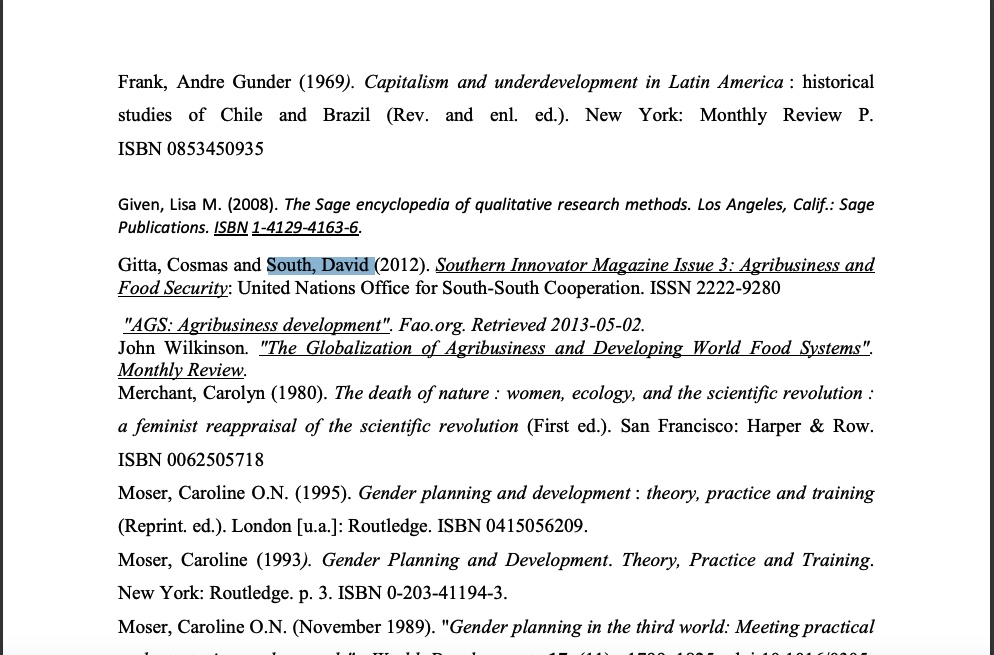
Southern Innovator was initially launched in 2011 with the goal of – hopefully – inspiring others (just as we had been so inspired by the innovators we contacted and met). The magazine seeks to profile stories, trends, ideas, innovations and innovators overlooked by other media. The magazine grew from the monthly e-newsletter Development Challenges, South-South Solutions published by the United Nations Office for South-South Cooperation (UNOSSC) since 2006. A selection of books and papers citing stories from the magazine are featured below to aid researchers, in particular those interested in health and human development and the role of innovators in international development.
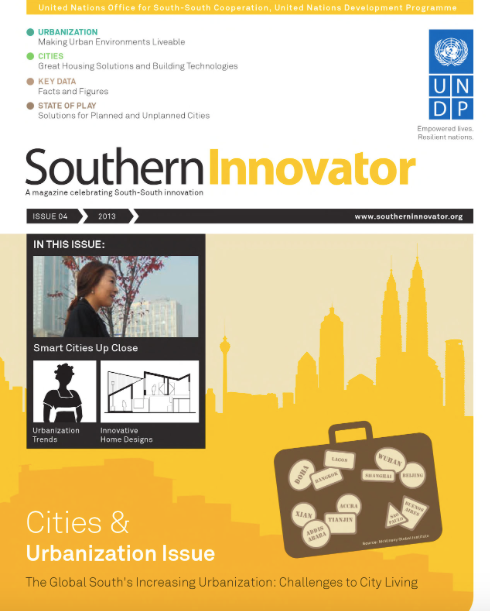
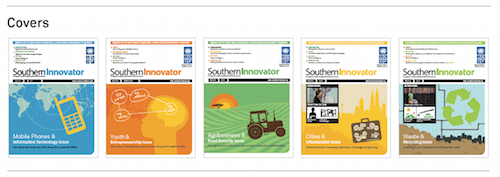
The first five issues of Southern Innovator from 2011 to 2014. Called a “Beautiful, inspiring magazine from UNDP on South-South innovation.”
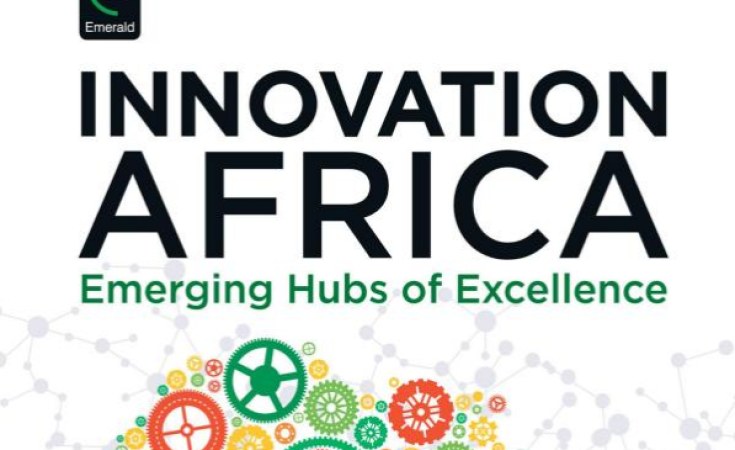
“Innovation is critical to growth and development in Africa. In the context of a continent characterized by fast growing economies as well as an array of socioeconomic challenges, such as high levels of poverty and inequality, innovation in Africa must be understood in an encompassing manner. Africa needs to support the emergence of its own Silicon Valleys, but it must also foster the invention and adoption of cleaner technologies that limit respiratory illnesses, deforestation and combat climate change. This book contains a number of analytical case studies that examine the nature and origins of emerging high-end innovation hubs in Africa. These “hubs” or ecosystems are both understudied and little known inside and outside the continent. With this analysis, the book highlights and draws lessons from some of the most promising and successful innovation cases in Africa today, exploring the key factors driving their successful emergence, growth and future prospects. Relevant for scholars, policymakers, and business leaders, the book provides both inspiration and useful policy advice that can inform strategies and concrete measures to speed up the pace of innovation in Africa today.”
“Research on gated communities is moving away from the hard concept of a ‘gated community’ to the more fluid one of urban gating. The latter allows communities to be viewed through a new lens of soft boundaries, modern communication and networks of influence.
The book, written by an international team of experts, builds on the research of Bagaeen and Uduku’s previous edited publication, Gated Communities (Routledge 2010) and relates recent events to trends in urban research, showing how the discussion has moved from privatised to newly collectivised spaces, which have been the focal point for events such as the Occupy London movement and the Arab Spring.
Communities are now more mobilised and connected than ever, and Beyond Gated Communities shows how neighbourhoods can become part of a global network beyond their own gates. With chapters on Australia, Canada, Europe, South America, Asia, Africa and the Middle East, this is a truly international resource for scholars and students of urban studies interested in this dynamic, growing area of research.”
“The economic, political and social situation in Chile shows a country in transition. Some observers anticipate a broad “reboot” of the nation. While Chile is still seen by many as an example of progress in South America and of developmental potential in the global South, it faces a complex political constellation, particularly in the aftermath of the re-election of Michelle Bachelet. Many wonder how social and institutional innovations can be incepted without interrupting the country’s remarkable success over the past decades.
This book provides an interdisciplinary analysis of Chile’s situation and perspectives. In particular, it addresses the questions:
What is Chile’s real socio-political situation behind the curtains, irrespective of simplifications?
What are the nation’s main opportunities and problems?
What future strategies will be concretely applicable to improve social balance and mitigate ideological divisions?
The result is a provocative examination of a nation in search of identity and its role on the global stage.
Roland Benedikter, Dr., is Research Scholar at the Orfalea Center for Global and International Studies, University of California, Santa Barbara, Senior Research Scholar of the Council on Hemispheric Affairs Washington D.C., Trustee of the Toynbee Prize Foundation Boston and Full Member of the Club of Rome.
Katja Siepmann, MA, is Senior Research Fellow of the Council on Hemispheric Affairs Washington D.C., Member of the German Council on Foreign Relations, and Lecturer at the Faculty of Interdisciplinary Cultural Sciences of the European University Frankfurt/Oder.
The volume features a Foreword by Ned Strong, Executive Director of the David Rockefeller Center for Latin American Studies, Harvard University, and a Preface by Larry Birns, Director of the Council on Hemispheric Affairs, Washington D.C., and Former Senior Public Affairs Officer of the United Nations’ Economic Commission for Latin America (Santiago, Chile).”
“A Sociological Approach to Health Determinants investigates how the social works in determining health and health inequity. Taking a global perspective, the book shines a light on how experiences of health, illness and health care are shaped by a variety of complex social dynamics. Informed primarily by sociology, the book engages with the WHO’s social determinants of health approach and draws on contributions from history, political economy and policy analysis to examine issues such as class, gender, ethnicity and indigeneity, and the impact they have on health. A Sociological Approach to Health Determinants is a comprehensive resource that provides a new perspective on the influence of social structures on health, and how our understanding of the social can ensure improved health outcomes for people all over the globe. Toni Schofield is Associate Professor at the University of Sydney. She specialises in research and teaching in sociology, and public policy and administration.”
New Directions in Children’s and Adolescents’ Information Behavior Research edited by Dania Bilal and Jamshid Beheshti (Emerald Group Publishing: 2014)”This book comprises innovative research on the information behavior of various age groups. It also looks at special populations such as ethnic minorities, indigenous peoples, and users with disabilities. The book presents research and reflections on designing systems that help the new generation cope with a complex knowledge society.
Economy Reports for APEC Economies on demographics, policies & ICT applications for people with Special Needs (Seniors and People with Disabilities), Asia-Pacific Economic Cooperation, APEC Telecommunications and Information Working Group, January 2013
Taming the Tide: Stories from India by Claire Bentley, Vanessa Brombosz, Sofianne Gabrielli, Ga Eun Lee, Vaidehi Nafade, Lindsay Steele and Muhammad Wali, Global Health Case Studies: A Compilation from PPHS 511 Fundamentals of Global Health, McGill Global Health Programs, Case studies – Fall 2015, pages 23 to 32
If you would like to either sponsor an issue of Southern Innovator or place an advertisement in the magazine, then please contact southerninnovator@yahoo.co.uk.




























 David South Consulting
You must be logged in to post a comment.