Categories
Archive Development Challenges, South-South Solutions Newsletters Southern Innovator magazine

Chilean Eco-Buildings Pioneering Construction Methods

By David SouthDevelopment Challenges, South-South Solutions

SOUTH-SOUTH CASE STUDY

Across the global South, the search is on for new ways to build without extracting a high price from local environments.

More and more people are recognizing the advantages of energy-saving methods like prefabrication. Prefab building techniques involve assembling a structure from pre-assembled parts or modules made in a factory, or transporting a completed, factory-made structure to a site (http://en.wikipedia.org/wiki/Prefabricated_building). Pre-fabrication has many advantages, especially now that information technologies bring precision to the building process. Prefabrication means the construction process can be tightly controlled, helping to avoid waste, time delays, weather problems, or any of the other idiosyncrasies of a building site. It can also allow large numbers of dwellings to be built quickly by maximizing skills and efficiencies in an assembly-line model of production.

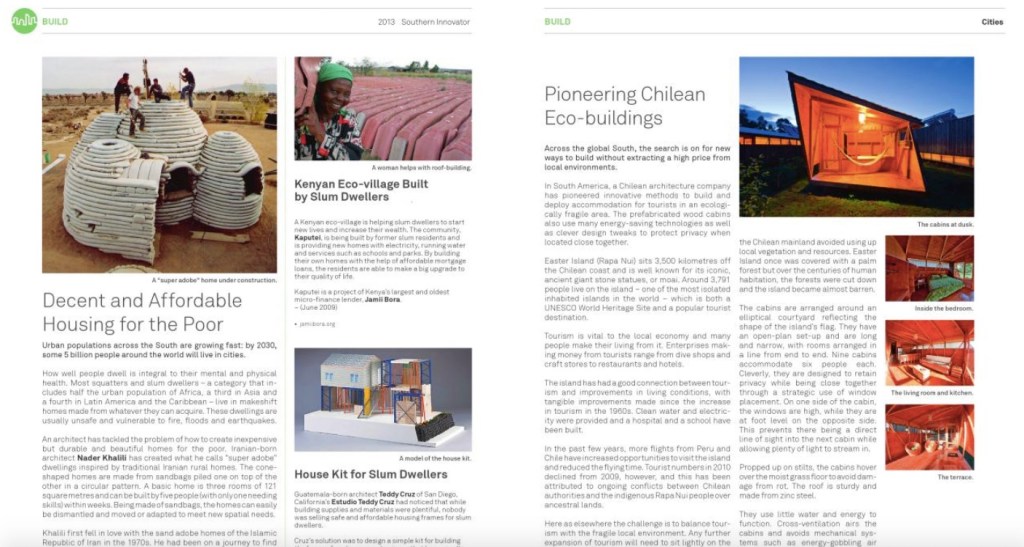
In South America, a Chilean architecture company has pioneered innovative methods to build and deploy accommodation for tourists in an ecologically fragile area. The prefabricated wood cabins also use many emerging saving technologies and clever design tweaks to protect privacy when located close together.

Easter Island (Rapa Nui) (http://en.wikipedia.org/wiki/Easter_Island) sits 3,500 kilometers off the Chilean coast and is well known for its iconic, giant head ancient stone statues, or moai (http://en.wikipedia.org/wiki/Moai). Around 3,791 people live on the island – one of the most isolated inhabited islands in the world – which is both a UNESCO World Heritage Site and a popular tourist destination.

Tourism is vital to the local economy and many people make their living from it. Enterprises making money from tourists range from dive shops and craft stores to restaurants and hotels.

The island has had a good connection between tourism and improvements in living conditions, with tangible improvements made since the increase in tourism in the 1960s. Clean water and electricity were provided and a hospital and a school built.

In the past few years, more flights from Peru and Chile have increased opportunities to visit the island and lowered flight times. The island’s only airport is being expanded to further increase the capacity of flights, a project due to be completed by 2015.

But tourist numbers in 2010 declined from 2009 and this has been attributed to ongoing conflicts between Chilean authorities and the indigenous Rapa Nui people over ancestral lands.

Here as elsewhere, the challenge is to balance tourism with the fragile local environment. Any further expansion of tourism will need to sit lightly on the land and respect the rights of the Rapa Nui people.

The brief for the Morerava eco cabins (http://www.morerava.com/) was to provide environmentally sensitive accommodation that uses few local resources. Built by Santiago-based Chilean architects AATA Associate Architects (http://aata.cl/), the cabins were prefabricated in a factory and shipped to the island during 2010.

The architects specialize in industrial, commercial, educational and institutional, residential and interior design. They pay attention to environmental conditions and the use of resources.

The cabins are arranged around an elliptical courtyard reflecting the shape of the island’s flag design. They have an open-plan set-up and are long and skinny, with rooms arranged in a line from end to end. Nine cabins accommodate six people each. Cleverly, they are designed to retain privacy while being close together. Privacy is maintained through a strategic use of window placement. On one side of the cabin, the windows are high, while they are low at foot level on the opposite side. This prevents there being a direct sight line into the next cabin, while allowing plenty of light to stream in.

Having the cabins built on the Chilean mainland avoided using up local vegetation and resources. Easter Island once was covered with a palm forest. But over the centuries of human habitation, the forests were cut down and the island became almost barren.

Propped up on stilts, the cabins hover over the moist grass floor to avoid damage from rot. The roof is sturdy and made from zinc steel.

They use little water and energy to function. Cross-ventilation airs the cabins and avoids mechanical systems like energy-gobbling air conditioners. Electricity on the island is generated from expensive petrol, so any means to avoid using it means a big savings.

With a mild climate, the cabins do not need insulation.

Water is captured from rainfall on the roof and is then drained into a storage tank below the cabins (http://en.wikipedia.org/wiki/Rainwater_harvesting), and hot water is provided by solar heaters placed on the rooftops. This system circulates the hot water without electricity by using a technology called thermosiphon (http://en.wikipedia.org/wiki/Thermosiphon) which exploits the natural phenomenon of heated water being less dense and rising while cooler water flows downward through the force of gravity.

At the other end of the construction spectrum, one of the most notoriously energy-wasting of structures – an office building – has been given a green makeover. Another Chilean pioneer in green architecture is the Santiago headquarters of Empresas Transoceanica (http://www.transoceanica.cl/), a private investment company in real estate, hotels and tourism, agro-industry and logistics. Its new campus HQ – part park, part office building – maximizes light through the building’s long and bulbous shape.

Designed to reduce energy demand while improving work spaces, it favours natural light while avoiding excess heat build up through wooden slats outside the building.

Geothermal energy comes from a well 75 metres below ground. This provides water cooled at 12 degrees Celsius, to cool the building. The building has been built following the strict environmental guidelines laid down in the LEED guidelines (Leadership in Energy & Environmental Design (LEED) – an internationally recognized green building certification system (http://en.wikipedia.org/wiki/Leadership_in_Energy_and_Environmental_Design).

Extensive planning and design work went into making sure the building’s structure, orientation, lighting, insulation and landscaping reduced energy use and need for energy-intensive mechanical solutions. Skylights bring natural light into the building’s public spaces. There are three stories above ground and two stories below providing underground parking.

The landscaped park around the building is actually the roof for the underground parking garage. The whole edifice creates a seamless connection between the building and the greenery and water features surrounding it.

Published: February 2011

Resources

1) Series of photographs and architectural renderings of the Transoceanica headquarters. Website: http://www.plataformaarquitectura.cl/2010/10/28/edificio-transoceanica-arquitectos-2/

2) World Hands Project: An NGO specialising in simple building techniques for the poor. Website: www.worldhandsproject.org

3)  Builders Without Borders: Is an international network of ecological builders who advocate the use of straw, earth and other local, affordable materials in construction. Website: http://builderswithoutborders.org/

4) An inspiring collection of prefabrication buildings and the techniques used to make them. Website: http://inhabitat.com/architecture/prefab-housing/

5)  Tiny House Design Blog: The blog is full of ideas and plans for making small homes cheaply. Website: http://www.tinyhousedesign.com/

6)  Building and Social Housing Foundation: The Building and Social Housing Foundation (BSHF) is an independent research organisation that promotes sustainable development and innovation in housing through collaborative research and knowledge transfer. Website: http://www.bshf.org/

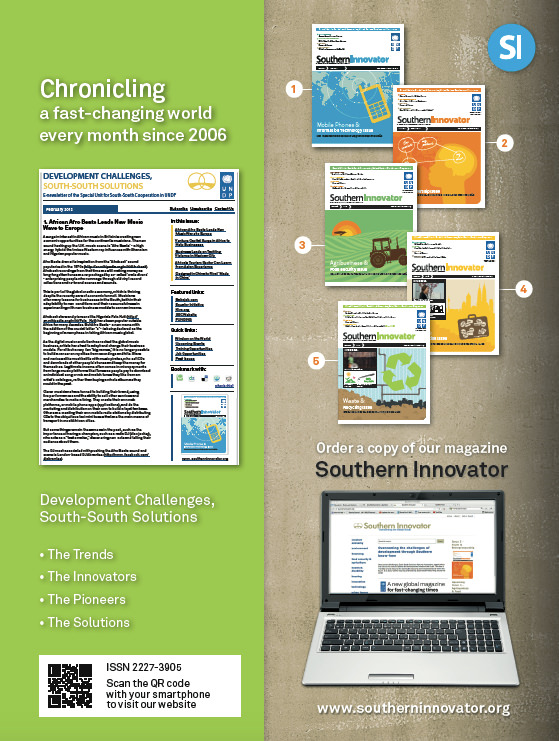
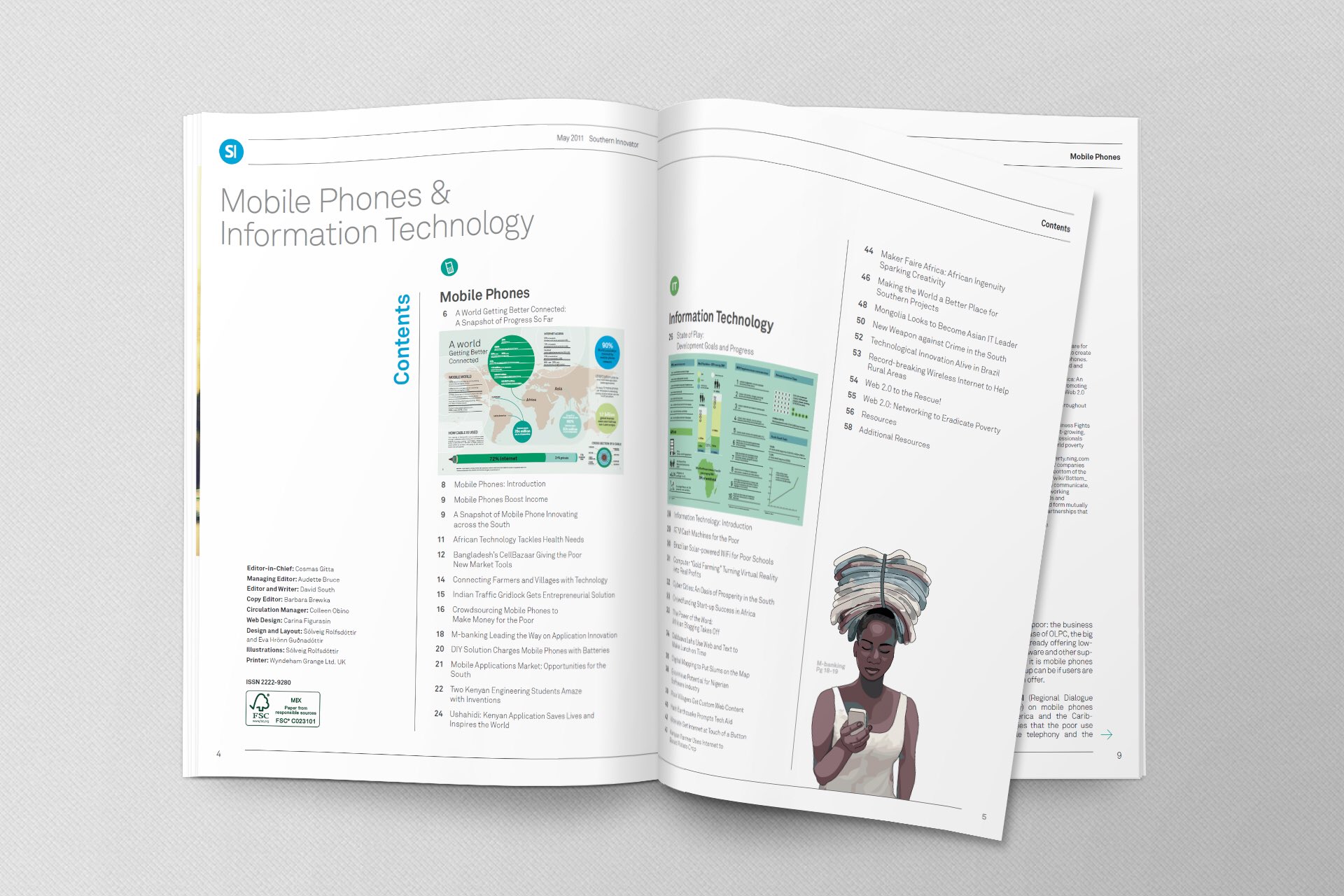
Development Challenges, South-South Solutions was launched as an e-newsletter in 2006 by UNDP’s South-South Cooperation Unit (now the United Nations Office for South-South Cooperation) based in New York, USA. It led on profiling the rise of the global South as an economic powerhouse and was one of the first regular publications to champion the global South’s innovators, entrepreneurs, and pioneers. It tracked the key trends that are now so profoundly reshaping how development is seen and done. This includes the rapid take-up of mobile phones and information technology in the global South (as profiled in the first issue of magazine Southern Innovator), the move to becoming a majority urban world, a growing global innovator culture, and the plethora of solutions being developed in the global South to tackle its problems and improve living conditions and boost human development. The success of the e-newsletter led to the launch of the magazine Southern Innovator.  

Creative Commons License

This work is licensed under a
Creative Commons Attribution-Noncommercial-No Derivative Works 3.0 License.

ORCID iD: https://orcid.org/0000-0001-5311-1052.

© David South Consulting 2023

Categories
Archive Development Challenges, South-South Solutions Newsletters

Asian Factories Starting to go Green

By David SouthDevelopment Challenges, South-South Solutions

SOUTH-SOUTH CASE STUDY

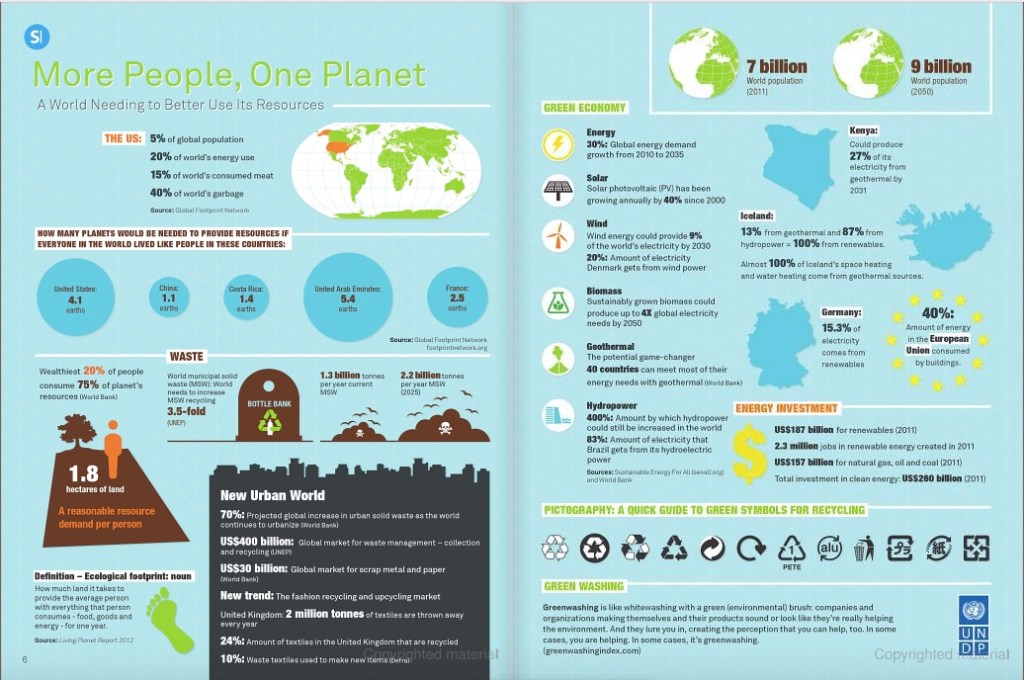
Media headlines have recently highlighted the growing air pollution crisis in Asia’s expanding cities. This is caused by a mix of factors – the growing number of vehicles, coal-powered factories, people burning dirty fuels to heat their homes, and poor enforcement of standards – and has severe consequences for human health. If it’s not tackled, more and more countries will see large rises in respiratory problems, cancers and early deaths from pollution-caused illnesses (http://www.nrdc.org/air/).

The World Health Organization (WHO) says air pollution is the world’s largest environmental health risk, killing 7 million people every year. Asia has the largest number of air pollution deaths in the world, with 3.3 million deaths linked to indoor air pollution and 2.6 million deaths related to outdoor air pollution (Clean Air Asia).

While most of the Asian countries where this is a problem are also aggressively growing their economies in order to get richer and raise living standards, there is a rising awareness of the need to balance a modern, industrial economy with human health and the environment.

One solution is to adopt green and sustainable building standards when constructing new factories. This is more than just a public relations exercise: the energy savings possible from building smart pay off in the long run. And green factories not only pollute less, they save lives and the environment.

Asia plays a critical role in producing the world’s consumer products, from the small and simple to the highly complex components used in 21st-century computing technologies.

Intel (intel.com), the manufacturer of electronic devices and the computer chips that go inside them, is trying to lead the way. It has built a US $1 billion manufacturing plant 16 kilometers outside Ho Chi Minh City, Vietnam, and it is designed to exceed Vietnamese environmental and sustainability guidelines and laws.

Opened in 2010, it boasts the country’s largest solar power system. It is also currently working on a water reclamation system to reduce water consumption at the plant by 68 per cent, according to The New York Times. It is hoping to receive certification from the US Green Building Council (usgbc.org).

It is all part of a wider trend that is starting to reverse the damaging, short-termist approach of the past. More and more Western multinationals and their Asian suppliers are building environmentally sound factories in the developing world.

According to the US Green Building Council, around 300 manufacturing facilities in Asia are either certified or are awaiting Leadership in Energy and Environmental Design (LEED) certification. The LEED certification recognizes the building has met certain standards in becoming a ‘green’ building.

Going green is more and more part of corporate policy for companies that want to avoid the bad publicity of disasters such as the garment factory collapse that killed 1,135 people in Bangladesh in April 2013.

But it is not just driven by a desire to avoid bad publicity: large corporations that build factories in the global South are also realizing there are big financial savings to be made.

Intel has been able to reduce its global energy costs by US $111 million since 2008. It did this by investing US $59 million in 1,500 projects to boost sustainability across its facilities worldwide. The projects have reduced carbon dioxide emissions equivalent to the amount produced by 126,000 American households per year.

Intel’s solar array in Vietnam, which cost US $1.1 million, offsets the equivalent of 500 pollution-belching motorbikes every day.

How effective are LEED-certified buildings? The New York Times reported that a 2011 survey compared a typical shoe factory with a LEED factory run by the American sport shoe maker Nike. It found the LEED factory used 18 per cent less electricity and fuel and 53 per cent less water.

And this trend is creating a new economy unto itself. As an example, a new marketplace for industrial efficiency upgrading is developing in India. Power outages are frequent in India, so finding a way to save electricity and alternatives to dependence on the national power grid is attractive to any economic enterprise.

Prashant Kapoor, principal industry specialist for green buildings at the International Finance Corporation (IFC), believes demand for upgrades is strong enough that various companies can specialize in this field and profit from it.

And things are also happening in the notoriously smog-choked cities of China. By the end of 2012, China had certified eight factories and 742 buildings as LEED, according to the China buildings programme at the Energy Foundation (ef.org) in San Francisco.

Damien Duhamel of Solidiance (solidiance.com), a firm that advises businesses on how to grow in Asia, believes avoiding risk caused by environmental accidents or scandals is heightened by the growing presence of social media, which amplifies negative publicity.

“The next battle will be here” for higher corporate environmental standards, Duhamel believes. “This is why some smart companies – Intel, for example – took the steps of being proactive.”

Published: April 2014

Resources

1) Leadership in Energy and Environmental Design (LEED): LEED, or Leadership in Energy & Environmental Design, is a green building certification program that recognizes best-in-class building strategies and practices. Website: http://www.usgbc.org/leed

2) US Green Building Council (USGBC): Its mission is to transform the way buildings and communities are designed, built and operated, enabling an environmentally and socially responsible, healthy, and prosperous environment that improves the quality of life. Website: http://www.usgbc.org/

3) Dwell: Dwell magazine is focused on demonstrating that modern design can be both functional and comfortable. Website: dwell.com

4) Inhabitat: Design for a Better World: Inhabitat.com is a weblog devoted to the future of design, tracking the innovations in technology, practices and materials that are pushing architecture and home design towards a smarter and more sustainable future. Website: inhabitat.com

5) Solidiance: Singapore-based consulting firm specializing in Asia’s green-building sector. Website: solidiance.com

6) Clean Air Asia: Clean Air Asia was established in 2001 as the premier air quality network for Asia by the Asian Development Bank, World Bank, and USAID. Its mission is to promote better air quality and livable cities by translating knowledge to policies and actions that reduce air pollution and greenhouse gas emissions from transport, energy and other sectors. Website: cleanairinitiative.org

7) Southern Innovator Issue 4: Cities and Urbanization: This issue is packed with ideas on to how make cities and urban environments greener and reduce air pollution. Website: http://www.scribd.com/doc/133622315/Southern-Innovator-Magazine-Issue-4-Cities-and-Urbanization and here: http://tinyurl.com/oc2mqgm

8) Better Air Quality Conference 2014 and 8th Regional Environmentally Sustainable Transport Forum in Asia:  From 19 to 21 November 2014 in Colombo, Sri Lanka, BAQ is the leading event on air quality in Asia, covering the key sectors of transport, energy, industry and climate change, with a particular emphasis on government policies and measures. Website: http://cleanairinitiative.org/portal/node/12274

9) Tianjin Eco-city: The Sino-Singapore Tianjin Eco-city’s vision is to be a thriving city which is socially harmonious, environmentally-friendly and resource-efficient. Website: tianjinecocity.gov.sg

10) Songdo: Songdo International Business District (IBD) officially opened on August 7, 2009 as a designated Free Economic Zone and the first new sustainable city in the world designed to be an international business district. Website: songdo.com

https://davidsouthconsulting.org/2022/09/27/caribbean-island-st-kitts-goes-green-for-tourism/

https://davidsouthconsulting.org/2021/01/25/creating-green-fashion-in-china/

https://davidsouthconsulting.org/2021/02/01/ethiopia-and-djibouti-join-push-to-tap-geothermal-sources-for-green-energy/

https://davidsouthconsulting.org/2023/02/03/environmental-public-awareness-handbook-case-studies-and-lessons-learned-in-mongolia/

https://davidsouthconsulting.org/2021/08/29/indian-business-model-makes-green-energy-affordable/

https://davidsouthconsulting.org/2022/11/11/innovation-cairos-green-technology-pioneers/

https://davidsouthconsulting.org/2021/10/22/innovations-in-green-economy-top-three-agenda/

https://davidsouthconsulting.org/2021/08/07/mongolian-green-book/

https://davidsouthconsulting.org/2022/04/14/prisons-with-green-solutions/

https://davidsouthconsulting.org/2021/02/04/us-450-million-pledged-for-green-economy-investments-at-kenyan-gssd-expo/

Development Challenges, South-South Solutions was launched as an e-newsletter in 2006 by UNDP’s South-South Cooperation Unit (now the United Nations Office for South-South Cooperation) based in New York, USA. It led on profiling the rise of the global South as an economic powerhouse and was one of the first regular publications to champion the global South’s innovators, entrepreneurs, and pioneers. It tracked the key trends that are now so profoundly reshaping how development is seen and done. This includes the rapid take-up of mobile phones and information technology in the global South (as profiled in the first issue of magazine Southern Innovator), the move to becoming a majority urban world, a growing global innovator culture, and the plethora of solutions being developed in the global South to tackle its problems and improve living conditions and boost human development. The success of the e-newsletter led to the launch of the magazine Southern Innovator.  

Creative Commons License

This work is licensed under a
Creative Commons Attribution-Noncommercial-No Derivative Works 3.0 License

ORCID iD: https://orcid.org/0000-0001-5311-1052.

© David South Consulting 2022

Categories
Archive Development Challenges, South-South Solutions Newsletters

Caribbean Island St. Kitts Goes Green for Tourism

By David SouthDevelopment Challenges, South-South Solutions

SOUTH-SOUTH CASE STUDY

Going green may sound like the right thing to do but it can also be associated with being a costly burden and boring. But, as one island nation is proving, being green is a great selling point for attracting tourists and investors – especially in a world where many places are grappling with pollution and resource depletion.

St. Kitts, an island located between the Caribbean Sea and the Atlantic Ocean, is part of the Federation of Saint Kitts and Nevis and has a population of around 35,000 (stkittstourism.kn).

The country shut down its main source of income, the sugar industry, in 2005. Facing dropping profits, it decided the industry was not worth supporting anymore.

But what would be the replacement source of income and employment? St. Kitts has turned to tourism for the answer. While many other Caribbean islands have long drawn on tourism – along with banking and finance, in some cases – in order to diversify economies away from dependence on agriculture, St. Kitts had not developed this sector. As a latecomer, St. Kitts needed to think about how it could do things differently and stand out from the crowd.

St. Kitts decided to become a regional champion for green tourism and green energy, and to lure tourists to the island by championing its green credentials.

The launch in 2013 of a Euro 1.8 million (US $2.48 million) one-megawatt solar energy farm nearby the Robert L. Bradshaw International Airport (http://www.stkittstourism.kn/explore-st-kitts-getting-here-airport.php) – enough to power a few hundred houses – showed St. Kitts was getting serious about going green (http://www.cuopm.com/?m=201302&paged=13).

Joining the new solar farm, an all-green resort is hoping to further boost St. Kitts’ green credentials. The ambitious Kittitian Hill (kittitianhill.com) resort stretches across 162 hectares and includes four hotels, an organic farm and multiple restaurants. In the pipeline is a plan to open film production and editing facilities to lure movie-makers looking for a green film-making studio.

Kittitian Hill is the brainchild of property developer Val Kempadoo (http://www.linkedin.com/pub/valmiki-kempadoo/8/53a/339), who is trying to set a precedent for sustainable resorts in the Caribbean. It is being developed with a mix of foreign experts and local contractors.

The resort boasts organic food fresh from tropical farms and an on-site tropical forest, described as an “edible landscape” offering a bounty of fresh fruit and vegetables. Around the resort, “Pick Me” signs encourage visitors to pick ripe fruit and sit down and make a meal of it.

The grounds include rare and heirloom fruit trees, and the resort hopes to create a reserve to protect endangered species. To spread the green message, the plants and seeds are shared locally with farmers and others. It is part of a strategy to encourage farmers to produce organic food, avoiding pesticides and chemicals, and to farm animals ethically.

The resort’s green ethos even extends to its 18-hole golf course. Golf courses are notorious water-wasters, but this one has a smart water management system, using organic crops and fruit trees to help keep the soil moist, interweaving a farm throughout the golf course. Caddies will guide golfers to the ripest fruits while they putt their way around the course.

“My vision is to bring together community and culture, along with mindful conservation of natural resources,” said Kempadoo. “This means we can offer our guests an unforgettable experience, while bringing lasting, life-changing benefits to the local people and economy.”

As an added sweetener to get investment coming in, St. Kitts and Nevis offers citizenship to investors in the country. In return, investors can travel visa-free to 120 countries – something that has appealed to investors from around the global South.

“It is important for St. Kitts to be selective and careful about development and focus on high-end rather than high-volume tourism,” Kempadoo told Monocle magazine. “The best asset of this island is its natural beauty, and we want to preserve it.”

Published: June 2014

Resources

1) The International Ecotourism Society: The International Ecotourism Society (TIES) is a 501(c)(3) nonprofit organization dedicated to promoting ecotourism. Website: https://www.ecotourism.org/what-is-ecotourism

2) Top Five Eco Resorts of Mexico: Website: http://www.ecotourismtrips.org/topics/show/3809

3) 3 Rivers Dominica Eco Lodge: “An award-winning range of comfortable and charming self-contained cottages, nature, adventure and community-based ecotourism activities, restaurant, rivers and relaxation”. Website: http://www.3riversdominica.com/

4) Jungle Bay Resort and Spa: Award-winning Jungle Bay was built and is operated in alignment with international Geotourism and Ecotourism guidelines. As an alternative to traditional Caribbean tourism, the focus is on enjoyable nature-based activities and wellness of guests with quality service, guided by the principles as set by both National Geographic’s Center for Sustainable Destinations and The International Ecotourism Society (TIES). Website: junglebaydominica.com

https://davidsouthconsulting.org/2022/10/20/african-tourism-leads-the-world-and-brings-new-opportunities/

https://davidsouthconsulting.org/2022/09/28/asian-factories-starting-to-go-green/

https://davidsouthconsulting.org/2022/02/07/boosting-tourism-in-india-with-surfing-culture/

https://davidsouthconsulting.org/2021/01/25/creating-green-fashion-in-china/

https://davidsouthconsulting.org/2022/11/20/ecotourism-to-heal-the-scars-of-the-past/

https://davidsouthconsulting.org/2023/02/03/environmental-public-awareness-handbook-case-studies-and-lessons-learned-in-mongolia/

https://davidsouthconsulting.org/2021/02/01/ethiopia-and-djibouti-join-push-to-tap-geothermal-sources-for-green-energy/

https://davidsouthconsulting.org/2022/11/11/innovation-cairos-green-technology-pioneers/

https://davidsouthconsulting.org/2021/10/22/innovations-in-green-economy-top-three-agenda/

https://davidsouthconsulting.org/2022/10/10/a-solution-to-stop-garbage-destroying-tourism/

https://davidsouthconsulting.org/2021/03/05/southern-innovator-issue-5/

https://davidsouthconsulting.org/2021/02/04/us-450-million-pledged-for-green-economy-investments-at-kenyan-gssd-expo/

Development Challenges, South-South Solutions was launched as an e-newsletter in 2006 by UNDP’s South-South Cooperation Unit (now the United Nations Office for South-South Cooperation) based in New York, USA. It led on profiling the rise of the global South as an economic powerhouse and was one of the first regular publications to champion the global South’s innovators, entrepreneurs, and pioneers. It tracked the key trends that are now so profoundly reshaping how development is seen and done. This includes the rapid take-up of mobile phones and information technology in the global South (as profiled in the first issue of magazine Southern Innovator), the move to becoming a majority urban world, a growing global innovator culture, and the plethora of solutions being developed in the global South to tackle its problems and improve living conditions and boost human development. The success of the e-newsletter led to the launch of the magazine Southern Innovator.  

Creative Commons License

This work is licensed under a
Creative Commons Attribution-Noncommercial-No Derivative Works 3.0 License

ORCID iD: https://orcid.org/0000-0001-5311-1052.

© David South Consulting 2023

Categories
Archive Development Challenges, South-South Solutions Newsletters

Innovative Ways to Collect Water from Air

By David SouthDevelopment Challenges, South-South Solutions

SOUTH-SOUTH CASE STUDY

 World water resources are being depleted quickly as populations grow, urbanize and demand better living standards. Many scientists believe we are reaching peak water – the point at which fresh water is consumed faster than it is replenished.

According to Ensia (ensia.com), a magazine showcasing environmental solutions in action, 70 per cent of the earth’s fresh water reserves are locked up in snow or ice, and are expensive to tap and bring to the world’s water-stressed places. Of the remainder, most is in groundwater, soil moisture, swamps or permafrost, while just 0.3 per cent is easy to access in freshwater lakes and rivers.

By far the biggest user of water in the world – accounting for 69 per cent of the total – is farm irrigation. That’s a serious concern when considering the world will need to grow more food to feed an increasing population. Just 1 per cent of water is used for livestock, while 15 per cent is used for electricity generation and 7 per cent for manufacturing. More water is currently being pumped from underground resources than is being replaced from underground aquifers.

The average person needs to consume 0.6 to 1.3 gallons (2.72 liters to 6 liters) of water per day to survive in a moderate climate. For drinking, cooking, bathing and sanitation, an individual needs 13 gallons (59 liters) a day (Ensia).

In many places, obtaining water requires a long trek to a well or stream. But non-desert climates have water as a resource readily available all around – trapped in the air. The clue to this resource’s existence is in the air’s humidity levels, the most visible sign of which is the dew that is found covering the grass and leaves every morning when people wake up. The trick is to extract that water from the air and create a steady supply of this essential resource.

Italian architect and designer Arturo Vittori (http://www.vittori-lab.com/team/arturo-vittori), a lecturer on aerospace architecture, technology transfer and sustainability, believes he has an answer.

Wired magazine (http://www.wired.com/2014/03/warka-water-africa/) reported that Vittori was inspired by a trip to Ethiopia, where he observed the daily struggle to get water. Access to water in northeastern Ethiopia often requires a long walk, which reduces the amount of time left in the day to do other things. Parents often take along their children, meaning the children cannot go to school. The time consumed by gathering water leaves people poorer and unable to dedicate more of their day to income-earning activities.

And there is no guarantee the water is safe to drink or free of chemical contaminants. This situation left Vittori pondering ways of coming up with an inexpensive solution that would eliminate the daily hassle of finding water and guarantee its quality.

The answer was a WarkaWater Tower (http://www.architectureandvision.com/projects/chronological/84-projects/art/492-073-warkawater-2012?showall=&start=1). The bamboo structure – which looks like an upended, latticework funnel – captures the dew and moisture in the air and collects it in a basket at the bottom.

The water collector is inspired by the Warka tree, or Ficus vasta (http://en.wikipedia.org/wiki/Ficus_vasta). Native to Ethiopia, it is known for providing shade and as a rendezvous point for traditional gatherings.

A WarkaWater Tower stands 8 meters in height and is made from either bamboo or reeds. Inside, a mesh traps humidity from the air and the water drips down into a basket. One tower can gather around 94 liters of water a day. The water is right there in the community and not kilometers away, meaning time and energy saved for income-generating tasks.

A WarkaWater Tower is constructed in sections, which are assembled and then stacked on top of each other. The construction does not need special scaffolding or special machinery. Once the tower is in place, it can also be used as a solar-power generator.

The tower is still a prototype and Vittori plans to build two towers for a launch in 2015.

In Peru, reports the Latin American Herald Tribune (http://www.laht.com/article.asp?ArticleId=700400&CategoryId=14095), another innovative solution to the water crisis has been developed by students at the University of Engineering and Technology (UTEC) (http://www.utec.edu.pe/Utec.aspx). The students have developed a highway advertising billboard that can draw drinking water out of the air. Inspired by a campaign called “Ingenuity in Action”, the students teamed up with a local advertising agency to design the billboard. It is capable of extracting water from the air and processing it through a filtration system as it flows down to a series of taps at the bottom.

The water-making billboard is at the 89.5 kilometer distance marker of the Pan-American Highway and has five electric-powered tanks that can hold a total of 96 liters of drinkable water. It is capable of providing enough water for hundreds of families. A true sign of our times!

Published: July 2014

Resources

1) How to Build a Rainwater Collection System. Website: http://www.wikihow.com/Build-a-Rainwater-Collection-System

2) The geopolitical difficulties of access to water covered in The Devil and the Disappearing Sea: A True Story about the Aral Sea Catastrophe by Robert Ferguson. Website: amazon.com

3) “Earth may have underground ‘ocean’ three times that on surface” from The Guardian. Website: http://www.theguardian.com/science/2014/jun/13/earth-may-have-underground-ocean-three-times-that-on-surface

An article on the impact of the water crisis on food supplies. Website: http://www.theguardian.com/lifeandstyle/2014/jul/09/enjoy-your-coffee-you-may-soon-not-be-able-to-afford-it

5) How to Make Water in the Desert. Website: http://www.wikihow.com/Make-Water-in-the-Desert


Development Challenges, South-South Solutions was launched as an e-newsletter in 2006 by UNDP’s South-South Cooperation Unit (now the United Nations Office for South-South Cooperation) based in New York, USA. It led on profiling the rise of the global South as an economic powerhouse and was one of the first regular publications to champion the global South’s innovators, entrepreneurs, and pioneers. It tracked the key trends that are now so profoundly reshaping how development is seen and done. This includes the rapid take-up of mobile phones and information technology in the global South (as profiled in the first issue of magazine Southern Innovator), the move to becoming a majority urban world, a growing global innovator culture, and the plethora of solutions being developed in the global South to tackle its problems and improve living conditions and boost human development. The success of the e-newsletter led to the launch of the magazine Southern Innovator.  

https://davidsouthconsulting.org/2022/11/02/clay-filters-are-simple-solution-for-clean-water/

https://davidsouthconsulting.org/2023/01/16/hip-driven-pump-brings-water-to-parched-fields/

https://davidsouthconsulting.org/2022/11/19/saving-water-to-make-money/

https://davidsouthconsulting.org/2021/03/05/southern-innovator-issue-5/

https://davidsouthconsulting.org/2022/02/10/urban-farmers-gain-from-waste-water/

https://davidsouthconsulting.org/2022/10/17/the-water-free-south-african-bathing-solution/

Follow @SouthSouth1

Google Books: https://books.google.co.uk/books?id=waeXBgAAQBAJ&dq=Development+Challenges+February+2008&source=gbs_navlinks_s

Slideshare: http://www.slideshare.net/DavidSouth1/development-challengessouthsouthsolutionsfebruary2008issue

Southern Innovator Issue 1: https://books.google.co.uk/books?id=Q1O54YSE2BgC&dq=southern+innovator&source=gbs_navlinks_s

Southern Innovator Issue 2: https://books.google.co.uk/books?id=Ty0N969dcssC&dq=southern+innovator&source=gbs_navlinks_s

Southern Innovator Issue 3: https://books.google.co.uk/books?id=AQNt4YmhZagC&dq=southern+innovator&source=gbs_navlinks_s

Southern Innovator Issue 4: https://books.google.co.uk/books?id=9T_n2tA7l4EC&dq=southern+innovator&source=gbs_navlinks_s

Southern Innovator Issue 5: https://books.google.co.uk/books?id=6ILdAgAAQBAJ&dq=southern+innovator&source=gbs_navlinks_s

Creative Commons License

This work is licensed under a
Creative Commons Attribution-Noncommercial-No Derivative Works 3.0 License.

ORCID iD: https://orcid.org/0000-0001-5311-1052.

© David South Consulting 2023