Categories
Archive Development Challenges, South-South Solutions Newsletters Southern Innovator magazine

Indonesian Wooden Radio Succeeds with Good Design

By David SouthDevelopment Challenges, South-South Solutions

SOUTH-SOUTH CASE STUDY

One Indonesian industrial designer has pioneered an innovative business that has rejuvenated the economy of a farming village and improved the sustainability of local forests – and he’s doing it all with wood.

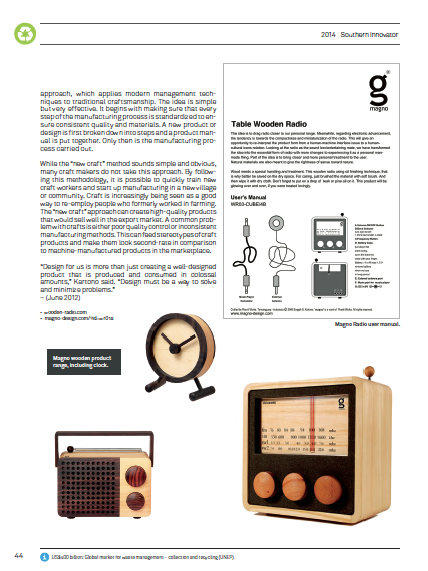
A range of wooden radios (wooden-radio.com) hold pride of place for the Magno brand (http://www.magno-design.com/?id=wr01a), which has carved out a niche as a maker of high-quality, crafted products that marry traditional skills with modern design. Magno is creating jobs and skills while also creating a unique, exportable product that commands a good price.

Indonesian designer Singgih Susilo Kartono developed the radio design concepts while at the Faculty of Fine Art and Design in Bandung, Java, Indonesia in the 1990s.

He takes an organic approach to designing, enjoying the journey and not necessarily being sure where he is going.

“I never start my design according to the market research or demand. I design by absorbing events, global or local events and even mundane daily life things that happen around me. Consequently, I start to think what will be good and better for these people,” he explains in his brochure.

The workshop in which the radios are made is a handsome wooden-roofed building and craftspeople sit at long wooden tables to assemble the models.

Each radio is made from a single piece of wood and takes a craftsperson 16 hours to construct, drawing on traditional woodworking skills. The radios are made from Indian rosewood, which is often used to manufacture many musical instruments because of its excellent sound resonance.

The radios are made in stages, with more than 20 steps involved in assembling each one. The individual parts are precision cut by machines before being assembled using a tongue and groove (http://en.wikipedia.org/wiki/Tongue_and_groove) construction technique.

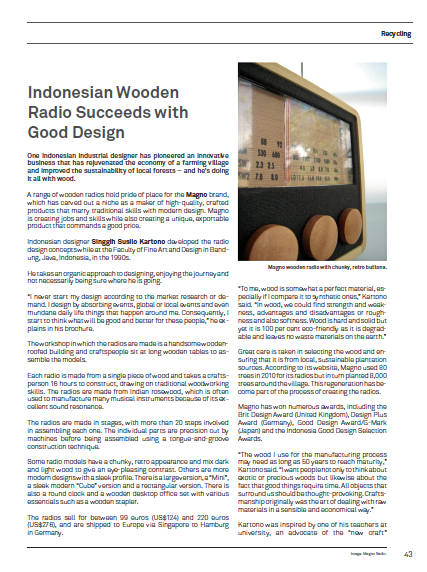
Some radio models have a chunky, retro appearance and mix dark and light wood to give an eye-pleasing contrast. Others are more modern designs with a sleek profile. There is a large version, a ‘Mini’, a sleek modern Cube’ version and a rectangular version. There is also a round clock and a wooden desktop office set with various essentials like a wooden stapler.

The radios sell for between Euros 99 (US $124) and Euros 220 (US $276), and are shipped to Europe via Singapore to Hamburg in Germany.

“To me, wood is somewhat a perfect material – especially if I compare it to synthetic ones,” Kartono said. “In wood we could find strength and weakness, advantages and disadvantages or roughness and also softness. Wood is hard and solid but yet it is 100 per cent eco-friendly as it is degradable and leaves no waste materials on the earth.”

Great care is taken in selecting the wood and ensuring it is from local, sustainable plantation sources. According to its website, Magno used 80 trees in 2010 for its radios but in turn planted 8,000 trees around the village. This regeneration has become part of the process of creating the radios.

Magno has won numerous awards, including the Brit Design Award (UK), Design Plus Award (Germany), Good Design Award/G-Mark (Japan) and the Indonesia Good Design Selection Awards.

“The wood I use for the manufacturing process may need as long as 50 years to reach maturity,” Kartono said. “I want people not only to think about exotic or precious woods but likewise about the fact that good things require time. All objects that surround us should be thought-provoking. Craftsmanship originally was the art of dealing with raw materials in a sensible and economical way.”

As Kartono tells it, he faced the typical university graduate’s dilemma about his career path. Should he work as an in-house designer in a city or return to his home village of Kandangan and start a business? His choice was unusual. Once somebody with a university education leaves a small village, it is rare they return. And at first, Kartono did not.

But he was drawn back by the dire situation in the village, and decided to apply his knowledge of product design to revive its economic fortunes. He started by visiting just twice a year because that was all he could afford. This had the advantage of giving him perspective on the situation in the village.

“At first glance, these changes (happening to the village) were seen as a ‘progress,’” he said. “But when I looked more closely I concluded that it was only the ‘surface’ which experienced change. The basic structure of the village did not undergo any changes; moreover, some was actually deteriorating.”

He concluded that the village was being damaged by various government attempts to modernize agricultural practices. The debt problems this caused meant many farmers lost their farms and were forced to seek work in the city or look for another way to make money.

Craft work seemed to be the answer to this problem. It has many advantages, as Kartono sees it. It is something that can grow and fits well with village lifestyles. It is labour intensive, doesn’t need sophisticated technology and can use already existing local resources.

Kartono was inspired by one of his teachers at university, an advocate of the ‘New Craft’ approach, which applies modern management techniques to traditional craftsmanship. The idea is simple but very effective. It begins with making sure every step of the manufacturing process is standardized to ensure consistent quality and materials. A new product or design is first broken down into steps and a product manual is put together. Only then is the manufacturing process carried out.

While the New Craft method sounds simple and obvious, many craft makers do not take this approach. By following this methodology, it is possible to quickly train new craft workers and start up manufacturing in a new village or community. Craft is increasingly being seen as a good way to re-employ people who formerly worked in farming. The New Craft approach can create high-quality products that would sell well in the export market. A common problem with crafts is either poor quality control or inconsistent manufacturing methods. This can feed stereotypes of craft products and make them look second-rate in comparison to machine-manufactured products in the marketplace.

“Design for us is more than just creating a well-designed product that is produced and consumed in colossal amount,” Kartono said. “Design must be a way to solve and minimize problems.”

Published: June 2012

Resources

1) Cradle to Cradle: Remaking the Way We Make Things by William McDonough and Michael Braungart. It is a manifesto calling for the transformation of human industry through ecologically intelligent design. Website: http://www.mcdonough.com/cradle_to_cradle.htm

2) Rio+20: At the Rio+20 Conference, world leaders, along with thousands of participants from governments, the private sector, NGOs and other groups, will come together to shape how we can reduce poverty, advance social equity and ensure environmental protection on an ever more crowded planet to get to the future we want. Website: http://www.uncsd2012.org/
https://davidsouthconsulting.org/2021/03/20/accessing-global-markets-via-design-solutions/

https://davidsouthconsulting.org/2021/03/12/afro-coffee-blending-good-design-and-coffee/

https://davidsouthconsulting.org/2021/02/20/baker-cookstoves-designing-for-the-african-customer/

https://davidsouthconsulting.org/2021/12/20/better-by-design-in-china/

https://davidsouthconsulting.org/2021/08/29/brazilian-design-for-new-urban-middle-class-world/

https://davidsouthconsulting.org/2022/08/02/design-collaborations-revitalize-traditional-craft-techniques/

https://davidsouthconsulting.org/2021/01/26/designed-in-china-to-rival-made-in-china/

https://davidsouthconsulting.org/2022/10/20/ghanaian-coffins-prove-design-and-craftsmanship-boost-incomes/

https://davidsouthconsulting.org/2020/04/30/local-fashions-pay-off-for-southern-designers/

https://davidsouthconsulting.org/2021/10/04/putting-quality-and-design-at-the-centre-of-chinese-fashion/

Development Challenges, South-South Solutions was launched as an e-newsletter in 2006 by UNDP’s South-South Cooperation Unit (now the United Nations Office for South-South Cooperation) based in New York, USA. It led on profiling the rise of the global South as an economic powerhouse and was one of the first regular publications to champion the global South’s innovators, entrepreneurs, and pioneers. It tracked the key trends that are now so profoundly reshaping how development is seen and done. This includes the rapid take-up of mobile phones and information technology in the global South (as profiled in the first issue of magazine Southern Innovator), the move to becoming a majority urban world, a growing global innovator culture, and the plethora of solutions being developed in the global South to tackle its problems and improve living conditions and boost human development. The success of the e-newsletter led to the launch of the magazine Southern Innovator.

https://davidsouthconsulting.org/2021/03/05/southern-innovator-issue-5/

Creative Commons License

This work is licensed under a
Creative Commons Attribution-Noncommercial-No Derivative Works 3.0 License.

ORCID iD: https://orcid.org/0000-0001-5311-1052.

© David South Consulting 2023

Categories
Archive Blogroll Southern Innovator magazine United Nations Development Programme United Nations Office for South-South Cooperation

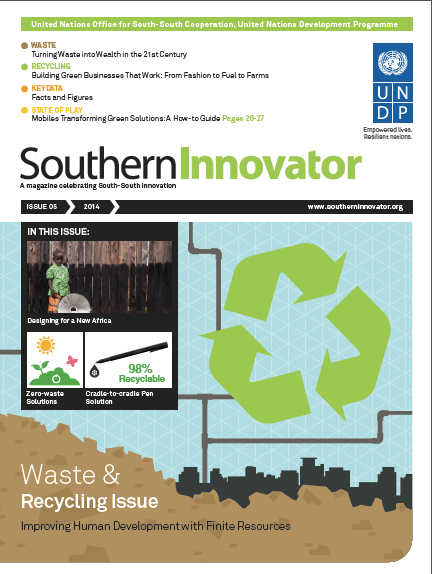
Southern Innovator Issue 5

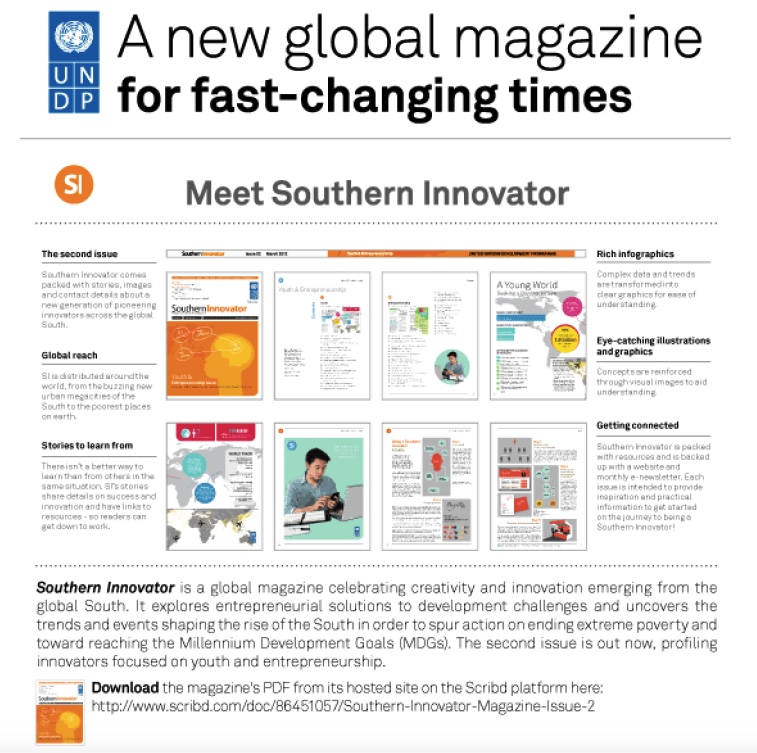
Launched in May 2011, the new global magazine Southern Innovator (ISSN 2222-9280) is about the people across the global South shaping our new world, eradicating poverty and working towards the achievement of the Millennium Development Goals (MDGs). 

Team | Southern Innovator Phase 1 Development (2010 – 2015)

They are the innovators.

Follow the magazine on Twitter @SouthSouth1. 

Southern Innovator Issue 1

Southern Innovator Issue 2

Southern Innovator Issue 3

Southern Innovator Issue 4

Southern Innovator Issue 5

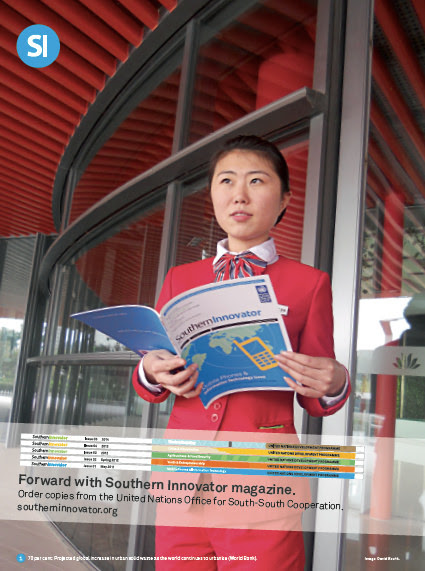
If you would like hard copies of the magazine for distribution, then please contact the United Nations Office for South-South Cooperation (UNOSSC)(https://www.unsouthsouth.org/2014/12/25/southern-innovator-magazine/).

Citations

Recasting ‘truisms’ of low carbon technology cooperation through innovation systems: insights from the developing world by Alexandra Mallet, Innovation and Development, Volume 5, 2015 – Issue 2: Low-Carbon Innovation and Development

https://davidsouthconsulting.org/2021/07/30/disrupted-whatever-happened-to-southern-innovator-issue-6/

https://davidsouthconsulting.org/2021/07/30/issue-6-will-launch-in-autumn-2014-get-on-board-28-july-2014/

https://davidsouthconsulting.org/2021/12/20/press-release-1-southern-innovator/

https://davidsouthconsulting.org/2021/12/20/press-release-2-southern-innovator/

https://davidsouthconsulting.org/2021/12/20/press-release-3-southern-innovator/

https://davidsouthconsulting.org/2021/03/05/southern-innovator-issue-1/

https://davidsouthconsulting.org/2021/03/05/southern-innovator-issue-2/

https://davidsouthconsulting.org/2021/03/05/southern-innovator-issue-3/

https://davidsouthconsulting.org/2021/03/05/southern-innovator-issue-4/

https://davidsouthconsulting.org/southern-innovator-scale-up-fundraiser/

ORCID iD: https://orcid.org/0000-0001-5311-1052.

© David South Consulting 2023

Categories
Archive Blogroll Southern Innovator magazine United Nations Development Programme United Nations Office for South-South Cooperation

Southern Innovator Issue 4

Eco-cities Up Close

Smart Cities Up Close

Launched in May 2011, the new global magazine Southern Innovator (ISSN 2222-9280) is about the people across the global South shaping our new world, eradicating poverty and working towards the achievement of the Millennium Development Goals (MDGs). 

Team | Southern Innovator Phase 1 Development (2010 – 2015)

They are the innovators.

Follow the magazine on Twitter @SouthSouth1. 

Southern Innovator Issue 1

Southern Innovator Issue 2

Southern Innovator Issue 3

Southern Innovator Issue 4

Southern Innovator Issue 5

If you would like hard copies of the magazine for distribution, then please contact the United Nations Office for South-South Cooperation (UNOSSC)(https://www.unsouthsouth.org/2014/12/25/southern-innovator-magazine/).

https://davidsouthconsulting.org/2021/12/20/press-release-2-southern-innovator/

https://davidsouthconsulting.org/southern-innovator-scale-up-fundraiser/

Southern Innovator Editor and Writer David South with Issue 4 at the Sydney Opera House in 2013. Photo: Jill Lawless

ORCID iD: https://orcid.org/0000-0001-5311-1052.

© David South Consulting 2024

Categories
Archive Blogroll Development Challenges, South-South Solutions Newsletters

US $450 Million Pledged for Green Economy Investments at Kenyan GSSD Expo

By David SouthDevelopment Challenges, South-South Solutions

SOUTH-SOUTH CASE STUDY

Innovators working in the global green economy could benefit from over US $450 million in investment recently pledged at the UN’s Global South-South Development Expo (GSSD Expo) held in Nairobi, Kenya.

A combination of green investors, businesses, governments and others came together at the UN Environment Programme’s (UNEP) headquarters in the Kenyan capital from 28 October to 1 November 2013 to share solutions and strike deals and partnerships.

The event represented a significant turning point in awareness of the role played by the global South’s innovators in global development and growing economies. The quantity of pledges and investment deals struck at the Expo bodes well for the future of south-south solution sharing.

Organized by the UN’s Office for South-South Cooperation in UNDP (UNOSSC) (southsouthexpo.org) and hosted by UNEP (unep.org) under the theme “Building inclusive green economies”, the Global South-South Development Expo (GSSD Expo) is the world’s biggest event for development solutions created in the South for the South.

“The theme of this year’s Expo is fitting in that Southern countries have both the opportunity and the obligation to pursue a ‘smarter’ development course than their predecessors,” said General Assembly President John Ashe.

Examples of the investment deals struck include helping to build organic fertilizer factories and constructing solar power plants in Kenya, and growing green business ventures for women in Egypt.

South-South cooperation is the exchange of resources, technology and knowledge between developing countries. Today, over US $5 trillion in currency reserves are held by countries of the global South. They also make up 47 per cent of global trade.

Tapping this rich resource is an unparalleled economic development opportunity and could be one of the main engines of growth in the years ahead, the Expo organizers believe.

“As so many stories that we have heard this week demonstrate, South-South Cooperation is playing a vital role in facilitating this global transition,” said UN Under-Secretary-General and UNEP Executive Director Achim Steiner.

“Not only are these local, national and regional efforts producing positive results, but they are overcoming barriers, building new partnerships, creating new finance mechanisms, generating knowledge, sharing information, providing training and capacity building in areas and sectors that are critical for a global transition to a low carbon, resource efficient and inclusive economy,” he added.

As an example of how solutions are shared and deals are struck, more than 40 companies were successfully matched and held business negotiations using the Expo’s South-South Global Assets and Technology Exchange (SS-GATE). An online match-making service bringing together innovative companies with the knowledge and funding they need to grow, the SS-GATE was able to get 148 companies to list their projects on the SS-GATE web-platform during an Expo event.

For the first time in its history, the Expo garnered a strong online presence with the help of volunteers who collaborated remotely around the world on social media. The event was so popular that it trended on Twitter in Kenya, meaning that the message of the value and growing scope of South-South cooperation reached the next generation of development practitioners, entrepreneurs, environmentalists, thinkers and leaders.

Also at the Expo, the fourth issue of Southern Innovator magazine (southerninnovator.org) had its official launch. Southern Innovator Issue 4 visits the new cities being built to tackle the challenges of a rapidly urbanizing 21st-century world. The magazine also highlights some of the solutions being devised to the challenges people face as the world becomes a majority urban place.

Some innovators are building new cities from scratch, applying the latest thinking and hard-wiring in cutting-edge information technologies and innovative environmental measures to create “smart” cities and eco-cities. Architects are designing and refining homes that are beautiful and functional, easy to build, affordable and conserve energy. Social entrepreneurs are innovating ways to create liveable and socially inclusive urban areas, often in places where planning has been scant and where incomes are very low. All the stories featured in the magazine were chosen for their focus on improving human development and for their ingenuity and fresh thinking.

Southern Innovator champions a 21st-century global innovator culture. It is being distributed through the United Nations’ network and partners and reaches some of the world’s poorest and remotest places, as well as the vibrant but stressed growing global megacities. It is hoped the magazine will inspire budding innovators with its mix of stories, essential information, facts and figures, images and graphics.

Published: November 2013

Resources

1) Global South-South Development Expo: The Global South-South Development Expo (GSSD Expo) is the FIRST EVER Expo solely from the South and for the South. It showcases successful Southern-grown development solutions (SDSs) to address the need to meet the Millennium Development Goals (MDGs). Website: http://www.southsouthexpo.org/

2) Southern Innovator online story archive: Organized by theme, the story archive is a treasure trove of innovation stories and resources from the global South stretching back to 2006. Website: southerninnovator.org

3) Southern Innovator on Scribd: Archived copies of the full-color, 60-page magazine can be downloaded here. Website: http://www.scribd.com/SouthernInnovator.

4) Southern Innovator on Twitter: Catch Southern Innovator’s Tweets and keep on top of a growing global network of innovators. Follow @SouthSouth1

Development Challenges, South-South Solutions was launched as an e-newsletter in 2006 by UNDP’s South-South Cooperation Unit (now the United Nations Office for South-South Cooperation) based in New York, USA. It led on profiling the rise of the global South as an economic powerhouse and was one of the first regular publications to champion the global South’s innovators, entrepreneurs, and pioneers. It tracked the key trends that are now so profoundly reshaping how development is seen and done. This includes the rapid take-up of mobile phones and information technology in the global South (as profiled in the first issue of magazine Southern Innovator), the move to becoming a majority urban world, a growing global innovator culture, and the plethora of solutions being developed in the global South to tackle its problems and improve living conditions and boost human development. The success of the e-newsletter led to the launch of the magazine Southern Innovator.

Creative Commons License

This work is licensed under a
Creative Commons Attribution-Noncommercial-No Derivative Works 3.0 License.

ORCID iD: https://orcid.org/0000-0001-5311-1052.

© David South Consulting 2021