Tag: Goal 3

  • African Technology Tackles Health Needs

    African Technology Tackles Health Needs

    By David SouthDevelopment Challenges, South-South Solutions

    SOUTH-SOUTH CASE STUDY

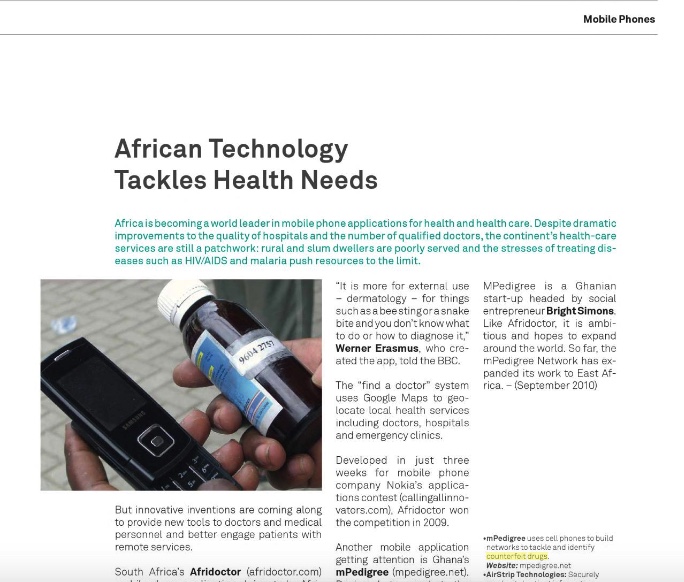
    Africa is becoming a world leader in mobile phone applications for health and healthcare. Despite dramatic improvements to the quality of hospitals and the number of qualified doctors, the continent’s healthcare services are still a patchwork, with rural and slum dwellers poorly served and the stresses of treating patients with contagious diseases like HIV/AIDS and malaria pushing resources to the limit.

    But innovative inventions are coming along to provide new tools to doctors and medical personnel and to better engage patients with remote services.

    South Africa’s Afridoctor (http://twitter.com/afridoctor) mobile phone application claims to be Africa’s first personal mobile health clinic. It lets patients use its “SnapDiagnosis” system to submit photos of their ailments and in turn receive advice from a panel of medical professionals, or use the mapping feature to find doctors, clinics and health industry-related services nearby.

    Afridoctor was conceived to fill the gap across Africa for basic health information that is reliable and trustworthy.

    There is an emergency feature to notify next of kin during a medical emergency and provide a location. Other features include symptom checkers, first-aid information, health calculators and quizzes.

    Expert feedback comes within 48 hours after submission of a request.

    A winner of a Nokia competition, Afridoctor was developed by the labs of media company 24.com (http://20fourlabs.com) of Cape Town, South Africa.

    “It is more for external use – like dermatology – for things like a bee sting or a snake bite and you don’t know what to do or how to diagnose it,” Werner Erasmus, who created the app, told the BBC.

    The “find a doctor” system uses Google Maps to geo-locate local health services including doctors, hospitals and emergency clinics.

    The distress feature enables users to contact a family member or friend at the touch of a button. It does this by storing the mobile phone number of a selected relative. When the distress button is pressed, they are notified of the phone’s location.

    Developed in just three weeks, to enter mobile phone company Nokia’s contest (http://www.callingallinnovators.com) for mobile phone applications, Afridoctor went on to win the competition in 2009. It is now being expanded to be usable on most, if not all, smart phones.

    As in the rest of Africa, mobile phone use in South Africa has dramatically increased in the past 10 years. It is estimated that over 70 percent of South Africans now have access to one.

    Another application getting attention is Ghana’s mPedigree (http://mpedigree.net). Designed to combat the damage done by counterfeit drugs in Africa and across the South, mPedigree works by letting a person send a text message by mobile phone to the mPedigree service to check a drug’s authenticity. A message comes back confirming whether the medicine is authentic or not.

    The World Health Organization (WHO) has estimated that 25 percent of medicines sold around the developing world are counterfeit. Some contain no active ingredients, and others are even harmful.

    MPedigree is a Ghanian start-up headed by social entrepreneur Bright Simons (http://www.worldpress.org/freelancers/index.cfm/hurl/page=freelancerDetails/id=7). Like Afridoctor, it is ambitious and hopes to expand around the world. So far, the mPedigree Network has expanded its work to East Africa.

    Published: September 2010

    Resources

    Development Challenges, South-South Solutions was launched as an e-newsletter in 2006 by UNDP’s South-South Cooperation Unit (now the United Nations Office for South-South Cooperation) based in New York, USA. It led on profiling the rise of the global South as an economic powerhouse and was one of the first regular publications to champion the global South’s innovators, entrepreneurs, and pioneers. It tracked the key trends that are now so profoundly reshaping how development is seen and done. This includes the rapid take-up of mobile phones and information technology in the global South (as profiled in the first issue of magazine Southern Innovator), the move to becoming a majority urban world, a growing global innovator culture, and the plethora of solutions being developed in the global South to tackle its problems and improve living conditions and boost human development. The success of the e-newsletter led to the launch of the magazine Southern Innovator.  

    Creative Commons License

    This work is licensed under a
    Creative Commons Attribution-Noncommercial-No Derivative Works 3.0 License.

    ORCID iD: https://orcid.org/0000-0001-5311-1052.

    © David South Consulting 2023

  • Combating Counterfeit Drugs

    Combating Counterfeit Drugs

    By David SouthDevelopment Challenges, South-South Solutions

    SOUTH-SOUTH CASE STUDY

    Access to good quality drugs is a serious problem across the South. The International Narcotics Control Board estimates that up to 15 per cent of all drugs sold around the world are fake or counterfeit, and in parts of Africa and Asia this figure jumps to 50 per cent. The US Food and Drug Administration estimates counterfeit drugs make up 10 per cent of the global medicine market. The US Centre for Medicines in the Public Interest predicts counterfeit drug sales will reach US $75 billion globally in 2010, an increase of more than 90 per cent from 2005.

    Fake drugs are a major cause of unnecessary death and destroy public confidence in medicines and health services. While counterfeit drugs have been on the rise, there is little co-ordinated or effective action to counter this menace afflicted on the sick.

    But in Ghana, a solution has emerged that shows a way to guarantee that quality drugs get to the sick who need them. CareShop Ghana uses the franchise model – where licenses are sold to approved vendors who adhere to strict guidelines – to ensure that the quality, accessibility and affordability of essential medicines in and around Accra is guaranteed. CareShop has made deals with close to 300 franchisee pharmacies – often modest operations – who sell over-the-counter drugs.

    In Ghana, preventable and curable illnesses like malaria and diarrhoeal diseases are among the leading causes of death. Their treatment pushes many people to financial despair; they can ill afford the extra burden of worrying about counterfeit drugs and the harm they do. Like many countries in the South, Ghana’s public healthcare system is unable to meet these needs and so most people turn to the private sector for help.

    An estimated 65 per cent of people turn to licensed pharmacies. But many of these operate haphazard businesses, dispensing expired or counterfeit drugs.

    The Ghana Social Marketing Foundation Enterprises Limited (GSMFEL) founded CareShop in 2002, hoping to battle common infectious diseases in poor areas by making sure good drugs get through to the sick.

    GSMFEL makes a small profit as the franchisor by selling high-quality drugs to the franchisees. The key to CareShop’s success is imposing standardization on franchisees, so they have to stick to common diagnosis, quality and pricing. They make more money when they adhere to these rules than when they break them. To ensure there is no tampering with the drugs, they are delivered straight to the vendor’s doorsteps, and it is all backed up with health and business training support and branded materials.

    The tide can be turned around on fake drugs: in 2002, the WHO reported that 70 per cent of drugs in Nigeria were fake or substandard: by 2004 that figure had fallen to 48 per cent.

    Stimulating private sector solutions to African healthcare problems is now receiving an additional boost from a new fund established by the World Bank’s private sector arm, the International Finance Corporation. Launched in 2007, it offers cash and loans totalling US $500 million to commercial healthcare projects in Africa. According to its own statistics, 60 per cent of health expenditure in sub-Saharan Africa is privately funded, and the market, excluding South Africa, is worth US $19 billion.

    Published: May 2008

    Resources

    • SafeMedicines.org is a website offering the latest reports on fake medicines and is a good place to report incidences.
      Website: http://safemedicines.org/in_the_news/
    • A paper on the global threat of counterfeit drugs: Click here.

    Development Challenges, South-South Solutions was launched as an e-newsletter in 2006 by UNDP’s South-South Cooperation Unit (now the United Nations Office for South-South Cooperation) based in New York, USA. It led on profiling the rise of the global South as an economic powerhouse and was one of the first regular publications to champion the global South’s innovators, entrepreneurs, and pioneers. It tracked the key trends that are now so profoundly reshaping how development is seen and done. This includes the rapid take-up of mobile phones and information technology in the global South (as profiled in the first issue of magazine Southern Innovator), the move to becoming a majority urban world, a growing global innovator culture, and the plethora of solutions being developed in the global South to tackle its problems and improve living conditions and boost human development. The success of the e-newsletter led to the launch of the magazine Southern Innovator.  

    Creative Commons License

    This work is licensed under a
    Creative Commons Attribution-Noncommercial-No Derivative Works 3.0 License.

    ORCID iD: https://orcid.org/0000-0001-5311-1052.

    © David South Consulting 2022

  • Southern Innovator Magazine

    Southern Innovator Magazine

    Estimated Reading Time: 2 mins

    “What a tremendous magazine your team has produced! It’s a terrific tour de force of what is interesting, cutting edge and relevant in the global mobile/ICT space… Really looking forward to what you produce in issues #2 and #3. This is great, engaging, relevant and topical stuff.”

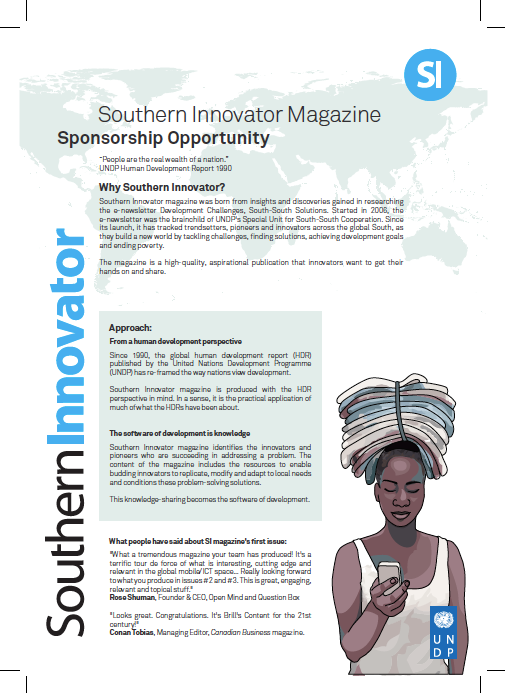
    Southern Innovator was initially launched in 2011 with the goal of inspiring others (just as we had been so inspired by the innovators we contacted and met). The magazine seeks to profile stories, trends, ideas, innovations and innovators overlooked by other media. The magazine grew from the monthly e-newsletter Development Challenges, South-South Solutions published by the United Nations Office for South-South Cooperation (UNOSSC) since 2006.

    https://sites.google.com/davidsouthconsulting.org/southern-innovators/home

    Issue 6’s theme has been decided on: it will focus on Science, Technology and Innovation. For this issue, Southern Innovator is seeking invitations from cutting-edge knowledge and science innovators in the global South to view their work. Time is tight, so don’t miss this opportunity to let the whole global South know about your work. In the past, Southern Innovator has visited green pioneers in Cuba, a smart city in South Korea and an eco-city in China.

    Contact me if you wish to receive a copy/copies of the magazine for distribution. Follow @SouthSouth1.

    Southern Innovator Issue 1

    Southern Innovator Issue 2

    Southern Innovator Issue 3

    Southern Innovator Issue 4

    Southern Innovator Issue 5

    “Beautiful, inspiring magazine from UNDP on South-South innovation. Heart is pumping adrenaline and admiration just reading it”

    Southern Innovator Issue 6

    Innovator Stories and Profiles

    Citing Southern Innovator

    Finding Southern Innovator

    Press Release 1

    Press Release 2

    Press Release 3

    Southern Innovator Impact Summaries | 2012 – 2014

    “The e-newsletter Development Challenges, South-South Solutions proved to be a timely and prescient resource on the fast-changing global South, tracking the rise of an innovator culture driven by the rapid adoption of mobile phones and information technology …

    “In 2010, work began on the development of the world’s first magazine dedicated to the 21st-century innovator culture of the global South. My goal was to create a magazine that would reach across countries and cultures, meet the UN’s standards, and inspire action. Southern Innovator was the result. Mr. [David] South played a vital role in the magazine’s development from its early conception, through its various design prototypes, to its final global launch and distribution.

    “Both the e-newsletter and magazine raised the profile of South-South cooperation and have been cited by readers for inspiring innovators, academics, policy makers and development practitioners in the United Nations and beyond.

    “I highly recommend Mr. [David] South as a thoughtful, insightful, analytical, creative and very amicable person who has the unique ability to not only grasp complex problems but also to formulate a vision and strategy that gets things done. … ” Cosmas Gitta, Former Assistant Director, Policy and United Nations Affairs at United Nations Office for South-South Cooperation (UNOSSC) in UNDP

    “I think you [David South] and the designer [Solveig Rolfsdottir] do great work and I enjoy Southern Innovator very much!” Ines Tofalo, Programme Specialist, United Nations Office for South-South Cooperation

    Team | Southern Innovator Phase 1 Development (2010 – 2015)

    According to zoominfo in 2023, Southern Innovator is one of the Popular Searches online for the United Nations Office for South-South Cooperation (UNOSSC).

    Like our content? Help contribute to the costs of keeping it online. 

    Scan code with your phone and help us out.

    https://davidsouthconsulting.org/southern-innovator-scale-up-fundraiser/

    ORCID iD: https://orcid.org/0000-0001-5311-1052.

    © David South Consulting 2021