Tag: Goal 11

  • More Futuristic African Cities in the Works

    More Futuristic African Cities in the Works

    By David SouthDevelopment Challenges, South-South Solutions

    SOUTH-SOUTH CASE STUDY

    It has been well documented that China is undergoing the largest migration in human history from rural areas to cities. But this urbanization trend is occurring across the global South, including in Africa, as well. According to the UN, more than half the world’s population already lives in cities, and 70 per cent will live in urban areas by 2050. Most of the world’s population growth is concentrated in urban areas in the global South.

    These emerging urban areas represent vast opportunities for innovators. Innovators will be needed to build them, and in turn they will provide modern facilities for innovators to operate in and engage with the global economy. And they will connect innovators to 21st-century information technology.

    But while the government in China engages in significant planning and preparation to facilitate movements to urban areas – often building entire cities from scratch (http://www.time.com/time/photogallery/0,29307,1975397,00.html) – that has not been the case in Africa. People in Africa are on the move because they are seeking out opportunities, but much of this movement has been poorly planned and not well thought out.

    But now more and more African governments are grappling with how to call time on chaotic and haphazard development and build sustainable, planned cities that will significantly improve human development and quality of life.

    Across Africa, a host of ambitious new cities and urban developments are in the works.

    Kenya’s Konza Technology City (konzacity.co.ke) is planned as a new centre 60 kilometres from the capital, Nairobi. Calling itself a “world-class technology hub and a major economic driver for the nation”, it offers a high-tech vision full of ultra-modern buildings and houses in order to spur the future growth of Kenya’s technology industry.

    It is hoped Konza will create 100,000 jobs by 2030. There will be a central business district, a university campus for 1,500 students, a residential community, and parks and wildlife in green corridors.

    The groundbreaking ceremony occurred on January 2013 but the Kenyan Ministry of Lands and Housing has halted operations to allow for greater community engagement, according to Urban Africa. A dispute had erupted with the current landowners who wanted to be better consulted about the development and had accused the government of locking them out of the physical planning process.

    Tatu City, Kenya (tatucity.com) bills itself as “by Kenyans, for Kenyans”. It is being built by Rendeavour (rendeavour.com), the urban development division of Moscow-based Renaissance Group (rengroup.com), one of the largest urban developers of land in Africa. It joins Konza Technology City as a flagship project for the government’s Vision 2030, hoping to turn Kenya into a middle-income country and a role model for other countries in East Africa.

    Tatu City is 15 kilometres from Nairobi. It will take up 1,035 hectares and will be completed in 10 phases. Construction began in May 2012 and is scheduled to be completed by 2022.

    It is selling safety and a “beautiful urban environment” just a short journey away from Nairobi’s existing Central Business District. Tatu City wants to be “a model of the African city of the future” as a “dynamic mixed-use, mixed-income environment that will be home to an estimated 70,000 residents and 30,000 day visitors”.

    Just 25 minutes from Jomo Kenyatta International Airport, it promises to be one of “the most modern, well-planned urban developments in East Africa”.

    In Ghana, a number of innovative projects in development reflect the country’s impressive economic growth and information technology achievements in the past decade.

    Two cities are being designed by Rendeavour. One, Appolonia, is being built in the Greater Accra area while the second, King City, is being built on the west coast of the country where there is an oil and gas boom underway.

    Both will have houses, retail and commercial centres, schools, healthcare facilities and other social services.

    “Our objective is to provide the basic infrastructure, planning and necessary management framework in creating satellite cities that reverses the current trend of unplanned development and urban congestion in most of Africa’s growing cities,” Tim Beighton of Rendeavour told CNN.

    These projects are in an advanced stage, with all plans completed and approved by the government, according to their websites.

    Appolonia City of Light near Accra (appolonia.com.gh) – due to break ground in the third quarter of 2013 – capitalizes on Accra’s status as one of Africa’s fastest-growing urban areas. The Appolonia development will be a “planned, sustainable, mixed-use and mixed-income city” to build a “work-live-play” community for 88,000 people living in 22,000 homes.

    It will be built 30 kilometres northeast of Accra’s central business district and will have retail, commercial and industrial space combined with tourism, social and recreation facilities.

    King City in Takoradi (kingcity.com.gh) calls itself “Western Ghana’s new holistic city”. It will offer homes, shops, offices, industries and public places. The plan includes building 25,000 new homes and, importantly, over 30 per cent of the city will be allocated for green space. It will take up 1,000 hectares on the outskirts of Sekondi-Takoradi.

    Elsewhere in Accra, the Hope (Home Office People Environment) City (http://www.rlgghana.com/index.php/2013-02-07-11-25-04.html) is a much more ambitious concept. It is one of a cluster of projects in Africa focused on building the infrastructure for a 21st century, high-tech future. Costing US $10 billion, it will be built outside Accra and is focused on boosting Ghana’s already established reputation in the field of information and communications technology. It will be home to 25,000 people and create jobs for 50,000. There will be six towers including a 75-storey, 270 metre building that hopes to be the highest in Africa.

    It is being financed by RLG Communications, a mix of investors and a stock-buying scheme.

    There will be an assembly plant for high-tech products, business offices an information technology university, a hospital and restaurants, theaters and sports centres.

    The design is hyper-modern and tries to create a vertical office environment that is dense and reduces the amount of time it takes to get around and circulate between businesses in the complex.

    Eko Atlantic on Victoria Island in Lagos, Nigeria (ekoatlantic.com) is a coastal residential and business development that calls itself “The New Gateway to Africa”. To ease pressure in an already crowded city, it is being built on 10 square kilometres of reclaimed land from the Atlantic Ocean. It will be able to house 250,000 people and give work to 150,000.

    The story began in 2003 when the Lagos State government was looking for a solution to protect the Bar Beach area of the city from coastal erosion. Land is being reclaimed from the sea and it will make up an area the equivalent of Manhattan in New York City. Just like Manhattan, it is hoped Eko Atlantic will become the new financial centre for West Africa by the year 2020.

    Kilamba, or Nova Cidade de Kilamba (https://www.facebook.com/media/set/?set=a.231897596836631.80284.228497773843280), 30 kilometres outside Luanda, Angola is being built by the China International Trust and Investment Corporation (http://www.citic.com/wps/portal). It is on a vast scale and is designed to be home to 500,000 people with apartment blocks and commercial spaces. It has cost so far US $3.5 billion and is part of a government pledge to provide a million new homes within four years. Kilamba has come in for criticism for not being affordable enough for ordinary Angolans and for having much of the site unoccupied. With the apartments too expensive for ordinary Angolans, the government has decided to take action and ordered the prices to be reduced and made more affordable, according to Angola Press .

    La Cite du Fleuve in the Democratic Republic of Congo (lacitedufleuve.com) is  a more conventional luxury housing development built on two islands in the capital, Kinshasa. Kinshasa, despite its problems and the turmoil from an ongoing civil war, is one of the continent’s fastest-growing cities. Developed by Hawkwood Properties, La Cite du Fleuve will need to reclaim 375 hectares of sandbanks and swamps to be able to build a collection of riverside villas, offices and shopping centres. It is is planned to take 10 years to complete.

    And finally, Kigali, the capital of Rwanda, wants to transform itself into the “center of urban excellence in Africa”.

    The 2020 Kigali Conceptual Master Plan (http://www.kigalicity.gov.rw/spip.php?article494) hopes to create a regional hub for business, trade and tourism, by building a mix of commercial and shopping districts with glass skyscrapers and modern hotels, parks and entertainment facilities.

    Critics, however, believe these new cities and modern developments are tackling the problems of urban development by bypassing most of the population. They argue they are just developments for those with money who can buy their way out of the chaos and lack of planning of current African cities.

    “They are essentially designed for people with money,” Vanessa Watson, professor of city planning at the University of Cape Town, told CNN. She believes most of the plans are unsustainable “urban fantasies” detached from the reality of African poverty and informal living.

    But while it is easy to criticize these ambitious projects, they reflect not only optimism for the continent’s future but also a clear recognition the continent will not be able to get wealthier without modern cities and infrastructure in keeping with a 21st-century economy.

    Published: August 2013

    Resources

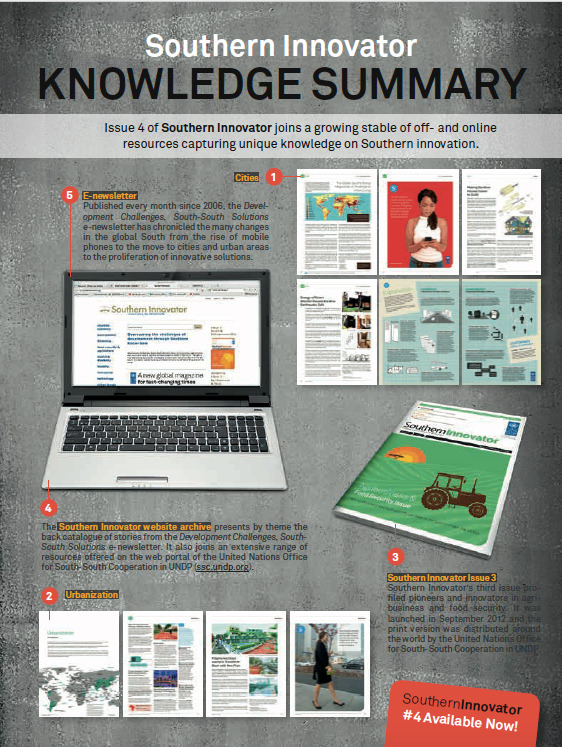
    1) Southern Innovator Issue 4: Cities and Urbanization: SI’s fourth issue goes to the many new cities under construction to build the new 21st century world emerging in the global South. Website: http://www.scribd.com/doc/133622315/Southern-Innovator-Magazine-Issue-4-Cities-and-Urbanization

    2) Urban Africa: Urban Africa is a digital entry point for knowledge sharing, interactive exchange and information dissemination on urbanization in Africa. Website: http://urbanafrica.net/

    3) Arrival City: A third of humanity is on the move. History’s largest migration is creating new urban spaces that are this century’s focal points of conflict and change — unseen districts of rapid transformation and febrile activity that will reshape our cities and reconfigure our economies. Website: http://arrivalcity.net/

    4) Global Urbanist: The Global Urbanist is an online magazine reviewing urban affairs and urban development issues in cities throughout the developed and developing world. Website: globalurbanist.com

    5) Africa Renewal: The Africa Renewal information programme, produced by the Africa Section of the United Nations Department of Public Information, provides up-to-date information and analysis of the major economic and development challenges facing Africa today. Website: http://www.un.org/africarenewal/

    Citations

    Cited in Beyond Gated Communities by Samer Bagaeen and Ola Uduku (2015).
    https://davidsouthconsulting.org/2022/02/09/african-megacity-makeovers-tackle-rising-populations/

    https://davidsouthconsulting.org/2022/10/19/chinese-building-solution-for-rapidly-urbanizing-global-south/

    https://davidsouthconsulting.org/2022/05/23/debt-free-homes-for-the-poor/

    https://davidsouthconsulting.org/2022/10/17/east-africa-to-get-its-first-dedicated-technology-city/

    https://davidsouthconsulting.org/2022/03/20/global-south-eco-cities-show-how-the-future-can-be/

    https://davidsouthconsulting.org/2021/11/12/global-souths-rising-megacities-challenge-idea-of-urban-living/

    https://davidsouthconsulting.org/2022/03/29/model-city-to-test-the-new-urbanism-concept-in-india/

    https://davidsouthconsulting.org/2017/11/08/smart-cities-up-close-2013/

    https://davidsouthconsulting.org/2022/09/26/3d-home-printing-landmark-10-houses-in-a-day/

    https://davidsouthconsulting.org/2022/11/17/tiny-homes-to-meet-global-housing-crisis/

    Development Challenges, South-South Solutions was launched as an e-newsletter in 2006 by UNDP’s South-South Cooperation Unit (now the United Nations Office for South-South Cooperation) based in New York, USA. It led on profiling the rise of the global South as an economic powerhouse and was one of the first regular publications to champion the global South’s innovators, entrepreneurs, and pioneers. It tracked the key trends that are now so profoundly reshaping how development is seen and done. This includes the rapid take-up of mobile phones and information technology in the global South (as profiled in the first issue of magazine Southern Innovator), the move to becoming a majority urban world, a growing global innovator culture, and the plethora of solutions being developed in the global South to tackle its problems and improve living conditions and boost human development. The success of the e-newsletter led to the launch of the magazine Southern Innovator. 

    https://davidsouthconsulting.org/2021/03/05/southern-innovator-issue-4/

    Creative Commons License

    This work is licensed under a
    Creative Commons Attribution-Noncommercial-No Derivative Works 3.0 License.

    ORCID iD: https://orcid.org/0000-0001-5311-1052.

    © David South Consulting 2022

  • Model Cities Across the South Challenge Old Ways

    Model Cities Across the South Challenge Old Ways

    By David SouthDevelopment Challenges, South-South Solutions

    SOUTH-SOUTH CASE STUDY

    Pioneering thinking about how resources are used and how people live their lives is taking place in the dynamic economies of the global South. Facing a vast population surge to urban areas, these include attempts to build “green” cities and low-waste, smart and digital communities.

    These model cities are clever solutions for the world’s growing – and urbanizing – populations coping with a stressed and damaged environment. Unlike one-off technologies and ideas developed in isolation, the model cities approach starts from scratch. They become living laboratories on which research and development take place at the heart of the community, not just the preserve of aloof academics hidden away in labs.

    This is critical work because the world is rapidly urbanizing and needs solutions to ensure this process does not lead to chaos and misery. How these cities turn out could hold the fate of humanity and much is at stake. According to a report by the International Institute for Environment and Development, Africa now has a larger urban population than North America and 25 of the world’s fastest growing big cities. Getting to grips with urban development will be critical for the future of the continent and the wellbeing of its people.

    By 2025, Asia could have 10 or more cities with populations larger than 20 million (Far Eastern Economic Review). People will be living in densely populated cities and they will need to be smart cities if they are to work.

    In the United Arab Emirates (http://en.wikipedia.org/wiki/Abu_Dhabi), Masdar City (http://www.masdar.ae/en/home/index.aspx), is a model city not only being built, but being used as way to develop commercially successful environment technologies – renewable energy solutions and clean technologies – that will turn into future income for the city and Abu Dhabi.

    The traditional approach in other countries has been to keep scientists and innovators disconnected from the living, breathing city. They toil away in labs or universities and only really get to test their technologies and theories after going through lengthy testing and approval by a city’s government. As Masdar’s website says, this city will develop “from research to commercial deployment – with the aim of creating scalable clean energy solutions.”

    The planned community will be 6 square kilometres in size and wants to be “one of the most sustainable cities in the world”. Located 17 kilometres from Abu Dhabi, it hopes to be a pedestrian-friendly town home to 40,000 residents. At the heart of Masdar City is the Masdar Institute: a research university developed with the Massachusetts Institute of Technology (MIT). The students are the city’s first residents and a range of top international companies are planning to locate in there as well. German technology company Siemens will place its Middle East headquarters in Masdar and its Center of Excellence in Building Technologies R&D centre. Others joining them include GE, BASF, Schneider and the Korea Technopark Association.

    The Surbana Urban Planning Group (www.surbana.com) spent five decades developing its experience with the rapid growth of Singapore (http://en.wikipedia.org/wiki/Singapore): a city-state boasting the highest quality of life in Asia (Economist Intelligence Unit) which took itself from an impoverished city to one of the world’s leading export and manufacturing economies. Surbana built 26 planned townships in Singapore that now house 85 percent of the city’s 4.5 million residents. It specializes in designing, implementing and maintaining complex urban areas.

    Singapore has pioneered a number of ways to house a large population within a small territory. This experience is now being put to work in China at the Tianjin Eco-City development (http://www.tianjinecocity.gov.sg/masterplan.htm). Known for high pollution levels due to heavy industry Tianjin will undergo a big change. The project aims to develop a template that can be used for other cities throughout China and around the world.

    The 30-square-kilometre Tianjin Eco-City is being built around a wetland and river. The idea is to offer its residents an environment with easy access to recreational spaces and the natural environment. The transport system will avoid cars and instead use a light rail system as the main mode of transport. It should be home to 350,000 people.

    Cleverly, each suburban area will have commercial sub-centres to enable as many people as possible to work locally and avoid the need to commute long distances. The Eco-City will be built by assembling “eco-cell” – like a bee’s honeycomb – neighbourhoods self-contained with schools, child care, commercial and work areas, and parks. This set up is geared to collecting a common mistake in other new developments that only consider housing, forgeting about how people work, shop and recreate.

    There will be seven distinct neighbourhoods: Lifescape, Eco-Valley, Solarscape, Urbanscape, Windscape, Earthscape and Eco-Corridors (http://inhabitat.com/tianjin-eco-city-is-a-futuristic-green-landscape-for-350000-residents/). An “Eco-Valley” will run through the city as a green spine connecting north and south.

    It is hoped the city will be completed by 2020. Just 10 minutes’ drive from the Tianjin Economic-Technological Development Area (http://en.investteda.org/) business parks, the residents should be well served for jobs.

    In South Korea, the Digital Media City in Seoul (http://dmc.seoul.go.kr/eng/index.do) bills itself as a “harmony of nature, high-tech, and culture”. The Seoul municipal government devised the DMC in the 1990s to capitalize on the economic and social benefits of being the world’s most digitally wired nation.

    The DMC project serves the nation’s larger goals of transitioning from a manufacturing to an innovation economy and promoting Seoul as an east-Asian hub for commerce. The DMC is about creating new business opportunities.

    But this isn’t just about business and research and development: it is a comprehensive digital economy experience, with schools, housing for the affiliates of international firms, moderate and lower-income housing, commercial and convention facilities, entertainment zones, and the city’s central rail station are all located in or near the Digital Media City.

    Published: February 2011

    Resources

    1) More Urban, Less Poor: The first textbook to explore urban development and management and challenge the notion unplanned shanty towns without basic services are the inevitable consequence of urbanization. Website: www.earthscan.co.uk

    * Arrival City: The Final Migration and Our Next World by Doug Saunders. Website: www.arrivalcity.net

    https://davidsouthconsulting.org/2022/03/29/model-city-to-test-the-new-urbanism-concept-in-india/

    https://davidsouthconsulting.org/2022/10/06/africas-fast-growing-cities-a-new-frontier-of-opportunities/

    https://davidsouthconsulting.org/2020/12/04/big-data-can-transform-the-global-souths-growing-cities/

    https://davidsouthconsulting.org/2022/10/19/chinese-building-solution-for-rapidly-urbanizing-global-south/

    https://davidsouthconsulting.org/cities-urbanization/

    https://davidsouthconsulting.org/2021/10/21/cities-for-all-shows-how-the-worlds-poor-are-building-ties-across-the-global-south/

    https://davidsouthconsulting.org/2020/12/11/cyber-cities-an-oasis-of-prosperity-in-the-south/

    https://davidsouthconsulting.org/2017/11/08/eco-cities-up-close-2013/

    https://davidsouthconsulting.org/2022/03/20/global-south-eco-cities-show-how-the-future-can-be/

    https://davidsouthconsulting.org/2021/11/12/global-souths-rising-megacities-challenge-idea-of-urban-living/

    https://davidsouthconsulting.org/2022/11/16/housing-innovation-in-souths-urban-areas/

    https://davidsouthconsulting.org/2020/12/14/innovation-in-growing-cities-to-prevent-social-exclusion/

    https://davidsouthconsulting.org/2022/10/10/more-futuristic-african-cities-in-the-works/

    https://davidsouthconsulting.org/2021/11/12/new-cities-offering-solutions-for-growing-urban-populations/

    https://davidsouthconsulting.org/2017/11/08/smart-cities-up-close-2013/

    https://davidsouthconsulting.org/2021/10/22/south-south-cooperation-for-cities-in-asia/

    https://davidsouthconsulting.org/2021/03/05/southern-innovator-issue-4/

    https://davidsouthconsulting.org/2022/09/26/3d-home-printing-landmark-10-houses-in-a-day/

    https://davidsouthconsulting.org/2022/11/17/tiny-homes-to-meet-global-housing-crisis/

    Development Challenges, South-South Solutions was launched as an e-newsletter in 2006 by UNDP’s South-South Cooperation Unit (now the United Nations Office for South-South Cooperation) based in New York, USA. It led on profiling the rise of the global South as an economic powerhouse and was one of the first regular publications to champion the global South’s innovators, entrepreneurs, and pioneers. It tracked the key trends that are now so profoundly reshaping how development is seen and done. This includes the rapid take-up of mobile phones and information technology in the global South (as profiled in the first issue of magazine Southern Innovator), the move to becoming a majority urban world, a growing global innovator culture, and the plethora of solutions being developed in the global South to tackle its problems and improve living conditions and boost human development. The success of the e-newsletter led to the launch of the magazine Southern Innovator.  
    Creative Commons License

    This work is licensed under a
    Creative Commons Attribution-Noncommercial-No Derivative Works 3.0 License

    ORCID iD: https://orcid.org/0000-0001-5311-1052.

    © David South Consulting 2023

  • 3D Home Printing Landmark: 10 Houses in a Day

    3D Home Printing Landmark: 10 Houses in a Day

    By David SouthDevelopment Challenges, South-South Solutions

    SOUTH-SOUTH CASE STUDY

    The global South is experiencing urban growth on a scale unprecedented in human history, far outstripping the great urbanization wave that swept across Europe and North America during the 19th and 20th centuries.

    Faced with growth at this pace, governments – both national and local – often become overwhelmed by the rate of change and find it difficult to cope. One of the most common complaints urban-dwellers around the world have is about their living conditions. Even in developed countries, creating enough housing to match demand can be a struggle.

    Quality housing is crucial to human development and quality of life. Adequate living space and access to running water make a significant contribution to people’s health and well-being. Despite this obvious conclusion, millions of urban dwellers live in squalid conditions with poor sanitation, overcrowding, crime, pollution, noise and a general feeling of insecurity. Insecure people find it difficult to access stable jobs and suffer stigma for living in poor-quality neighbourhoods.

    But many initiatives are seeking to speed up the pace of home construction.

    These include the Moladi construction system from South Africa (moladi.net). Moladi uses moulds to assemble houses, so that the building skills required are minimal and easily learned. Built to a template that has been tested for structural soundness and using a design that produces a high-quality home both in structure and appearance, the Moladi system seeks to provide an alternative to makeshift homes that are structurally unsound and vulnerable to fires, earthquakes and other natural disasters.

    Another clever approach is a home and dwelling assembly system developed by architect Teddy Cruz (http://estudioteddycruz.com) (http://visarts.ucsd.edu/faculty/teddy-cruz) that allows slum dwellers to gradually construct a building in stages as they can afford it. It is earthquake-safe and fire resistant.

    Another approach turns to the fast-growing technology of 3D printing (http://en.wikipedia.org/wiki/3D_printing). This technology has gone mainstream in the past five years in the form of desktop-sized 3D printers, or fabricators as they are sometimes called. The machines assemble objects in an additive fashion – layer-by-layer – using digital designs from a computer.

    3D printers can make a complex object without having to resort to mass manufacturing. An accurate, one-off object can be created with the same precision as a machined object. Architects, for example, use the technology to make 3D models of their designs. And now a company in China is hoping to use 3D printers to make houses.

    The WinSun Decoration Design Engineering Co. (http://www.yhbm.com/index.aspx) 3D printed 10 houses in 24 hours in Shanghai’s Qinpu district, reported Business Insider.

    This landmark achievement was accomplished with a giant printer – 152 meters long, 10 meters wide, and 6 meters high – which manufactured walls for the house from a mix of construction waste and cement.

    As a sign of the confidence the company has in the innovative construction technique, it built its own 10,000 square meter headquarters in one month using the same materials. The company’s chief executive officer, Ma Yihe, is also the inventor of the technique. It is a very flexible technology and the material can be tinted different colors according to the customer’s wishes. It is cheap to work with and is also less draining on environmental resources than traditional building materials.

    The 10 houses consist of two concrete side supporting walls with glass panels at the front and back and with a triangle roof. They will be used as offices at a high-tech industrial park in Shanghai. The company has big plans, hoping to use the technology to build more homes – and even skyscrapers.

    Competition is heating up as people around the world seek to perfect 3D technology to print houses to meet the growing demand for dwellings.

    In The Netherlands, Dutch architectural firm Dus Architects (dusarchitects.com)  commissioned the development of a leviathan 3D printer so it could print entire rooms. Modeled on a much smaller home desktop version, the Ultimaker (ultimaker.com), this printer creates whole rooms that are then assembled into custom-built houses.

    The 6-meter high KamerMaker (kamermaker.com), or “room builder”, is being used in Amsterdam to build a full-size house.

    The project is called “3D Print Canal House” (http://3dprintcanalhouse.com/). The printer assembles the rooms individually, and then they are snapped together to make a house. The internal structure of the building blocks are in a honey-comb pattern, which is then filled with a foam that becomes as hard as concrete.

    “For the first time in history, over half of the world’s population is living in cities,” Dus Architects founder Hans Vermeulen told cnet.com. “We need a rapid building technique to keep up the pace with the growth of the megacities. And we think 3D printing can be that technique.

    “We bought a container from the Internet and we transformed it into one of the biggest printers on this planet.”

    This technology can also easily use recycled waste materials and lower the pollution and cost of moving building materials around. The Dus Architects prototype house is expected to take three years to complete (so, still in its early development phase) and will look like a typical Dutch canal house with a pointy, gabled roof (http://www.build.com.au/gabled-roof).

    One of the pioneering advocates for using 3D technology to address the global South’s urbanization and housing challenge has been Larry Sass, director of the Digital Design Fabrication Group (http://ddf.mit.edu/) at the Massachusetts Institute of Technology (MIT).

    Three technologies have been developed at MIT since the 1950s that have made digital fabrication possible – computer numerical control (CNC), which enables computers to control machines; computer-aided design software in the 1960s; and 3D printing in the 1980s to make solid models using digital designs.

    Sass told MIT’s Spectrum newsletter (spectrum.mit.edu) that large-scale 3D printing would mean “buildings will rise faster, use fewer resources, cost less, and be more delightful to the eye than ever before.”

    He envisions a future in which architects will be able to send their designs by computer to a 3D printer and it will then be able to start “printing” the building or a house accurately according to the original designs.

    The conventional way of making buildings has been stuck in the same approach since the 1800s, according to Sass. It uses highly skilled and extensive labour, it is slow and plagued by weather disruptions and urban congestion, and it is expensive, often using materials brought from far away.

    Digitally fabricating buildings takes a radically different approach: the building is made in a series of precision-cut, interlocking parts and then assembled on site like a jigsaw puzzle.

    “It’s the right delivery system for the developing world, because the developing world doesn’t have an infrastructure of tools, air guns, saws and power,” Sass said.

    “Design and high-quality construction is mostly for the rich,” added Sass, who was raised in Harlem, a New York City neighbourhood with high poverty levels. “I’ve always wanted to figure out how to bring design choice and architectural delight to the poor.”

    Published: July 2014

    Resources

    1) 3D Printing Technologies: A website exploring the development of 3D technology. Website: http://www.3d-printing-technologies.com/index.html

    2) Sweet Home 3D: An open source, free interior design software application that allows users to draw the plan of their house, arrange furniture and view in 3D. Website: sweethome3d.com

    3) A video showing how it was done is here: http://www.businessinsider.com/this-video-shows-how-a-company-3-d-printed-10-houses-in-a-day-2014-4.

    4) 3-D Printed Buildings for A Developing World from MIT’s Spectrum. Website: http://spectrum.mit.edu/articles/3-d-printed-buildings-for-a-developing-world/


    This work is licensed under a Creative Commons Attribution 4.0 International License.

    ORCID iD: https://orcid.org/0000-0001-5311-1052.

    © David South Consulting 2023

  • Recycling Waste to Boost Incomes and Opportunities

    Recycling Waste to Boost Incomes and Opportunities

    By David SouthDevelopment Challenges, South-South Solutions

    SOUTH-SOUTH CASE STUDY

    We all know that green is good, but often the best way to encourage recycling and other environment-improving activities is to put in place economic incentives. It is one thing to admonish people and tell them something is the right thing to do; it is another to make keeping a clean environment pay.

    Many initiatives across the global South have proven it is possible to develop an economy of recycling and garbage collection in poor neighbourhoods. These economies take many forms and models.

    At the most basic end of the scale are the desperate, survival-driven examples of recycling. In countries likeIndia, recycling can be purely a question of survival – people are so poor they can’t allow anything that might have income potential go to waste. Other countries are very familiar with large numbers of desperately poor people picking through garbage dumps and waste to eke out a living. Or, for example in Brazil, as in many other countries, it’s common to see poor and homeless people picking through garbage on the streets.

    These are examples of degrading ‘green’ economies. But there other ways to encourage waste recycling that offer real income benefits and life improvements.

    Brazil, a world leader in waste recycling and green technologies, has pioneered the recycling of plastic bottles, aluminum, steel cans, solid plastic waste and glass. And now energy companies inBrazilhave created credit schemes that encourage waste recycling while giving people real economic benefits in return for doing the right thing for the environment. The first scheme went so well, it quickly inspired others to replicate its programme in other poor communities.

    Coelce (http://www.coelce.com.br/default.aspx) is a power company in the Ceará State in northeastern Brazil. The company is primarily engaged in the distribution of electrical power for industrial, rural, commercial and residential consumption. In 2007 it set up Ecoelce (http://www.coelce.com.br/coelcesociedade/programas-e-projetos/ecoelce.aspx), a programme allowing people to recycle waste in return for credits towards their electricity bills. The success of the programme led to an award from the United Nations.

    The programme works like this: people bring the waste to a central collection place, a blue and red building with clear and bright branding to make it easy to find. In turn they receive credits on a blue electronic card – looking like a credit card – carrying a picture of a child and arrows in the familiar international recycling circle.

    These credits are then used to calculate the amount of discount they should receive on their energy bill. The scheme is flexible, and people can also use the credits for food or to pay rent. In 2008, after its first yearthe scheme had expanded to 59 communities collecting 4,522 tons of recyclable waste and earning 622,000 reais (US $349,438) in credits for 102,000 people. People were receiving an average of 5 to 6 reais (US $2.80 to US $3.37) every month towards their energy bills.  A clear success leading to an expansion of the scheme.

    Now in Ceará’s state capital, Fortaleza (http://en.wikipedia.org/wiki/Fortaleza), – population 3.5 million – there are more than 300,000 people recycling a wide range of materials, from paper, glass, plastics, and metals to cooking oil to get electricity discounts, according to the Financial Times.

    In Brazil’s second largest city, Rio de Janeiro, a favela clean-up programme is being run by electricity firm Light S.A. (http://www.light.com.br/web/tehome.asp), which took its inspiration from the success of the Ecoelce experience.

    The number of favelas, or informal slum neighbourhoods (http://en.wikipedia.org/wiki/Favela), in Rio is debated: according to the federal government, there are 1,020 favelas, while Rio’s housing department lists 582. The government has been trying to tackle the law and order problems in these neighbourhoods – many are plagued with violent drug gangs – and endemic poverty. It calls this programme “pacification” (http://brazilportal.wordpress.com/2011/10/20/rios-top-cop-talks-public-safety-policy-favela-pacification-program/) as it tries to bring law and order and boost economic development and social gains.

    Recycling programmes are helping to bring improvements to life in the favelas by simultaneously cleaning up neighbourhoods and boosting household wealth.

    Light S.A. is a Brazilian energy company working in the generation, transmission, distribution and marketing of electricity. It distributes to 31 municipalities inRio de Janeiroand has around 3.8 million customers.

    According to the Financial Times, the Light project pays residents 0.10 reais per kilogram of paper and plastic (US .5 cents). It also pays 2.50 reais per kilogram of aluminum and lead (US $ 1.40).

    Importantly for community relations, the scheme is open not just to favela residents but to nearby middle class neighbourhoods.

    “The idea is to unite the community and the people living around it,” Fernanda Mayrink, Light’s community outreach officer, told the Financial Times.

    The project has helped improve theSanta Martafavela ofRio, where police have been working since 2008 to take back the neighbourhood from the control of violent drug gangs. Community police officers can now do their job of taking care of safety for the 6,000 residents.

    “You don’t see drugs and guns any more but you do see lots of rubbish,” Mayrink said.

    “This project encourages recycling within the company’s concession area and at the same time contributes to sustainable development and the consumer’s pocket. Light wins, the customer wins (and) the environment wins.”

    In Vietnam, the NGO Anh Duong (http://www.anhduonghg.org/en/) or “Sun Ray” shows schoolchildren how to collect plastic waste to sell for recycling. In return, their schools receive improvements and the students can win scholarships. It is estimated ruralVietnam is littered with 100 million tons of waste every year. Much of it is not picked up.

    The project is operating in 17 communities in Long My and Phung Hiep districts in southernVietnam, mobilising children from primary and secondary schools. School children wearing their uniforms fan out in groups and collect the plastic waste. The money made from selling the plastic waste is being used to improve school facilities and fund scholarships for poor children.

    In 2010, the project reported that 10,484 kilograms of plastic waste was collected by 26,015 pupils. This provided for 16 scholarships for school children.

    The Anh Duong NGO was set up by a group of social workers with the goal of community development. They target the poorest, bringing together the entire community and seek out “low cost and sustainable actions”. The NGO has a mix of specialties, from agriculture to aquaculture, health, microfinance and social work.

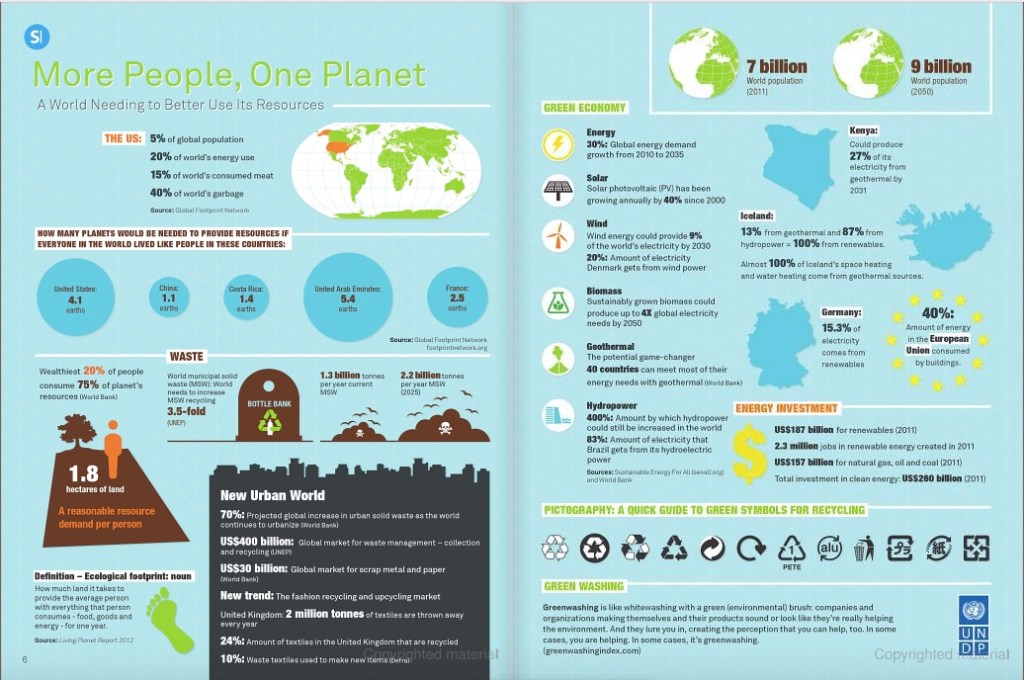
    “Close, but no cigar” some might say, but we were genuinely flattered to be shortlisted in 2014 for inclusion in the book Visual Storytelling: Infographic Design in News published by Images Publishing in Shanghai, China. It is a lovely book to look at and the quality of infographics chosen for the book is high so it must have been a tough call. It was further proof Southern Innovator was getting known around the world and gaining respect for its content and design. The excellent work done by our graphic designer and illustrator Solveig Rolfsdottir speaks for itself.
    Graphic Designer and Illustrator: Sólveig Rolfsdóttir.

    Published: November 2011

    Resources

    1) A travelling exhibit, In The Bag: The Art and Politics of the Reusable Bag Movement, showcases bags and art produced by communities throughout the world and by individual artists. Website:http://www.unrisd.org/80256B3C005BE6B5/%28httpNews%29/D1AB353A91EC2466C125793600519C7B?OpenDocument

    2) EPAP guide: Based on extensive research throughout Mongolia by UNDP, this guide includes the application of the Blue Bag project to Mongolia’s sprawling slum districts surrounding the capital Ulaanbaatar. Website:http://tinyurl.com/yfkn2dp

    Development Challenges, South-South Solutions was launched as an e-newsletter in 2006 by UNDP’s South-South Cooperation Unit (now the United Nations Office for South-South Cooperation) based in New York, USA. It led on profiling the rise of the global South as an economic powerhouse and was one of the first regular publications to champion the global South’s innovators, entrepreneurs, and pioneers. It tracked the key trends that are now so profoundly reshaping how development is seen and done. This includes the rapid take-up of mobile phones and information technology in the global South (as profiled in the first issue of magazine Southern Innovator), the move to becoming a majority urban world, a growing global innovator culture, and the plethora of solutions being developed in the global South to tackle its problems and improve living conditions and boost human development. The success of the e-newsletter led to the launch of the magazine Southern Innovator.  

    Follow @SouthSouth1

    Google Books: https://books.google.co.uk/books?id=waeXBgAAQBAJ&dq=Development+Challenges+February+2008&source=gbs_navlinks_s

    Slideshare: http://www.slideshare.net/DavidSouth1/development-challengessouthsouthsolutionsfebruary2008issue

    Southern Innovator Issue 1: https://books.google.co.uk/books?id=Q1O54YSE2BgC&dq=southern+innovator&source=gbs_navlinks_s

    Southern Innovator Issue 2: https://books.google.co.uk/books?id=Ty0N969dcssC&dq=southern+innovator&source=gbs_navlinks_s

    Southern Innovator Issue 3: https://books.google.co.uk/books?id=AQNt4YmhZagC&dq=southern+innovator&source=gbs_navlinks_s

    Southern Innovator Issue 4: https://books.google.co.uk/books?id=9T_n2tA7l4EC&dq=southern+innovator&source=gbs_navlinks_s

    Southern Innovator Issue 5: https://books.google.co.uk/books?id=6ILdAgAAQBAJ&dq=southern+innovator&source=gbs_navlinks_s

    Creative Commons License

    This work is licensed under a
    Creative Commons Attribution-Noncommercial-No Derivative Works 3.0 License.

    ORCID iD: https://orcid.org/0000-0001-5311-1052.

    © David South Consulting 2023