Categories
Archive Development Challenges, South-South Solutions Newsletters Southern Innovator magazine

More Futuristic African Cities in the Works

By David SouthDevelopment Challenges, South-South Solutions

SOUTH-SOUTH CASE STUDY

It has been well documented that China is undergoing the largest migration in human history from rural areas to cities. But this urbanization trend is occurring across the global South, including in Africa, as well. According to the UN, more than half the world’s population already lives in cities, and 70 per cent will live in urban areas by 2050. Most of the world’s population growth is concentrated in urban areas in the global South.

These emerging urban areas represent vast opportunities for innovators. Innovators will be needed to build them, and in turn they will provide modern facilities for innovators to operate in and engage with the global economy. And they will connect innovators to 21st-century information technology.

But while the government in China engages in significant planning and preparation to facilitate movements to urban areas – often building entire cities from scratch (http://www.time.com/time/photogallery/0,29307,1975397,00.html) – that has not been the case in Africa. People in Africa are on the move because they are seeking out opportunities, but much of this movement has been poorly planned and not well thought out.

But now more and more African governments are grappling with how to call time on chaotic and haphazard development and build sustainable, planned cities that will significantly improve human development and quality of life.

Across Africa, a host of ambitious new cities and urban developments are in the works.

Kenya’s Konza Technology City (konzacity.co.ke) is planned as a new centre 60 kilometres from the capital, Nairobi. Calling itself a “world-class technology hub and a major economic driver for the nation”, it offers a high-tech vision full of ultra-modern buildings and houses in order to spur the future growth of Kenya’s technology industry.

It is hoped Konza will create 100,000 jobs by 2030. There will be a central business district, a university campus for 1,500 students, a residential community, and parks and wildlife in green corridors.

The groundbreaking ceremony occurred on January 2013 but the Kenyan Ministry of Lands and Housing has halted operations to allow for greater community engagement, according to Urban Africa. A dispute had erupted with the current landowners who wanted to be better consulted about the development and had accused the government of locking them out of the physical planning process.

Tatu City, Kenya (tatucity.com) bills itself as “by Kenyans, for Kenyans”. It is being built by Rendeavour (rendeavour.com), the urban development division of Moscow-based Renaissance Group (rengroup.com), one of the largest urban developers of land in Africa. It joins Konza Technology City as a flagship project for the government’s Vision 2030, hoping to turn Kenya into a middle-income country and a role model for other countries in East Africa.

Tatu City is 15 kilometres from Nairobi. It will take up 1,035 hectares and will be completed in 10 phases. Construction began in May 2012 and is scheduled to be completed by 2022.

It is selling safety and a “beautiful urban environment” just a short journey away from Nairobi’s existing Central Business District. Tatu City wants to be “a model of the African city of the future” as a “dynamic mixed-use, mixed-income environment that will be home to an estimated 70,000 residents and 30,000 day visitors”.

Just 25 minutes from Jomo Kenyatta International Airport, it promises to be one of “the most modern, well-planned urban developments in East Africa”.

In Ghana, a number of innovative projects in development reflect the country’s impressive economic growth and information technology achievements in the past decade.

Two cities are being designed by Rendeavour. One, Appolonia, is being built in the Greater Accra area while the second, King City, is being built on the west coast of the country where there is an oil and gas boom underway.

Both will have houses, retail and commercial centres, schools, healthcare facilities and other social services.

“Our objective is to provide the basic infrastructure, planning and necessary management framework in creating satellite cities that reverses the current trend of unplanned development and urban congestion in most of Africa’s growing cities,” Tim Beighton of Rendeavour told CNN.

These projects are in an advanced stage, with all plans completed and approved by the government, according to their websites.

Appolonia City of Light near Accra (appolonia.com.gh) – due to break ground in the third quarter of 2013 – capitalizes on Accra’s status as one of Africa’s fastest-growing urban areas. The Appolonia development will be a “planned, sustainable, mixed-use and mixed-income city” to build a “work-live-play” community for 88,000 people living in 22,000 homes.

It will be built 30 kilometres northeast of Accra’s central business district and will have retail, commercial and industrial space combined with tourism, social and recreation facilities.

King City in Takoradi (kingcity.com.gh) calls itself “Western Ghana’s new holistic city”. It will offer homes, shops, offices, industries and public places. The plan includes building 25,000 new homes and, importantly, over 30 per cent of the city will be allocated for green space. It will take up 1,000 hectares on the outskirts of Sekondi-Takoradi.

Elsewhere in Accra, the Hope (Home Office People Environment) City (http://www.rlgghana.com/index.php/2013-02-07-11-25-04.html) is a much more ambitious concept. It is one of a cluster of projects in Africa focused on building the infrastructure for a 21st century, high-tech future. Costing US $10 billion, it will be built outside Accra and is focused on boosting Ghana’s already established reputation in the field of information and communications technology. It will be home to 25,000 people and create jobs for 50,000. There will be six towers including a 75-storey, 270 metre building that hopes to be the highest in Africa.

It is being financed by RLG Communications, a mix of investors and a stock-buying scheme.

There will be an assembly plant for high-tech products, business offices an information technology university, a hospital and restaurants, theaters and sports centres.

The design is hyper-modern and tries to create a vertical office environment that is dense and reduces the amount of time it takes to get around and circulate between businesses in the complex.

Eko Atlantic on Victoria Island in Lagos, Nigeria (ekoatlantic.com) is a coastal residential and business development that calls itself “The New Gateway to Africa”. To ease pressure in an already crowded city, it is being built on 10 square kilometres of reclaimed land from the Atlantic Ocean. It will be able to house 250,000 people and give work to 150,000.

The story began in 2003 when the Lagos State government was looking for a solution to protect the Bar Beach area of the city from coastal erosion. Land is being reclaimed from the sea and it will make up an area the equivalent of Manhattan in New York City. Just like Manhattan, it is hoped Eko Atlantic will become the new financial centre for West Africa by the year 2020.

Kilamba, or Nova Cidade de Kilamba (https://www.facebook.com/media/set/?set=a.231897596836631.80284.228497773843280), 30 kilometres outside Luanda, Angola is being built by the China International Trust and Investment Corporation (http://www.citic.com/wps/portal). It is on a vast scale and is designed to be home to 500,000 people with apartment blocks and commercial spaces. It has cost so far US $3.5 billion and is part of a government pledge to provide a million new homes within four years. Kilamba has come in for criticism for not being affordable enough for ordinary Angolans and for having much of the site unoccupied. With the apartments too expensive for ordinary Angolans, the government has decided to take action and ordered the prices to be reduced and made more affordable, according to Angola Press .

La Cite du Fleuve in the Democratic Republic of Congo (lacitedufleuve.com) is  a more conventional luxury housing development built on two islands in the capital, Kinshasa. Kinshasa, despite its problems and the turmoil from an ongoing civil war, is one of the continent’s fastest-growing cities. Developed by Hawkwood Properties, La Cite du Fleuve will need to reclaim 375 hectares of sandbanks and swamps to be able to build a collection of riverside villas, offices and shopping centres. It is is planned to take 10 years to complete.

And finally, Kigali, the capital of Rwanda, wants to transform itself into the “center of urban excellence in Africa”.

The 2020 Kigali Conceptual Master Plan (http://www.kigalicity.gov.rw/spip.php?article494) hopes to create a regional hub for business, trade and tourism, by building a mix of commercial and shopping districts with glass skyscrapers and modern hotels, parks and entertainment facilities.

Critics, however, believe these new cities and modern developments are tackling the problems of urban development by bypassing most of the population. They argue they are just developments for those with money who can buy their way out of the chaos and lack of planning of current African cities.

“They are essentially designed for people with money,” Vanessa Watson, professor of city planning at the University of Cape Town, told CNN. She believes most of the plans are unsustainable “urban fantasies” detached from the reality of African poverty and informal living.

But while it is easy to criticize these ambitious projects, they reflect not only optimism for the continent’s future but also a clear recognition the continent will not be able to get wealthier without modern cities and infrastructure in keeping with a 21st-century economy.

Published: August 2013

Resources

1) Southern Innovator Issue 4: Cities and Urbanization: SI’s fourth issue goes to the many new cities under construction to build the new 21st century world emerging in the global South. Website: http://www.scribd.com/doc/133622315/Southern-Innovator-Magazine-Issue-4-Cities-and-Urbanization

2) Urban Africa: Urban Africa is a digital entry point for knowledge sharing, interactive exchange and information dissemination on urbanization in Africa. Website: http://urbanafrica.net/

3) Arrival City: A third of humanity is on the move. History’s largest migration is creating new urban spaces that are this century’s focal points of conflict and change — unseen districts of rapid transformation and febrile activity that will reshape our cities and reconfigure our economies. Website: http://arrivalcity.net/

4) Global Urbanist: The Global Urbanist is an online magazine reviewing urban affairs and urban development issues in cities throughout the developed and developing world. Website: globalurbanist.com

5) Africa Renewal: The Africa Renewal information programme, produced by the Africa Section of the United Nations Department of Public Information, provides up-to-date information and analysis of the major economic and development challenges facing Africa today. Website: http://www.un.org/africarenewal/

Citations

Cited in Beyond Gated Communities by Samer Bagaeen and Ola Uduku (2015).
https://davidsouthconsulting.org/2022/02/09/african-megacity-makeovers-tackle-rising-populations/

https://davidsouthconsulting.org/2022/10/19/chinese-building-solution-for-rapidly-urbanizing-global-south/

https://davidsouthconsulting.org/2022/05/23/debt-free-homes-for-the-poor/

https://davidsouthconsulting.org/2022/10/17/east-africa-to-get-its-first-dedicated-technology-city/

https://davidsouthconsulting.org/2022/03/20/global-south-eco-cities-show-how-the-future-can-be/

https://davidsouthconsulting.org/2021/11/12/global-souths-rising-megacities-challenge-idea-of-urban-living/

https://davidsouthconsulting.org/2022/03/29/model-city-to-test-the-new-urbanism-concept-in-india/

https://davidsouthconsulting.org/2017/11/08/smart-cities-up-close-2013/

https://davidsouthconsulting.org/2022/09/26/3d-home-printing-landmark-10-houses-in-a-day/

https://davidsouthconsulting.org/2022/11/17/tiny-homes-to-meet-global-housing-crisis/

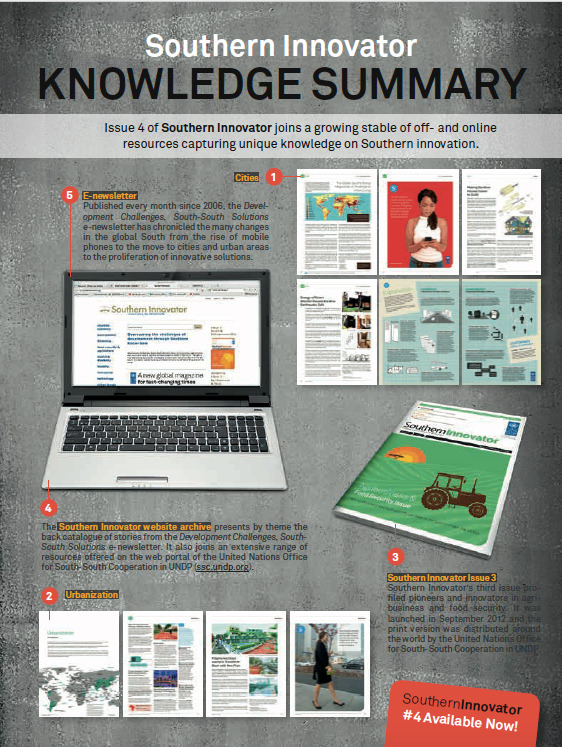
Development Challenges, South-South Solutions was launched as an e-newsletter in 2006 by UNDP’s South-South Cooperation Unit (now the United Nations Office for South-South Cooperation) based in New York, USA. It led on profiling the rise of the global South as an economic powerhouse and was one of the first regular publications to champion the global South’s innovators, entrepreneurs, and pioneers. It tracked the key trends that are now so profoundly reshaping how development is seen and done. This includes the rapid take-up of mobile phones and information technology in the global South (as profiled in the first issue of magazine Southern Innovator), the move to becoming a majority urban world, a growing global innovator culture, and the plethora of solutions being developed in the global South to tackle its problems and improve living conditions and boost human development. The success of the e-newsletter led to the launch of the magazine Southern Innovator. 

https://davidsouthconsulting.org/2021/03/05/southern-innovator-issue-4/

Creative Commons License

This work is licensed under a
Creative Commons Attribution-Noncommercial-No Derivative Works 3.0 License.

ORCID iD: https://orcid.org/0000-0001-5311-1052.

© David South Consulting 2022

Categories
Archive Blogroll Development Challenges, South-South Solutions Newsletters Southern Innovator magazine The Global Urbanist

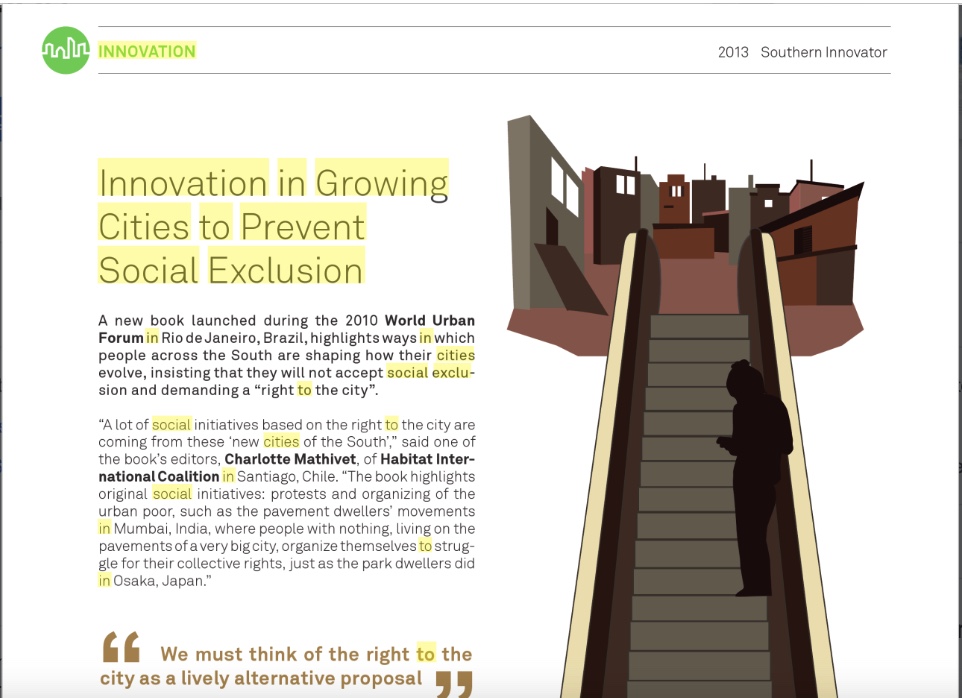
Innovation in Growing Cities to Prevent Social Exclusion

By David SouthDevelopment Challenges, South-South Solutions

SOUTH-SOUTH CASE STUDY

As of 2007, the world became a majority urban place. The largest movements of people in human history are occurring right now, as vast populations relocate to urban and semi-urban areas in pursuit of a better quality of life, or because life has become intolerable where they currently live.

A new book launched during this year’s World Urban Forum in Rio de Janeiro, Brazil highlights ways in which people across the South are shaping how their cities evolve, insisting that they will not accept social exclusion and demanding a “right to the city.”

“A lot of social initiatives based on the right to the city are coming from these ‘new cities of the South,’ said one of the book’s editors, Charlotte Mathivet of Habitat International Coalition in Santiago, Chile. “The book highlights original social initiatives: protests and organizing of the urban poor, such as the pavement dwellers’ movements in Mumbai, India where people with nothing, living on the pavements of a very big city, organize themselves to struggle for their collective rights, just as the park dwellers did in Osaka, Japan.”

This first edition of Cities for All: Proposals and Experiences towards the Right to the City, comes in three languages – English (http://www.hic-net.org/document.php?pid=3399) , Spanish ( http://www.hic-net.org/document.php?pid=3400) and Portuguese (http://www.hic-net.org/document.php?pid=3401) – is intended to inspire people to tackle positively this fast-changing urban world.

The book’s chapters span an eclectic mix of topics, from democracy in the world’s future cities to experiences in Africa’s cities, to how the 2008 Beijing Olympics affected the metropolis, to ways of involving children in urban planning.

One innovative case study included in the book is the children’s workshops in Santiago, Chile, which aim to make a more child-friendly city by including children in the planning process.

One example of the success of a child-friendly approach has been the work of the former mayor of Bogotá, Colombia, Enrique Peñalosa (http://www.pps.org/epenalosa-2/) . As mayor of the city of over 6.6 million people from 1998 to 2001, he put children to the fore in planning.

“In Bogotá, our goal was to make a city for all the children,” he told Yes! magazine. “The measure of a good city is one where a child on a tricycle or bicycle can safely go anywhere. If a city is good for children, it will be good for everybody else. Over the last 80 years we have been making cities much more for cars’ mobility than for children’s happiness.”

His term in office saw the establishment or refurbishing of 1,200 parks and playgrounds, the building of three large and 10 neighbourhood libraries and the opening of 100 nurseries for children under five. He also oversaw the creation of 300 kilometres of bike lanes, the largest such network in the developing world, created the world’s longest pedestrian street, at 17 kilometres, and turned land earmarked for an eight-lane highway into a 45 kilometre green belt path.

Cities for All’s publisher, Habitat International Coalition (HIC) (www.hic-net.org) , says it focuses on the link between “human habitat, human rights, and dignity, together with people’s demands, capabilities, and aspirations for freedom and solidarity.”

The group works towards the creation of a theoretical and practical framework for what it calls a “right to the city.”

The cities of Africa and Asia are growing by a million people a week. If current trends continue, megacities and sprawling slums will be the hallmarks of this majority urban world. Currently in sub-Saharan Africa, 72 percent of the population lives in slum conditions. And by 2015, there will be 332 million slum-dwellers in Africa, with slums growing at twice the speed of cities.

“The consequences have produced a deeper gap between the city and countryside and also within the city between the rich and poor,” said Mathivet.

“We must think of the right to the city as a lively alternative proposal,” Mathivet said, “a banner under which social movements, academics, and social organizations are struggling against the perverse effects of neo-liberalism in cities such as the privatization of land, public spaces and services, land speculation, gentrification, forced evictions, segregation, and exclusion.”

Published: July 2010

Resources

1) Model Village India: Drawing on self-organizing methods used in India since 1200 BC, the Model Village India is based around India’s democratic system of Panchayats: a village assembly of people stemming back to pre-colonial times. Website: www.modelvillageindia.org.in

2) More Urban, Less Poor: The first textbook to explore urban development and management and challenge the notion unplanned shanty towns without basic services are the inevitable consequence of urbanization. Website:www.earthscan.co.uk

3) Building and Social Housing Foundation: The Building and Social Housing Foundation (BSHF) is an independent research organisation that promotes sustainable development and innovation in housing through collaborative research and knowledge transfer. Website: http://www.bshf.org

4) World Social Forum Dakar, Senegal 2011. Website:www.worldsocialforum.info

Development Challenges, South-South Solutions was launched as an e-newsletter in 2006 by UNDP’s South-South Cooperation Unit (now the United Nations Office for South-South Cooperation) based in New York, USA. It led on profiling the rise of the global South as an economic powerhouse and was one of the first regular publications to champion the global South’s innovators, entrepreneurs, and pioneers. It tracked the key trends that are now so profoundly reshaping how development is seen and done. This includes the rapid take-up of mobile phones and information technology in the global South (as profiled in the first issue of magazine Southern Innovator), the move to becoming a majority urban world, a growing global innovator culture, and the plethora of solutions being developed in the global South to tackle its problems and improve living conditions and boost human development. The success of the e-newsletter led to the launch of the magazine Southern Innovator. 
“Cities for All, recently published by Habitat International Coalition, draws together thinkers and innovators in a compilation of case studies addressing the challenges of inclusive cities in the global South. The book seeks to articulate experiences of South-South cooperation and enhance the links between different regions. David South interviews the co-editor, Charlotte Mathivet.”

Read the full interview here: https://www.hic-net.org/innovation-in-growing-cities-to-prevent-social-exclusion/.
Creative Commons License

This work is licensed under a
Creative Commons Attribution-Noncommercial-No Derivative Works 3.0 License.

ORCID iD: https://orcid.org/0000-0001-5311-1052.

© David South Consulting 2023

Categories
Annex Gleaner Archive

Will The Megacity Mean Mega-Privatization?

Annex Gleaner (Toronto, Canada), March 1997

As the provincial government tries to shoehorn six municipalities into one megacity, opponents of the plan worry that one of the results of amalgamation will be widespread privatization of public services.

References to contracting out and tendering municipal services in order to achieve savings run through the provincial government’s much-maligned report supporting a megacity, produced by consultants KPMG.

Many observers feel the new city will have no choice, while others argue privatization won’t be nearly as extensive as some fear. Still others think it is far from a foregone conclusion that a future amalgamated council will push privatization.

“Who knows if the council will have an interest in privatization?” says a senior bureaucrat at the City of Toronto, who did not want to go on record. “People are running around saying they will privatize everything, but who knows what the political make-up will be of the new council? They are assuming there will always be savings to be had from privatization – that doesn’t automatically follow. The financial pressures on the megacity can’t be avoided by privatization.”

Among the six current Metro municipalities, it is Etobicoke that has most fully embraced contracting out. The City of Etobicoke’s experiments with contracting out – 60 per cent of public works contracts are performed by private-sector companies – calls into question the estimates of substantial savings being bandied about by the provincial government.

According to the senior bureaucrat in charge of running that city, acting city manager and commissioner of public works Tom Denes, contracting out isn’t the tax-saving nirvana some believe.

“I think we are finding in contracting out,” says Denes, “that the higher the skills of the workforce, the less sense it makes to contract out. For example, it would be very expensive to contract out water treatment.”

Denes says the city’s pride and joy is its privatized garbage collection handled by Waste Management Inc. and BFI. The WMI contract is worth $6 million a year, down from the $7.5 million a year it was costing to publicly run garbage collection. The price is fixed for five years, when it must be negotiated again. While the city made $1.9 million selling its old trucks, councillors set up a $4 million fund so Etobicoke could go back to collecting garbage itself if private companies tried to gouge the city.

Denes, who has been meeting with counterparts at other cities and the provincial government, believes the new Toronto will be divided up into several districts which private garbage collectors will have to compete for.

“Based on what I know, if you were to divide the city up into waste contracts, it would be at least four areas,” claims Denes. “No company can handle the whole city. You just can’t find a company that could handle a megacity. It would become a monopoly.”

Denes thinks the likely suspects for contracting out would be any manual labour work and the TTC. He thinks a megacity would be mistaken to contract out skilled work like surveying, arguing that skilled workers would use their desirability to their advantage and charge high consulting fees.

“The US cities have all gone through these exercises. They are in fact contracting services back in,” says Denes.

While the Tories have been slipperier than a scoop of ice cream about their specific privatization plans, one thing is clear: An essential element of the Tory economic vision is a greater role for the private sector in delivering public services. The $100,000 KPMG report plays to this, making it clear contracting out is a key means to saving money in the new megacity. The report claims between $28 million and $43 million per year could be saved from contracting out computer operations and some management; between $38.5 million and $68 million by contracting out fraud investigations; between $29.6 million and $54.5 million by contracting out road and electrical maintenance, snow removal and data collection; between $21 million and $39.4 million by contracting out garbage pick-up and processing.

The report also offers this proviso: “There is no such thing as automatic, cost-free savings from organizational change. The implementation process must be tightly managed to produce the savings suggested here.”

Ron Moreau is the administrator for Local 43 of the Metro Toronto Civic Employees Union, which represents over 3,000 public works workers and ambulance drivers at Metro.

“How will the megacity and municipalities cope with pressure from the public to hold the line on taxes? Where will councils find the difference between spending and revenues?” asks Moreau. “The level of service will suffer. When you contract out, public policy is held hostage by private enterpise.”

Moreau threatens that labour will play hardball with the new city. Most of the contracts for Moreau’s members run out on Dec. 31 of this year.

“Assuming the government doesn’t tamper with the labour legislation on our books, the unions can be organized into two large locals, one clerical/technical, the other outside workers. They would have effective bargaining clout.”

One major player looking for government contracts in a megacity will be Laidlaw Inc. While the company recently sold its garbage collection operations to an American firm, USA Waste, it still has interests in operating school buses and ambulances. Laidlaw is a heavy contributor to the Ontario Progressive Conservative Party, according to records kept by the Commission on Election Financing. Laidlaw has also made an influential new friend: in January, it hired former Metro chief administrative officer Bob Richards as its vice-president.

Ward 13 city councillor John Adams is definitely in the privatization-if-necessary-but-not-necessarily-privatization camp. “I don’t see everything being contracted out, but more stuff being put out for competitive bids.”

Adams thinks contracting out could be a good tactic to help modernize garbage collection, for example. He points to the City of Toronto’s deal with WMI to collect garbage at apartment buildings. In that deal, costs were reduced by $2.5 million over a five-year contract, and the crews on trucks were reduced from two to one. Instead of an extra crew member, closed-circuit television cameras were installed on trucks to speed up pick-up. Adams points out the crews are still unionized, but instead of CUPE it is the Teamsters.

“The way we pick up garbage from households is back-breakingly stupid. I think we need to rethink how we do it, to use machines more than people’s backs.”

But Adams doesn’t believe a megacity is a money-saver. “There will be a leveling up of wages. How long will two firefighters work side-by-side for different salaries? You can bet the union will negotiate an increase at the first opportunity.”

Adams thinks a megacity will be more prone to the slick lobbying efforts of companies like Laidlaw because councillors will be dependent on political parties to get elected. “The provincial government will contract out municipal government to Laidlaw,” he says sarcastically.

More on megacities:

African Megacity Makeovers Tackle Rising Populations

Artists Fear Indifference From Megacity

Cities For All Shows How The World’s Poor Are Building Ties Across The Global South

Global South’s Rising Megacities Challenge Idea of Urban Living

Safety At Stake

Southern Innovator Issue 4

David South Consulting business card
In 2010, David South Consulting was relaunched with a new logo and branding for the 21st century. It represented a new phase, as work became global and very high-profile and influential. The foundations have been laid for future growth and expansion.
Creative Commons License

This work is licensed under a
Creative Commons Attribution-Noncommercial-No Derivative Works 3.0 License.

ORCID iD: https://orcid.org/0000-0001-5311-1052.

© David South Consulting 2021