Tag: Global South

  • Global South’s Rising Economies Gain Investor Spotlight

    Global South’s Rising Economies Gain Investor Spotlight

    By David SouthDevelopment Challenges, South-South Solutions

    SOUTH-SOUTH CASE STUDY

    A new book is arguing that the world’s attention should switch away from BRICS countries – Brazil, Russia, India, China and South Africa – and take another look at nations and regions elsewhere across the global South. It argues many are lodestones of future growth and prosperity in the making and will see dramatic changes over the next decade.

    The story of the BRIC and BRICS countries is an impressive one. In just eight years from 2000 to 2008, the BRIC countries’ combined share of total world economic output rose from 16 to 22 per cent. This led to a 30 per cent increase in global output during the period, showing how key these countries were to global prosperity in the 2000s. BRIC countries make up nearly half the world’s population and are regional leaders. Taken together, their gross domestic products (GDPs) are not far behind the United States.

    Ruchir Sharma’s Breakout Nations: In Pursuit of the Next Economic Miracles (http://www.amazon.com/Breakout-Nations-Pursuit-Economic-Miracles/dp/0393080269) argues that the BRICS are now entering a more stable growth path and thus will not see the rapid-fire expansion and quick profits investors have become used to in the past decade.

    “The BRICs,” Sharma told Forbes magazine, “were last decade’s team.”

    The BRIC acronym (http://en.wikipedia.org/wiki/BRIC) was coined in 2001 by Goldman Sachs managing director Jim O’Neill, in a 2001 paper titled “Building Better Global Economic BRICs” (http://www.goldmansachs.com/ourthinking/brics/building-better.html). O’Neill predicted that this handful of countries would dominate the growth and economic development story for the years 2000 to 2010. This was because they all shared a similar stage of advanced economic development.

    The BRIC states first began meeting together in 2006. South Africa was added in 2010 to form the BRICS acronym.

    The buzz surrounding the BRICS countries over the past decade has been justified by their impressive growth rates, declining poverty levels,modernizing economies and societies and growing middle class populations.

    China alone had seen its gross domestic product grow by US $5 trillion between 2001 and 2011.

    Now, Sharma argues, it is someone else’s turn.

    Sharma is head of emerging markets with Morgan Stanley Investment Management in New York, and Breakout Nations looks at where the next economic surprise stories will take place.

    “A breakout nation is a nation that will grow above expectations, and will grow more than nations with similar per capita income,” Sharma told Forbes. “You can’t bunch all of the emerging markets together anymore. The last decade saw these countries behaving the same economically, but I think that is behind us now. Investors today will really have to pick their spots.”

    He points out that Indonesia was the best performing emerging market in 2011 and has an economy that will surpass a trillion dollars in the coming years.

    He also believes Sri Lanka and Nigeria are economies to watch.

    Sharma says funds flowing into emerging market stocks grew by 478 per cent from 2005 to 2010, a massive jump compared to 2000 to 2005, when they grew by 92 per cent.

    As he sees it, China has now reached middle-income status and its growth rates will not be as high as they have been for the past two decades. In his research, he found that countries like Japan, South Korea and Taiwan all slowed down once their per capita income went past US $5,000.

    Investors who watch the emerging markets predict the hot growth areas for the next decade will be around energy, technology, and agricultural resources.

    Sharma picks out Indonesia, Turkey, the Philippines, Poland and the Czech Republic for future investment interest, but urges caution with thinking all emerging economies are on course to boom.

    “You’ve got to pick your spots, rather than just assume that because you put a tag of emerging on a particular nation, it’s going to boom,” Sharma told The Globe and Mail newspaper.

    To make sense of the complexity of fast-emerging economies, a flurry of new investor acronyms has popped up. One of the country clusters is called the CIVETS: Colombia, Indonesia, Vietnam, Egypt, Turkey, South Africa (http://en.wikipedia.org/wiki/CIVETS).

    The MINTS (Mexico, Indonesia, Nigeria and Turkey) are also set for great growth in the next decade, many investors believe.

    Then there is the N-11 or Next 11. This is the MINTS plus Bangladesh, Egypt,Iran, Pakistan, the Philippines, South Korea and Vietnam.

    And after that there is VISTA (Vietnam, Indonesia, South Africa, Turkey and Argentina). While clearly the creative juices are flowing at investment houses as they come up with ever-catchier acronyms, a more serious point is being made: many countries in the global South, for the first time in history, are no longer solely dependent on the Western economic system for demand.

    These countries, investors note, now have an unprecedented range of options uncoupled from the political, financial and economic legacy of Western developed nations. They say that many nations in the global South are set for a runaway investment boom because they are making changes and modernizing their economies faster than many expect.

    As the BRICS economies mature and slow down and take on different priorities based around improving the quality of life of their citizens, those seeking faster profits will look elsewhere. This trend is even happening within the BRICS, as Chinese and Brazilian companies offshore work to Vietnam and Colombia.

    There are many new centres of economic activity and rising prosperity across the emerging markets that often fail to gain wider attention. Few would probably know that the Northeast Asian nation of Mongolia – mired in the 1990s in the worst peacetime economic collapse in half a century (http://www.scribd.com/doc/20864541/Mongolia-Update-1998-Book) – is now the world’s fastest-growing economy (http://www.worldbank.org/en/news/2012/02/28/what-behind-mongoliaeconomic-boom) and one of the top places for mobile phone usage and penetration (http://www.businessmongolia.com/mongolia/2012/03/19/mongolia-ringing-the-changes/).

    Then there is Myanmar (formerly Burma), where many are hoping recent moves toward democracy and improvements in diplomatic relations will lead to an economic boon for the region. Investors are also targeting Kazakhstan in Central Asia.

    Reflecting these changing realities, Standard Bank, Africa’s largest bank, has been documenting the rising role played by the Chinese currency in international trade. A recent report forecast US $100 billion (R768 billion) in Sino-African trade would be settled in the Chinese currency, the renminbi, by 2015. This would be double the trade between China and Africa in 2010. It also found 70,000 Chinese companies are using the renminbi in international trade transactions.

    Published: April 2012

    Resources 

    1) Beyondbrics blog: A blog by the Financial Times calling itself “The Ft’s emerging markets hub”. Website: http://blogs.ft.com/beyond-brics/

    2) BRICS Summit: The Fourth BRICS Summit was hosted in New Delhi on 29 March 2012 under the overarching theme of “BRICS Partnership for Global Stability, Security and Prosperity.” The Summit has imparted further momentum to the BRICS process. Website: bricsindia.in

    3) Market Oracle: A good source for updates on investor sentiment about the emerging market economies. Website: marketoracle.co.uk

    4) Monocle magazine: “A briefing on global affairs, business, culture and design” often featuring trends in the emerging market countries. Website: monocle.com

    5) BRICS Information Centre, University of Toronto. Website: brics.utoronto.ca

    https://davidsouthconsulting.org/2022/04/15/african-youth-want-to-do-business-in-fast-growing-economy/

    https://davidsouthconsulting.org/2022/03/20/global-south-eco-cities-show-how-the-future-can-be/

    https://davidsouthconsulting.org/2021/07/19/global-south-trade-boosted-with-increasing-china-africa-trade-in-2013/

    https://davidsouthconsulting.org/2022/10/20/global-souths-middle-class-is-increasing-prosperity/

    https://davidsouthconsulting.org/2022/10/20/global-souths-rising-economies-gain-investor-spotlight-2/

    https://davidsouthconsulting.org/2021/11/12/global-souths-rising-megacities-challenge-idea-of-urban-living/

    https://davidsouthconsulting.org/2022/11/15/indonesian-middle-class-recycle-wealth-back-into-domestic-economy/

    https://davidsouthconsulting.org/2022/10/20/trade-to-benefit-the-poor-up-in-2006-and-to-grow-in-2007/

    https://davidsouthconsulting.org/2022/11/20/venezuelas-currencies-promote-cooperation-not-competition/

    https://davidsouthconsulting.org/2022/10/10/wireless-internet-culture-helping-zimbabwe-economy-recover/

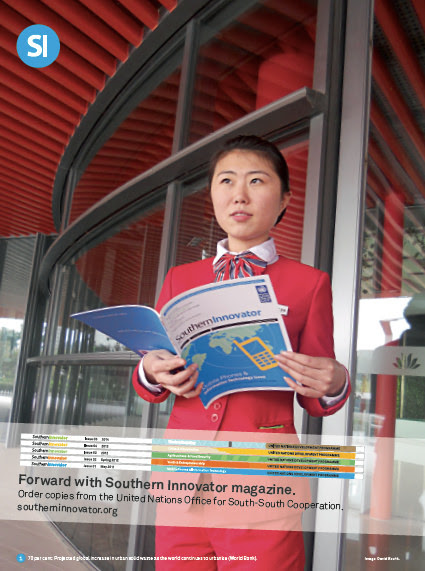
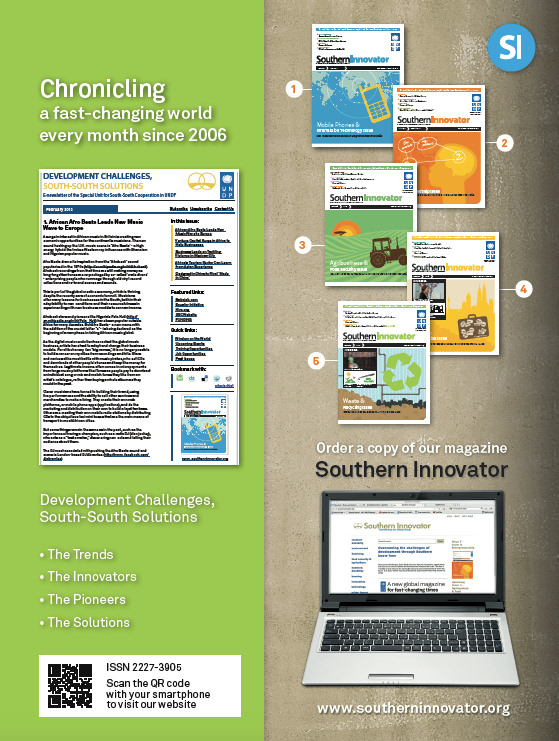
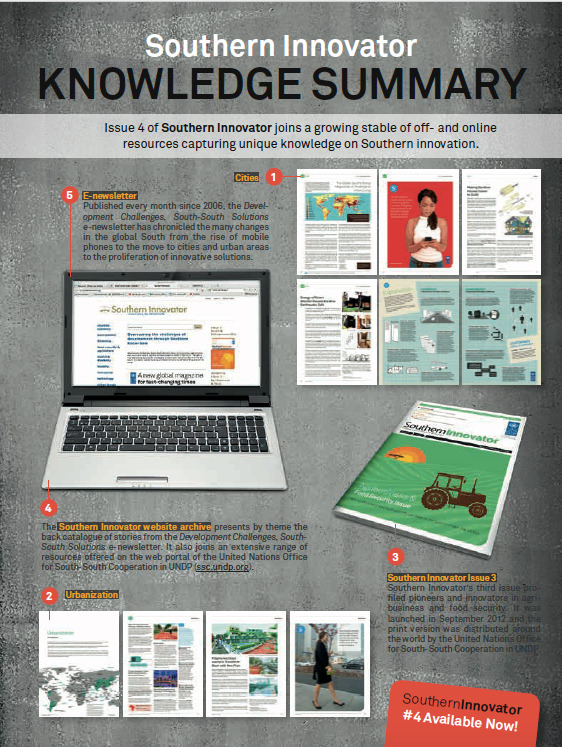
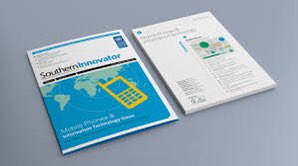
    Development Challenges, South-South Solutions was launched as an e-newsletter in 2006 by UNDP’s South-South Cooperation Unit (now the United Nations Office for South-South Cooperation) based in New York, USA. It led on profiling the rise of the global South as an economic powerhouse and was one of the first regular publications to champion the global South’s innovators, entrepreneurs, and pioneers. It tracked the key trends that are now so profoundly reshaping how development is seen and done. This includes the rapid take-up of mobile phones and information technology in the global South (as profiled in the first issue of magazine Southern Innovator), the move to becoming a majority urban world, a growing global innovator culture, and the plethora of solutions being developed in the global South to tackle its problems and improve living conditions and boost human development. The success of the e-newsletter led to the launch of the magazine Southern Innovator. 

    https://davidsouthconsulting.org/2021/03/05/southern-innovator-issue-2/

    Creative Commons License

    This work is licensed under a
    Creative Commons Attribution-Noncommercial-No Derivative Works 3.0 License.

    ORCID iD: https://orcid.org/0000-0001-5311-1052.

    © David South Consulting 2022

  • Global South’s Middle Class is Increasing Prosperity

    Global South’s Middle Class is Increasing Prosperity

    By David SouthDevelopment Challenges, South-South Solutions

    SOUTH-SOUTH CASE STUDY

    The global middle class is on the rise – and this is creating both challenges and opportunities. As poverty rates have come down across the global South, many countries have seen a rise in the proportion of their population categorized as “middle class”. Globally, being middle class is defined as a person able to consume between US $4 a day and US $13 a day (ILO).

    According to the Organization for Economic Cooperation and Development (OECD), most of this growth will be in Asia and the region will soon make up 66 per cent of the world’s middle class. Historical experience shows that members of the middle class quickly become absorbed in spending their accumulated capital on housing, equipment, industry and business, health and education. In countries with a growing middle class, policy makers need to show a strong interest in creating stable economic conditions to encourage this expanding consumption and domestic demand, the OECD advises.

    Growth of the world’s middle class took off after 2001, with an additional 400 million workers joining this group. The McKinsey group of consultants found the total number reached 2 billion in a dozen “emerging nations” in 2010, collectively spending US $6.9 trillion every year (McKinsey).

    Forecasters predict a further increase in the middle class across the global South will bring with it a surge in consumption (a combination of spending and demand). Areas being highlighted by various studies and reports include China’s small and mid-size cities, other areas of East Asia and Africa.

    Middle class spending in these dozen emerging nations could reach US $20 trillion during the next decade – twice the amount of consumption occurring in the United States right now (McKinsey).

    The result is a re-shaping of populations, with growing numbers of people now neither rich nor desperately poor, but landing in the middle of the income distribution.

    And local competitors in the global South are fighting hard for these consumers on their own turf.

    The Hangzhou Wahaha (http://en.wahaha.com.cn/) beverage maker in China has been able to compete against multinationals such as Coca-Cola and PepsiCo, according to McKinsey. It has turned itself into a US $5.2 billion business using a multi-pronged strategy: targeting rural areas, catering to local needs, keeping costs low and positioning itself as the patriotic choice.

    And this change is also occurring in Africa, where a growing middle class is fuelling sales of refrigerators, television sets, mobile phones, motors and automobiles across the continent, according to the OECD. In Ghana, for example, car and motorcycle ownership has risen by 81 per cent since 2006.

    According to the African Development Bank (AfDB), Africa’s middle class has reached 34 per cent of the population, or 350 million people. In 1980, it was 126 million people, or 27 per cent of the population.

    Countries with the largest middle classes in Africa include Tunisia and Morocco, while Liberia and Burundi have the smallest number of people in the middle class.

    The economic growth that is fuelling this middle-class surge is coming from a combination of increasing investment in the services sector, the tapping of the natural resource sector and better economic policies in the past two decades. Africa’s middle class is driving growth in the private sector and boosting demand for goods and services, most often also provided by the private sector.

    “The liberalization of African economies has resulted in improved efficiencies and led to a rapid growth in the service sector, which has spurred the growth of the middle class,” Lawrence Bategeka, a principal researcher at the Uganda-based Economic Policy Research Centre, told The East African newspaper.

    How important the middle class is to increasing consumption levels can be seen in the cases of Brazil and South Korea.

    According to the OECD, both countries had similar income levels and growth rates in the 1960s. But by the 1980s, high income inequality in Brazil capped the middle class at 29 per cent of the population. In South Korea in the 1980s, the middle class population reached 53 per cent. This larger middle class population enabled South Korea to switch from an export-driven growth strategy to domestic consumption.

    While Brazil wasn’t able to do this at the time, it has since made impressive gains in reducing poverty – from 40 per cent of the population in 2001 to 25 per cent in 2009. This has seen the middle class grow to 52 per cent of the population and boosted domestic consumption.

    While a rising middle class in the global South is good news for improving human development and living standards, the OECD found much of the new middle class was vulnerable and could easily slip out of that category. They also often lacked enough income to purchase more expensive durable goods such as automobiles (OECD Yearbook 2012).

    The success of this fragile but growing middle class will be key to how well the global economy fares in the coming years.

    A new report by the UN’s International Labour Organization (ILO) argues that the global South’s growing middle classes are just the thing to spur growth across the wider world economy.

    “Over time, this emerging middle-class could give a much needed push to more balanced global growth by boosting consumption, particularly in poorer parts of the developing world,” said Steven Kapsos, one of the authors of the report.

    In Indonesia, an example of the economic impact of the middle class trend in action can be seen in the surging life insurance business.

    Association of Indonesian Life Insurance Companies (AAJI) chairman Hendrisman Rahim believes the growing middle class are potential customers for the country’s thriving life insurance industry.

“They are the ones who have the need to be insured and can afford to purchase a policy. Extremely rich people are financially capable [of buying], but may not have the need. Extremely poor people have the need, but require financial assistance to be insured,” he said to the Jakarta Post.

    As the Indonesian middle class increases, the life insurance industry is expecting to see revenue rise by 30 per cent in 2013.

    Published: February 2013

    Resources

    1) The $10 Trillion Dollar Prize by Michael J. Silverstein. Website: amazon.com

    2) The Middle of the Pyramid: Dynamics of the Middle Class in Africa. Website: http://www.afdb.org/en/blogs/afdb-championing-inclusive-growth-across-africa/post/the-african-consumer-market-8901/

    3) McKinsey Quarterly: Capturing the world’s emerging middle class. Website:http://www.mckinseyquarterly.com/Capturing_the_worlds_emerging_middle_class_2639

    4) OECD Observer: An emerging middle class by Mario Pezzini. Website:http://www.oecdobserver.org/news/fullstory.php/aid/3681/An_emerging_middle_class.html

    Southern Innovator logo

    London Edit

    31 July 2013

    Development Challenges, South-South Solutions was launched as an e-newsletter in 2006 by UNDP’s South-South Cooperation Unit (now the United Nations Office for South-South Cooperation) based in New York, USA. It led on profiling the rise of the global South as an economic powerhouse and was one of the first regular publications to champion the global South’s innovators, entrepreneurs, and pioneers. It tracked the key trends that are now so profoundly reshaping how development is seen and done. This includes the rapid take-up of mobile phones and information technology in the global South (as profiled in the first issue of magazine Southern Innovator), the move to becoming a majority urban world, a growing global innovator culture, and the plethora of solutions being developed in the global South to tackle its problems and improve living conditions and boost human development. The success of the e-newsletter led to the launch of the magazine Southern Innovator. 
    Creative Commons License

    This work is licensed under a
    Creative Commons Attribution-Noncommercial-No Derivative Works 3.0 License.

    ORCID iD: https://orcid.org/0000-0001-5311-1052.

    © David South Consulting 2023

  • Chinese Building Solution for Rapidly Urbanizing Global South

    Chinese Building Solution for Rapidly Urbanizing Global South

    By David SouthDevelopment Challenges, South-South Solutions

    SOUTH-SOUTH CASE STUDY

    The global South is currently experiencing the biggest surge in urban population ever seen in human history. This transformation from urban to rural is happening in many different ways across the global South. Some countries have highly detailed plans and are building new cities from scratch, while other countries feel overwhelmed by their booming urban populations.

    By 2025, it is estimated the developing world could become home to 37 megacities with more than 10 million residents (http://en.wikipedia.org/wiki/Megacity) (The Guardian). Sixty years ago there were just two megacities: New York and Tokyo. Today, there are between 21 and 23, and the UN is forecasting that by 2025 Asia will have nine new megacities. By 2025, the majority of the world’s megacities will be in the global South.

    But how will these cities be built? How will they use resources well and ensure the rapidly rising new buildings are safe and healthy?

    A Chinese innovator and Internet sensation has developed a way to rapidly build high-density, high-rise structures that are also safe and meet strict earthquake-proofing standards. Building upwards is an efficient way to get more use out of space and to free up land for things like parks.

    Just as the first megacities such as New York began building skyscrapers a century ago, going upwards will be the solution many of the new megacities will choose as they feel the pressing twin demands of rising populations and financial restraints.

    Based in Changsha, China (http://en.wikipedia.org/wiki/Changsha), the BROAD Group
    (http://www.broad.com/) (http://www.broad.com:8089/english/) has become an Internet sensation for posting videos of it rapidly building skyscrapers. It does this to show off its innovative technologies, which have significantly reduced the time it takes to build high-rise buildings.

    The BROAD Group calls itself “an enterprise based on the vision of unique technologies and the philosophy of preserving life.”

    The company is a pioneer in making non-electric air conditioning equipment, energy systems, and sustainable building technology.

    The company has come a long way since it was started in 1988 with just US $3,000. By 1995, it had shed its debts and loans. It sees its mission as confronting the two major crises facing the world today: atmospheric pollution and global warming. The company hopes to evolve into a social enterprise.

    BROAD calls itself a world leader in making central air conditioning powered by natural gas and waste heat (http://en.wikipedia.org/wiki/Broad_Group). The company is currently exporting its systems to more than 60 countries and was an official supplier to the 2010 Shanghai Expo.

    BROAD has recently been expanding its product range and moving into constructing sustainable buildings. In particular it is developing an expertise in rapid construction techniques. This is important in the modern world as cities across the global South experience population growth and the pressing need to house people and create workplaces efficiently. BROAD is proud of the 15-storey hotel in Dongting Lake in Hunan Province it built in just six days, which became a hit on YouTube (http://www.youtube.com/watch?v=sjGhHl-W8Wg). After this achievement, BROAD constructed a 30-storey hotel in 15 days.

    Part of the BROAD Group, Broad Sustainable Building (BSB) claims to make the “World’s first factory-made building.” BROAD says its buildings are sustainable because they efficiently use recycled construction materials, rely on materials free of formaldehyde, lead, radiation and asbestos and avoid “construction sewage” dust or waste.

    BROAD was provoked into making sustainable buildings after the Wenchuan Earthquake in 2008 (http://quake.mit.edu/~changli/wenchuan.html). A year after the earthquake, 300 researchers from BROAD developed an earthquake-resistant building technology.

    The factory-made building works like this: a “main board” is prepared with a floor and ceiling, ventilation, water supply and drainage, electricity and lighting. This is then placed on a truck and taken to the building site. All the workers need to do on site is assemble the building by screwing in the bolts and finishing it with the painting and other decorating. This makes the time spent assembling the building on site, according to BROAD, just 7 per cent of the total construction hours. This means 93 per cent of the building is prefabricated in a factory compared to an industry norm of 40 per cent.

    BROAD’s latest project and biggest challenge is to build Sky City One (http://skycityone.wordpress.com/) – the world’s tallest tower at 220 floors and 838 metres – in Changsha in just 90 days. A mix of residential, commercial and retail space, it will allow between 70,000 and 120,000 people to work and live. The start date could be November 2012 and the building completed by early 2013.

    The finished building will be 10 metres taller than the current tallest tower, the Burj Khalifa (http://www.burjkhalifa.ae/) in Dubai.

    Published: October 2012

    Resources

    1) 20th Century World Architecture: The Phaidon Atlas by The Phaidon Editors, Publisher: Phaidon. Focusing on 750 of the most outstanding works built between 1900 and 1999, the book features every imaginable building type. Website: http://uk.phaidon.com/store/ 

    2) Megacities Foundation: The Megacities initiative originates from the awareness of the future role of cities as the dominant type of settlement for humanity. Cities will play this role not just as a matter of fact but out of necessity as the only way of housing the world’s increasing population. Website: http://megacities.nl/ 

    3) Andrew Marr’s Megacities: A BBC series exploring the rise of the megacities and what life will be like for their residents. Website: http://www.bbc.co.uk/programmes/b011ql6k 

    4) The Rise of Megacities Interactive: An online resource on the world’s rising megacities. Website: http://www.guardian.co.uk/global-development/interactive/2012/oct/04/rise-of-megacities-interactive

    https://davidsouthconsulting.org/2022/10/26/african-trade-hub-in-china-brings-mutual-profits-2/

    https://davidsouthconsulting.org/2021/12/20/better-by-design-in-china/

    https://davidsouthconsulting.org/2022/10/20/china-consumer-market-asian-perspective-helps/

    https://davidsouthconsulting.org/2020/04/25/china-looking-to-lead-on-robot-innovation/

    https://davidsouthconsulting.org/2020/04/25/china-pushing-frontiers-of-medical-research/

    https://davidsouthconsulting.org/2020/12/10/china-sets-sights-on-dominating-global-smartphone-market/

    https://davidsouthconsulting.org/2022/10/04/chinas-booming-wine-market-can-boost-south/

    https://davidsouthconsulting.org/2020/04/29/chinas-outsourced-airliner-development-model/

    https://davidsouthconsulting.org/2021/01/25/creating-green-fashion-in-china/

    https://davidsouthconsulting.org/2021/01/26/designed-in-china-to-rival-made-in-china/

    https://davidsouthconsulting.org/2021/07/19/global-south-trade-boosted-with-increasing-china-africa-trade-in-2013/

    https://davidsouthconsulting.org/2021/02/12/rammed-earth-houses-china-shows-how-to-improve-and-respect-traditional-homes/

    https://davidsouthconsulting.org/2022/10/26/tackling-chinas-air-pollution-crisis-an-innovative-solution/

    https://davidsouthconsulting.org/2020/04/17/virtual-supermarket-shopping-takes-off-in-china/

    Development Challenges, South-South Solutions was launched as an e-newsletter in 2006 by UNDP’s South-South Cooperation Unit (now the United Nations Office for South-South Cooperation) based in New York, USA. It led on profiling the rise of the global South as an economic powerhouse and was one of the first regular publications to champion the global South’s innovators, entrepreneurs, and pioneers. It tracked the key trends that are now so profoundly reshaping how development is seen and done. This includes the rapid take-up of mobile phones and information technology in the global South (as profiled in the first issue of magazine Southern Innovator), the move to becoming a majority urban world, a growing global innovator culture, and the plethora of solutions being developed in the global South to tackle its problems and improve living conditions and boost human development. The success of the e-newsletter led to the launch of the magazine Southern Innovator. 

    Creative Commons License

    This work is licensed under a
    Creative Commons Attribution-Noncommercial-No Derivative Works 3.0 License.

    ORCID iD: https://orcid.org/0000-0001-5311-1052.

    © David South Consulting 2023

  • More Futuristic African Cities in the Works

    More Futuristic African Cities in the Works

    By David SouthDevelopment Challenges, South-South Solutions

    SOUTH-SOUTH CASE STUDY

    It has been well documented that China is undergoing the largest migration in human history from rural areas to cities. But this urbanization trend is occurring across the global South, including in Africa, as well. According to the UN, more than half the world’s population already lives in cities, and 70 per cent will live in urban areas by 2050. Most of the world’s population growth is concentrated in urban areas in the global South.

    These emerging urban areas represent vast opportunities for innovators. Innovators will be needed to build them, and in turn they will provide modern facilities for innovators to operate in and engage with the global economy. And they will connect innovators to 21st-century information technology.

    But while the government in China engages in significant planning and preparation to facilitate movements to urban areas – often building entire cities from scratch (http://www.time.com/time/photogallery/0,29307,1975397,00.html) – that has not been the case in Africa. People in Africa are on the move because they are seeking out opportunities, but much of this movement has been poorly planned and not well thought out.

    But now more and more African governments are grappling with how to call time on chaotic and haphazard development and build sustainable, planned cities that will significantly improve human development and quality of life.

    Across Africa, a host of ambitious new cities and urban developments are in the works.

    Kenya’s Konza Technology City (konzacity.co.ke) is planned as a new centre 60 kilometres from the capital, Nairobi. Calling itself a “world-class technology hub and a major economic driver for the nation”, it offers a high-tech vision full of ultra-modern buildings and houses in order to spur the future growth of Kenya’s technology industry.

    It is hoped Konza will create 100,000 jobs by 2030. There will be a central business district, a university campus for 1,500 students, a residential community, and parks and wildlife in green corridors.

    The groundbreaking ceremony occurred on January 2013 but the Kenyan Ministry of Lands and Housing has halted operations to allow for greater community engagement, according to Urban Africa. A dispute had erupted with the current landowners who wanted to be better consulted about the development and had accused the government of locking them out of the physical planning process.

    Tatu City, Kenya (tatucity.com) bills itself as “by Kenyans, for Kenyans”. It is being built by Rendeavour (rendeavour.com), the urban development division of Moscow-based Renaissance Group (rengroup.com), one of the largest urban developers of land in Africa. It joins Konza Technology City as a flagship project for the government’s Vision 2030, hoping to turn Kenya into a middle-income country and a role model for other countries in East Africa.

    Tatu City is 15 kilometres from Nairobi. It will take up 1,035 hectares and will be completed in 10 phases. Construction began in May 2012 and is scheduled to be completed by 2022.

    It is selling safety and a “beautiful urban environment” just a short journey away from Nairobi’s existing Central Business District. Tatu City wants to be “a model of the African city of the future” as a “dynamic mixed-use, mixed-income environment that will be home to an estimated 70,000 residents and 30,000 day visitors”.

    Just 25 minutes from Jomo Kenyatta International Airport, it promises to be one of “the most modern, well-planned urban developments in East Africa”.

    In Ghana, a number of innovative projects in development reflect the country’s impressive economic growth and information technology achievements in the past decade.

    Two cities are being designed by Rendeavour. One, Appolonia, is being built in the Greater Accra area while the second, King City, is being built on the west coast of the country where there is an oil and gas boom underway.

    Both will have houses, retail and commercial centres, schools, healthcare facilities and other social services.

    “Our objective is to provide the basic infrastructure, planning and necessary management framework in creating satellite cities that reverses the current trend of unplanned development and urban congestion in most of Africa’s growing cities,” Tim Beighton of Rendeavour told CNN.

    These projects are in an advanced stage, with all plans completed and approved by the government, according to their websites.

    Appolonia City of Light near Accra (appolonia.com.gh) – due to break ground in the third quarter of 2013 – capitalizes on Accra’s status as one of Africa’s fastest-growing urban areas. The Appolonia development will be a “planned, sustainable, mixed-use and mixed-income city” to build a “work-live-play” community for 88,000 people living in 22,000 homes.

    It will be built 30 kilometres northeast of Accra’s central business district and will have retail, commercial and industrial space combined with tourism, social and recreation facilities.

    King City in Takoradi (kingcity.com.gh) calls itself “Western Ghana’s new holistic city”. It will offer homes, shops, offices, industries and public places. The plan includes building 25,000 new homes and, importantly, over 30 per cent of the city will be allocated for green space. It will take up 1,000 hectares on the outskirts of Sekondi-Takoradi.

    Elsewhere in Accra, the Hope (Home Office People Environment) City (http://www.rlgghana.com/index.php/2013-02-07-11-25-04.html) is a much more ambitious concept. It is one of a cluster of projects in Africa focused on building the infrastructure for a 21st century, high-tech future. Costing US $10 billion, it will be built outside Accra and is focused on boosting Ghana’s already established reputation in the field of information and communications technology. It will be home to 25,000 people and create jobs for 50,000. There will be six towers including a 75-storey, 270 metre building that hopes to be the highest in Africa.

    It is being financed by RLG Communications, a mix of investors and a stock-buying scheme.

    There will be an assembly plant for high-tech products, business offices an information technology university, a hospital and restaurants, theaters and sports centres.

    The design is hyper-modern and tries to create a vertical office environment that is dense and reduces the amount of time it takes to get around and circulate between businesses in the complex.

    Eko Atlantic on Victoria Island in Lagos, Nigeria (ekoatlantic.com) is a coastal residential and business development that calls itself “The New Gateway to Africa”. To ease pressure in an already crowded city, it is being built on 10 square kilometres of reclaimed land from the Atlantic Ocean. It will be able to house 250,000 people and give work to 150,000.

    The story began in 2003 when the Lagos State government was looking for a solution to protect the Bar Beach area of the city from coastal erosion. Land is being reclaimed from the sea and it will make up an area the equivalent of Manhattan in New York City. Just like Manhattan, it is hoped Eko Atlantic will become the new financial centre for West Africa by the year 2020.

    Kilamba, or Nova Cidade de Kilamba (https://www.facebook.com/media/set/?set=a.231897596836631.80284.228497773843280), 30 kilometres outside Luanda, Angola is being built by the China International Trust and Investment Corporation (http://www.citic.com/wps/portal). It is on a vast scale and is designed to be home to 500,000 people with apartment blocks and commercial spaces. It has cost so far US $3.5 billion and is part of a government pledge to provide a million new homes within four years. Kilamba has come in for criticism for not being affordable enough for ordinary Angolans and for having much of the site unoccupied. With the apartments too expensive for ordinary Angolans, the government has decided to take action and ordered the prices to be reduced and made more affordable, according to Angola Press .

    La Cite du Fleuve in the Democratic Republic of Congo (lacitedufleuve.com) is  a more conventional luxury housing development built on two islands in the capital, Kinshasa. Kinshasa, despite its problems and the turmoil from an ongoing civil war, is one of the continent’s fastest-growing cities. Developed by Hawkwood Properties, La Cite du Fleuve will need to reclaim 375 hectares of sandbanks and swamps to be able to build a collection of riverside villas, offices and shopping centres. It is is planned to take 10 years to complete.

    And finally, Kigali, the capital of Rwanda, wants to transform itself into the “center of urban excellence in Africa”.

    The 2020 Kigali Conceptual Master Plan (http://www.kigalicity.gov.rw/spip.php?article494) hopes to create a regional hub for business, trade and tourism, by building a mix of commercial and shopping districts with glass skyscrapers and modern hotels, parks and entertainment facilities.

    Critics, however, believe these new cities and modern developments are tackling the problems of urban development by bypassing most of the population. They argue they are just developments for those with money who can buy their way out of the chaos and lack of planning of current African cities.

    “They are essentially designed for people with money,” Vanessa Watson, professor of city planning at the University of Cape Town, told CNN. She believes most of the plans are unsustainable “urban fantasies” detached from the reality of African poverty and informal living.

    But while it is easy to criticize these ambitious projects, they reflect not only optimism for the continent’s future but also a clear recognition the continent will not be able to get wealthier without modern cities and infrastructure in keeping with a 21st-century economy.

    Published: August 2013

    Resources

    1) Southern Innovator Issue 4: Cities and Urbanization: SI’s fourth issue goes to the many new cities under construction to build the new 21st century world emerging in the global South. Website: http://www.scribd.com/doc/133622315/Southern-Innovator-Magazine-Issue-4-Cities-and-Urbanization

    2) Urban Africa: Urban Africa is a digital entry point for knowledge sharing, interactive exchange and information dissemination on urbanization in Africa. Website: http://urbanafrica.net/

    3) Arrival City: A third of humanity is on the move. History’s largest migration is creating new urban spaces that are this century’s focal points of conflict and change — unseen districts of rapid transformation and febrile activity that will reshape our cities and reconfigure our economies. Website: http://arrivalcity.net/

    4) Global Urbanist: The Global Urbanist is an online magazine reviewing urban affairs and urban development issues in cities throughout the developed and developing world. Website: globalurbanist.com

    5) Africa Renewal: The Africa Renewal information programme, produced by the Africa Section of the United Nations Department of Public Information, provides up-to-date information and analysis of the major economic and development challenges facing Africa today. Website: http://www.un.org/africarenewal/

    Citations

    Cited in Beyond Gated Communities by Samer Bagaeen and Ola Uduku (2015).

    https://davidsouthconsulting.org/2022/02/09/african-megacity-makeovers-tackle-rising-populations/

    https://davidsouthconsulting.org/2022/10/19/chinese-building-solution-for-rapidly-urbanizing-global-south/

    https://davidsouthconsulting.org/2022/05/23/debt-free-homes-for-the-poor/

    https://davidsouthconsulting.org/2022/10/17/east-africa-to-get-its-first-dedicated-technology-city/

    https://davidsouthconsulting.org/2022/03/20/global-south-eco-cities-show-how-the-future-can-be/

    https://davidsouthconsulting.org/2021/11/12/global-souths-rising-megacities-challenge-idea-of-urban-living/

    https://davidsouthconsulting.org/2022/03/29/model-city-to-test-the-new-urbanism-concept-in-india/

    https://davidsouthconsulting.org/2017/11/08/smart-cities-up-close-2013/

    https://davidsouthconsulting.org/2022/09/26/3d-home-printing-landmark-10-houses-in-a-day/

    https://davidsouthconsulting.org/2022/11/17/tiny-homes-to-meet-global-housing-crisis/

    Development Challenges, South-South Solutions was launched as an e-newsletter in 2006 by UNDP’s South-South Cooperation Unit (now the United Nations Office for South-South Cooperation) based in New York, USA. It led on profiling the rise of the global South as an economic powerhouse and was one of the first regular publications to champion the global South’s innovators, entrepreneurs, and pioneers. It tracked the key trends that are now so profoundly reshaping how development is seen and done. This includes the rapid take-up of mobile phones and information technology in the global South (as profiled in the first issue of magazine Southern Innovator), the move to becoming a majority urban world, a growing global innovator culture, and the plethora of solutions being developed in the global South to tackle its problems and improve living conditions and boost human development. The success of the e-newsletter led to the launch of the magazine Southern Innovator. 

    https://davidsouthconsulting.org/2021/03/05/southern-innovator-issue-4/

    Creative Commons License

    This work is licensed under a
    Creative Commons Attribution-Noncommercial-No Derivative Works 3.0 License.

    ORCID iD: https://orcid.org/0000-0001-5311-1052.

    © David South Consulting 2022