Tag: Global South

  • Mapping Beirut Brings City to Light

    Mapping Beirut Brings City to Light

    By David SouthDevelopment Challenges, South-South Solutions

    SOUTH-SOUTH CASE STUDY

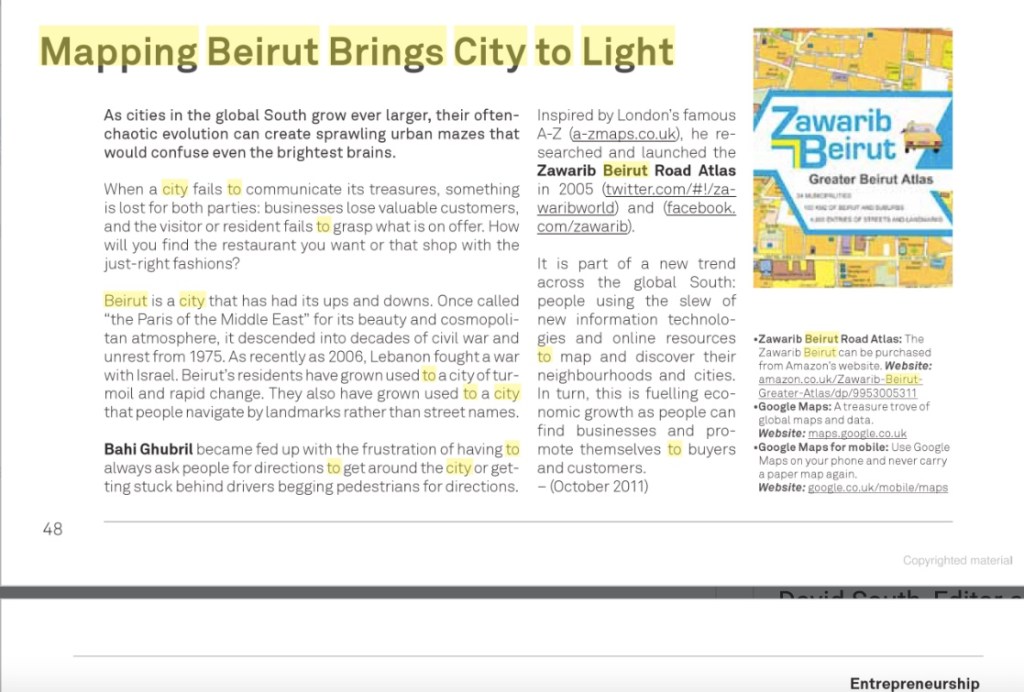
    As cities in the global South grow ever larger, their often-chaotic evolution can create sprawling urban mazes that would confuse even the brightest brains.

    Streets can be unnamed, unnumbered, twisty, full of dead ends and alleys. Informal settlements can pop up within weeks, whole neighbourhoods are razed to the ground and replaced by gleaming office buildings and apartments within months. Some countries experience political instability and conflict, disrupting daily life and making planning difficult. All this chaos makes business and travel more inefficient, especially to visiting businesspeople looking to trade or tourists simply wanting to look around.

    When a city fails to communicate its treasures, something is lost for both parties: the city’s businesses lose valuable custom and the visitor or resident fails to grasp what is on offer. How will you find the restaurant you want, or that shop with the just-right fashions?

    Beirut is a city that has had its ups and downs. Once called “the Paris of the Middle East” for its beauty and cosmopolitan atmosphere, it descended into decades of civil war and unrest from 1975, most recently in 2006 it had a war with Israel. Its residents have grown used to a city of turmoil and rapid change. They also have grown used to a city that people navigate by landmarks rather than street names.

    Bahi Ghubril grew fed up with the frustration of having to always ask people for directions to get around the city, or getting stuck behind drivers begging pedestrians for directions.

    Inspired by London’s famous A-Z (http://www.a-zmaps.co.uk), he researched and launched the Zawarib Beirut Road Atlas in 2005 (http://twitter.com/#!/zawaribworld) and (http://www.facebook.com/zawarib).

    It is part of a new trend across the global South: people using the slew of new information technologies and online resources to map and discover their neighbourhoods and cities. In turn, this is fuelling economic growth as people can find businesses and promote themselves to buyers and customers.

    It took Ghubril two years to put together the first guide, gathering street images from satellite photos and then combining them with information collected on foot and from local mayors and cartographers.

    “The project was born from a need to organise the city,” he told Monocle magazine, “but also as a socio-political project to open up the city to its residents and visitors.”

    As an entrepreneur, Ghubril had no previous experience in publishing. He has been an actor and worked in finance.

    During the research for the guide, Ghubril developed a rich knowledge of the city’s structure, its bureaucracy and how people really live their lives. His willingness to do this hard work is paying off.

    Zawarib Beirut – which translates as Beirut Alleys – has successfully expanded into editions covering nearby cities, a pocket version, eight versions colourfully decorated by local artists, and the first Beirut bus map.

    The service has a database including thousands of street names, landmarks, sectors and districts within the 34 municipal regions making up Greater Beirut. It includes useful phone numbers, car parks and a bus map. During holidays, like the Muslim holy month of Ramadan, it publishes a map of all of Beirut’s mosques.

    Ghubril promotes the guide directly to the city’s residents. Wearing blue and black t-shirts asking “Lost? ask me,” young women help to distribute the guide on the streets of Beirut.

    Other mapping projects depend on the mobile phones that are more and more part of daily life in the South’s slums – even for the poorest people. With the spread of mobile phones, it is becoming possible to develop a digital picture of a slum area and map its needs and population. It has become possible to undertake digital mapping initiatives to truly find out who is where and what is actually going on.

    An NGO called Map Kibera (http://www.mapkibera.org) is working on an ambitious project to digitally map Africa’s largest slum, Kibera in Nairobi, Kenya.

    The Map Kibera project uses an open-source software programme, OpenStreetMap (http://www.openstreetmap.org), to allow users to edit and add information as it is gathered. This information is then free to use by anybody wanting to grasp what is actually happening in Kibera: residents, NGOs, private companies and government officials.

    It will literally put Kibera on Kenya’s map.

    In Brazil, an NGO called Rede Jovem (http://www.redejovem.org.br) is deploying youths armed with GPS (global positioning system)-equipped (http://en.wikipedia.org/wiki/Global_Positioning_System) mobile phones to map the favelas of Rio de Janerio.

    The mappers physically travel around the favela and upload information on each individual landmark (restaurants, roads etc.) as they go. They use Nokia N95s mobile phones that are connected to Google Maps (http://www.maps.google.com). The project then uses Wikimapa (http://www.wikimapa.org.br), and Twitter (http://www.twitter.com) to log the information.

    Published: October 2011

    Resources

    1) Zawarib Beirut Road Atlas: The Zawarib Beirut can be purchased from Amazon’s website. Website: http://www.amazon.co.uk/Zawarib-Beirut-Greater-Atlas/dp/9953005311

    2) Google Maps: A treasure trove of global maps and data. Website: http://maps.google.co.uk/

    3) Google Street View: A global database of photographs showing neighbourhoods and streets. Website: http://maps.google.com/intl/en/help/maps/streetview/#utm_campaign=en&utm_medium=van&utm_source=en-van-na-us-gns-svn

    4) Google Maps for mobile: Use Google Maps on your phone, and never carry a paper map again. Website: http://www.google.co.uk/mobile/maps/

    https://davidsouthconsulting.org/2022/02/17/digital-mapping-to-put-slums-on-the-map/

    https://davidsouthconsulting.org/2022/10/25/indian-city-slum-areas-become-newly-desirable-places-to-live/

    https://davidsouthconsulting.org/2022/10/17/mapping-to-protect-kenyas-environment-the-emazingira-solution/

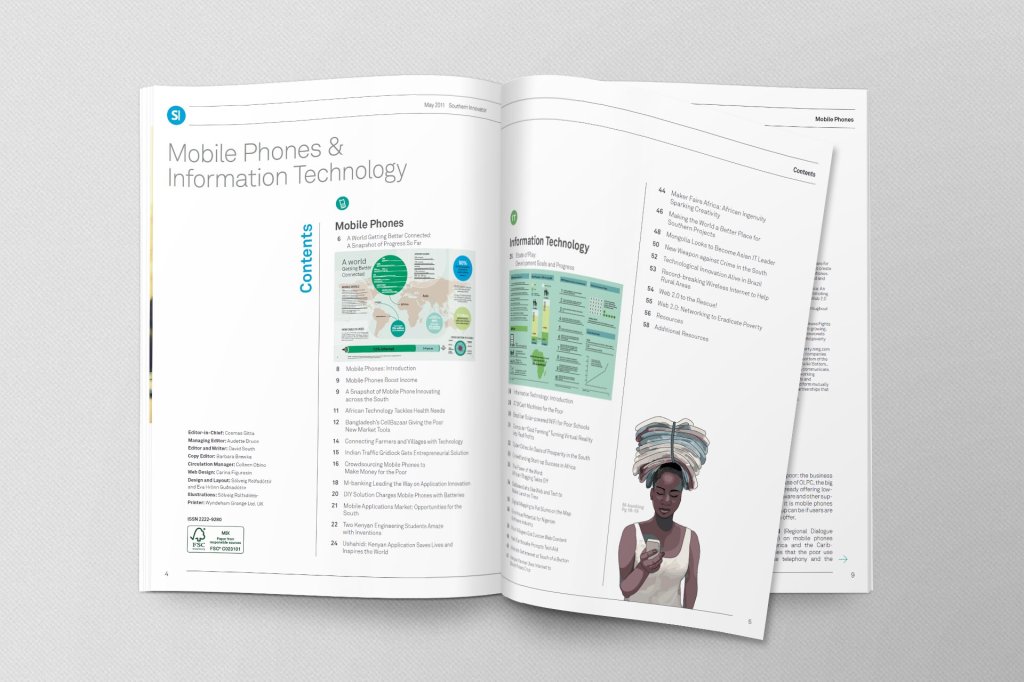
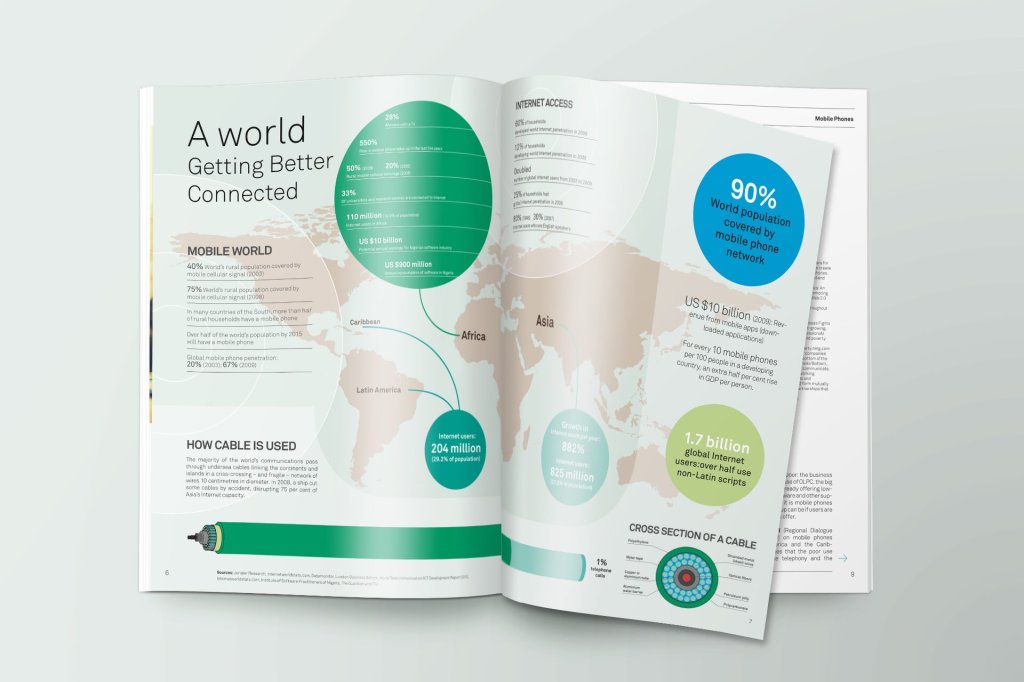
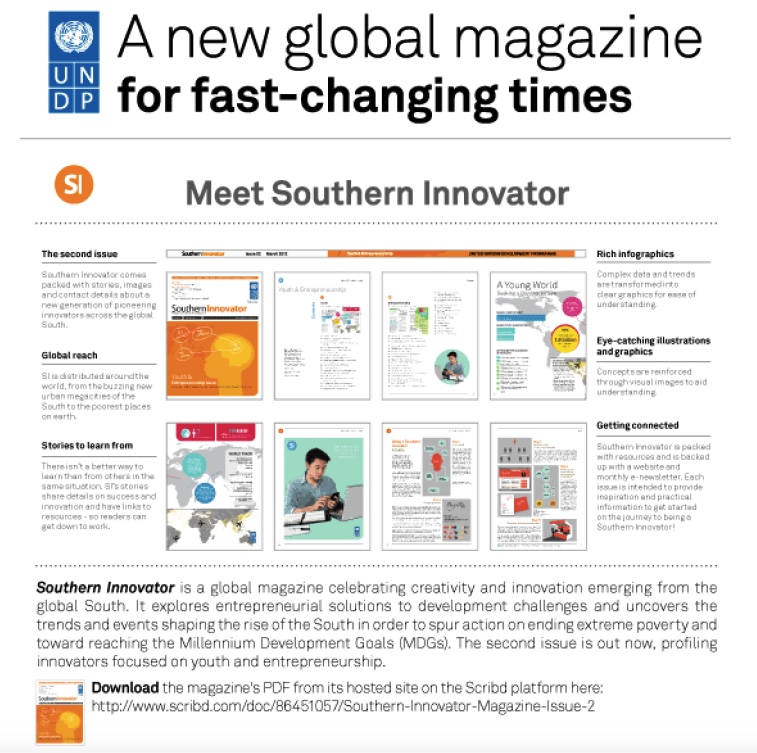
    Development Challenges, South-South Solutions was launched as an e-newsletter in 2006 by UNDP’s South-South Cooperation Unit (now the United Nations Office for South-South Cooperation) based in New York, USA. It led on profiling the rise of the global South as an economic powerhouse and was one of the first regular publications to champion the global South’s innovators, entrepreneurs, and pioneers. It tracked the key trends that are now so profoundly reshaping how development is seen and done. This includes the rapid take-up of mobile phones and information technology in the global South (as profiled in the first issue of magazine Southern Innovator), the move to becoming a majority urban world, a growing global innovator culture, and the plethora of solutions being developed in the global South to tackle its problems and improve living conditions and boost human development. The success of the e-newsletter led to the launch of the magazine Southern Innovator. 

    https://davidsouthconsulting.org/2021/03/05/southern-innovator-issue-1/

    Creative Commons License

    This work is licensed under a
    Creative Commons Attribution-Noncommercial-No Derivative Works 3.0 License.

    ORCID iD: https://orcid.org/0000-0001-5311-1052.

    © David South Consulting 2022

  • Bamboo Becomes Transport Option for the South

    Bamboo Becomes Transport Option for the South

    By David SouthDevelopment Challenges, South-South Solutions

    SOUTH-SOUTH CASE STUDY

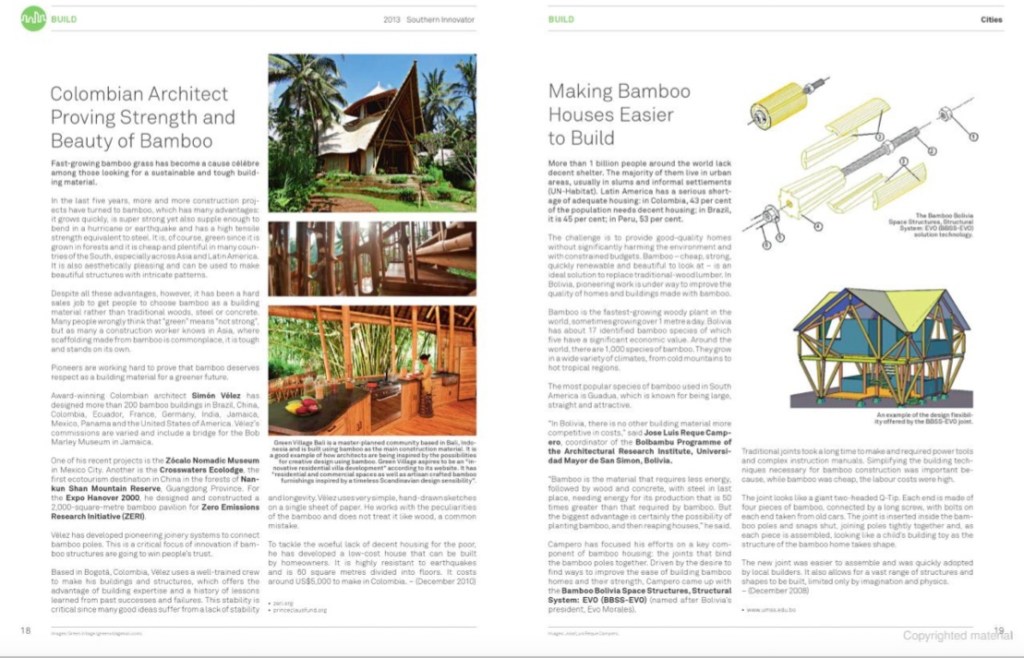
    The sturdy bamboo plant (http://en.wikipedia.org/wiki/Bamboo) is enjoying a revival around the world as a building material. A strong, fast-growing and highly renewable woody plant, it is becoming increasingly popular as people seek out less environmentally wasteful alternatives to steel and other materials.

    But who would have thought bamboo taxis would turn up on the scene?

    A fleet of bamboo taxis is now plying the streets in Tabontabon, a municipality in The Philippines that is home to 10,000 people, most of them rice farmers.

    Bamboo can sometimes grow more than 1 metre a day. While in Asia, it has long been a traditional construction material, people are now turning to it to make transportation vehicles. In The Philippines, there are 62 species of bamboo, up to 15 of which are suitable for industrial applications.

    So-called habal-habal motorcycles, the most popular form of transportation in the town, are also the source of many accidents and are uncomfortable on sunny days or when it rains. A covered taxi service is both a safer and a more comfortable alternative.

    The town’s mayor, Rustico Balderian, took the initiative to build a fleet of bamboo taxis. He set four criteria the new taxis had to meet: they should be low-cost, fuel efficient, safe and environmentally friendly. The bamboo has a higher tensile strength (http://en.wikipedia.org/wiki/Tensile_strength) than steel, which also requires vast quantities of energy to produce.

    The taxis are 90 percent made of bamboo and are built by unemployed youth. They are divided into Eco 1 (a model that seats 20 people and runs for eight hours on one gallon of coco-biodiesel from coconuts) (http://cocobiodiesel.blogspot.com/), and Eco 2, which seats eight people, has a stereo and sound system, and also runs for eight hours on a gallon of coco-biodiesel.

    Both are made by the Tabontabon Organic Transport Industry [TOTI] (http://totieco.multiply.com/).

    Making vehicles out of bamboo is a serious endeavour that also has been under development in Japan. In 2008, Kyoto University’s Venture Business Laboratory (VBL) unveiled a unique single-seat electric vehicle equipped with a body made from bamboo. The vehicle was developed under the Kyoto Electric Car Development Project, which is one of the laboratory’s major initiatives. Nicknamed Bamgoo, this eco-car’s body is made of braided rods of bamboo, one of the local specialty products of the area.

    Other bamboo modes of transport in the South include bamboo bicycles in Ghana. A partnership between an American bike designer and a Ghanaian government initiative is taking advantage of this local resource to manufacture bicycles for the local market – and as a source of export income.

    Not only are the Ghanaian builders harvesting bamboo to make bikes for the domestic market, they are also offering a sophisticated online shopping service for the overseas market. People from around the world can now buy Ghanaian bikes using a website (http://www.bamboosero.com). Customers can choose frame builders by their specialty – cargo bike, mountain bike or road bike – and then order it online. The completed bikes are quality checked and then distributed by Calfee Design in California, USA. This approach keeps the middlemen out of the transaction, and means more money gets back to the bike builder.

    Meanwhile in Cambodia, the legendary bamboo railway is a people’s solution to the poor service offered by the established railway system. In the northwest of the country near the second city of Battambang, an entire railway system has been built using bamboo.

    The bamboo trains, called ‘noris’ or ‘lorries’ by the locals, are driven by a electric generator engine. Passengers sit on a bamboo platform placed on two sets of wheels. The bamboo train reaches speeds of over 40 km/h.

    “We’re very careful,” 18-year-old Sok Kimhor, a 10-year veteran of the bamboo trains, told the BBC. “We look out for children and animals running across the lines, and we have to slow down when other trains come along.”

    There is just one track, so when two trains meet, one has to be taken off the track to pass.

    The regular rail service runs only once a week to the capital, Phnom Penh. This makes the bamboo train the only alternative for many people to get around. While the main railway station is deserted, the bamboo service is a hive of activity.

    “They’re very safe – a motorbike taxi is too fast, and if I use one of those I sometimes get dizzy and fall off,” said Sao Nao as she sat on the rails with a small group of people. “On a bamboo train I can sit down and go to sleep. You can’t do that on a motorbike.”

    Design for Development (http://designfordevelopment.org/) is also turning to bamboo for a transport solution. The Canadian NGO is working in Kenya on making five emergency medical transportation devices (EMTD), or ambulances, to move local people to health clinics or hospitals. Bamboo is locally available and they hope to set up a workshop and make the ambulances using local labour.

    Published: August 2009

    Resources

    1) A slideshow of the bamboo taxis. Website:http://totieco.multiply.com/photos/album/2/ECO2

    2) UNEP, the UN’s Environment Programme, has produced a report on bamboo biodiversity and how it can be preserved. Website: http://www.unep-wcmc.org

    3) The Asian Development Bank is using its Markets for Poor programme to link bamboo products to marketplaces, helping poor communities. Website:http://www.markets4poor.org/

    4) A blog describing the use of coco-biodiesel in the Philippines. Website: http://cocobiodiesel.blogspot.com/

    Development Challenges, South-South Solutions was launched as an e-newsletter in 2006 by UNDP’s South-South Cooperation Unit (now the United Nations Office for South-South Cooperation) based in New York, USA. It led on profiling the rise of the global South as an economic powerhouse and was one of the first regular publications to champion the global South’s innovators, entrepreneurs, and pioneers. It tracked the key trends that are now so profoundly reshaping how development is seen and done. This includes the rapid take-up of mobile phones and information technology in the global South (as profiled in the first issue of magazine Southern Innovator), the move to becoming a majority urban world, a growing global innovator culture, and the plethora of solutions being developed in the global South to tackle its problems and improve living conditions and boost human development. The success of the e-newsletter led to the launch of the magazine Southern Innovator. 
    Creative Commons License

    This work is licensed under a
    Creative Commons Attribution-Noncommercial-No Derivative Works 3.0 License.

    ORCID iD: https://orcid.org/0000-0001-5311-1052.

    © David South Consulting 2023

  • 2011 Trends for the South

    2011 Trends for the South

    By David SouthDevelopment Challenges, South-South Solutions

    SOUTH-SOUTH CASE STUDY

    The world has been through a dramatic and fascinating period since the global economic crisis erupted in 2008. While the wealthy, developed nations of the North have been pitched into one crisis after another, the countries of the global South (many of whom are well accustomed to crises) have been part of a powerful new economic phenomenon: the rapid growth of South-South trade, investment and exchange. Its effects include stronger ties between Asia and South America and between China and Africa.

    South-South trade is the great economic success story of the past decade. World Trade Organization (WTO) (www.wto.org) figures show South-South trade grew to 16.4 percent of the US $14 trillion in total world exports in 2007, from 11.5 percent in 2000. While the global economic crisis has slowed trade down, the overall trend for South-South trade and connections seems firmly established.

    South-South trade made up 20 percent of global exports by 2010, and foreign direct investment to developing economies rose by 10 percent in 2010 due to a rapid economic recovery and increasing South-South flows.

    Trade between China and Africa has surged during the decade since China joined the WTO in 2001, from around US $10 billion in 2000 to US $73.3 billion in 2007, a year-on-year increase of 32.2 percent. By 2008, it had soared by 44.1 percent to reach a record high of US $106.84 billion, according to Zhang Yongpeng of the Institute for West Asian and African Studies (IWAAS).

    The surge is remarkable and recent. For example, according to accountants KPMG, between 2001 and 2009 China invested just US $215 million in Brazil. But in 2010, China invested US $20 billion in energy and chemical companies in Argentina and Brazil. And Luis Alberto Moreno, president of the Inter-American Development Bank, told the Financial Times that “seven percent of Colombian gasoline has been replaced by domestic ethanol, produced with green Indian technology – while Indian companies, including Infosys and Tata, now have 17,000 employees in Latin America and the Caribbean.”

    This jump in investment has also had its downside: coming fast and furious as investment cash chases better investment profits in the global South, it has pushed up inflation and commodity prices and spawned property speculation bubbles. This, as can be seen across North Africa and the Middle East, can lead to political and social instability.

    A review of the big trends bubbling under the surface in 2011 shows how important South-South exchange will be in alleviating poverty and improving lives in the run-up to the 2015 Millennium Development Goals (http://www.un.org/millenniumgoals/). It also shows up the dangers inherent in this new environment – rising inflation without economic growth can crush the poor. A focus on innovation and new thinking will be necessary to get through this year and beyond.

    Some of the top trends that will have a big impact in 2011 are:

    – Inflation: In 2011 it looks like we will hear a lot about inflation. As the global economy tries to stabilize and return to growth, there will be inflation surges for a wide variety of reasons. People will need strategies and new techniques to make sure they can afford the necessities of life. This will be critical if development gains from the past decade are not to be lost.

    – Super cycle: Some are putting forward the theory we are entering a ‘super cycle’ (http://www.bloomberg.com/news/2011-01-23/super-cycle-leaves-no-economy-behind-as-davos-shifts-to-growth-from-crisis.html) created by better connectivity, global travel and mobility and the ease of moving around investment to create businesses and jobs. The super cycle theory claims that this will spark the greatest period of human development in history – raising all national economies – as more and more people benefit from rising living standards and opportunities.

    – Switch to South-South trade: With the trend of increasing South-South trade now firmly established, there is a greater awareness now of the power of sharing ideas across the South. One example of this idea-sharing is the annual Global South-South Development Expo (http://www.southsouthexpo.org/) run by UNDP’s Special Unit for South-South Cooperation Unit (http://ssc.undp.org/).

    – New technologies: The spread of new technologies around the world will continue and bring many changes. Africa is seeing increasing access to high-speed Internet as new undersea cables are laid around the continent. Mobile phones will continue to be a critical tool for many to stay in touch and boost incomes.

    – MDGs on horizon in 2015: The Millennium Development Goals (MDGs) target of 2015 is just four years away. This will face the headwinds of the global economic crisis and urgent attention will be needed to make sure gains are not lost as 2015 approaches. The role played by South-South trade will be a critical partner in aiding goal achievements.

    – Cities: A surge to the urban was pronounced by 2007 and we are now living in a majority urban world. Innovation and sharing experiences and knowledge will play a key role in ensuring this is not a disaster. A recent book, Arrival City by Canadian journalist Doug Saunders, detailed this urban surge occurring across the global South, the largest movement of people to cities and urban and semi-urban areas in human history. It follows the pattern that was seen in Europe in the 19th century, as economies change and people seek the new opportunities promised by cities, or find rural economies unsustainable.

    – The China model of development: The big talking point will be China’s economic model for eradicating poverty on a mass scale. A new book by Dambisa Moyo, How the West Was Lost: Fifty Years of Economic Folly – And the Stark Choices Ahead, investigates the mistakes made in developed, Western nations and what can be learned from the experiences in the global South.

    – Food crisis: At the beginning of February, the Food and Agricultural Organization (FAO) issued a warning about the risk of a new global food crisis after its food price index reached a record high in January 2011. The FAO also issued an alert about severe drought in China, the world’s largest wheat producer. Flooding in Brazil and Australia have also devastated crops, much of which are exported to countries across the South. There is also risk to crops from flooding in southern Africa. Wheat, corn and soybean prices are rising, and prices reached a peak just as they did in 2008 (FAO).

    Even developed countries normally used to food surpluses are at risk. In the US, corn reserves are at a 15 year low (US Department of Agriculture), and the price of corn has doubled in past six months.

    A billion people go to bed hungry every night; someone starves to death every 3.6 seconds – 75 percent are children under five, according to the World Food Programme (http://www.wfp.org/1billion).

    Published: 2011

    Resources
    1) Global Information and Early Warning System on Food and Agriculture: A data mix tracking global food prices and situation reports. Website: http://www.fao.org/worldfoodsituation/wfs-home/en/
    2) World Bank Food Crisis blog: Website: http://www.worldbank.org/foodcrisis/
    3) Trade Law Centre for Southern Africa: “Building capacity to help Africa trade better”: tralac’s mission is to build trade law capacity in southern Africa so that these countries can participate effectively in the global economy; to negotiate trade agreements that will support their development objectives, and so that they can implement the agreements to ensure that they realise the potential benefits of international trade. Website: http://www.tralac.org/cgi-bin/giga.cgi?cmd=cause_dir_cause&cause_id=1694
    4) Future Forum world videos: Compelling animated videos exploring the hard choices of an urbanizing world and the need to promote sustainable development and environmental harmony. Website: http://www.youtube.com/user/forumforthefuture96

    Development Challenges, South-South Solutions was launched as an e-newsletter in 2006 by UNDP’s South-South Cooperation Unit (now the United Nations Office for South-South Cooperation) based in New York, USA. It led on profiling the rise of the global South as an economic powerhouse and was one of the first regular publications to champion the global South’s innovators, entrepreneurs, and pioneers. It tracked the key trends that are now so profoundly reshaping how development is seen and done. This includes the rapid take-up of mobile phones and information technology in the global South (as profiled in the first issue of magazine Southern Innovator), the move to becoming a majority urban world, a growing global innovator culture, and the plethora of solutions being developed in the global South to tackle its problems and improve living conditions and boost human development. The success of the e-newsletter led to the launch of the magazine Southern Innovator. 
    Creative Commons License

    This work is licensed under a
    Creative Commons Attribution-Noncommercial-No Derivative Works 3.0 License.

    ORCID iD: https://orcid.org/0000-0001-5311-1052.

    © David South Consulting 2022

  • Social Networking Websites: A Way Out of Poverty

    Social Networking Websites: A Way Out of Poverty

    By David SouthDevelopment Challenges, South-South Solutions

    SOUTH-SOUTH CASE STUDY

    Social networking websites also known as, Web 2.0 – the name given to the new wave of internet businesses and websites such as YouTube and MySpace that are transforming the way people interact with the Web – has been dubbed the social web for its power to bring people together. The label has been derided as a marketing gimmick by some, but many argue there are a number of characteristics to Web 2.0 that make it something different and a valuable tool for entrepreneurs seeking ways out of poverty.

    The new Web 2.0 applications offer many free software tools stored online, from accounting and business related tools, to new multimedia ways to communicate for free. Unlike Web 1.0 sites, which offered information to passive users, Web 2.0 sites allow interaction and comment. These qualities have meant Web 2.0 can be used to build communities and social and business networks. By being able to store vast quantities of information online, it becomes faster to work and reduces the painful delays brought on by slow connections.

    All these new tools are making it easier and easier for entrepreneurs to work from home, in internet centres, or anywhere there is a wireless connection, and is slashing the costs of managing a business. All the applications are online so there is no need to be hidebound by one operating system or hardware capability. The number of internet centres has increased significantly all over Asia and Africa, bringing the power of Web 2.0 to millions more people.

    Linking mobile phones and the internet is also remarkable. It is becoming more and more possible in Africa to send messages to weblogs via text messaging, to post photos and videos, or to stay connected with a community, advocacy or business group via messaging to its website.

    “Web 2.0 is a pre-occupation of ours that can be beneficial in fighting poverty,” said Tobias Eigan, founder and co-executive director of Kabissa.org, a web portal dedicated to promoting Web 2.0 in Africa. “It is really relevant for Africa. It makes the internet a read and write function, it is more user-friendly – that dynamic is going to make a big difference. It is so much easier to upload content with Web 2.0. It will build the capacity of local institutions and society and that will improve the lives of people – it will be much easier to fight poverty with this connectivity.”

    Two other champions of the Web 2.0 way out of poverty are Waleed al-Shobakky, science and technology reporter for alJazeera.net, and Jack Imsdahl, a consultant and technology commentator. While they admit subsistence farmers and the illiterate will not directly benefit, those who are students or are working in proximity to computers will definitely benefit. They point out how rapidly mobile phones have been taken up by the poor and that this is being driven by the new services they offer.

    There are still profound obstacles to more rapid take-up, however. Internet connection speeds will have to get better and more will need to be invested in this area. Web 2.0 tools will also need to be adapted to local languages if they hope to get past those who speak major web languages like English.

    Entrepreneurs in the global South can now easily sign up to a vast array of e-newsletters that are sent to email accounts and keep on top of trends and innovations in their field. The relative anonymity of these email lists mean subscribers are less likely to be judged on their physical circumstances.

    Published: March 2007

    Resources

    Afriville is a Web 2.0 service and an African Caribbean social network started by two Nigerian web entrepreneurs in their twenties, Folabi Ogunkoya and Lawrence Bassey-Oden.

    Afriville is a community website along the lines of the famous MySpace. Users are free to message and post profiles. The difference is that the user is able to choose how closed or open the networks are. The site features a state of the art music management system which allows African and Caribbean artists to get straight in touch with their fans.

    “We have created a solid app(lication) with features that will give the big players a run for their money,” said Ogunkoya.

    African entrepreneurs have already stepped in with other Web 2.0 offerings. These include: Mooziko.com (an African YouTube), Afribian.com (news sharing), Afriqueka.com (social networking), Yesnomayb (online dating).

    Both Yahoo! And Google offer extensive free online tools for entrepreneurs and businesses that integrate seamlessly with their email services.

    Kabissa: Space for Change in Africa: An online African web community promoting and supporting the transition to Web 2.0 services in Africa. Offers lots of opportunities to meet people throughout Africa and learn more.

    Alexa: Here can be found a detailed break down by country in Africa of web use and site popularity and trends.

    Digital Divide Network: A website linking together initiatives and offering opportunities to debate current issues and problems.

    Global Voices: An initiative from the Reuters news agency to aggregate the global conversation online from countries outside the US and Western Europe.

    Free Web 2.0 tools for entrepreneurs:

    Wikis: Here is a detailed article on wikis – collaborative websites that allow authorised users to rapidly and easily change the content of pages – and a detailed list of free or low-cost wiki services.

    >> Blogging (an online diary):

    Blogger.com – A free, easy-to-use, online service owned by Google.

    BlogPlanet.net – Blog from your mobile phone, free.

    Blogsome.com – An easy-to-use, free service with good support for photos.

    Movable Type – An open-source, free, easy to use, online publishing system popular with bloggers.

    WordPress – Another easy, free, and popular online publishing system popular with bloggers.

    >> Aggregators (these are programmes that gather links and resources off the web):

    AmphetaDesk – One of the first news aggregators to really catch on, it’s still popular.

    Bloglines – Allows bloggers and webmasters to search, subscribe to, publish, and share RSS news feeds online.

    Del.icio.us – Aggregate content from your favorite Web sites and share them with others.

    Feed Demon – The news you want delivered to your desktop.

    Technorati – A real-time search engine that keeps track of what is happening in the world of blogs.

    Techsoup.org is an excellent resource for all the latest developments in Web 2.0 and how to access free or low-cost resources. Being based in the US, it gets the inside scoop on cutting edge developments in Silicon Valley.

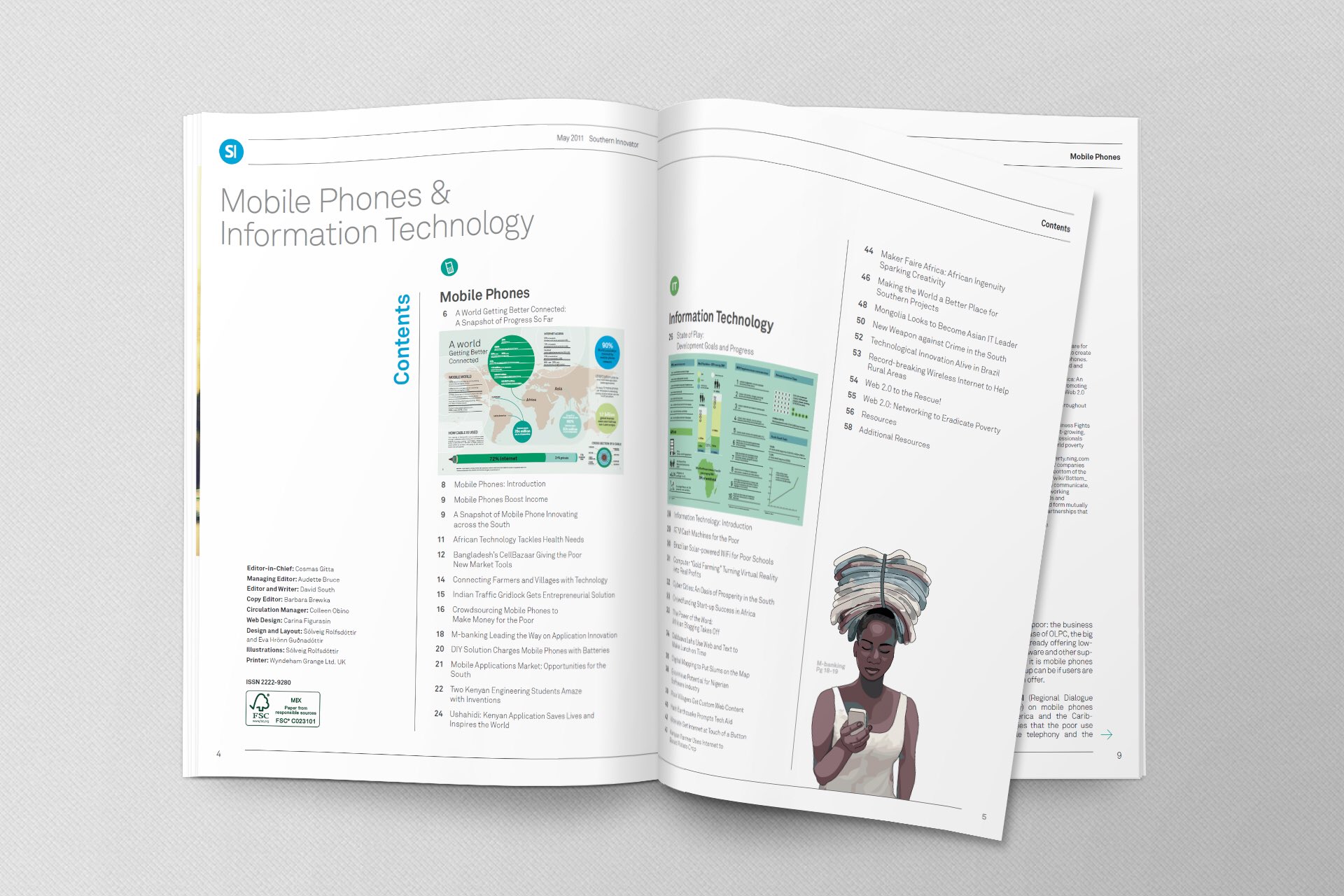
    Development Challenges, South-South Solutions was launched as an e-newsletter in 2006 by UNDP’s South-South Cooperation Unit (now the United Nations Office for South-South Cooperation) based in New York, USA. It led on profiling the rise of the global South as an economic powerhouse and was one of the first regular publications to champion the global South’s innovators, entrepreneurs, and pioneers. It tracked the key trends that are now so profoundly reshaping how development is seen and done. This includes the rapid take-up of mobile phones and information technology in the global South (as profiled in the first issue of magazine Southern Innovator), the move to becoming a majority urban world, a growing global innovator culture, and the plethora of solutions being developed in the global South to tackle its problems and improve living conditions and boost human development. The success of the e-newsletter led to the launch of the magazine Southern Innovator. 
    Creative Commons License

    This work is licensed under a
    Creative Commons Attribution-Noncommercial-No Derivative Works 3.0 License.

    ORCID iD: https://orcid.org/0000-0001-5311-1052.

    © David South Consulting 2023