Tag: Global South

  • Indonesia Best for Entrepreneurs

    Indonesia Best for Entrepreneurs

    By David SouthDevelopment Challenges, South-South Solutions

    SOUTH-SOUTH CASE STUDY

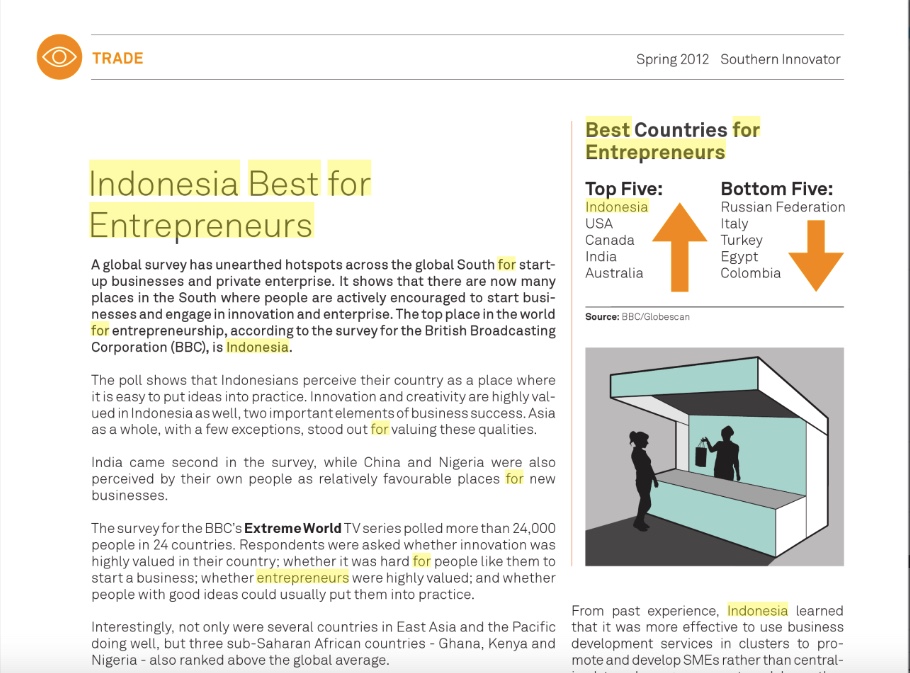
    A global survey has unearthed hotspots across the global South for start-up businesses and private enterprise. It shows there are now many places in the South where people are actively encouraged to start businesses and engage in innovation and enterprise. The top place in the world for entrepreneurship, according to the survey for the British Broadcasting Corporation (BBC), is Indonesia.

    The poll shows that Indonesians perceive their country as a place where it is easy to put ideas into practice. Innovation and creativity are highly valued in Indonesia as well, two important elements of business success. Asia as a whole, with a few exceptions, stood out for valuing these qualities.

    India came second in the survey, while China and Nigeria were also perceived by their own people as relatively favourable places for new businesses.

    The survey for the BBC’s Extreme World TV series polled more than 24,000 people across 24 countries (http://www.globescan.com/news_archives/bbc2011_entrepreneur/backgrounder.html). Respondents were asked whether innovation was highly valued in their country; whether it was hard for people like them to start a business; whether entrepreneurs were highly valued; and whether people with good ideas could usually put them into practice.

    Interestingly, not only were several countries in East Asia and the Pacific doing well, but three sub-Saharan African countries – Nigeria, Kenya and Ghana – ranked above the global average.

    The survey found work still needed to be done in Latin America. While Mexico and Peru scored highly, Brazil and Colombia ranked below average.

    So, what are the things that make Indonesia so positive for entrepreneurs and private business? And what do they do – or not do – for small business start-ups?

    According to Bali International Consulting Group, the Indonesian economy is highly dependent on small and medium-sized enterprises: they make up 99.95 percent of the total number of enterprises, and provide most of the country’s jobs. Authorities have identified a problem with the sector, however: productivity per worker is very low compared to large enterprises. Poor productivity matters because it means people are working very hard for low return and this affects the overall standard of living in the country and its human development.

    The Indonesian government has set about boosting productivity in the sector, adopting a ‘clustering’ approach in partnership with non-governmental organizations (NGOs). Like-minded businesses tend to cluster together across the archipelago of islands that makes up the nation. By targeting these places with resources and support, it can use those resources more efficiently. The country has a dedicated ministry for small and medium enterprises (http://www.depkop.go.id) and a wide range of businesses and services targeting them. From dedicated trading and office facilities (http://www.smescoindonesia.com) to an online marketplace to display, trade and sell SME products (http://www.smescotrade.com), extensive resources are applied to give SMEs a boost and a competitive edge in the global marketplace.

    From past experience, Indonesia learned it was more effective to use business development services in clusters to promote and develop SMEs, rather than centralised, top-down government models or other approaches.

    As Bali International Consulting Group notes, “The government has introduced many models for promoting SMEs, including business incubators, business consulting clinics and technology centers. However, those sponsoring programs have not been productive and could not sustain themselves for a long time. The government then turned to supporting BDS (Business Development Services) providers to serve a certain cluster in a selected area.”

    Developed countries like the United States significantly grew their wealth by allowing entrepreneurs and small and medium-sized enterprises to flourish. The USA’s highly innovative and globe-straddling high tech and information technology businesses would not have been so successful without entrepreneurs. Think of Bill Gates, one of the founders of Microsoft, or Steve Jobs, one of the pioneers behind the Apple computer brand.

    China – the country that has seen the largest lifting of people out of poverty in our time – is awash with entrepreneurs. So successful at providing manufacturing services to foreign companies, China is fast on track to become the wealthiest country in the world. The International Monetary Fund recently issued a report predicting China would be number one within five years.

    Entrepreneurs play a key role in any country’s economic strategy. The more they are encouraged to flourish – and build wealth and their businesses – the better a country can do. Large human development gains can come about when entrepreneurs are matched with a fair and transparent tax system, balancing between social and economic needs.

    China is the source of one of the most successful aids to small business growth in the global South. Hong Kong-based Alibaba (http://www.alibaba.com) is an online trading and selling marketplace aimed at small businesses and start-ups. Packed with support, advice and inspiration, it makes it possible for people anywhere in the world to get trading and selling.

    To help small businesses trade with each other, New Delhi, India-based Go4World Business.com (http://indonesia.go4worldbusiness.com) has for the past 12 years helped exporters and importers to explore new markets and increase their international business in a simple, cost effective manner.

    The Internet has not only radically transformed how to trade and sell, it has also opened up many ways for small and medium-sized businesses to raise funds and borrow money. Examples include Zopa (www.zopa.com) – “Where people meet to lend and borrow money”; social lenders like Kiva (www.kiva.org)w, whose mission is to connect people, through lending, for the sake of alleviating poverty; and Betterplace (www.betterplace.org), an online marketplace for projects to raise funds. It is free to use, and it passes on 100 percent of the money raised on the platform to the projects. For those with a creative business idea, Kickstarter (http://www.kickstarter.com) is a funding platform for artists, designers, filmmakers, musicians, journalists, inventors, and explorers.

    Published: June 2011

    Resources

    1) Small business guide: An online resource packed with advice and resources on starting a small business. Website: http://www.smallbusiness.co.uk/

    2) The red dot logo stands for belonging to the best in design and business. The red dot is an internationally recognized quality label for excellent design that is aimed at all those who would like to improve their business activities with the help of design. Website: http://www.red-dot.de

    3) Dutch Designers in Development: The Dutch NGO works with producers to develop skills and adapt producers’ products to present and future demands in Europe. By following this approach, Southern producers can reduce the risk of making products nobody wants, or that lack originality in the marketplace and thus won’t sell. Website: http://www.ddid.nl/english/index.html

    4) SME toolkits abound: Here are two from Africa: SME Toolkit Kenya Website: http://kenya.smetoolkit.org/kenya/en and SME Toolkit South Africa: Website: http://southafrica.smetoolkit.org/sa/en

    5) African Alliance for Capital Expansion: A management consultancy focused on private sector development and agribusiness in West Africa. Website: http://www.africanace.com/v3

    6) World Business Fair: The World Business Fair is an international trade platform for global entrepreneurs and professionals. Website: http://www.worldbusinessfair.com

    7) Small businesses looking to develop their brand can find plenty of free advice and resources here. Website: www.brandingstrategyinsider.com

    8) Brandchannel: The world’s only online exchange about branding, packed with resources, debates and contacts to help businesses intelligently build their brand. Website: www.brandchannel.com

    9) ZanaAfrica (ZanaA) is a non-profit whose mission is to craft tools from within Africa to slay the giants of poverty. The tools are in the nexus of health, education, and environment with a particular focus on gender and technology. These tools address root causes of poverty, and are primarily market-based solutions with a national and replicable scope to provide leveraged, lasting solutions with significant multiplier effects. Website: http://www.zanaa.org/

    10) Small Business in Indonesia by Peter Van Diermen. Explores how critical families are to business success in Indonesia. Website: http://books.google.com/books/about/Small_business_in_Indonesia.html?id=WSu1AAAAIAAJ

    11) SME Toolkit Indonesia: The SME Toolkit Indonesia offers a wide range of how-to articles, business forms, free business software, online training, self-assessment exercises, quizzes, and resources to help entrepreneurs, business owners, and managers in emerging markets and developing countries start, finance, formalize, and grow their businesses. Website: http://indonesia.smetoolkit.org/indonesia/en

    12) The 3rd Indonesia International Conference on Innovation, Entrepreneurship, and Small Business 2011: From July 25 to 28, is aimed at challenging researchers, Indonesians in particular, to study and create local knowledge on Innovation, Entrepreneurship, and Small Business. Website: http://www.ciel-sbm-itb.com/iicies2011

    Development Challenges, South-South Solutions was launched as an e-newsletter in 2006 by UNDP’s South-South Cooperation Unit (now the United Nations Office for South-South Cooperation) based in New York, USA. It led on profiling the rise of the global South as an economic powerhouse and was one of the first regular publications to champion the global South’s innovators, entrepreneurs, and pioneers. It tracked the key trends that are now so profoundly reshaping how development is seen and done. This includes the rapid take-up of mobile phones and information technology in the global South (as profiled in the first issue of magazine Southern Innovator), the move to becoming a majority urban world, a growing global innovator culture, and the plethora of solutions being developed in the global South to tackle its problems and improve living conditions and boost human development. The success of the e-newsletter led to the launch of the magazine Southern Innovator. 
    Creative Commons License

    This work is licensed under a
    Creative Commons Attribution-Noncommercial-No Derivative Works 3.0 License.

    ORCID iD: https://orcid.org/0000-0001-5311-1052.

    © David South Consulting 2023

  • Urban Farming to Tackle Global Food Crisis

    Urban Farming to Tackle Global Food Crisis

    By David SouthDevelopment Challenges, South-South Solutions

    SOUTH-SOUTH CASE STUDY

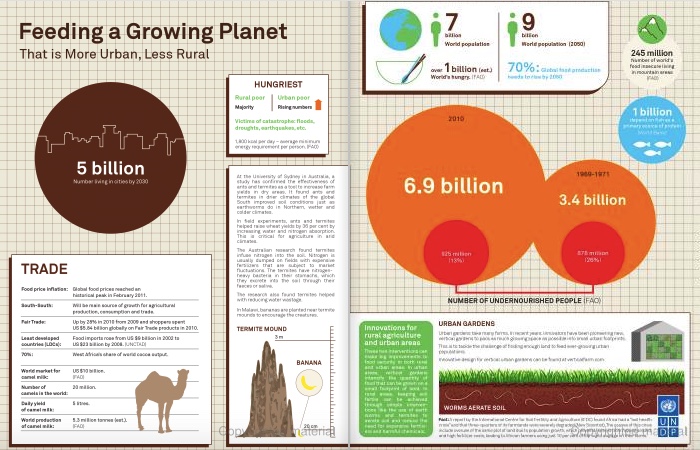
    The world’s population is becoming more urban by the day. By 2030, some five billion people around the world will live in cities. This year is the tipping point: urban dwellers (3.3 billion people) now outnumber rural residents for the first time (UNFPA’s State of the World Population 2007 Report). 

    But with rising food prices across the globe, many city-dwellers are experiencing hunger and real hardship. On international commodity markets, food prices have gone up 54 percent over the last year, with cereal prices soaring 92 percent (FAO – World Food Situation). While living in an urban environment means living cheek-by-jowl with other people, it doesn’t mean there aren’t ways to grow food and supplement urban dwellers’ tight budgets and boost diets.

    U.N. Secretary General Ban Ki-moon has called for food production to increase 50 percent by 2030 just to meet rising demand – and right now there are 862 million people undernourished (FAO). But one solution, urban farming, can make a huge difference, as the Caribbean island of Cuba has shown.

    Today, Cuba imports about 50 percent of its minimum fuel and food requirements – a cost that reached US $1.6 billion last year for food. (Reuters). The island has been buffeted by one food crisis after another in the past two decades, first by the collapse of its aid from the Soviet Union, and then by a fuel crisis. But now, urban farming in Cuba provides most of the country’s vegetables, thanks to urban gardens that have sprung up on abandoned land in the country’s cities and towns. And the food is pesticide-free: 70 percent of the vegetables and herbs on the island are organic (http://www.soilassociation.org/web/sa/saweb.nsf/Living/ whatisorganic.html).

    These urban farms mean fresh food is just a short walk away from the people who eat it. And in a world of rising fuel prices, Cuba has reduced the use of fossil fuels in the production and transportation of food.

    The urban farms have created 350,000 jobs that pay better than most government jobs. It has also improved Cuban’s health: many have moved from diets dominated by rice and beans and imported canned goods from Eastern Europe, to fresh vegetables and fruits.

    While Cubans receive at least a basic state ration of rice, beans and cooking oil, the rations do not include fresh fruit and vegetables. After the withdrawal of Soviet subsidies, the average Cuban’s daily calorie intake fell sharply. Between 1989 and 1993, daily calorie intake dropped from 3,004 to 2,323 (UN). But with the growth of urban farms, this has moved up to 3,547 calories a day – even higher than the amount recommended for Americans by the US government.

    The secret to this success has been the rise of entrepreneurs like Miladis Bouza, a 48-year-old former research biologist who had to abandon a comfortable middle class life after the collapse of the Soviet Union. Her government salary dropped to US $3 a month. Unable to make ends meet and provide food for her family, she quit her job.

    The Cuban government allowed people to turn unused urban land into mini farms. The cities have many vacant lots because the state owns most land and there isn’t competition from private developers, as in many other countries. Unusually for communist Cuba, 80 percent of the profits are kept by the farmers. This can be an average wage of US $71 per month.

    “Those salaries are higher than doctors, than lawyers,” Roberto Perez, an agronomist who runs the country’s first urban farm, told The Associated Press. “The more they produce, the more they make. That’s fundamental to get high productivity.”

    Miladis grabbed this opportunity to farm a half-acre plot near her home in Havana. Along with her husband, she grows tomatoes, sweet potatoes and spinach, and sells the vegetables at a stall on nearby busy street. This has enabled her monthly income to rise to between US $100 per month and US $250 per month, far more than the average government salary of US $19 per month.

    Cuba was inspired by greenbelt farms in Shanghai (http://en.shac.gov.cn/hjgl/jqgk/t20030805_82028.htm): but Cuba has gone even further to make urban farming a key part of the national food supply.

    All this urban farming is also all-natural farming. Farms have had to turn to natural compost as fertilizer, and natural pesticides like strong-smelling celery to ward off insects.

    So-called organoponicos (http://academicos.cualtos.udg.mx/Pecuarios/ PagWebEP/Lecturas/ORGANOPONICOS.htm ) gather together a wide variety of vegetables, fruits and herbs, as well as ornamental plants. Customers are offered mangos, plantains, basil, parsley, lettuce, garlic, celery, scallions, collard greens, black beans, watermelon, tomatoes, malanga, spinach and sweet potatoes.

    “Nobody used to eat vegetables,” said David Leon, 50, buying two pounds of Swiss chard at a Havana organoponico. “People’s nutrition has improved a lot. It’s a lot healthier. And it tastes good.”

    Published: June 2008

    Resources

    https://davidsouthconsulting.org/2020/12/14/african-farming-wisdom-now-scientifically-proven/

    https://davidsouthconsulting.org/2022/10/10/cheap-farming-kit-hopes-to-help-more-become-farmers/

    https://davidsouthconsulting.org/2023/01/16/hip-driven-pump-brings-water-to-parched-fields/

    https://davidsouthconsulting.org/2022/11/23/kenyan-farmer-uses-internet-to-boost-potato-farm/

    https://davidsouthconsulting.org/2022/10/31/new-kenyan-services-to-innovate-mobile-health-and-farming/

    https://davidsouthconsulting.org/2021/11/09/pocket-friendly-solution-to-help-farmers-go-organic/

    https://davidsouthconsulting.org/2021/09/16/small-fish-farming-opportunity-can-wipe-out-malnutrition/

    https://davidsouthconsulting.org/2022/10/18/woman-wants-african-farming-to-be-cool/

    Development Challenges, South-South Solutions was launched as an e-newsletter in 2006 by UNDP’s South-South Cooperation Unit (now the United Nations Office for South-South Cooperation) based in New York, USA. It led on profiling the rise of the global South as an economic powerhouse and was one of the first regular publications to champion the global South’s innovators, entrepreneurs, and pioneers. It tracked the key trends that are now so profoundly reshaping how development is seen and done. This includes the rapid take-up of mobile phones and information technology in the global South (as profiled in the first issue of magazine Southern Innovator), the move to becoming a majority urban world, a growing global innovator culture, and the plethora of solutions being developed in the global South to tackle its problems and improve living conditions and boost human development. The success of the e-newsletter led to the launch of the magazine Southern Innovator. 

    https://davidsouthconsulting.org/2021/03/05/southern-innovator-issue-3/

    Creative Commons License

    This work is licensed under a
    Creative Commons Attribution-Noncommercial-No Derivative Works 3.0 License.

    ORCID iD: https://orcid.org/0000-0001-5311-1052.

    © David South Consulting 2023

  • Woman Restaurant Entrepreneur Embraces Brand-Driven Growth

    Woman Restaurant Entrepreneur Embraces Brand-Driven Growth

    By David SouthDevelopment Challenges, South-South Solutions

    SOUTH-SOUTH CASE STUDY

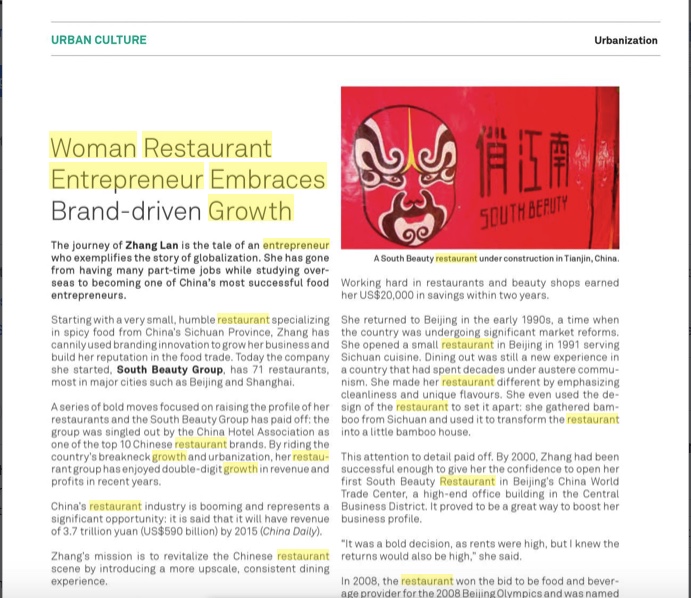
    The journey of Zhang Lan is the tale of an entrepreneur who exemplifies the story of globalization. She has gone from working many part-time jobs while studying overseas, to becoming one of China’s most successful food entrepreneurs.

    Starting with a very small and humble restaurant specializing in spicy food from China’s Sichuan province, Zhang has cannily used branding innovation to grow her business and build her reputation in the food trade. Today the company she started, South Beauty Group (southbeauty.com), has 71 restaurants, most in major cities such as Beijing and Shanghai.

    A series of bold moves focused on raising the profile of her restaurants and the South Beauty Group has paid off: the group was singled out by the China Hotel Association as one of the top 10 Chinese restaurant brands. By riding the country’s breakneck growth and urbanization, her restaurant group has enjoyed double-digit growth in recent years in revenue and profits.

    Zhang’s mission is to revitalize the Chinese restaurant scene by introducing a more upscale and consistent dining experience.

    China’s restaurant industry is booming and represents a significant opportunity: it is said it will have revenue of 3.7 trillion yuan (US $590 billion) by 2015 (China Daily).

    “Most people in China don’t know how to present food. I am happy that I have given some importance to the appearance of food,” Zhang told the China Daily newspaper.

    “I strike a balance between popular and high-end brands in my daily life. This also works for South Beauty Group, which aims to attract customers to a modern place to enjoy high-grade and popular Chinese cuisine.”

    Her business mission is to take the group outside of China and become a global brand.

    “Buoyed by the booming domestic high-end catering market, South Beauty Group is looking to be a major luxury brand in the global catering industry. It is not an easy task considering that there are different cultures and eating habits. But my past experience has taught me that opportunities often come along with challenges,” she told China Daily.

    Zhang’s business story started in a journey to Canada to pursue further education. To make ends meet, at one time she took on six part-time jobs, including washing dishes and food preparation.

    Anybody who has gone to another country to work and better their life knows how hard this can be: “During that period, I was so tired by the end of the day that I had to lift my legs onto the bed with my hands,” Zhang said.

    But working hard in restaurants and beauty shops earned her US $20,000 in savings within two years.

    She returned to Beijing in the early 1990s, a time when the country was undergoing significant market reforms. She opened a small restaurant in Beijing in 1991 serving Sichuan cuisine. Dining out was still a new experience in a country that had spent decades under austere communism. She made her restaurant different by emphasizing cleanliness and unique flavours for the food. She even used the design of the restaurant to set it apart: she gathered bamboo from Sichuan and used it to transform the restaurant into a little bamboo house.

    This attention to detail paid off. By 2000, Zhang had been successful enough to give her the confidence to open her first South Beauty Restaurant in Beijing’s China World Trade Center, a high-end office building in the Central Business District. It proved to be a great way to boost her business’s profile.

    “It was a bold decision, as rents were high, but I knew the returns would also be high,” she said.

    By 2006, she was successful enough to make another brave move: open a luxury restaurant called the Lan Club, in Beijing. Having learned about the importance of distinguishing herself in the ever-growing restaurant marketplace in China, she invited world-famous designer Philippe Starck (http://www.starck.com/en/) to design the restaurant.

    For Zhang, there was a bigger strategy at work: “I was not disheartened when some people said that I threw money away like dirt and 12 million yuan (US $1.92 million) was too much for a design draft. But I got great publicity and brand recognition with this design, far more than what is received by most companies which spend millions of yuan on television advertisements. Not everyone in China can boast of a Starck design in their restaurant.”

    In 2007, the company also started cooking meals for airlines flying between China and France, the Netherlands and South Korea. In 2008, it won the bid to be food and beverage provider for the 2008 Beijing Olympics and was named official caterer to the 2010 Shanghai World Expo.

    “These international events have given us great confidence in planning overseas expansion,” Zhang said.

    The hallmarks of the dining experience at a South Beauty Restaurant include dramatic food presentation, upscale décor, a pleasant dining atmosphere and critically, waiting staff who are informed about the dishes they are serving.

    Dramatic food preparation includes cooking food at the table for the diners and serving stir-fried shrimp on a plate with a goldfish bowl filled with live fish.

    “I want to change the cheap price and bad atmosphere tag that most Westerners have about Chinese food,” Zhang told China Daily.

    She has attracted investors to take a stake in the business and become the second richest female entrepreneur in China, according to the 2011 China Restaurant Rich List.

    While the international economic crisis is still damaging growth in the United States and Europe, Zhang still plans to go global. She is looking to initially expand into Asia before moving into Europe and North America.

    “Our mission is to promote authentic Chinese cuisine across the world. With (the) Chinese economy growing steadily and its cultural influence gaining, it will not be long before we see some big global Chinese catering companies, much like McDonald’s,” Zhang concluded. And it looks like South Beauty Group wants to lead the way.

    Published: November 2012

    Resources 

    1) Restaurant Branding: A website dedicated to discussing restaurant branding and how to do it. Website:http://www.restaurantbranding.com/

    2) How to Start a Restaurant: Tips from the Entrepreneur.com website. Website:http://www.entrepreneur.com/article/73384

    3) Top tips on opening a restaurant from successful celebrity chef Gordon Ramsay. Website:http://www.channel4.com/programmes/ramsays-kitchen-nightmares/articles/gordon-ramsays-top-tips-for-starting-a-restaurant

    4) Tips on how to handle the start-up costs of staring a restaurant. Website:http://www.inc.com/articles/201111/business-start-up-costs-restaurant.html

    https://davidsouthconsulting.org/2022/11/10/acai-berry-brazils-boon/

    https://davidsouthconsulting.org/2022/08/14/brazil-preserves-family-farms-keeping-food-local/

    https://davidsouthconsulting.org/2022/11/10/brazilian-restaurant-serves-amazonian-treats/

    https://davidsouthconsulting.org/2022/10/20/china-consumer-market-asian-perspective-helps/

    https://davidsouthconsulting.org/2022/11/19/cooking-up-a-recipe-to-end-poverty/

    https://davidsouthconsulting.org/2022/11/11/havanas-restaurant-boom-augers-in-new-age-of-entrepreneurs/

    https://davidsouthconsulting.org/2022/10/24/latin-american-food-renaissance-excites-diners/

    https://davidsouthconsulting.org/2022/11/11/urban-farming-to-tackle-global-food-crisis/

    Development Challenges, South-South Solutions was launched as an e-newsletter in 2006 by UNDP’s South-South Cooperation Unit (now the United Nations Office for South-South Cooperation) based in New York, USA. It led on profiling the rise of the global South as an economic powerhouse and was one of the first regular publications to champion the global South’s innovators, entrepreneurs, and pioneers. It tracked the key trends that are now so profoundly reshaping how development is seen and done. This includes the rapid take-up of mobile phones and information technology in the global South (as profiled in the first issue of magazine Southern Innovator), the move to becoming a majority urban world, a growing global innovator culture, and the plethora of solutions being developed in the global South to tackle its problems and improve living conditions and boost human development. The success of the e-newsletter led to the launch of the magazine Southern Innovator. 

    https://davidsouthconsulting.org/2021/03/05/southern-innovator-issue-2/

    Creative Commons License

    This work is licensed under a
    Creative Commons Attribution-Noncommercial-No Derivative Works 3.0 License.

    ORCID iD: https://orcid.org/0000-0001-5311-1052.

    © David South Consulting 2023

  • Indian Newspapers Thrive with Economy

    Indian Newspapers Thrive with Economy

    By David SouthDevelopment Challenges, South-South Solutions

    SOUTH-SOUTH CASE STUDY

    The onslaught of digital media in the developed countries of the world regularly brings pronouncements of the death of the traditional newspaper. But this assumption of digital triumph misses out on the reality in countries across the global South.

    As incomes rise and literacy levels go up, so does the desire to consume news and information. And while many are jumping straight to online and mobile phone sources, just as many are enjoying more traditional print media offerings like magazines and newspapers.

    India boasts both a fast-growing economy and the largest number of paid-for newspapers in the world. The print media industry in India has seen phenomenal growth since 2005, with the number newspaper titles increasing by 40 percent to 2,700 (World Association of Newspapers). The two factors driving this growth in newspapers are rising literacy and a booming economy

    The World Association of Newspapers found China leads the world for newspaper subscribers, with 93.5 million readers a day. India is second. It is estimated the Indian newspaper industry will generate US $3.8 billion in revenues in 2010, a 13 percent growth rate over the last five years.

    Estimates place growth in the newspaper industry in the next four years at 9 percent a year, to US $5.9 billion (KPMG).

    Part of the reason India is defying the decline in newspaper numbers and readership seen in developed countries is poor internet penetration across the country. Because of this, only 7 percent of the population uses the web for information. And the country’s high number of illiterates (just 65 percent of the population can read) means even if many could afford a newspaper, they couldn’t use it.

    According to Amar Ambani, head of research at India Infoline Group, “Unlike the West where the internet publishing and advertising has significantly hit the print media, the Internet threat to print media is still in its nascent stage in India, given the low penetration of computers and adequate bandwidth across the country.”

    Newspapers are also growing in a highly competitive market exploding with new television channels on cable and satellite and other media distractions like mobile phone applications.

    The newspapers (http://www.world-newspapers.com/india.html) are a strong reflection of how much the economy has changed in the past decade. They contain advertisements for property, mobile phones, cars and dating services.

    Cost is also a critical element in their success: at only four rupees each (US $0.09 cents), many Indians buy several newspapers at a time for their home. The publications are able to charge so little because of the health of the advertising revenue coming in. Newspaper advertising in India increased by 30 percent between January and Match 2010 alone, the quickest jump in ads for the Asia-Pacific region (Nielsen India).

    There is a hierarchy in the newspaper industry: English-language newspapers attract wealthier readers and can charge the most for advertising. But rising literacy rates combined with increasing personal wealth is fuelling growth in regional papers written in local languages. India has 22 official languages and English as an associate language. The country as a whole has about 33 different languages and over 2,000 local dialects. Hindi newspaper circulation rose from 8 million in the early 1990s to over 25 million in 2009.

    The Times of India (http://timesofindia.indiatimes.com) is now the world’s largest circulation English-language newspaper, with 4 million readers. It uses this success to charge 10 times what regional papers can for advertising. At present, the regional newspapers’ bread-and-butter is mostly government-paid advertising.

    But if trends continue as they are, then the tables will turn on big beasts like the Times of India. Regional papers will grow as people look for an opportunity to read in their own local language.

    Flush with cash and confidence, Indian newspapers are also innovating new ways to advertise untried in other countries. Talking ads attached to the actual newspaper’s back pages caused a great stir when they were trialled in India recently (http://www.guardian.co.uk/media/greenslade/2010/sep/28/newspapers-advertising). The talking ads for a car company delivered a sales pitch but also alarmed and annoyed many people because the talking ad wouldn’t stop talking.

    Ambani puts the success of the Indian newspaper industry down to five factors: the economic boom in semi-urban and rural India; growing local content; more opportunity to grow the number of readers; rising advertising spending; and rising literacy as a result of rising secondary school enrolment. He believes students aged between 10 and 15 are getting the newspaper habit and they represent huge future growth in newspaper readers.

    Published: October 2010

    Resources

    https://davidsouthconsulting.org/2022/11/17/book-boom-rides-growing-economies-and-cities/

    https://davidsouthconsulting.org/2022/09/29/cheap-indian-tablet-seeks-to-bridge-digital-divide/

    https://davidsouthconsulting.org/2022/10/20/the-e-reader-battle-reaches-india/

    https://davidsouthconsulting.org/2022/10/12/free-magazine-boosts-income-for-rickshaw-drivers/

    https://davidsouthconsulting.org/2022/05/26/kenyan-book-company-brings-online-sales-to-east-africa/

    https://davidsouthconsulting.org/2022/10/12/rickshaw-drivers-prosper-with-new-services/

    Development Challenges, South-South Solutions was launched as an e-newsletter in 2006 by UNDP’s South-South Cooperation Unit (now the United Nations Office for South-South Cooperation) based in New York, USA. It led on profiling the rise of the global South as an economic powerhouse and was one of the first regular publications to champion the global South’s innovators, entrepreneurs, and pioneers. It tracked the key trends that are now so profoundly reshaping how development is seen and done. This includes the rapid take-up of mobile phones and information technology in the global South (as profiled in the first issue of magazine Southern Innovator), the move to becoming a majority urban world, a growing global innovator culture, and the plethora of solutions being developed in the global South to tackle its problems and improve living conditions and boost human development. The success of the e-newsletter led to the launch of the magazine Southern Innovator. 

    https://davidsouthconsulting.org/2021/03/05/southern-innovator-issue-1/

    Creative Commons License

    This work is licensed under a
    Creative Commons Attribution-Noncommercial-No Derivative Works 3.0 License.

    ORCID iD: https://orcid.org/0000-0001-5311-1052.

    © David South Consulting 2024