Tag: Global South

  • Mobile Phones: Engineering South’s Next Generation of Entrepreneurs

    Mobile Phones: Engineering South’s Next Generation of Entrepreneurs

    By David SouthDevelopment Challenges, South-South Solutions

    SOUTH-SOUTH CASE STUDY

    Technology is fuelling unprecedented growth in productivity in Asia, with sub-Saharan Africa languishing behind (International Labour Organization). But the growth in mobile phones could help close this gap, as home-grown entrepreneurs are stepping up to exploit this new opportunity.

    Mobile phone applications are proving a boon to small businesses and entrepreneurs. They are now putting power in the hands of individuals, making it easier to invent new ways of doing things, transfer money, organise business accounts, provide services, sell things, and keep in touch and up-to-date.

    Technology has been the common factor in increases in productivity around the world, and with the rapid rise in mobile phone use, especially in Africa, it looks as if this handy device augers in the next wave of innovation.

    And technology and mobile phones in particular, are creating a whole new route to wealth: “The switch.. frees people from geography,” Gregory Clark, an economic historian at the University of California, Davis told The Christian Science Monitor. “Singapore can be as rich as Canada, even though Singapore has no land.”

    Technology is seen to be opening a new phase in economic competition in services, embracing a wide range of fields, from banking to tourism to healthcare. And it is entrepreneurs who will be at the forefront of making this happen. The majority (59 per cent) of the world’s 2.4 billion mobile phone users live in developing countries (MIT) – making it the first telecommunications technology in history to have more users there than in the developed world. The number of African mobile phone users passed 200 million at the beginning of this year (www.ovum.com), making it the fastest growing mobile phone market. It has increased at an annual rate of 65 per cent – twice the global average (MIT Media Laboratory).

    In Kenya in 2005, the government’s Economic Survey found the small business sector, which employs the majority of workers in the nation of 32 million people, created 437,900 jobs – mostly down to the boom in mobile phones. According to the Massachusetts Institute of Technology (MIT), adding an additional 10 mobile phones per 100 people boosts a typical developing country’s GDP growth by 0.6 per cent. The boost comes from the innovative use of mobile phone technology by local entrepreneurs.

    At the University of Nairobi, the SMS Boot Camp (SMS is the text messaging system on mobile phones) is breeding the next generation of African technology entrepreneurs. Working in partnership with MIT, the student entrepreneurs are working on an impressive list of projects, which can be found online at eprom.mit.edu. The projects are varied, and include perfecting prototype ways to collect medical data on mobiles, accurately tracking phone user’s profiles (habits, friend networks etc.), improving communication between Kenyan hospitals and the centralised blood banks in the country, and quick ways to install applications on all of Kenya’s mobile phone SIM cards.

    One graduate, Mohammed Temam Ali in Addis Ababa, is now working on a project for the Ethiopian Telecommunications Company. Another is working for Kenyan mobile phone download service, Cellulant.

    Nathan Eagle, a visiting lecturer at the University of Nairobi, has been working with the students on the projects: “Phones are starting to be used as a surrogate for all sorts of technology we take for granted in the West. Credit cards, TVs, radios, computers, etc… In the small Kenyan village where I’m writing this email, I can pay for the taxi ride home with my mobile — we’re even scheduled to be getting a Wimax network (wireless internet) here next year. Talk about leapfrog…”

    “I’m also advising a small group of newly graduated Rwandan hackers who are building an SMS-based payment system for electricity.”

    But Eagle says the obstacles can still be huge: “Government corruption and red-tape. SMS is illegal in Ethiopia… it is pretty frustrating when you go over to teach an ‘sms bootcamp’ class.”

    In India, where there are 185 million mobile phone subscribers, computer science doctoral student and founder of Ekgaon Technologies, Tapan Parikh, has founded a business specifically targeting developing mobile phone-based information systems for small businesses in the developing world. Working in rural India, the applications are designed to make it easier for business owners to manage their own operations in an efficient and transparent way, and also to build strong connections both with established financial institutions and their customers. By making it easier to access finance, and also to get a better price, these businesses will stand a better chance of flourishing, it is believed.

    One of his applications is called Cam (named after the phone’s camera). It is a toolkit that makes it simple to use phones to capture images and scan documents, enter and process data, and run interactive audio and video.

    Parikh is also using these applications to improve micro-finance. Targeting Indian self-help groups (15 to 20 people who pool their capital together, usually women), the application (called SHG MIS – self-help group management and information system) uses the phone’s camera to enter data, uploading it to online databases, and a package of Web-based software for managing data and reporting to the institution that lent the money.

    “In these groups, things are often done in a somewhat ad hoc manner, using informal documentation,” Parikh says, “which can lead to instability and impermanence and contribute to the kinds of tensions that lead small groups to fall apart.” The software gives groups a more systematic method of documenting decisions, tracking financial performance over time, and collecting information on loan effectiveness. Parikh has developed his applications around the needs and behaviour of the users.

    This next wave of entrepreneurs will be joining a growing list of made-in-the-South mobile phone innovators like ARYTYG-Cash and Smart Money in the Philippines; WIZZITand MTN Mobile Money in South Africa; M-Pesa in Kenya; Celpay in Zambia and the Democratic Republic of Congo.

    Published: September 2007

    Resources

    • Key Indicators of the Labour Market, 2007: www.ilo.org
    • Commission for Africa report on mobile phones and development: www.commissionforafrica.org
    • The Massachusetts Institute of Technology and the University of Nairobi are training the next generation of mobile phone entrepreneurs with their “SMS Boot Camp”, focused on developing applications for African phone users: eprom.mit.edu.
    • Entrepreneurs can track the growth of the mobile phones market here: www.wirelessintelligence.com

    Development Challenges, South-South Solutions was launched as an e-newsletter in 2006 by UNDP’s South-South Cooperation Unit (now the United Nations Office for South-South Cooperation) based in New York, USA. It led on profiling the rise of the global South as an economic powerhouse and was one of the first regular publications to champion the global South’s innovators, entrepreneurs, and pioneers. It tracked the key trends that are now so profoundly reshaping how development is seen and done. This includes the rapid take-up of mobile phones and information technology in the global South (as profiled in the first issue of magazine Southern Innovator), the move to becoming a majority urban world, a growing global innovator culture, and the plethora of solutions being developed in the global South to tackle its problems and improve living conditions and boost human development. The success of the e-newsletter led to the launch of the magazine Southern Innovator.

    Four issues of Southern Innovator Magazine.
    Creative Commons License

    This work is licensed under a
    Creative Commons Attribution-Noncommercial-No Derivative Works 3.0 License.

    ORCID iD: https://orcid.org/0000-0001-5311-1052.

    © David South Consulting 2022
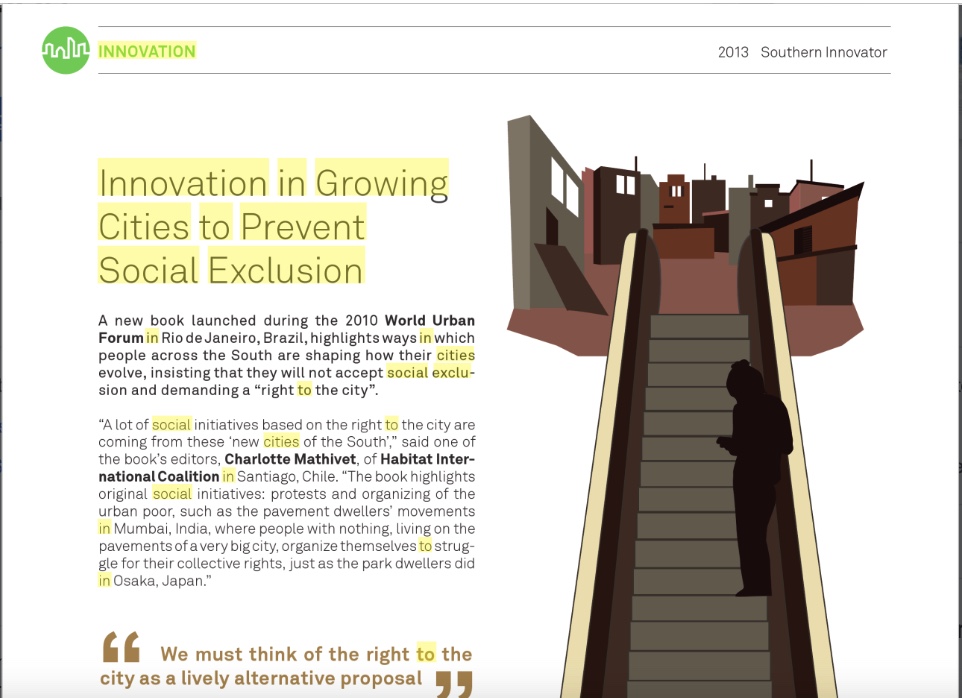
  • Innovation in Growing Cities to Prevent Social Exclusion

    Innovation in Growing Cities to Prevent Social Exclusion

    By David SouthDevelopment Challenges, South-South Solutions

    SOUTH-SOUTH CASE STUDY

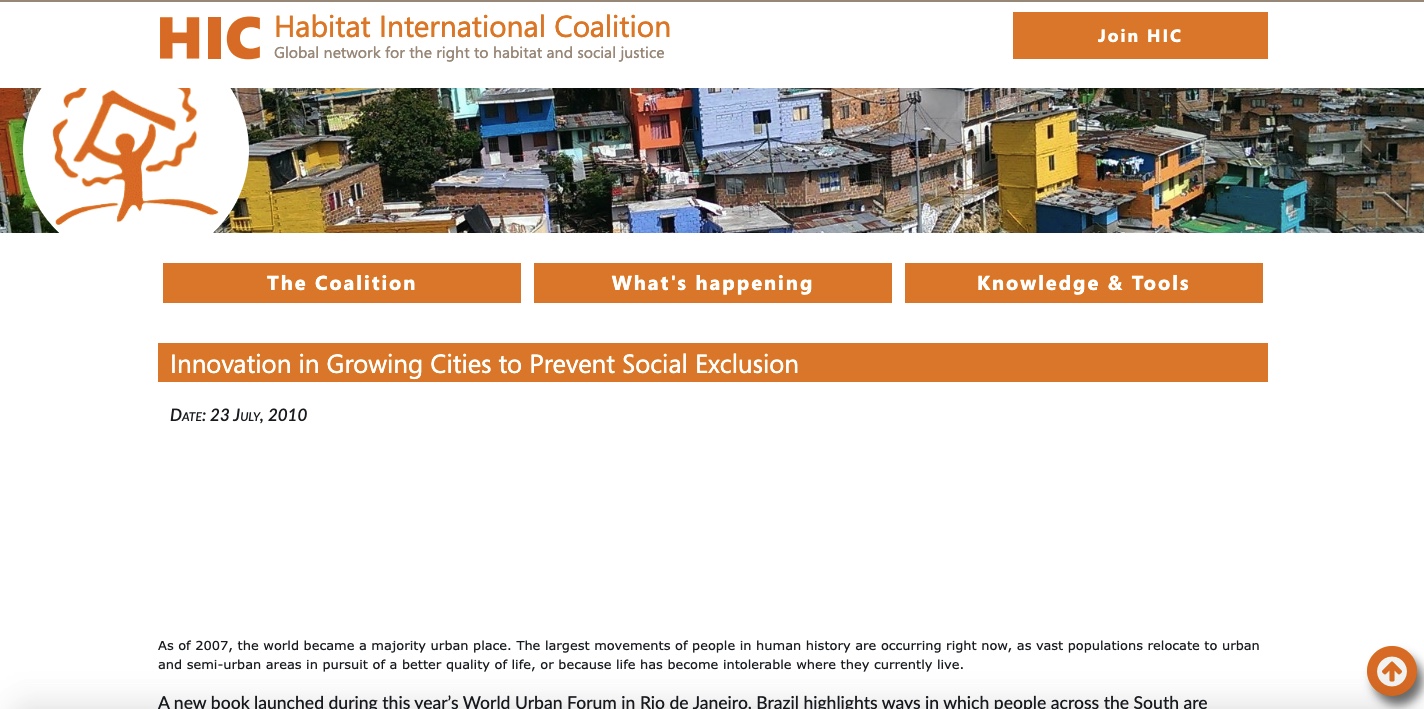
    As of 2007, the world became a majority urban place. The largest movements of people in human history are occurring right now, as vast populations relocate to urban and semi-urban areas in pursuit of a better quality of life, or because life has become intolerable where they currently live.

    A new book launched during this year’s World Urban Forum in Rio de Janeiro, Brazil highlights ways in which people across the South are shaping how their cities evolve, insisting that they will not accept social exclusion and demanding a “right to the city.”

    “A lot of social initiatives based on the right to the city are coming from these ‘new cities of the South,’ said one of the book’s editors, Charlotte Mathivet of Habitat International Coalition in Santiago, Chile. “The book highlights original social initiatives: protests and organizing of the urban poor, such as the pavement dwellers’ movements in Mumbai, India where people with nothing, living on the pavements of a very big city, organize themselves to struggle for their collective rights, just as the park dwellers did in Osaka, Japan.”

    This first edition of Cities for All: Proposals and Experiences towards the Right to the City, comes in three languages – English (http://www.hic-net.org/document.php?pid=3399) , Spanish ( http://www.hic-net.org/document.php?pid=3400) and Portuguese (http://www.hic-net.org/document.php?pid=3401) – is intended to inspire people to tackle positively this fast-changing urban world.

    The book’s chapters span an eclectic mix of topics, from democracy in the world’s future cities to experiences in Africa’s cities, to how the 2008 Beijing Olympics affected the metropolis, to ways of involving children in urban planning.

    One innovative case study included in the book is the children’s workshops in Santiago, Chile, which aim to make a more child-friendly city by including children in the planning process.

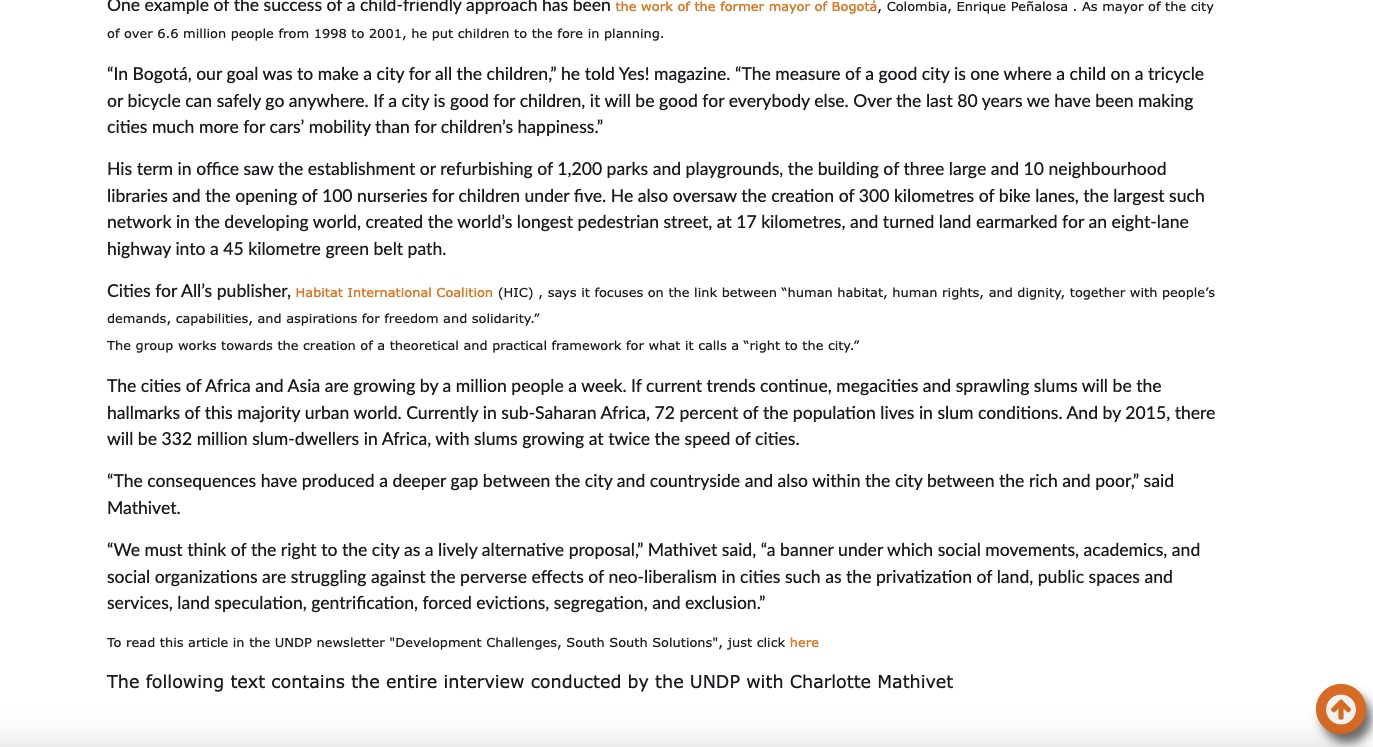
    One example of the success of a child-friendly approach has been the work of the former mayor of Bogotá, Colombia, Enrique Peñalosa (http://www.pps.org/epenalosa-2/) . As mayor of the city of over 6.6 million people from 1998 to 2001, he put children to the fore in planning.

    “In Bogotá, our goal was to make a city for all the children,” he told Yes! magazine. “The measure of a good city is one where a child on a tricycle or bicycle can safely go anywhere. If a city is good for children, it will be good for everybody else. Over the last 80 years we have been making cities much more for cars’ mobility than for children’s happiness.”

    His term in office saw the establishment or refurbishing of 1,200 parks and playgrounds, the building of three large and 10 neighbourhood libraries and the opening of 100 nurseries for children under five. He also oversaw the creation of 300 kilometres of bike lanes, the largest such network in the developing world, created the world’s longest pedestrian street, at 17 kilometres, and turned land earmarked for an eight-lane highway into a 45 kilometre green belt path.

    Cities for All’s publisher, Habitat International Coalition (HIC) (www.hic-net.org) , says it focuses on the link between “human habitat, human rights, and dignity, together with people’s demands, capabilities, and aspirations for freedom and solidarity.”

    The group works towards the creation of a theoretical and practical framework for what it calls a “right to the city.”

    The cities of Africa and Asia are growing by a million people a week. If current trends continue, megacities and sprawling slums will be the hallmarks of this majority urban world. Currently in sub-Saharan Africa, 72 percent of the population lives in slum conditions. And by 2015, there will be 332 million slum-dwellers in Africa, with slums growing at twice the speed of cities.

    “The consequences have produced a deeper gap between the city and countryside and also within the city between the rich and poor,” said Mathivet.

    “We must think of the right to the city as a lively alternative proposal,” Mathivet said, “a banner under which social movements, academics, and social organizations are struggling against the perverse effects of neo-liberalism in cities such as the privatization of land, public spaces and services, land speculation, gentrification, forced evictions, segregation, and exclusion.”

    Published: July 2010

    Resources

    1) Model Village India: Drawing on self-organizing methods used in India since 1200 BC, the Model Village India is based around India’s democratic system of Panchayats: a village assembly of people stemming back to pre-colonial times. Website: www.modelvillageindia.org.in

    2) More Urban, Less Poor: The first textbook to explore urban development and management and challenge the notion unplanned shanty towns without basic services are the inevitable consequence of urbanization. Website:www.earthscan.co.uk

    3) Building and Social Housing Foundation: The Building and Social Housing Foundation (BSHF) is an independent research organisation that promotes sustainable development and innovation in housing through collaborative research and knowledge transfer. Website: http://www.bshf.org

    4) World Social Forum Dakar, Senegal 2011. Website:www.worldsocialforum.info

    Development Challenges, South-South Solutions was launched as an e-newsletter in 2006 by UNDP’s South-South Cooperation Unit (now the United Nations Office for South-South Cooperation) based in New York, USA. It led on profiling the rise of the global South as an economic powerhouse and was one of the first regular publications to champion the global South’s innovators, entrepreneurs, and pioneers. It tracked the key trends that are now so profoundly reshaping how development is seen and done. This includes the rapid take-up of mobile phones and information technology in the global South (as profiled in the first issue of magazine Southern Innovator), the move to becoming a majority urban world, a growing global innovator culture, and the plethora of solutions being developed in the global South to tackle its problems and improve living conditions and boost human development. The success of the e-newsletter led to the launch of the magazine Southern Innovator. 

    “Cities for All, recently published by Habitat International Coalition, draws together thinkers and innovators in a compilation of case studies addressing the challenges of inclusive cities in the global South. The book seeks to articulate experiences of South-South cooperation and enhance the links between different regions. David South interviews the co-editor, Charlotte Mathivet.”

    Read the full interview here: https://www.hic-net.org/innovation-in-growing-cities-to-prevent-social-exclusion/.
    Creative Commons License

    This work is licensed under a
    Creative Commons Attribution-Noncommercial-No Derivative Works 3.0 License.

    ORCID iD: https://orcid.org/0000-0001-5311-1052.

    © David South Consulting 2023

  • African Farming Wisdom Now Scientifically Proven

    African Farming Wisdom Now Scientifically Proven

    By David SouthDevelopment Challenges, South-South Solutions

    SOUTH-SOUTH CASE STUDY

    Increasing the agricultural productivity of Africa is critical for the continent’s future development, and the world’s. Two-thirds of Africans derive their main income from agriculture, but the continent has the largest quantity of unproductive – or unused – potential agricultural land in the world.

    This means the continent has the potential to become the world’s new breadbasket – but there is a problem. A report by the International Centre for Soil Fertility and Agriculture (IFDC) found the continent had a “soil health crisis” and that three-quarters of its farmlands were severely degraded (New Scientist). The causes of this crisis include overuse of the same plot of land due to population growth, which prevents farmers moving around, and high fertilizer costs, leading to African farmers using just 10 per cent of the world average on their farms.

    But a new study shows that an existing practice by some African farmers could help solve this dilemma if it was adopted by the majority.

    At the University of Sydney in Australia, a study has confirmed the effectiveness of ants and termites as a tool to increase farm yields in dry areas. It found ants and termites in drier climates of the global South improved soil conditions just as earthworms do in northern, wetter and colder climates. Both termites and ants, by burrowing their way through the soil, carve out tunnels that make it easier for plants to shoot their roots outwards in search of water.

    In field experiments, ants and termites helped raise wheat yields by 36 per cent by increasing water and nitrogen absorption. This is critical for agriculture in arid climates.

    While termites wreak havoc on crops such as maize (corn) and sugarcane, they are very useful for other African crops.

    The Australian research found termites infuse nitrogen into the soil. Nitrogen is usually dumped on fields with expensive fertilizers that are subject to market fluctuations. The termites have nitrogen-heavy bacteria in their stomachs, which they excrete into the soil through their faeces or saliva.

    The research also found termites helped with reducing water wastage.

    This research reinforces what has long been known to some African farmers. Long-held farmer tradition in parts of West Africa uses termites to enhance soil by placing wood on the earth to attract them. By burying manure in holes near newly planted grains, farmers in Burkina Faso attract termites to the soil.

    In Malawi, bananas are planted near termite mounds to encourage the creatures. In southern Zambia, soil from termite nests is harvested and used as top soil on agricultural land.

    If more farmers adopted this practice, Africa could simultaneously address its chronic malnutrition and hunger problem and contribute to the world’s food needs. As the McKinsey Global Institute (MGI) found, “With 60 percent of the world’s uncultivated arable land and low crop yields, Africa is ripe for a ‘green revolution’ like those that transformed agriculture in Asia and Brazil.”

    McKinsey estimated that Africa’s agricultural output could increase from US $280 billion a year now to US $500 billion by 2020 and as much as US $880 billion by 2030.

    The UN recently declared that the world’s population has reached 7 billion. That is many mouths to feed and presents Africa with a dilemma and an opportunity.

    And as urban growth accelerates across the global South – the world is now a majority urban place – there is a huge profit to be made from providing food to growing urban populations.

    The time to act is now, as there have been reports from African farmers that they are seeing harvests declining by 15 to 25 per cent. And the picture gets gloomier: many farmers think their harvests will drop by half over the next five years.

    Given that there are 2,600 different species of termites now recognised in the world (UNEP) and with over 660 species, found in Africa, it is by far the richest continent in termite diversity (Eggleton 2000) and they are proof that an affordable solution is close at hand to the current crisis.

    Published: January 2012

    Resources

    1) World Vegetable Center: The World Vegetable Center is the world’s leading international non-profit research and development institute committed to alleviating poverty and malnutrition in developing countries through vegetable research and development. Website:http://www.avrdc.org

    2) Songhai Centre: a Benin-based NGO that is a training, production, research, and development centre in sustainable agriculture. Website:http://www.songhai.org/english

    3) Marketing African Leafy Vegetables: Challenges and Opportunities in the Kenyan Context by Kennedy M. Shiundu and Ruth. K. Oniang. Website:http://www.ajfand.net/Issue15/PDFs/8%20Shiundu-IPGR2_8.pdf

    4) 2050: Africa’s Food Challenge: Prospects good, resources abundant, policy must improve: A discussion paper from the Food and Agricultural Organization (FAO). Website:http://www.fao.org/wsfs/forum2050/wsfs-background-documents/issues-briefs/en

    5) African Alliance for Capital Expansion: A management consultancy focused on private sector development and agribusiness in West Africa. Website:http://www.africanace.com/v3

    6) Ants and termites increase crop yield in a dry climate by Theodore A. Evans, Tracy Z. Dawes, Philip R. Ward and Nathan Lo, Nature Communications 2, Article number: 262

    7) Integrating Ethno-Ecological and Scientific Knowledge of Termites for Sustainable Termite Management and Human Welfare in Africa by Gudeta W. Sileshi et al, Ecology and Society, Volume 14, Number 1. Website:http://www.ecologyandsociety.org/vol14/iss1/art48

    8) State of the World 2011: Innovations that Nourish the Planet. Website: http://www.worldwatch.org/sow11

    9) Soil health crisis threatens Africa’s food supply. Website:http://www.newscientist.com/article/dn8929-soilhealth-crisis-threatens-africas-food-supply.html

    Creative Commons License

    This work is licensed under a
    Creative Commons Attribution-Noncommercial-No Derivative Works 3.0 License.

    ORCID iD: https://orcid.org/0000-0001-5311-1052.

    © David South Consulting 2023

  • Cyber Cities: An Oasis of Prosperity in the South

    Cyber Cities: An Oasis of Prosperity in the South

    By David SouthDevelopment Challenges, South-South Solutions

    SOUTH-SOUTH CASE STUDY

    The future is arriving in the South even faster than many think: so-called “cyber cities” are being created to become this century’s new Silicon Valleys. Well-known ‘cyber cities’ like India’s Hyderabad and Bangalore have been joined by many other cities across the global South. But two places are set to make big waves with their ambition and drive in 2008: Mauritius and China.

    Mauritius, an island in the Indian Ocean strategically close to Africa, better known for tourism and luxury hotels, wants to become the world’s “cyber island”. Armed with the first 3G network in Africa (the third generation of mobile phone technology – offering high-speed internet access and video telephony), Mauritius is moving fast to make good on this advantage. And it is even moving to the next level of mobile-phone speed, something called High-speed Download Packet Access (HSDPA) – allowing even greater quantities of information to be exchanged.

    Mauritius joins a select few countries, including Japan and South Korea, at the forefront of access to 3G. Wireless – or wi-fi – computer access is available in three-quarters of the island.

    Outside the capital of Port Louis, former sugar cane plantations are being turned into a “cyber city”. The centrepiece of the development is the 12-story Cyber Tower, home to young technology start-ups. The country is also investing heavily in education from primary school to university, to make sure the country’s 1.2 million people are cyber-ready.

    Computer novices in remote villages are being visited by a Cyber Caravan with a classroom teaching housewives, children, the unemployed and the disabled basic computing and world processing.

    Mauritius built its wealth on tourism, sugar plantations and textile manufacturing. But it is worried that trading arrangements that helped the sugar and textile industries to flourish, will be taken away. So it is focusing on the future: it sees itself as the world centre for disaster recovery computing services for the world’s companies in event of a disaster in their own country that destroys computer networks.

    In China, its largest Cyber Park is under construction in Wujin New and High-tech Development Zone of Changzhou. It will be a technology incubator, a research and development centre, and a place for small and medium-sized enterprises to innovate.

    What is truly making people stop and think is another far-reaching project: the Beijing Cyber Recreation District (CRD) – China’s most ambitious digital media industry development: a virtual worlds’ initiative with digital media academies and company incubators. It is spread over 100 square kilometres, creating the world’s largest virtual world development. It is already home to more than 200 game and multimedia content producers in western Beijing.

    The CRD says its goal is “to create a virtual economy providing infrastructure and platforms through which any business – not just those based in China – can come in and sell their real-world products and services. While a concerted effort will be placed on bringing Chinese businesses and consumers in, the effort is worldwide and open to businesses and consumers from any country.”

    The idea is to create a vast virtual economy for commerce where manufacturers can directly connect with billions of customers – bypassing middlemen.

    It claims it will be “the world’s one-stop shop for customers and producers.” It will host billions of avatars – or virtual people – surpassing the capability of the very popular Second Life virtual world game’s 40,000.

    Published: January 2008

    Resources

    • The Atlas of Ideas is an 18-month study of science and innovation in China, India and Republic of Korea Korea, with a special focus on new opportunities for collaboration with Europe. It is a comprehensive account of the rising tide of Asian innovation. Special reports on China, India and Korea, introducing innovation policy and trends in these countries can be downloaded for free.
    • The Cyber Cities Reader: the first book to bring together a
      vast range of debates and examples of ICT-based city changes.
    • Entrepreneurship Development Institute of India
    • Innovation China: A website linking all stories on the fast-breaking world of Chinese innovation.

    https://davidsouthconsulting.org/2022/02/09/african-health-data-revolution/

    https://davidsouthconsulting.org/2020/12/04/big-data-can-transform-the-global-souths-growing-cities/

    https://davidsouthconsulting.org/2020/04/25/china-looking-to-lead-on-robot-innovation/

    https://davidsouthconsulting.org/2020/12/10/china-sets-sights-on-dominating-global-smartphone-market/

    https://davidsouthconsulting.org/2021/03/20/computer-gold-farming-turning-virtual-reality-into-real-profits/

    https://davidsouthconsulting.org/2020/12/04/data-surge-across-global-south-promises-to-re-shape-the-internet/

    https://davidsouthconsulting.org/2021/01/26/designed-in-china-to-rival-made-in-china/

    https://davidsouthconsulting.org/2017/11/08/eco-cities-up-close-2013/

    https://davidsouthconsulting.org/2020/12/11/false-data-makes-border-screening-corruptible/

    https://davidsouthconsulting.org/2022/09/28/model-cities-across-the-south-challenge-old-ways/

    https://davidsouthconsulting.org/2022/10/04/popular-chinese-social-media-chase-new-markets/

    https://davidsouthconsulting.org/2017/11/08/smart-cities-up-close-2013/

    https://davidsouthconsulting.org/2021/02/18/what-is-the-un-doing-with-your-data/

    Check out award-winning cyber and digital work here: http://www.davidsouthconsulting.com/blog/2020/2/26/awards-1998-2003-february-2020.html

    More stories on cyber innovation from e-newsletter Development Challenges, South-South Solutions and magazine Southern Innovator

    China Sets Sights on Dominating Global Smartphone Market

    China Looking to Lead on Robot Innovation

    Crowdsourcing Mobile Phones To Make The Poor Money

    Mobile Phones: Engineering South’s Next Generation of Entrepreneurs

    Development Challenges, South-South Solutions was launched as an e-newsletter in 2006 by UNDP’s South-South Cooperation Unit (now the United Nations Office for South-South Cooperation) based in New York, USA. It led on profiling the rise of the global South as an economic powerhouse and was one of the first regular publications to champion the global South’s innovators, entrepreneurs, and pioneers. It tracked the key trends that are now so profoundly reshaping how development is seen and done. This includes the rapid take-up of mobile phones and information technology in the global South (as profiled in the first issue of magazine Southern Innovator), the move to becoming a majority urban world, a growing global innovator culture, and the plethora of solutions being developed in the global South to tackle its problems and improve living conditions and boost human development. The success of the e-newsletter led to the launch of the magazine Southern Innovator.  

    Follow @SouthSouth1

    Google Books: https://books.google.co.uk/books?id=dKaXBgAAQBAJ&dq=Development+Challenges+January+2008&source=gbs_navlinks_s

    Slideshare: http://www.slideshare.net/DavidSouth1/development-challengessouthsouthsolutionsjanuary2008issue

    Southern Innovator Issue 1: https://books.google.co.uk/books?id=Q1O54YSE2BgC&dq=southern+innovator&source=gbs_navlinks_s

    Southern Innovator Issue 2: https://books.google.co.uk/books?id=Ty0N969dcssC&dq=southern+innovator&source=gbs_navlinks_s

    Southern Innovator Issue 3: https://books.google.co.uk/books?id=AQNt4YmhZagC&dq=southern+innovator&source=gbs_navlinks_s

    Southern Innovator Issue 4: https://books.google.co.uk/books?id=9T_n2tA7l4EC&dq=southern+innovator&source=gbs_navlinks_s

    Southern Innovator Issue 5: https://books.google.co.uk/books?id=6ILdAgAAQBAJ&dq=southern+innovator&source=gbs_navlinks_s

    https://davidsouthconsulting.org/2021/03/05/southern-innovator-issue-1/

    https://davidsouthconsulting.org/2021/03/05/southern-innovator-issue-4/

    Creative Commons License
    This work is licensed under a
    Creative Commons Attribution-Noncommercial-No Derivative Works 3.0 License.

    ORCID iD: https://orcid.org/0000-0001-5311-1052.

    © David South Consulting 2023