Tag: Global South

  • Computer ‘Gold Farming’ Turning Virtual Reality Into Real Profits

    Computer ‘Gold Farming’ Turning Virtual Reality Into Real Profits

    ByDavid South,Development Challenges, South-South Solutions

    SOUTH-SOUTH CASE STUDY

    The rapid spread of the internet around the global South is bringing with it new forms of work. One of these trends is so-called “gold farming”: making money in the virtual world of computer gaming by trading in virtual money, prizes and goods for busy gamers who don’t have time to do it themselves. This work now employs 400,000 people – mostly men and mostly in China, but also elsewhere in the South, according to new report.

    Working out of internet centres where they can get access to high-speed or broadband internet connections, “gold farmers” use the global trade in virtual goods for online computer games in the same way stockbrokers trade shares on the world’s stock exchanges. The trade operates similarly to the stock market, with prices fluctuating based on demand and changing by the minute.

    And as the report discovered, this trade is acting as a gateway into the world of information technology employment, where computer-literate young men are able to earn an income they could not have done otherwise.

    It is a trade that can provide gold farmers with US $145 a month in income. They are often given free food and accommodation to do it, and many have few other economic choices.

    “You can probably think of two models,” said the report’s author, Professor Richard Heeks of Manchester University’s Development Informatics Group. “They could play as an individual at a local cybercafe doing their own in-game farming and then selling to one of the trading sites (that buy from farmers at one price, then sell on to player-buyers at a higher price). Or they could be organized into a small/medium enterprise by an owner, all working together in a room full of computers.”

    There is a dark side to gold farming too: there have been reports of youths forced to gold farm by gangs who make them work 12 hour days. Crime gangs sometimes become involved and scams proliferate.

    Heeks says the downside is the result of governmental ignorance. “The main problem is a lack of understanding about ICT and ICT enterprise generally in some governments in developing countries and in particular a relative lack of understanding about the spread and implications of computer games.”

    Supporters see gold farming as a flourishing Southern economy that is worth hundreds of millions of dollars, and exposes participants both to information technology skills and the wide horizons of the virtual computing world. Its defenders say it shows that those who dismiss the expansion of IT infrastructure as a waste of time are missing the emerging economic opportunities it is creating.

    Heeks said we still know too little about this fast-evolving sector, but that “gold farming does seem to be providing income/livelihood for young men who would otherwise be unemployed. There are claims that it has helped mop up youths who had otherwise been involved in crime, but we don’t yet know how generalized such claims are.”

    The number of players engaged in online gaming has grown by 80 percent per year, and Heeks sees the rise in gold farming as linked to a bigger trend: “in both North and South, we will spend increasing amounts of work and leisure time in cyberspace. Couple that with the growing penetration of ICTs into developing countries, including into poor communities, and there will be growing opportunities for this kind of ‘virtual outsourcing.’”

    Currently, more than 300 million people worldwide have access to the internet through fast broadband connections (mostly in developed countries, although this is changing quickly), and more than 1.1 billion of the world’s estimated 6.6 billion people are online.

    China is working hard to capture the economic power of the internet. The country’s economic boom has helped create an affluent urban middle class clamouring for the social aspects of internet access like chat rooms, while the government has been driving the roll-out of internet access in rural areas.

    The country’s largest Cyber Park is under construction inWujin New and High-tech Development Zone of Changzhou. It will be a technology incubator, a research and development centre, and a place for small and medium-sized enterprises to innovate.

    China’s most ambitious digital media industry development is the Beijing Cyber Recreation District (CRD), a collection of digital media academies and company incubators spread over 100 square kilometres, creating the world’s largest virtual world development. It is already home to more than 200 game and multimedia content producers in western Beijing.

    And even in Africa, where broadband penetration rates are very poor, countries are now looking to the mobile phone companies to provide their populations with access to the internet, as they struggle to find a place at the digital table.

    Mauritius, an island in the Indian Ocean strategically close to Africa and better known for tourism and luxury hotels, wants to become the world’s “cyber island”, and Africa’s e-gateway. Armed with the first 3G network in Africa (the third generation of mobile phone technology – offering high-speed internet access and video telephony), Mauritius is moving fast to make good on this advantage. And it is even moving to the next level of mobile-phone speed, High-speed Download Packet Access (HSDPA) – allowing even greater quantities of information to be exchanged.

    Mauritius joins a select few countries, including Japan and South Korea, at the forefront of access to 3G. Wireless – or wi-fi – computer access is available in three-quarters of the island.

    Published: September 2008

    https://davidsouthconsulting.org/2022/11/21/asia/

    https://davidsouthconsulting.org/2022/10/20/china-consumer-market-asian-perspective-helps/

    https://davidsouthconsulting.org/2020/12/10/china-sets-sights-on-dominating-global-smartphone-market/

    https://davidsouthconsulting.org/2020/12/11/cyber-cities-an-oasis-of-prosperity-in-the-south/

    https://davidsouthconsulting.org/2021/01/26/designed-in-china-to-rival-made-in-china/

    https://davidsouthconsulting.org/2022/10/04/popular-chinese-social-media-chase-new-markets/

    https://davidsouthconsulting.org/2020/04/17/virtual-supermarket-shopping-takes-off-in-china/

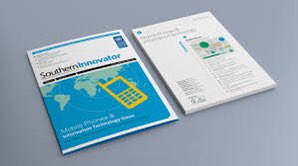
    Development Challenges, South-South Solutionswas launched as an e-newsletter in 2006 by UNDP’s South-South Cooperation Unit (now the United Nations Office for South-South Cooperation) based in New York, USA. It led on profiling the rise of the global South as an economic powerhouse and was one of the first regular publications to champion the global South’s innovators, entrepreneurs, and pioneers. It tracked the key trends that are now so profoundly reshaping how development is seen and done. This includes the rapid take-up of mobile phones and information technology in the global South (as profiled in the first issue of magazine Southern Innovator), the move to becoming a majority urban world, a growing global innovator culture, and the plethora of solutions being developed in the global South to tackle its problems and improve living conditions and boost human development. The success of the e-newsletter led to the launch of the magazine Southern Innovator.

    Follow@SouthSouth1

    Archive.org:https://archive.org/details/Httpwww.slideshare.netDavidSouth1development-challengessouthsouthsolutionsseptember2008issue

    Slideshare:http://www.slideshare.net/DavidSouth1/development-challengessouthsouthsolutionsseptember2008issue

    Southern Innovator Issue 1:https://books.google.co.uk/books?id=Q1O54YSE2BgC&dq=southern+innovator&source=gbs_navlinks_s

    Southern InnovatorIssue 2: https://books.google.co.uk/books?id=Ty0N969dcssC&dq=southern+innovator&source=gbs_navlinks_s

    Southern Innovator Issue 3:https://books.google.co.uk/books?id=AQNt4YmhZagC&dq=southern+innovator&source=gbs_navlinks_s

    Southern Innovator Issue 4:https://books.google.co.uk/books?id=9T_n2tA7l4EC&dq=southern+innovator&source=gbs_navlinks_s

    Southern Innovator Issue 5:https://books.google.co.uk/books?id=6ILdAgAAQBAJ&dq=southern+innovator&source=gbs_navlinks_s
    Creative Commons License
    This work is licensed under a
    Creative Commons Attribution-Noncommercial-No Derivative Works 3.0 License.

    ORCID iD:https://orcid.org/0000-0001-5311-1052.

    © David South Consulting 2025

  • Cashing in on Old Wisdom

    Cashing in on Old Wisdom

    By David SouthDevelopment Challenges, South-South Solutions

    SOUTH-SOUTH CASE STUDY

    India’s traditional weavers, heirs to a 2,000-year-old textile industry, are turning to the ancient practice of ayurvedic medicine to make their products more appealing and boost sales. Drawing on recipes once used by weavers to the Indian royal courts, clothes are woven and infused with ayurvedic, herb-and-spice medicinal recipes to address various health problems. Strange as it may sound, the health-giving properties of the clothes have been backed up by clinical trials at the Government Ayurveda College in Thiruvanathapuram, southern India.

    The college claims the trials were successful for 40 patients with rheumatism, allergies, hypertension, diabetes, psoriasis and other skin ailments. It is believed the healing properties of the herb-and-spice-infused clothes enter the skin and contribute to healing.

    Modern India’s founding father, Mahatma Gandhi, championed hand-spun cloth and weaving. But India’s weavers have been hit hard by the rise in the rupee against the dollar and an inability to compete internationally. They are facing stiff competition from a flood of machine-made cheap clothing. According to Siddique Hassan of the Weaver and Artisans Rights Front (WARF), 1 million of India’s 5 million weavers have lost their jobs because of competition (Deutsche Presse-Agentur).

    But rising interest in sustainability and natural healing is creating a growing global market for organic clothes – sales are set to triple to US $2.6 billion in 2008 (Organic Exchange).

    Against this backdrop, local governments have turned to traditional ayurvedic medicine to help save the livelihoods of handloom weavers and develop a market niche for their eco-friendly fabrics.

    In the technique called Ayurvastra, the clothes are dyed with herbal essences, infusing the cotton with the medicine. More than 200 herbs are used, mostly taken from roots, flowers, leaves, seeds and bark. Most of the clothes are made with cotton and silk, and some with wool and jute. A dress is marketed to people who suffer from hypertension. There are bedcovers, pillow covers, nightgowns, and even suits. It is believed the healing effect is best when the patient is sleeping.

    The clothes are made in Balaramapuram, home to traditional weaving in Kerala, southern India, and sell for between 1,000 and 1,800 rupees (US $25 to US $45). Ayurvastra clothing is currently being exported to the Middle East, the US, Italy, Germany, Britain, Singapore, Malaysia and Jordan.

    Acknowledging traditional medicine as a useful development tool goes back to the World Health Organisation’s Alma-Ata Declaration in 1978, which urged governments for the first time to include traditional medicine in their primary health systems and recognise traditional medicine practitioners as health workers. During the last 30 years there has been a considerable expansion in the use of traditional medicine across the world. Despite their ancient origins, it is still critical these medicines do meet efficacy and health standards and are proven to work.

    Ayurvastra is a branch of the 5,000-years-old Indian ayurveda health system. Ayur means health in Sanskrit, veda means wisdom, and vastra is cloth or clothing. There are no synthetic chemicals and toxic irritants and the technique uses organic cotton that has been hand loomed.

    “The entire process is organic,” said K. Rajan, chief technician at the Handloom Weavers Development Society in India, to Zee News. “The cloth is bleached with cow’s urine, which has high medicinal value. The dyeing gum too is herbal. It does not pollute like synthetic dye. And the waste is used as bio manure and to generate bio gas.”

    Chaitanya Arora of Penchant Traders, an Indian company promoting and exporting ayurvastra cloth and clothing, tells how it works: “usage of the cloth is based on the principle of touch. By coming in contact with ayurvastra, the body loses toxins and its metabolism is enhanced.”

    One clothes buyer, T D Kriplani, told Zee News, “Basically, I have read about the concept in newspapers… I was inquisitive and have also heard that it is in direct touch with body pores. I have come here after reading about it and hope it will benefit people.” It is even claimed the clothes can keep people cool.

    Another seller of ayurvastra, Hitesh, is enthusiastic about its impact: “The medicinal clothes that we have launched is a new revolution in the textile industry. In there, we dye the clothes with ayurvedic dyes and the clothes have medicinal qualities, which hopefully are good for diseases.”

    Published: February 2008

    Resources

    • Think! Clothing: A stylish UK-based designer using fair-trade, hand woven clothes from Indian women from the ‘untouchable’ caste.
    • An online shopping site based in Kerala, India offers a wide range of the ayurvastra clothing: http://www.ayurvastraonline.com/
    • Fibre2Fashion: An excellent web portal can be found here to connect weavers with the wider fashion industry – basically an online marketplace for making deals.
    • Asia-Pacific Traditional Medicine and Herbal Technology Network: an excellent first stop for any entrepreneur, where they can find out standards and regulations and connect with education and training opportunities: www.apctt-tm.net

    Creative Commons License

    This work is licensed under a
    Creative Commons Attribution-Noncommercial-No Derivative Works 3.0 License.

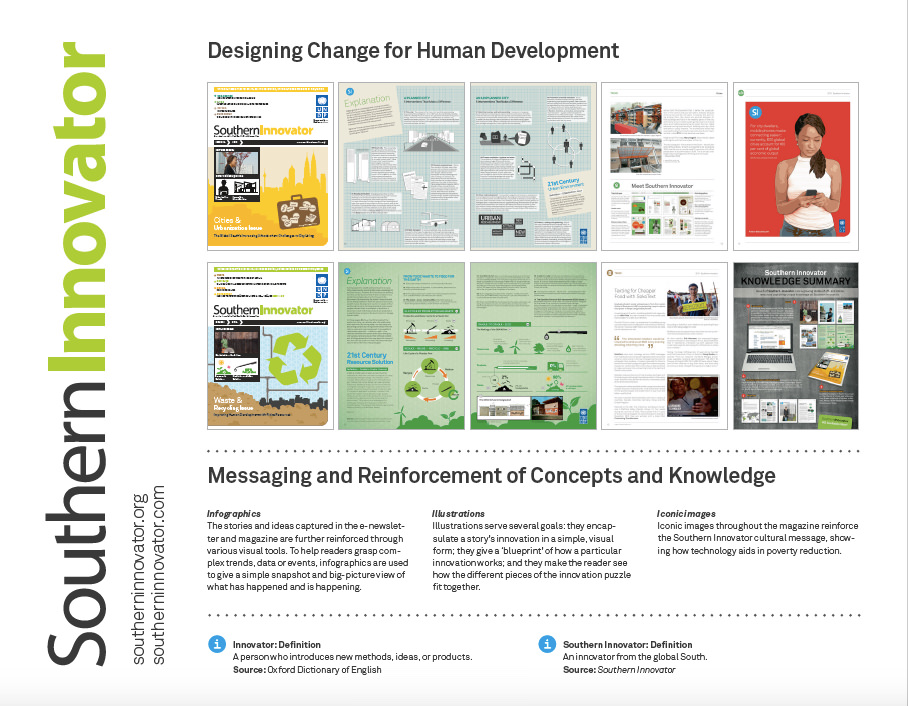
    Southern Innovator was initially launched in 2011 with the goal of inspiring others (just as we had been so inspired by the innovators we contacted and met). The magazine seeks to profile stories, trends, ideas, innovations and innovators overlooked by other media. The magazine grew from the monthly e-newsletter Development Challenges, South-South Solutions published by the United Nations Office for South-South Cooperation (UNOSSC) since 2006.

    Issue 6’s theme has been decided on: it will focus on Science, Technology and Innovation. For this issue, Southern Innovator is seeking invitations from cutting-edge knowledge and science innovators in the global South to view their work. Time is tight, so don’t miss this opportunity to let the whole global South know about your work. In the past, Southern Innovator has visited green pioneers in Cuba, a smart city in South Korea and an eco-city in China.

    Contact me if you wish to receive a copy/copies of the magazine for distribution. Follow @SouthSouth1.

    Southern Innovator Issue 1

    Southern Innovator Issue 2

    Southern Innovator Issue 3

    Southern Innovator Issue 4

    Southern Innovator Issue 5

    Southern Innovator Issue 6

    Innovator Stories and Profiles

    Citing Southern Innovator

    Finding Southern Innovator

    Press Release 1

    Press Release 2

    Press Release 3

    Southern Innovator Impact Summaries | 2012 – 2014

    ORCID iD: https://orcid.org/0000-0001-5311-1052.

    © David South Consulting 2021

  • Southern Innovator Issue 3

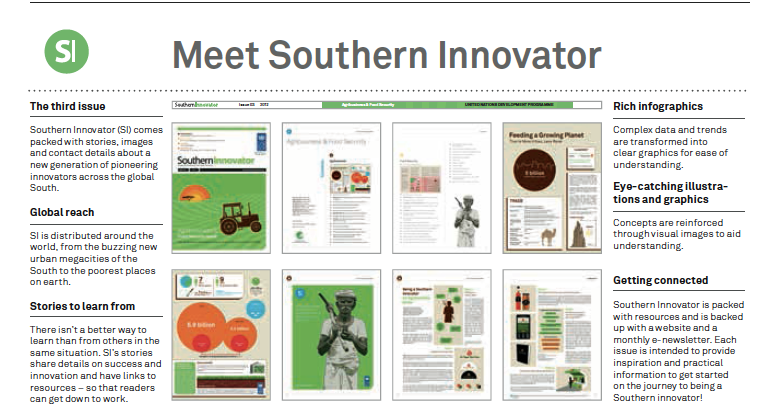
    Southern Innovator Issue 3

    Launched in May 2011, the new global magazine Southern Innovator (ISSN 2222-9280) is about the people across the global South shaping our new world, eradicating poverty and working towards the achievement of the Millennium Development Goals (MDGs). 

    Team | Southern Innovator Phase 1 Development (2010 – 2015)

    They are the innovators.

    Follow the magazine on Twitter @SouthSouth1. 

    Southern Innovator Issue 1

    Southern Innovator Issue 2

    Southern Innovator Issue 3

    Southern Innovator Issue 4

    Southern Innovator Issue 5

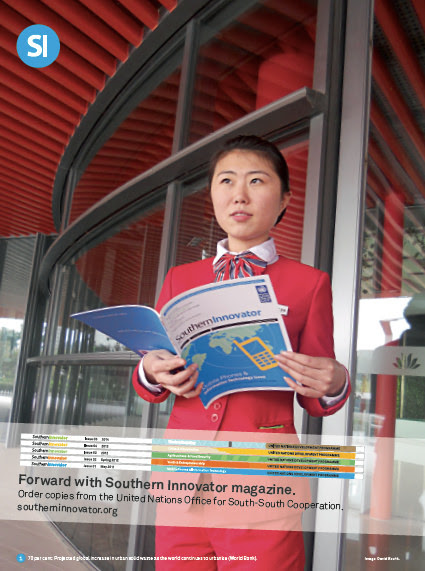
    If you would like hard copies of the magazine for distribution, then please contact the United Nations Office for South-South Cooperation (UNOSSC)(https://www.unsouthsouth.org/2014/12/25/southern-innovator-magazine/).

    https://davidsouthconsulting.org/southern-innovator-scale-up-fundraiser/

    ORCID iD: https://orcid.org/0000-0001-5311-1052.

    © David South Consulting 2021

  • Indian ID Project is Foundation for Future Economic Progress

    Indian ID Project is Foundation for Future Economic Progress

    By David SouthDevelopment Challenges, South-South Solutions

    SOUTH-SOUTH CASE STUDY

    India is in the midst of the biggest national identification project in the country’s history. The aim is for every Indian to receive a voluntary electronic identification card containing his or her details and a unique number. Called an Aadhaar, it is a 12-digit unique number registered with the Unique Identification Authority of India (http://uidai.gov.in) (UIDAI). The project joins a growing trend across the global South to map populations in order to better achieve development goals.

    About one-third of the world’s urban dwellers live in slums, and the United Nations estimates that number will double by 2030 as a result of rapid urbanization in developing countries. How to improve slum-dwellers’ living conditions and raise their standard of living is the big challenge of the 21st century.

    With just four years to go until the 2015 deadline to meet the Millennium Development Goals (http://www.undp.org/mdg), and the current economic downturn reversing some gains, any tool that can make development decisions more precise has to be a benefit.

    Innovators are turning to the opportunities afforded by digital technologies to reach slums and poor areas. The approaches vary, from India’s national identification system to new ways of using mobile phones and Internet mapping technologies. With mobile phones now available across much of the global South, and plans underway to expand access to broadband internet even in poorly served Africa, it is becoming possible to develop a digital picture of a slum and poor areas and map population needs.

    Put to the right use, this powerful development tool can fast-track the delivery of aid and better connect people to markets and government services. In a country of severe regional disparities and caste (http://en.wikipedia.org/wiki/Caste) divisions, the national identification number has the advantage of not documenting people in a way that would bring prejudice.

    India’s Aadhaar is intended to serve a number of goals, from increasing national security to managing citizen identities, facilitating e-governance initiatives and tackling illegal immigration. While critics of ID schemes complain about the civil liberties implications of national identity card projects (www.bigbrotherwatch.org.uk), it is a fact that countries that want to increase the social benefits available to their citizens need to understand who those citizens are, where they live and what their social needs are. India’s problem to date has been a lack of knowledge of its citizens: many millions exist in a limbo world of not being known to local authorities.

    The unique number is stored in a database and contains details on the person’s demographics (name, age, etc.) and biometrics (http://en.wikipedia.org/wiki/Biometrics) – a photograph, 10 fingerprints and an iris scan. Residents in an area find out about the Aadhaar through various sources, from local media to local government agencies. An ‘Enrolment Camp’ is established in the area where people go to register, bringing anything they have that can prove their identity. The biometric scanning takes place here. ID cards are issued between 20 and 30 days later.

    On January 13, 2011 the project declared it had registered its millionth person, a 15-year-old named Sukrity from North Tripura. The goal is to register 600 million people in the next four years.

    One of the immediate advantages to many poor people is gaining access to banking services for the first time, because an Aadhaar number is accepted as sufficient ID to open a bank account. The identification authority says the scheme will be “pivotal in bringing financial services to the millions of unbanked people in the country, who have been excluded so far because of their lack of identification.”

    The Times of India reported in 2010 that Khaiver Hussain, a homeless man in an addiction treatment programme, was able to get a bank account after receiving the identification number. He was able to open an account with the Corporation Bank along with 27 other homeless people. Having a bank account has removed the fear he had of being robbed of his meagre savings while he slept.

    Another homeless day labourer, Tufail Ahmed from Uttar Pradesh, said “This passbook and the UID card have given people like me a new identity. It has empowered us.” He has been able to use the saved money to rent a room with four other day labourers.

    In countries where no national ID card schemes exist, people are turning to other methods to register and map populations in order to improve their living conditions.

    In Kenya and Brazil, digital mapping projects are underway using mobile phones to paint a picture of the population living in slum areas and shanty towns. An NGO called Map Kibera (www.mapkibera.org) began work on an ambitious project to digitally map Africa’s largest slum, Kibera in Nairobi, Kenya. The Map Kibera project uses an open-source software programme, OpenStreetMap (www.openstreetmap.org), to allow users to edit and add information as it is gathered.

    An NGO called Rede Jovem (www.redejovem.org.br) is deploying youths armed with GPS (global positioning system)-equipped (http://en.wikipedia.org/wiki/Global_Positioning_System)mobile phones to map the favelas of Rio de Janerio.

    Powerful tools now exist to aid digital mapping. Google Maps (www.maps.google.com) is one example.

    While the project is impressively ambitious – and it remains to be seen if it is completed as planned – the economic and development implications of this vast data collection and national identification are enormous. It will enable very accurate identification of markets and needs and also of development challenges and needs. This should lead to many business innovations in the country in coming years and also draw in more business from outside the country.

    Published: April 2011

    Resources

    1) Ushahidi is a website that was developed to map reports of violence in Kenya after the post-election fallout at the beginning of 2008. The new Ushahidi Engine has been created to use the lessons learned from Kenya to create a platform that allows anyone around the world to set up their own way to gather reports by mobile phone, email and the web – and map them. It is being built so that it can grow with the changing environment of the web, and to work with other websites and online tools. Website:http://blog.ushahidi.com/

    2) Google Android: Get inventing! This software enables anyone to start making applications for mobile phones. And it offers a platform for developers to then sell their applications (apps). Website: www.android.com

    https://davidsouthconsulting.org/2022/10/09/a-new-mobile-phone-aimed-at-the-poor/

    https://davidsouthconsulting.org/2022/09/29/cheap-indian-tablet-seeks-to-bridge-digital-divide/

    https://davidsouthconsulting.org/2022/02/17/digital-mapping-to-put-slums-on-the-map/

    https://davidsouthconsulting.org/2022/10/09/entrepreneurs-use-mobiles-and-it-to-tackle-indian-traffic-gridlock/

    https://davidsouthconsulting.org/2020/12/11/false-data-makes-border-screening-corruptible/

    https://davidsouthconsulting.org/2022/09/27/india-2-0-can-the-country-make-the-move-to-the-next-level/

    https://davidsouthconsulting.org/2022/11/01/indian-newspapers-thrive-with-economy/

    https://davidsouthconsulting.org/2022/10/18/indians-fighting-inflation-with-technology/

    https://davidsouthconsulting.org/2020/12/12/mobile-phone-shopping-to-create-efficient-markets-across-borders/

    “Unique Identity for All”: Biometric identity is being rolled out across the planet. HSB is one of the many players in this fast-growing data collection sector.

    Development Challenges, South-South Solutions was launched as an e-newsletter in 2006 by UNDP’s South-South Cooperation Unit (now the United Nations Office for South-South Cooperation) based in New York, USA. It led on profiling the rise of the global South as an economic powerhouse and was one of the first regular publications to champion the global South’s innovators, entrepreneurs, and pioneers. It tracked the key trends that are now so profoundly reshaping how development is seen and done. This includes the rapid take-up of mobile phones and information technology in the global South (as profiled in the first issue of magazine Southern Innovator), the move to becoming a majority urban world, a growing global innovator culture, and the plethora of solutions being developed in the global South to tackle its problems and improve living conditions and boost human development. The success of the e-newsletter led to the launch of the magazine Southern Innovator.

    By 2014, Southern Innovator had published five issues and become a recognised global innovation brand.

    https://davidsouthconsulting.org/2021/03/05/southern-innovator-issue-1/

    Creative Commons License

    This work is licensed under a
    Creative Commons Attribution-Noncommercial-No Derivative Works 3.0 License.

    ORCID iD: https://orcid.org/0000-0001-5311-1052.

    © David South Consulting 2023