Tag: Global South

  • Global South Eco-cities Show How the Future Can Be

    Global South Eco-cities Show How the Future Can Be

    By David SouthDevelopment Challenges, South-South Solutions

    SOUTH-SOUTH CASE STUDY

    The world is currently undergoing a high-stress transition on a scale not seen since the great industrial revolution that swept Europe in the 19th and 20th centuries. Today’s urban and industrial transition involves many more people and is taking place on a greater proportion of the planet. With rapid urbanization comes a demand for middle class lifestyles, with their high-energy usage and high consumption of raw materials.

    This is stretching the planet’s resources to breaking point. And as many have pointed out, if the world’s population is to continue past today’s 7 billion to reach 9 billion and beyond, new ways of living are urgently required. Radical thinking will be necessary to match the contradictory goals of raising global living standards for the world’s poor with pressured resources and environmental conditions.

    But there are innovative projects already under development to build a new generation of 21st-century cities that use less energy while offering their inhabitants a modern, high quality of life. Two examples are in China and the Middle East.

    Both projects are seen as a way to earn income and establish viable business models to build the eco-cities of the future. Each project is seeking to develop the expertise and intellectual capacity to build functioning eco-cities elsewhere. In the case of the Masdar City project in the United Arab Emirates, international businesses are being encouraged to set up in Masdar City and to develop technologies that can be sold to other countries and cities – in short, to create a green technology hub akin to California’s hi-technology hub ‘Silicon Valley’. Masdar City is also being built in stages as investors are found to help with funding. Both projects hope to prove there is money to be made in being green and sustainable.

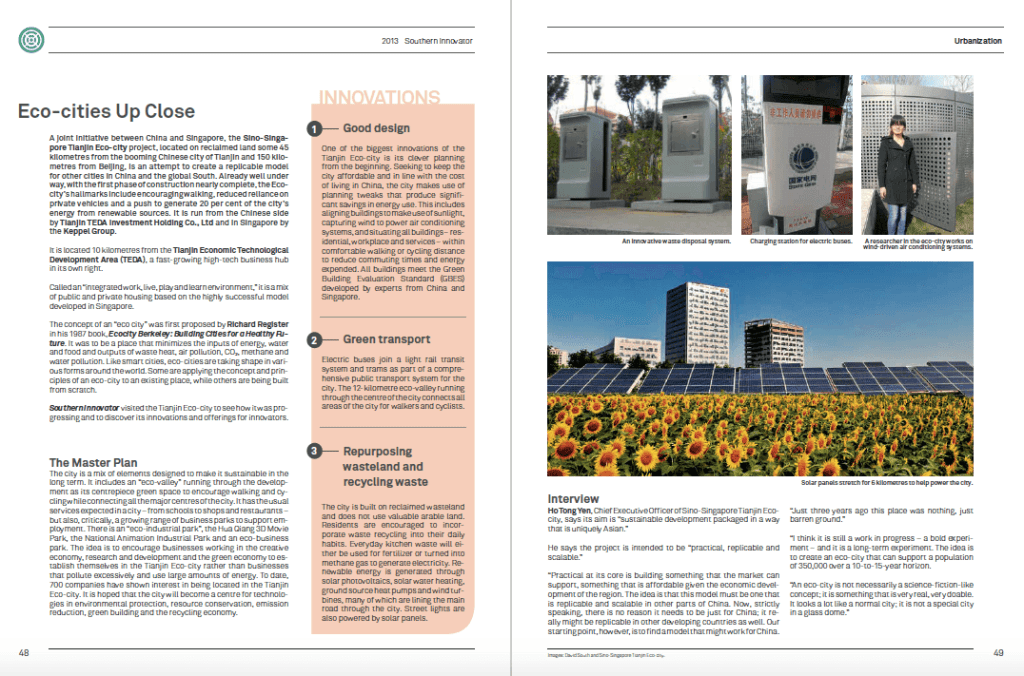
    The Tianjin Eco-city (tianjinecocity.gov.sg) project is a joint venture between China and Singapore to build a 30 square kilometre city to house 350,000 residents.

    Tianjin (http://en.wikipedia.org/wiki/Tianjin) is a large industrial city southeast of China’s capital, Beijing. It is a place that wears the effects of its industrial expansion on the outside. Air pollution is significant and the city has a grimy layer of soot on most outdoor infrastructure.

    China has received a fair bit of criticism for its polluted cities as the country has rapidly modernized in the past two decades. This sprint to be one of the world’s top economic powers has come at a cost to the environment. In this respect, China is not unusual or alone. Industrialization can be brutal and polluting, as Europe found out during its earlier industrial revolution.

    But China is recognizing this can’t go on forever and is already piloting many initiatives to forge a more sustainable future and bring development and high living standards back in line with what the environment can handle.

    Sino-Singapore Tianjin Eco-city is the second large-scale collaboration between the Chinese government and Singapore. The first was the Suzhou Industrial Park (http://www.sipac.gov.cn/english/).The Tianjin project came up in 2007 as both countries contemplated the challenges of rapid urbanization and sustainable development.

    The project’s vision, according to its website, is to be “a thriving city which is socially harmonious, environmentally-friendly and resource-efficient – a model for sustainable development.”

    The philosophy behind the project is to find a way of living that is in harmony, with the environment, society and the economy. It is also about creating something that could be replicated elsewhere and be scaled up to a larger size.

    The city is being built 40 kilometres from Tianjin centre and 150 kilometres from Beijing. It is located in the Tianjin Binhai New Area, considered one of the fastest growing places in China.

    Construction is well underway and can be followed on the project’s website (http://www.tianjinecocity.gov.sg/gal.htm). It will be completed in 2020.

    This year, the commercial street was completed and is ready for residents to move in.

    Residents will be encouraged to avoid motorized transport and to either use public transport or people-powered transport such as bicycles and walking.

    An eco-valley runs down the centre of the city and is meant to be a place for pedestrians and cyclists to enjoy.

    The basic building block of the Eco-city – its version of a city block – is called the Eco Cell. Each Eco Cell measures 400 metres by 400 metres, a comfortable walking distance. Four Eco Cells make a neighbourhood. Several Eco Neighbourhoods make an Eco District and there are four Eco Districts in the Eco-city. It is a structure with two ideas in mind: to keep development always on a walkable, human scale and also to provide a formula for scaling up the size of the Eco-city as the number of residents increases.

    It is a logical approach and seeks to address one of the most common problems with conventional cities: sprawling and unmanageable growth that quickly loses sight of human need.

    Agreement was also reached on the standards that should be achieved for a wide variety of criteria, from air and water quality to vegetation, green building standards, and how much public space there should be per person.

    An ambitious project in the United Arab Emirates is trying to become both the world’s top centre for eco cities and a living research centre for renewable energy. Masdar City (http://www.masdarcity.ae/en/)is planned to be a city for 40,000 people. It is billed as a high-density, pedestrian-friendly development where current and future renewable energy and clean technologies will be “marketed, researched, developed, tested and implemented.”

    The city hopes to become home to hundreds of businesses, a research university and technology clusters.

    This version of an eco-city is being built in three layers in the desert, 17 kilometres from the Emirati capital Abu Dhabi. The goal is to make a city with zero carbon emissions, powered entirely by renewable energy. It is an ambitious goal but there are examples in the world of cities that use significant renewable energy for their power, such as Reykjavik, Iceland in Northern Europe, which draws much of its energy from renewables and geothermal sources.

    Masdar City is designed by world-famous British architect Norman Foster (fosterandpartners.com) and will be 6.5 square kilometres in size.

    The design is highly innovative. The city will be erected on 6 metre high stilts to increase air circulation and reduce the heat coming from the desert floor. The city will be built on three levels or decks, to make a complete separation between transport and residential and public spaces.

    The lowest deck will have a transportation system based on Personal Rapid Transport Pods. These look like insect eyes and are automated, controlled by touch screens, using magnetic sensors for propulsion. On top of this transport network will be the pedestrian streets, with businesses, shops and homes. No vehicles will be allowed there, and people will only be able to use bicycles or Segway (segway.com) people movers to get around. An overhead light railway system will run through the city centre, all the way to Abu Dhabi City.

    “By layering the city, we can make the transport system super-efficient and the street level a much better experience,” Gerard Evenden, senior partner at Foster + Partners, told The Sunday Times. “There will be no car pollution, it will be safer and have more open spaces. Nobody has attempted anything like this.”

    Masdar City is being built in stages as funding comes, with the goal of completion by 2016. It hopes to achieve its aspiration to be the most technologically advanced and environmentally friendly city in the world. As for water supplies in the desert, there is a plan: dew collected in the night and morning and a solar-powered desalination plant turning salt water into drinking water.

    Electricity will come from a variety of sources. Solar panels will be on every roof and double as shade on alleyways. Non-organic waste will be recycled, while organic waste will be turned into fuel for power plants. Dirty water will be cleaned and then used to irrigate green spaces. Because of the design, the planners hope the city will just use a quarter of the energy of a conventional city.

    To keep the city smart and the project on top of developments in renewable energy, the Masdar Institute of Science and Technology (http://www.masdar.ac.ae/) will specialize in renewable energy technology.

    The cost for the city was pegged at US $22 billion in 2009.

    The chief executive of Masdar – Abu Dhabi’s renewable-energy company – is Sultan Al Jaber. He sees the city as a beacon to show the way for the rest of the Emirate to convert from a highly inefficient consumer of energy to a pioneer in green technology.

    “The problem with the renewable-energy industry is that it is too fragmented,” he told The Sunday Times. “This is where the idea for Masdar City came from. We said, ‘Let’s bring it all together within the same boundaries, like the Silicon Valley model (in California, USA).’”

    The project needs to gather much of its funding as it progresses. The United Nations’ Clean Development Mechanism (http://cdm.unfccc.int/) is helping with financing. Companies can earn carbon credits if they help fund a low-carbon scheme in the global South. The sultan is ambitious and sees this as a “blueprint for the cities of the future.” It has been able to bring on board General Electric (GE) and the Massachusetts Institute of Technology (MIT) to sponsor the university.

    It is possible to visit Masdar City and take a tour (http://www.masdarcity.ae/en/105/visit-masdar-city/) and it is also possible to view online what has been built so far (http://www.masdarcity.ae/en/32/built-environment/).

    Published: June 2012

    Resources

    1) Center for Innovation, Testing and Evaluation (CITE): Located in Texas, USA, CITE is a fully functioning city with no residents to test new technologies before they are rolled out in real cities. Website: http://www.pegasusglobalholdings.com/test-center.html

    2) Digital Cities of the Future: In Digital Cities, people will arrive just in time for their public transportation as exact information is provided to their device. The Citizen-Centric Cities (CCC) is a new paradigm, allowing governments and municipalities to introduce new policies. Website: http://eit.ictlabs.eu/action-lines/digital-cities-of-the-future/

    3) Eco-city Administrative Committee: Website: http://www.eco-city.gov.cn/

    4) Sino-Singapore Tianjin Eco-city, Investment and Development Co., Ltd. Website: tianjineco-city.com

    5) ‘The Future Build’ initiative, a new green building materials portal from Masdar City. Website: thefuturebuild.com

    6) UNHABITAT: The United Nations Human Settlements Programme is the UN agency mandated to promote socially and environmentally sustainable towns and cities with the goal of providing adequate shelter for all. Website: http://www.unhabitat.org

    Creative Commons License

    This work is licensed under a
    Creative Commons Attribution-Noncommercial-No Derivative Works 3.0 License.

    ORCID iD: https://orcid.org/0000-0001-5311-1052.

    © David South Consulting 2022

  • Urban Farmers Gain from Waste Water

    Urban Farmers Gain from Waste Water

    By David SouthDevelopment Challenges, South-South Solutions

    SOUTH-SOUTH CASE STUDY

    The global food crisis continues to fuel food price inflation and send many into hunger and despair. Around the world, solutions are being sought to the urgent need for more food and cheaper food. U.N. Secretary General Ban Ki-moon has called for food production to increase 50 percent by 2030 just to meet rising demand – and right now there are 862 million people undernourished (FAO).

    One fast-growing solution is bringing farming to urban and semi-urban spaces, where the majority of the world’s population now lives.

    Urban farmers can take advantage of their close proximity to consumers, keeping costs down and profits up. They can also solve one of agriculture’s enduring problems – where to find water for irrigation by using existing waste water. Waste water is plentiful in urban environments, where factories usually pump out waste water into streams, rivers and lakes.

    The amount of urban farmed agriculture is still small, about 10 percent of the world’s agricultural production, but is a potential growth area if handled well. In 53 cities surveyed by the International Water Management Institute, 1.1 million farmers – some 200 million worldwide – are now using recycled or waste water to irrigate their crops.

    In Accra, Ghana, more than 200,000 people depend on food grown with wastewater. In Pakistan, a full quarter of the grown vegetables use wastewater.

    The use of waste water comes with its ups and downs. While the World Health Organization rightfully points out that waste water can be a source of disease and pollution, cities also face a dilemma: diverting fresh water to irrigate crops means less for people to drink. Out of the 53 cities surveyed by the International Water Management Institute, 85 percent dumped their raw sewage and wastewater into streams and lakes. With this in mind, the WHO has altered its stance on wastewater, and now supports its use for irrigating farmland as long as all efforts are made to treat wastewater and that people are warned to thoroughly wash food before eating it.

    Pay Drechsel, who heads the IWMI’s research division based in Accra, Ghana, studying safe and productive use of low-quality water, says sophisticated systems to use waste water have developed in Vietnam, China and India, “where this practice has been going on for centuries.”

    “People know how to avoid health risks, like thorough cooking of vegetables,” he said. “In Vietnam and China, waste from households (fecal waste, solid waste and wastewater from household use) have always been effectively recycled in ‘closed systems’ at a household level where the waste/nutrients are recycled into the food chain and so return for human consumption.”

    Drechsel cites examples like Calcutta, where a large wetland is being used for treating and recycling wastewater for beneficial uses such as fish farming. In Northern Ghana, fecal sludge from septic tanks is spread on fields that are later used to grow cereals.

    “The risk for the consumer is extremely low, a waste product is productively recycled, the farmer has a good harvest and the city gets rid of their waste,” Drechsel said. “A multiple win-win situation.

    “Depending on the local situations such models can be widely used, provided they are documented and the risk factors are controlled,” he added.

    Farmers use various methods to reduce the risk of contamination, including drip irrigation where the water does not touch the crop.

    The risks for both farmers and consumer can be managed with the right protocols. For farmers, Drechsel recommends wearing of rubber boots and careful hand washing to avoid skin diseases. He points out that these farmers usually make more money than those who do not use waste water, and thus can afford the extra cost of precautionary measures, like de-worming tablets. They can quickly get out of poverty by using this water.

    For consumers, the risk is from diarrhoea, typhus or cholera if raw food is eaten unwashed or poorly washed. The best solution is to turn to the WHO’s guidelines and proven local practices and tested techniques developed by researchers.

    “Here more awareness creation on invisible risks through pathogens is needed. Perception studies in West Africa showed that nearly all households wash vegetables but they target visible dirt. Thus, the methods used are not effective. Best would be therefore a combination of risk reducing interventions from farm to fork, as none alone is 100 percent efficient. This is also what the new WHO guidelines promote: a flexible approach, reducing in each country the health risks as far as it is possible and feasible.”

    Drechsel sees an opportunity for water treatment plants to seize: “What is missing so far is a ‘design for reuse.’ If treatment plants would be designed to serve farmers they could be less sophisticated and easier to maintain. Farmers could be involved in this, maybe a win-win situation.

    “The environment benefits too. Spreading wastewater over fields, and allowing it to leach back through the soil into local waterways, turns out to be a reasonable way to purify it. The process filters out all the organic contaminants, and much of the nitrogen and phosphates that would otherwise contribute to algal blooms and dead zones further downstream. It is certainly preferable to dumping wastewater straight into the nearest big river or lake.”

    Published: September 2008

    Resources

    • Vertical farming, where hothouses are piled one on top of the other, is an option being promoted as a solution to the food needs of urban dwellers.
      Website: http://www.verticalfarm.com/
    • Extensive photographs of vertical farm project concepts by Chris Jacobs in cooperation with the grandfather of skyscraper farm concepts: Dr. Dickson Despommier of Columbia University. His ideal: all-in-one eco-towers would actually produce more energy, water (via condensation/purification) and food than their occupants would consume. His mission: to gather architects, engineers, economists and urban planners to develop a sustainable and high-tech wonder of ecological engineering.
      Website: weburbanist.com
    • Urban Gardening News, a news service providing a review of daily news targeting everyone involved in planning & practicing alternative farming in cities. Great updates on how things are progressing across the South.
      Website: http://www.urbanagriculture-news.com

    Follow @SouthSouth1

    Slideshare: http://www.slideshare.net/DavidSouth1/development-challengessouthsouthsolutionsnovember2010issue

    Southern Innovator Issue 1: https://books.google.co.uk/books?id=Q1O54YSE2BgC&dq=southern+innovator&source=gbs_navlinks_s

    Southern Innovator Issue 2: https://books.google.co.uk/books?id=Ty0N969dcssC&dq=southern+innovator&source=gbs_navlinks_s

    Southern Innovator Issue 3: https://books.google.co.uk/books?id=AQNt4YmhZagC&dq=southern+innovator&source=gbs_navlinks_s

    Southern Innovator Issue 4: https://books.google.co.uk/books?id=9T_n2tA7l4EC&dq=southern+innovator&source=gbs_navlinks_s

    Southern Innovator Issue 5: https://books.google.co.uk/books?id=6ILdAgAAQBAJ&dq=southern+innovator&source=gbs_navlinks_s

    Creative Commons License

    This work is licensed under a
    Creative Commons Attribution-Noncommercial-No Derivative Works 3.0 License.

    ORCID iD: https://orcid.org/0000-0001-5311-1052.

    © David South Consulting 2023

  • Food Inflation: Ways to Fight It

    Food Inflation: Ways to Fight It

    By David SouthDevelopment Challenges, South-South Solutions

    SOUTH-SOUTH CASE STUDY

    Food inflation has taken off at the beginning of 2011. As the global economic crisis enters its next phase, both developed and developing countries are experiencing inflation. There are many factors fuelling the rise in prices – inefficient distribution and storage systems, lack of investment in agriculture, devaluing currencies, high demand, natural and man-made disasters, use of food products like corn to make biofuels – but there are also ways to counter the effects of food inflation that have been tried and tested across the South.

    The United Nations Conference on Trade and Development (UNCTAD) says the least developed countries spent US $9 billion on food imports in 2002. By 2008, that amount had risen to US $23 billion. Supachai Panitchpakdi, secretary general of UNCTAD, says “the import dependence has become quite devastating.”

    Worse, more people had less money to buy the food. The number of individuals living in extreme poverty “increased by 3 million per year during the boom years of 2002 and 2007,” reaching 421 million people in 2007.

    For millions of people, it is a matter of life and death that food remains affordable. The poor pay the largest share of their income on food. Raise that cost, and the poor quickly have little money left for other things, like housing, transport, clothing or education.

    Approached as a problem needing a solution, it is possible to deal with a bout of food inflation. Every food crisis has its origins and can be resolved. A staggering amount of food goes to waste every year, and a vast quantity can’t get from the farm to the market in time because of infrastructure problems.

    An Indian refrigerator – the ChotuKool fridge (http://www.godrej.com/godrej/godrej/index.aspx?id=1) – is designed to stay cool for hours without electricity and to use half the power of conventional refrigerators. Priced at US $69, it is targeted at India’s poor – a population of over 456 million, almost half the total Indian population (World Bank).

    Manufactured by Godrej and Boyce and weighing just 7.8 kilograms, it is designed around the stated needs of the poor, who wanted a fridge capable of cooling 5 to 6 bottles of water and 3 to 4 kilograms of vegetables. Portability was crucial as well, since needs to be moved when large family gatherings take place in small rooms.

    As a photo shows (http://innovation.hindustantimes.com/summit-photos/godrej/chotukool-3.php), the fridge looks more like a drinks cooler than the typical large refrigerator. It works by replacing the standard compressor motor found in most fridges with a battery-powered heat exchanger.

    In Ghana, a mobile phone-driven Internet marketplace is helping to improve efficiencies in farming and selling food. Esoko (esoko.com/#lang=en), tracks products including ground nuts, sesame, tomato, maize and white beans. It offers market information from Afghanistan, Benin, Burkina Faso, Cameroon, Cote d’Ivoire, Ghana, Madagascar, Mali, Mozambique, Nigeria, Sudan and Togo.

    India’s e-Choupal is making food distribution more efficient in a country experiencing high inflation. E-Choupal (http://www.echoupal.com) has developed a reputation for both controlling prices and increasing incomes for poor farmers. Started in 2000 by the major Indian company ITC Limited (http://www.itcportal.com), it links farmers to the latest prices for products including soybeans, wheat, coffee and prawns.

    E-Choupal works through computers set up in rural areas and has built one of the largest internet initiatives in rural India, reaching 4 million farmers in 40,000 villages.

    Brazil, over the last 30 years, has transformed itself from a food importer to one of the world’s major food exporters. It made these impressive achievements with few government subsidies. The agricultural success is down to Embrapa (http://www.embrapa.br/english) – short for Empresa Brasileira de Pesquisa Agropecuária, or the Brazilian Agricultural Research Corporation. A public company set up in 1973, it has turned itself into the world’s leading tropical research institution. It breeds new seeds and cattle and has developed innovations from ultra-thin edible wrapping paper for foodstuffs that turns colour when the food goes off to a nano-tech lab creating biodegradable ultra-strong fabrics and wound dressings.

    Another approach can be found with a farmer in Kenya, Zack Matere, who boosted his potato crop by turning to Facebook for help. On his farm in Seregeya, Matere used the internet to find a cure for his ailing potato crop.

    He uses his mobile phone to access the internet at a costs of about US 0.66 cents a day. One example of the kind of intelligence Matere is able to glean from the internet is reports of cartels deceiving farmers by buying potatoes in over-large 130 kg bags instead of 110 kg bags. Matere takes this information, translates it into Swahili and posts it on community notice boards.

    Another fast-growing solution is bringing farming to urban and semi-urban spaces, where the majority of the world’s population now lives.

    Urban farmers can take advantage of their close proximity to consumers, keeping costs down and profits up. They can also solve one of agriculture’s enduring problems – where to find water for irrigation by using existing waste water. Waste water is plentiful in urban environments, where factories usually pump out waste water into streams, rivers and lakes.

    In Accra, Ghana, more than 200,000 people depend on food grown with wastewater. In Pakistan, a full quarter of the grown vegetables use wastewater.

    Family farms are critical to weathering economic crises and ensuring a steady and secure food supply. The International Fund for Agricultural Development (IFAD) (www.ifad.org) called in 2008 for small family farms – which sustain the livelihoods of more than 2 billion people _ to be put at the heart of the global response to high food prices and uncertain food security.

    In Brazil, this call is being answered by a bold initiative to create a “social technology,” combining a house-building programme with diverse family farms.

    This is where the Brazilian farmer’s cooperative Cooperhaf: Cooperativa de Habitacao dos Agricultores Familiares (http://www.cooperhaf.org.br/) steps in.

    “We see the house as the core issue,” said Adriana Paola Paredes Penafiel, a projects adviser with the Cooperhaf. “The farmers can improve their productivity but the starting point is the house.

    “Family farming is very important for the country – 70 percent of food for Brazilians comes from family farming,” said Penafiel. “The government wants to keep people in rural areas.”

    Making farming more appealing is being shown as a great way to get ahead in modern Africa. One woman hopes more people will be attracted to farming and boost the continent’s food security and reduce costly imports.

    Cynthia Mosunmola Umoru’s company, Honeysuckle PTL Ventures (http://www.tootoo.com/d-c3015227-Honeysuckles_Ptl_Ventures/), is based in Lagos, the business capital of Nigeria.

    Leading by example, Umoru has set up a successful and modern agribusiness focusing on high-quality food products using modern packaging and fast delivery. She produces meat products, from seafood like shrimps and prawns to snails, beef, chicken, and birds. Her niche is to deliver the product however the customer wishes: fresh, frozen or processed.

    Radical new food sources are also another option over time. The Food and Agricultural Organization (FAO) has explored insect protein as a contributor to better nutrition, the economics of collecting edible forest insects, methods of harvesting, processing and marketing edible forest insects, and ways of promoting insect eating with snacks, dishes, condiments — even recipes.

    The range of insects that can be tapped for food is huge, and includes beetles, ants, bees, crickets, silk worms, moths, termites, larvae, spiders, tarantulas and scorpions. More than 1,400 insect species are eaten in 90 countries in the South. Entrepreneurs in the South are making insects both palatable and marketable – and in turn profitable. These innovations are adding another income source for farmers and the poor, and supplying another weapon to the battle for global food security.

    Resources

    1) The global movement for slow food, which encourages organic production and appreciation of traditional foods and cooking. Website: www.SlowFood.com

    2) A video story by CNN on Tradenet/Esoko. Website: http://www.youtube.com/watch?v=s6z0ywkHPPQ

    3) Olam: The story of Olam – a global food supply company in ‘agri-products’ that got its start in Nigeria – shows how a Southern brand can grow and go global, and overcome the difficulties of cross-border trade. Website: http://www.olamonline.com/home/home.asp

    4) South African company Eat Your Garden: It provides urban dwellers and food businesses with their own food gardens bursting with juicy and tasty foods whilst at the same time reducing carbon footprints, and creating employment and provide training, helping poverty alleviation. Website: http://www.eatyourgarden.co.za/

    5) Vertical farming, where hothouses are piled one on top of the other, is an option being promoted as a solution to the food needs of urban dwellers. Website: http://www.verticalfarm.com/

    Follow @SouthSouth1

    Slideshare: http://www.slideshare.net/DavidSouth1/development-challengessouthsouthsolutionsnovember2010issue

    Southern Innovator Issue 1: https://books.google.co.uk/books?id=Q1O54YSE2BgC&dq=southern+innovator&source=gbs_navlinks_s

    Southern Innovator Issue 2: https://books.google.co.uk/books?id=Ty0N969dcssC&dq=southern+innovator&source=gbs_navlinks_s

    Southern Innovator Issue 3: https://books.google.co.uk/books?id=AQNt4YmhZagC&dq=southern+innovator&source=gbs_navlinks_s

    Southern Innovator Issue 4: https://books.google.co.uk/books?id=9T_n2tA7l4EC&dq=southern+innovator&source=gbs_navlinks_s

    Southern Innovator Issue 5: https://books.google.co.uk/books?id=6ILdAgAAQBAJ&dq=southern+innovator&source=gbs_navlinks_s

    Creative Commons License

    This work is licensed under a
    Creative Commons Attribution-Noncommercial-No Derivative Works 3.0 License.

    ORCID iD: https://orcid.org/0000-0001-5311-1052.

    © David South Consulting 2024

  • African Megacity Makeovers Tackle Rising Populations

    African Megacity Makeovers Tackle Rising Populations

    By David SouthDevelopment Challenges, South-South Solutions

    SOUTH-SOUTH CASE STUDY

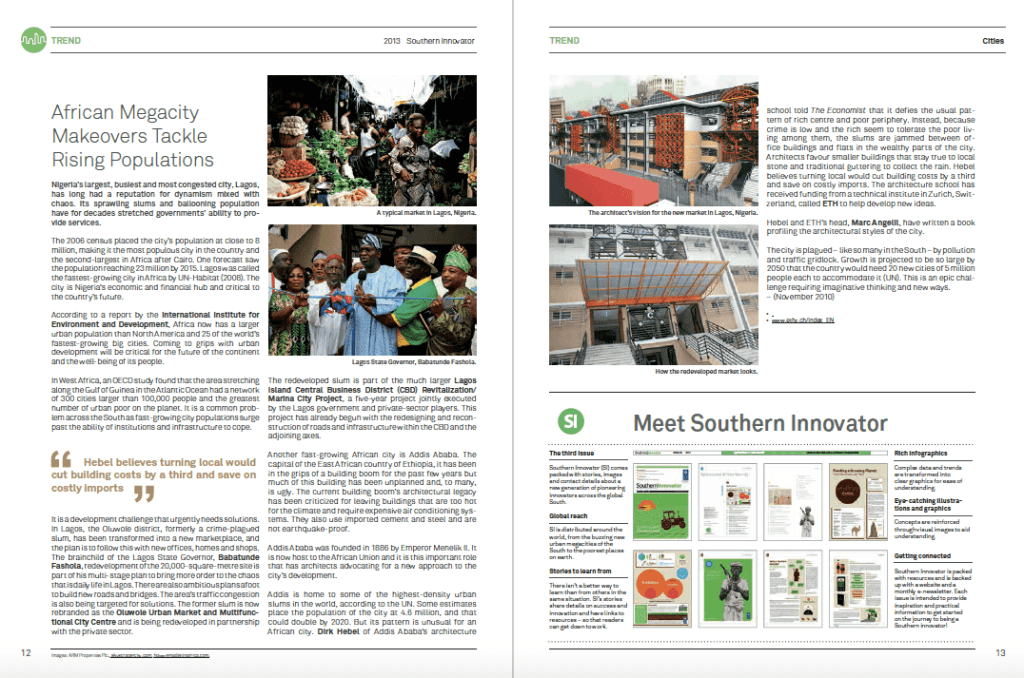
    Nigeria’s largest, busiest and most congested city, Lagos, has long had a reputation for dynamism mixed with chaos. Its sprawling slums and ballooning population have for decades stretched governments’ ability to provide services.

    The 2006 census placed the city’s population at close to 8 million, making it the most populous city in the country and the second largest in Africa after Cairo. One forecast saw the population reaching 23 million by 2015. It was called the fastest growing city in Africa by UNHABITAT (2008). The city is Nigeria’s economic and financial hub and critical to the country’s future.

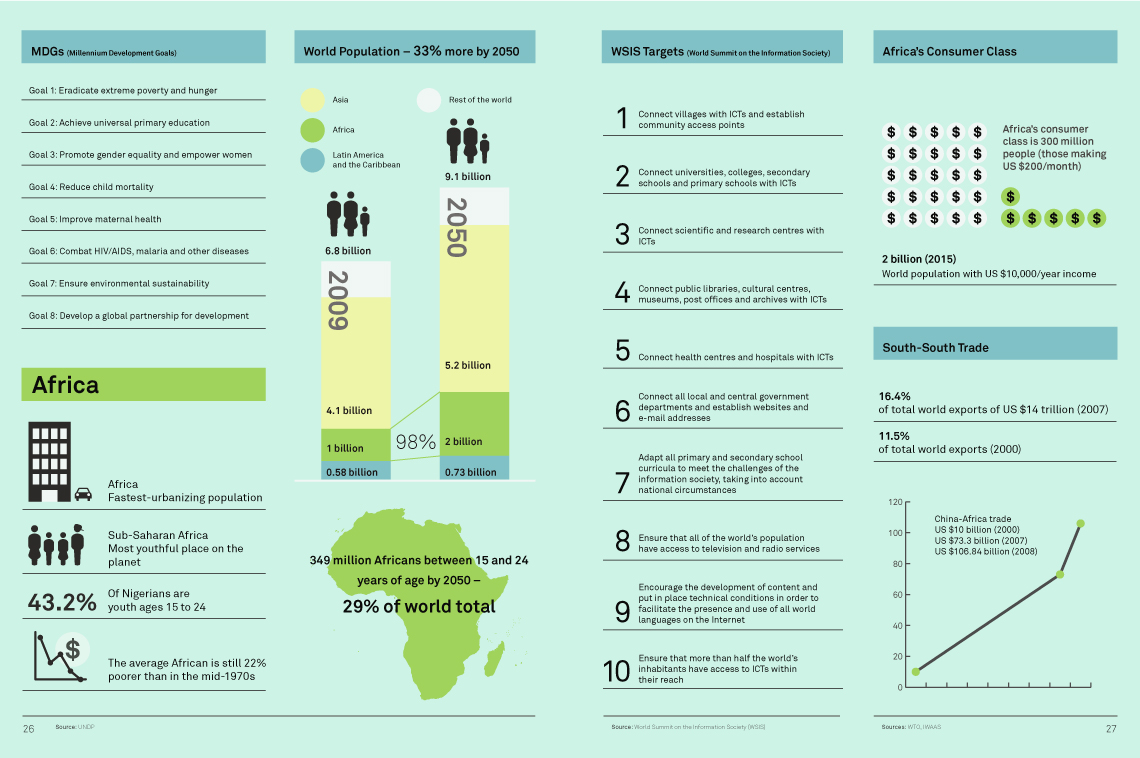
    According to a report by the International Institute for Environment and Development, Africa now has a larger urban population than North America and 25 of the world’s fastest growing big cities. Getting to grips with urban development will be critical for the future of the continent and the wellbeing of its people.

    In West Africa, an OECD study found the area stretching along the Gulf of Guinea in the Atlantic Ocean had a network of 300 cities larger than 100,000 people and the biggest collection of urban poverty on the planet.

    It is a common problem across the South as fast-growing city populations surge past the ability of institutions and infrastructure to cope.

    By 2025, Asia could have 10 or more cities with populations larger than 20 million (Far Eastern Economic Review).

    It is a development challenge that urgently needs solutions.

    In Lagos, the Oluwole district – formerly a crime-plagued slum – has been transformed into a new marketplace, and the plan is to follow this with new offices, homes and shops. The brainchild of the Lagos state governor Babatunde Fashola (http://en.wikipedia.org/wiki/Babatunde_Fashola), redevelopment of the 20,000 square metre site is part of his multi-stage plan to bring more order to the chaos that is daily life in Lagos. There are also ambitious plans afoot to build new roads and bridges. The area’s traffic congestion is also being targeted for solutions. The former slum is now re-branded as the Oluwole Urban Market and Multifunctional City Centre (http://tinyurl.com/2wmrscq) and is being re-developed in partnership with the private sector.

    The re-developed slum is part of the much-larger Lagos Island Central Business District (CBD) Revitalisation/Marina City Project, a five-year project, jointly executed by the Lagos government and private sector players. This project has already begun with the redesigning and reconstruction of roads and infrastructure within the CBD and the adjoining axes.

    Another fast-growing African city is Addis Ababa. The capital of the East African nation of Ethiopia, it has been in the grip of a building boom for the past few years. But much of this building has been unplanned and, to many, is ugly. The current building boom’s architectural legacy has been criticized for leaving buildings that are too hot for the climate and require expensive air conditioning systems. They also use imported cement and steel and are not earthquake-proof.

    Addis Ababa (http://en.wikipedia.org/wiki/Addis_Ababa) was founded in 1886 by Emperor Menelik II. It is now host to the African Union (http://www.africa-union.org/) and it is this important role that has architects advocating for a new approach to the city’s development.

    Addis is home to some of the highest density urban slums in the world, according to the UN. Some estimates place the population at of the city at 4.6 million people and that it could double by 2020. But its pattern is unusual for an African city. Dirk Hebel of Addis Ababa’s architecture school  (http://www.eiabc.edu.et/managing-board/scientific-director.html) told The Economist it defies the usual pattern of rich centre and poor periphery. Instead, because crime is low and the rich seem to tolerate the poor living among them, the slums are jammed between office buildings and flats in the wealthy parts of the city.

    Architects favour smaller buildings that stay true to local stone and traditional guttering to collect the rain. Hebel believes turning local would cut building costs by a third and save on costly imports.

    The architecture school has received funding from a technical institute in Zurich, Switzerland called ETH (http://www.ethz.ch/index_EN) to help develop new ideas.

    Hebel and ETH’s head, Marc Angelil, have written a book profiling the architectural styles of the city. The city has gone through various phases: during its Marxist period (1974-1991) government buildings mimicked the Soviet Union. During the Italian fascist occupation (1935-1941) they followed the styles favoured by Italian dictator Benito Mussolini. Political problems aside, the architects believe the Italians brought good planning, allowing streets to radiate out from landmark buildings.

    The city is plagued – like so many in the South – by pollution and traffic gridlock. Growth is on projection to be so large by 2050, the country would need 20 new cities of 5 million people each to accommodate it (UN). This is an epic challenge requiring imaginative thinking and new ways.

    Published: November 2010

    https://davidsouthconsulting.org/2022/10/17/ambitious-schemes-hope-to-advance-economic-development/

    https://davidsouthconsulting.org/2020/04/22/artists-fear-indifference-from-megacity/

    https://davidsouthconsulting.org/2020/12/04/big-data-can-transform-the-global-souths-growing-cities/

    https://davidsouthconsulting.org/2022/10/19/chinese-building-solution-for-rapidly-urbanizing-global-south/

    https://davidsouthconsulting.org/2021/10/21/cities-for-all-shows-how-the-worlds-poor-are-building-ties-across-the-global-south/

    https://davidsouthconsulting.org/2020/12/11/cyber-cities-an-oasis-of-prosperity-in-the-south/

    https://davidsouthconsulting.org/2021/11/04/filipino-architect-wants-to-transform-slum-with-new-plan/

    https://davidsouthconsulting.org/2022/03/20/global-south-eco-cities-show-how-the-future-can-be/

    https://davidsouthconsulting.org/2021/11/12/global-souths-rising-megacities-challenge-idea-of-urban-living/

    https://davidsouthconsulting.org/2022/09/28/model-cities-across-the-south-challenge-old-ways/

    https://davidsouthconsulting.org/2022/10/10/more-futuristic-african-cities-in-the-works/

    https://davidsouthconsulting.org/2021/11/12/new-cities-offering-solutions-for-growing-urban-populations/

    https://davidsouthconsulting.org/2017/11/08/smart-cities-up-close-2013/

    https://davidsouthconsulting.org/2021/10/22/south-south-cooperation-for-cities-in-asia/

    https://davidsouthconsulting.org/2020/04/22/will-the-megacity-mean-mega-privatization/

    Development Challenges, South-South Solutions was launched as an e-newsletter in 2006 by UNDP’s South-South Cooperation Unit (now the United Nations Office for South-South Cooperation) based in New York, USA. It led on profiling the rise of the global South as an economic powerhouse and was one of the first regular publications to champion the global South’s innovators, entrepreneurs, and pioneers. It tracked the key trends that are now so profoundly reshaping how development is seen and done. This includes the rapid take-up of mobile phones and information technology in the global South (as profiled in the first issue of magazine Southern Innovator), the move to becoming a majority urban world, a growing global innovator culture, and the plethora of solutions being developed in the global South to tackle its problems and improve living conditions and boost human development. The success of the e-newsletter led to the launch of the magazine Southern Innovator.  

    Follow @SouthSouth1

    Slideshare: http://www.slideshare.net/DavidSouth1/development-challengessouthsouthsolutionsnovember2010issue

    Southern Innovator Issue 1: https://books.google.co.uk/books?id=Q1O54YSE2BgC&dq=southern+innovator&source=gbs_navlinks_s

    Southern Innovator Issue 2: https://books.google.co.uk/books?id=Ty0N969dcssC&dq=southern+innovator&source=gbs_navlinks_s

    Southern Innovator Issue 3: https://books.google.co.uk/books?id=AQNt4YmhZagC&dq=southern+innovator&source=gbs_navlinks_s

    Southern Innovator Issue 4: https://books.google.co.uk/books?id=9T_n2tA7l4EC&dq=southern+innovator&source=gbs_navlinks_s

    Southern Innovator Issue 5: https://books.google.co.uk/books?id=6ILdAgAAQBAJ&dq=southern+innovator&source=gbs_navlinks_s

    https://davidsouthconsulting.org/2021/03/05/southern-innovator-issue-4/

    Creative Commons License
    This work is licensed under a
    Creative Commons Attribution-Noncommercial-No Derivative Works 3.0 License.

    ORCID iD: https://orcid.org/0000-0001-5311-1052.

    © David South Consulting 2022