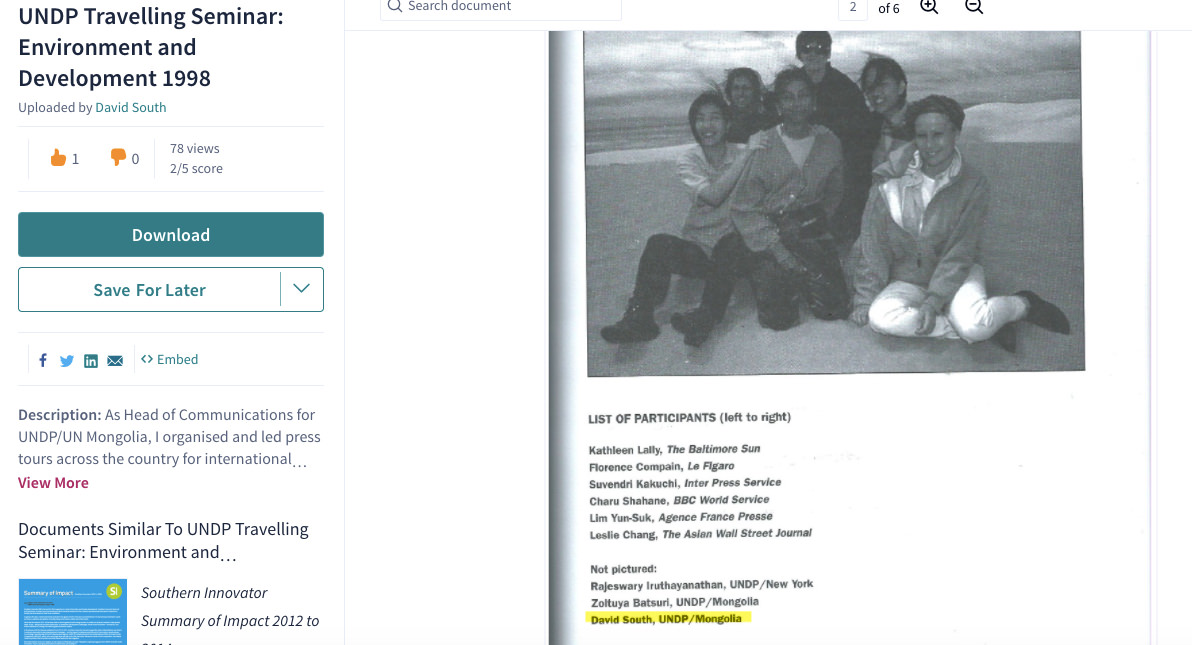
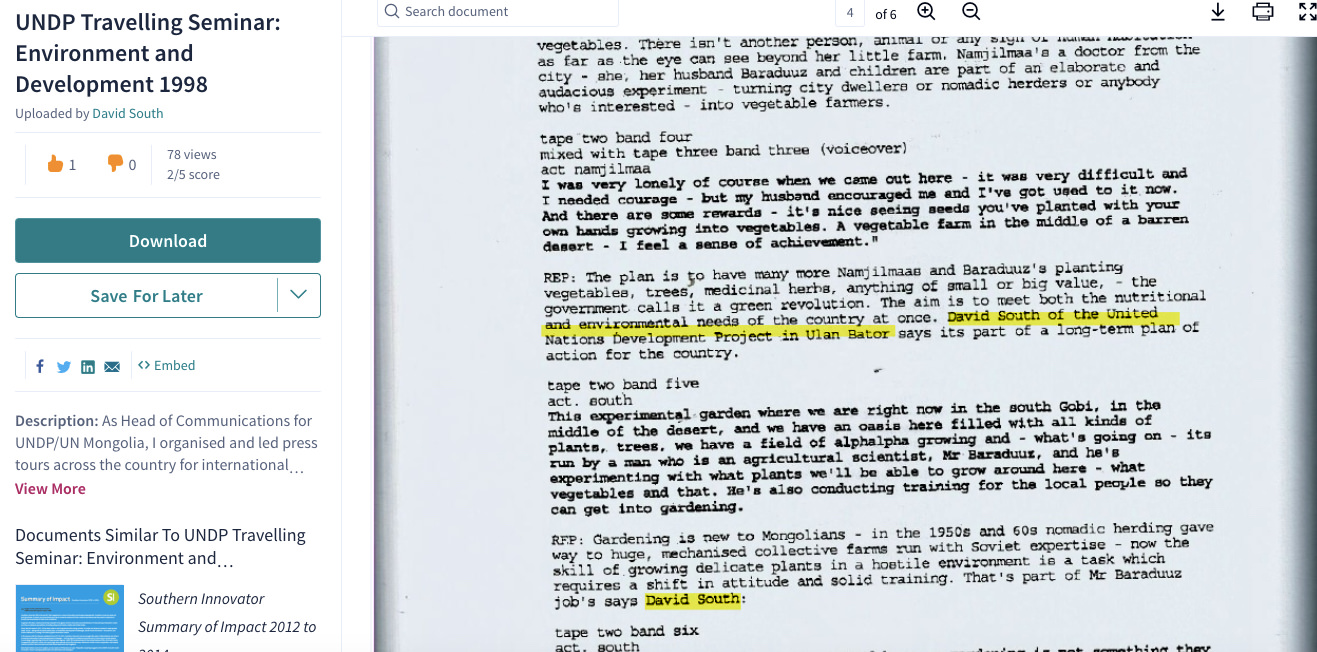
The media tour of Mongolia included the following journalists: Kathleen Lally (The Baltimore Sun), Florence Compain (Le Figaro), Suvendrini Kakuchi (Inter Press Service), Charu Shahane (BBC World Service), Lim Yun-Suk (Agency France Presse), Leslie Chang (The Asian Wall Street Journal).An Interoffice Memorandum from Djibril Diallo, Director, Division of Public Affairs, UNDP, to Mr. Nay Htun, Assistant Administrator and Director, Regional Bureau for Asia and the Pacific.An interview with the BBC World Service while visiting gardens in the Gobi Desert, 1998. I led media tours of Mongolia while serving as the UN/UNDP Mongolia Communications Coordinator from 1997-1999.
The UNDP Mongolia Communications Office would reach out to journalists to help tell the story of Mongolia’s late 1990s transition to free markets and democracy.
The BBC’s Charu Shahane joined other journalists on a UNDP Mongolia media tour in 1998.
UNDP Mongolia staff photo 1997. I served for two years as the UNDP Mongolia Head of Communications (1997-1999).
“Mongolia is not an easy country to live in and David [South] showed a keen ability to adapt in difficult circumstances. He was sensitive to the local habits and cultures and was highly respected by his Mongolian colleagues. … David’s journalism background served him well in his position as Director of the Communications Unit. … A major accomplishment … was the establishment of the UNDP web site. He had the artistic flare, solid writing talent and organizational skills that made this a success. … we greatly appreciated the talents and contributions of David South to the work of UNDP in Mongolia.” Douglas Gardner, UN Resident Coordinator and UNDP Resident Representative Mongolia
For many years it was a given that the world’s problem was not a lack of food, but that it was unfairly shared. But as the switch to biofuels gathers pace, farmland is being diverted away from growing food for people, to food for fuel. On top of this, growing prosperity in many countries in the South has boosted demand for better quality food, including grain-devouring meat diets – it takes 10 kilograms of grain to get one kilogram of meat from a cow. The crisis has deeply alarmed the UN’s World Food Programme and the World Bank. In the economic battle for food, the poor are the most vulnerable.
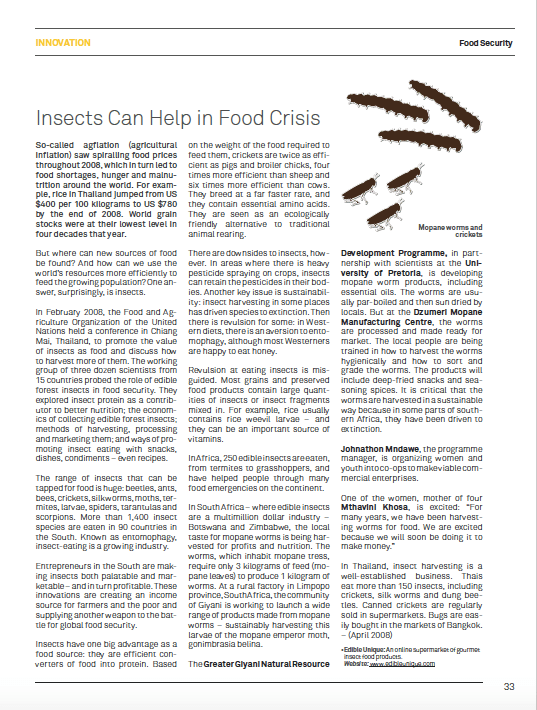
So-called agflation (agricultural inflation) has seen spiraling food prices, which in turn are causing food shortages, hunger and malnutrition around the world. For example, rice in Thailand has jumped from US $400 per 100 kilograms in January, to US $760. World grain stocks are at their lowest level in four decades.
But where can new sources of food be found? And what would be a more efficient use of the world’s resources to feed the growing population? One answer, surprisingly, is insects.
In February this year the UN’s Food and Agriculture Organization held a conference in Chiang Mai, Thailand to devour the dietary value of insects as food and discuss how to harvest more of them. The working group of three dozen scientists from 15 countries probed the role of edible forest insects in food security. They explored insect protein as a contributor to better nutrition, the economics of collecting edible forest insects, methods of harvesting, processing and marketing edible forest insects, and ways of promoting insect eating with snacks, dishes, condiments — even recipes.
The range of insects that can be tapped for food is huge: beetles, ants, bees, crickets, silk worms, moths, termites, larvae, spiders, tarantulas and scorpions. More than 1,400 insect species are eaten in 90 countries in the South. Known as entomophagy, insect eating is a growing industry. Entrepreneurs in the South are making insects both palatable and marketable – and in turn profitable. These innovations are adding another income source for farmers and the poor, and supplying another weapon to the battle for global food security.
Insects have one big advantage as a food source: they are efficient converters of food into protein. Based on the weight of the food required to feed them, crickets are twice as efficient as pigs and broiler chicks, four times more efficient than sheep and six times more efficient than cows. They breed at a far faster rate, and they contain essential amino acids. They are seen as an ecologically friendly alternative to traditional animal rearing.
There are downsides to insects, however. In areas where there is heavy pesticide spraying on crops, insects can retain the pesticides in their bodies. Another key issue is sustainability: insect harvesting in some places has driven species to extinction. Then there is revulsion for some: in Western diets, there is an aversion to entomophagy, although most Westerners are happy to eat honey.
Revulsion at eating of insects is misguided. Most grains and preserved food products contain large quantities of insects or insect fragments mixed in. For example, rice usually contains rice weevil larvae – and they can be an important source of vitamins.
In Africa, 250 edible insects are eaten, from termites to grasshoppers, and have helped people through many food emergencies on the continent.
In South Africa — where edible insects are a multimillion dollar industry — Botswana and Zimbabwe, the local taste for mopane worms is being harvested for profits and nutrition. The worms, which inhabit mopane tress, require only three kilograms of feed (mopane leaves) to produce one kilogram of worms. At a rural factory in Limpopo province, South Africa, the community of Giyani is working to launch a wide range of products made from mopane worms – sustainably harvesting this larvae of the mopane emperor moth, gonimbrasia belina.
The Greater Giyani Natural Resources Development Programme in partnership with scientists at the University of Pretoria, is developing mopane worm products, including essential oils. The worms are usually par-boiled and then sun dried by locals. But at the Dzumeri Mopane Manufacturing Centre, the worms are processed and made ready for market. The local people are being trained in how to harvest the worms hygienically, and how to sort and grade the worms. The products will include deep-fried snacks and seasoning spices. It is critical the worms are harvested in a sustainable way, because in some parts of southern Africa, they have been driven to extinction.
Johnathon Mndawe, the programme manager, is organizing women and youth into co-ops to make viable commercial enterprises. “We expect the product to hit supermarket shelves in 2009,” said Morewane Mampuru, coordinator for the Centre for Scientific and Industrial Research, another partner.
One of the women, mother of four Mthavini Khosa, is excited: “For many years, we have been harvesting worms for food. We are excited because we will soon be doing it to make money.”
In Thailand, insect harvesting is a well-established business. Thais eat more than 150 insects, including crickets, silk worms and dung beetles. Canned crickets are regularly sold in supermarkets. Bugs are easily bought in the markets of Bangkok.
Online vendor Thailand Unique, based in Udon Thani, sells and markets a wide range of edible insects. They include edible scorpions, preserved giant water bugs, roasted grasshoppers, edible big crickets, bamboo worms, crushed giant bug paste, and introducing this year, Bug Snackz and Scorpion Thai Green Curry. There is even a ‘Bug Sample Pack’, containing a mix of seven edible insects and arachnids, all slow roasted for easy snacking.
Another important centre for insect harvesting is Latin America. In Venezuala, the Pemon Indians eat fire ants during the rainy season.
In Colombia, so-called “fatass ant” or “hormiga culona” is eaten like popcorn in movie theatres. Some believe it is a defence against cancer, or a natural aphrodisiac. Eating the ants or culona, has been happening right back to the ancient Guane Indians.
In Santander province, farmers are exporting the ants for sale, some being dipped in Belgian chocolate and sold as a luxury food in London’s Harrods and Fortnum and Mason department stores. The abundant ant population brings in US $11 a pound (kilogram conversion) for the farmers, a doubling in price since 2000.
Farmers in the artist colony of Barichara harvest the ants – though concerns have been raised that they have been over-harvesting the population. Restaurants in the area offer ant-based spreads for bread and an ant-flavored lamb sauce.
“It’s an age-old dilemma for the farmer — should I kill it or eat it?” said Andres Santamaria to CBS News, who was given a $40,000 grant from Santander’s government to develop an environmentally sustainable, export-oriented programme for breeding the ants.
In Tijuana, Mexico, ancient Aztec, pre-Colombian insect meals are on offer at this restaurant, joining a global trend. Cien Anios (“100 Years”), specialises in pre-Colombian, Aztec insect recipes. It is proof there is money in preparing insects for food. Typical dishes include garlicky ant eggs and cactus worms in butter.
Published: April 2008
Resources
A network for insect collectors: Website: www.insect.net
Sunrise Land Shrimp: A do-it-yourself guide to raising and harvesting insects for food, with important information on health and hygiene: Website: www.slshrimp.com
Edible Unique: An online supermarket of gourmet insect food products. Website:www.edibleunique.com
Tijuana‘s Cien Años was the original inspiration for this story. As one of the first stories to draw attention to the insects-for-food market, it contributed to a growing awareness of this exciting food source. I had a delicious all-insect meal there in 2002.
An ingenious solution is helping Rwanda reduce the cost of running its bursting prisons, while improving conditions for the prisoners and helping protect the environment.
The country’s prison population soared to a peak of 120,000 suspects awaiting trial for their role in the 1994 genocide, in which 800,000 Tutsis and moderate Hutus were killed. The traditional court system, gacaca, is being used for national reconciliation, but the process is slow and costly for a country where 90 per cent of the population exist on subsistence agriculture, and where food production has dropped below 70 per cent of the levels needed for self-sufficiency (USAID).
But thanks to enormous, bee-hive shaped human manure digesters, a steady supply of biogas is on tap for cooking and lighting at prisons – the first country in Africa to do this. Five of the country’s largest prisons – two at Gitarama and one each in Butare, Kigali and Cyangugu – now have biogas plants producing 50 per cent of the gas needed to cook for prisoners. It has also saved half of each prison’s US $44,000 a year firewood costs. The money saved is being ploughed back into renovations to the prisons to improve conditions, and to provide more services like healthcare.
Biogas is produced from the fermentation of household or agricultural waste or animal or human feces, and has become a viable alternative when traditional gas sources become more expensive. The waste is placed in a 150 cubic meter beehive-shaped digester and fermented until a gas is produced. According to lead engineer on the project, Ainea Kimaro, 100 cubic meters of waste is turned into 50 cubic meters of fuel by bacteria devouring the manure in just four weeks.
“Biogas kills two birds with one stone,” Kimaro told the BBC. It gets rid of all the human waste and helps cover the enormous costs of feeding so many prisoners. Prior to the digesters, the quantity of human waste was a real problem: it was flooding down hillsides and leaking into rivers and lakes.
A school, the Lycee de Kigali , also has a digester. “The methane gas is used to cook for 400 students and for operating Bunsen burners in the school laboratories”, Kimaro said.
Many would think this a smelly affair, but in fact the whole process isn’t that pungent. Most of the digester is underground and the gas produced burns a clean, blue smokeless flame. It is much cleaner than the smoke from firewood. The remaining sludgy residue is used as an odourless compost for soil. This is used in the prison gardens to grow maize, mangos, bananas and tomatoes – all of which ends up back on the prisoner’s plates, improving the quality of their nutrition.
“The firewood savings are excellent – they really make a difference for us,” a Cyangugu prison warden said, adding that the odour-free compost had done wonders for the prison gardens. “Look at all these bananas! This fertiliser really is the best,” he said to the BBC.
In Uganda, human urine and feces are being mixed with banana peels, algae, water hyacinth and poultry droppings to make biogas. In Uganda’s rural Mukono district, biogas is used for cooking, lighting pressure lamps and to power engines. The slurry left over is then used to fertilise the soil. For Ugandans, most of whom are rural dwellers, electricity is rare and petrol to run generators and refrigeration units is expensive.
“It keeps the environment free of organic wastes, is convenient, time-saving and reduces smoke-related illnesses often associated with the use of firewood,” said Patrick Nalere, country director of the Heifer Project International, an American NGO which shares livestock and knowledge to reduce poverty. “If the majority of Ugandans adopted biogas, we would preserve our biodiversity. People should exploit decomposing raw materials, which are free. Therefore, no monthly power tariffs.”
Published: February 2008
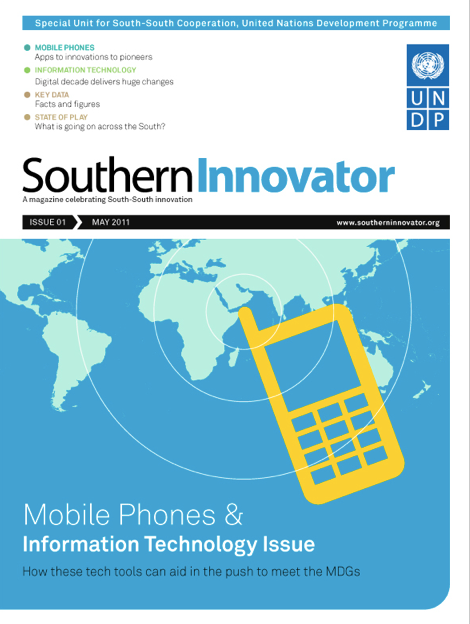
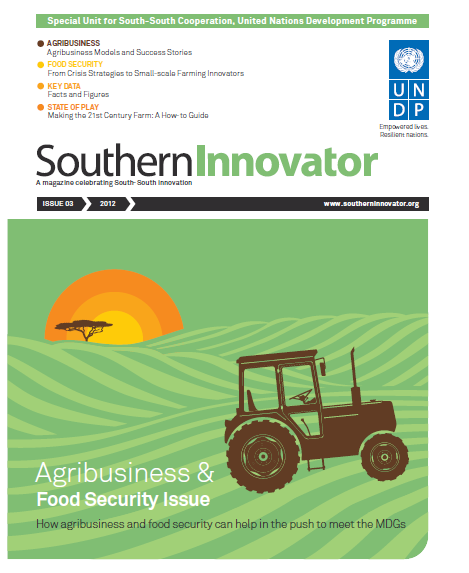
Development Challenges, South-South Solutions was launched as an e-newsletter in 2006 by UNDP’s South-South Cooperation Unit (now the United Nations Office for South-South Cooperation) based in New York, USA. It led on profiling the rise of the global South as an economic powerhouse and was one of the first regular publications to champion the global South’s innovators, entrepreneurs, and pioneers. It tracked the key trends that are now so profoundly reshaping how development is seen and done. This includes the rapid take-up of mobile phones and information technology in the global South (as profiled in the first issue of magazine Southern Innovator), the move to becoming a majority urban world, a growing global innovator culture, and the plethora of solutions being developed in the global South to tackle its problems and improve living conditions and boost human development. The success of the e-newsletter led to the launch of the magazine Southern Innovator.



















 David South Consulting
You must be logged in to post a comment.